Skip to content

Posts from the ‘Jazz’ Category

Piano trios at XJAZZ

Vijay Iyer TrioXJAZZ is the name of an annual festival held in Kreuzberg, a district of Berlin that is home to a large immigrant population. The four-day event is dispersed between a dozen or so venues, all within walking distance of each other. Most of them are rock or dance clubs, but there are also the very striking 19th century Emmaus Church, reconstructed after 1945, and the Lido, built in the 1950s as a cinema.

Of the events I attended this year, the two most striking were both by piano trios. Vijay Iyer’s group (pictured above), completed by the bassist Stephan Crump and the drummer Marcus Gilmore, arrived at a packed Lido on Friday night intending to play the usual hour or so after being presented with the German jazz critics’ association album of the year award for their latest ECM album, Break Stuff. Such was the crowd’s enthusiasm that they ended up playing only a minute or three short of two hours.

They began by playing without pause for more than half an hour, and the applause that greeted the closing notes might have gone almost as long had a rather bemused Iyer not manage to bring it to a halt. The response was the same throughout the set as the trio explored complex but irresistible grooves that created and released tension with an exhilarating effect. They played many original compositions, several of which — such as “Hood” — showed off a love of playing rhythmic games, as well as Thelonious Monk’s “Work” and Henry Threadgill’s “Little Pocket Size Demons”.

Sooner or later the deluge of creative piano-trio music will dry up, but perhaps not for a while yet. The following evening another interesting group took the stage at Watergate, a house and techno club whose bar looks out on to the River Spree. As the light faded on the water through the windows behind them, the Bosnian-born drummer Dejan Terzic, the Danish bassist Jonas Westergaard and the German pianist Florian Weber created three-way conversations characterised by an astringent lyricism and a wonderful ability to play with full commitment while giving each other plenty of room.

These two trios operate at a dauntingly high level of intellectual activity, but the spontaneous enthusiasm of both sets of listeners demonstrated the music’s ability to warm the spirit as well as stimulate the mind.

Connecting with Empirical

Empirical 1

How many great modern jazz ballads are there? I’m not thinking of the kind of American Songbook standards, such as “Body and Soul” or “Lush Life”, that have offered their melodies and chord sequences to jazz improvisers over the decades. I’m thinking of strictly instrumental pieces written by jazz musicians: things like Monk’s “Round Midnight”, Benny Golson’s “I Remember Clifford”, Bill Evans’s “Blue in Green”, Elmo Hope’s “Mirror-Mind Rose”, Stan Tracey’s “Starless and Bible-Black”, or Dudu Pukwana’s “B My Dear”.

There’s one on Empirical’s new album. It’s called “Lethe”, written by the band’s vibraphone-player, Lewis Wright. It starts with soft chimes and Tom Farmer’s double bass in a rising four-note pattern, Shaney Forbes’s pattering mallets on his tom-toms introducing an exposed theme for Nathaniel Facey’s plaintive alto saxophone. Facey’s subsequent improvisation slips easily in and out of double and triple time, encouraging the others to get busier and thicken the textures, but the band never loses the enraptured mood of the theme, which turns the whole seven-minute piece into a complete and very elegant construction, rather than something that just happened.

I’ve heard them play it two or three times in various settings over the past year, along with some of the other new material, and one of the things that strikes me about the album, which is titled Connection, is the way they’ve not only captured the spirit of their live performances in the studio but even taken the process a step further.

The band’s fifth release continues their 10-year exploration of the kind of jazz first measured out in those Blue Note albums of the mid-’60s — by Andrew Hill, Eric Dolphy, Bobby Hutcherson and others — that took bebop in a late-modernist direction, very harmonically and rhythmically demanding, avoiding the easier options offered by post-Kind of Blue modal jazz. The music is challenging, often superficially austere and angular, but never academic or unfriendly. The 10 compositions by Facey, Wright and Farmer come at the idiom from a variety of angles, offering plenty of light and shade and exploiting the basic tonal palette and their internal relationships to the full.

They can do many things extremely well, and one of them is swing. Forbes’s drumming on two of Farmer’s tunes, “Driving Force” and “Card Clash”, creates classic triplet-based propulsion of the highest quality, establishing a really inspiring platform for the soloists. By contrast, Farmer’s “The Maze” explores a favourite trick of Miles Davis’s second great quartet by having the lead voices — Facey and Wright — stick to a measured written theme while the rhythm instruments are allowed complete freedom to invent. Wright’s closing “It’s Out of Our Hands” brings their innate lyricism back to the surface, with passages utilising a great asymmetrical Latin groove.

Exceptionally well recorded by Richard Woodcraft at RAK Studios in London, and mixed by Alex Bonney, this is a staggeringly good album that stands comparison with the very best of jazz in the 21st century. And from the way “Lethe” has lodged itself in my head over the past 12 months, I’d say that one deserves to become a classic.

* The photograph of Empirical was taken at Foyle’s in London last year.

Not just another chanteuse

KANDACE SPRINGS

You wouldn’t ask your worst enemy to perform at an awards ceremony, particularly a standing-only affair where the audience is milling around, enjoying free champagne and noisy gossip. So it took some guts for the American singer Kandace Springs to perform Mal Waldron’s ballad “Soul Eyes” when she was given a slot at just such a function this week.

As she began by testing out the rather indifferent piano with a few bluesily decorated arpeggios, a friend and I looked at each other with raised eyebrows. It’s like the first sentence of a novel: sometimes you just know that this is going to be all right. And despite a hubbub that barely diminished in volume, Kandace Springs was able to use her allotted handful of minutes to demonstrate a talent that demanded further attention.

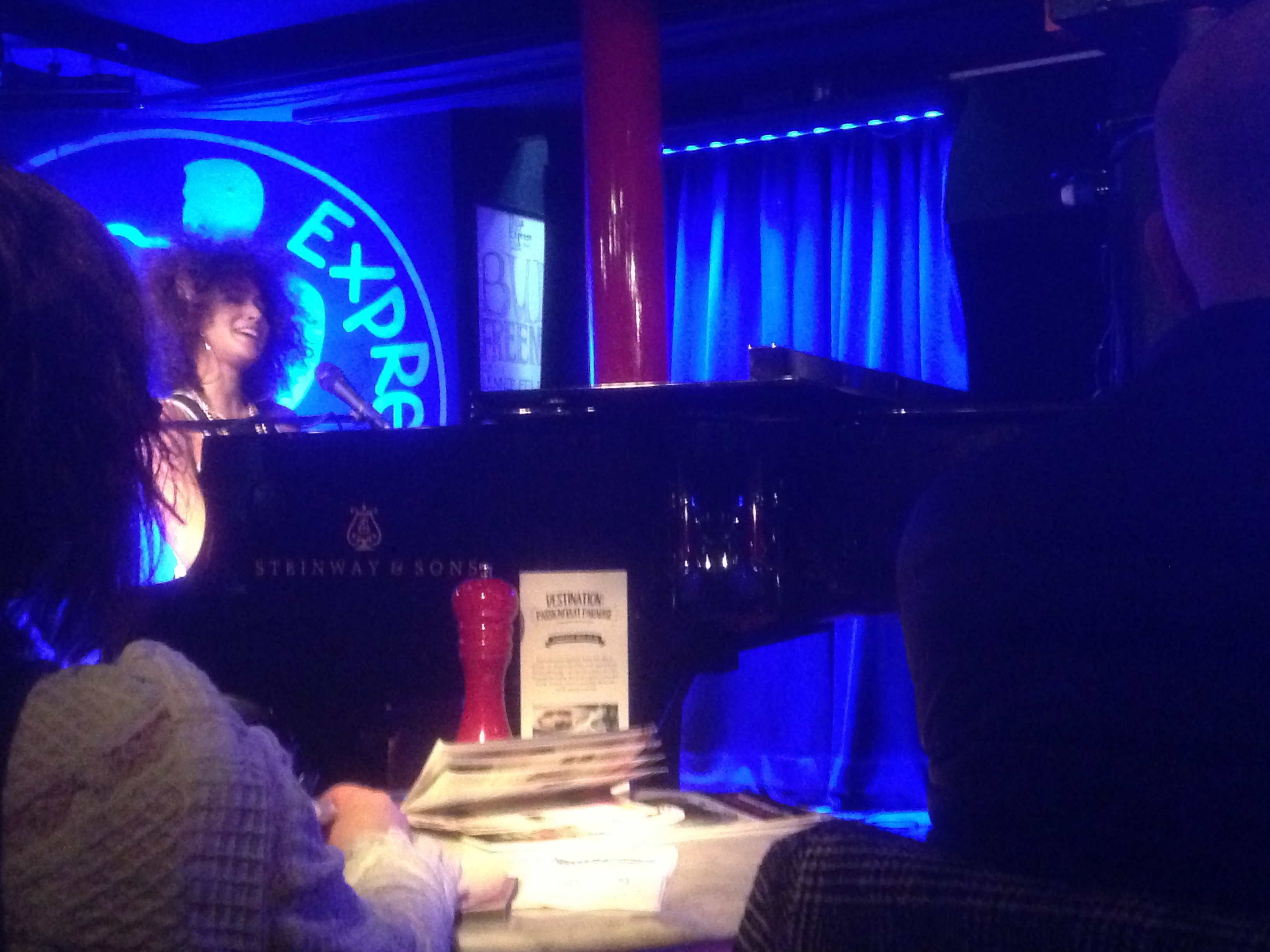
A couple of days later she was at the Pizza Express on Dean Street for a lunchtime showcase gig in front of a more attentive invited audience of industry and media types. One of the half-dozen songs she performed was “The Nearness of You”, written in 1937 by Hoagy Carmichael and Ned Washington. It was Norah Jones’s version of the song, she told us, that had inspired her to embark on a career in music. Tackling the song alone, with only her piano in support, she succeeded in making it her own property, without recourse to distortion or exaggeration, thus deepening the favourable impression.

Ms Springs’s coolness factor is high. Prince called her up after hearing her cover of Sam Smith’s “Stay With Me”. She has an album out on Blue Note in July. She has been opening for Gregory Porter on his European dates, and she is at the Cheltenham Jazz Festival this coming Monday. The world is awash with female “jazz singers” who try to combine the American Songbook repertoire with contemporary sounds, some in the hope of ending up on X Factor. It’s a genre for which I have a pretty limited tolerance. But she seems to have something different and more substantial.

She is 27 years old, she comes from Nashville, and she has a likeable self-possession that gets the audience on her side. Musicians, too. On her British dates she has been expertly and discreetly accompanied by the double bass of Sam Vicary and the drums of Luke Flowers, both from the Cinematic Orchestra, and at the Pizza Express they seemed to be enjoying themselves.

“The Nearness of You” isn’t on the album, which is titled Soul Eyes and was produced — rather conservatively for my taste, but never mind — by Larry Klein. I like the way she feels confident enough to do something other than plug the album to death, and she finished off at the Pizza Express with something else that isn’t on it: a beautifully poised and understated version of Ewan McColl’s “First Time Ever I Saw Your Face” which reminded that if you live long enough, everything comes around again.

Back in 1972 I went to another showcase, at Ronnie Scott’s, to see Roberta Flack, whose fame was secured when Clint Eastwood used her version of the McColl song on the soundtrack to Play Misty For Me. Flack brought an ace band with her, including Richard Tee on keyboards and Chuck Rainey on bass, and she was quietly sensational.  And I have to say that the woman who performed 100 yards away this week was every bit as good. As long as she wards off the dreaded melisma virus and keeps her sights high when selecting her repertoire, she’ll be an adornment to the scene.

Anyway, whenever I try to type the name Kandace Springs, the spellcheck device insists on changing it to “Candace”. I suspect it won’t be long before that particular algorithm wises up.

Trondheim Voices in Bremen

Trondheim VoicesThey were only invited at the last minute after their compatriot Mette Henriette had been forced to withdraw from the Jazzahead! festival in Bremen, but the women of Trondheim Voices provided me with what is likely to be the most lasting musical memory from this year’s event. Based in a city famous for the open-minded young musicians produced by the jazz courses taught at its adventurous and well resourced music conservatory, they have been going, with various changes in size and personnel, since 2001. Over the past year they’ve begun to explore the possibilities of individual sound-tailoring devices created by the mixing engineer and sound designer Asle Karstad: the singers wear discreet wireless boxes on their belts, with controls enabling them to modify their own output in real time.

Currently the group consists of nine members, five of whom were in Bremen. Tone Åse, Torunn Sævik, Heidi Skjerve, Anita Kaasbøll and Siri Gjære (their current artistic director) undertook a 30-minute performance collectively improvised from start to finish, using the possibilities provided by Karstad’s Maccatrol system to create a panoply of sounds, from multiple clucking effects to gorgeous echo-laden chorales. While they did so, an element of restrained theatricality was introduced as they moved around the auditorium, making use of a widened central aisle and the steps up to the stage.

All sorts of music were briefly referenced, from the highly melodic Laurel Canyon singer-songwriter mode through to the sort of fragmented expressionism that might be associated with Diamanda Galas and Yoko Ono, but nothing seemed tricksy or contrived. Their long experience of working together was evident in the way the whole thing was spontaneously shaped into a striking dramatic unity.

A deeply affecting finale featured shimmering layers of voices. After its echoes had died away, Siri Gjære told me that normally they like to give site-specific performances requiring a degree of immersion in their surroundings (in June they’ll be spending several days at Munich’s Whitebox art space). On Saturday the wonderful blend of sound and movement made it hard to believe they’d been given only a few days’ notice and a brief sound-check in a relatively bland environment. I can’t wait for further encounters.

* The photograph shows members of Trondheim Voices after their performance in one of the Jazzahead! halls on Saturday. Their Facebook page — https://www.facebook.com/trondheimvoices/ — contains some examples of their work, including a clip of them using the Maccatrol system.

Masabumi Kikuchi’s ‘Black Orpheus’

Masabumi KikuchiThe pianist Masabumi Kikuchi died last year at the age of 75, mourned by those whose love of jazz is based, at least in part, on the way it offers a home to wandering spirits. It’s clear from the testimony of those who worked with Kikuchi that he wasn’t an easy person, either on himself or on others; his music was the product of an endless pilgrimage towards some sort of essence, some sort of truth, that could not be found in pretty surfaces or routine politeness.

A new solo piano album called Black Orpheus (ECM) is the product of a recital three years ago in Tokyo, his birthplace. Like his last trio album, Sunrise (2012), it reveals the ultimate success of his search: here is a musician who refused to rest until he had discovered his own true voice, his genuine originality.

The first time I saw Kikuchi was the early ’70s, in Gil Evans’s apartment in Westbeth, an artists’ housing co-op in the West Village. He was in the process of making what turned out to be a permanent move from Tokyo to New York, and Gil was acting as a kind of patron. The first time I heard him was when he turned up in London as one of the three keyboard players in the 13-piece band Evans brought to the Royal Festival Hall for his UK debut in 1978, an event that still looms large in the memory of those fortunate enough to have been present. Then I heard the trio records he made with Gary Peacock in Japan in the 1970s, where his personality started to become clear, and a couple of decades later came his memorable trio with Peacock and Paul Motian, which operated under the name Tethered Moon.

His playing grew more distilled as the years went by. All excesses were gradually pared away. In a short essay accompanying the new album, his fellow pianist Ethan Iverson recalls a note Kikuchi left for himself on a piano. “Play slower,” it said. “I sound better when I play slower.” You can hear the effect of that self-imposed ordinance throughout the new album, in the nine wholly improvised pieces and the original composition called “Little Abi”, but most of all in the piece that gives the album its title.

Black Orpheus, the film made by Marcel Camus in Brazil in 1959, won the Palme d’Or at the Cannes festival, and the Oscar, the Golden Globe and the BAFTA award for the best foreign or foreign-language film at the Oscar. It also introduced audiences to Brazilian culture. “Manhã de Carnaval”, the haunting and much-covered Luis Bonfa tune, is its theme.

In almost any hands, the song conveys that special blend of sunny optimism and underlying melancholy that made the first wave of bossa nova songs so appealing. Kikuchi does something different with it. He slows it down to the pace of his thoughts, dismantles its components and slowly reassembles them in new shapes, testing their outline and weight by shifting the voicing of the underlying harmonies and adjusting the trajectory of the familiar melodic fragments. There are many pauses, in which the reverberations of the preceding notes are allowed to hang and decay in their own time.

The result is an eight-minute piece of great poise, beauty and profundity. To know how hard he worked to achieve it, you need only listen to a version he recorded in 1994 and released on a Verve album titled After Hours: Solo Piano, on which the theme is not so closely interrogated and a relatively straightforward two-chord modal structure (with an Evansesque voicing) supports an improvisation which builds towards conventional climaxes. The later version soars to a different level altogether and I can pay no higher compliment than to say it recalls Cecil Taylor’s epic recasting of Richard Rodgers’ “This Nearly Was Mine” (from the 1960 album The World of Cecil Taylor), in which a sentimental little show tune was transformed into a modernist aria, setting the pattern for a certain deviant strand of jazz pianism.

I guess the biggest difference between the two pianists is that Taylor found his voice early on. It took Kikuchi decades of patient burrowing and tunnelling to reach the pitch of perfection he achieved in his final years, of which Black Orpheus — every piece of it, not just “Manhã de Carnaval” — surely represents a pinnacle.

* The photograph of Masabumi Kikuchi is taken from Black Orpheus and was taken by Abby Kikuchi.

The Necks at the Union Chapel

Necks at Union Chapel 1The beautiful Union Chapel in Islington proved to be the perfect final stop for the Necks’ short UK round of pipe organ concerts last night. They were sharing the series, titled The Secret Life of Organs, with James McVinnie, who opened the evening with two pieces by Philip Glass and two short suites by Tom Jenkinson (better known to electronica fans as Squarepusher).

By comparison with the Necks’ appearance at the Kaiser Wilhelm Memorial Church in Berlin last November, this hour-long set more closely resembled what one often hears in their performances using the conventional piano-trio format: an initial gathering of resources leading to surging and slowly mutating waves of sound.

In Berlin most of the audience, facing the altar, could not see the musicians, who were perched in the organ loft/choir balcony above the main door. In London the listeners were facing a stage on which Lloyd Swanton (bass) and Tony Buck (drums) did their stuff. Chris Abrahams was hidden away at the organ console behind the huge central pulpit, but his hands — and the pipes and bellows of the organ — could be seen on a large screen.

Not surprisingly, the sound balance favoured the organ, which was built in 1877 and features 2,000 pipes. Buck’s chattering and rattling percussive commentary could be heard clearly enough, but you had to watch Swanton closely if you wanted to make out his individual contribution. The bass player’s job in this environment, with Abrahams having the organ’s foot pedals at his disposal, is the hardest of three.

It’s fascinating to hear these musicians adapting to the circumstances, and in particularly to the way the various organs “speak”. I hope they release an album of one of these performances. Meanwhile, Abrahams has a new solo CD, Fluid to the Influence, which contains a great deal of absorbing music assembled on a variety of acoustic and electronic keyboard instruments and one marvellous track, “Trumpets of Bindweed”, on which he plays the pipe organ at the Melbourne Town Hall, where the Necks gave their first organ concert in 2005.

Last night they brought the set back to silence with one of those conclusions whose combination of spontaneous mutual decision-making and intuitive aesthetic logic simply take your breath away. Only improvisers can do this.

* The Secret Life of Organs was part of the Barbican’s contemporary music series, co-presented with No-Nation. Future concerts feature the Kronos Quartet, the Bang on a Can All Stars, and Colin Stetson + Sarah Neufeld.

Gato Barbieri 1932-2016

Gato Barbieri 2At some point in his career, Leandro “Gato” Barbieri became a sound. A great sound, for sure, its hoarse urgency bursting with Latin passion, but he learnt that he needed to do little more than apply it to the theme he wrote in 1972 for Bernardo Bertolucci’s Last Tango in Paris to satisfy his large core audience.

Maybe that film was the watershed. He had arrived in New York from Buenos Aires in the mid-’60s as an unknown tenor saxophonist and plunged straight into the maelstrom of the avant-garde, bringing a voice as distinctive as that of another saxophone incomer, John Tchicai. Barbieri was heavily featured on Don Cherry’s first two brilliant albums for Blue Note, Complete Communion and Symphony for the Improvisers, quickly followed by his debut as a leader, In Search of the Mystery, recorded for ESP Disk’ with a quartet including the cellist Calo Scott. He was a featured soloist on Michael Mantler’s “Communications #8″from the seminal Jazz Composers Orchestra double-album in 1968, which meant equal billing with Cherry, Cecil Taylor, Pharaoh Sanders, Roswell Rudd and Larry Coryell. The following year he was a prominent contributor to Charlie Haden’s first Liberation Music Orchestra album, and was featured on Escalator Over the Hill, the epic “chronotransduction” by Carla Bley and Paul Haines, released in 1971.

He made an impression on all of them, with a powerfully vocalised tone and the sort of confident delivery necessary to hold his own in such strong company. Decades later we could hear how he sounded stretching out in a club environment back in 1966 on recordings made at the Café Montmartre in Copenhagen, featuring Cherry’s quintet with Karl Berger on vibes, Bo Stief on bass and Aldo Romano on drums, released in three volumes by the renascent ESP between 2007-09.

The special pungency of his playing also derived, consciously or not in the listener’s mind, from the knowledge of his South American background: this seemed to be the sound of liberation movements across the continent. Barbieri strengthened the connection with tune titles such as “Tupac Amaru”, named after the Inca leader murdered by the Spanish invaders and to be found on a 1971 Flying Dutchman album called Fenix, reissued a couple of years ago on BGP, and “Viva Emiliano Zapata”, from an excellent biggish-band album of the same name, released on Impulse in 1974.

I saw him live just once, at the Montreux Jazz Festival in 1971, in a performance later released on Flying Dutchman as El Pampero, with Lonnie Liston Smith on keyboards, Chuck Rainey on bass guitar, Bernard Purdie on drums, and Nana Vasconcelos and Sonny Morgan on percussion. (Rainey and Purdie were present at the festival as members of King Curtis’s band, but played with several other artists.) It was a powerful set, but for me it lacked the profundity of the work he’d done with the free-formers.

A year later Last Tango was making him famous, and he took the fork in the road that leads to a more radio-friendly aesthetic. But then in 1982 I saw a film destined to be much less successful, Matthew Chapman’s Strangers Kiss, which starred Peter Coyote and Victoria Tennant and a Barbieri soundtrack that I liked much better. The music had the familiar backstreet-tango-bar vibe, but it felt as though it was playing a more organic part in the movie. It seems to have disappeared so completely that I might have imagined it.

He died on Saturday, aged 83. If you go to http://www.gatobarbierimusic.com, you’ll find a link to clips from his most recent album, New York Meeting, a quartet session recorded five years ago in a straight-ahead style. There had been health problems, but that sound was still there.

* The photograph of Gato Barbieri was taken by Francis Wolff at Don Cherry’s Complete Communion session on Christmas Eve, 1965. There’s another one from the same occasion in The Blue Note Years: The Jazz Photography of Francis Wolff, published by Rizzoli in 1995.

Finding Bob Campbell, photographer

Robert Campbell Son House John HammondIt’s 14 years since Jessica Ferber, who had just graduated in sociology and photography from the University of Vermont, was handed a few boxes of photographic prints and negatives and other bits and pieces left by a recently deceased resident of a homeless shelter. She was asked if she wanted to do something with them. They would occupy much of her time for the next decade as she sorted through the material, began the painstaking process of restoration, and then raised funds via Kickstarter to complete the work and to secure publication in book form.

The battered prints, negs, postcards, receipts, letters, cassette tapes and a journal were all that remained of the life of Robert James Campbell, who had died at the age of 65 of accumulated symptoms, including heart and kidney disease, more than 30 years after his career as a photographer had petered out. But what Ferber saw convinced her that here was something worth preserving.

Bob Campbell was born in New York into a wealthy family, and grew up in homes in Portsmouth, New Hampshire and Burlington, Vermont. He was interested in cameras from an early age, and he also played the double bass. He dropped out of college after a year and his first photographs of jazz musicians seem to have been taken when he served in the US Army in the 1950s. When he moved to New York on his 25th birthday in 1961, taking a studio in the West Village, he gravitated towards clubs like the Village Vanguard.

Rebirth of the Cool is the product of Ferber’s 10-year obsession, a handsome large-format book that chronicles not just Campbell’s work but his life, mainly through family photographs from his childhood. It includes impressive black and white studies of many important musicians, among them Bud Powell (at the recording session for The Return of Bud Powell in 1964), Elvin Jones, Miles Davis and John Coltrane, Wayne Shorter, Lee Morgan, the MJQ (shot during a trip to Germany in 1958), Tommy Turrentine, Philly Joe Jones, the Adderley brothers, Dave Brubeck, Gerry Mulligan, and Warne Marsh with Lee Konitz.

Campbell was also taken with Bob Dylan; although there are no shots to document that specific interest, his involvement in the burgeoning Greenwich Village folk and blues scene is reflected in photographs of Son House with the great A&R man John Hammond (see above), Mississippi John Hurt, Miriam Makeba (with Sivuca, the Brazilian accordionist), Richie Havens, Bill Monroe, the Staple Singers and the duo Jim & Jean — Jim Glover and Jean Ray (below), the models for the characters played by Carey Mulligan and Justin Timberlake in Inside Llewyn Davis.
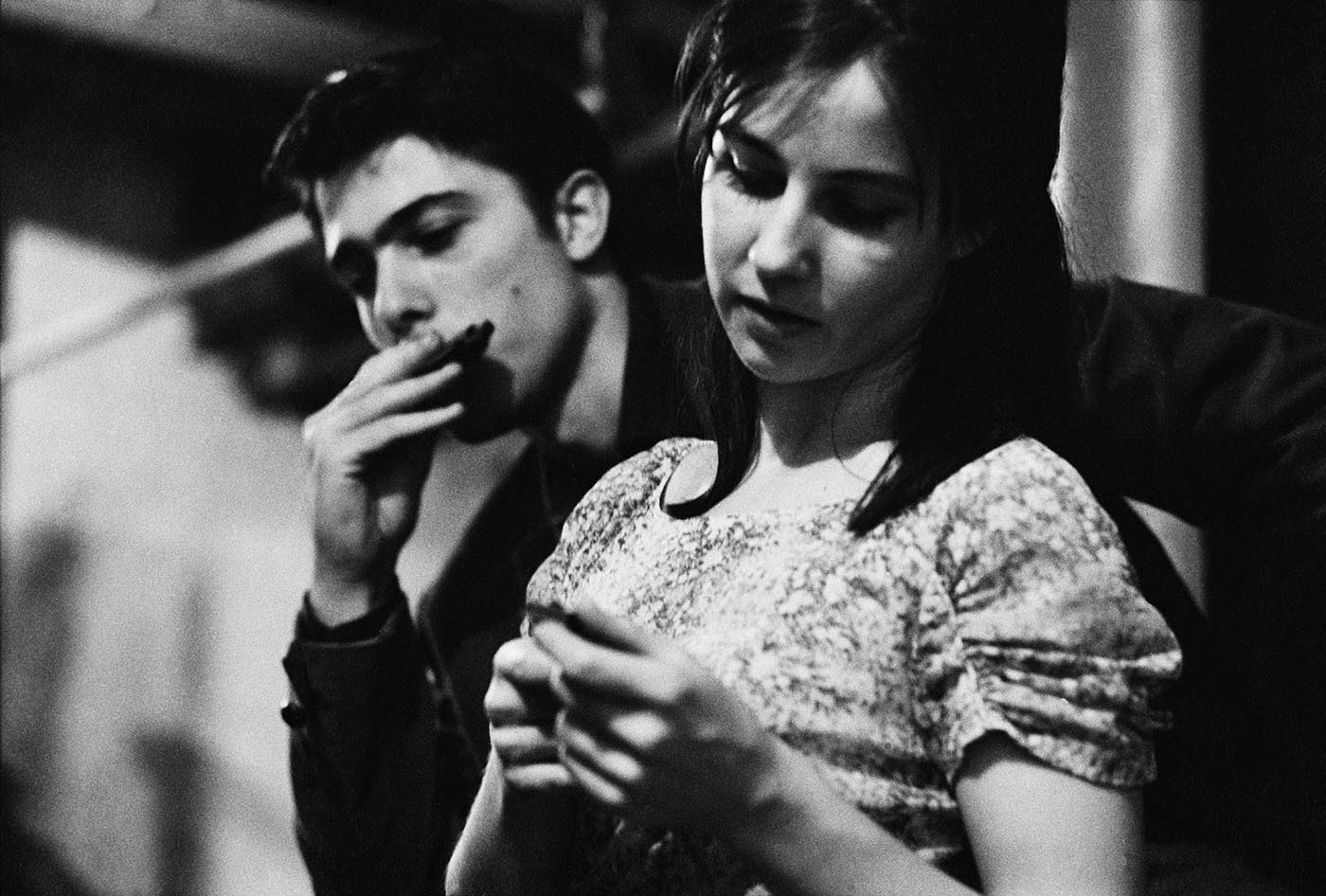
Robert Campbell Jim and Jean

The influence of Henri Cartier-Bresson is pretty clear in these photographs, particularly when Campbell moves outside to shoot scenes in Washington Square and the streets of the Village. He didn’t make stylised images of smoke-wreathed musicians, as Herman Leonard had done. He was after the informality of an emerging counterculture, more in the manner of Carole Reiff or Ed van der Elsken. One shot from a party in a Village apartment is so cool that it makes me wish it were 1964 all over again. He seems to have tried fashion work, but he needed to take other jobs, such as building sets for theatre companies, to keep going.

I’d come across him once before, in the pages of Blue Melody, the excellent memoir of Tim Buckley by Lee Underwood, Buckley’s friend and guitarist. Campbell met Buckley and Underwood at the Tin Angel, a Village club, and moved with them to California in 1967 before drifting out of sight. “Bob was in his early thirties, bearded, very bright, well-read, a musically literate fellow who did not graduate from college,” Underwood writes. “When I asked him why, he said, ‘I like books and I read a lot, but I don’t study. When reading becomes work, a task, then that’s it. My seventh- and eighth-grade guidance counsellor accused me of learning by osmosis. My mother got burned up at my motto in the yearbook: I’m not lazy, I’m just tired.'”

Underwood records Campbell as having turned up at Buckley’s funeral in Santa Monica in 1975. “One true and trusted friend,” he calls him. By that time the photography was over and the set-building was how he earned his money. Ferber reconstructs the story of his last years from minimal evidence, telling us that in the early 1980s he returned to Portsmouth, New Hampshire, where he inherited the family home on his mother’s death in 1987. But it all disappeared, and so did he until 1995, when he was taken in by a homeless charity in Burlington until his death seven years later.

He wasn’t a genius, but the photographs show that there was certainly a measure of poetry in his soul, and Ferber’s devotion to the surviving fragments of his life adds an extra layer of it to this fine book.

* Rebirth of the Cool by Jessica Ferber, with a foreword by Marc Myers, is published by powerHouse Books of Brooklyn, NY. Blue Melody by Lee Underwood was published by Backbeat Books of San Francisco in 2002.

Jazz in the Round

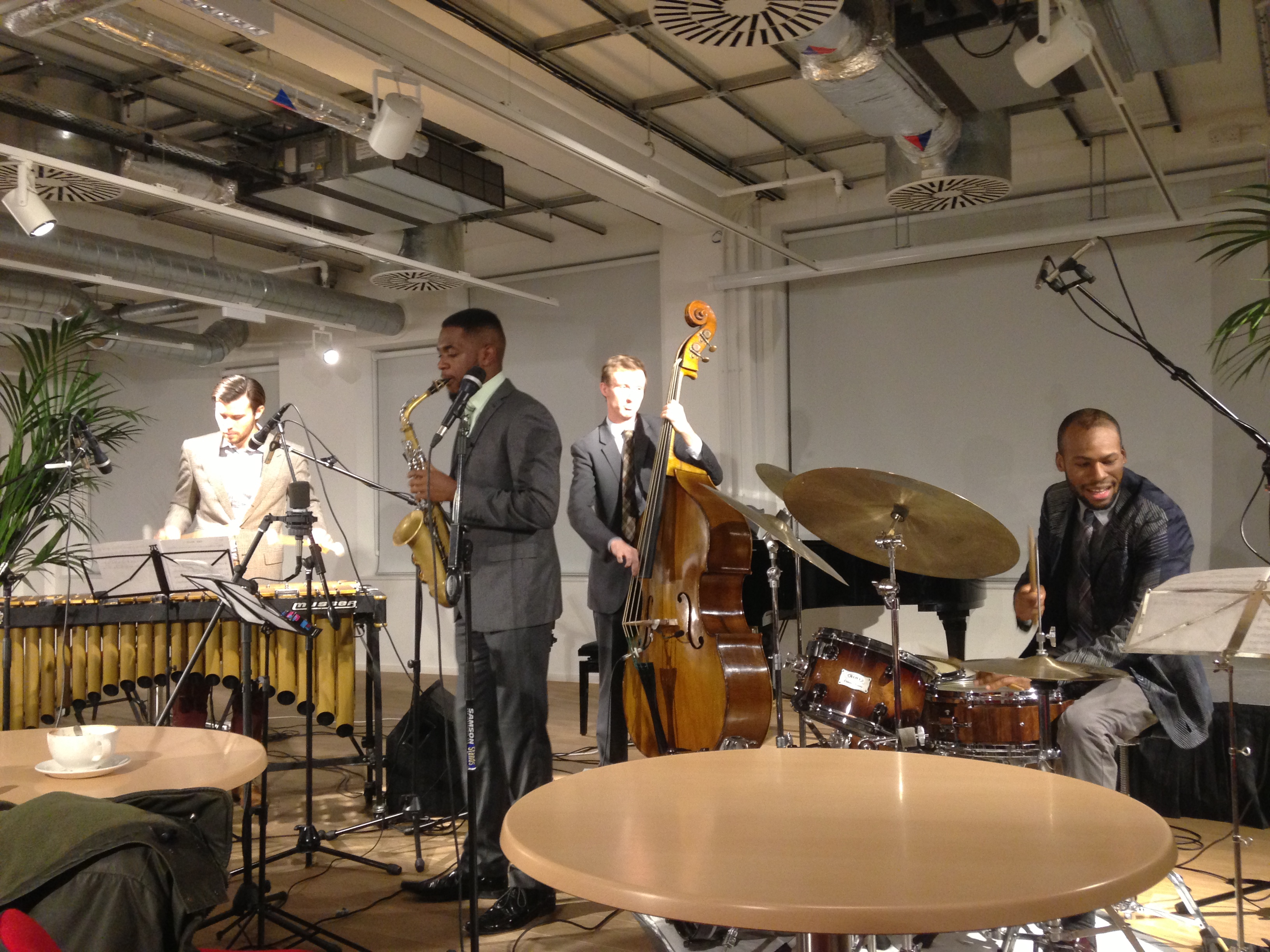
Jazz in the Round 1Jez Nelson’s monthly Jazz in the Round nights at the Cockpit Theatre in Marylebone are as good a way to hear improvised music in London as anyone has yet devised. A couple of hundred listeners settle themselves down in mini-bleachers on all four sides of the floor, where the musicians set up to face each other, creating an unusual degree of intimacy radiating through 360 degrees. As a member of Empirical — I think it was Nathaniel Facey, the alto saxophonist — told last night’s audience, it makes you play differently. In a good way.
Facey and his colleagues kicked off what turned out to be a special night even by the standards of this excellent series. The evening was being recorded for transmission (on March 28) as the last-ever Jazz on 3, which Nelson presents, and after 18 years he was understandably emotional as he introduced a bill handpicked to represent the programme’s philosophy over the years. After Empirical came Django Bates, who gave the solo performance that traditionally separates the evening’s two bands, followed by a set of free improvisation from a multi-generational quartet assembled specially for this event: Laura Jurd (trumpet), Alexander Hawkins (piano), Orphy Robinson (marimba) and Evan Parker (tenor saxophone).

Empirical were coming off a week of thrice-daily gigs in a pop-up revue at Old Street tube station: a wheeze that apparently worked as well as it deserved to, attracting crowds of passers-by intrigued by what they heard. They’re an exceptional band and they played a fine set of striking new compositions by each of the four members, ending with “Lethe”, a quietly beautiful slow tune by the vibraphonist Lewis Wright. I’ve heard them play it before, and it stuck in my head. I was delighted to hear it again, and to discover that it’s on their new album, Connection.

Bates had just arrived from Switzerland, where he is a professor of jazz at Bern’s University of the Arts. He began by singing, to his own deft kalimba accompaniment, a little song about the anxiety of a man introducing himself to a piano (which turns out to be female). Then he sat down at the keyboard to play a piece in which he doubled his improvised single-note lines in the treble register with whistling of virtuoso standard. A tenor horn solo preceded a final stint at the keyboard, which included some gorgeous gospel figurations and a song about a London pub transformed by a developer into empty luxury apartments. “Empty luxury,” he repeated, sotto voce but with emphasis.

The members of the final improvising group were chosen to show how Jazz on 3 has always reflected the way this music spans the generations, with the accent on new developments. They had never played together as a unit, but the shared qualities of musicianship and sensitivity ensured that they created a genuine conversation that not only gripped their listeners but enfolded them in the act of creation. It was, as Nelson pointed out, the best possible way to demonstrate that, in the hands of such people, the music’s future is safe.

* The photograph of Empirical at the Cockpit Theatre was taken by Steven Cropper, and is used by kind permission. His blog, with more of his fine images, is at http://www.transientlife.uk. Jazz on 3 will be replaced on BBC Radio 3 by Jazz Now, presented by Soweto Kinch. Jez Nelson’s Somethin’ Else will be on Jazz FM on Saturday nights from April 2. Jazz in the Round takes place on the last Monday of each month: http://www.thecockpit.org.uk/show/jazz_in_the_round_0.

Feat. Bill Frisell

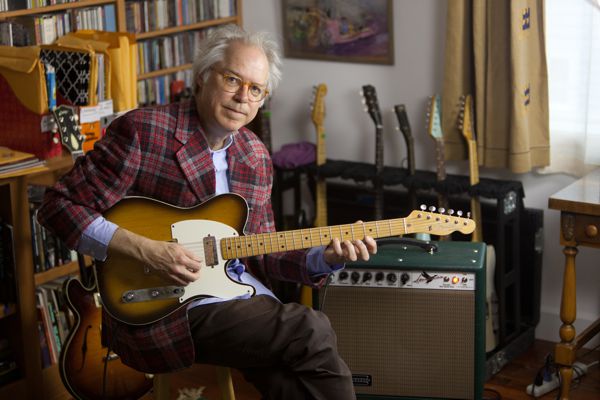
Bill Frisell at home 2There was a time, seven or eight years ago, when I came to the conclusion that Bill Frisell was simply making too many records. I fell out of the habit of automatically buying his new releases because he seemed to be spreading himself too thin. Good Dog Happy Man (1999) and Blues Dream (2001) are still two of my all-time favourite albums, but I tend to prefer him nowadays as a contributor to other people’s records — something to which his particular expertise is well suited. Used sparingly, the characteristics of his playing add texture and flavour, just like King Curtis or Steve Cropper once did.

The job of being an accompanist is much underrated these days, so it’s good to welcome the arrival of two outstanding new albums on which Frisell fulfils that role: first with the saxophonist and flautist Charles Lloyd on I Long to See You and second with singer-songwriter Lucinda Williams on The Ghosts of Highway 20. They’re very different, of course, but they benefit equally from the guitarist’s modest, graceful touch.

When I interviewed him for the Guardian in 2002, Frisell explained a personal evolution that had begun with his first 45, the Beach Boys’s “Little Deuce Coupe”. Then came the Beatles and Manfred Mann — “that’s where I heard the blues for the first time” –followed by the Rolling Stones, John Mayall and the Paul Butterfield band. “I was coming to the blues backwards,” he said, “by figuring out where the English bands were getting a lot of their stuff from.” He may be in his sixties now, but he’s kept a sense of discovery in his music, whatever company he happens to be keeping.

I Long to See You finds Lloyd and Frisell tackling some familiar material, such as the saxophonist’s “Of Course Of Course” and “Sombrero Sam”, and a version of “Shenandoah” that doesn’t quite match the sublime reading Frisell and Ry Cooder contrived on Good Dog Happy Man. The biggest surprise is a resolute instrumental version of Dylan’s “Masters of War”, while the soulful Spanish traditional song “La Llorona”– previously recorded by Lloyd — invites Frisell to display his innate lyricism. Guest appearances by Willie Nelson on “Last Night I Had the Strangest Dream” and Norah Jones on “You Are So Beautiful” are pleasant but not exactly essential.

The track that justifies the album’s existence, however, is its closer, the 16-minute “Barche Lamsel”. Named after a Buddhist prayer, it allows Lloyd (its composer), Frisell and their three bandmates — the steel guitarist Greg Leisz, the bass guitarist Reuben Rogers and the drummer Eric Harland — to improvise a dreamy five-minute intro on a single chord before drifting into a pulse defined by the drums  for a delicately funky jam that would once have been described as “spaced out”.

The concerns of The Ghosts of Highway 20 are more earthly in tone but no less spiritual in nature, if much less comforting. Lucinda Williams’ ravaged voice and bar-room country-blues songs do not trade in reassurance. Her America is a place of wayfaring strangers fleeing the past and seeking refuge from the future. As the poet of this world of lost highways and dangerous glances, Williams is rivalled only by James McMurtry.

Like its predecessor, 2014’s Down Where the Spirit Meets the Bone (which also featured Leisz and Frisell), this one is a two-disc set. The extra length offered by the format would exhaust the capacity of most singer-songwriters, but it seems ideally suited Williams’ temperament. Although her songs are often skeletal, they need to stretch out and breathe inside arrangements that create their own sense of time. On “Louisiana Story” the two guitarists sit either side of the parched voice, carefully picking out a double commentary against a tempo that flows like a thin stream of black treacle.

* The photograph of Bill Frisell is by Monica Frisell.