Intakt in London
 A packed house celebrating the 70th birthday of the bassist and composer Barry Guy provided the best possible start to the Swiss record label Intakt’s 11-day festival at the Vortex on Sunday night. The opening evening showcased Guy in dialogues with three of his closest collaborators across a 50-year career: the violinist Maya Homburger, the saxophonist Evan Parker and the pianist Howard Riley.
He and Homburger began their set as they did the 2011 concert which formed the lovely album Tales of Enchantment, with the plain-spoken elegance of the ninth-century hymn “Veni Creator Spiritus”. Sunday’s performance also included their interpretation of H. I. F. Biber’s intensely beautiful Mystery Sonata No 9: “The Agony in the Garden”, two of its sections linked by Guy’s improvised conversation with the percussionist Lucas Niggli. Original compositions were carefully elided into the externally sourced material, and the overall impression was one of a confident unity of purpose and conception.
I haven’t always found Guy’s music the easiest to warm to, but here was irrefutable evidence of a genuinely original method of blending written composition with the free-improvisation techniques of which the bassist, during his time on the London scene in the late 1960s and early ’70s, was a noted pioneer and master. In Homburger, who shares his sensibility and matches his virtuosity, he clearly found a soul-mate.
Later in the evening Guy and Parker, who first met in 1966 during a Spontaneous Music Ensemble gig at the legendary Little Theatre Club, evoked memories of various stages of their long collaboration with an improvisation which proceeded conventionally enough for much of its duration of 20 minutes or so before coming to the sort of conclusion — unexpected, unpredictable, seemingly plucked out of the air but emphatically and satisfyingly logical — that is the special property of free improvisers of such quality and experience.
Guy and Howard Riley have played together in the pianist’s trio for five decades: first with Jon Hiseman on drums, then Alan Jackson, then Tony Oxley, in a series of albums that placed Riley’s group firmly among the most creative piano trios of their era. At the Vortex it was Niggli’s turn to complete the group. I hadn’t seen Howard perform for many years. His health has not been good, and on Sunday he looked frail. His playing, however, was nothing short of miraculous: its content pared right down, every note essential, still with hints of austerity in its outlines and astringency in its emotions but with the spirit of Ellington, Monk and Taylor warming its bones. All the technique he needs for this is happily still available, and the spontaneous reactions of Guy and Niggli could not have been more perfect. The audience held its breath — at first through concern, then swiftly enthralled by the distilled brilliance and profundity of what they were privileged to hear.
Intakt, based in Zurich, may not have the public profile of one or two of the other European independent labels specialising in contemporary jazz and related forms of improvised music, but the quality and consistency of its output is as high as any. Between now and April 27 the festival’s programme includes the percussionists Pierre Favre, Louis Moholo Moholo and Julian Sartorius, the violinist Mark Feldman, the saxophonists Rudi Mahall, Florian Egli, Ingrid Laubrock, Omri Ziegele and Christoph Irniger, and the pianists Sylvie Courvoisier, Alexander von Schlippenbach, Stefan Aeby, Aki Takase and Irène Schweizer (whose album Live at Taktlos was Intakt’s first release back in 1986). All 11 nights at the Vortex are being recorded by the label’s founder, Patrik Landolt. If there was enough of Riley’s unforgettable set to make a CD, I’ll be the first in line.
 Last summer I was blown away by
 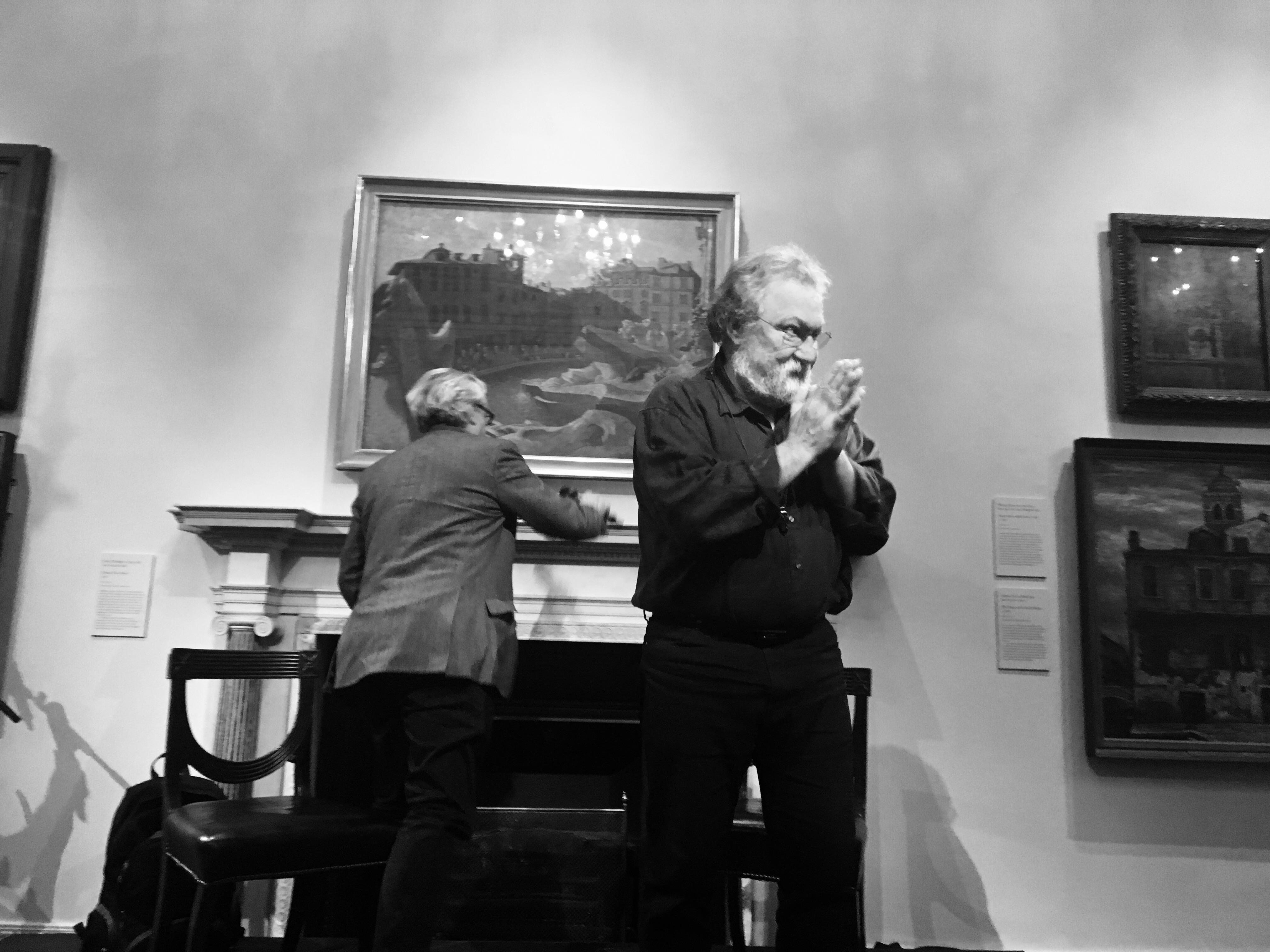 As I was on the way to see the blockbuster Abstract Expressionism show at the Royal Academy the other day, it was pointed out that jazz and AbEx seem to share a special relationship. I suppose that has something to do with synchronicity. Franz Kline and Mark Rothko were creating their revolutionary canvases at the same time as Charlie Parker and Thelonious Monk were making the music that changed everything, and the two developments seemed to share a sensibility. It’s easy to imagine Kline or Rothko playing “Ornithology” or “Well, You Needn’t” while working on a canvas in a Greenwich Village studio.
 They were only invited at the last minute after their compatriot Mette Henriette had been forced to withdraw from the Jazzahead! festival in Bremen, but the women of Trondheim Voices provided me with what is likely to be the most lasting musical memory from this year’s event. Based in a city famous for the open-minded young musicians produced by the jazz courses taught at its adventurous and well resourced music conservatory, they have been going, with various changes in size and personnel, since 2001. Over the past year they’ve begun to explore the possibilities of individual sound-tailoring devices created by the mixing engineer and sound designer Asle Karstad: the singers wear discreet wireless boxes on their belts, with controls enabling them to modify their own output in real time.


 thebluemoment.com

