It’s wonderful, it’s wonderful
 If the EFG London Jazz Festival were ever required to stand up in a court of law and produce a convincing justification for its existence, it could point to its habit of bringing Paolo Conte to the South Bank on a regular basis. Last night the 80-year-old former lawyer from Asti was greeted with applause so warm and prolonged that it practically stopped the show on several occasions and was brought to an end only when the singer drew a forefinger across his throat to indicate that there was no more to give.
While this most Italian of performers was doing his stuff, his footballing compatriots were failing to qualify for next summer’s World Cup finals for the first time in 60 years. For two hours, at least, the many Italians in the audience at the Festival Hall were spared that pain, and the lasting glow probably eased the subsequent anguish.
The show wasn’t very different in substance from the one I wrote about on his last visit, four years ago. Most of the favourites were there, including “Max”, “Sotto le Stelle del Jazz”, “Gli Impermeabili”, “Come Di”, a hurtling “Diabolo Rosso” and a wonderfully restrained “Alla Presa di Una Verde Milonga”. And, of course, “Via Con Me”, with which even the monoglot English could sing along — “It’s wonderful, it’s wonderful, it’s wonderful, I dream of you… Chips! Chips! Chips!” — and which reappeared as a coda to the evening.
The arrangements made full use of the versatility of his 10 musicians, switching constantly between a full range of saxophones (sopranino to baritone), clarinet and bassoon, accordion and bandoneon, violin, piano, marimba, drums, hand percussion, all resting on the base provided by three acoustic guitars and Jini Touche’s double bass. The short improvised solos were beautifully positioned, and the endings invariably cunning. The stage lighting, which cast equal illumination on all those playing at any given moment while leaving the rest in shadow, was brilliant.
Conte gave us his irresistible sandpapered croon, his brief vocal imitation of a trombone (his first instrument in childhood), and a snatch of kazoo. I don’t know anyone else who can do what he does, blending archaic forms and sounds — hints of Ellington’s Cotton Club band, chanson, Palm Court glide, tango, Hot Club of France swing, dolce vita and spaghetti western — into a genuinely modern music with such originality, such grace, such dignity.
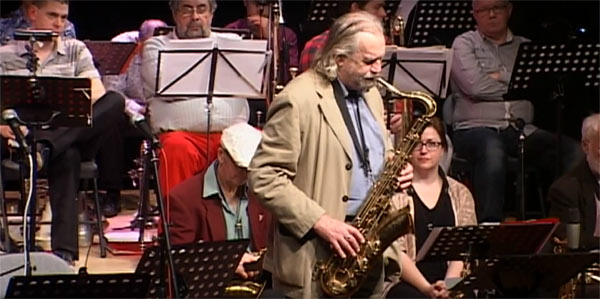 Lou Gare held his tenor saxophone aslant, like Lester Young, whose light-fingered articulation and disdain for the obvious he shared. Gare was born in Rugby but it was in Plymouth in the early 1960s that he first played with the band of the young Mike Westbrook, alongside the even younger John Surman. In London in 1965 he became a founder member, with Eddie Prévost, Cornelius Cardew and Keith Rowe, of AMM, one of the seminal groups of the first generation of British free improvisers. Lou was on their debut album, AMMMusic, recorded at Sound Techniques in Chelsea and released by Elektra Records in 1966. Six years later, with the group reduced to a Gare-Prévost duo, they performed at Harvey Matusow’s International Carnival of Experimental Sound event in London, their set released initially in part on an Incus EP as AMM at the Roundhouse and then in full on a Matchless CD under the same title.
 If you’re ever at a loose end in Berlin on a Monday night, my advice would be to head for A-Trane, the jazz club in Charlottenburg, where Andreas Schmidt, a pianist, composer and teacher at the city’s Jazz Institut, holds a weekly free-admission session featuring a changing cast of friends and students.
 A few hours ahead of her gig with her band, the Weather Station, at the Lexington pub in Islington last night, the Canadian singer-songwriter Tamara Lindeman tweeted a photograph she’d taken during a walk along the nearby Regent’s Canal. “Sandy Denny in headphones,” she added. Sandy would have been pleased by the compliment and intrigued by her admirer’s performance, and in particular by the way Lindeman managed to make the 50-year-old concept of folk-rock sound brand new.
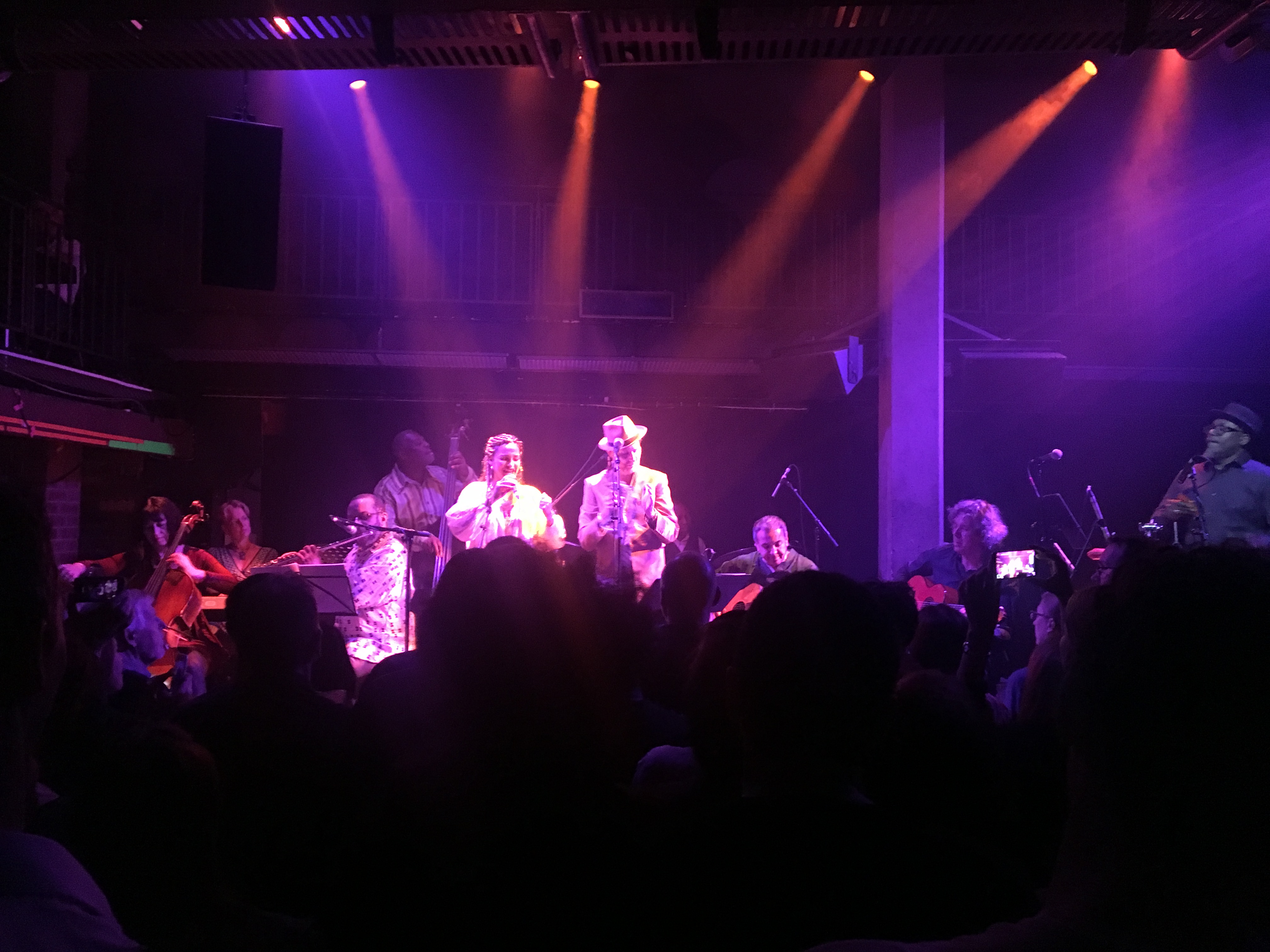 If your name isn’t Van Morrison, it takes some kind of courage to tackle Astral Weeks, one of the sacred texts of the late ’60s. No one has ever really explained how the singer, his American musicians and Larry Fallon, the arranger and conductor, and his producer, Lewis Merenstein, came up with the unique blend of idioms that make the album so distinctive. Jazz, folk, rock and blues are all in there, but so thoroughly metabolised that the eight songs create, for the length of a long-playing record, an idiom of their own. In his lyrics, too, Morrison plunged head-on into a new world of poetic spirituality.
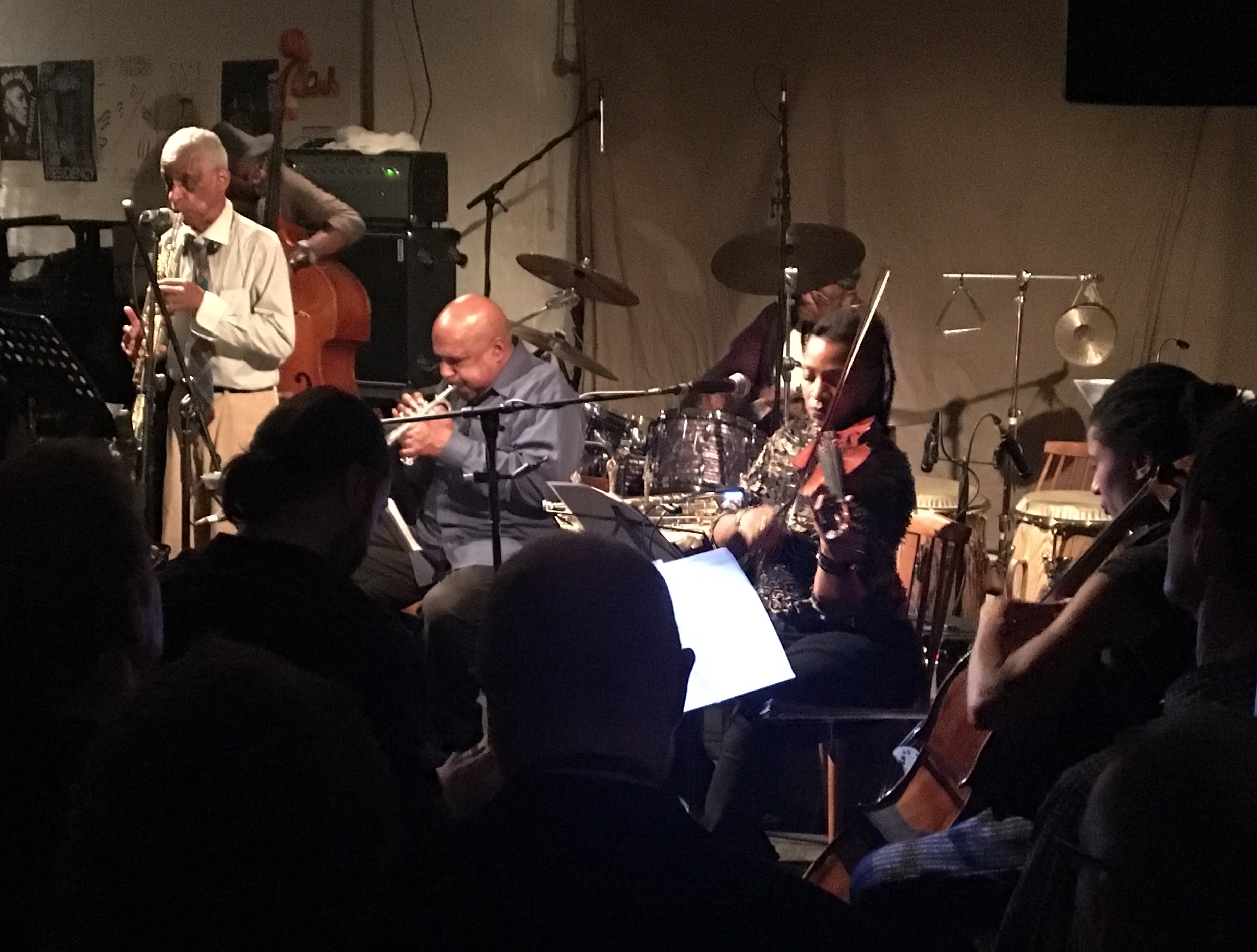 Amid the strangest weather in 30 years, with sand from the Sahara and dust from Iberian wildfires turning the air in London dark red at lunchtime on the hottest October 16th since records were first kept, there was another surprise awaiting the audience for the second of the Art Ensemble of Chicago’s three sold-out nights at Cafe Oto this week.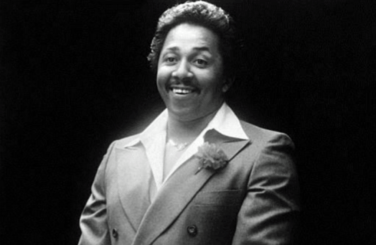
 It’s been my experience that no time spent checking out the Kronos Quartet’s latest activity is ever wasted, and the group’s new album, Ladilikan, in which they accompany Mali’s Trio Da Kali, is a beauty. The meeting between the voice of Hawa Diabaté, the balafon of Lassana Diabaté and the bass ngoni of Mamadou Kouyaté and the violins of David Harrington and John Sherba, the viola of Hank Dutt and the cello of Sunny Yang turns out to sound like something that has always existed, somewhere in the universe.
 thebluemoment.com