Skip to content

Posts tagged ‘Miles Davis’

Silencing the Voice of America

Time for jazz… Willis Conover speaking… This is the Voice of America Jazz Hour…

When, as a schoolboy in the late 1950s, I started to discover the music I love and write about, that process took some work. The music wasn’t easy to find, which of course added to the sense of its value. One priceless resource was the nightly Jazz Hour on the Voice of America station, beamed around the world from studios in Washington DC as a tool of the US State Department’s soft-power policy.

Willis Conover, a white man in early middle age, spoke slowly and clearly in an Eisenhower-era sort of voice, so that listeners in other countries with perhaps only a smattering of English could get his meaning. It wasn’t a voice that indulged in hip vernacular, but somehow it conveyed a love of the music, as did the fact that the show’s signature tune was Duke Ellington’s “Take the A Train”.

As I recall, the Jazz Hour was part of a nightly two-hour strand labelled Music USA. The first hour was devoted to the last knockings of the Swing Era. What followed, I think at 10pm UK time, was 60 minutes of what interested me. This was where, in late 1959, I first heard “All Blues”, that mesmerising track from Miles Davis’s Kind of Blue, igniting a relationship that would lead 50 years later to the writing of the book that gave this blog its title. I can still remember the first time I heard those little syncopated muted trumpet figures that Miles laid over the fade. A whole new world was opening up, right there on the family radio.

Similarly, I remember being hypnotised again a few months later when Gil Evans’s “La Nevada” came over the VOA airwaves. It was the lead track from Evans’s latest album, Out of the Cool, and Conover played all 15 minutes of it, complete with solos from the trumpeter Johnny Coles, the bass trombonist Tony Studd, the tenor saxophonist Budd Johnson, the bassist Ron Carter and the guitarist Ray Crawford, all propelled by Charlie Persip’s restlessly propulsive snare-drum accents and Elvin Jones’s maraccas, with Evans’s piano and Crawford’s guitar and the background tapestry of semi-improvised woodwind and brass figures adding a commentary to what is still the richest and most compelling extended piece of jazz I know.

To be honest, I haven’t listened to VOA since the ’60s. I don’t even know whether it still broadcasts jazz alongside its news and other programming. But I have a lot for which to thank the Jazz Hour, even though its true intended audience during the years I listened was much further to the east, behind the Iron Curtain, where it reached people in Poland and Russia and East Germany who were even hungrier for the music and the culture for which it seemed to stand, one of freedom from repression.

I remember one particular sign of VOA’s effectiveness. On many nights the music on the Jazz Hour would obliterated by a loud and sometimes prolonged burst of static. The Soviet bloc’s jamming stations were doing their job.

This past weekend, the 1,300 employees of the Voice of America were told of an executive order signed by President Trump stripping the station of its resources. The document instructed its managers to reduce its output “to the minimum presence and function required by law” in order to “ensure taxpayers are no longer on the hook for radical propaganda.”

The knowledge that VOA was launched in 1942 to beam anti-Nazi propaganda to Germany and its occupied territories adds a layer of irony that would be funny were it not essentially tragic. Among those likely to be gratified by the decision are Elon Musk, who called for it to be shut down, and Vladimir Putin, who blocked its broadcasts to Russia after the invasion of Ukraine.

Willis Conover died in 1996, aged 75. He’s buried in Arlington National Cemetery. I imagine he’d be glad not to be around for all this.

* The photograph of Willis Conover interviewing Louis Armstrong was taken in 1955.

The lost genius of Albert Stinson

This is a piece about the bassist Albert Stinson (1944-1969). It’s something I’ve been meaning to write for a long time. The great drummer Jim Keltner was kind enough to talk to me about his boyhood friend, as was another drummer from Los Angeles, Doug Sides, who toured and recorded with him in John Handy’s band. I first heard Stinson in 1963 on Passin’ Thru, Chico Hamilton’s very striking Impulse album, recorded when the bassist was all of 18 years old. To my 16-year-old ears, he was exceptional even then; goodness knows what he might have become.

It’s the evening of Friday, April 7, 1967 in the Harmon Gymnasium at the University of California, Berkeley. Your name is Albert Stinson, you play the double bass, and you’re about to deputise for Ron Carter in what might be the greatest small jazz group of all time: the Miles Davis Quintet as constituted between the autumn of 1964, when Wayne Shorter arrived to join Davis, Carter, Herbie Hancock and Tony Williams, and the middle of 1968, when Carter became the first to leave. The greatest? Certainly the one applying new levels of freedom and near-telepathic interplay to the business of improvising on tunes.

So this group has been together and constantly evolving for the best part of three years and you’re being dropped into the middle of it. You’re only 22 years old but you’re ready, in the sense that you have the chops and the experience. You were a prodigy, and you’ve played alongside Charles Lloyd and Gábor Szabó in a brilliant Chico Hamilton Quintet, and with other heavyweights.

But to play in this band, at this stage, you had to be ready for anything. Accelerando or ritardando, not always synchronised. Stopping on a dime without warning, restarting at the merest twitch of a nerve-end, intuiting the leader’s moves but following without following, waiting out a silence, hitting the short, sharp ramp from triple-p to triple-f without a moment’s doubt. Playing against or through what someone else was doing.

You’re not the first bassist to deputise for Carter, a busy guy on call for many sessions. Gary Peacock was the first. Then Reggie Workman, then Richard Davis. After you, there’ll be Miroslav Vitous before Carter goes for good and Dave Holland becomes a permanent member. All great, great bassists. And now it’s your turn.

There’s a buzz in the Harmon Gymnasium. For starters, Miles calls “Gingerbread Boy”, the brusque, flaring Jimmy Heath tune featured on Miles Smiles, the quintet’s second studio album, the one that made everyone realise something different was happening here. At a rocket-propelled 80 bars a minute, the theme hurtles past, with Williams’s drums at their most volcanic. You play time, straight. You survive, although you miss the cue at the end and the piece finishes with your phrase trailing off, as if surprised by the sudden silence around you.

Miles leads into “Stella by Starlight”, his tone at its purest, the trumpet holding a long note into what feels like infinity as you join Hancock in a free background that seems to be inventing itself outside the tune. Eventually you move into a walking medium 4/4, deploying your big, strong tone but keeping the elasticity that enables you to move with the others when the tempo doubles and Williams starts to force the issue. You’re okay, and a little more than that when you respond to the wind-down of Shorter’s solo with something that shows you’re getting the hang of this particular freedom of narrative. Hancock’s solo begins out of tempo and you invent figures to support him before you slide back into the 4/4, seamlessly.

And then, on Shorter’s “Dolores”, a post-bop epigram also from Miles Smiles, the tempo goes back up, and now you’re no longer feeling your way but fully contributing, the equal of these four giants as they charge through a warp-speed exercise in musical plasticity, in aural geometry, in listening, hearing and responding at some Zen level of intuitiveness. In fact you’re almost too ready when Miles creates the silence from which he goes into “Round Midnight”, and you let your lower-register notes bloom in a way that Carter would probably consider excessive. But you’re part of the excitement as Williams’s snare-drum fusillades overwhelm the two-horn fanfares and soon you’re shifting the time around behind the flickering, nudging phrases of Shorter’s solo.

And now you’re home, riding the waves as the set continues with something based on the bones of “So What” and concludes with “Walkin'”. After just under an hour, it ends with an ovation.

—ooOoo—

“Albert brought something different to that band,” the drummer Jim Keltner told me when I asked him to talk about his longtime friend. “Ron Carter is one of the greatest musicians ever, but Albert brought a different kind of fire. They were so highly evolved, and Albert was one of them. I don’t really want to talk about genius-this and genius-that, but I do believe that he was a genius. He came back and told us that Miles had asked him to join the band, but he said he couldn’t because he had too many gigs lined up with Chico. That’s mind-boggling. But it’s the kind of player and person he was.”

Keltner, who would go on to play with Bob Dylan, John Lennon, George Harrison, Ry Cooder, Neil Young and countless others, was in his last year at the mostly white Pasadena High School when he met Stinson, who was two years younger and attending the mostly black John Muir HS. They were neighbours in the Altadena. “I was always aware that I was older than Albert,” Keltner said, “but I knew that I would never be as smart as him. A very, very smart cat. A very high IQ.” Another neighbour, the vibraphonist Bobby Hutcherson, had just graduated from John Muir, and the three played together constantly.

“Albert lived in a kind of cul-de-sac about five minutes from my house. It was a very diverse community, very well integrated. White people had black or Asian neighbours, and there were a lot of Mexicans around. And I’m half-Mexican.”

He remembered that Stinson lived with his mother, a former dancer, and her steady flow of boyfriends. His father had left the family early. When Keltner got married young, to a girl he’d known in high school, Stinson envied him. “He always loved the fact that Cynthia, my wife, and me, we made the long haul, which is very unusual for musicians. I think he wanted that and thought he could have it, but it wasn’t to be. I can’t really bring myself to talk about his personal life, but he was hurt badly by his relationship. His very first girlfriend was really young, a young beautiful black girl, and he was young, too… he was in love with her. I can’t speak for her but he was really in love with her. They were a little team. At some point he married and had a baby. He’s called Ian Stinson. He looks just like Albert, but with dreads… a beautiful kid. He’s a drummer and lives up north.”

Keltner remembered an early visit to the Stinson house on Shelly Street. “One afternoon I went over and he was sitting on the floor with his cigarette and ashtray and his weed and a little half-smoked doobie and a glass of cheap Ripple white wine, with a newspaper and glue and a huge massive book. He was making his own bass from a library book. I’m not sure how he did it, but the bass that he built himself was the one that I used to put in my car, because I would drive him everywhere. An upright bass and my drums in a Volkswagen.”

But before long they’d all hooked up with another young star of the future, the saxophonist and flautist Charles Lloyd. “I told Charles Lloyd about Albert when we were driving down from a little gig in a country club up in the mountains,” Keltner said. He was subbing for Mike Romero, Lloyd’s regular drummer. Hutcherson was already in the band, along with the pianist Terry Trotter and the bassist George Morrow. Soon Stinson would be replacing Morrow and also persuading Keltner, who thought he would never be as good as Romero, out of giving up music altogether.

“Mike Romero would come into the music store where I worked and I just thought he was the coolest guy in the world. One day he said to me, ‘You want to sub for me for half a set?’ I acted very confident and yet I was scared shitless. So I played, then I stayed and watched Mike, and I was so demoralised. Albert lit into me and told me how dumb I was. He said, ‘I would rather play with you any day than with Mike Romero.’ I said, you’re just saying that because you’re my friend. But I never forgot it. It carried me through.”

Of Stinson’s six albums with Chico Hamilton, recorded between 1962 and 1965, Passin’ Thru is the one that made a deep impression on me at the time. On pieces like “Lady Gabor” and the title track, he seemed to have metabolised the deep-groove drone effects created by the multiple bassists on such John Coltrane recordings as Olé and Africa/Brass. Barely 18, his strength and maturity were extraordinary.

He’d also recorded for Pacific Jazz with the pianist Clare Fischer (Surging Ahead, 1962), the guitarist Joe Pass (Catch Me!, 1963) and Charles Lloyd (Nirvana, 1965). He’d played (although not recorded) with Gerald Wilson’s mighty big band in Los Angeles. In 1964 he’d visited London with Hamilton, Szabó and the altoist/flautist Jimmy Woods to record the soundtrack for Roman Polanski’s Repulsion. He’d been in Rudy Van Gelder’s famous studio in Englewood Cliffs, New Jersey, one day in 1967 to record a quartet session for Blue Note under Hutcherson’s leadership, with Hancock on piano and Joe Chambers on drums, featuring a fantastic Stinson solo on a piece called “My Joy”, although the album wouldn’t be released until 1980, under the title Oblique.

“Albert loved playing music and he loved jazz,” Keltner said. “He was a thorough jazz musician. All of our friends, jazz players, were completely inspired by him. He was a leader, a ringleader. I was always round at his house, listening to music. We listened to Bartók, we listened to Coltrane. Everything I heard, I heard it first with Albert. Bobby Hutcherson lived even closer to him than I did. Those 3 a.m. calls to rescue Albert, it was always Bobby and me who went to save him.”

Those 3 a.m. calls came when he’d overdosed on heroin, something that had existed in his life alongside music well before, in 1967, he, Hutcherson and Keltner joined the band of the altoist John Handy, whose reputation had been made by an incendiary performance at the 1965 Monterey Jazz Festival. “Albert got me that gig,” Keltner said. “It was a fantastic time for me. It was at a club in San Francisco called the Both/And. I don’t remember playing very good, just hanging on and trying to get it right. I didn’t have the confidence. Jazz playing is a huge amount about confidence. Not like rock and roll, where you do your thing. Not that I’m belittling it. But jazz is a different thing. And even though I wasn’t cutting it, and I knew it, Albert would make it right.”

By the time the new line-up made a well received album, New View, recorded live at the Village Gate in New York for Columbia, featuring a wonderful version of Coltrane’s “Naima”, Keltner had been replaced by Doug Sides, another young musician from Los Angeles.

“Albert was one of these kids who just had a glorious talent, and he was a person that almost anybody would love,” Handy told David Brett Johnson, a deejay on Indiana University’s radio station, in 2008. “A very easy, sweet young guy, and his playing was just incredible. He seemed to have a bunch of natural ability, which I understood because I came that way myself, without that much experience, but just kind of knew how to do it. However, I was afraid — even with those guys in my band, there were drugs. They kept it away from me. They were younger, they kind of… you know, when you‘re the bandleader the little cliques kind of take place, and they weren‘t vicious, they just… I could see the half-generation difference in age and all.”

Doug Sides, who moved to the UK in 2010 and died at his home in Kent this month (October 2024), aged 81, remembered meeting Stinson at jam sessions in an LA place known as the Snake House — actually the home of a musician who kept pet snakes.

“Albert a very special human being,” he told me. “He was one of the nicest guys I ever met. He didn’t have animosity toward anybody. He just liked to have fun. But he had one problem. He liked to get high and he liked to shoot up with the junkies. And he tried to keep up with them, which caused him to overdose a few times before he died in New York doing the same thing.

“He was a really great player. He had a big sound, too, and he could play any tempo. For a small cat – he was short – but he was very strong, strong like somebody who was 6’5 or something, he had that kind of strength. In those days they had beer cans that you couldn’t crush very easily, not like the modern ones where you just squeeze and they fold up. He used to crush them like they were the modern ones.”

His seven months with Handy included a stint in San Francisco performing an opera, The Visitation, written by Gunther Schuller for 19 voices, woodwind and string sections and a jazz quartet, applying ideas from Kafka’s The Trial to the world of civil rights in America, and blending 12-tone composition with jazz.

“Albert had never played with a conductor,” Handy told David Brent Johnson. “Well, man, he learned those parts by just — with one or two rehearsals, and they were very difficult, as you can imagine if you know anything about Gunther Schuller‘s music. And at one point Gunther Schuller stopped the rehearsal and said to the bass players, ‘Do you hear this bass player? He sounds as big as almost all of those guys put together back there!’ And poor Albert was so sick, I didn‘t realise it, from doing crazy things, you know, and vomiting during the breaks because he was taking drugs… I didn‘t know that. He kept it away from me. All I know is he played his butt off.”

Jim Keltner said he thought one of the reasons Stinson turned down Miles Davis’s offer was that he didn’t want to leave Altadena, where his mother had left him their house on Shelly Street. “My own life had really changed by that time,” the drummer recalled. “I’d done rock and roll with Gary Lewis and the Playboys in 1965. Albert thought that was cool. He wasn’t judgmental. Some of the others were jazz snobs. By 1968-69 I was playing in a couple of bands and Albert was travelling more so I was seeing him less, but I’d hear things.”

Stinson joined the band of the guitarist Larry Coryell, whose popularity had taken off during his time with Gary Burton’s quartet. “When I heard he’d joined Coryell,” Keltner continued, “someone said he was playing electric bass, or thinking about it. I thought, oh wow, that’s incredible. He’ll burn that thing up. He’ll make it his own and he’ll be one of the baddest cats and maybe at some point we’ll play together again. But then, bam.”

On the road in June 1969, a few weeks short of his 25th birthday, Stinson overdosed again in a New York hotel room. This time he would not be saved. “It wasn’t a shock,” Keltner said, “but it was incredibly sad. Then I started hearing stories about the guys he was getting high with. Instead of trying to save him, they got scared and ran away. That’s one of the things I learned in the earlier days, one of the sad, dumb things, about how you don’t do that. You’ve got to save them. Which then, in turn, I got saved two times later. Bobby and I weren’t there to save him.

“Because of that rumour, I remember just hating Larry Coryell and everything about him. It was a misplaced anger. I didn’t know the details or anything. Eventually I had to let go of blaming him for Albert’s death.”

Whatever his habits, and the problems they may have caused for himself and others, Albert Stinson was someone who inspired powerful feelings of love and loss in fellow musicians. In Keltner and Sides, obviously, and also in Charles Lloyd, who cherishes his memory. Four months after Stinson’s death, Bobby Hutcherson wrote and recorded a lament called “Now”, dedicated to his late friend, with a lyric by Gene McDaniels delivered by the soprano Christine Spencer: “At the end, no more need…”

“Later in life,” Keltner told me, “I came to appreciate that although people will compliment you on your talent, generally speaking your talent is based on who you’re playing with. Every time I played with Albert, under any situation, whether it was some little silly gig like a bar mitzvah or whatever, it was incredible. It was always great. I always felt like I was somebody.

“It shows how amazing Albert was. He was so soulful. And he was too sensitive a cat for the world. A sensitive, beautiful old soul.”

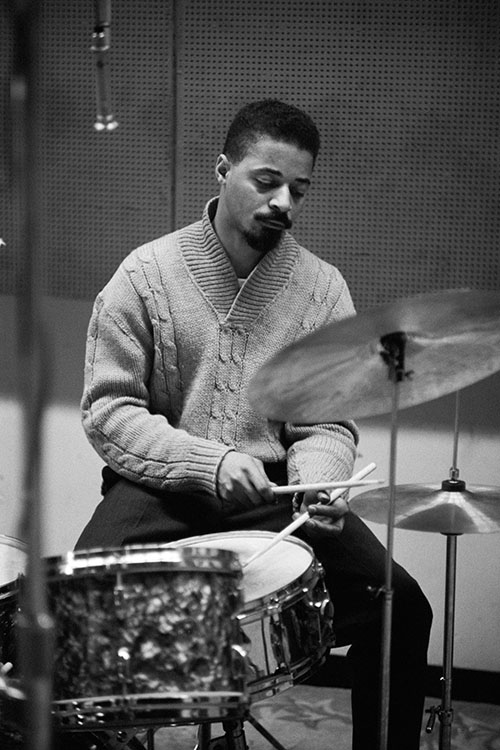
* The fine photograph of Albert Stinson is by Ave Pildas, whose work in jazz and many other fields can be seen at http://www.avepildas.com. A bootleg of the radio broadcast of the Miles Davis Quintet’s Harmon Gymnasium concert was released on a CD some years ago by the recordJet label.
Miles à l’Olympia

Miles Davis arrived in Paris on the morning of November 30, 1957 for a tour booked by a local promoter, Marcel Romano. He was met at the airport by the singer and actress Juliette Gréco, whose lover he had become during his first visit to France, in 1949, and by the young film director Louis Malle, who wanted him to provide music for the soundtrack to his film Ascenseur pour l’échafaud.

That same night the tour began at the historic Olympia music hall on the Boulevard des Capucines, with Miles at the head of a band completed by the 20-year-old Franco-American tenor saxophone prodigy Barney Wilen, the great American drummer Kenny Clarke, and two excellent French musicians, the pianist René Urtreger and the bassist Pierre Michelot. They performed, as Urtreger told his biographer, Agnès Desarthe, “sans répétition” — without rehearsal.

The soundtrack was recorded on December 4, with the same quintet; it was a turning point in Miles’s music, representing a move away from the standard ballads-and-blues repertoire towards pieces of indeterminate length based on minimal harmonic information rather than closed-loop chord sequences, played live in fragments as Davis watched the film being projected on to a screen in the studio.

Meanwhile, however, the material was more conventional when the band played at the Olympia and at another concert in Amsterdam’s Concertgebouw a few days later, followed by a return to Paris for three weeks at the Club Saint-Germain, apparently arranged when Romano failed to secure the concert bookings across Europe for which he had been hoping. After a concert in Brussels on December 20, Miles flew back to New York, where he began putting together the sextet that would record Milestones early in the new year.

The Amsterdam concert was recorded for radio broadcast, and has been bootlegged several times, most recently on a CD on the Lone Hill label, with lamentably anachronistic packaging and a rather brittle, toppy sound. No complete recording of the Olympia concert was known to exist until, after Romano’s death, his nephew and heir found a set of reel-to-reel tapes among his possessions. He sold them to Jordi Pujol, the Barcelona-based specialist in historical reissues, who commissioned the audio engineer Marc Doutrepont to restore and master them. Doutrepont has achieved a sound as good as the best live recordings of the time: true, clear, warm and perfectly balanced.

Davis and Clarke were old friends and colleagues, and the trumpeter had played with Urtreger and Michelot during his second trip to Europe with the Birdland All Stars, 12 months earlier. Wilen was new to him, but the whole band sounds at ease from the start of their first appearance as a unit. They play a dozen pieces: “Solar”, “Four”, “What’s New”, “No Moe”, “Lady Bird”, “Tune Up”, “I’ll Remember April”, “Bags’ Groove”, “‘Round Midnight”, “Now’s the Time”, “Walkin'” and “The Theme”.

The American writer and musician Mike Zwerin, a steel baron’s son who had played trombone with Davis’s nonet at the Royal Roost in 1948 (aged 18!), was in the audience at the Olympia. Much later Zwerin wrote that the concert had begun with “Walkin'” and that — “in an entrance worthy of Nijinsky” — Miles appeared on stage only midway through that opening tune, to wild applause. No sign of any such thing here.

Miles’s tone and attack were at their most exquisite at this time, between the sessions for Miles Ahead and Milestones, the alertness of his mind ensuring that the poignancy of his sound never became self-indulgent. His solo on “Four” is the sort of thing, like his improvisations on the studio versions of “Milestones” and “So What”, that could be transcribed and studied for the details of its nuanced perfection. He takes “What’s New” as a solo ballad feature, producing elegant variations that can be listened to over and over again.

Wilen, precociously poised and inventive, gets Tadd Dameron’s “Lady Bird”, “I’ll Remember April” and a bouncy “Now’s the Time” to himself with the rhythm section. They are respectively the fifth, seventh and tenth tracks on the album, making me wonder if this is the same order as the actual set list. Would Miles have left the stage and returned so often? Given that he had only stepped off a transatlantic flight a few hours earlier, perhaps so.

Other joys include the trumpeter’s intense blues playing on “Bags’ Groove” and his relaxed exchanges with the immaculate Clarke on Sonny Rollins’s “No Moe”. A couple of fluffed phrases at the start of “Walkin'” are rare blemishes on a a release whose artistic value is the equal of its historical interest. If you love Miles, don’t miss this.

* The Miles Davis Quintet’s In Concert at the Olympia Paris 1957 is on Fresh Sound Records. The uncredited photo is from the booklet accompanying the album. If you want to know why the soundtrack to the Louis Malle movie — released in the UK as Lift to the Scaffold — was such a significant moment in Davis’s career, you might like to read the book after which this blog is named: The Blue Moment: Miles Davis’s Kind of Blue and the Remaking of Modern Music (Faber & Faber).

On August 29, 1970

IoW Miles 2

Saturday at the 1970 Isle of Wight Festival started at lunchtime with a two-hour solo set by John Sebastian during which, after delivering “Daydream”, “Nashville Cats”, “You’re a Big Boy Now” and others, he was unexpectedly joined by his former Lovin’ Spoonful colleague Zal Yanovsky, who had sent a note up to the stage asking to be invited to join in. Together they ran through some more of the Spoonful’s hits, including “Do You Believe in Magic” and the gorgeous “Darling Be Home Soon”. Sebastian finished off with “Younger Girl” and “Red-Eye Express”, leaving the crowd feeling beatific at the start of a day of unbroken sunshine.

An hour and half later came a different kind of singer-songwriter: Joni Mitchell, three albums into her career, already known for “Chelsea Morning”, “Both Sides, Now”, “Woodstock” and “Big Yellow Taxi”, wearing a long dress the colour of goldenrod, a few shades darker than her hair, and a discreet assortment of silver and turquoise jewellery. And she was about to face an ordeal that no one present would forget.

She came on with her guitar and began with “That Song About the Midway”. “Chelsea Morning” was next, but as she started the third verse she appeared to lose her way. After strumming on for a few more bars, she announced: “I don’t feel like singing that song so much.” She gave a little laugh and got a round of sympathetic applause, but already the strain of being alone on the stage in front of more than half a million people, delivering such intimate music, was beginning to tell, and her unease seemed to communicate itself to the crowd.

It’s hard to get that many people to be completely silent on a sunny afternoon. Her next little speech expressed annoyance. “When I hear someone saying, ‘Joni, smile for Amsterdam!’ it really puts me off and I get uptight and I forget the words and I get really nervous and it’s a drag. Just give me a little help, will you?” And then just as announced that she was going to play “Woodstock”, a disturbance in front of the stage led her to stand up and move away as a stoned boy was removed from the crowd.

She sat back down and started again. As she finished the song, a bearded man in a dark T-shirt who had been crouching behind the piano rose to his feet and asked if he could use her microphone. He wanted to make an announcement to the people in the encampment on the hill beyond the perimeter fence. Elliot Roberts, Mitchell’s manager, led a group of half a dozen people who quickly surrounded him and moved him away from the singer.

All the tensions of the weekend were coming to the surface. Some of the people in the crowd had chanted “Let him speak!” Was a rock festival a commercial enterprise or a free-for-all? Were the anarchists and situationists and freaks right to try and tear down the fences? Rikki Farr, the organisers’ spokesman, sensibly ordered the uniformed security guards to leave the stage. But how, in 1970, were you supposed to deal with a moment like that? For a minute, even in that brilliant Saturday sunshine, the atmosphere was closer to Altamont than Woodstock.

Shaken but determined to continue, Mitchell tried to resume her performance. Behind her back, the bearded man was finally being dragged away, and the crowd didn’t like the way it was done. So she stopped and made another speech, an angry and distressed plea for the chance to do her work: “Last Sunday I went to a Hopi ceremonial dance in the desert and there were a lot of people there and there were tourists who were getting into it like Indians and Indians who were getting into it like tourists, and I think that you’re acting like tourists, man. Give us some respect!”

It was brave, and it worked. She was able to complete her performance in relative peace, the crowd now more attentive and the atmosphere lightened appreciably by “Big Yellow Taxi”. Having been led away by Roberts at the end of the set, the sound of cheering brought her back for encores that washed away the memory of the earlier interruptions.

And that was just the start of an extraordinary sequence. Here’s what I wrote in the Melody Maker about the next performer: “Mr Herbert Khaury, alias Tiny Tim, alias Larry Love the Singing Canary, bounded on stage to sing ‘a few tunes from the early part of the century.’ Blowing kisses to the audience and strumming his ukelele, he seemed unlikely to retain the audience’s interest for long. But his rock and roll medley, with some of the most untogether playing ever heard (‘This is my wonderful English band… my wonderful English band’) was very amusing. The master stroke was his final medley of ‘There’ll Always Be an England’ and ‘Land of Hope and Glory’, which somehow got the audience on its feet to sing these ridiculously patriotic songs.”

Tiny Tim’s bizarre bonhomie had removed the last trace of bad vibes. While the road crew rearranged the stage, Jeff Dexter, the festival’s DJ, made two crowd-pleasing choices: Otis Redding’s “Respect” and Free’s “All Right Now”, during which a multicoloured hot-air balloon floated above the crowd, its two occupants exchanging peace signs with the mass of humanity below.

Now it was late afternoon, and into the last rays of the sun slid Miles Davis, a 44-year-old jazz trumpeter who had served his apprenticeship almost a quarter of a century earlier with Charlie Parker and now faced the challenge of captivating 600,000 hippies. He took the stage in a thin red leather jacket over an orange knitted top, with studded blue jeans and silver boots. His sidemen — the saxophonist Gary Bartz, Chick Corea and Keith Jarrett on electric keyboards, Dave Holland on bass guitar, Jack DeJohnette on drums and Airto Moreira on percussion — had come as they were.

In August 1970 Miles was moving from a freer version of the complex music his quintet played in the second half of the ’60s to a direct engagement with funk. He’d already played to young audiences at the Fillmores in San Francisco and New York, on bills with the Grateful Dead and the Steve Miller Band. But the ties to the earlier music were not yet cut. The rhythm section he brought to the Isle of Wight ensured that however groove-centred the music became, it retained its freedom and complexity.

An unbroken set alluded to five compositions from the previous couple of years — “Directions”, “Bitches Brew”, “It’s About that Time”, “Sanctuary” and “Spanish Key” — before finishing with a fragment of his usual fanfare. Shrewdly, he played for barely 35 minutes: enough to intrigue and even beguile the hippies who didn’t know his music, not enough to try their patience.

The opening salvo took no prisoners. Miles wanted the music to burn, and he was concentrating hard as he led the way with fierce stabs and insolent runs on his lacquered instrument. The stage was bracketed by Jarrett, on an RMI keyboard that gave him the sounds of an electric piano and an organ, and Corea, who had what looks like a ring modulator on the top of his Hohner instrument and used it to make bleeps and squiggles of sound. Holland brought a jazz musician’s inventiveness to the funk bass lines, which was not what Miles would ultimately want, but there was a passage when he and DeJohnette meshed into a kind of broken second-line rhythm that lifted the music right up. Bartz flighted his brief soprano and alto solos with a keening sound and a striking trajectory, while Airto added the exotic noises of the shaker, the pandeira, the agôgo, and the cuica, a Brazilian friction drum with a distinctive whooping sound.

Miles prowled the stage, never far from the action. A quarter of an hour in, midway through “It’s About that Time”, virtually unrecognisable from its treatment on In a Silent Way a year earlier, the music took off. As it seethed and roiled, Miles returned to centre-stage and played two short, quiet phrases that redirected everything. Then he sketched the exposed theme of “Sanctuary” before cueing up the riff of “Spanish Key”.

He let the band get on with it for five minutes before raising his horn and lowering it back to the microphone, the signal for the funk to back off and textures to be laid over the simmering pulse behind his exquisite open-horn phrases, some of the them hinting at old Moorish influence. As he returned to the staccato jabs, the rhythm section, which had been simmering quietly, rose up again in response, coming back to the boil.

And suddenly the time was up. The music shuddered towards a halt. While the rhythm section wound down, Miles bent down to pick up his silver mute, waved his trumpet once to the crowd, grabbed his shoulder bag and his jacket, and was gone, into the dusk, leaving us to talk about the extraordinary nature of what we’d heard, and what it meant to hear it in the context of a giant rock festival. When they asked him the names of the pieces he’d played, he said, “Call it anything.”

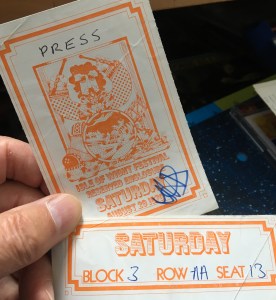
IoW tickets

* The full sets by Joni Mitchell and Miles Davis are on YouTube, filmed by Murray Lerner for his documentary on the festival. Miles’s set can also be found on the album Bitches Brew Live, released in 2011 by Columbia Legacy, and on Electric Miles: A Different Kind of Blue, an Eagle Rock DVD from 2004.

Jimmy Cobb 1929-2020

Jimmy Cobb

Jimmy Cobb swung. That’s what he did, with a poise and a grace inherited from Kenny Clarke. He died from lung cancer in New York City on Sunday, aged 91, the last survivor of the seven musicians who played on Kind of Blue. The cymbal splash — however inadvertently and uncharacteristically heavy — that launched Miles Davis into his solo on “So What” seemed to open not only the album but a whole new world of feeling.

Drummers are praised for having “good time”, meaning they keep the beat steady. Of course Cobb had good time. Like his unshowy finesse, it was a quality that served him well throughout a long career. Great singers (including Dinah Washington and Sarah Vaughan) and soloists loved him for it. But Cobb was also a drummer who knew that time wasn’t a static thing, tied to a metronome.

I first noticed that when listening to the old bootlegs of the Davis quintet’s tour of Europe in the spring of 1960, and particularly on various renderings of “So What”, which habitually stretched from the 9min 25sec of the previous year’s studio version to around a quarter of an hour. You couldn’t miss how the tune had been speeded up. In the studio, on March 2, 1959, it had been taken at a relaxed 35 bars per minute. By the time they played it for a TV show that April, with Wynton Kelly at the piano in place of Bill Evans, it had accelerated slightly to 38.

A year later, on concert stages across Europe, they were kicking off the tune around 20 bars per minute faster than the original. More important than that, however, it was ending up even faster. At the first show in Paris on March 21, over the course of 13 minutes, it went from a brisk 56 to 65 bars per minute. At both concerts in Stockholm the following night it went from 60 to 68.

Does this mean that Cobb wasn’t doing his job? Of course it doesn’t. He and the other four — Davis, John Coltrane, Wynton Kelly and Paul Chambers — were doing what they needed to do. Doing what the music required. Doing what it took, in that moment, to swing. RIP, Mr Cobb.

* The photograph of Jimmy Cobb was taken by Ted Williams, whose work was collected in Jazz: The Iconic Images of Ted Williams, published by ACC Editions in 2016. The European concerts are on Miles Davis & John Coltrane: The Final Tour, released in 2018.  Kind of Blue is in your collection.

‘Porgy and Bess’ revisited

Porgy 2

As he surveyed the ranks of musicians preparing to play Gil Evans’s score for Porgy and Bess at St John’s, Smith Square last night, Nick Smart knew that he had everything he needed: a 21-piece orchestra including the correct complement of French horns (three), bass clarinets (three), flutes of various sizes (four, when necessary), and a quartet of wonderful trumpeters — Henry Lowther, Martin Shaw, Steve Fishwick and Freddie Gavita — prepared to hand around the role of soloist. Since that soloist was, of course, Miles Davis, the task facing the four men was not without its challenge.

Smart also had the benefit of dealing with Evans’s actual score. As John Billett, the concert’s promoter, pointed out in his introduction, even the best intentioned reproductions of Evans’s pieces for Davis have been forced to make do with transcribed versions which inevitably miss some of the infinite subtlety of the original orchestrations. Thanks to the Evans family’s generosity, last night’s orchestra — consisting of alumni of the Royal Academy of Music, where Smart is in charge of the jazz programme — were able to work from the notes as Gil wrote them.

Of the three much loved albums Davis and Evans recorded together between 1957 and 1960, Porgy and Bess may be the most ambitious and fully realised, the pinnacle of the highly original approach to large-ensemble music that the arranger had been developing since his days with the Claude Thornhill band in the 1940s. Sixty years later, the richness and variety of gesture Evans applied to George Gershwin’s show tunes remain a source of wonder. And it can only be said that, under Smart’s direction, last night’s ensemble did the score complete justice in both execution and spirit.

To watch and listen as the ensemble brought Evans’s unorthodox instrumental deployments and love of dynamic contrast to life was a delight, from the whispered accompaniment of the French horns behind the trumpet solo on “It Ain’t Necessarily So” to the sudden brassy flares of “Prayer”. To hear each trumpet soloist pay the proper homage to Davis without forfeiting his own character was enormously impressive (and I’m not going to compare them: they were all outstanding). To admire the way Jeremy Brown coped with the bass lines written for Paul Chambers and the restrained panache with which Ed Richardson attacked the drum parts played in the studio by Philly Joe Jones and Jimmy Cobb was hugely impressive. Nor can one forget the trumpeter who didn’t solo: George Hogg, who played Ernie Royal’s lead parts with perfectly judged power and precision.

The nave of St John’s was packed for the occasion. The sessions for the original album took place in Columbia Records’ studio on East 30th Street in New York City, in a deconsecrated Armenian Orthodox church whose dimensions created a famously perfect natural reverberation. Apart from a hum that briefly emerged late in the set, the amplified sound in the former Anglican church in Westminster, built in 1728, severely damaged in the war and then restored as a concert hall, was equally sumptuous, revealing all the fine detail of the scoring.

This was the last night of the EFG London Jazz Festival, and earlier in the evening the pianist Chris Ingham had led a sextet through downscaled versions of pieces from Miles Ahead, the first of the three Davis/Evans albums. They included “Blues for Pablo”, “New Rhumba”, “Maids of Cadiz”, and a rearrangement of “The Duke” on which the combo managed to sound like a big band, and there was also a lively account of “Boplicity”, an earlier Evans arrangement for Davis’s 1948 Birth of the Cool nonet. Paul Higgs played the Miles parts on trumpet and flugelhorn with great finesse, flanked by two outstanding saxophonists, Jamie O’Donnell on alto and Colin Watling on tenor.

A long relationship with the music that Gil Evans and Miles Davis made together a lifetime ago tends to create an unusually strong emotional bond. Probably the greatest tribute that can be paid to the evening at St John’s is that the listener emerged with that bond not only confirmed but strengthened. Congratulations, then, to everyone involved in a sublime experience.

For art’s sake

Rene Urtreger 2The French pianist René Urtreger, who celebrates his 80th birthday next month, was a member of the Miles Davis Quintet that recorded the celebrated soundtrack to Louis Malle’s Lift to the Scaffold in 1957. He had become a frequent collaborator with Lester Young, Chet Baker, Sonny Rollins, Stan Getz and many others during an era when his native Paris provided American jazz musicians with a warm welcome. Until now, however, his only appearance in Britain had been in the 1970s, when he visited London in his rather different capacity as Sacha Distel’s musical director.

Last night he and the other members of his trio — the bassist Yves Torchinsky and the drummer Eric Dervieu — performed in a small downstairs ballroom at the Connaught Hotel in Mayfair. They were playing to celebrate the opening of a new show, at the Timothy Taylor Gallery in Carlos Place, next door to the hotel, by the abstract expressionist painter Sean Scully, who was born in Dublin and brought up in South London, and now lives in New York and Bavaria. The centrepiece of the exhibition is a work titled Kind of Red, inspired by Miles Davis’s Kind of Blue: a series of five large paintings, in oil on aluminium, conceived as a single unit (you can see them on the gallery’s website, here).

Given the nature of the work’s origin, and Scully’s love of music (as a teenager he ran a blues club over a pub in Bromley High Street, and later named one of his paintings after John Coltrane’s “Dakar”), Timothy Taylor wanted something special to provide an unusual end to the conventional sequence of a private view followed by a small dinner. It seemed right to call on someone with a connection to the inspiration behind the paintings. The way Miles went about recording the music for Lift to the Scaffold — in particular the paring away of harmonic material — exerted a profound influence, two years later, on the concept of Kind of Blue. And Urtreger is now the only surviving member of the group that recorded the soundtrack to Malle’s noir classic.

His story is a fascinating one, revealed in an extensive interview with Pascal Anquetil in last January’s issue of the French monthly Jazz Magazine/Jazzman. To me the most striking single detail was his account of how, having waited day after day as an 11-year-old at the Gare de l’Est for the return of his Polish-Jewish mother, deported by the Nazis, only to discover that she had perished in the gas chambers at Auschwitz, he responded a handful of years later to the discovery of bebop: a music without overt sentiment.

But not, of course, without feeling, as we discovered last night in his fluent, thoughtful versions of “Old Devil Moon”, “So What”, “The Duke” and a handful of bop themes. “I suffered during my youth from a shyness that led me to imagine that I wasn’t at the same level as my (musical) partners,” he told Anquetil. “Today, that’s over. I’ve reached an age at which I have nothing to prove, and everything to give.” Last night’s audience, in which gallerists and collectors were joined by Bryan Ferry (like Scully, a former art student in Newcastle) and several of the painter’s friends, including the former champion boxer Barry McGuigan and the poet Kelly Grovier, accepted the gift with warmth and gratitude.

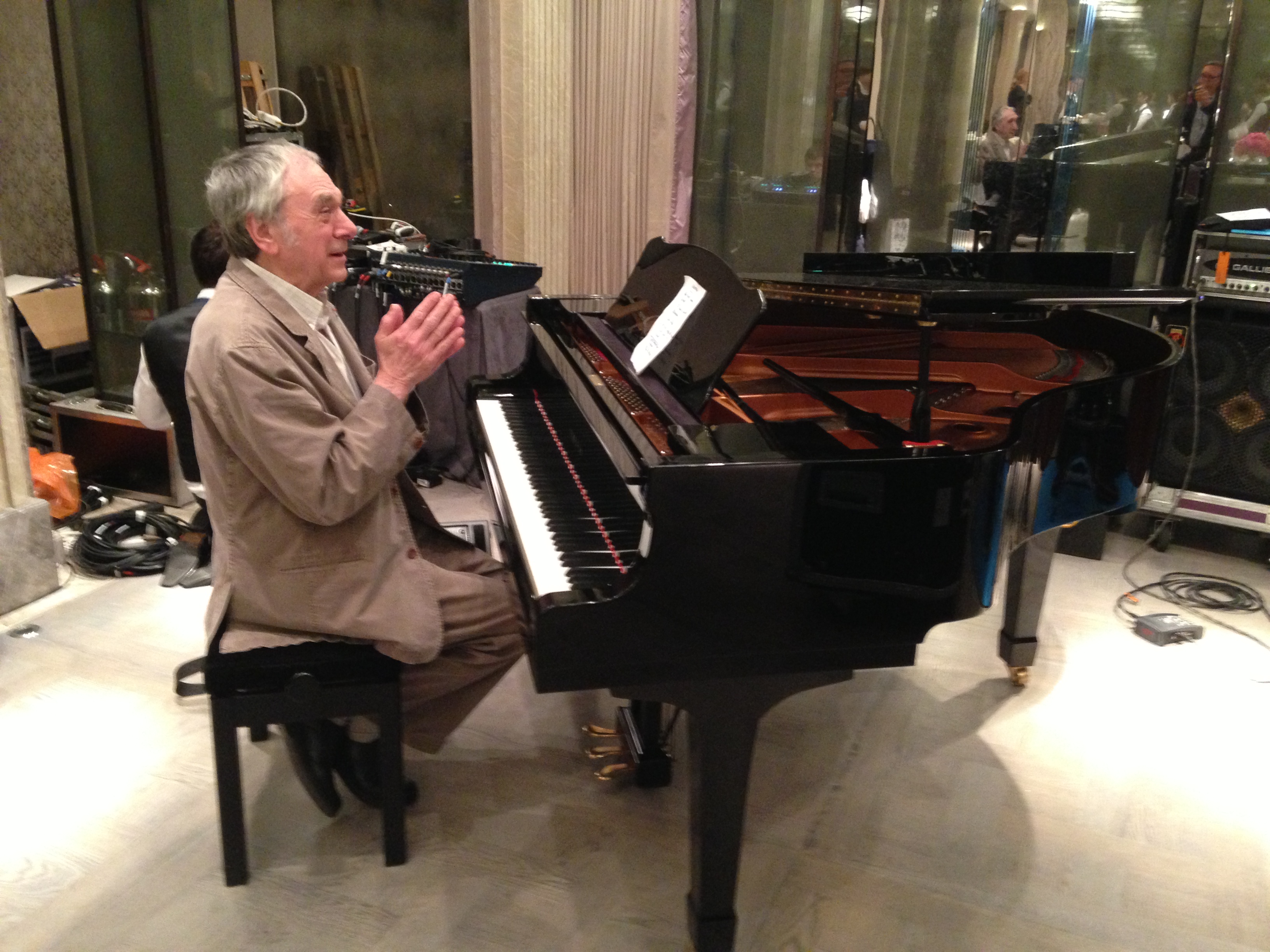
* The photograph of René Urtreger was taking during the sound-check at the Connaught. His most recent solo piano album, Tentatives (Minium, 2006), is highly recommended, and there will be a new album by the trio this summer. The Kind of Red exhibition opens today, June 11, and is on show until July 12 at 15 Carlos Place, London W1. Thcatalogue is published by the Timothy Taylor Gallery. 

Apropos of Barney Wilen

Barney WilenLouis Malle’s Lift to the Scaffold begins a season at the BFI in London this week, providing an opportunity to enjoy the conjunction of the director’s (and his cinematographer, Henri Decae’s) images and Miles Davis’s historically significant soundtrack. A classic of French film noir, made in 1957, it looks and sounds wonderful — particularly when experienced on a big screen in a proper cinema.

Miles recorded the music in a Paris studio, using four musicians with whom he had just embarked on a short tour: Rene Urtreger on piano, Pierre Michelot on bass, Kenny Clarke on drums, and — a surprising choice, and a particularly inspired one — the 20-year-old tenor saxophonist Barney Wilen, a prodigy who would become one of the most significant European jazz musicians of his generation. Together they took the conceptual leap that would lead Davis, within a couple of years, to Kind of Blue.

Wilen’s story is a fascinating one. Born in Nice in 1937 to a French mother and an American father, he left France with his family in 1940 and spent the next six years in America, where an uncle gave him a saxophone. On returning to Nice at the end of the war, he developed his interest in music; at 13 he was already playing with local jazz bands and at 16, having moved to Paris, he was performing at Le Tabou in Saint-Germain-des-Pres with his fellow saxophonist Bobby Jaspar and the pianist Henri Renaud. In 1957, a few weeks before answering Davis’s call, he made his first recordings under his own name, for the Vogue label: reissued on CD a few years ago under the title Tilt, they show a young man clearly fascinated by the compositions of Thelonious Monk and completely at ease with such pieces as “Round Midnight”, “Think of One”, “Hackensack”, “We See”, “Blue Monk”, “Let’s Call This” and “Misterioso”.

His style was never one that cried out for attention, but it evolved into an approach that could hold its own among the hard-bop giants of the day, such as Roy Haynes, Milt Jackson and Donald Byrd, with whom he also recorded during the 1950s. (In 1959 he wrote a film soundtrack of his own, for Edouard Molinaro’s Un Temoin dans la ville, which he recorded with a band including the trumpeter Kenny Dorham.) Although his playing never lacked strength, there was no sense of trying to grab the listener by the lapels. He could swing forcefully while still seeming to take his time, and it’s hard to think of anyone who would have fitted so beautifully into the soundtrack recording with Miles, where subtlety and light-footedness were crucial. He had a lovely tone and a frictionless sense of swing; if there were a missing link between Lucky Thompson and Wayne Shorter, perhaps it would be him. He knew how to be cool without being cold.

He also possessed an inquiring and unorthodox mind, and was keen to venture beyond the confines of an idiom he had so quickly mastered. Seduced by the possibilities of free jazz, and encouraged by the adventurous German record producer Joachim-Ernst Berendt, in 1968 he recorded an album called Auto Jazz: The Tragic Destiny of Lorenzo Bandini, in which he and his quartet improvised against a recording of the commentary from the previous year’s Monaco Grand Prix, during which Bandini had been burnt to death at the wheel of his Ferrari. It was released on the MPS label, and is now hard to find.

“I have a French passport and I live in  Paris,” he once observed. “I consider myself a musician of the world, temporarily French.” In 1969, having grown his hair, adopted a more relaxed wardrobe and befriended such leading lights of the Parisian counter-culture as the film director Philippe Garrel and the actor Pierre Clementi, he and his girlfriend, the English-born model Caroline de Bendern, went to Africa, where they spent several months travelling in a Land Rover through Morocco, Algeria, Niger, Mali, Upper Volta and Senegal, recording with with local musicians as they went. The first results were issued under the title Moshi in 1972, on the Saravah label; about a year ago de Bendern  issued a second instalment of this fascinating Afro-funk trance music — with bits of conversation and street song interpolated and overlapping — under the title Moshi Too, on the Sonorama label.

Then, in effect, he disappeared. The next couple of decades were apparently spent back on the Cote d’Azur, where he played occasionally with a local group, effectively off the scene and out of the mainstream. Until, in 1988, an illustrator named Jacques de Loustal and my old friend Philippe Paringaux, a former editor of Rock & Folk magazine, collaborated on what we would nowadays call a graphic novel titled Barney et la note bleu, a romanticised version of Wilen’s life as an itinerant saxophonist on the jazz scene. Stylish and evocative, it was a huge hit (it’s still in print) and prompted Wilen to record a new album, titled La Note Bleu and using Loustal’s artwork. Accompanied by an excellent rhythm section, he proved that his old skills — particularly as a ballad player, on Gordon Jenkins’ “Good-Bye” and a short unaccompanied version of “Besame Mucho” — had not atrophied. His tone was, if anything, even more perfectly formed.

People suddenly remembered how good he was, and he was invited to make more recordings. I have a lovely quartet recording with the guitarist Jimmy Gourley from 1987 (Double Action, on the Elabeth label) and a fine duo album with the pianist Alain Jean Marie, his longtime associate, from 1992 (Dreamtime, on Nocturne). Both, coincidentally, contain versions of “Good-Bye”; along with “Besame Mucho”, it’s among my very favourite songs, and although his fondness for revisiting both these tunes at every opportunity is not why I’m such a fan of his, it probably helps.

According to Blue Melody, a short biography written by Yves Buin and published in France by Castor in 2011, Wilen already knew that he was suffering from stomach cancer by the time he travelled to the US in 1994. There he recorded an album called New York Romance at Rudy Van Gelder’s studio, with an A-team rhythm section: the pianist Kenny Barron, the bassist Ira Coleman and the drummer Lewis Nash. The following year he made Passione with his own musicians plus the Italian trumpeter Enrico Rava. It would be his last recording; the man who was as great a ballad player as any produced by the European jazz scene died on May 25, 1996, aged 59. Go and see Lift to the Scaffold and marvel not just at an ageless film but at how good Barney Wilen had already become when his 20th birthday was still a recent memory.

And if you want to know more, spend 55 minutes watching The Rest of Your Life, Stephane Sinde’s terrific biographical film, made in 2005:

* The photograph of Barney Wilen (and the bassist Beb Guerin) is from the back cover of Auto Jazz: The Tragic Destiny of Lorenzo Bandini and was taken by Jean Maurice Pioton on February 13, 1968 while the musicians improvised the soundtrack as they watched the footage on a screen in the Tonstudio Bauer, Ludwigsburg.

Miles: back to mono

Miles in MonoLike a fool, I gave myself a Christmas present. After all, I could hardly justify asking anyone else to buy Miles Davis: The Original Mono Recordings for me. It’s just too much of a record-company scam. But I’m enough of an idiot to fall for it. Which is exactly what they’re counting on.

The trouble is that Miles Davis isn’t around any more. I spent around 30 years buying his records when he was alive, and more than 20 years later it’s still hard to get out of the habit. So every time they repackage something artfully enough, I open my wallet. It’s the nearest thing to having him back again.

And I can’t say I regret holding in my hand the black and white box containing The Original Mono Recordings, even though the nine albums in the package contain not a single note of music that I don’t already own (and in the case of several of the albums, several times over in marginally different forms). The albums included are Round About Midnight, Miles Ahead, Milestones, Jazz Track (including the Lift to the Scaffold soundtrack), Porgy and Bess, Kind of Blue, Sketches of Spain, Someday My Prince Will Come and Miles and Monk at Newport, recorded between 1957 and 1961, and all presented in card sleeves with miniaturised versions of their original US artwork. At the very least, it’s an excuse to listen again to the products of this phenomenally fertile and career-defining period.

The remastering engineer, Mark Wilder, talks in the accompanying booklet of how he “added a little more bass and mid-range” to Miles Ahead, “as well as a little high-treble equalisation to create air around the instruments,” and used a tube compressor to “tone down the treble a little” on Someday My Prince Will Come. Of course they sounded fine to most of us in their original monaural vinyl incarnations, thanks to the particular properties of Columbia’s 30th Street studio and the sensitive ears of the engineers, such as Fred Plaut and Harold Chapman, who worked there but go uncredited in this repackage.

You can listen to these “restored” versions with enormous pleasure, but direct comparisons reveal evidence not always supporting the implication behind the claim of George Avakian, Miles’s first producer at Columbia, that “mono has always been truer to the studio sound and the original intent”. When I flip back and forth between the mono and stereo versions of “Summertime”, a particular favourite from Porgy and Bess, it’s impossible not to notice how the stereophonic picture clarifies the individual voices in Evans’s horn arrangement behind Miles, while in mono they coalesce into a more recessed and undifferentiated blur of subdued colour. Maybe the latter effect is what the arranger had in mind, but somehow I doubt it. On the other hand, I much prefer the sound of Davis’s flugelhorn in the new mono versions of “Springsville” and “Blues for Pablo” from Miles Ahead: it’s more rounded, not so brightly burnished by the studio EQ, and somehow truer to itself.

These matters are less of a consideration when it comes to the combo albums, where mix and balance are more straightforward, although I’ve never been sure whether I prefer to hear “Milestones” — probably my favourite piece of music ever, when all is said and done — with all the instruments separated and laid out in a panorama, every detail highlighted, or with the tighter aural focus of the version in which I learnt to love it, and which still seems perfectly suited to its sense of forward movement.

Just in terms of the music, the album that interests me most at the moment is Someday My Prince Will Come, always seen as a transitional affair in terms of Davis’s career. Perhaps feeling that his basic 1961 working quintet with Hank Mobley on tenor was not stimulating enough, Miles invited John Coltrane back to play on two of the album’s six pieces, both in 3/4, a metre in which Coltrane was deeply involved with his own quartet: the title track (where he solos after Miles, Mobley and Wynton Kelly, providing the piece with its climax), and the modal, Spanish-tinged “Teo”, on which his long solo is an absolute beauty. Davis’s own playing is luminous and inventive thoroughout, particularly on “Teo” and the ballads: “Old Folks”, “Drad-Dog” and “I Thought About You”.

It’s wonderful to listen closely to this music again. And I certainly don’t want to do Mr Wilder — or the reissue producer, Steve Berkowitz — a disservice. Maybe their diligence has made it a little easier, for instance, to appreciate the genius of Paul Chambers on these marvellous recordings, to which the great bassist, with his lovely tone, impeccable note selection and peerless swing, contributed so much. And if that’s so, perhaps we can say the whole project was worthwhile.

* The photograph of Miles Davis (playing flugelhorn) was taken by Don Hunstein during the Miles Ahead sessions and appears in the booklet accompanying The Original Mono Recordings (Columbia/Legacy).

One night in Berlin

Miles in BerlinAt the start of the film of the Berlin concert which forms a bonus DVD to three audio CDs of the recently released Miles Davis Quintet Live in Europe 1969 set, you can’t help being struck by the impassive demeanour of the musicians as they are announced, one by one, to the audience. Jack DeJohnette doesn’t even look up as he fiddles with the placement of a microphone boom over one of his cymbals. Dave Holland, the young Englishman, is expressionless as he adjusts his double bass. Chick Corea reaches out his left hand to twist a knob above the keyboard of his Fender-Rhodes piano. Wayne Shorter licks his mouthpiece and stares into the middle distance. Meanwhile Miles has already prowled on to the stage, clearly not caring that the spontaneous wave of applause for his arrival has disrupted the MC’s scene-setting introductions. From none of the musicians comes even the tiniest acknowledgement of the audience’s welcome. This is how far the influence of Miles’s own super-cool on-stage deportment had spread, to men a generation younger than him (and, in the case of Corea and Holland, with naturally outgoing temperaments); he, in turn, is taking his wardrobe cues from them.

None of that stops it being a great concert, of course — or half a concert, in fact, since Miles’s group were sharing the bill at that night’s concert with Stan Kenton. You might think it an unlikely combination, even by the eclectic standards of the Berliner Jazztage, and that was how the 2,400-strong audience saw it, too. I remember half of them vociferously expressing their dissatisfaction with Kenton’s set, while those who acclaimed Kenton were clearly disconcerted by what Miles was up to (although their presence can be detected in the film only in the shot of some listeners frowning and shaking their heads as the camera scans the audience while the band leaves the stage). This intolerance was typical of Berlin audiences of the time and seemed particularly impolite since the whole festival, including that evening’s performances, had been dedicated in advance to Duke Ellington, who was due to appear at the same venue the following night in a concert scheduled in celebration of his 70th birthday.

It was my first exposure to Miles in person, and I certainly wasn’t disappointed. Urged on by sidemen who were leading him to the frontier of free jazz, he was spellbinding. Less than a year later, as he veered away from freedom towards an engagement with funk, he would be wanting his musicians to anchor the beat in a much more explicit way. But this was enthralling, a  freewheeling post-In a Silent Way, pre-Bitches Brew journey into abstraction, with a gorgeously oblique version of “I Fall in Love Too Easily” to seduce even those scandalised by the black shirt, trousers and leather waistcoat and the orange and gold scarf in which he took the stage, an outfit to match his black and orange trumpet.

Poor Kenton suffered far worse from the hecklers. He was booed even before he started, and later confessed that the experience had given him a sleepless night. Conducting the specially assembled Berlin Dream Band, a 19-strong multinational emsemble which included the trumpeter Carmell Jones, the trombonists Ake Persson and Jiggs Whigham and the alto saxophonist Leo Wright, he ran through a series of his best known pieces: “Artistry in Rhythm”, “Intermission Riff”, “The Peanut Vendor” and so on. Towards the end, however, he gestured the band to stand down as he performed his personal homage to Ellington, a five-minute variation on “Take the ‘A’ Train” delivered with such sincerity of emotion that the dissenters were temporarily silenced.

From the point of view of the audience’s divided reaction, it was one of the most bizarre concerts I’ve ever attended. The festival’s director, the late Jo Berendt, a man of broad vision and catholic taste, was intensely embarrassed. The following night, however, Ellington took the stage at the head of a band including Cootie Williams, Lawrence Brown, Johnny Hodges, Paul Gonsalves and Harry Carney, and harmony was restored.