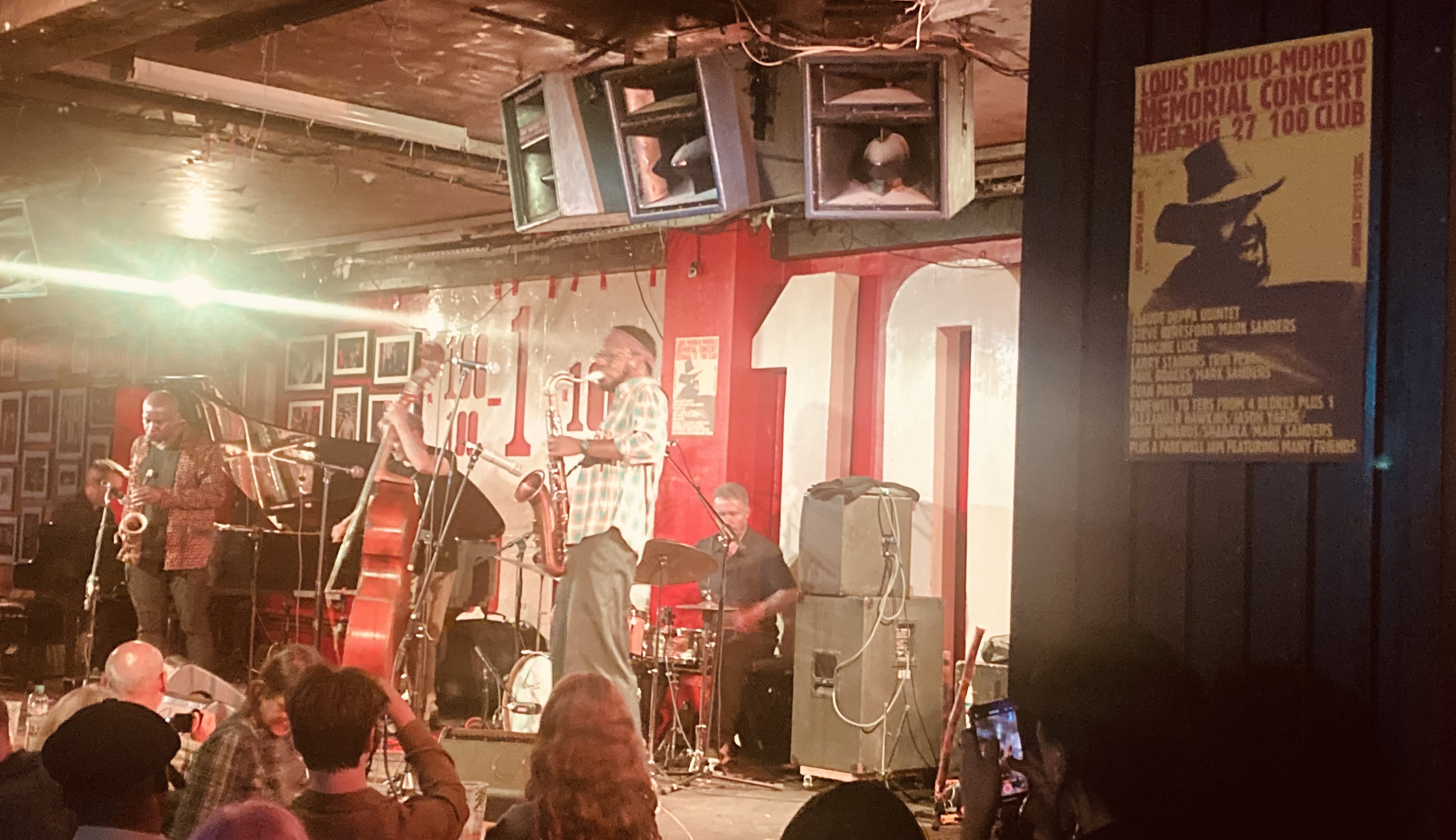
There used to be a civilised convention that normal reviewing practice should be suspended for certain kinds of musical events: those put on for charity, or memorials. Of the celebration of the life of Louis Tebogo Moholo-Moholo at a packed 100 Club last night, it need really only be said that the whole evening was suffused with the indomitable spirit of the great South African drummer, who died in June, aged 85.
The trumpeter Claude Deppa, his friend and frequent bandmate in Viva La Black, started the proceedings at the head of his warm-hearted quartet. Then the pianist Steve Beresford and the drummer Mark Sanders took over for an intricate and absorbing free conversation. Evan Parker brought out his soprano saxophone, removed its mouthpiece, and tapped the keys to produce a quite extraordinary 10-minute percussion solo which managed to be both a shadow commentary on what he might have played with the mouthpiece in place and a unique tribute to his former colleague in the band Foxes Fox. The trio of Larry Stabbins on alto saxophone, Paul Rogers on bass and Sanders again on drums played a set notable for Rogers manoeuvring his bespoke seven-string instrument into the expressive space between a Celtic harp and a cello.
The heart of the celebration of Bra Tebs (as his friends knew him), which was organised by Hazel Miller and Mike Gavin of Ogun Records, came in the set by Four Blokes + 1, his last London-based band. Pictured above, this featured Jason Yarde and Shabaka on saxophones, Alex Hawkins on piano and John Edwards on bass, with the superb Sanders once more on the drum stool, embodying rather than imitating the characteristics of Louis’s playing. They came out roaring, and that’s how they were still sounding as I had to make my departure, with the darkly ecstatic closing cadences of “Dikeledi Tsa Phelo” accompanying me up the stairs and into the night.
Maybe you saw Daniel Blumberg’s acceptance speech for the best soundtrack award during the Academy Awards ceremony at the weekend. Honoured for his work on The Brutalist, he finishes off with a mention of Cafe Oto, which is less of a surprise when you’ve noticed, among the musical credits, the names of such Oto-adjacent improvisers as the saxophonists Seymour Wright and Evan Parker, the pianist John Tilbury and the trumpeter Axel Dörner.
After seeing Brady Corbet’s ambitious film at the IMAX in London today, I came away with mixed feelings. Sometimes it feels like three different and much shorter films, maybe four, trapped together in a very large sack and left to fight it out for three and a half hours.
But the real reason I went was to find out what use Blumberg had made of Evan Parker’s unique qualities. The saxophonist is featured in a sequence filmed amid the marble quarries at Carrara, in the hills above the Tuscan coast, the source of the material from which Michelangelo’s David was wrought, along with Rome’s Pantheon and London’s Marble Arch.
As a camera hovers over the spectacularly gorgeous hewn terraces of white stone, the air is filled with the sound of Parker’s soprano saxophone. Unbroken skeins of squiggling multiphonic sound are shaped with a sound-sculptor’s skill and imagination, soaring like birds above a sombre low-brass chorale.
Given the film’s narrative requirements, it’s a moment of audio-visual magic that can’t last long. But I could happily have taken three and a half hours of that alone, without all the plot-driven drama that surrounds it. Right there, perhaps, was yet another film struggling to escape: a potential classic of slow cinema.
It felt like a great privilege to be at Cafe Oto last night to hear the Schlippenbach Trio — Alexander von Schlippenbach (piano), Evan Parker (tenor saxophone) and Paul Lytton (drums) — make a rare appearance in London in front of a capacity crowd. This is a group that has existed since 1972, with one personnel change: Lytton’s arrival some years ago to replace his great friend Paul Lovens, who stopped touring.
At 77, Lytton is the youngster of the group. Parker is 80, Schlippenbach 86. Although their group is one of the enduring monuments of European free jazz, they continue play as though the music is being invented every night — which it is, albeit with its foundations in their vast experience, both individual and collective. Last night’s 50-minute set was a further exploration of the spaces between them: a true conversation of equal voices, merging and separating and merging again with a perfect sense of spontaneous form and balance.
On the 243 bus ride to yesterday’s matinee show at Cafe Oto, I finished Samantha Harvey’s short novel Orbital, the winner of this year’s Booker Prize. Starting as a description of the lives of six astronauts aboard a space station, it finishes as a meditation on the world — the planet, the universe — and our place in it.
With that in my head, listening to Evan Parker, Matthew Wright and their four colleagues in this edition of Transatlantic Trance Map create their intricate musical conversations was like zooming in on the smallest level of earthly detail: an example of our human potential, in the face of cosmic irrelevance.
For two shortish sets of unbroken free improvisation, Parker (soprano saxophone) and Wright (turntables and live sampling devices) were joined by Hannah Marshall (cello), Pat Thomas (electronics), Robert Jarvis (trombone) and Alex Ward (clarinet). The music was calm, collective, and often very beautiful in its constant warp and weft. Maybe it was the occasional (very subtle and always appropriate) pings and hums from the electronics that reinforced the connection in my mind with Orbital: the whoosh of a closing airlock, the light clang of a piece of space junk against a titanium hull. But that was obviously just me.
Many years ago I went to interview Evan at his home in Twickenham. One thing I noticed was that his shelves of LPs had a particularly long stretch of orange and black spines: John Coltrane on the Impulse label, of course. Evan has never sounded like Coltrane, but his study of the great man was foundational to his own development and his interest remains deep. Yesterday, for example, he was keen to tell me about the extraordinary sound quality of the reissue of the 1962 Graz concert by Coltrane’s classic quartet on Werner Uehlinger’s ezz-thetics label. “You can hear the ping of Elvin’s ride cymbal,” he said.
So it was by an interesting coincidence that I went on from Dalston to another event on the last day of the EFG London Jazz Festival, a concert at the Queen Elizabeth Hall called Coltrane: Legacy for Orchestra. For this performance of arrangements by various hands of some of Coltrane’s compositions (“Impressions”, “Central Park West”, “Giant Steps”, “Naima” etc), and a few other pieces that he recorded (including “So What”, “Crepuscule with Nellie” and “Blue in Green” and a handful of standards, including “My Favourite Things”), the full BBC Concert Orchestra, conducted by Edwin Outwater, was joined by two horn soloists, the young American trumpeter Giveton Gelin and the experienced British saxophonist Denys Baptiste, and the trio of the pianist Nikki Yeoh, with Shane Forbes on drums and Ewan Hastie on bass.
Inevitably, I suppose, there were times when it felt as though Coltrane was being reduced to something close to light music; there was certainly no attempt to get to grips with the turbulence of the music he made in the last three years of his life in albums such as Interstellar Space. But there were moments of distinction, too. Baptiste tore into “Impressions”, while Gelin — a New York-based Bahamian in his mid-twenties — earned ovations for his poised reading of “My One and Only Love” and for a lovely coda to “In a Sentimental Mood”, mining the elegant post-bop tradition of Clifford Brown, Lee Morgan and Freddie Hubbard.
In terms of the response from a full house, it was a great success. But there was one moment when the music went deeper, closer to what Coltrane was really about, and it came in the arrangement of “Alabama” by Carlos Simon, a composer in residence at the John F. Kennedy Centre for the Performing Arts in Washington DC, and the principal begetter of this project.
“Alabama” is Coltrane’s most sacred song, a slow, heavy hymn to the memory of the four African American schoolgirls murdered by racists in the bombing of a church in Birmingham, Alabama on September 15, 1963. Simon chose to orchestrate it in the way Eric Dolphy and McCoy Tyner might have done, had it been written in time for inclusion in 1961 in Coltrane’s first Impulse album, Africa/Brass, on which Dolphy and Tyner made dramatic use of low brass.
Here, Simon added trombones and French horns, using tympani and a gran cassa to augment Shane Forbes’s mallets on his tom-toms, thus amplifying the effect of Elvin Jones’s original rolling thunder behind Baptiste’s emotionally weighted statements of the rubato theme. Like the tenorist’s extended but carefully shaped solo on the in-tempo passage, it honoured not only Coltrane’s memory but his intentions, and will be worthy of special attention when Radio 3 broadcasts the concert later this week.
* Transatlantic Trance Map’s album Marconi’s Drift is out now on the False Walls label (www.falsewalls.com), which is also about to release a four-CD box set of Evan Parker’s solo improvisations, titled The Heraclitean Two-Step, Etc. The live recording of Coltrane: Legacy for Orchestra will be broadcast on BBC Radio 3 between 19:30 and 21:45 on Thursday 28 November, thereafter available on BBC Sounds.
Martin Davidson, who died just before Christmas at the age of 81, was a valued friend of improvised music in Britain and elsewhere. Most significantly, he ran the Emanem label, which made its debut in 1974 with Steve Lacy’s first album of unaccompanied soprano saxophone pieces. Emanem went on to amass a catalogue of new and archive vinyl releases featuring the first generation of London-based improvisers — John Stevens, Trevor Watts, Evan Parker, Derek Bailey, Paul Rutherford and so on — and then, following its re-emergence as a CD label in the mid-’90s, of their successors and many others.
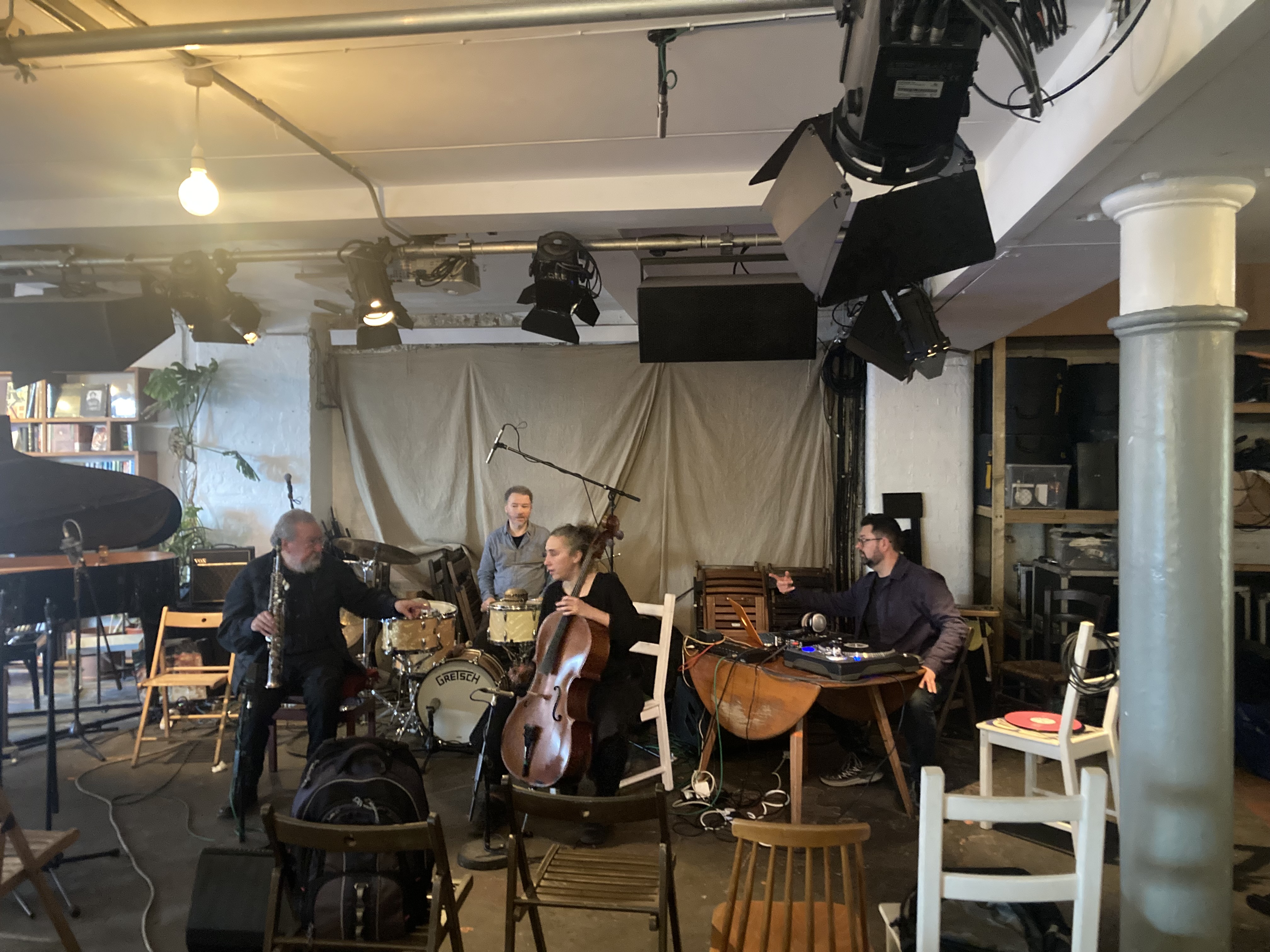
Today at Café Oto and the Vortex many of those artists performed in celebration and commemoration of Martin’s life. It was my privilege to introduce the Café Oto gig, which began with a set from the quartet pictured above during their soundcheck — Parker, Mark Sanders, Hannah Marshall and Matt Wright — and continued with the duo of the altoist Caroline Kraabel and the pianist Veryan Weston before concluding with the 27-strong London Improvisers Orchestra.
I met him 11 August 1969. I remember it because it was my first day in London, my first day at the Melody Maker, and I was sent to review Mike Westbrook’s band at the 100 Club that night. Martin was the man with a box of very desirable albums for sale, set up on a table in the space between the end of the bar and the stage. I soon learned that he was a man of views that were carefully considered and firmly held, some of them expressed in reviews for the MM over the next couple of years.
I was able to share with the audience a handful of the characteristic aphorisms from his New Musical Dictionary, which he posted online. Easy Listening: Music that is extremely difficult to listen to for anyone who really listens to music.Post-modernism: New things for people who don’t like new things.An Improviser: A musician who combines the roles of both composer and interpreter, yet usually receives less respect and remuneration than either.
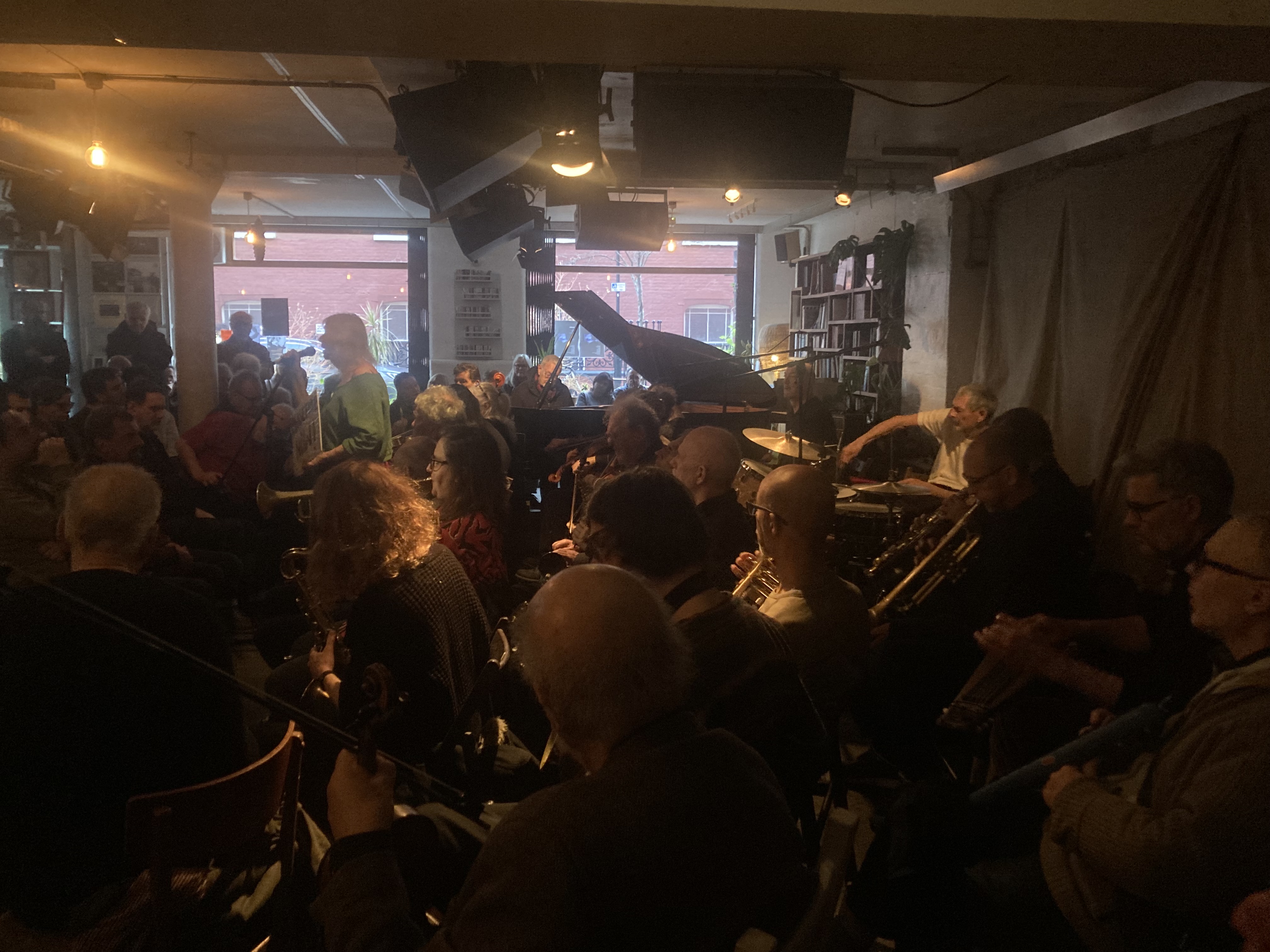
At the request of Mandy Davidson, Martin’s widow (and the other Em in Emanem), all the proceeds from the gigs, for which the musicians waived their fees, will go to B’Teselem, a Jerusalem-based non-profit organisation documenting human rights violations in Israeli-occupied Palestine. At the end of the LIO set, which consisted of ensemble improvisations conducted by Terry Day, Ashley Wales and others, Maggie Nichols — who met Martin when she was a member of the SME — read a verse by a Palestinian poet killed in the Gaza fighting. That’s what you can see in the picture below, as she holds up a placard saying CEASEFIRE NOW!!
Xhosa Cole and Caroline Kraabel arrive at Café Oto
In the middle of the afternoon, an outsized multicoloured scarf walked through the door into the Vortex, playing an alto saxophone. It turned out, after he had unwrapped himself, to be Xhosa Cole, who carried on playing as he made his way to the stage. There he fitted seamlessly into a free improvisation being devised by the trumpeter Chris Batchelor, the tenorist Julian Siegel, the cellist Shirley Smart and the pianist Liam Noble as part of a three-venue benefit for the saxophonist Jason Yarde.
Yarde, who is one of Britain’s very greatest jazz musicians, collapsed on stage in south-west France in mid-October after suffering a massive stroke. The presence of a couple of medics in the audience may have saved his life, and the process of treatment for a bleed on his brain continued at a hospital in Toulouse. He is recovering at home now, but an appeal for funds to meet his costs has met a predictably warm response, leading to the three jazz clubs in Dalston — the Vortex, Café Oto and Servant Jazz Quarters — getting together to organise a highly unusual benefit.
Starting at two o’clock in the afternoon, several dozen musicians of diverse age, gender and ethnicity spent two and a half hours migrating between the three adjacent venues, joining up for collective improvisation in spontaneously self-selected ensembles. I began my listening at the Vortex, where a group featuring the altoist Caroline Kraabel, the tenorists Dave Bitelli and Harrison Smith, the guitarist Dave Okumu, the bassist Dominic Lash and the drummer Sebastian Rochford surged through free passages into a charging section of unruly swing that reminded me of Charles Mingus’s “Hog Callin’ Blues”. Later Cole joined a group with Loz Speyer (trumpet), Neil Charles (bass) and Rochford again on drums, whose interplay was agile and intuitive.
Arriving at Café Oto, I discovered I’d just missed a line-up featuring Evan Parker and Eddie Prévost. Instead I heard a set by a group including the singer Cleveland Watkiss, the baritone saxophonist Cath Roberts, the trumpeter Charlotte Keeffe and the violinist Benedict Taylor, in which the pianist Veryan Weston played a duet with the improvising tapdancer Petra Hasler. As I was leaving, a re-scarfwound Cole was marching towards the Oto’s entrance, accompanied by Kraabel, together creating al fresco counterpoint for two altos.
Next, over in the basement at Servant Jazz Quarters, I had said hello to the pianist Steve Beresford and heard a couple of minutes of a set featuring the tabla player Ansuman Biswas and several string players. But then, with a loud BANG, the lights went out and the music stopped dead. A water leak from adjacent building works had found its way into the club’s electrics. No injuries but plenty of confusion. End of music.
Back at the Vortex, the altoist Dee Byrne, the pianist Laura Cole, the guitarist Daniel Thompson and the drummer Mark Sanders, with Taylor on violin and Lash on bass, had just got started when Charlotte Keeffe and Cath Roberts arrived to join them, already playing as they made their way up the stairs. Soon they were joined by another violinist, Sylvia Hallett, and together they conjured something that soared at first noisily and then gently before floating to earth in the sort of inspired ending that is one of the joys of free improvisation.
It was the kind of a day when the music really does turn itself into a common property, its barriers dismantled and prejudices abandoned, available to all. A day that fully reflected the qualities of the inspired and inspiring musician to whose recovery it was dedicated.
Alexander Hawkins and Evan Parker (photo: Dawid Laskowski)
Organising free improvisers might seem like a fool’s task. Why would the special breed of players who spend their lives resolutely creating music from scratch suddenly want to submit to the will of a composer? Nevertheless, history proves that sometimes it works: notable successes were recorded by Michael Mantler with the original Jazz Composer’s Orchestra, Alexander von Schlippenbach with his Globe Unity Orchestra and Barry Guy with the London Jazz Composers’ Orchestra. Each project depended to some extent on the leader/composer’s familiarity with the techniques of contemporary European straight music, but the idea was given new impetus with the introduction of the looser and perhaps more organic-to-the-idiom technique of “conduction”, pioneered by the late Butch Morris and pursued by George Lewis and Tyshawn Sorey, among others. Slightly to one side were the adventures of the British duo Ashley Wales and John Coxon, known as Spring Heel Jack, who created stimulating modern environments for many individual improvisers, including Wadada Leo Smith and John Tchicai.
The first sound heard on Togetherness Music: For Sixteen Musicians, Alexander Hawkins’ new album, is that of Evan Parker’s soprano saxophone, unwinding its always surprising coils of sound, the seemingly unbroken skeins of notes punctuated by split-second darts and lurches into other registers. As usual, it’s exhilarating and mesmerising, particularly when the sound of the isolated soprano blooms with reverberation, which may or may not be the natural property of Challow Park Studios in Oxfordshire, where the set was recorded. But then Hawkins introduces his other resources: the five string players of the Riot Ensemble and nine other musicians, including the trumpeter Percy Pursglove, the saxophonist and flautist Rachel Musson, the cellist Hannah Marshall, the bassist Neil Charles, the drummer Mark Sanders, and Matthew Wright on electronics, all conducted by Aaron Hollway-Nahum. Gradually they add sombre pedal-points, heightening the atmosphere before Parker drops out and the strings begin to slip and slide until the piece ends, after almost 10 minutes, with several of them holding a tentative D natural.
Sanders and Pursglove are the next to get the concerto grosso for improvisers treatment, a layer of restless percussion under the silvery trumpet continuing into a dialogue with written lines for flute/bass clarinet and viola/cello. On the third piece Parker returns for a pointilliste conversation with Hawkins’ scrambling piano in which the Riot Ensemble make their full presence known, soaring and churning as the music holds itself together through some mysterious centripetal force.
Hawkins, the 16th musician, is featured on the fourth piece, against a walking line played by two basses (Charles and Marianne Schofield) and possibly one of the two cellos, too. Showing the pianist at his most inventive and hyper-alert, it has the loping gait and harmonically ambiguous flavour of the music created by young Cecil Taylor and the bassist with his early groups, Buell Neidlinger, before Parker pipes up with a reminder of another early Taylor collaborator, Steve Lacy, in a passage of ensemble agitation that resolves into an elegant, ruminative diminuendo.
The strings dominate the fifth piece, a collective statement in which the individual instruments glide around each other as if in mismatched orbits, the fine details of tone and timbre revealed within an aural space that feels busy yet uncluttered. The sixth and final composition opens with a trio of Charles, Sanders and Wright, bass and drums working around light electronic taps, thuds and crackles. Pursglove and Hawkins emerge with staccato trumpet figures and a purposefully wandering single-note piano line, continuing as Sanders briefly dominates with thrashing brushwork before the other musicians reappear in a crescendo of exultant sound. A graceful withdrawal gives the last word to Parker and Hawkins, two improvisers who share a near-infallible instinct for an ending.
The six pieces are titled, in order, “Indistinguishable from Magic”, “Sea No Shore”, “Ensemble Equals Together”, “Leaving the Classroom of a Beloved Teacher”, “Ecstatic Baobabs” and “Optimism of the Will”. I’ve described them in such details because the more you listen, the more distinctive they become: each one a living organism with its own cellular structure, texture and micro-climate. I’ve said before that Hawkins has a rare understanding of how to combine composition and improvisation, and here, in this very special recording, we have a perfect example of his gift.
Perhaps I’ve found Togetherness Music particularly valuable because I’ve missed attending live performances of free improvisation very much over the past year. Recordings of small groups, however excellent, aren’t the same thing as hearing and seeing this music conjured in front of you. But by framing improvisation so creatively, Hawkins brings it to life in a different way.
* Alexander Hawkins’ Togetherness Music is out now on the Intakt label (www.intaktrec.ch)
No apologies for returning, one last time, to the continuing celebrations of ECM’s 50th anniversary. For a short festival at the Royal Academy of Music, the director of the jazz programme, Nick Smart, invited several of the label’s luminaries — the bassist Anders Jormin, the pianists Craig Taborn and Kit Downes, the singer Norma Winstone and the saxophonist Evan Parker — to spend a week working with students before presenting the results in two public concerts on Thursday and Friday night.
Jormin’s compositions — very much what many people would think of as archetypal ECM music, with a restrained lyricism that seemed to have its deepest roots in Nordic folk music — were played by a septet notable for the outstanding singing of Ella Hohnen-Ford and Alma Naidu. Downes and his colleagues in the trio called ENEMY, the bassist Petter Eldh and the drummer James Maddren, enhanced their tricky compositions with arrangements for string quartet, three woodwind and two percussionists, of which the most successful were “Last Leviathan”, a piece from Downes’s ECM debut, Obsidian, fetchingly rearranged for strings and piano, and Eldh’s eventful “Prospect of K”, cunningly scored by Ole Morten Vågan.
For the festival’s closing set, Smart led the Academy big band through a sequence of rare and unheard compositions by the late Kenny Wheeler, another ECM stalwart, featuring Winstone, Parker and Stan Sulzmann. The juxtaposition of the two tenors of Parker and Sulzmann created a contrast that exemplified the breadth of Wheeler’s conception — although their thunder was almost stolen by the alto saxophone of Lewis Sallows, a student whose long solo displayed a disinclination to plump for stylistic orthodoxy and a powerfully dramatic imagination. The crisp and flexible drumming of Ed Richardson, an Academy graduate, also took the ear.
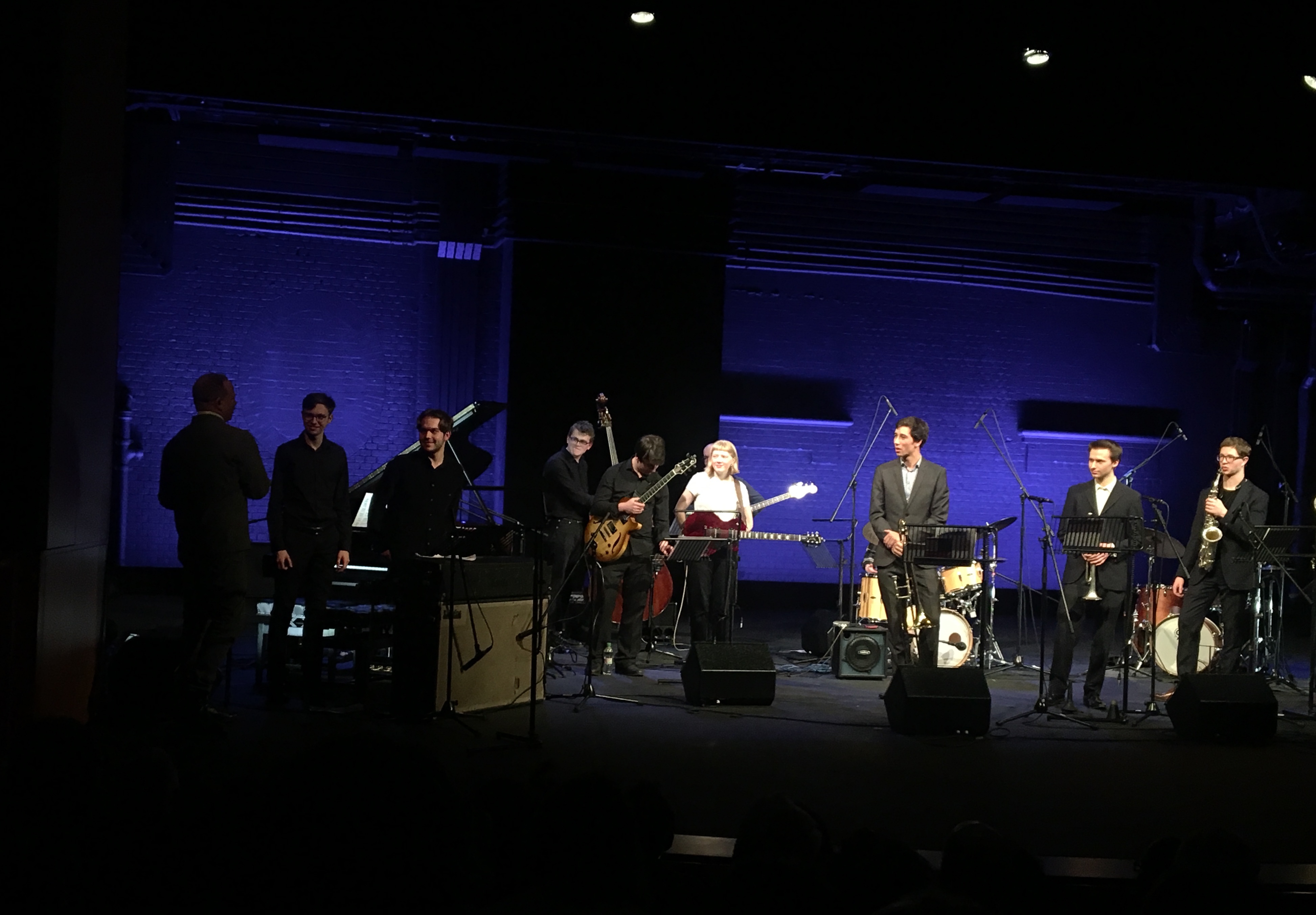
Twenty four hours earlier, Sallows had also been part of the 12-piece band (pictured above) which provided the festival’s highlight. Craig Taborn is already known as one of the most creative and original pianists of the current era; those who were present at the Vortex for his solo gig last year speak of it in awed tones. Friday’s set showed him to rank alongside Steve Lehman, Vijay Iyer, Mary Halvorson and Eve Risser as an adventurous composer-leader who knows how to exploit the resources of a larger ensemble while retaining all the spontaneous interaction of a small group.
Although this was music of great sophistication, there were times when its sheer fire put me in mind of those great Mingus units of the late ’50s and early ’60s, when the members of the Jazz Workshop learnt their parts by ear and took it from there. The trombonist Joel Knee, the trumpeter Laurence Wilkins and the two altoists, Sallows and Sean Payne, threw themselves into the project with enormous skill and gusto, and the ear was also taken by the guitarist Rosie Frater-Taylor, whose opening solo was strikingly thoughtful and who made significant contributions to the riff-ostinatos on which several of the pieces were built.
Taborn’s own solos on acoustic and Fender-Rhodes pianos demonstrated his gift for gathering all the energy once associated with Cecil Taylor and using it to activate the coiled springs of his own imagination. During an unaccompanied introduction, he made the Rhodes roar in a way that completely divested the instrument of its familiar role as a provider of a cool funky background sound. It was one of many moments, individual and collective, that made the event such a success.
The news of the death of the photographer Jak Kilby has saddened all those who called him a friend. I met him in 1969, when he was a year or two into his work of chronicling a section of London’s jazz scene bracketed by two bands: the Spontaneous Music Ensemble and Chris McGregor’s Blue Notes. That lasted through ’70s and into the ’80s, resulting in a valuable record of the work of musicians such as John Stevens, Trevor Watts, Dudu Pukwana, Louis Moholo and many others.
Jak was a warm, kind man, and he was close to the musicians. He shared houses with some of them and drove them to their gigs in, as Trevor Watts told me, a series of vehicles that invariably broke down. He loved the music — and that was how it was always known: the music — because, I think, of its human qualities and a spirituality that was inherent even in the playing of those who did not think of themselves in such terms. (Later he converted to Islam, adopting the name Muhsin, and moved to Malaysia, the base from which he travelled to explore the Muslim world.)
Since the news came through I’ve been listening to a new CD by the saxophonist Evan Parker, the bassist Barry Guy and the drummer Paul Lytton: three musicians regularly captured by Jak’s camera in his early years on the scene. It’s called Concert in Vilnius and was recorded in the Lithuanian capital in October 2017, making it the fruit of almost half a century of collaborations.
Starting out when jazz-based free improvisation was in its infancy, each of them achieved a great deal in terms of expanding the vocabulary of their instruments, which was always part of the project. Now we can listen to them expressing all the wisdom and confidence of their maturity in a language — individual and collective — that they created.
Of the four pieces that make up almost an hour of music, perhaps the most ear-popping is Part III, which opens with a prodigious solo by Guy, using many different resources to make his bass sound like a regiment. It moves into a passage of astonishingly detailed and dynamic percussion/bass dialogue, and then reaches full trio-sized fruition with the arrival of Parker, who unfurls one of his most astonishing tenor improvisations, moving from brusque lyricism to those mind-bending skirls that seem to exist in two or three adjacent dimensions.
The idiom may be half a century old, but it will never be an easy-listening experience; it demands attention and commitment from the listener as well as from the player. What Jak Kilby and other lovers of free improvisation recognised early on is how risk is answered by reward to a degree unavailable in any other kind of music. In those moments it can reach the sublime, touch the infinite.
* Concert in Vilnius is released on a Lithuanian label called NoBusiness Records. The photograph of Guy, Lytton and Parker is from the CD insert and was taken by Vytautas Suslavičius.
There are many worthwhile things going on in jazz at the moment, and one of them is the collaboration with open-minded young musicians from the straight world. Last night at Cafe Oto there were two such efforts, both featuring an eight-piece contingent from the Riot Ensemble, a London-based group who might be compared, I suppose, to Berlin’s Stargaze Orchestra.
The first half of the evening began with two members of the ensemble, Ausiàs Garrigós on bass clarinet and Amy Green on baritone saxophone, playing a fully composed piece called ‘We Speak Etruscan’, written 20 years ago by Lee Hyla, a New York composer who died in 2014. Beautifully conceived as two voices twirling around each other, it was performed with an irresistible momentum and a virtuosity that left plenty of room for the human sound of the instruments.
Then came the other members of the group — Mandira de Saram and Marie Schreer (violins), Jenny Ames (viola), Louise McMonagle (cello), Marianne Schofield (double bass) and Sam Wilson (percussion) — to play a sequence of pieces by Alexander Hawkins, conducted by Aaron Holloway-Nahum, with Hawkins on piano and Evan Parker on soprano saxophone. Parker led off with unaccompanied solo, quietly joined by the strings and a bowed vibraphone, holding a cloud-like chord. Already the textures were new and gorgeous.
The four pieces making the continuous sequence could be played in any order, discreetly cued by the conductor. The music shifted tone and weight constantly, using extended instrumental techniques (including one fantastic passage of drifting harmonics from the strings), and occasionally making space for solos, including one from Hawkins in which he used devices on the piano’s strings to get a kalimba effect. The music was intense and rarified, but never overbearing.
The Riot Ensemble musicians returned for the second half, this time to work with the trio known as ENEMY — Kit Downes on piano, Petter Eldh on bass and James Maddren on drums — on pieces written and arranged by Downes and Eldh. This was a very different formula: much more predetermined, much more vertical and horizontal structure, but enormously dynamic and involving, and greatly appreciated by the audience.
Everything played at Cafe Oto is professionally recorded. This was one of those nights when you leave with the hope that what you’ve just heard will eventually be released, so that you can enjoy it again and think about it some more.






 thebluemoment.com