Skip to content

Remembering Nino Rota

Amarcord Nino RotaWhen it appeared in 1981, Hal Willner’s Amacord Nino Rota kick-started the phenomenon of tribute albums. The New York producer gathered a bunch of musicians — among them Carla Bley, Jaki Byard, Bill Frisell, Chris Stein and Debbie Harry, Steve Lacy, and the then-unknown Wynton Marsalis — to take a variety of approaches, in various combinations, to Rota’s music for the films of Federico Fellini.

Last night, as part of the EFG London Jazz Festival, Willner presented a greatly expanded version of the project, featuring only two of the original participants — Bley and her partner, the bass guitarist Steve Swallow — but adding a bunch of new pieces arranged by and featuring the likes of Mike Gibbs, John Etheridge, Kate St John, Steve Beresford, Rita Marcotulli, Nitin Sawhney, Giancarlo Vulcano, Karen Mantler and Steven Bernstein. Now opened up to include Rota’s music from non-Fellini films, the evening contained almost too many wonderful moments to remember.

Those I carried away with me included Beresford’s use of B.J. Cole’s outrageously eloquent steel guitar on music from Il Bidone; the expansion of Bley’s brilliant arrangement of themes from 8 1/2; Mantler’s deployment of her own chromatic harmonica during her marvellous settings of the various themes from The Godfather; the emotions that surged to the surface during Gibbs’s arrangement of music from The Glass Mountain (a 1949 film directed by Henry Cass and Edoardo Anton, and starring Michael Denison and Dulcie Gray); and the very moving conclusion, which found Sawhney at the piano, meditating on melodies from La Strada, accompanied by string quartet and bass flute.

I felt a little less warm towards the brief appearances of Marc Almond and Richard Strange, delivering songs from Fellini’s Casanova films. But the arrangers were fortunate to be able to call on the services of a terrific orchestra, whose soloists included the wonderful brazen trombonist Barnaby Dickinson, the feather-tongued tenor saxophonist Julian Siegel, the deft guitarist John Etheridge, Bernstein on slide trumpet (surely the most Felliniesque of instruments), and Marcotulli, who contributed a fine piano improvisation to The Glass Mountain. Topped and tailed — with typically Willnerian hipster ingenuity — by recordings of Ken Nordine reading Shel Silverstein’s poem “Where the Sidewalk Ends”, the result was a two-and-a-half-hour triumph.

Ten Freedom Summers / 2

Leo Smith 1His Ten Freedom Summers may have been shortlisted for this year’s Pulitzer Prize, but that doesn’t mean Wadada Leo Smith has stopped work on the epic composition which he began writing more than three decades ago (and about which I wrote here back in August). During last night’s performance at Cafe Oto in London, the first of three across which he will deliver the entire sequence, he inserted an entirely new movement, and it turned out to be the most memorable of the lot.

Smith arrived in East London with a slightly reduced version of the double ensemble that appeared on the 4CD version released by Cuneiform Records last year. Alongside his trumpet, the piano of Anthony Davis, the bass of John Lindberg and the drums of Anthony Brown were the Ligeti Quartet — Mandhira de Saram (first violin), Patrick Dawkins (second violin), Richard Jones (viola) and Ben Davis (cello) — with the video artist Jesse Gilbert operating from a desk next to the sound mixer.

A clue to the inspiration behind the new movement, called “That Sunday Morning”, arrived when an image of a church appeared on the screens behind the players, followed by the faces of four young African American girls. They were Addie Mae Collins, Cynthia Wesley, Carole Robertson and Denise McNair, the four members of the congergation who died on September 15, 1963 when a group of Ku Klux Klan members set a bomb under the steps of the 16th Street Baptist Church in Birmingham, Alabama. It was one of the most terrible incidents of the long struggle commemorated by Smith through the titles of the other movements, which mention Dred Scott, Medgar Evers, Emmett Till, Rosa Parks, Martin Luther King, the Freedom Riders, and others.

As you might have expected, the new piece adopted the mood of a threnody, a quiet and reflective lament that contained moments of striking beauty, particularly in Smith’s brief outbursts and in the rolling gospel phrases that Anthony Davis used sparingly but to very powerful effect. It was heartbreaking and spellbinding, and I hope the composer finds a way to record it in this form one day soon.

Two hours of music, with hardly a break, passed quickly, as I imagine they will tonight and tomorrow. I found myself thinking that the rearrangement of the pieces for the string quartet, rather than the nine-piece ensemble used on the album, worked extremely well, and perhaps even better, thanks not least to the talent and commitment of the young British quartet, rising to the challenge of a masterpiece.

Back into the arms of Venus de Milo

TV 1The muffled tolling of church bells prefaced last night’s performance by Television at the Roundhouse in north-west London, a lovely noise that filled the purple-lit dome of the old engine shed. When the band appeared, they began their set with an episode of seemingly random tuning-up that slowly transmuted itself into a series of guitar phrases that sounded like calls to prayer, punctuated by sustained ensemble power-chords. And then, with the distinctive riff of “(The Arms of) Venus de Milo”, came the first cheers of the night.

Tom Verlaine seemed to be in a benign mood and good voice as the quartet worked their way through all eight tracks of their 1977 debut album, the classic  Marquee Moon, scrambling the running order and interspersing the songs with a handful of others, including “Little Johnny Jewel”, their first single, and “1880 Or So” from their fantastic 1992 reunion album. There were two songs I didn’t recognise. One was a long excursion into the realm of raga-rock, its meandering tune sung by Verlaine in unison with his guitar line, the instrument’s notes shorn of their attack through his manipulation of the volume control. The other, the second of the two encores, took the surprising form of a country-soul ballad that could have been plucked from the repertoire of Percy Sledge, and might have been called “I’m Coming For You Someday”. Perhaps those two songs were among the 16 they are said to have recorded in a New York studio six years ago, and which have never seen the light of day**.

Generally they’re sounding much as they did at Hammersmith Odeon in 1977, when they were at the height of their hipster vogue and were supported by the emerging Blondie. A little chunkier, perhaps, in the contribution of Fred Smith’s bass and Billy Ficca’s drums, but still sounding like a band searching for the infinite spaces between the 13th Floor Elevators and the John Coltrane Quartet. Purists will claim to miss the blend of Verlaine’s guitar with that of Richard Lloyd, but Jimmy Rip — who replaced Lloyd in 2007 — illuminated “Prove It” with a magnificently dramatic solo and acted as the perfect foil for Verlaine’s flights of invention.

For me the best moment came when “Torn Curtain” was wrenched by Verlaine’s long solo out of its somewhat leaden beginning and into the realms of the sublime. The song was rounded off with a gorgeously delicate coda, the kind of soaring crystalline structure created from the contrasting timbres of two Fender guitars — the glassy sound of Verlaine’s Strat and the metallic twang of Rip’s Tele — reminiscent of Television at their finest, while also suggesting that their work might not yet be done.

* Sorry about the quality of the photograph (although I kind of like it). If you want to know what Tom Verlaine actually looks like in 2013, go to Dave Simpson’s Guardian review of the Gateshead show here.

** Thanks to http://www.setlist-fm, via my friend Tony Paley, for the information that the raga-rock tune is called “Persia” and the country-soul ballad is called “I’m Gonna Find You”.

Paolo Conte in London

Paolo Conte 1When I get home from a concert by Paolo Conte, the first thing I do is put on some of his records. Great as so many of them are, however, they’re not the same as watching this wonderful figure — half professor, half boulevardier, like someone you might spot in the corner of a cafe in Trieste, quietly writing in a small notebook — deliver his delicious songs while manipulating his excellent musicians through an evening that never seems long enough.

Conte is 76 now, and having given his audience a single encore at the end of an hour and a half of music at the Royal Festival Hall last night, he smiled and drew his finger across his throat, to indicate that there would be no more. But what he had given was more than enough to ensure that he would be bathed in waves of affection, respect and gratitude.

He had brought 10 of the 11 musicians who accompanied him on his last studio album, Nelson, released in 2010, and they were so outstanding, individually as well as collectively, that I’m going to name them all, in the knowledge that the list will give you some idea of the versatility at Conte’s command, and the range of textures available: Claudio Chiara (tenor saxophone, flute, accordion), Luca Velotti (alto saxophone, clarinet), Massimo Pizianti (piano, keyboards, accordion, bandoneon, soprano and baritone saxophones, clarinet), Lucio Caliendo (keyboard, oboe, bassoon, percussion), Piergiorgio Rosso (violin), Nunzio Barbieri, Daniele Dall’Omo and Luca Enipeo (guitars), Jino Touche (double bass, bass guitar), and Daniele Di Gregorio (drums, percussion, marimba).

Conte’s performance was part of the opening weekend of the EFG London Jazz Festival, and although what he does is basically a form of pop music, jazz provides its underpinning and its guiding spirit. For him, sounds that were once at the cutting edge — the horns of Ellington’s Cotton Club band, for instance, or the guitars of the Quintet of the Hot Club of France — have lost none of their modernity. His particular gift is to write songs with chord structures so beguiling that you don’t miss the apparent absence of a melody (if there is one, his mode of laconic recitation barely hints at it).

He has so many songs that it doesn’t really matter which ones he chooses on any given night. He might not sing your favourite, but those he does perform — including the ones you don’t recognise — will be more than sufficient. Last night he included a swooning “Gli impermeabili”, the spaghetti western swing of “Diavolo rosso”, a yearning “Max”, a driving “La Negra” (one of a number of up-tempo songs in which the advantage of having three acoustic rhythm guitars strumming away became apparent) and, best of all for me, a long, slow sweep through the elegantly descending cadences of “Alle prese con una verde milogna”, the sultriest tango you could ever hope to hear, supported by Touche’s swaying bass and drenched in grown-up romance.

There were all sorts of sounds to be heard: Di Gregorio leaving the drums to play a racing marimba improvisation behind the leader’s vocal on “Dancing”, for instance, or an unorthodox horn section of alto, tenor and baritone saxes plus bassoon, or the combination of accordion and bandoneon, or a magnificently flamboyant violin solo from Rosso, or Conte’s occasional insistence on singing through a kazoo, each element within the complex overall design perfectly calibrated while retaining a precious air of informality and spontaneity. There really is nothing like it.

Last tango in Kilburn

ManzaneraA corroncho, Phil Manzanera tells me, is a particularly ugly fish found in Colombia. When fisherman pull one out of the water, they take a look and throw it straight back. It’s what the people of Bogota call the inhabitants of Barranquilla.

The Two Corronchos is the name of a project on which Manzanera is currently working with his friend Lucho Brieva, a Colombian sculptor who occupies part of the mews in north-west London where the former Roxy Music guitarist has his recording studio. Manzanera was born to a Colombian mother, spending much of his early life in Venezuela, Colombia and Cuba, and the album will tell the possibly somewhat picaresque story in music of two men travelling round the Americas, providing social and political commentary while reflecting local sounds and styles.

A profusion of Brieva’s iron gates and railings are a feature of the buildings, which were once a stables and a railway depot. The main line from Euston runs a stone’s throw away, necessitating considerable efforts to sound-proof the rooms when the studio was built. On Manzanera’s walls are the posters and gold records and other bits and pieces of memorabilia that you’d expect, but also lots of South American art and several large paintings by Nick de Ville, the professor of visual art at Goldsmiths College and the art director of the early Roxy Music album covers.

I first met Phil in November 1970, when he and Bill MacCormick, one of his fellow members of a band called Quiet Sun, came to see me at the Melody Maker. They’d sent me a tape, I’d liked the sound of it, and after we talked in the Red Lion, the pub round the back of Fleet Street where artists used to come to be interviewed, I wrote a piece about them. The next time I saw him, several months later, was at an old cinema in Battersea, where he was doing a spot of roadying for the embryonic Roxy Music. They were auditioning for EG Management and he was about to step into the shoes of the departing David O’List.

When I paid him a visit this week, Manzanera was welcoming a string quartet led by Ros Stephen, the violinist and arranger whose work made such an impact on For the Ghosts Within, the album she made three years ago with Robert Wyatt and Gilad Atzmon. Like Wyatt’s previous two albums, it was made at Phil’s studio. This time she and her colleagues were here to add their contribution to a piece from the Corronchos project and to a track from Manzanera’s next album of his own guitar music.

The latter came first, and presented Stephen with the challenge of writing an arrangement for a piece called “Rosemullion Head”, a gentle, lyrical acoustic guitar improvisation (inspired by a coastal path in South Cornwall) to which minimal piano, bass and percussion had been added later. The sobriety of the lines for two violins, viola and cello placed a gently restraining hand on any hint of romantic indulgence, and after a handful of takes — in which adjustments were made to compensate for metrical irregularities in the original improvisation — an interesting phenomenon emerged: what had started out sounding like an accompaniment began to create the illusion of a dialogue. As one playback followed another it seemed as though the guitar, recorded long before, was now responding to the strings.

Next came “El Tango Infinito”, in which the two Corronchos visit Buenos Aires and whip up a fantastic groove, something of which the Gotan Project mob would be proud, with a laconic rap from Brieva and a fine guitar solo. Here, too, Stephen found a way of making the string quartet sound integral. Later in the day her husband, Julian Rowlands, would be arriving to add his bandoneon to the mix. He’s also her partner in their bands Tango Siempre and Orquesta Tangazo; you’ll find an example of their work here.

Outside in the courtyard, the early winter sun was setting on Lucho Brieva’s exotic ironwork. I left with the echoes of two pieces of music that won’t make their public appearance for some time, but which I’m looking forward to hearing again.

One used record store: £300K, no offers

On the BeatA seemingly nondescript little doglegged cut-through just north of Soho, linking Oxford Street and Tottenham Court Road, Hanway Street is the sort of alley that has always given central London its character. It’s a mess of scaffolding and construction at the moment, with a big hole where something’s been torn down and something grander will no doubt be erected.

For me Hanway Street was aways notable for its musical associations. In the early 1970s there was the office of John Abbey’s Blues & Soul magazine, which I read principally for the magnificently obsessive columns published under the name of Dave Godin. The same building was also the headquarters of the magazine’s associated record labels, Contempo and Mojo, whose catalogues included such names as Oscar Toney Jr, Doris Duke and Timmy Thomas. I’m pretty sure I did my first interview with the great Mable John on those premises. More recently there have been JB’s Records, a collectors’ vinyl-only shop which closed a couple of months back and is now a place where you can get your eyebrows plaited or your nether regions waxed, and On the Beat, a shop selling vinyl of all types along with old music magazines and books.

You might have read in the last few days about On the Beat, whose proprietor has put it up for sale on eBay, at a buy-now price of £300,000 with a guaranteed 10-year lease on the premises. I stopped by there today, and he told me that if a buyer isn’t found by the end of January, the shop will close.

For old times’ sake, I dropped a tenner on a copy of Joe Tex’s “A Mother’s Prayer”, a 1973 B-side on the Dial label that US radio disc jockeys preferred to the designated A-side, “I Gotcha”. It’s one of my favourites of Tex’s sermons, and I think I might have heard it for the first time when it was part of the repertoire of Kokomo, the great English pub-soul band. Anyway, the copy I found in On the Beat looks unplayed, which is more than you can say about the UK Mercury version already in my collection (or the rather battered one that some kind soul has uploaded on to YouTube).

It would certainly be welcome if a buyer stepped forward. But these places are disappearing, one by one. Maybe we were just lucky to have them for so long.

Still melting in the dark

Jimmy WebbJimmy Webb has been giving interviews to promote his new album, and when someone asked him which he considered to be the best of the countless recorded versions of “MacArthur Park”, I was pleased by his answer. “Richard Harris,” he said, clearly harbouring no resentment over the Irish actor’s insistence on rendering the title as “MacArthur’s Park”, despite attempts by the 21-year-old composer, arranger and producer to correct to him during the sessions in 1968 for A Tramp Shining, the album from which the seven-minute track would be plucked to become a huge hit.

Forty-five years later, the composer sings it as he originally intended in the version included on Still Within the Sound of My Voice, in which he recruits a bunch of guests to help him on the album’s 14 tracks. Lyle Lovett appears on “Sleepin’ in the Daytime”, Joe Cocker on “The Moon’s a Harsh Mistress”, Art Garfunkel on “Shattered”, David Crosby and Graham Nash on “If These Walls Could Speak”, and so on. Mostly, these aren’t real duets: the guests either add background vocals or, like Rumer on the title track, pop up to deliver a verse or two. Webb is unquestionably at the centre of the stage, ensuring the album’s overall coherence, something assisted by Fred Mollin’s production, which is full of banjos, mandolins, fiddles and dobros on top of a de luxe rhythm section: the epitome of LA-goes-to-Nashville polish.

The tracks I like best include the singularly beautiful “Elvis and Me”, in which he touchingly outlines the story of his real-life meetings with Presley, assisted by the Jordanaires (recorded before the death of Gordon Stoker, their last original member, earlier this year), and the duet with Keith Urban on “Where’s the Playground, Susie?”, a lovely song which didn’t do quite as well for Glen Campbell in 1968 as its trio of Webb-composed predecessors, “By the Time I Get to Phoenix”, “Wichita Lineman” and “Galveston”. But the pick of the lot is the remake of the thoroughly eccentric song that turned a wayward thespian into a star of the pop charts.

The wonderful choice of guest on Webb’s new version of “MacArthur Park” is Brian Wilson. We’re given the full seven minutes and 21 seconds of this extraordinary song, all four movements, without the lavish orchestration of the original but with an arrangement that more subtly reproduces the full dramatic range and makes marvellous use of Wilson’s celestial harmonies, stacked behind and around the lead (and we won’t ask how they were achieved: just enjoy the result). The third movement, originally the orchestral interlude, is now opened up to feature a majestically soaring dobro solo from the master of the instrument, Jerry Douglas, as the rhythm team races alongside him.

There’s always an extra dimension of poignancy that a composer with even half a voice brings to a performance of his or her own song, and Webb sings his great lyric — what an opening: “Spring was never waiting for us, girl / It ran one step ahead / As we followed in the dance” — as well as it has ever been sung. His homespun delivery makes him sound like a modest sort of chap. But in the future, if anyone asks him which he considers to be the best version of “MacArthur Park”, he can say: “Mine.”

* The photograph of Jimmy Webb is from the insert to Still Within the Sound of My Voice, and was taken by Jessica Daschner.

The Necks in London

Necks Evan 11.

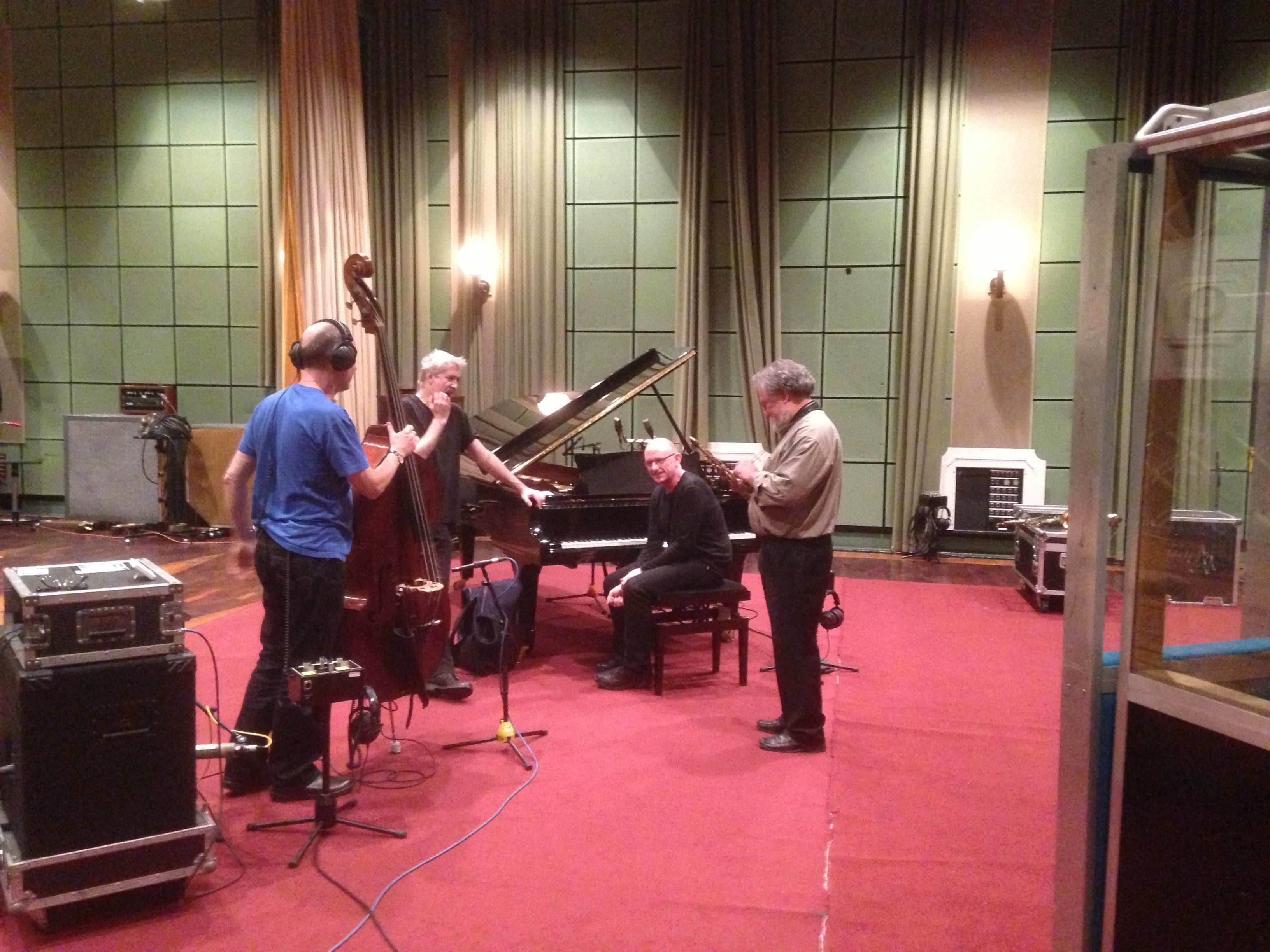
Originally built as a roller-skating rink, the BBC’s Maida Vale building was taken over by the corporation in 1934 as the principal location for the recording of its musical output. It contains six studios, some of which retain certain period features. The medium-sized Studio Three, for instance, still has what looks like its original art deco parquet floor, although the space occupied by the Necks and Evan Parker yesterday was covered by a large dark red rug.

Midway through their European tour, the Necks were in Maida Vale on the morning of the last of their three sold-out nights at Cafe Oto because Philip Tagney, a producer of Radio 3’s Late Junction, is in the habit of putting together combinations of musicians who have not played together before. When he asked the Australian trio to nominate someone with whom they would like to record a session, they nominated Parker. Only their pianist, Chris Abrahams, had previously collaborated with the great saxophonist, on a short duo improvisation at the end of a concert at the Bath Festival about four years ago, after both had played solo sets.

So the four of them met in the studio at 11 o’clock yesterday morning and, after a short warm-up, began the first of two collective improvisations. They started playing more or less simultaneously, and not surprisingly the first half of what turned out to be an hour-long piece contained passages in which it sounded as though they were waiting for something to happen, for someone to seize the initiative. Each member of the Necks has plenty of experience in free improvisation; however, having played together for more than a quarter of a century, it’s hardly surprising that they should fall naturally into certain patterns of response, and you could see and hear Parker looking for a way in.

The last 20 minutes, however, contained moments of outstanding and surprisingly gentle beauty, Abrahams coaxing filigree from the studio’s Steinway, Lloyd Swanton plucking notes with the fingers of his left hand at the top of double bass’s fingerboard, Tony Buck adding cymbal washes with one hand and rapid strokes on his floor tom-tom with the mallet in the other, and Parker exhaling feathery tenor saxophone phrases (this was the Parker of his solo on Tony Oxley’s celebrated “Stone Garden”, a track from the drummer’s 1969 album, The Baptised Traveller).

For the second piece, Swanton suggested using the Necks’ standard operating procedure, by which one of the players — it could be any of them — begins the piece with a repeated phrase of his choice, the others joining in when they feel ready. The bassist himself started this one off with double-stopped harmonics, Buck joining in with mallets on his snare drum (with the snare off), Parker — having switched to soprano — producing sustained notes with a hollow, reedy tone, and finally Abrahams entering to initiate a dialogue with the saxophonist, to which the others provided the backdrop of a thrumming, variable-speed bass ostinato and the soft clanking of a small Oriental cymbal struck with a mallet as it lay on the head of the floor tom-tom.

The difference between this piece and its predecessor was apparent throughout, in the suggestion of a constant tonal centre and an underlying pulse (characteristics that set the Necks’ live performances apart from those of the majority of free improvisers). The music surged and ebbed as it often does when the Necks play in concert (and as it had done in both halves of the previous night’s performance at Cafe Oto), inviting Parker to move with it, using circular breathing to weave his skeins and flurries of sound in and out of the group tapestry. After 30 minutes the piece ended with a sudden and unexpected moment of grace: subdued clicks and squeals from the saxophone, growls from the lower end of the piano keyboard, the bassist letting his bow bounce off the strings, more cymbal splashes, and suddenly a silence that, while abrupt and unpremeditated, seemed completely logical.

2.

I made it to the second and third nights at the Cafe Oto, on Tuesday and Wednesday, each of which consisted of two long sets. The first of those nights was very enjoyable, particularly for a pair of very graceful endings, although the music contained nothing wildly unexpected. Wednesday’s music, however, seemed to come from a different place.

Abrahams began the first set and dominated it throughout, maintaining a sense of unresolved harmony that kept the tension high. It was a powerful and beautifully shaped and proportioned performance, and during the intermission Buck said he thought that the experience of playing with Parker earlier in the day might have had something to do with it.

The set that followed it was something else altogether. The previous night, as the music began in a mood of quiet, serene rumination, I’d been wondering what would happen if the group ever started one of their collective improvisations with a really loud opening statement. Now I know the answer. Buck set this one off with a triple-forte snare-drum rattle, announcing three-quarters of an hour of music that became brutal — almost harrowing — in its volume and emotional intensity. To follow the process by which they found their way out of the maelstrom and wound down to closure was an education in itself, followed by perhaps 10 seconds of transfixed silence in which every member of the audience was thinking, “Did I really just hear what I think I heard?” Then the applause came, and it didn’t want to stop.

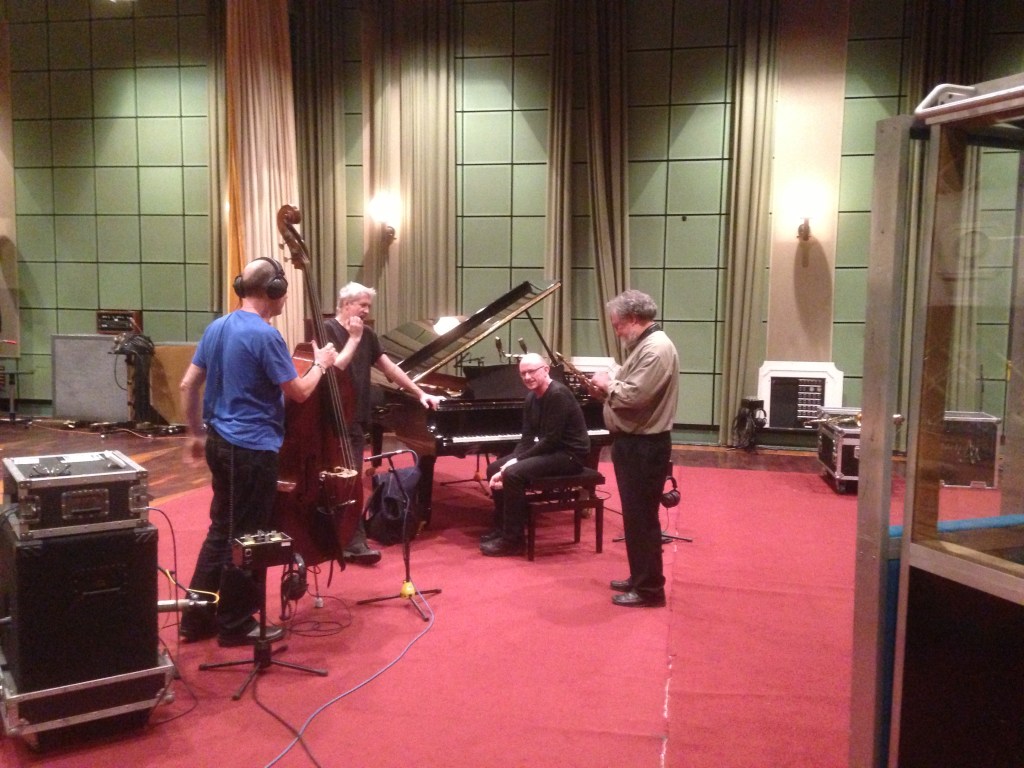
* The photograph above was taken before the start of the second improvisation at Maida Vale. Left to right: Lloyd Swanton, Tony Buck, Chris Abrahams and Evan Parker. An edited version of the session will be broadcast on Late Junction on Thursday, November 21. Part of Tuesday night’s performance at the Cafe Oto can be heard on Jazz on 3 next Monday, November 11. 

Bobby Parker 1937-2013

Bobby Parker

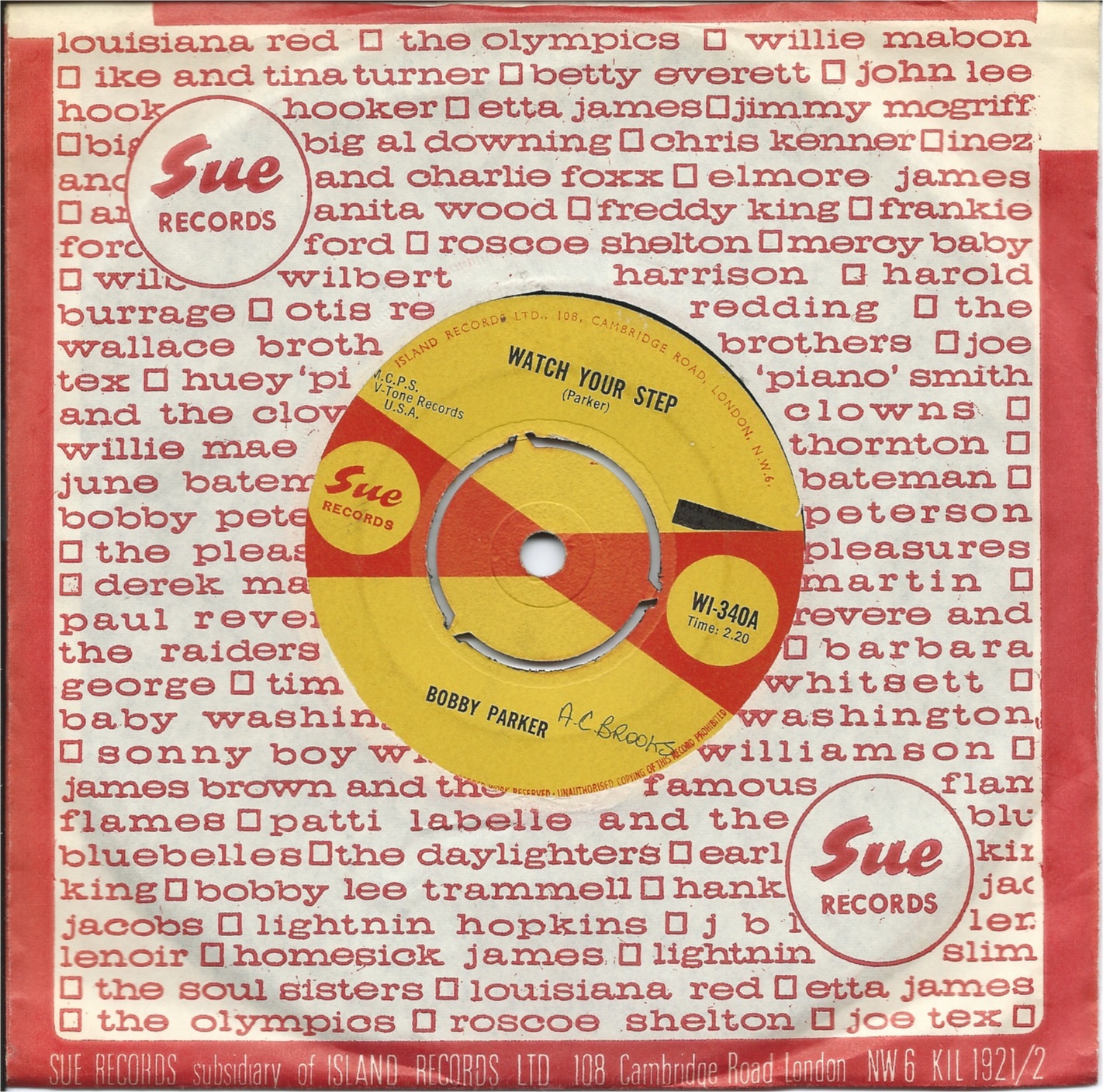
When my son was home on holiday this summer, I got him to put down the Fender Jazzmaster I bought him for his birthday a few years ago and listen to a 45 that had, I told him, the greatest guitar sound ever committed to wax: Bobby Parker’s “Watch Your Step”, recorded in 1961 for the V-Tone label and released in the UK three years later on Island’s Sue imprint. It was gratifying to observe his response. Here is the record in question, in all its explosive, spine-tingling glory.

Parker died last week, aged 76, one of the last of his kind. “Watch Your Step” was a key recording of the early ’60s, particularly among young musicians forming beat groups. Like Howlin’ Wolf’s “Smokestack Lightning” or Muddy Waters’ “Hoochie Coochie Man”, it taught us the power of the riff and the power of distortion. Lots of people learnt and adapted Bobby Parker’s jolting two-bar figure, but none more effectively, to my mind, than Robbie Robertson when he was coming up with a lead guitar part for Bob Dylan’s “Tell Me, Momma” on that celebrated world tour in 1966.

Parker was born in Lafayette, Louisiana, but spent most of his life in Washington DC, which is where “Watch Your Step” was recorded. A very nice obituary in the Washington Post tells his story, including the tale of an unsuccessful visit to the UK. It turns out that Parker got the idea for his riff from Dizzy Gillespie’s “Manteca”, which makes perfect sense — just like Pee Wee Ellis being inspired by Miles Davis’s “So What” when he came to finish off the James Brown jotting that became “Cold Sweat”.

“Watch Your Step” was one of those rare great 45s that boasted an almost equally valuable B-side. “Steal Your Heart Away”, another Parker composition, was a slice of gospel-blues that would have fitted very nicely on to Ray Charles’s classic album The Genius Sings the Blues, alongside “I Believe to My Soul”. Parker sold both copyrights for practically nothing to Ivan Mogull, the owner of V-Tone, so he never received the rewards he deserved, or the status to bring him level with such contemporaries as Albert and Freddie King. But we’re still listening to him, and marvelling at the sound he made.

Bryan Ferry’s dance to the music of time

Bryan Ferry 2Bryan Ferry is doing a rather brave thing with his current tour, which reached the Albert Hall last night and continues around the country for the next three weeks. Unlike most performers of his age, he is trying to give us more than we bargained for.

The show begins with the nine members of the Bryan Ferry Orchestra, the band that created instrumental versions of Roxy Music songs in the style of Jelly Roll Morton, Bix Beiderbecke and Duke Ellington on The Jazz Age and went on to contribute to the soundtrack of Baz Luhrmann’s The Great Gatsby. So we’re presented with a banjo, a bass saxophone, a variety of clarinets, a string bass and a drum kit from a 1920s photograph: but Colin Good, Ferry’s musical director, has such a profound understanding of this form — as do his musicians, notably the trumpeter Enrico Tomasso — that the results go well beyond mere pastiche or novelty.

For some members of the audience, however, it is undoubtedly something of a shock to hear “Avalon”, “Slave to Love”, “The Bogus Man” and “Do the Strand” so radically transformed, and they have to wait until half a dozen pieces have been delivered in this fashion before Ferry himself arrives on stage to sing “The Way You Look Tonight”, joined by his two backing singers. “Reason or Rhyme” also begins in the same idiom, but is transformed by the mid-song arrival of Cherisse Ofosu-Osei, who settles behind a second drum kit, and Oliver Thompson, who plugs in his Gibson Les Paul, heralding a sudden time-shift to the present day.

From that instant the momentum builds, thanks in large part to Ofosu-Osei, who bludgeons her equipment with an unwavering ferocity that would make Paul Thompson, Roxy’s hard-hitting old drummer, sound as though he were playing for tea-drinkers at the Ritz. But Ferry hasn’t stopped taking chances. He’s going to sing what he wants to sing, and what he wants us to hear, and much of the pleasure of the concert is derived from seeing how he and Good marshal their resources to refresh the material, with Martin Wheatley switching from banjo and guitar to mandolin for a delicate “Carrickfergus”, John Sutton adding percussive decoration to Ofuso-Osei’s rolling thunder, and Tomasso and Iain Dixon providing a blast of Dizzy Gillespie and Charlie Parker on “Au Privave” as a prelude to “N.Y.C.” (a song from Ferry’s album Mamouna). And if you have a bass saxophone standing there, why not use it on “Editions of You”?

The set is liberally sprinkled with Dylan songs, including a lovely voice-and-piano treatment of “Don’t Think Twice, It’s All Right”, and there’s a version of “Shame, Shame, Shame” in which the backing singers interpolate a chorus of “Can I Get a Witness”: a witty and appropriate touch that you can’t imagine coming from anyone who didn’t have a real love and first-hand experience of that kind of R&B.

And that’s what I liked most about the concert. It was about the music, not the image. Ferry seems to have adopted Dylan’s view of time, which is that there is no division between the past and the present. On this evidence he seems to be making it work, for us as well as for him.