The Originals — I’m pretty sure it’s Freddie Gorman, Walter Gaines, Hank Dixon and a replacement member, Dixon’s daughter Terrie — singing “Baby I’m For Real” in Pittsburgh in 2003, reprising their No 1 R&B hit of 1969. What a great record that was, and here given a performance epitomising the art of growing older with dignity utterly undiminished. This stuff just doesn’t get weary. And, like “The Bells”, its successor, it was co-written by Marvin Gaye with his first wife, Anna Gordy, whose death at the age of 92 has just been announced.
Every time I find myself writing the obituary of one of the great women of Motown, particularly those who existed in the background, such as Esther Gordy Edwards, Maxine Powell or now Anna Gordy Gaye, I’m reminded of what an extraordinary story it all was, from the moment in 1959 when, at a meeting to listen to Berry Jr asking to be given seed money from the family start-up fund, Anna and her sister Gwen sided with their brother, pleading his case so effectively that eventually Esther, the eldest sister, whose scepticism of his ability to get a business going made her the last obstacle, finally gave way.
As anyone who’s read a biography of Marvin Gaye or listened to Here, My Dear will know, Anna Gordy’s story wasn’t one of unrelieved happiness. But she was part of something which left us music, like “Baby I’m For Real”, that will be cherished for a long, long time.
Louis Malle’s Lift to the Scaffold begins a season at the BFI in London this week, providing an opportunity to enjoy the conjunction of the director’s (and his cinematographer, Henri Decae’s) images and Miles Davis’s historically significant soundtrack. A classic of French film noir, made in 1957, it looks and sounds wonderful — particularly when experienced on a big screen in a proper cinema.
Miles recorded the music in a Paris studio, using four musicians with whom he had just embarked on a short tour: Rene Urtreger on piano, Pierre Michelot on bass, Kenny Clarke on drums, and — a surprising choice, and a particularly inspired one — the 20-year-old tenor saxophonist Barney Wilen, a prodigy who would become one of the most significant European jazz musicians of his generation. Together they took the conceptual leap that would lead Davis, within a couple of years, to Kind of Blue.
Wilen’s story is a fascinating one. Born in Nice in 1937 to a French mother and an American father, he left France with his family in 1940 and spent the next six years in America, where an uncle gave him a saxophone. On returning to Nice at the end of the war, he developed his interest in music; at 13 he was already playing with local jazz bands and at 16, having moved to Paris, he was performing at Le Tabou in Saint-Germain-des-Pres with his fellow saxophonist Bobby Jaspar and the pianist Henri Renaud. In 1957, a few weeks before answering Davis’s call, he made his first recordings under his own name, for the Vogue label: reissued on CD a few years ago under the title Tilt, they show a young man clearly fascinated by the compositions of Thelonious Monk and completely at ease with such pieces as “Round Midnight”, “Think of One”, “Hackensack”, “We See”, “Blue Monk”, “Let’s Call This” and “Misterioso”.
His style was never one that cried out for attention, but it evolved into an approach that could hold its own among the hard-bop giants of the day, such as Roy Haynes, Milt Jackson and Donald Byrd, with whom he also recorded during the 1950s. (In 1959 he wrote a film soundtrack of his own, for Edouard Molinaro’s Un Temoin dans la ville, which he recorded with a band including the trumpeter Kenny Dorham.) Although his playing never lacked strength, there was no sense of trying to grab the listener by the lapels. He could swing forcefully while still seeming to take his time, and it’s hard to think of anyone who would have fitted so beautifully into the soundtrack recording with Miles, where subtlety and light-footedness were crucial. He had a lovely tone and a frictionless sense of swing; if there were a missing link between Lucky Thompson and Wayne Shorter, perhaps it would be him. He knew how to be cool without being cold.
He also possessed an inquiring and unorthodox mind, and was keen to venture beyond the confines of an idiom he had so quickly mastered. Seduced by the possibilities of free jazz, and encouraged by the adventurous German record producer Joachim-Ernst Berendt, in 1968 he recorded an album called Auto Jazz: The Tragic Destiny of Lorenzo Bandini, in which he and his quartet improvised against a recording of the commentary from the previous year’s Monaco Grand Prix, during which Bandini had been burnt to death at the wheel of his Ferrari. It was released on the MPS label, and is now hard to find.
“I have a French passport and I live in Paris,” he once observed. “I consider myself a musician of the world, temporarily French.” In 1969, having grown his hair, adopted a more relaxed wardrobe and befriended such leading lights of the Parisian counter-culture as the film director Philippe Garrel and the actor Pierre Clementi, he and his girlfriend, the English-born model Caroline de Bendern, went to Africa, where they spent several months travelling in a Land Rover through Morocco, Algeria, Niger, Mali, Upper Volta and Senegal, recording with with local musicians as they went. The first results were issued under the title Moshi in 1972, on the Saravah label; about a year ago de Bendern issued a second instalment of this fascinating Afro-funk trance music — with bits of conversation and street song interpolated and overlapping — under the title Moshi Too, on the Sonorama label.
Then, in effect, he disappeared. The next couple of decades were apparently spent back on the Cote d’Azur, where he played occasionally with a local group, effectively off the scene and out of the mainstream. Until, in 1988, an illustrator named Jacques de Loustal and my old friend Philippe Paringaux, a former editor of Rock & Folk magazine, collaborated on what we would nowadays call a graphic novel titled Barney et la note bleu, a romanticised version of Wilen’s life as an itinerant saxophonist on the jazz scene. Stylish and evocative, it was a huge hit (it’s still in print) and prompted Wilen to record a new album, titled La Note Bleu and using Loustal’s artwork. Accompanied by an excellent rhythm section, he proved that his old skills — particularly as a ballad player, on Gordon Jenkins’ “Good-Bye” and a short unaccompanied version of “Besame Mucho” — had not atrophied. His tone was, if anything, even more perfectly formed.
People suddenly remembered how good he was, and he was invited to make more recordings. I have a lovely quartet recording with the guitarist Jimmy Gourley from 1987 (Double Action, on the Elabeth label) and a fine duo album with the pianist Alain Jean Marie, his longtime associate, from 1992 (Dreamtime, on Nocturne). Both, coincidentally, contain versions of “Good-Bye”; along with “Besame Mucho”, it’s among my very favourite songs, and although his fondness for revisiting both these tunes at every opportunity is not why I’m such a fan of his, it probably helps.
According to Blue Melody, a short biography written by Yves Buin and published in France by Castor in 2011, Wilen already knew that he was suffering from stomach cancer by the time he travelled to the US in 1994. There he recorded an album called New York Romance at Rudy Van Gelder’s studio, with an A-team rhythm section: the pianist Kenny Barron, the bassist Ira Coleman and the drummer Lewis Nash. The following year he made Passione with his own musicians plus the Italian trumpeter Enrico Rava. It would be his last recording; the man who was as great a ballad player as any produced by the European jazz scene died on May 25, 1996, aged 59. Go and see Lift to the Scaffold and marvel not just at an ageless film but at how good Barney Wilen had already become when his 20th birthday was still a recent memory.
And if you want to know more, spend 55 minutes watching The Rest of Your Life, Stephane Sinde’s terrific biographical film, made in 2005:
* The photograph of Barney Wilen (and the bassist Beb Guerin) is from the back cover of Auto Jazz: The Tragic Destiny of Lorenzo Bandini and was taken by Jean Maurice Pioton on February 13, 1968 while the musicians improvised the soundtrack as they watched the footage on a screen in the Tonstudio Bauer, Ludwigsburg.
Bruce Springsteen and the expanded E Street Band played their first South African concert in Cape Town last Sunday night. Here’s the official film of how they kicked it off, with their version of “Nelson Mandela”, written 30 years ago by Jerry Dammers for the Special AKA. It’s a good example of why so many of us feel such enduring affection for Springsteen. This isn’t something slung together on a whim. It’s a gesture, perhaps for one night only, but he’s made sure to prepare it as carefully as the arrangements of his own songs. The bringing of the backing singers to the forefront, the horn riffs, the percussion, the solos from Jake Clemons on tenor and Tom Morello on guitar and the brilliant false ending make it one more entry in the cavalcade of memories he’s provided over the years.
We all have our instinct-based responses, and mine is to recoil from bombast. That’s why I liked the last two albums by the Lebanese trumpeter Ibrahim Maalouf — lovely music filled with subtle touches — and also why I’m surprised that I enjoy his latest one. Its predecessors — Diagnostic (2011) and Wind (2012) — were marked in the first case by a subtle blend of east and west and in the second by a perfect understanding of the sort of melodic, modally based two-horns-and-rhythm jazz perfected by Herbie Hancock with “Maiden Voyage” and heard most recently on Manu Katche’s first two ECM albums.
The new one, titled Illusions, is very different, and its cover seems to set the tone: Maalouf, all blinged up in a white suit, shiny turquoise shirt and gold shoes, surrounded by what appear to be a kind of burlesque version of the musicians from Prince’s band. There’s surely something ironic going on here.
Born in Beirut 33 years ago, he moved with his family to Paris during Lebanon’s civil war. His father, Nassim Maalouf, was a well known trumpeter, the inventor of the four-valve quarter-tone instrument, and ensured that his son was thoroughly educated in both Arab and western music. Ibrahim was on the road with his dad from the age of nine, long before he began his studies at the conservatory in Paris. His subsequent career has been varied and distinguished.
The trumpeter’s extensive sleeve notes to Illusions — which is released on his own label, Mi’ster Productions — describe his ambition of using the album to portray the lives of men and women in the modern world as he sees it, with all the dissatisfactions, deceits, dilemmas and compromises that stand in their way. So the music makes use of three trumpeters (as well as himself) and keyboards to provide textures that often flare like neon above a hard-driving jazz-funk rhythm section. The playing is outstanding (Frank Woeste, the keyboards player, is a holdover from Wind), even when it goes a little too far over the top for my taste, as on the hard-rock “hidden” track — but perhaps that’s the point. As a composer, Maalouf shows in an intricately arranged piece like “Unfaithful” (listen here) that he is capable of juxtaposing the churn and the lyricism and blending them into something exhilarating.
I don’t love Illusions in the way I loved its predecessors, although I think I see what Maalouf is trying to achieve through this sustained essay in garishness. His own playing, however, is extraordinary. This is a voice that definitely comes from a non-western world, with a silvery tone and liquid phrasing, whether bouncing lines off the answering trumpet choir or producing passages of glowing lyricism. Like Ambrose Akinmusire in the US and Arve Henriksen in Norway, he demonstrates that this ancient instrument, with a history going back several millennia, definitely belongs to the present day.
If you don’t know him, I’d recommend starting with Wind, which consists of music written by Maalouf to accompany a Rene Clair silent film from 1927, The Prey of the Wind, and was inspired by Miles Davis’s soundtrack for Louis Malle’s Lift to the Scaffold. It’s relatively conventional, but he and Woeste sound completely at home in the company of three top-class American musicians: the always-interesting tenor saxophonist Mark Turner, the bassist Larry Grenadier and the drummer Clarence Penn. Then you’ll probably want to discover what else he’s been up to.
* The photograph of Ibrahim Maalouf is from one of the postcards included with Illusions and was taken by Denis Rouvre.
In a pair of parallel alleyways under the railway line that runs through Lambeth from Waterloo station, parallel with the river, you will find two dozen panels like the one above, created by Southbank Mosaics, a non-profit community enterprise, to commemorate the work of the great English visionary William Blake. A few yards away is the housing estate that occupies the site on which stood the house where Blake and his wife lived between 1790 and 1800, and in which he composed and printed his Songs of Experience. One of those poems is called “London”, and this is how begins: “I wander thro’ each charter’d street / Near where the charter’d Thames does flow / And mark in every face I meet / Marks of weakness, marks of woe…” In the late 18th century, it needs to be said, the term “charter’d” could be taken to mean “in private ownership”. It’s a shattering poem, born of the conditions to which Blake bore witness every day of his life amid the teeming riverine streets, and it doesn’t seem to have lost any of its force or relevance.
Hercules Road, on which Blake’s house stood until it was demolished in 1912, is not a place to attract tourists in search of his traces. The anonymous postwar council estate — which bears the poet’s name and an appropriate plaque — occupies one side; the railway arches line the other. It takes some imagination to link it to the music composed by John Zorn for In Lambeth, an album inspired by the time Blake spent there.
This is Zorn’s second attempt to capture the poet’s spirit. The first, released in 2012 (also on the composer’s Tzadik label), was called Vision in Blakelight and was written for a sextet of keyboards, harp, vibes, bass, drums and percussion; its 10 sprightly, occasionally almost ecstatic pieces featured particularly fine playing by John Medeski on organ and Trevor Dunn on double bass.
In Lambeth, subtitled “Visions from the Walled Garden of William Blake”,filters that mood through a finer mesh. The group here is Zorn’s Gnostic Trio, in which two members of the Blakelight group, the harpist Carol Emanuel and Kenny Wolleson on vibes and bells, are joined by the guitar of Bill Frisell. The music is no less lively and active, often based on arpeggiated figurations reminiscent of the ostinatos of Terry Riley and Steve Reich, but its glistening instrumental timbres and the intimacy of the interplay between these brilliant musicians give it a character of its own. Here’s a track called “The Night of Enitharmon’s Joy”, referring to a female figure used by Blake to signify beauty and poetry (and possibly inspired by his wife, Catherine).
It’s as distinctive, in its own way, as the Jimmy Giuffre Trio of “The Train and the River”, as close as that to jazz — in fact impossible without it — yet breathing quite different air. Beyond category, and highly seductive.
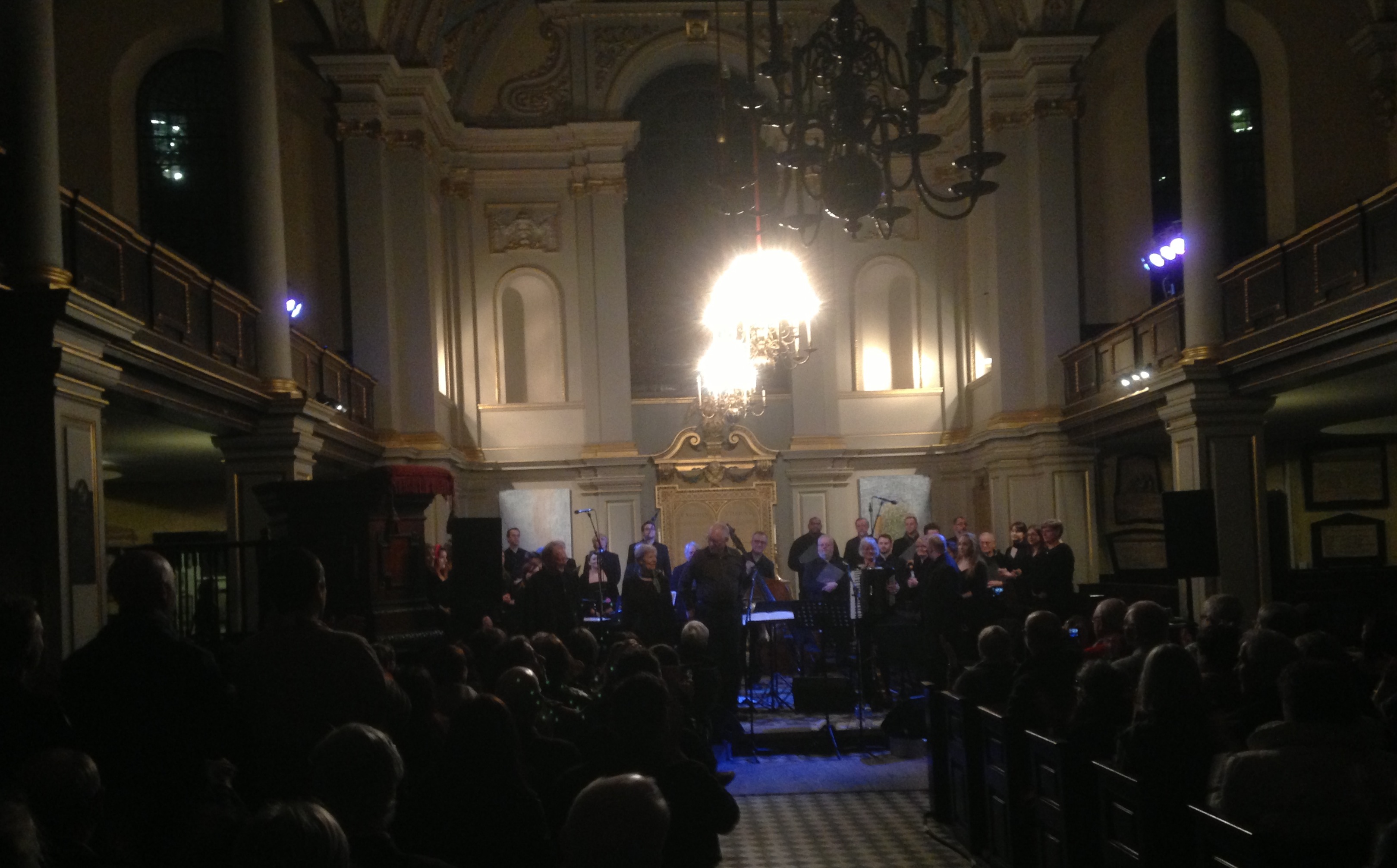
In related Blake-and-jazz news: on Saturday, February 8, at the church of St Giles-in-the-Fields at the end of Denmark Street (once London’s Tin Pan Alley), Mike Westbrook and his musicians, including the Queldryk Choral Ensemble, will perform Glad Day, his celebrated settings of Blake’s poems, to promote the release of the music on a CD recorded live at the Toynbee Hall in London five years ago. This latest concert is dedicated to the memory of the poet Adrian Mitchell, with whom Westbrook worked on Tyger, the Blake-inspired musical performed at the National Theatre in 1971. Not to be missed, I’d say.
Joel and Ethan Coen do a good job of catching a pivotal moment in the history of contemporary music in Inside Llewyn Davis, which opens in the UK next weekend. I’ve seen it a couple of times and was impressed by the faithful portrayal of the Greenwich Village folk scene as it prepared for the transition from Pete Seeger to Bob Dylan (although, as a friend pointed out, nobody tied a scarf with a loop in the way Oscar Isaac, who plays Davis, does until about 10 years ago).
I’m not going to spoil the fun by describing the moment — a quite subtle and very telling one — at which Dylan makes his appearance in a film based on Dave Van Ronk’s entertaining Village memoir, The Mayor of MacDougal Street (and my recent Guardian piece on that is here). Until then, however, Dylan’s unseen presence is enough to make him the principal supporting actor — even more crucial than Ulysses, the ginger tom inserted by the Coens in order to provide the film with something resembling a narrative.
The film is set in the early weeks of 1961. It would be a year before Dylan’s influence began to make itself felt, initially when Joan Baez and Peter, Paul and Mary began performing and recording his songs. Dylan’s own versions of those songs represented a completely different experience, one that introduced a generation to a notion of authenticity in voice, language and looks, but it took a while until, at the beginning of 1965, he suddenly achieved a kind of pop-star status in Britain. On the eve of his second UK tour, the title track of The Times They Are a-Changin’, first released a year earlier, shot into the top 10. A few weeks later it would be followed by “Subterranean Homesick Blues”, taken from his new album, Bringing It All Back Home.
I remember that little period of Dylanmania very clearly. At the time I was in a rhythm and blues band, playing clubs and pubs and other venues in and around Nottingham. A five-piece, we relied on the standard repertoire: Jimmy Reed, Muddy Waters, Bo Diddley, Little Walter, Howlin’ Wolf and so on. We borrowed our name — the Junco Partners — from a song recorded by the Texas-born bluesman James Wayne (as, unbeknown to us, did a band in Newcastle upon Tyne, later resident at the celebrated Club A Go-Go).
One of our two guitarists had come to us from the local folk scene. His name was Dave Turner and he also sang and played harmonica; in the folk clubs, his broad sense of humour and gift for mimicry enabled him to perform a wicked parody of early Dylan. So at a moment when demand for solo acoustic Dylan clearly outstripped that for Chicago-style R&B, we let him loose on our audiences. I have a vivid memory of a night at the Dungeon Club in Nottingham when the rest of us — lead guitarist Mick Dale, electric pianist Ian Taylor, bass-guitarist and singer Rae Drewery (later to become the father of Swing Out Sister’s Corinne Drewery) and me — sat in the dressing room and listened rather glumly to the cheers as Dave went through a more or less straight-faced impersonation of the hero of the hour. His “All I Really Want To Do”, with a lascivious spin, went down particularly well. Eventually we returned to the stage and the audience went back to dancing. I seem to remember that happening quite a few times.
We played together for the best part of a year but called it a day that summer, when real life beckoned. It’s fair to say that we left no trace. I’m pretty sure that our last gig was at the Elizabethan Rooms in Nottingham, supporting Tom Jones. “It’s Not Unusual” was still in the charts, and he was still backed by the Squires. When I next saw him it was in Las Vegas about 40 years later and he was in excellent form, but in the meantime he’d nicked our repertoire: it was Howlin’ Wolf pretty much all the way.
The five of us lost touch but I know that Dave returned to the Midlands folk circuit, where his mixture of traditional songs and broad humour is said to have influenced Billy Connolly, Mike Harding, Jasper Carrott, Fred Wedlock and others. He died in 2008, aged 66. Here he is in full comedy-folk guise, performing a song he wrote in the Sixties called “The Ballad of Cosmic Ray”, incorporating bits of “Freight Train” (with a reminder of his Dylan parody) and “Won’t You Come Home, Bill Bailey”, and some fantastic finger-picking. And here’s a complete 40-minute set of his full-frontal ribaldry, recorded at a Coventry folk club in the 1970s (warning: contains mentions of Woodbine cigarettes and bodily functions).
* The photograph of Dave Turner was taken in 1965, during his time with the Junco Partners. It was our only publicity shot but to save embarrassment I’ve cropped the rest of us out of it.
During the golden age of soul music we were able to revel not just in great voices and wonderful playing but in the quality of the imagination and inventiveness shown by the best songwriters, and the lyricists in particular. They didn’t have to get fancy about it, either. Introduced to me was Delilah / Right away I reached for her hand / Suddenly a thrill went through me / Made me feel as though I was king of the land — Curtis Mayfield (for Major Lance). A simple touch upon my face / A tender kiss and a warm embrace / A few kind words, spoken sincere / These things will keep me loving you, dear — Harvey Fuqua, Sylvia Moy and Johnny Bristol (for the Velvelettes). Simple emotions, expressed with a succinct directness.
I’ve been listening to Give the People What They Want, the new album from Sharon Jones and the Dap-Kings. There’s so much to like about it. As usual, Sharon proves herself to be an outstanding soul singer, worthy of consideration alongside the likes of Betty Wright, Jean Knight and Ann Peebles. The musicians are terrific: they and their producers demonstrate a perfect understanding of the relevant styles and textures of the late 1960s and early ’70s. The singer and her band are so good at what they do that you never even stop to think that you’re listening to a recreation.
Only in one area can it be said that they fail to do themselves justice, and unfortunately it’s an important one: the songwriting. Once again all their material comes from inside the collective, mostly from the pens of bassist Bosco Mann, drummer Homer Steinweiss and saxophonist Cochemea Gastelum. Idiomatically speaking, it’s all fine. The funky swing of “We Get Along”, by Steinweiss and guitarist Joseph Crispiano, the walking bass line and great horn chart of Steinweiss’s “Now I See”, punctuated by tympani, and the sweet uptown soul of Mann’s “Making Up and Breaking Up” are extremely pleasant to the ear, but none of them contains the sort of hook, were these songs released as A-sides, that would make you put the needle back to the beginning over and over again until the whole thing had burned itself into your brain.
For me, the closest they got to that was in 2007 with “Tell Me”, a track written by guitarist Neil Sugarman for their third album, 100 Days 100 Nights. Now that had everything: not just a groove that grabs you and won’t let go, the smeary horns, the great lead vocal and the essential Northern Soul ingredient of vibes like broken milk-bottles, but a chorus that sticks to the ribs. I wish they had a few more of those.
What’s the problem? Almost certainly that, unlike the songwriters of the 1960s, they’re not engaged in fierce daily competition with rivals in other cities for the national hits that would keep them in a job. They’re not subjected to the kind of critical scrutiny that forced Smokey Robinson to keep his similes sharp and made Curtis Mayfield ensure that each song painted its own little picture. It’s a system that maintained its grip on country music but disappeared from soul and R&B some time in the 1970s. It didn’t matter whether it was “Seven Rooms of Gloom” or “What Made Milwaukee Famous (Made a Loser Out of Me)”, each song needed to start with a distinctive idea of its own. And those hits weren’t made without hard work.
I admire the people at Daptone Records a great deal. But if I were them, I’d locate one of the survivors of the golden age — someone like Benny Latimore, Phillip Mitchell or Paul Kelly — and put them on the payroll, working with Mann, Steinweiss and the others to ensure that each song they write has its own identity and earns its place. Because, as I say, they’ve got everything else down.
* The photographs of Sharon Jones and the Dap-Kings is from the cover of their new CD, and was taken by Kyle Dean Reinford.
Amiri Baraka’s death at the age of 79 was announced today. Almost 50 years ago, when he was still known as LeRoi Jones, his book Blues People and his “Apple Cores” column in Down Beat magazine helped reshape a lot of thoughts, including mine. He wrote about Albert Ayler, Archie Shepp, Sun Ra, Pharoah Sanders, Cecil Taylor, Sunny Murray, John Tchicai. He saw this music — the “new thing” — as an expression of social and political as well as cultural revolution.
I bought his books of poems (Preface to a Twenty Volume Suicide Note, The Dead Lecturer), his essays (Home, Tales), his plays (Dutchman), his novel (The System of Dante’s Hell), which contained paragraphs like this: “Blonde summer in our south. Always it floats down & hooks in the broad leaves of those unnamed sinister southern trees. Blonde. Yellow, a narrow sluggish water full of lives. Desires. The crimson heavy blood of a race, concealed in those absolute black nights. As if, each tiny tragedy had its own universe / or God to strike it down.”
Later in the ’60s he got less lyrical, more angry, and became an activist. A few years ago, at St Mark’s Church on East 10th Street in New York City, I heard him read a poem about Rudy Giuliani that was truly shocking in its directed fury. After 9/11 he’d ruffled a lot of feathers — and lost his post as the poet laureate of Newark, New Jersey, his hometown — with a poem called “Somebody Blew Up America”, which was easily and sometimes wilfully misunderstood: here he is reading it in 2009 at the Sanctuary for Independent Media in Troy, NY, with Rob Brown playing Monk on the alto saxophone.
“One of the most baffling things about America,” he wrote in 1964 in his sleeve note to Coltrane Live at Birdland, “is that despite its essentially vile profile, so much beauty continues to exist here. Perhaps it’s as so many thinkers have said, that it is because of the vileness, or call it adversity, that such beauty does exist. (As balance?)” Vileness and beauty: both present and correct in the work of an irreplaceable figure, a man of his time.
Medleys used to have a bad name. I could forgive Duke Ellington the habit because he had so much music to get into any given concert (and because he was Duke Ellington), while Dionne Warwick’s 20-song Bacharach/David selection was an exhilarating marathon, particularly when she had a proper orchestra behind her. But not many medleys manage to assemble their component parts in a way that creates a greater meaning.
Here’s one that does. It’s Frank Sinatra, with the help of Nelson Riddle, plaiting together a trio of classic saloon ballads — “Last Night When We Were Young” (music: Harold Arlen/words: Yip Harburg), “Violets For Your Furs” (music: Matt Dennis/words: Tom Adair) and “Here’s That Rainy Day” (music: Jimmy Van Heusen/words: Johnny Burke) — into something that describes the full emotional arc of a love affair. It couldn’t have worked better if the three composers and their lyricists had got their heads together for that express purpose.
I first heard it three or four years ago on the Sinatra: New York box set, taken from a 1974 concert at Carnegie Hall. This filmed performance seems to have been made the year before, presumably in a television studio. It’s not quite as wonderful in terms of singing and orchestral blend as the version on the CD (although this one benefits from not having a corny spoken introduction), but it’s a precious reminder of what he could do with songs as sophisticated and timeless as these.
The first sound you hear on the soundtrack of David O Russell’s new film American Hustle is that of the Duke Ellington Orchestra playing “Jeep’s Blues” during their historic appearances at the Newport Festival in 1956, and it just about lifted me out of my seat. There’s something about the sound of six brass, five reeds and three rhythm — in this particular case — that no amount of technology can reproduce or match.
I suppose whole generations have grown up without experiencing that sensation. I was lucky enough to see Ellington, Basie and Lionel Hampton leading their full-scale outfits, and a few others besides. The species still exists, if you search for it (I’m no great fan of Jools Holland, but he should certainly be commended for doing his bit in that respect), allowing people to discover what happens when all those instruments start disturbing the air in a room — preferably that of a smallish club.
The Jimmy Heath Big Band is an occasional ensemble led by a tenor saxophonist and composer who would have replaced John Coltrane in the Miles Davis Quintet in 1959 had he not been on parole at the time and not allowed to leave his native Philadelphia, thus preventing him from going on the road with one of the three or four leading small groups of the day. His consolation prize came when Miles recorded his composition “Gingerbread Boy” on the Miles Smiles album a few years later. He is the brother of the late Percy Heath, the bassist with the Modern Jazz Quartet, and the drummer Albert “Tootie” Heath: probably Philadelphia’s greatest musical family.
Heath is now 87; he was a mere 85 when his band recorded their new album, Togetherness, at the Blue Note club in New York City for the JLP label. It features several Heath originals, plus his arrangements of the standard “Lover Man”, Billy Strayhorn’s “A Flower Is a Lovesome Thing”, Dizzy Gillespie’s “Fiesta Mojo” and Charlie Parker’s “Yardbird Suite”, the presence of which reminds us that in his youth, when he was playing alto, Heath was known in Philly as “Little Bird”.
This is music that never attempts to escape the conventions of the type of straightforward modern jazz which emerged from the bebop revolution. Heath arranges as he plays, with a complete understanding and command of that idiom, translating his knowledge to the broader canvas. The sections do exactly what they are supposed to do: they swing, they shout, they purr, and occasionally they whisper. Heath’s “A Sound for Sore Ears” is a terrific opener, and his tender improvisation on “Lover Man” is the highlight of the whole set for me. The other soloists include the trumpeter Roy Hargrove and the altoist Antonio Hart. The double bassist is Peter Washington and the drummer is Lewis Nash, which means that the rhythm section moves on well oiled bearings. This not an album to start a musical revolution, but it’s a reminder of how well the format can still work.
“Jeep’s Blues”, incidentally, is just the first of many pieces of music featured throughout American Hustle — which, as you might already know, is set in the 1970s, that decade beloved of a generation of film directors too young to have experienced it at first hand. Nothing else on the soundtrack — with the possible exception of Steely Dan’s “Dirty Work” — lives up to that great start. But it’s still a very clever and entertaining film.
* The still from American Hustle shows Christian Bale, Amy Adams and Bradley Cooper.