Skip to content

Visions of A Love Supreme
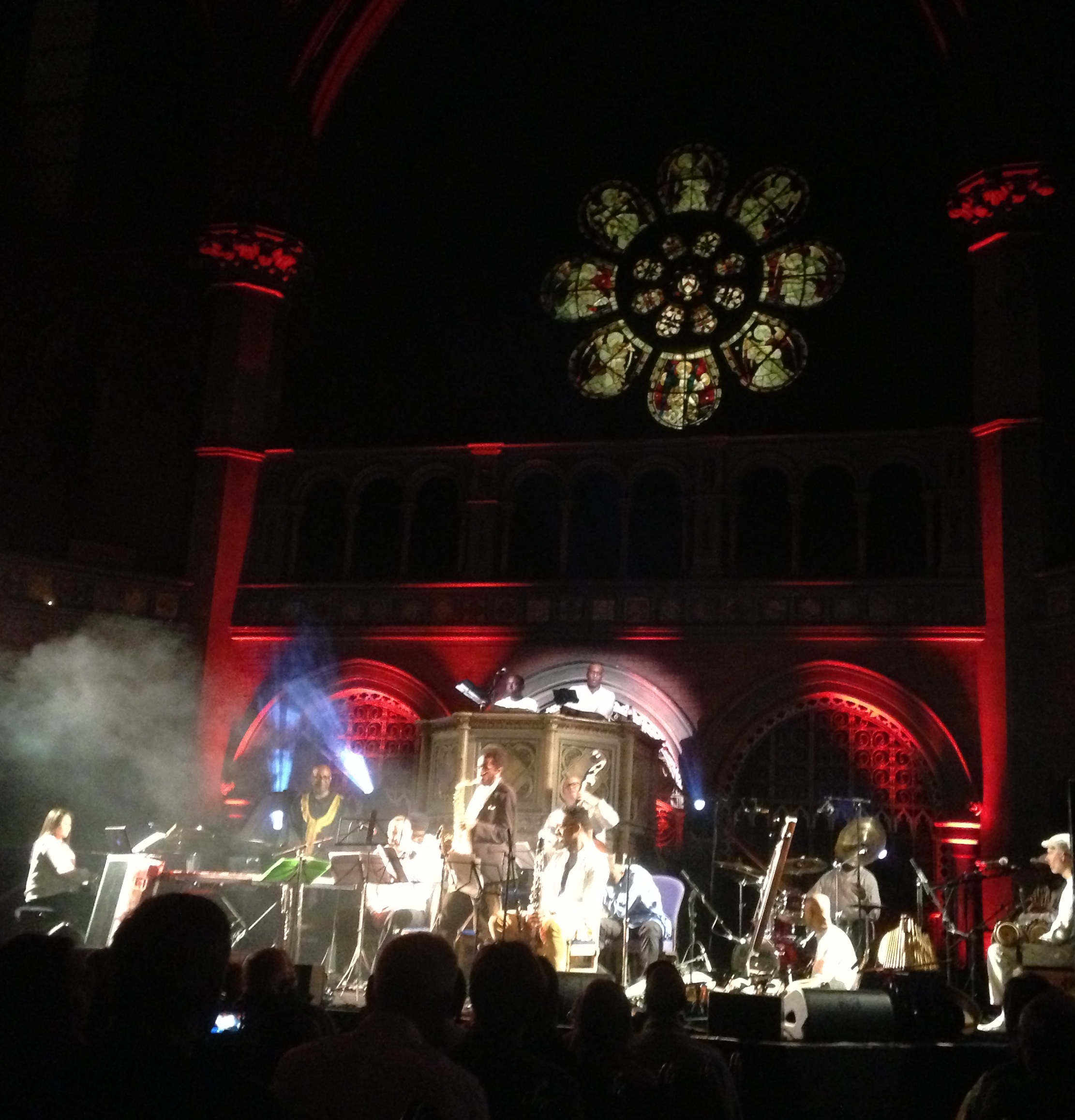
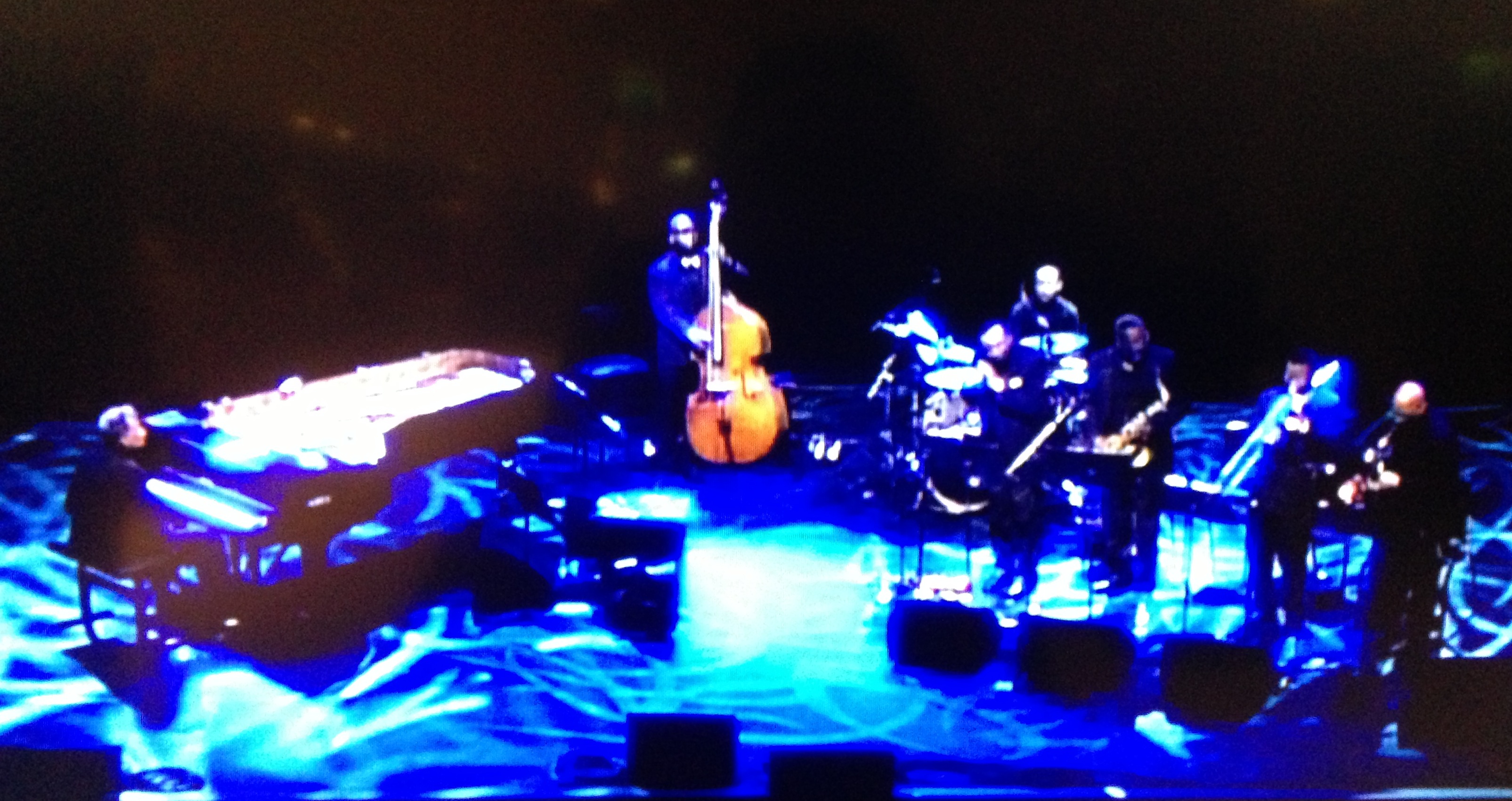
A Love Supreme 1“Welcome to the London branch of the Church of St John Coltrane,” the writer, editor and concert promoter Paul Bradshaw said, introducing last night’s event at the Union Chapel, the loveliest of the city’s performance spaces, featuring Rowland Sutherland’s Enlightenment, a large-scale “re-envisioning” of A Love Supreme.

It was 50 years to the day since Coltrane, McCoy Tyner, Jimmy Garrison and Elvin Jones settled into Rudy Van Gelder’s studio in Englewood Cliffs, New Jersey, to record their masterpiece in a single session. Sutherland’s 90-minute version involved himself and 14 other musicians working their way through an unbroken sequence of episodes that sometimes took direct inspiration from the work in question and at others explored underlying or suggested tendencies, taking in and finding ways to use the implications of Coltrane’s music both before December 9, 1965 and in the further year and a half preceding his death.

To give an idea of the richness of the resources at band, here’s the personnel: Sutherland (flute, alto flute), Cleveland Watkiss and Juwon Ogungbe (voices), Steve Williamson (tenor saxophone), Shabaka Hutchings (bass clarinet), Kadialy Kouyate (kora), Ansuman Biswas (tamboura, santoor, conch, tablas, miscellaneous small percussion), Orphy Robinson (xylosynth), Pat Thomas (keyboard, electronics), Nikki Yeoh (piano), Yaron Stavi (double bass), Mark Mondesir (drums), Crispin Ade Egun Robinson, Dave Pattman, and Ronald Thomas (bata drums, voices).

The piece began quietly with the strings of the tamboura and the kora, evoking the cultural wellsprings — India, West Africa — from Coltrane drew as he drove his music forward through the ferment of the early 1960s. Ogunbe and Watkiss recited devotional verses, starting with words from the Hindu mystic Swami Satchidananda and later using lines adapted from the 69-line poem that Coltrane included on the sleeve of the original album (“I will do all I can to be worthy of Thee O Lord…”). Watkiss scatted inventively and Ogunbe, alongside him in the chapel’s high pulpit, sang powerfully in Yoruba. Occasionally they were joined by the chants of the three bata drummers, lined up on the extreme right of the stage.

Even those who don’t get on with late Coltrane would have conceded that this ensemble brought not just passion but clarity to the methods the saxophonist used in the last months of his life, when he invited additional musicians to join the basic group (something he had been doing, in fact, since the celebrated 1961 recordings at the Village Vanguard) in order to explore the possibilities of the musical equivalent of “speaking in tongues”. This was the development of a new (to the western world) language of ecstasy and catharsis, and it continues to divide opinion.

There were strikingly effective solos last night from a poised Yeoh, a ferocious Williamson, a wild Hutchings, a volcanic Mondesir, an entrancing Robinson and a cunning Thomas (who, as my friend Jody Gillett pointed out, “likes to keep the rest of them on their toes”), from Biswas on santoor (a small Indian cimbalom), and from Stavi, who produced an improvisation that fused Garrison’s suppleness with Charlie Haden’s spiritual power, provoking an ovation from the large and attentive audience.

Waves of energy surged back and forth across the stage, separated by passages of luminous serenity. A judicious pruning of 10 minutes or so might have done no harm, but even the most hardened atheist (that’s me) would have found it difficult to remain unmoved by the depth and intensity of these musicians’ creative response to one of jazz’s great cornerstones, sharing with us its undiminished power to inspire and uplift.
Summer of ’89

Donna Summer 1I always felt Donna Summer belonged in the second tier of female soul singers, below Aretha, Gladys and Dionne and alongside Irma Thomas, Candi Staton and Dee Dee Warwick, which isn’t bad company. What she had going for her, the thing that marked her out, was a hint of sadness in her tone. Even when she was at her most exultant and ecstatic (the obvious examples being “Could It Be Magic” and “I Feel Love”), there was a darker emotional undertow. I imagine it was that sense of ambiguity which caught Giorgio Moroder’s attention back in the mid-’70s. And somehow it was rendered even more potent by the contrast with the Munich producer’s machine-tooled beats.

Long after she and Moroder had parted company, she put her name and voice to a pop-disco masterpiece that illustrates better than anything what I’m trying to describe. And it came, much to my astonishment, from the team of Mike Stock, Matt Aitken and Pete Waterman, with whom Summer decided to work after hearing the hits they’d made with Rick Astley. That was in 1987, and things weren’t going well in her relationship with David Geffen’s label. Her last hit, “She Works Hard for the Money”, had been four years earlier. Looking for a new angle, she made an album with Stock, Aitken and Waterman. But when Geffen heard it, he didn’t like it. As Waterman relates in the notes to the newly remastered and expanded reissue of Another Place and Time, the record company president asked for more guitars. Waterman, quite properly, told him where to get off and a stalemate ensued.

To break it, Rob Dickens, the head of WEA, Geffen’s European distributors, played the unreleased album to Ahmet Ertegun, who loved it. Which is how it came to be released, on the Atlantic label in the US and WEA in Europe, two years after being made. And how Donna Summer came to make her way back into the top 10 in the US and the UK with a perfectly standard, upbeat and affectless SA&W song called “This Time I Know It’s For Real”.

But the track Ertegun heard first, and the one that sold him on the project, was the one I’ve always been crazy about. Another SA&W composition, it’s called “Love’s About to Change My Heart”, a slice of pure pop-soul-disco that plays to every one of the singer’s strengths. From an out-of-tempo intro to a Moroder-ish four-on-the-floor that qualified, in 1989, as a retro gesture, aided by the producers’ meticulous attention to building and releasing tension constantly throughout the track, Summer takes a good tune and a lyric worthy of Hal David — “I’m waiting for the doorbell to chime / I always lived one day at a time / I thought that I was getting on fine / Never felt that I was alone until you changed my mind” — and soars. Give her a song like this, and she could make it sound like she’d lived it.

The three-CD reissue of the album contains many remixes and offers no fewer than nine versions of “Love’s About to Change My Heart”, which shows what a dancefloor favourite it was, even if it failed to make much noise on the charts. But the version I love is the first one I heard, the producers’ own mix for the original issue on a 45rpm single. Everything about its beautifully detailed three minutes and 43 seconds is perfect, including two moments of absolute pop transcendence created by the producers. The first comes at 2:24, when Summer is reflecting on her changed emotional state. “What did I know?” she asks, and her own voice suddenly appears from another direction, overlapping and repeating the final syllable with a gospel howl, like her subconscious mind bursting out from beneath the narrative. If you were dancing you’d throw up your arms and howl along. And then, at 3:02, the pounding 128bpm rhythm is cut for a full 10 seconds, leaving Donna and the backing choir hanging in the air, a cappella, until the beat comes crashing back in, with the choir commenting — encouraging or warning? — like a Greek chorus: “Changin’… changin’… changin’…” until Donna joins in — “Change me… change me…” and the piece starts to fade. Weirdly, that touch of genius isn’t on the album version.

Luckily, the single version is the last of the nine extra mixes on the third disc of the reissue. It’s a record I’ve loved for 25 years. In fact I’m going to play it again now, over and over again, as loud as I can get away with.

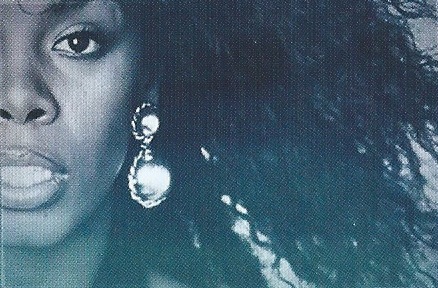
The photograph above appears on the reissue of Another Place and Time, on the Driven by the Music label, credited to the Donna Summer Archive.

Mr Brown, Mr Bart and Mr Byrd

Get On UpOn the way to see Get On Up, Tate Taylor’s new James Brown biopic, in a cinema in Victoria this week, I realised that I was walking past a construction site where once had stood the last place where I saw a performance by the film’s subject. It was the end of the 1970s, and the place was the Venue, a medium-sized joint with an uninspiring name but an excellent atmosphere. I saw all kinds of people there, from the McGarrigle sisters to Sun Ra, via Gary U.S. Bonds and Joe Ely. And the Godfather of Soul was in terrific form that night, not far past his untouchable prime.

Taylor’s movie features a fine central performance by Chadwick Boseman. He doesn’t become his character in the way Jamie Foxx became Ray Charles a few years ago, but you can’t take your eyes off him. He and the brothers Jamarion and Jordan Scott, eight-year-old twins from Mississippi who play Brown at various stages of his childhood, are tackling the story of a complex man.

There are too many artful devices — Brown talking directly to the camera, the boy suddenly appearing in place of the man in a scene from his adult life, various games with flashbacks and original footage — to make it work as a straightforward narrative. At times it seems as though the scriptwriters, Jez and John-Henry Butterworth, were influenced more by the multi-faceted approach of Todd Haynes’ I’m Not There than by traditional modes of storytelling, but they don’t go the whole way.

Like Taylor Hackford with Ray, the director of Get On Up makes the sensible decision to stick with the original music: what you see is actor-musicians miming, very convincingly, to the real tracks, from “Please Please Please” to “The Payback”. And on a cinema sound system it sounds great, particularly in a reconstruction of the scene from the 1965 teen flick Ski Party where he debuts “I Got You (I Feel Good)” (here’s the original), and in a great recreation of a Paris concert in, I think, 1971 (original here).

It’s a long film at two and a quarter hours, but even that isn’t enough in which to tell the story properly. Give the great documentary maker Ken Burns 1o hours of television time and there might be a chance. Whether or not it works in every dimension, however, Taylor’s film certainly succeeds in two areas. There’s a fruitful concentration on Brown’s relationships with Bobby Byrd, an original member of the Famous Flames who became his right-hand man, and with Ben Bart, his trusted (white) agent, who dropped dead on a golf course in 1968. And the early scenes of Brown’s life as a child — first in a shack in the Georgia pines while his parents’ relationship was falling apart, and then as a kind of mascot in a brothel — make us think about what he endured on the way to becoming one of the most influential musicians of the 20th century.

In September 1969, 10 years before that gig at the Venue, Charlie Gillett and I interviewed him (for the Record Mirror and the Melody Maker, respectively). We asked him if, at a time of continuing racial unrest in the United States, with the echoes of the shots that killed Martin Luther King still reverberating, he believed that he had some role and influence as a leader.

“If I can use my position to bring about better understanding,” he told us, “I should take advantage of the opportunity. I want people to respect other people, to see that all kinds of different people, yellow, black, are people! To see that there are all ways of living, and they can exist side by side. I hope I can help to bring people closer together.”

The day after I saw the film, riots broke out again in Ferguson, Missouri and elsewhere across the USA in response to the decision not to prosecute the white police officer who shot and killed Michael Brown, an unarmed young black man. For all its frequent moments of exhilaration, Get On Up is also a reminder that, beneath the surface, not much has really changed. Or at least much less than we might have hoped.

* The photograph is of Chadwick Boseman as James Brown in Get On Up.

A threnody for Lou Reed

lou and jzIt’s already a year since Lou Reed died. You could mark the anniversary by saving up for the new super-deluxe edition of the Velvet Underground’s third album, now expanded to six CDs through the addition of alternative mixes and live stuff, or by reading the updated version of Jeremy Reed’s biography, Waiting for the Man. Or you could make a lateral move and listen to Transmigration of the Magus, written and recorded by John Zorn in memory of his late friend.

Just released on Zorn’s own Tzadik label, the album features the composer’s well established Gnostic Trio — Bill Frisell (guitar), Carol Emanuel (harp) and Kenny Wollesen (vibes and bells) — plus John Medeski (organ), Bridget Kibbey (harp) and Al Upowski (vibes and bells). The instrumentation along gives you an idea of what the music sounds like: a bright celestial noise reflecting Zorn’s interest in the numinous and his desire to write something to help Reed’s spirit through the bardo — the Tibetan word for the transitional state between death and the next incarnation.

Somewhere beneath the profanity of Reed’s music, the sacred was always lurking — whether in the exquisite melody of  “Pale Blue Eyes” or in Songs for Drella, the lovely elegy he and John Cale wrote for Andy Warhol. It’s not hard to glimpse him in the shimmering, tinkling haze of Zorn’s heavily arpeggiated compositions, but easier still in the handful of pieces where, without breaking the poise or the delicate weave of the ensemble, Frisell and Medeski get the chance to cut loose.

At the London Jazz Festival last week I listened to Frisell and Greg Leisz playing electric guitars on “Tired of Waiting for You” and “Turn! Turn! Turn!” during the Guitar in the Space Age! show and was struck by how the silvery quality of the combined strings and a general feeling of ascension reminded me of two other partnerships: Television’s Tom Verlaine and Richard Lloyd and the Grateful Dead’s Jerry Garcia and Bob Weir. Frisell is equally wonderful here. The title track of Transmigration of the Magus is one of the loveliest and most powerful things I’ve heard all year.

* The photograph of Lou Reed and John Zorn was taken by Heung Heung Chin at (le) Poisson Rouge in New York City on September 2, 2008, at a concert in celebration of Zorn’s 55th birthday.

Lush laments in Dalston

Hakon Stene at Cafe OtoIf I had to persuade you to buy one album this year by someone of whom you’ve probably never heard, it would almost certainly be Håkon Stene’s Lush Lament for Lazy Mammal. I wrote about it here in March, and last night Stene brought his four-piece Ensemble to the Cafe Oto.

In addition to the leader on marimbas and guitars, the group comprised Tanja Orning on cello, Heloisa Amaral on piano and organ, and Sigbjørn Apeland on harmonium. They played through the compositions by Laurence Crane, Gavin Bryars and Christian Wallumrød that make up the CD, opening them up to the further possibilities inherent in the act of live performance, even when the performers are reading from a score.

Crane’s gorgeously drifting compositions, such as “Prelude for HS”, and “Blue Blue Blue”, feature dreamlike slow-motion harmonic shifts that, in these tintinnabulating interpretations, made me think of some lost blueprint for the instrumental tracks of the ballads from Pet Sounds. The same composer’s “Bobby J” — which we were told had been inspired by the Tour de France rider Bobby Julich — saw Stene apply his electric guitar to a similar format. The darker colours and hovering surges of Bryars’ “Hi Tremelo” created a mood of subdued ecstasy, while Wallumrød’s two pieces opened up the structures a little, and on one of them, called “Low Genths”, Stene made use of his second marimba, tuned a quarter-tone away from the first. In all, an hour of extremely beautiful and compelling music.

In a modest sort of way, the evening was a showcase for Hubro, the interesting young Norwegian label which released Stene’s album and has a catalogue that also includes recordings by Huntsville, the trio called 1982 (which includes the Hardanger fiddle virtuoso Nils Økland), the piano trio Moskus, Erik Honoré, and others.

An opening set was played by Sigbjørn Apeland, whose Hammond-size single-manual harmonium was placed front and centre of the performance floor so that the audience could watch his hands as he moved between gentle Nordic folk and hymnal elements, at one point tearing and folding pages from what looked like the London Overground timetable and stuffing them between the keys to create middle-register drones on which then he elaborated at the extremes of the instrument’s range. He has a new album, too. It’s called Glossolalia, and if it’s anything like last night’s recital, it will be worth investigating.

The road to Plaistow

PlaistowIf the Mercury Prize-nominated GoGo Penguin are the One Direction of contemporary piano trios, Plaistow are the Radiohead: intense, demanding, sometimes thrilling, sometimes stubborn. They’re Swiss, they’ve been playing together since 2007, and they made their London debut today in a lunchtime concert at the Pizza Express on Dean Street. For me, the event confirmed the good impression made by their new album, Citadelle, just released on the Two Gentlemen label.

They are Johann Bourquenez (piano), Vincent Ruiz (double bass) and Cyril Bondi (drums). Apparently they acquired their name from the title of a Squarepusher track to which they took a fancy. I don’t know if they’ve been to Plaistow, which is in East London, but perhaps they know that the meaning of the word, in one interpretation derived from the Old English Plagestoue, is “place of play”.

The 75-minute set began with Bourquenez doing what he does a lot, which is to use both hands in the middle register to set up roiling waves of sound (you can hear him do it on “Lisa”, from the new album, and on the title track of its predecessor, Lacrimosa). We are verging on Charlemagne Palestine territory here, and the club’s excellent Steinway responded beautifully, allowing the overtones to speak clearly. After a few minutes Ruiz and Bondi joined in, both playing simple patterns, the former repeating a single note in a 3/4 pulse against the drummer’s 2/4 cymbal strokes. Then it got complicated.

Another point of reference might be the Necks, but whereas the Australian trio improvise from a standing start at every performance, Plaistow clearly prepare their material with great care. Compound time signatures are used, as are sudden and unpredictable stops and starts, but there is no hint of the flashiness such devices usually encourage. It’s hard to say how much is improvised, but it doesn’t seem to matter. What they have in common is a gift for what, if this were pop music, you would call hooks: the repeated phrases and, particularly, the harmonic shifts that engage the listener’s emotions. Like the Necks, they make you wait so long for the shift to take place that the eventual resolution comes as an exquisite relief.

Ruiz played the quietest bass solo I’ve ever heard, barely touching the strings. Bondi broke out of the repetition to produce a wonderful series of clattering solos on “Cube”, a piece built around him (also from Lacrimosa). And Bourquenez, in addition to the waves-of-overtones thing, proved himself — on “Les Oiseaux”, a track from Citadelle — a virtuoso at the skill of using his left hand inside the piano to damp and bend the notes he was playing with his right hand, at times making the instrument sound like an oud or, as my neighbour suggested, like a cimbalom, the hammered dulcimer of Central and Eastern Europe. As with everything they did, the technique was put to good expressive purpose.

They make you think about sound and about time. They can sweep you away with a burst of lyricism or pin you to the spot. They’ve been one of the best surprises of this year’s London Jazz Festival. And the hauntingly beautiful “Orion”, from the new album, is likely to be one of my tracks of the year.

* The picture of Plaistow — left to right: Cyril Bondi, Johann Bourquenez, Vincent Ruiz — was taken by Raphaëlle Mueller.


…all that might have been…

Peter Hammill CDThe last conversation I had on the subject of Peter Hammill, several years ago, was with the novelist Nick Hornby, who upbraided me for having cost him the price of an album when he decided to act upon my warm recommendation, in the pages of the Melody Maker, for an album by Hammill’s band, Van Der Graaf Generator. This was 1970, and Hornby was 13 years old. When he got the record home and listened to it, he wasn’t happy. The resentment seemed to have lingered, although I wouldn’t suggest that this is necessarily why we haven’t spoken since.

Now, almost four and a half decades since that ill-fated recommendation, I have another one for him, also involving Hammill. The singer has filled the intervening years with activity, most of it as a solo artist and songwriter. I can’t claim to have kept a close watch on his progress, meaning that his new record, …all that might have been…, arrives as all the more of a revelation.

The album came about while Hammill was trying to assemble lyrics to go with music that he’d been putting together himself, using notes that he’d made over a period of years. He realised that he could use these fragments of observed behaviour, sidelong glimpses collected during his time as a travelling musician, to create something he’d long wanted to achieve: a series of songs that could then be fractured and reassembled in an order that would make the narrative more elusive and suggestive — more “filmic”, to use his word.

…all that might have been… comes in three different CD forms. The first, titled the RETRO, contains the original instrumental sound beds: mostly synths, guitars, bass and a bit of percussion. The second, the SONGS, consists of the 10 basic compositions. The third, the CINÉ, is the finished 40-minute tapestry of 21 linked pieces, cut up and rearranged, most of them no more than two minutes long. You can buy the latter separately, or all three together in a box.

There’s a story of sorts to the full CINÉ version, although Hammill intentionally leaves it ambiguous. We know that a man and a woman are involved, and that the viewpoint is mostly male. We can work out that, after a certain amount of ecstasy and rather more anguish, nothing ends happily.

“I’ve never been one to like dogma or absolute linearity to be at the core of songs, and I’ve always been keen on the idea of ‘show not tell’,” he writes in a sleeve essay. He describes the result as “the flickering light of things half-seen and often only half-understood.”

I’ll buy that. It’s how, inside ourselves, some of us perceive our life in the world: as a barely coherent series of events, internal and external, on which we fail to impose order and whose meaning changes according to the light, with an inevitable existential loneliness at its core. Hammill’s voice finds the right tone, or series of tones: he’s often compared to Bowie, but although he can certainly declaim his range also encompasses the sort of sensitivity associated with the Blue Nile’s Paul Buchanan. His overdubbed backing vocals function as a Greek chorus: commenting, interrupting, supporting, contradicting.

The  musical settings — mostly synths, occasional guitar, prowling bass, a sprinkling of percussion — ensure that the work never lapses into melodrama. There’s a lot of rubato but occasionally, as with “Inklings, Darling”, one of the two longer tracks, a light groove is allowed to settle. Hammill has been spending time in Japan recently, and perhaps you can hear the influence of kotos and shamisens from time to time, although never explicitly. The result is very spare, almost ambient, understated but nevertheless full of relevant incident: a partner rather than a soundtrack to the narrative. “He Turns Away”, the penultimate piece in the cycle (appearing in full as “Until” on the SONGS disc), is a thing of haunting beauty.

This feels like one of the big achievements of a long career. His devoted admirers will adore it, but it deserves a much wider audience. And if you don’t like this one, Nick, you can have your money back.

* …all that might have been… is available from Hammill’s website, sofasound.com, as a single disc or a 3CD box. My only reservation is that I wish the singer or his designer had made the lyrics more easily legible, rather than reversing them out of the photographs in the booklets that accompany the box set.

Abdullah Ibrahim at 80

Ekaya

Abdullah Ibrahim opened last night’s concert at the Royal Festival Hall with the sort of extended solo-piano reverie for which he has long been celebrated, dipping reflectively in and out of various themes, occasionally hinting at the beautifully harmonised hymn tunes that bring such balm to his listeners’ hearts. Then the great South African did something completely different, introducing a new trio in which he is joined by Cleave Guyton on flute and clarinet and Noah Jackson on cello.

For the next half an hour or so they performed a series of gentle miniatures, containing little improvisation but concentrating on the close inspection of a limited tonal palette when applied to an equally restricted emotional range: the tempos were slow to medium, the dynamic range seldom venturing beyond a polite murmur. It was like walking slowly past a series of small, pale-hued watercolours of the same landscape, viewed from slightly different vantage points. That doesn’t sound very exciting. But it contained enough of Ibrahim’s seed to hold the attention, even in the occasional moments when the intonation of the cellist or the clarinetist wavered slightly.

The second half of this EFG London Jazz Festival concert saw the three men (with Guyton switching to alto saxophone and Jackson moving to double bass) joined by the other members of the latest edition of Ekaya, the septet whose membership has shifted on a fairly regular basis since Ibrahim created it around 30 years ago: Andrae Murchison (trombone), Lance Bryant (tenor saxophone), Marshall McDonald (baritone saxophone) and Will Terrill (drums).

The concert had been introduced by a Radio London presenter who promised the audience that they were in for a helping of townships jazz, suggesting that dancing would be on the agenda. But that is not what Ekaya do. Their music is characterised by an air of restraint that guides its lyrical exploration of the timbres created by the combination of its four horns.

It was fascinating to hear the softly stabbing figures of “Nisa” played by this line-up, in which Bryant occasionally stepped forward to reveal himself as a front-rank improviser of concise inventiveness and great authority. Confounding stereotypes, the stealthy “Calypso Minor” — which first appeared in Ibrahim’s soundtrack for Claire Denis’s 1990 film No Fear, No Die (S’en fou  la mort) — could have been something cooked up by, say, Johnny Mandel for a Hollywood thriller in the 1950s.

At times throughout the set there were hints of the bejewelled miniatures created by Ellington’s small groups of the ’30s. And when the rhythm section laid out on an acapella version of “The Wedding”, the mind turned back to the horns-only version of “Abide With Me” recorded by Thelonious Monk. In his brief piano opening to the encore, as if to reaffirm his allegiances, Ibrahim alluded briefly to Monk’s “Crepuscule With Nellie” and Ellington’s introduction to “Take the ‘A’ Train”.

Like all great jazz musicians, Abdullah Ibrahim metastasised the sources of his inspiration in the process of developing his own voice. At 80 he remains one of the most powerful and distinctive composer-performers in jazz, even when the dancing is being done in your head.

Mingus fingers

Whahay 1About 20 minutes into Whahay’s set at the Vortex last night, Paul Rogers dug out a small steel cylinder and slipped it over the little finger of his left hand. A few seconds later he was playing bottleneck double bass: a fantastic sound.

It helped that he was playing his seven-string instrument, a beautiful thing with sloping shoulders, custom-built for him by a luthier in Nîmes. The fifth string is where the extra string on a five-string bass can usually be found, tuned to B, a fourth below the lowest string on a conventional instrument. The sixth and seventh are at the upper end of the register, tuned to C and F. It also has 14 sympathetic strings, set longitudinally under the bridge and the tailpiece.

The result bears some resemblance to a medieval viola da gamba, or the Italian viola bastarda of the 16th and 17th centuries. And in Rogers’ hands it can sound not just like a contrabass but like a cello, a lute, an oud, a finger-picked acoustic guitar, and sometimes — when he grips the strings with the fingers of both hands before wrenching them violently away in opposite directions — like an explosion in a factory making industrial-strength rubber bands.

Rogers moved to London from his native Chester in the mid-’70s and was regular on the British improvising scene, notably in various groups with Keith Tippett, John Stevens, Elton Dean and others, for more than a decade before moving first to the US and then to France, where he has lived since 1992 (currently in Le Mans). He had the seven-string bass made because he wanted something lighter and more travel-friendly than his usual instrument, but it has given him an enlarged vocabulary that is brilliantly displayed in the context of his current group.

Whahay is a trio in which Rogers is joined by the tenor saxophonist and clarinetist Robin Fincker, who was born in France but has lived for several years in London, where he is a member of the Loop Collective, and the drummer Fabien Duscombs, who first met Fincker when they were both studying in Toulouse. Their newly released debut album applies the techniques of free improvisation to the music of Charles Mingus, a project they’ve been working on for a couple of years.

Here’s a way of describing their sound and approach. If you drew a line from Mingus’s Blues & Roots to Albert Ayler’s Spiritual Unity, and called the distance x, and then continued the line until it reached Whahay, the distance between the first and third points would be something like 2.5x. That’s an attempt to explain the method by which Mingus’s tunes — including “Better Git It In Your Soul”, “Bird Calls”, “Ecclusiastics” and “Pithencanthropus Erectus” — are subjected not just to extreme abstraction but to the extended instrumental techniques that have evolved since Ayler’s heyday in the mid-’60s.

The album is terrific, but the gig was an absolute monster. After a slightly muted start, in which they sounded unexpectedly pastoral (more like a Jimmy Giuffre trio than an Ayler band), the three musicians hit their stride and didn’t pause for an hour, moving in and out of time, slipping easily from three-way conversations to duos to monologues, picking up cues with near-telepathic perception and showing how far they have advanced their interplay since the album was recorded in the spring.

Duscombs is an unusual player who seems constantly intent on taking his kit by surprise: his sticks appear to recoil from the playing surfaces, pulling the sound out of the startled drums and cymbals rather than hammering it in. Fincker, the least obviously assertive member of the group, is a hugely resourceful improviser who always found something interesting to add. Rogers was consistently astonishing in his combination of physicality and delicacy, whether sawing away with his big German bow or using all his fingers to tap out a filigree of shimmering harmonics.

What would Mingus have thought of it all? He was notoriously sceptical of free music. One summer’s day in 1972, over lunch at a table outside a cafe in Shepherd Market, he gave me a version of his standard line: “Some painters draw seriously, they draw precise lines and certain perspectives that correspond with something you’ve seen before. Then you get guys who throw paint at a canvas, throw some sand on top of it, and they say they paint. Some people let monkeys and little children use their fingers on it, and they call it good painting.” He looked up from his oxtail soup and glared at me. “It’s time for guys like you to decide what you want: bullshit, or something real.”

What Paul Rogers, Robin Fincker and Fabien Duscombs did last night was real enough. I think Mingus would have loved it.

* Whahay is distributed in the UK by the Babel label.

Blue Note at 75

Blue Note favouritesThis morning’s Guardian carried a prominent story announcing a collaboration between the record producer Mark Ronson and the novelist Michael Chabon, accompanied by a photograph of the two men casually posing against a display of Blue Note album covers: a couple of early Hank Mobleys, Sonny Clark’s Cool Struttin’ and Dial ‘S’ for Sonny, and Kenny Dorham’s Afro-Cuban, all conferring a sense of impeccable cool. All very collectible, too, in their first-pressing incarnations. One of those Mobleys — this one — apparently went for $5,600 in an auction not long ago.

Blue Note albums always seemed like pieces of art as well as a delivery system for great music. Francis Wolff’s fine photographs and the brilliant eye of the designer Reid Miles were combined with the use of thick card for the sleeves and, for the pressings, what seemed like twice as much unadulterated vinyl as the label’s competitors in order to enhance the sound lovingly captured by the microphones of Rudy Van Gelder. Something like Joe Henderson’s Page One or Grachan Moncur III’s Some Other Stuff has a special charisma; you know it when you look at it and you feel it when you hold it; actually listening to it is almost a bonus.

I’m not obsessive about such things myself, but it never surprises me that others happily devote themselves to the minutiae of Blue Note’s label copy, inner sleeves and run-off groove inscriptions. These albums are beautiful and precious artefacts, demanding the appreciation of the eye and the mind as well as the ears. And that’s certainly how I feel about the half-dozen I’ve assembled above, each a personal favourite from the label’s golden age (and all but one, I think, a first pressing…). A list of others for which I harbour a special fondness would include Sam Rivers’ Fuschia Swing Song, The Prophetic Herbie Nichols Vols 1 & 2, Wayne Shorter’s Night Dreamer, Stanley Turrentine and the Three Sounds’ Blue Hour, Lee Morgan’s Tom Cat and Sonic Boom, Larry Young’s Into Somethin’, Tina Brooks’s True Blue and Back to the Tracks, Grant Green’s Street of Dreams, Horace Silver’s Blowin’ the Blues Away, Eddie Gale’s Ghetto Music and Jackie McLean’s One Step Beyond. And about a hundred more.

Blue Note celebrates its 75th birthday this year, commemorating the initial success of Alfred Lion, a young German Jew who had recently left Berlin for New York, in persuading two great boogie-woogie pianists, Meade Lux Lewis and Albert Ammons, to make the first recordings for the company whose name he had registered in March 1939. Before the end of the year Lion was joined by Francis Wolff, a friend from Berlin and another refugee from the Nazis. Together they gradually built a label that would become a pillar of jazz, a symbol of the music at its most fully realised.

Uncompromising Expression is Richard Havers’ illustrated biography of the label, published this week. The author — a consultant to the Universal group, the current owners of the catalogue — tells the story from boogie-woogie and Sidney Bechet through Thelonious Monk and Clifford Brown, Art Blakey and Horace Silver, Jimmy Smith and Lou Donaldson, Lee Morgan and Tina Brooks, Herbie Hancock and Donald Byrd, Freddie Hubbard and Wayne Shorter, Stanley Turrentine and Baby Face Willette, Jackie McLean and Andrew Hill, all the way to the present day of Norah Jones, Robert Glasper, Gregory Porter and Ambrose Akinmusire. If it’s not as deep and detailed as the late Richard Cook’s Blue Note history, published in 2001, its physical form is quite different from that modestly proportioned and text-dominated volume.

A Blue Note album has a special charisma, and Havers’ designer does a wonderful job of reflecting Reid Miles’s graphic genius in the large-format layout of the book. Among the most stunning pages are the early spreads consisting of dozens of sleeves, grouped together by some of Miles’s favourite visual themes: the moody combination of blue and green type against a black background, the use of brash typography and brutally cropped photographs against white, the occasional fondness for scarlet. There are also pages from Lion’s session notebooks and several of Wolff’s contact sheets.

Perhaps it’s not the book for people whose primary interest lies in tracking down copies of the original vinyl albums with the 47 W. 63rd Street address on the sleeve or the “RVG” stamp on the run-out. For the rest, including those of us happy to mop up this great music for £3 a time on CD at Fopp, it’s one of the treats of the year.

* Richard Havers’ Uncompromising Expression is published by Thames & Hudson (£48). Havers will be talking to Don Was, the label’s current president, on November 22 at the South Bank Centre as part of the EFH London Jazz Festival (tickets here). That night at the Festival Hall a celebratory concert features representatives of the label’s current roster, including Robert Glasper and Jason Moran.