Art Ensemble at Cafe Oto
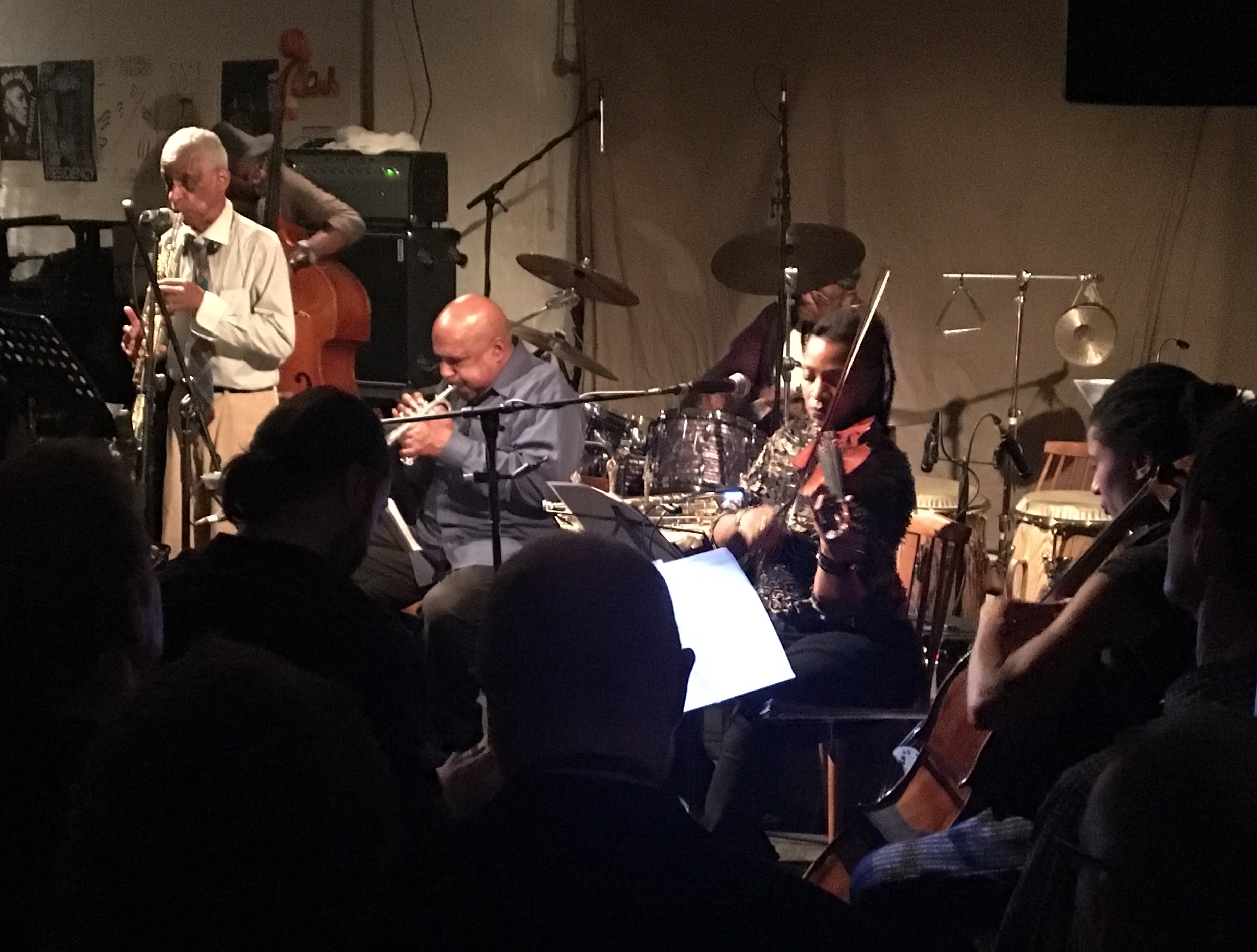 Amid the strangest weather in 30 years, with sand from the Sahara and dust from Iberian wildfires turning the air in London dark red at lunchtime on the hottest October 16th since records were first kept, there was another surprise awaiting the audience for the second of the Art Ensemble of Chicago’s three sold-out nights at Cafe Oto this week.
We had bought tickets expecting the regular four-piece line-up of the current AEC: co-founder Roscoe Mitchell (saxophones) and long-time member Famoudou Don Moye (drums and percussion) plus trumpeter Hugh Ragin and double bassist Junius Paul. What we encountered was the band extended to a septet by the presence of Mazz Swift (violin and vocals), Tomeka Reid (cello) and Silvia Bolognesi (double bass, the only one not visible in the photograph above). It was a special treat.
As you would expect, the unbroken 80-minute performance was a mixture of the prepared and the spontaneous, moving easily through contrasting ensemble passages which gave way to solos from each of the participants. The extra string players never felt like a bolt-on extra: they were fully integrated into the ensemble, playing equal roles in the composed passages, in the textured backgrounds and in the long, boilingly intense collective improvisation which prefaced the sign-off with the familiar descending cadences of “Odwalla”.
Mitchell played an astonishing sopranino solo during which he manipulated rapid sequences of harsh cries against a sustained whistling sound. Ragin alternated between regular and pocket trumpets, four-valve cornet and flugelhorn with unfailing relevance. Paul’s wonderfully emotional solo and his fast walking 4/4 with Moye in one passage evoked the spirit of the late Malachi Favors. On the opposite side of the stage, Bolognesi responded with an improvisation making energetic use of the bow. Swift sang with restrained warmth and she and Reid both left, in their solos and in the ensemble, the impression of instrumentalists of great character and inventiveness, virtuosos of unorthodox techniques and startling effects that contributed to the overall scheme. Throughout the set Moye reminded us of what wonderfully subtle and propulsive drummer he is.
The two sustained standing ovations that greeted the end of the set and the brief hymn-like encore were the equal of anything I’ve heard at Cafe Oto. It was an unforgettable end to a day marked by natural wonders.
 It’s been my experience that no time spent checking out the Kronos Quartet’s latest activity is ever wasted, and the group’s new album, Ladilikan, in which they accompany Mali’s Trio Da Kali, is a beauty. The meeting between the voice of Hawa Diabaté, the balafon of Lassana Diabaté and the bass ngoni of Mamadou Kouyaté and the violins of David Harrington and John Sherba, the viola of Hank Dutt and the cello of Sunny Yang turns out to sound like something that has always existed, somewhere in the universe.
 Jazz never had a more faithful friend than John Jack, who died on September 7 and whose life was celebrated at the 100 Club yesterday, following a committal at the Islington and Camden/St Pancras crematorium. Among those musicians and poets queuing up to pay tribute by through performance were Mike Westbrook and Chris Biscoe (pictured during their duet), Evan Parker and Noel Metcalfe, Jason Yarde and Alexander Hawkins, Steve Noble (with Hogcallin’, one of John’s favourite British bands), Pete Brown and Michael Horovitz. Many others were present, along with scores of faces familiar from countless nights in dozens of clubs down the years, all of us having trouble believing that we won’t be seeing John again with his beloved Shirley at their usual table in the Vortex.
 As the shops started to close and the street-food vendors began to disperse, twilight was falling on Deptford High Street. Arriving an hour early for last night’s concert by Mike Westbrook’s Uncommon Orchestra at the Albany Theatre, I heard a strange sound and walked towards it.
 Even though it meant missing the first set of Michael Gibbs’ 80th birthday concert at the Vortex, the idea of hearing Donald Fagen’s first solo album played by the new intake of students on the jazz course at the Guildhall School on Monday night was impossible to resist. The Nightfly is a wonderful album, made by a man in early middle aged in the era of Reagan looking back at how things felt as the era of Eisenhower shaded into that of Kennedy, in that brief period of illusory optimism when prosperity and progress seemed to be the prevailing forces, before the Cuban missile crisis, the civil rights marches and the Vietnam protests took over. I thought it might be interesting to see how it sounded in the era of a president whose name I don’t even want to type out on this blog.
 Two years ago I presented Cécile McLorin Salvant and her trio at the Berlin jazz festival. At that point, most of the audience hadn’t heard of the young Franco-Haitian singer who was brought up in Miami before studying classical and baroque music at the conservatory in Aix-en-Provence. To say they were impressed by her performance would be an understatement.
 thebluemoment.com