Han Bennink at Cafe Oto
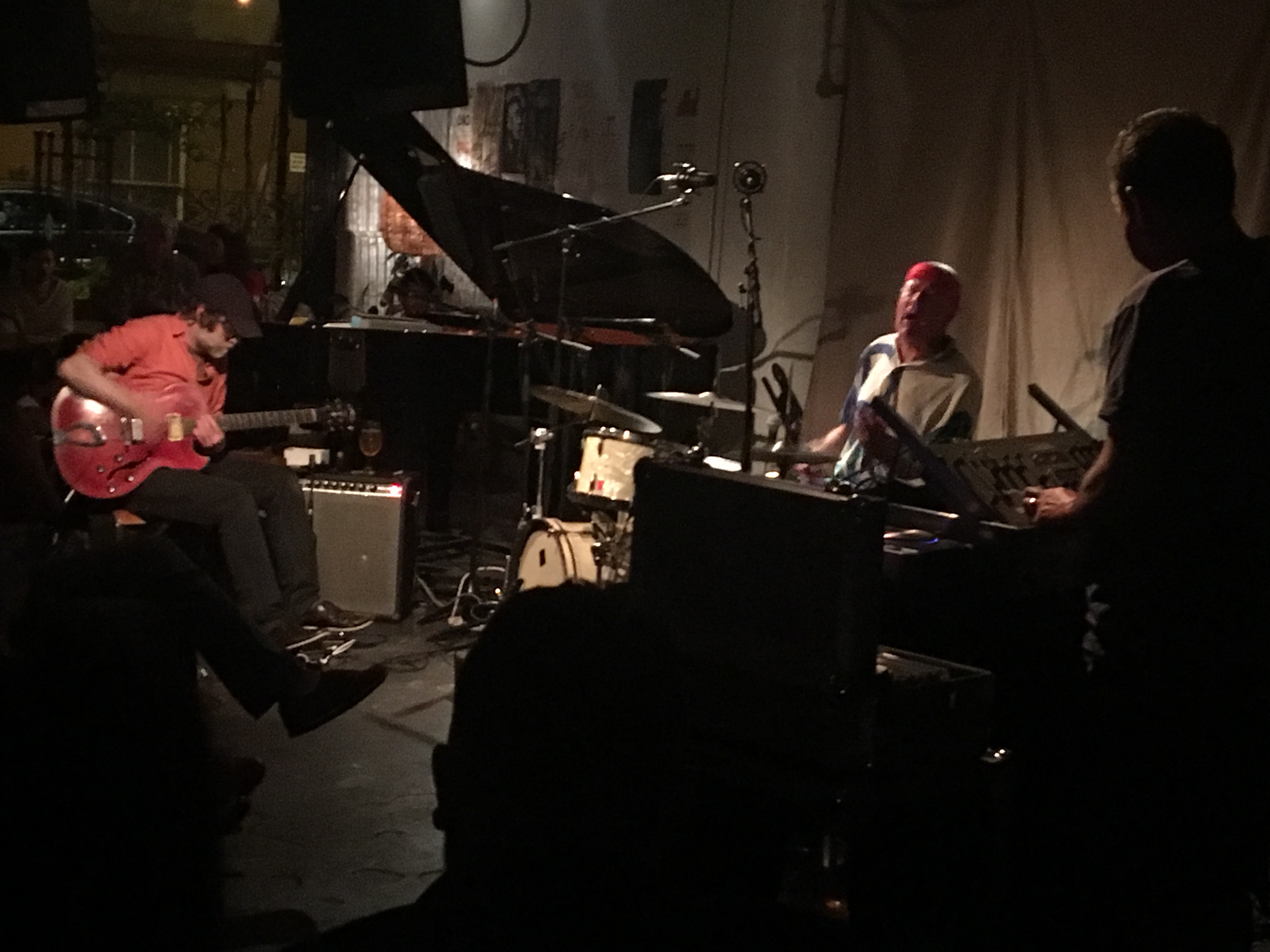
Cafe Oto, 12 August 2017: John Coxon, Han Bennink and Ashley Wales
The great Dutch drummer Han Bennink is famous for his anarchic humour and his resistance to orthodoxy: he’s known for using the heel of his boot to alter the tone of his drums on the fly, and for finding the music in the scenery of a club — if there are pillars or heating pipes in the vicinity, he is likely to start playing them. He has an unparalleled gift for terminating a collective improvisation with a slap of two pieces of metal or the sort of rimshot that brooks no negotiation. What’s sometimes overlooked is his ability to swing in the traditional meaning of the term. Of all the European drummers to emerge in the modern era, maybe only Phil Seaman commanded the same deep sense of swing.
But he’s always been a hard man to pin down. I first heard him with the German tenorist Peter Brötzmann in Berlin in 1969, playing the most uncompromisingly loud and violent free jazz you could imagine. Maybe 20 years later I heard him in Paris with a band led by the Italian trumpeter Enrico Rava, playing the music of Louis Armstrong’s Hot Five and Hot Seven, and you could tell that here was a man with a profound understanding of what Baby Dodds had been up to.
On Saturday, Han ended a three-night Cafe Oto residency in celebration of his 75th birthday with a series of collaborations in which his partners were the two men, the guitarist John Coxon and the electronics exponent Ashley Wales, together known as Spring Heel Jack; two guests from Amsterdam, the American violinist Mary Oliver and the Dutch guitarist Terrie Hessels, also known as Terrie Ex; and the pianist Steve Beresford. Amid the swirling anarchy, there were many moments when you could detect traces of the drummer who served a conventional rhythm-section apprenticeship with such visiting American giants as Eric Dolphy, Dexter Gordon and Wes Montgomery.
Since then Han’s career has taken him through countless collaborations. He first appeared with Coxon and Wales on Amassed, an early Spring Heel Jack studio album, in 2002. The following year they took him on a short Contemporary Music Network tour of Britain, along with the saxophonist Evan Parker, the pianist Matthew Shipp, the bassist William Parker and the guitarist J. Spaceman (Jason Pierce, with whom Coxon played in the band Spritualized). I saw that fascinating line-up give an epic performance at the Queen Elizabeth Hall — particularly in the second half, which began with a hyperactive duet between drums and bass and reached its climax in a long passage of richly textured improvisation over a mesmerising sequence of slowly descending piano chords that seemed, like an Escher staircase, to have no end. An album titled Live was assembled from the tour’s concerts in Bath and Brighton, and contains a version of that second half.
On Saturday, Han began with a trio set but soon left Beresford and Oliver to their own devices, listening from a chair at the side of the stage as they created a graceful two-part invention. Then the drummer was joined by Spring Heel Jack, creating a very different type of trio, the music constantly changing colours and momentum, restless but intensely satisfying (I loved a passage in which Coxon suddenly started running close-voiced jazz chords on his cherry-red Guild Starfire). Eventually Hessels, a member of the Dutch band the Ex, joined in, energetically lunging and retreating as he added jagged bursts of post-Hendrix noise.
After a third set in which the musicians joined in one by one until all six were together on stage, Han closed the evening with a short unaccompanied piece: brusque, urgent, very physical, unmistakably him but also unmistakably in the lineage of solo pieces by Dodds, Papa Jo Jones and Max Roach. This is a musician who stretched the vocabulary of his instrument, even changed it, while honouring and preserving the music’s essence.
 I’ve been reading Message to Our Folks, Paul Steinbeck’s new biography of the Art Ensemble of Chicago, and enjoying in particular the reminder of the impact the group made when they arrived in Europe in the spring of 1969. Their voluntary exile lasted a month short of two years, ending with their return to the US in April 1971. During that time, which was mostly spent in France, they made some important albums (including A Jackson in Your House, Message to Our Folks, the epic People in Sorrow and the soundtrack to the film Les Stances à Sophie) and participated in several significant events, including the five-day Actuel festival in Amougies in October 1969 — intended, as Steinbeck observes, to be continental Europe’s answer to Woodstock and the Isle of Wight — and Joachim-Ernst Berendt’s Free Jazz Meeting in Baden-Baden two months later, where they encountered Kenny Wheeler, Terje Rypdal, Albert Mangelsdorff and many others. They also met the drummer Don Moye, who became their fifth member.
 If you want to convince someone — even yourself — that Bob Dylan is a great singer, a place to go might be “Brownsville Girl”, an 11-minute epic from the otherwise threadbare 1986 album Knocked Out Loaded. More specifically, attend to the first line of the penultimate verse, at 8:51. “Strange how people who suffer together have stronger connections than those who are most content,” Dylan sings in a ruminative and rueful tone, delivering the line in a single breath, exhaling the sentence in such a way as to create a complete design, the internal rhythm gently coiling with a sing-song inflection and a slight but telling deceleration on the last four words, making the sense of it linger after the sound has moved on.
 I’m going to make no apology for returning to the subject of John Coltrane so soon after writing
  If you wanted to isolate an individual moment that summed up the curious position of the Beach Boys vis à vis the changing modes of youth culture in 1967, you might come up with the one in “Darlin'”, a single released in that pivotal year, when Carl Wilson sings a phrase written by Mike Love which lands precisely in the space between a letterman’s sweater and a paisley kaftan, between the disappearing culture and the emerging one: “You’re so doggone outtasight…”
 John Coltrane died in a Long Island hospital 50 years ago today. The singularly beautiful photograph above is by the great Roy DeCarava and was included in his wonderful book, The Sound I Saw. It was taken in 1960, and the figure dimly visible in the background is Elvin Jones.
 One of the things I love about Haruki Murakami’s fiction is the way he uses music to enrich the narrative: all kinds of music, from Haydn to the Beach Boys via Brenda Lee and Sly Stone. But jazz is his main thing, and my favourite example is probably the appearance in South of the Border, West of the Sun of Duke Ellington’s “The Star Crossed Lovers”, the gorgeous saxophone duet for Johnny Hodges’ alto and Paul Gonsalves’ tenor from Such Sweet Thunder, Duke’s 1957 suite on Shakespearean themes.
 thebluemoment.com