If I were given the freedom to design a place at which people could gather for the purpose of playing and hearing music, it would probably end up very much like Cafe Oto. Some of the Dalston venue’s features include an entrance straight off an interesting side street, chairs and tables on the pavement for use during the intervals between sets, large picture windows to give passers-by a glimpse of the goings-on inside, an informal and intimate performance space with no stage, with discreet lighting and perfect sound, a good piano, the option to sit or stand, unselfconscious interaction between musicians and listeners, excellent refreshments, bike parking. And, most important, an audience equipped with open ears and minds, not drawn from a single demographic.
Some of the best musicians in the world can be heard at Cafe Oto, usually for not much more than a tenner, and the atmosphere is such that I’ve never seen any of these distinguished figures — including Roscoe Mitchell, Marc Ribot, Annette Peacock, John Tchicai, the Necks and Louis Moholo-Moholo — give less than their absolute best. Maybe I’ve just been lucky in that respect, but I doubt it. In such ideal surroundings for improvised or otherwise adventurous music, what kind of musician would fail to produce a wholehearted response?
Cafe Oto is currently celebrating its 10th birthday, and two recent events fully illustrated its position in London’s creative musical life. The first was the latest of the club’s three-day residencies, this one granted to the pianist and composer Alexander Hawkins, whose breadth of knowledge and interests guaranteed that he would make the most of the opportunity to stretch out and create a diverse programme.
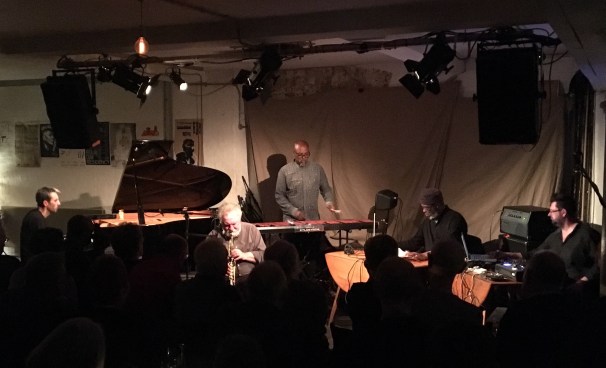
I went on the second night, opened by Hawkins in duets with the tenor saxophone of Evan Parker. Over the course of almost an hour the music came from many tangents and explored several different modes of collaboration: matched invention, accompaniment, dovetailing, even collision. For the second set (see photograph above) they were joined by Orphy Robinson (Xylosynth), Pat Thomas (Theremin-synthesiser), and Matthew Wright (laptop and turntable). Parker switched to soprano, and there were times when it seemed as though the others were providing a setting for him. Nothing to do with ego: that’s just how the music settled. The textures were fascinating and often beguiling, particularly when Robinson was using a bass-marimba effect to provide a slowly tolling background pulse. I was sorry to miss the third night, when Hawkins’s guests included the marvellous drummer Gerry Hemingway.
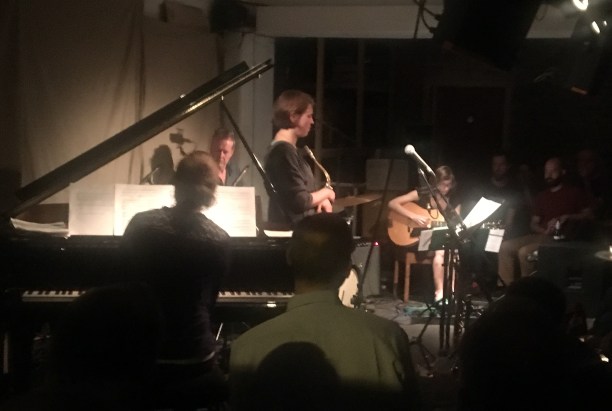
This week it was the turn of Ingrid Laubrock, the German-born saxophonist who came to London in 1989 to study at the Guildhall and stayed for almost 20 years before moving to Brooklyn in 2008. The first band she formed there, Anti-House 4, with Kris Davis on piano, Mary Halvorson on guitar and Tom Rainey on drums, played at Cafe Oto on Monday and Tuesday; they stunned everyone present with the impact of music which is carefully wrought but retains the best qualities of free improvisation. I was so struck by the first night’s music that I booked myself straight back in for a second helping.
Each of the individuals is a virtuoso. Laubrock now belongs in the very highest class of improvising saxophonists, blending outright ferocity with hints of the elegance absorbed from her study of Warne Marsh. Davis has a lot of Cecil Taylor in the bones of her playing, but she also makes me think instinctively of George Russell’s piano playing: those beautiful stretched arpeggios, sometimes broken, sometimes in contrary motion, enunciated with a touch poised between firm and hard, like a 2H pencil. Rainey is a master drummer who can make playing with a stick in his right hand and a beer bottle in his left seem the most logical of propositions. And Halvorson is in such command of the promptings of her remarkable imagination that, as her lines and chords slip and warp and overlap, she can convince you that there must be a second guitarist hidden away somewhere (at different times I imagined that phantom alter ego to be Derek Bailey, Link Wray or Kenny Burrell).
But it was as a collective that they left their deepest impression, thanks to Laubrock’s developing gift as an organiser of music. Her compositions are complex but seldom sound that way: there is no twiddling. The occasional hurtling unison passage grows naturally out of the improvisations, while the endings are often deliciously unexpected. One piece ended a couple of brief, cryptic phrases, guitar following piano, dissolving into silence, as if the music’s final traces had been blown away by a last puff of wind. That was every bit as dramatic as the piece with which they opened the first night: a sequence of violent stabs of sound that would have put any death-metal band to shame.
The second night began with unaccompanied improvisations from all four players, and it is a sign of the strength of the quartet’s character that this sequence never sounded like a series of solos. Even when only one person was playing, the music was that of a band — part of an overall scheme that has taken 10 years to emerge as something genuinely extraordinary, and whose fruition was enthusiastically appreciated by the audience. Perfect, of course, for Cafe Oto, one of those rare spaces that go beyond the simple function of presentation to achieve something more valuable, by providing encouragement and inspiration to creative musicians. In other words, a home.