Skip to content

Olie Brice at the Vortex

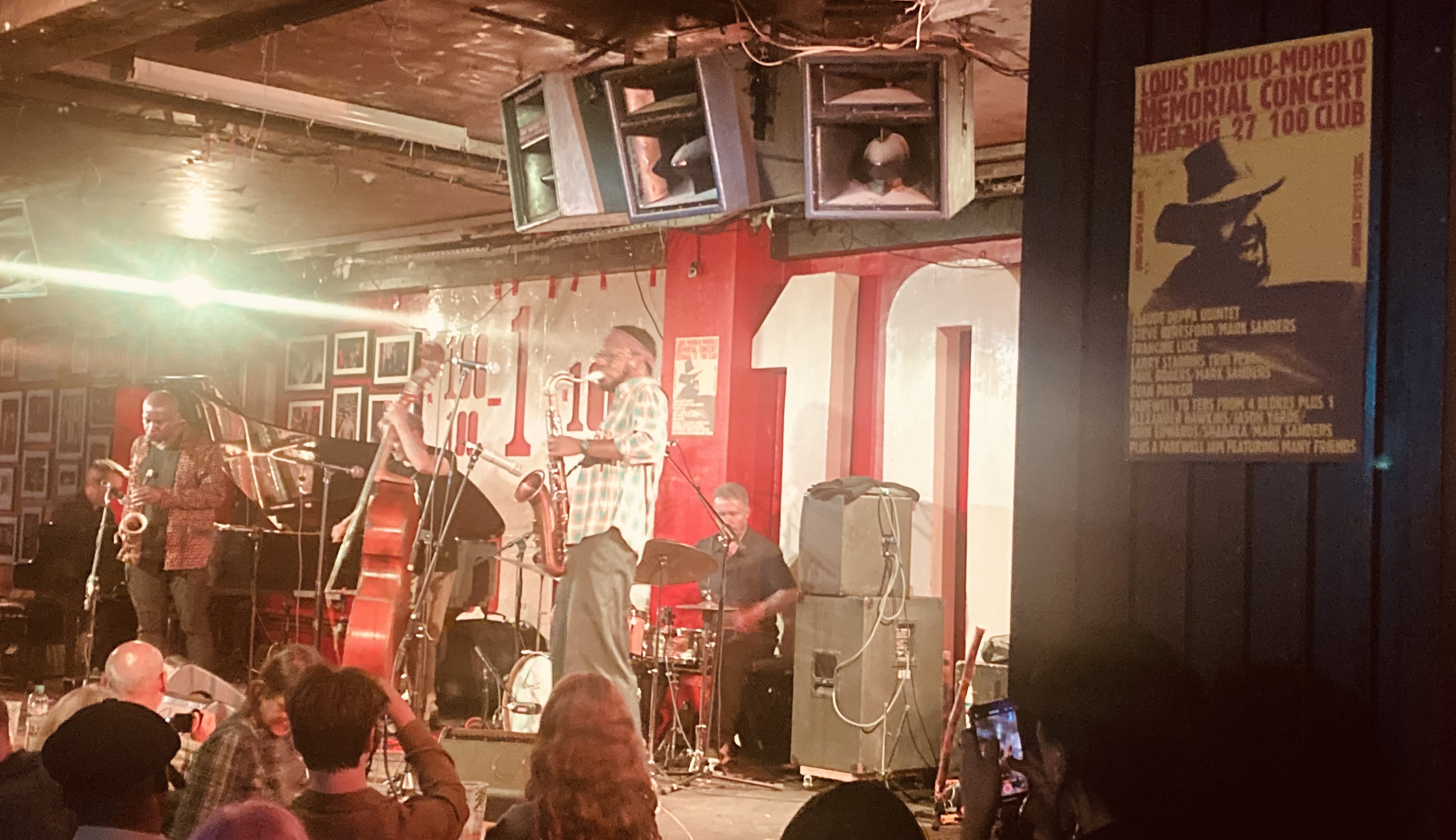
Almost a year ago I wrote warmly about the debut of the bassist and composer Olie Brice’s new quartet at Cafe Oto, noting that they’d be going into a studio the following day to record an album. That album — titled All It Was — is now out, its release celebrated at the Vortex last night with an evening of powerfully emotional music.

The tenor saxophonist Rachel Musson, the pianist Alexander Hawkins and the drummer Will Glaser are Brice’s accomplices in a project that takes all the lessons the four of them have ever learnt about how to play this music and puts the result at the service of a set of distinctive and memorable compositions.

Brice tends to lead off in the way Charles Mingus used to, with solo bass statements of attention-grabbing clarity and strength before the others dive into the structures of pieces such as “Listening Interntly to Raptors” (which began the set with a Monkish prowl), the soaring, hard-swinging “Happy Song for Joni”, the hypnotic “And We Dance on Firm Earth”, and the pointilliste “After a Break”.

A couple of of the pieces referred to recent losses. “Morning Mourning” was an elegy for Brice’s father, while Don Cherry’s “Awake Nu” was included as a tribute to Louis Moholo-Moholo, who died in South Africa last month. Fittingly, Glaser’s playing throughout the evening was lit by Louis’s fire: dense but never oppressive, building to ecstatic climaxes, particularly in several duet passages with Hawkins, who occasionally infiltrated almost subliminal elements of barrelhouse and boogie-woogie into his strongly percussive inventions.

Once again Musson impressed as one of the most creative saxophonists on the UK scene, employing a striking variety of tone and trajectory, from jagged outbursts at full throttle to the delicate altissimo phrases with which she brought one piece to its final rest.

That combination of grace and strength typified the assimilation of individual assets into the work of a truly extraordinary quartet. All It Was will be one of the records of the year, and this was a gig to match its excellence.

* The Olie Brice Quartet’s All It Was is on West Hill Records and available via Bandcamp: https://westhill.bandcamp.com/

Café Society in wartime

`

I imagine I picked up a copy of Life magazine’s edition of October 16, 1944 from a flea market many years ago because its cover featured the 20-year-old Lauren Bacall, making her screen debut in To Have and Have Not opposite Humphrey Bogart: “Midway through the first reel the sulky-looking girl shown on the cover saunters with catlike grace into camera range and in an insolent, sultry voice says, ‘Anybody got a match?'”

But along with that, I got something that now seems much more interesting.

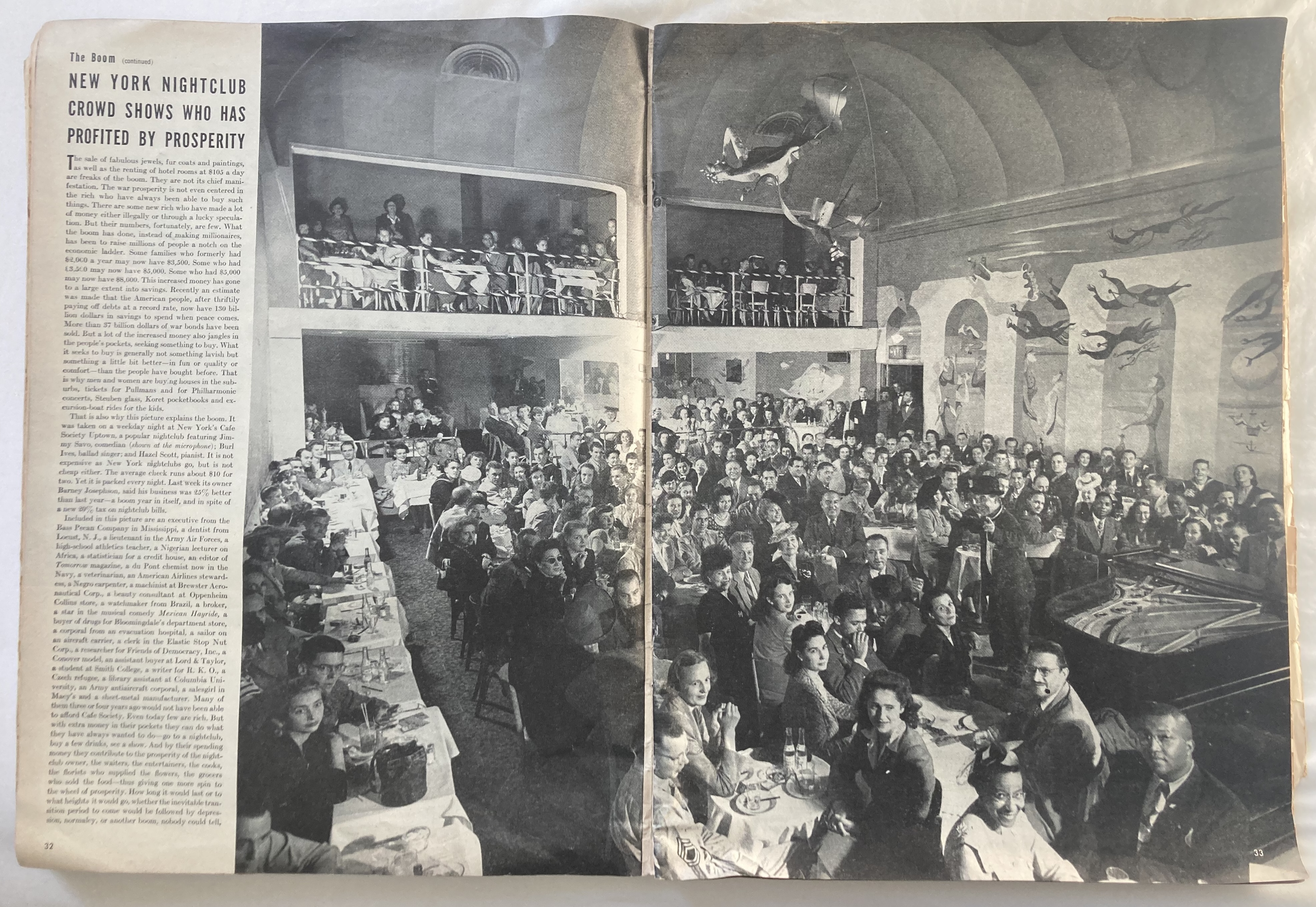
Between full-page ads for Packard and Pontiac cars, Texaco oil, Budweiser beer, National Dairy, Stromberg-Carlson radios and Chesterfield cigarettes, all using the military as a motif and/or urging citizens to buy war bonds, there’s a story describing how, in New York, “hotels are booked solid for weeks in advance and guests spend more money” and “the boom reaches a peak in the sale of luxury goods at department stores.” In a month when Allied troops are fighting their way into Germany, this is part of report on the vigorous economic upsurge created by the US participation in the Second World War.

To illustrate the upbeat mood, the editors present a double-page spread on a flourishing nightclub, Café Society Uptown. Located on East 58th Street, between Lexington and Park Avenues, it’s an adjunct to the original Café Society on Washington Square in Greenwich Village. Both were run by Barney Josephson, who booked Billie Holiday for opening night in 1938 at the Village establishment, where she would sing “Strange Fruit” for the first time a year later. The second club opened in 1940. Both were notable for the welcome they extended to all races.

The current attractions at the East 58th Street joint in the autumn of 1944 were the fine jazz pianist Hazel Scott, the folk singer Burl Ives and the comedian Jimmy Savo, who can be seen at the microphone. Higher wartime wages meant that business was up 25 per cent on the previous year, so Josephson told the magazine, and patrons were spending an average of $10 a head.

I could spend hours scanning the faces looking up at the lens deployed at a high angle by Herbert Gehr, a German-Jewish photographer who had escaped Nazism and photographed the Spanish Civil War before arriving in the US, where he joined the staff of Life. I wish there were a key giving the details of each individual in the teeming frame. But the magazine’s caption writers do their best in giving us an anonymised but still vivid snapshot of the diversity of the evening’s audience:

“Included in this picture are an executive from the Bass Pecan Company in Mississippi, a dentist from Locust, N. J., a lieutenant in the Army Air Forces, a high-school athletics teacher, a Nigerian lecturer on Africa, a statistician for a credit house, an editor of Tomorrow magazine, a du Pont chemist now in the Navy, a veterinarian, an American Airlines stewardess, a Negro carpenter, a machinist at Brewster Aeronautical Corp., a beauty consultant at Oppenheim Collins store, a watchmaker from Brazil, a broker, a star in the musical comedy Mexican Hayride, a buyer of drugs for Bloomingdale’s department store, a corporal from an evacuation hospital, a sailor on an aircraft carrier, a clerk in the Elastic Stop Nut Corp., a researcher for Friends of Democracy, Inc., a Conover model, an assistant buyer at Lord & Taylor, a student at Smith College, a writer for R. K. O., a Czech refugee, a library assistant at Columbia University, an Army anti-aircraft colonel, a salesgirl in Macy’s and a sheet-metal manufacturer.”

I’ve been trying to spot the “Conover model”, who would have been someone on the books of the agent Harry Conover. His roster included Eugenia “Jinx” Falkenburg, a former Hollywood High School student who posed for Edward Steichen, was named “Miss Rheingold” in a series of beer ads, and by 1944 had became famous enough to play herself alongside Rita Hayworth and Gene Kelly in Charles Vidor’s romantic comedy Cover Girl, with songs by Jerome Kern and Ira Gershwin. Four years later her younger brother Bob would win the Wimbledon men’s singles title. Maybe Jinx is there in the crowd.

But the conclusion reached by the caption writers, pursuing the theme of a wartime boom, is this: “Many of them three or four years ago would not have been able to afford Café Society. Even today few are rich. But with extra money in their pockets they can do what they have always wanted to do — go to a night club, buy a few drinks, see a show. And by their spending money they contribute to the prosperity of the night-club owner, the waiters, the entertainers, the cooks, the florists who supplied the flowers, the grocers who sold the food — thus giving one more spin to the wheel of prosperity. How long it would last or to what heights it would go, whether the inevitable transition period to come would be followed by depression, normalcy or another boom, nobody could tell.”

‘Quadrophenia: A Mod Ballet’

For me, if for no one else, the Who completed the important phase of their work in the period that began at the start of 1965 and ended in the middle of 1966, encompassing their magnificent first four singles: “I Can’t Explain”, “Anyway Anyhow Anywhere”, “My Generation” and “Substitute”. I’d add “The Kids Are Alright”, recorded for their first LP but released as a 45 after they’d skipped labels from Brunswick to Reaction. And I can’t dismiss the later “I Can See For Miles” and “Won’t Get Fooled Again”. But I could never enjoy Pete Townshend’s rock operas in the same way, much as I admired his ambition.

So I was surprised by how much I liked the version of Quadrophenia presented at Sadler’s Wells this week: a full-blown ballet production, directed by Rob Ashford, with Townshend’s music rendered in pre-recorded orchestral arrangements by the composer Rachel Fuller, who has been his partner for more than a quarter of a century. No lyrics or dialogue, of course. I liked that. Show, don’t tell.

The dancing, choreographed by Paul Roberts, is wonderful, led by the nervily agile Paris Fitzpatrick as Jimmy and the lustrous Serena McCall as Mod Girl (the roles taken by Phil Daniels** and Lesley Ash in Franc Roddam’s famous 1979 movie version). There’s a warmly welcomed cameo for Matthew Ball as the Godfather, while the peroxide-rinsed Dan Baines takes Sting’s role as the Ace Face.

On stage, in this format, Townshend’s creation seems much closer to West Side Story than in its previous incarnations, particularly when the two gangs sweep back and forth in a recreation of the Mods versus Rockers battles on Brighton sea front, using a freeze-frame technique now familiar from war films. Equally stunning is a sequence evoking the PTSD nightmares suffered by Jimmy’s intolerant working-class dad as a result of his wartime experiences.

All of it is enabled by Christopher Oram’s brilliant set design, sliding back and forth in conjunction with video projections to recreate an office, a suburban home, a coffee bar, a Soho club (the Marquee), train compartments and the Brighton beach and promenade. On my rare outings to the theatre and the ballet these days I’m usually struck by the creativity with which modern resources are deployed, and this was a fine example. The climax, with Jimmy alone on a jetty against the sweeping tide, is something that won’t fade quickly.

Two instrumental bits of original Who recordings are used: “I Can’t Explain” and an extended mix of “My Generation”. Otherwise Fuller’s orchestrations are lush and brassy, and do the job satisfactorily, although they were actually a bit too loud, which might seem a strange thing to say about something based on the music of the Who, in their prime the loudest band I ever heard.

The other criticism would be that the individual identities of the characters playing the four elements of Jimmy’s character — the Tough Guy, the Lunatic, the Romantic and the Hypocrite — are never fully established, however well they’re expressed by the quartet of dancers. Of course they all have to be wearing the same kind of three-button Tonik suits as Jimmy (designed, at Townshend’s request, by Paul Smith), but even subtle colour variations can’t make it clear.

I never thought Quadrophenia contained Townshend’s best music, but this ballet may be its most satisfying iteration. It’s on at Sadler’s Wells until this Sunday (July 13), and it wasn’t quite full earlier in the week, so there may be a few seats left.

* Box office: sadlerswells.com. It’s also at the Lowry in Salford from July 15-19: thelowry.com.

** Thanks to all those who corrected my original mention of Paul, not Phil, Daniels…

Under the same sky

In the 55 years since the discreet arrival of the first ECM album, Mal Waldron’s Free At Last, Manfred Eicher’s label has released somewhere north of a thousand albums. Contrary to a cynical early view, they don’t all sound the same. They are, however, distinguished by the presence of set of qualities — musical, aesthetic and philosophical — that appear, in varying proportions, in just about every one of them. You can detect those qualities in four of their recent releases, each of which exemplifies a certain characteristic taken to the very highest level.

1 Vijay Iyer / Wadada Leo Smith: Defiant Life

American jazz from the tradition continues to make its presence central to ECM’s output. Smith’s trumpet and Iyer’s keyboards and electronics weave their way through spellbinding duets subtextually infused with a sense of history. Smith’s “Floating River Requiem” is a dedication to Patrice Lumumba, the Congolese independence leader murdered by colonial forces in 1961, while Iyer’s “Kite” acknowledges Refaat Alareer, a leading Palestinian poet killed along with two siblings and four nephews during an Israel air strike on Gaza in late 2023. Sorrow and outrage are present in this music, but it also serves, in Iyer’s words, as a statement of “faith in human possibility.”

2 Anouar Brahem: After the Last Sky

Modes from all over the world find their way into the ECM matrix. The Tunisian oud player and composer Anouar Brahem first recorded for the label 35 years ago. On his latest album he is in the company of three of the company’s regulars: the cellist Anja Lechner, the pianist Django Bates and the bassist Dave Holland. Taking its title from a book by the late Edward Said, this album, too, is driven by reflections on the suffering, recent and historic, of the people of Gaza, as outlined in Adam Shatz’s fine sleeve essay. Unfolding with patience and elegance, metabolising elements from Arabic maqam, jazz and European classical music, these quartet pieces ache with grief.

3 Alexander Knaifel: Chapter Eight

By cultivating a widespread audience for the work of the Estonian composer Arvo Pärt via its New Series offshoot, ECM helped create the genre known as “holy minimalism”. Alexander Knaifel (1943-2024), born in Tashkent, studied cello with Rostropovich in Moscow in the 1960s before making a reputation writing operas and film music. A kind of an Uzbek version of Anthony Braxton, he also wrote an extended piece for 17 double basses and another for 35 Javanese gongs. But the pieces on this album, performed by an ensemble of three Latvian choirs and the Swiss cellist Patrick Demenga, are settings of verses from the Song of Solomon. Proceeding with great deliberation under the baton of Andres Mustonen, they achieve the required meditative glow to very satisfying effect, fully exploiting the acoustic resonance of the Jesuit church in Lucerne, where they were recorded in 2009.

4 Arve Henriksen / Trygve Seim / Anders Jormin / Markku Ounaskari: Arcanum

The crucial role played by ECM in the emergence of Nordic jazz needs no acknowledgement. Here are four leading players — the trumpeter Henriksen and the saxophonist Seim from Norway*, the bassist Anders Jormin from Sweden, and the Finnish drummer Ouaskari — at the height of their powers, taking memories of Ornette Coleman’s quartet as a starting point from which to develop conversations of great beauty and originality. All four of these albums are outstanding, but this is the one that sounds to me like a future classic.

* Due to a moment of brain-fade, this piece originally claimed that Henriksen and Seim are Finnish. My thanks to those who noticed and gently pointed out the error.

Brian Wilson meets his fans (1988)

On September 24, 1988, at the parish hall of Our Lady of the Visitation in Greenford, a West London suburb, Brian Wilson paid an unannounced visit to the annual convention of Beach Boys Stomp, a UK fanzine founded a decade earlier. This is a photograph I took that afternoon, unearthed while I was looking through some boxes of old stuff recently.

Brian was in London to promote his first solo album, with his notorious shrink, Eugene Landy, by his side. Somehow the convention’s organisers, Mike Grant and Roy Gudge, persuaded him to attend their event, overriding Landy’s objections, while managing to keep it a secret from the 325 attendees until the curtains parted on the small stage to reveal him seated at a Yamaha DX7 keyboard.

The pandemonium and applause lasted several minutes. Brian absorbed it all with equanimity before giving us solo performances of three songs. Two of them, “Love and Mercy” and “Night Time”, were from the new album. The first, though, was “Surfer Girl”. Yes, really. “Surfer Girl”. The song he’d written and recorded in 1963. Later he claimed it was actually his first attempt at songwriting. The Beach Boys’ first hit ballad, it reached the top 10 in the US and became the title track of their third album. Its doowop-influenced coda gave a clue to the riches of harmony singing to come, with a repeated question — “Do you love me, do you, surfer girl?” — that could much later be read as a hint of insecurities beneath the sunkissed surface.

His voice was a little unsteady to start with, but the falsetto was still in working order. “Thought we’d give you a little surprise today,” he said after that opening song. The other two were performed with increasing confidence and, in the case of “Night Time”, the encouragement of a steady 4/4 handclap from the audience.

The photo tells the rest of the story. Physically in decent shape, far removed from the heavily bearded 300lb creature he had been, Brian shook many hands before making his departure. In a troubled life, in that humble setting, it seemed like an unexpected but real moment of grace.

‘The Ballad of Wallis Island’

It’s a phenomenon you don’t hear a lot about because it’s slightly embarrassing, but many top artists play ludicrously well-paid private gigs for rich people. In the business such shows are known, with a suitable lack of poetry, as “corporates”. The Ballad of Wallis Island is about one such engagement, in which a slightly barmy middle-aged widower uses his lottery-jackpot winnings to persuades a British folk-pop duo, long acrimoniously sundered, to reunite for a single gig at his home on a small Welsh island, at which the audience will consist of him alone.

Tim Key plays the widower with gentle charm. He wrote the story and the screenplay with Tom Basden, who plays the male half of the duo with a barely suppressed resentment at his treatment by the music business. His erstwhile partner is played by Carey Mulligan, who manages to be both beatific and beady-eyed and turns up from Portland, Oregon, where she makes chutney, with her American husband, played by Akemnji Ndifornyen (who doesn’t say much but, close to the end, has the film’s most striking speech).

I saw it the other night and came out of the cinema having been charmed to bits by the whole thing but particularly struck by a scene in which the spectre of the duo’s former romantic engagement is evoked, summoning a sudden irruption of old artistic jealousies and resentments, all unresolved. It reminded me of so many music business stories. And the songs we hear, written by Basden, are very precisely not-quite-good-enough, making you understand how, in a different era, the duo could have enjoyed a brief, perhaps almost accidental popularity without managing to turn it into anything more substantial.

Apparently the film, directed by James Griffiths, cost just over a million and a half dollars to make. There should be many more like it: modest in scope and scale, formally unadventurous but intellligent, witty and well made, and aimed at no particular niche. Go and see it; you won’t be wasting your time.

* The Ballad of Wallis Island came out at the end of May and is still in cinemas. The photo shows Carey Mulligan and Tom Basden.

The last of the Blue Notes

Louis Moholo-Moholo died on Thursday at his home in Cape Town, aged 85. He was the last survivor of the Blue Notes, the group — also including the trumpeter Mongezi Feza, the alto saxophonist Dudu Pukwana, the pianist Chris McGregor and the bassist Johnny Dyani — who arrived in Europe in 1964, fleeing South Africa’s apartheid regime. Once settled in London, they infused the British jazz scene with the warmth and directness of their playing, leaving an impression that continues to be heard in the music of later generations. Now they’re all gone.

Nobody cracked the whip from the drum stool like Louis, with the most benign of intentions. Until you saw him live, you could have only the haziest impression of his invigorating and sometimes electrifying effect on those around him — whether the other member of a duo (perhaps the pianists Keith Tippett, Livio Minafra or Alexander Hawkins) or the massed ranks of McGregor’s Brotherhood of Breath or Pino Minafra’s Canto Generàl. I treasure memories of Mike Osborne’s incendiary trio with Louis and the bassist Harry Miller, another of the South African emigré cadre. Miller’s sextet, Elton Dean’s Ninesense and later on, the extraordinary quartet Foxes Fox were other bands whose fires he stoked.

And, of course, there was Four Blokes, his own final band, with Hawkins, Jason Yarde on saxophones and the bassist John Edwards. I had the thrill, when presenting the quartet at JazzFest Berlin in 2015, of hearing them start a fire the instant Louis was settled behind his kit. The effect, as always, was indescribably exhilarating. Because that’s what Louis did: he showed you what this music could do, where it could go, how it could touch your soul. Now may he rest in peace.

* The photograph of Louis Moholo-Moholo was taken at the Haus der Berliner Festspiele in 2015 by Camille Blake.

A point of stillness

There is a balm in Gilead, according to an African American spiritual whose lines were borrowed from the Old Testament Book of Jeremiah, and there is a profound sense of healing in Solace of the Mind, the new solo album by the pianist and organist Amina Claudine Myers.

Born 83 years ago in Blackwell, Arkansas, Myers moved to Chicago after graduating from music college and became a member of the Association for the Advancement of Creative Musicians in 1966. Ten years later she moved to New York. Before this new album, her last one was as a duo with the trumpeter Wadada Leo Smith, a dedication to Central Park, released a year ago. Her early albums for the Leo label, Song for Mother E and a tribute to Bessie Smith, recorded in 1979 and 1980 respectively, were recently made available on Bandcamp.

She is a musician of great sophistication, rich in imagination and technical resources, but in this recital she pares everything back to the essence and what we hear is her soul. Like Abdullah Ibrahim, she can take an ancient structures and allow it to glow from somewhere deep within. The simpler the hymn and the more straightforwardly it’s played, the great the inner strength it exudes. As long, of course, as the playing is done by an Ibrahim or a Myers.

There are nine original pieces here, starting with a delicately surging reinterpretation of “Song for Mother E”. Others include the brief and stately “Hymn for John Lee Hooker” — more hymn than Hooker — and the rhapsodic “Twilight”. On “Ode to My Ancestors”, recorded at her home, she moves to her Hammond B3 and recites a poem over sustained organ notes which, thanks to a phasing effect, seem to be fluttering in a breeze. The only non-original is the lovely spiritual “Steal Away”, which gently summons a whole world of African American culture; the whole recital seems to pivot around it. The closing benediction is a study in patience and exquisite phrasing titled “Beneath the Sun”.

What you won’t find here is anything remotely resembling a display of virtuosity. What you might discover, amid an increasingly maddened world, is a welcome point of stillness. Highly recommended.

* Amina Claudine Myers’ Solace of the Mind is released on June 20 on the Red Hook label (redhookrecords.com). The uncredited photograph is borrowed from Myers’ website.

‘What dives!’ Soho, 2/11/63

While clearing out the other day, I came across a brief attempt to keep a narrative diary during the winter of 1963/64. I was 16 years old and a few months away from being invited to leave school, to put it politely. Most of the diary was about girls, so toe-curling that it went straight to the shredder. But this page seemed worth preserving. It describes a school trip from Nottingham to London, arranged by one of our English masters, to see Joan Littlewood’s new musical Oh, What a Lovely War!, which had had just transferred from its first run at the Theatre Royal Stratford East to Wyndham’s Theatre on Charing Cross Road, Soho’s eastern border. As the diary entry describes, we arrived in Soho and were left to our own devices. Samuel Pepys it is not, but it is a little snapshot of something. Further notes below.

As you’ll see, the day before the trip I skipped the school orchestra rehearsal, visited a local coffee bar whose full name was the Don Juan, had a double bass lesson, and bought a Beatle jacket (brown, round neck, some kind of decorative buttons, 19/6d or thereabouts from C&A, I think). That night a friend and I went to the Rainbow Rooms, an occasional venue for beat groups, to see the Renegades, a band from Birmingham, and the Rocking Vulcans, a local outfit, and to dance with a couple of girls called Anne and Jean.

Once in Soho, the ambition seemed to be to visit as many coffee bars as possible, notably the 2i’s and Heaven & Hell, next door to each other on Old Compton Street. I remember (but didn’t write down) that as we stood outside, a couple naked from the waist up (at least) poked their heads out of a first floor window to chat with someone across the road; this, I thought, must be the life. We also visited Act 1 — Scene 1, directly across the road, and Le Macabre, on Meard Street, where the customers sat on coffins.

And there were record shops, including Ronnie Scott’s short-lived effort on Moor Street and, inevitably, Dobell’s. It must have been at Harlequin on Berwick Street (opened two years earlier) that I bought a Prince Buster 45 on the Blue Beat label (which gave its name to the idiom later known as ska) and “Orange Street” b/w “JA Blues” by the Blue Flames. That was on the R&B label, which I now know to have been named after its founders, Rita and Benny King (formerly Isen or Issel), who ran a record shop in Stamford Hill and had a label on the side, catering to the many West Indians who had recently populated the area.

After the brilliant and very moving show at Wyndham’s, performed by the original cast, including Barbara Windsor and Victor Spinetti, we wandered to the bottom end of Wardour Street to discover that the Whisky A Go-Go and the Flamingo’s All Nighter were out of our price range. But somewhere called Meg’s provided the “best hamburger I ever tasted” — almost certainly the first one that wasn’t a Wimpy.

The “Jeff” who accompanied me on these little adventures was Jeffrey Minson, a fellow member of our folk trio and eventually the author of Genealogies of Moral: Nietzsche, Foucault, Donzelot and the Eccentricity of Ethics. I just wish I could remember which two members of the Rolling Stones we spotted in Act 1 — Scene 1 that afternoon; their second single, “I Wanna Be Your Man”, had been released the day before.

(The missing word at the end of the page is “coach.”)

Songs for summer days and nights

I first got to know Philippe Auclair, a Frenchman living in London since 1986, as someone who wrote about football in both French and English with rigour, authority and elegance. His biographies of two celebrated fellow exiles, Eric Cantona and Thierry Henry, are unlikely to be bettered. The elegance I mentioned is the quality he brings to his other career as a musician, using the alias Louis Philippe.

The latest album by Louis Philippe & the Night Mail, The Road to the Sea, is a beauty. I’ve always known of his love for Brian Wilson and the Beach Boys, and that his past collaborators have included Sean O’Hagan of the High Lamas and Stuart Moxham of Young Marble Giants, which gives some idea of his orientation. So we have sunshine pop, chanson, a hint of the baroque (maybe with a nod to the Left Banke), and open ears in general, perhaps with a bit of Francis Lai and Paddy McAloon thrown in, but also with a strong enough personality to ensure freshness.

The strain of Beach Boys influence I get here is the period taking in Smiley Smile, Wild Honey and Friends, post-surf and mingling hippie serenity with a barely perceptible hint of unease. This isn’t retro music in any way — there are modern trimmings throughout, used sparingly — but Auclair’s carefully wrought arrangements sometimes throw in an unexpected tone or texture, like the sudden appearance of a Hammond organ on “Watching Your Sun Go Down”, a theremin effect on “All at Sea” and a melodica on “Always”.

Unfashionably, he writes chromatic melodies, like the shapely “Song for Paddy (Wings of Desire)”. Overall there’s a lightness of spirit that might represent the influence of Brazil, although perhaps I’m thinking that because I’m listening to “Where Did We Go Wrong”, which races along to a rapid samba rhythm.

His singing voice is calm and unaffected, sometimes rising effectively to the falsetto register; he could be the late Carl Wilson’s French penfriend. There are three songs in his native language, of which “Le Baiser” might well be the loveliest new song I’ll hear this year, with delicious, heartlifting background harmonies and an insouciant jazz piano playout. For sheer beauty, it’s almost matched by one of the English songs, “A Friend”.

The sun and the sea feature prominently in the lyrics, along with a feeling of life drifting along, as it can tend to do. As the days lengthen and June approaches, this is my album for summer days and summer nights.

* The Road to the Sea by Louis Philippe & the Night Train is released on the Tapete Records label: http://www.tapeterecords.com