Skip to content

On Kate Mossman’s ‘Men of a Certain Age’

(For the last decade and a half, Kate Mossman has written clever, funny, perceptive and quite candid interviews with ageing rock stars. They are, she admits, her speciality. Discussing Journey’s Steve Perry, she says: “I was drawn to him for his ageing vulnerability, his giant ego and his extreme oddness… the perfect combination for me.” She’s just published a collection of the interviews, with commentary and reflections. But I wasn’t very interested in my own opinion of her book. I wanted to know what a woman music journalist of my generation, who interviewed some of the same musicians when they were in their young prime, and for whom being hit on by male musicians was a largely unremarked fact of life, made of the views of a woman born in 1980. So I invited a friend whom I first met in 1969, when I’d just arrived at the Melody Maker and she was already well established along the corridor at Disc & Music Echo, to read the book and, if so moved, to give me her thoughts. She said yes, and here they are. — RW)

By CAROLINE BOUCHER

Is it a good idea to meet your heroes? I’ve met most of mine and the jury’s still out, and I think it’s probably the same for Kate Mossman.

In Men of a Certain Age Mossman meets 19 of them – pieces  previously published in The Word and the New Statesman. The subjects are all elderly, as were those chosen by Rolling Stone’s founding editor, Jann Wenner, when he published a selection of interviews claiming, justifiably, that only in their senior years do rock stars attain articulacy and eloquence (and, rather more controversially, that no women at all qualified under those criteria).

Mossman kicks off with the unashamed obsession with Queen’s drummer, Roger Taylor, that meant her teenage family holidays in Cornwall became a pilgrimage to every site connected with him, so that when she was finally granted an interview at his house she could have found it blindfold. Fortunately she reeled away from that confrontation still enamoured.

As she points out: “Rock journalism is unique in that it’s the only place where writers are also obsessive fans, though part of the art is pretending not to be.” A chunk of her early wages was spent on airfares to America where she’d travel to gigs by Greyhound buses or, in the case of a 5,000-mile pilgrimage to meet Glen Campbell in California, walking for three hours down the edge of a freeway.

I’m in awe of her fluid writing style, and jealous of the editorial freedom that now allows her to tell it like it is. By the time she meets Gene Simmons, Kiss have been in the business for 44 years. She likens his hair to “loft insulation”. Or on Trans-Siberian Orchestra’s Paul O’Neill (I know, who he?), who has amassed an extraordinary collection of first-edition books (one signed by Queen Victoria to Kitchener): “He wanders out on to the patio, where the sun beats down so strongly that he must be melting in his leathers… and for a moment he epitomises the contradiction at the heart of rock ‘n’ roll wealth: the baby boomers who bought the lifestyles of the landed aristocracy but insist on looking like pickled versions of the boys they were when they first picked up a guitar.”

Her subjects are a fascinating mix – not all of them out front onstage. For me, the most interesting was Cary Raditz, Joni Mitchell’s former lover and “mean old daddy” from “Carey”, the song named after him. It’s a vivid and fascinating portrayal of the two characters– who initially lived in a cave, and drifted in and out of each other’s lives as Mitchell’s star ascended.

When I was on a music paper in the late Sixties we helped peddle lies. I can still feel the boiling disappointment after an interview with the Byrds who were rude, arrogant and condescending, yet I wrote a bland piece. Syd Barrett was slumped out cold for the entire hour of my interview slot; he couldn’t utter a word. I can’t remember how I got round it, but my editor insisted on filling half a page and afterwards EMI sent me a congratulatory telegram.

An Engelbert Humperdinck review bore no mention of his chauffeur chasing me down the seafront to bring me back for some “entertainment’” Nor did a Mick Jagger interview betray my difficulty taking shorthand notes as his head was resting on my (fully clothed) chest.

As Mossman is meeting her idols in the twilight of their careers the testosterone has ebbed somewhat, although Kevin Ayers gives it a half-hearted try at his dusty French home. His self-belief seemed to be as strong as ever and I can wholeheartedly attest to how irritating he was when I had briefly turned gamekeeper from poacher and was doing PR for Elton John’s office. At the time Elton’s manager, John Reid, signed Ayers, so I flew some journalists out to Paris to see him perform and then talk to him over supper. I knew things were about to go spectacularly wrong when, from my balcony seat, I could see a blonde, cloaked figure at the side of the stage and recognised Richard Branson’s wife, Kristen, with whom Ayers was having an affair. We were spared a Daily Mail front page as fortunately none of the hacks knew who she was and were anyway spared interviews as he went straight back to the hotel with her.

Mossman’s original interviews are pre-Covid, each topped with an explanatory introduction, and many of the subjects have since died, but it’s an excellent read. Previously I had had no interest in many of  her heroes — Terence Trent D’Arby, Bruce Hornsby, Jon Bon Jovi, and I’d never even heard of the Trans-Siberian Orchestra — yet those, for me, were the most interesting and insightful pieces.

* After Caroline Boucher left Disc, she worked at Rocket Records and was then for many years at the Observer. Kate Mossman’s Men of a Certain Age is published by Nine Eight Books (£22). The photograph of Mossman with Kiss is from the book jacket.

Rainbows for Terry Riley

Terry Riley has been living in Japan for the past few years, passing on the teachings of Pandit Pran Nath in Kamakura, the country’s medieval capital, and Kyoto, the city of temples. Ahead of his 90th birthday on June 24, he announced this week that he’ll be scaling back his activities, handing his classes over to an acolyte while restricting himself to private lessons with advanced pupils.

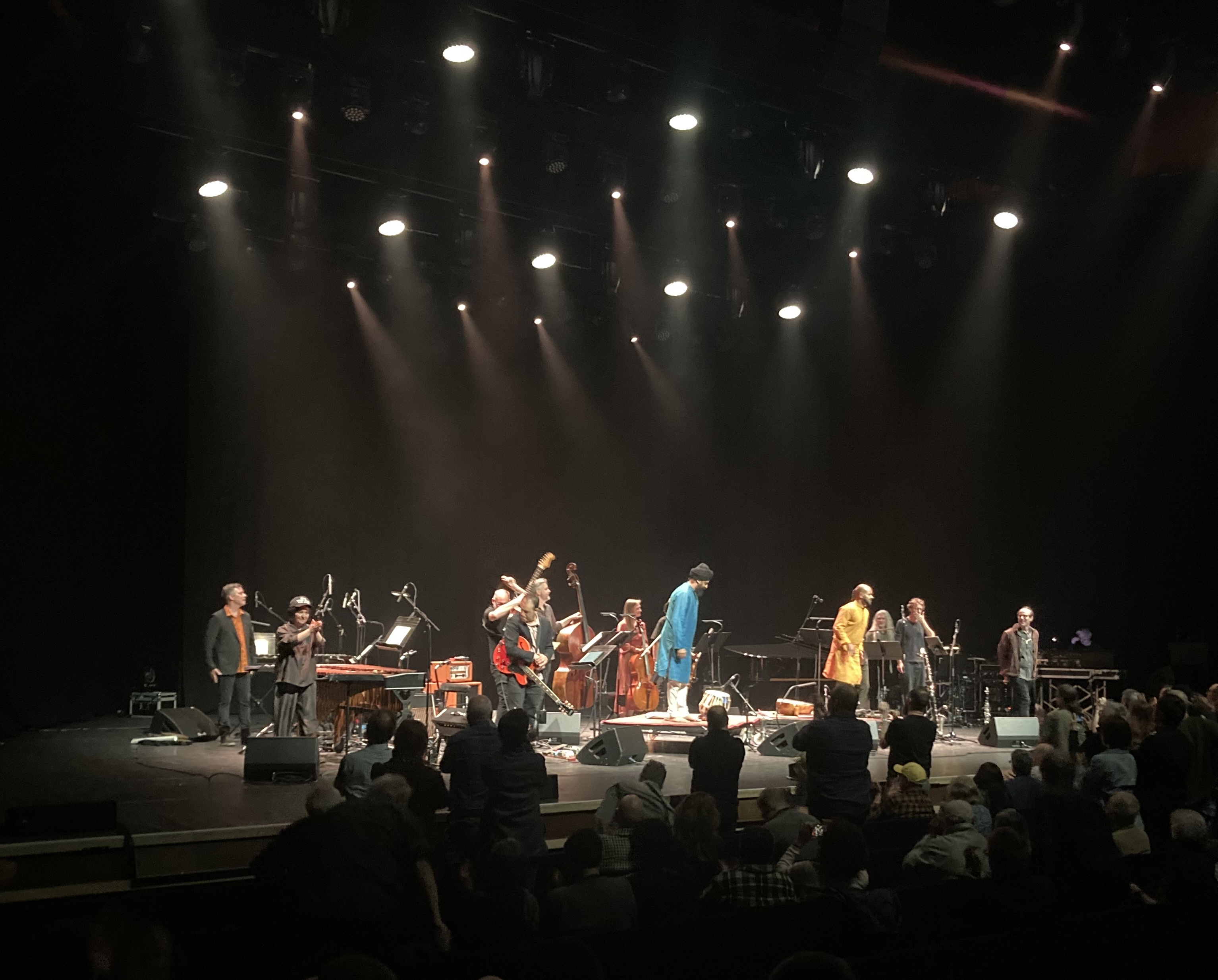
On Thursday night the New York ensemble Bang on a Can All Stars, longtime performers of Riley’s work, arrived at the Barbican to celebrate his birthday by presenting two of his most famous compositions, with the help of several guests. Riley, of course, was 6,000 miles away, but he welcomed the audience warmly with a recorded video message transmitted via large screens.

The evening began with the basic band — keyboard, clarinet/bass clarinet, electric guitar, cello, double bass and drum kit/vibes — performing A Rainbow in Curved Air, such a strong influence when it appeared in 1969 on the likes of Pete Townshend, Brian Eno and others experimenting with early synthesisers, although the original work itself was performed by Riley on organ, electric harpsichord, rocksichord, dumbec and tambourine, via overdubs.

Arranged for the sextet by Gyan Riley, Terry’s son, and slightly stretched from the original 19 minutes to 25, it preserved the sense of genially interlocking patterns, although Riley’s 14-beat measures seemed to have become a distinct 7/4, strongly articulated by the group’s drummer, David Cossin, before he switched to vibes for the later passages. The sudden halts and resumptions were as gently startling as they seemed on the album five and a half decades ago.

In C, first performed in 1964 and recorded in 1968, is the piece that made Riley’s reputation in the world of contemporary classical music. A remarkably versatile composition, open to any number of players and all musical instruments in any combination, its 53 modules — short musical phrases using all 12 tones of the tempered scale except C sharp and E flat — must be played in order but can be repeated according to each performer’s feeling for the piece’s overall collective development. For last night’s 65-minute performance, Bang on a Can were joined by Shabaka on flutes, Valentina Magaletti on marimba, Soumik Datta on sarod, Portishead’s Adrian Utley on guitar, Raven Bush on violin, Gurdain Rayatt on tablas and Jack Wyllie on soprano saxophone. (Pete Townshend was billed to appear but withdrew following a knee operation.)

I found the result entirely true to the original spirit of the composition, preserving the constant momentum and the sense of conversation without the presence of a conductor. The instrumentation produced wonderful fluctuations of density and shifting polyrhythmic layers; there were beautiful isolated moments, like a brief sarod/cello combination and the emergence of a clarinet melody, and the general lightness of tone brought the closing passage close to the texture of baroque music.

It was like lying on your back and watching clouds moving at a variety of altitudes across a busy but unthreatening sky, endlessly mutating and utterly absorbing until it was brought, with an act of intuitive collective decision, to the most graceful close. Happy birthday, Mr Riley.

Meet the house band

Before the evening show on the first of their two days at Cafe Oto on Saturday, the Necks were announced to the audience as “the house band”. We laughed, and so did they. But it seemed to fit. The Australian improvising trio have played in many London venues, but the little space on Ashwin Street in Dalston seems to suit them best.

Once the house was quiet, they began with Chris Abrahams picking out short melodic phrases in the piano, lightly hammering each note with the two fingers: the index finger of each hand. It was a lovely effect, almost like a santur or cimbalom. The phrases sounded vaguely Moorish, which might seem a bit vague and superficial as a description but is intended to suggest that they felt like fragments of ancient wisdom, conveyed without adornment.

Tony Buck was rubbing two old cymbals on the heads of his snare drum and floor tom-tom. They he began playing a medium fast 1-1-1-1 rhythm with his left hand on the top cymbal of his hi-hat, using a long slender stick. That cymbal stroke formed the basis of his contribution over the next 40 minutes, building in volume and density but retaining a silvery delicacy.

Meanwhile Lloyd Swanton plucked the open D string on his bass with emphasis, letting it ring. That became the tonal centre of the entire collective improvisation, the only fixed point as each of the three explored his own avenue of rhythmic and melodic creation, the symbiosis built up over 30 years enabling them to operate in seeming independence of each other and yet in complete communion. It takes the idea of listening to each other to a different place: listening without listening.

As is usual, but not inevitable, the music gathered power and volume until, by some unspoken intuition, the musicians broke it down, stripping back all the chosen materials until we were returned to the silence.

It’s always tempting to search for analogies and metaphors. Tempting, but unnecessary. Still, on Saturday I thought of the sea breaking on a shore, composed of countless waves and wavelets, all surging and cresting according to their own individual strengths and sub-trajectories, yet responding to a single tidal pulse. It’s an amazing thing to witness in person, when you see how these musicians never even look at each other in performance (Abrahams actually sits side-on, facing offstage) but are linked by something unique.

* The Necks are at Band on the Wall in Manchester tomorrow night (May 13), the Empire, Belfast (14), the Sugar Club, Dublin (15), and thereafter in Switzerland, Portugal, the Netherlands, Croatia, Greece, Poland, Spain, Italy and Belgium: https://shop.thenecks.com/tour-dates

Noah Davis at the Barbican

Sometimes painting really does, as the saying goes, approach the condition of music. Today I had that feeling pretty well all the way round the Barbican’s exhibition of work by Noah Davis, the African American artist who died of cancer aged 32 in Los Angeles, where he’d spent his last years setting up the Underground Museum, a place for showing art — not just his own — to people who’re not exposed to it on a regular basis. It occupied four adjacent storefronts on a street in Arlington Heights, a historically black and Latino/Latina district in Central LA.

Thinking about his own work, and his desire to “make something normal”, he said: “Does it have to be about hip-hop and that stuff to get people interested?” But also: “I wanted it to be more magical, not stuck in reality.” So you get a man reading the paper, or people splashing around in a pool, or three young people clustered in a doorway. Normal. But because of what Davis brings, painting over a base layer of rabbit-skin glue like Mark Rothko did, creating a kind of transparency even when the paint is dense, moving blocks of colour like blocks of sound, also magical.

There are explicit references to music in some of the paintings, like the one above, which is called “Conductor”; it stopped me in my tracks. Magical realism right there. He painted it in 2014, the year before he died. Or there’s one called “The Year of the Coxswain”, from 2009, which shows oarsmen carrying a boat out of the water; behind and alongside them is a black-clad figure holding a trumpet.

If you want to see and know more, there’s a Barbican trailer for the exhibition here and an Art News piece here. I’m afraid you only have until May 11, which is this coming Sunday, to see it in London. Sorry about that. Thereafter it can be seen at the Hammer Museum in Los Angeles (June 8-August 31).

I found it unforgettable. I could show you another picture, probably the three young people in the doorway, but because “Conductor” struck me so hard, here’s a closer look.

Everybody Loves a Train

About twenty years ago, my friend Charlie Gillett was compiling a series of themed CDs for a Polygram label called Debutante, under the aegis of the former Island A&R head Nick Stewart. Charlie asked me if I’d like to put one together, and if so, what the theme might be. “Trains,” I said, after about ten seconds’ thought, and then I went away to assemble a running order. It took a while, because I enjoyed the process so much.

Sadly, the series came to a sudden end before my contribution could see the light of day. But I’d edited together a disc of how I wanted it to go. I called it Everybody Loves a Train, after the song by Los Lobos. It has all sorts of songs, some of which speak to each other in ways that are obvious and not. I avoided the most obvious candidates, even when they perfectly expressed the feeling I was after (James Brown’s “Night Train” and Gladys Knight’s “Midnight Train to Georgia”) and instrumentals, too (see the footnote).

Every now and then I take it out and play it, as I did this week, with a sense of regret that it never reached fulfilment. Here it is, with a gentle warning: not all these trains are bound for glory. Remember, as Paul Simon observes, “Everybody loves the sound of a train in the distance / Everybody thinks it’s true.”

  1. Unknown: “Calling Trains” (From Railroad Songs and Ballads, Rounder 1997) Forty-odd seconds of an unidentified former New Orleans station announcer, recorded at Parchman Farm, the Mississippi state penitentiary, in 1936, calling from memory the itinerary of the Illinois Central’s “Panama Limited” from New Orleans to Chicago: “…Ponchatoula, Hammond, Amite, Independence… Sardis, Memphis, Dyersburg, Fulton, Cairo, Carbondale…” American poetry.
  2. Rufus Thomas: “The Memphis Train” (Stax single, 1968) Co-written by Rufus with Mack Rice and Willie Sparks. Produced by Steve Cropper. Firebox stoked by Al Jackson Jr.
  3. Los Lobos: “Everybody Loves a Train” (from Colossal Head, 1996) “Steel whistle blowin’ a crazy sound / Jump on a car when she comes around.” Steve Berlin on baritone saxophone.
  4. Bob Dylan: “It Takes a Lot to Laugh, It Takes a Train to Cry” (from Highway 61 Revisited, 1965) “Don’t the brakeman look good, mama, flaggin’ down the Double E?”
  5. Joe Ely: “Boxcars” (from Honky Tonk Masquerade, 1978) A Butch Hancock song. Ponty Bone on accordion, Lloyd Maines on steel guitar.
  6. Counting Crows: “Ghost Train” (from August and Everything After, 1993) “She buys a ticket ’cause it’s cold where she comes from / She climbs aboard because she’s scared of getting older in the snow…”
  7. Rickie Lee Jones: “Night Train” (from Rickie Lee Jones, 1979) It was a plane she took from Chicago to LA to begin her new life in 1969, and an old yellow Chevy Vega she was driving before she cashed the 50K advance from Warner Bros ten years later. But, you know, trains.
  8. The Count Bishops: “Train, Train” (Chiswick 45, 1976) London rockabilly/pub rock/proto-punk. Written by guitarist/singer Xenon De Fleur, who died a couple of years later in a car crash, aged 28, on his way home from a gig at the Nashville Rooms. Note that comma. I like a punctuated title.
  9. Julien Clerc: “Le prochain train” (from Julien, 1997) My favourite modern chansonnier. Lyric by Laurent Chalumeau.
  10. Blind Willie McTell: “Broke Down Engine Blues” (Vocalion 78, 1931) Born blind in one eye, lost the sight in the other in childhood. Maybe he saw trains in time to carry their image with him as he travelled around Georgia with his 12-string guitar.
  11. Laura Nyro: “Been on a Train” (from Christmas and the Beads of Sweat, 1970) One song she didn’t do live, as far as I can tell. Too raw, probably.
  12. Chuck Berry: “The Downbound Train” (Chess B-side, 1956) When George Thorogood covered this song, he renamed it “Hellbound Train”. He didn’t need to do that. Chuck had already got there.
  13. Bruce Springsteen: “Downbound Train” (from Born in the USA, 1984) “The room was dark, the bed was empty / Then I heard that long whistle whine…”
  14. Dillard & Clark: “Train Leaves Here This Morning” (from The Fantastic Expedition of Dillard & Clark, 1968) Written by Gene Clark and Bernie Leadon: “1320 North Columbus was the address that I’d written on my sleeve / I don’t know just what she wanted, might have been that it was getting time to leave…”
  15. Little Feat: “Two Trains” (from Dixie Chicken, 1973) In which Lowell George extends the metaphor of Muddy Waters’ “Still a Fool (Two Trains Running)”: “Two trains runnin’ on that line / One train’s for me and the other’s a friend of mine…”
  16. B. B. King: “Hold That Train” (45, 1961) “Oh don’t stop this train, conductor, ’til Mississippi is out of sight / Well, I’m going to California, where I know my baby will treat me right”
  17. Paul Simon: “Train in the Distance” (from Hearts and Bones, 1983) Richard Tee on Fender Rhodes. “What is the point of this story? / What information pertains? / The thought that life could be better / Is woven indelibly into our hearts and our brains.”
  18. Vince Gill: “Jenny Dreams of Trains” (from High Lonesome Sound, 1996) Written by Gill with Guy Clark. Fiddle solo by Jeff Guernsey. Find me something more beautiful than this, if you can.
  19. Muddy Waters: “All Aboard” (Chess B-side, 1956) Duelling harmonicas: James Cotton on train whistle effects, Little Walter on chromatic.
  20. Darden Smith: “Midnight Train” (from Trouble No More, 1990) “And the years go by like the smoke and cinders, disappear from where they came…”
  21. The Blue Nile: “From a Late Night Train” (from Hats, 1989) For Paul Buchanan, the compartment becomes a confessional.
  22. Tom Waits: “Downtown Train” (from Rain Dogs, 1985) “All my dreams, they fall like rain / Oh baby, on a downtown train.” A New York song.

Closing music: Pat Metheny’s “Last Train Home” (from Still Life (Talking), 1987) to accompany the photo of the Birmingham Special crossing Bridge No 201 near Radford, Virginia in 1957 — taken, of course, by the great O. Winston Link. Other appropriate instrumentals: Booker T & the MGs’ “Big Train” (from Soul Dressing, 1962, a barely rewritten “My Babe”) and Big John Patton’s “The Silver Meter Pts 1 & 2” (Blue Note 45, 1963, a tune by the drummer Ben Dixon whose title is a misspelling of the Silver Meteor, a sleeper service running from New York to Miami).

The Ballad of Dennis Hopper

If anyone contained multitudes, it was surely Dennis Hopper. Wild and crazy guy, but also a proper artist. Incarnated the simmering potential of the ’50s, the multicoloured dream of the ’60s, the long scream of the ’70s, and the all-over-the-place uncertainty of the ’80s.

All those movies: not just Rebel Without a Cause, Easy Rider, Apocalypse Now and Blue Velvet but The Trip, The American Friend and Rumble Fish. And the folie de grandeur of The Last Movie. Married to Michelle Phillips for eight days and to Daria Halprin, co-star of Antonioni’s Zabriskie Point, for a little longer. Great photographer, too (he spent so much time with a camera around his neck that his friend nicknamed him “the tourist”). No wonder Mike Scott decided to make a Waterboys album about him.

I took Life, Death and Dennis Hopper on a road trip last weekend and it kept me entertained and fascinated all the way there and back. Its 25 tracks form a mosaic of a life that began in Dodge City, Kansas in 1936 and ended in Venice, California in 2010. “Kansas”, the opening track, is bookended by the sound of a street parade and a departing steam train: the song itself, sung and co-written by Steve Earle, with just the singer’s guitar and Mickey Raphael’s harmonica, is like something from Nebraska‘s country cousin.

Then Scott enters to sing “Hollywood ’55” — the story of Hopper’s arrival in Movieland — against a finger-snapping beatnik swing and we’re into a sequence of snapshots set to era-adjacent music. “Live in the Moment”, about making it, rolls on Mitch Ryder’s Detroit Wheels. “Andy”, referencing his friendship with Warhol, is a smooth uptown pop mix settling somewhere between Broadway and Hollywood & Vine. “The Tourist”, about Hopper and his camera documenting the short life of hippie dream, could be the Strawberry Alarm Clock or H. P. Lovecraft imitating the Jefferson Airplane. “Riding Down to Mardi Gras”, in which Hopper and Peter Fonda make Easy Rider, is a fine piece of outlaw country-rock. And so on, all the way to “Golf, They Say”, a funny song about the late-life experience of Willie Nelson teaching Hopper to swing a club.

But it’s not just a kind of jukebox musical. There are brief interludes — notably five short impressionistic instrumental pieces of contrasting styles and hues, each dedicated to one of Hopper’s five wives — and a couple of recitatives, one a description of the 1967 Monterey Festival in an English posh-hippie voice, the other a parody of an American TV news report of his death.

The two finest individual tracks are the hard-slugging, thick-textured “Ten Years Gone”, referring to Hopper’s lost decade and closing with a passage spoken by Bruce Springsteen, and “Letter From an Unknown Girlfriend”, a painfully stark voice-and-piano ballad in slow waltz time sung and played by Fiona Apple. They’re followed by a snatch of aural hallucination called “Rock Bottom”, evoking the years Hopper spent in the abyss, and then the gorgeous, achingly redemptive “I Don’t Know How I Made It”, somewhat like the Blue Nile covering Blonde on Blonde.

As Scott suggests, you can listen to the tracks indvidually or in any order, but it’s really made to be heard from start to finish, although not in any burdensome or dutiful way. Congratulations to him and his guests and his co-writers and fellow Waterboys, including Paul Brown, James Hallawell, Aongus Ralston, Ralph Salmins and Greg Morrow. It’s a brave thing, executed with flair and imagination.

* The Waterboys’ Life, Death and Dennis Hopper is out now on Sun Records.

The art of Peter Till

Back in 1978, when I was editing Time Out, Bob Dylan came to play at Earl’s Court, his first London concerts in 12 years. As part of a preview, Jenny Fleet, the magazine’s art director, and I commissioned several illustrations. The one above was by the great Peter Till. I had a special fondness for it and a few years later he was kind enough to offer me the original. Yesterday I collected it.

The opportunity for the handover came at a private view of Peter’s exhibition at Hornsey Library, near his North London home. It’s a selling exhibition of his brilliant work over the years for many publications, including the Guardian, The Times, the New Scientist, the Radio Times and the New York Times. The money raised will go to supporting the Shepherd Hill allotment. That seems a worthy cause and I was glad to make a donation. The show is on until April 15 (see below).

The music of Gatsby

The moon had risen higher, and floating in the Sound was a triangle of silver scales, trembling a little to the stiff, tinny drip of the banjoes on the lawn.

Coinciding with the first publication of The Great Gatsby a hundred years ago (April 10, 1925), a new musical version of F. Scott Fizgerald’s masterpiece opens shortly in the West End of London. The trailer for this latest iteration of Gatsby makes it look like an all-singing, all-dancing, good-time entertainment. It would be unfair to prejudge, but the songs by Jason Howland and Nathan Tysen certainly sound as though they adhere to the Rice/Lloyd-Webber template for modern musical theatre.

Not much room there, one imagines, for the darker undertones beneath the careless rapture, for the portrayal of the corruption of extreme wealth (and the swipe at racism) that gave Fitzgerald’s narrative a resonance which has kept it alive in the minds of its readers for a hundred years.

The musical aspect of the original novel is hardly its most significant feature, but it does provide the story with an intermittently intriguing soundtrack. Early on, for instance, there’s a band at Jay Gatsby’s house playing something he describes as “yellow cocktail music” — and even though you may not be able to define it, you know exactly how it might sound. And that “stiff, tinny drip”: I can’t hear a banjo in a band playing early jazz without those words — as good as Whitney Balliett or Philip Larkin — coming to mind.

At another of Gatsby’s summer parties on his estate, where “in his blue gardens men and girls came and went like moths among the whisperings and the champagne and the stars,” is something titled “Vladmir Tostoff’s Jazz History of the World”. A composition on a grand scale, we’re told that it was first performed at Carnegie Hall, where it created a sensation. Now it’s delivered on the lawn to Gatsby’s guests by an orchestra that was “no five-piece affair, but a whole pitful of oboes and trombones and saxophones and viols and cornets and piccolos, and low and high drums.”

Nick Carraway, Fitzgerald’s narrator, doesn’t tell us what Mr Tostoff’s work actually sounds like, at least not in the final published version. In a passage Fitzgerald deleted from a draft manuscript, Nick describes it as “starting with a weird spinning sound, mostly from the cornets. Then there would be a series of interruptive notes which coloured everything that came after them, until before you knew it they became the theme and new discords were opposed outside. But just as you’d get used to the new discord one of the old themes would drop back in, this time as a discord, until you’d get a weird sense that it was a preposterous cycle, after all. Long after the piece was over it went on and on in my head — whenever I think of that summer I can hear it yet.”

The year before the book appeared, George Gershwin’s “Rhapsody in Blue” had received its première at the Aeolian Hall in New York, performed by the 23-piece Paul Whiteman Orchestra, with the composer at the piano. Scott and Zelda Fitzgerald were living in Great Neck, Long Island at the time. Whiteman had commissioned the piece, orchestrated by Ferde Grofé, for a concert called “An Experiment in Modern Music”. It’s what I imagine Tostoff’s music must have resembled.

A few chapters later there’s also young Ewing Klipspringer, Gatsby’s house guest, roused from his sleep one afternoon and reluctantly acceding to his host’s request to play the piano, despite claiming to be out of practice. He responds with “The Love Nest”, a song by Louis A. Hirsch and Otto Harbach from a 1920 George M. Cohan musical titled Mary, while thunder rumbles and summer rain falls outside on Long Island Sound.

Three years after The Great Gatsby‘s publication, Paul Whiteman would assemble his orchestra in New York to record an arrangement of “The Love Nest”. It’s nothing special until, just before the end, Bix Beiderbecke steps forward for a sublime eight-bar cornet solo that perfectly evokes what we imagine to be the spirit of the Jazz Age.

Finally, when Daisy Fay is enjoying the social life of Louisville, Kentucky while Gatsby, her besotted swain, is making his way back from army service in the Great War, she is “young and her artificial world was redolent of orchids and pleasant, cheerful snobbery and orchestras which set the rhythm of the year, summing up the sadness and suggestiveness of life in new tunes. All night the saxophones wailed the hopeless comment of the ‘Beale Street Blues’ while a hundred pairs of golden and silver slippers shuffled the shining dusk.” Written by W. C. Handy in 1917, the song was a hit in 1921 for Marion Harris, who recorded many blues songs and was perhaps the first white female vocalist to achieve success by imitating (rather than caricaturing) the style of black singers.

In a wonderful piece for the FT at the weekend, seeking Gatsby‘s echoes in our present condition, the author Sarah Churchwell concluded that the book “anticipates precisely the kind of society that would find Trumpism appealing: a culture losing its imaginative capacity, surrendering its ideals… The Great Gatsby captures a truth that repeats across generations: the powerful consolidate their control even as the dream of something better gleams ahead. Again and again, those with wealth and privilege fortify themselves against the possibility of a more just or democratic world, transforming progress into another cycle of entrenched power.”

Oh, well. Roll over, Vladmir Tostoff, and tell George Gershwin the news.

* The passage of musical description deleted from a draft of Gatsby is quoted from Some Sort of Epic Grandeur, Matthew J. Bruccoli’s biography of Fitzgerald, published in the UK by Hodder & Stoughton in 1981.

Stories old and new

“That was a young man’s song,” Paul Brady said as the applause began to fade at the Bush Hall last night. He’d just sung “Nothing But the Same Old Story”, written at the start of the 1980s to inhabit the world of a narrator who’d arrived in London from Ireland as a teenager looking for work and confronted by hostility in the time of the Troubles: “Living under suspicion / Putting up with the hatred and fear in their eyes…” It’s a song of resistance, one to drink and dance and cry to, and although only a few weeks from turning 78, Brady invested it with all its original innocence and rage.

This was the second of his two nights in Shepherd’s Bush, and he talked a little about how, arriving from Ireland as a member of a folk quartet called the Johnstons in 1969, they’d settled into a flat close by. He spoke fondly of how he’d learned from traditional musicians at pub sessions in west and north London.

I hadn’t seen him live since a gig at the Half Moon in Putney in 1981, when I was blown away by the material from his second solo album, Hard Station. Since then he’s had great success as a songwriter, his work recorded by Bonnie Raitt, Tina Turner and others. But today you can put him on stage alone with a guitar, a mandolin and a keyboard, and it’s the same old storyteller, now with a bit more of a growl but with wit and warmth and enough edge to lift you from your seat.

Sometimes, as in the gorgeous “Wheel of Heartbreak” and “The Long Goodbye”, he seemed like the most accomplished of adult rockers. During “Mother and Son” and “Follow On” (“a dark song that ended up in a butter commercial”) I started thinking that maybe what he was was a modern chansonnier, in the mould of Léo Ferré or Julien Clerc. And then there were the traditional songs that harked back to his time with the Johnstons and Planxty: the brilliant mandolin work on “The Jolly Soldier”, the sheer historical weight beneath the lilt of “Arthur McBride”.

The shows were arranged to greet the release of Paul Brady: The Archive, a four-CD, 63-track set of demos, one-off collaborations (with Dolores O’Riordan, Cara Dillon and Carole King, for example), interesting alternative versions of most of his best-known songs, and other fascinating bits and pieces, copiously illustrated with tickets, posters, photos and newspaper cuttings.

Curiously, the first two CDs begin with two songs that he didn’t write, both from the 1960s, which express polar opposites of the spirit of the time. One is the lovely hippie anthem “Get Together”, written by the American musician best known as Dino Valenti and containing a line I’ve never wanted to get out of my head: “We are but a moment’s sunlight / Fading in the grass.” Brady recorded it in 1999 for a set of songs associated with Greenwich Village in the ’60s, and his is a beautiful version, which he reprised last night. The other is “Gimme Shelter”, a song of a very different complexion: his treatment, recorded in 2009 with Bob Thiele Jr’s Forest Rangers for a TV series, Sons of Anarchy, loses nothing by comparison with the Stones’ original.

Those are among the many treasures in the box set. I’m still absorbing it, but I can say that the version of “Paddy’s Lamentation” for voice, piano, tin whistle and military drums, recorded in Dublin in 1980 for a long-vanished compilation album, might alone be worth the 50 quid.

Brady came back for an encore last night and of course it was “The Lakes of Pontchartrain”, the song he recorded in 1978 on his first solo album, Welcome Here Kind Stranger, and which he later taught to Bob Dylan. It’s a traditional song, but it’s his really, and The Archive has a fine version in Gaelic, translated by Prionnsias O’Maonaigh: “Bruach Loch Pontchartrain”.

Last night he sang it in English and gestured to us to sing the last two lines of the final verse with him, acappella: “So fare thee well my bonny o’ girl l’ll never see no more / But I’ll ne’er forget your kindness and the cottage by the shore…” Every heart melted, all over again.

* Paul Brady: The Archive is released by The Last Music Company: http://www.lastmusic.co.uk

All this beauty

So much wrong in the world, and yet so much wonderful new music. How to explain the existence, amid the trauma and violence and chaos agents and the encroachment of threat, of all this beauty? Here are five new albums I wouldn’t want to be without: Billy Hart’s Just (ECM), Yazz Ahmed’s A Paradise in the Hold (Night Time Stories), Nels Cline’s Consentrik Quartet (Blue Note), Vilhelm Bromander’s Jorden vi ärvde (Thanatosis), and — most of all — Ambrose Akinmusire’s Honey From a Winter Stone (Nonesuch). Each of them offers jazz pushing the edge of its current possibilities, moving forward as it has always done, drawing influences from wherever it sees potential, respecting the past, suggesting futures.

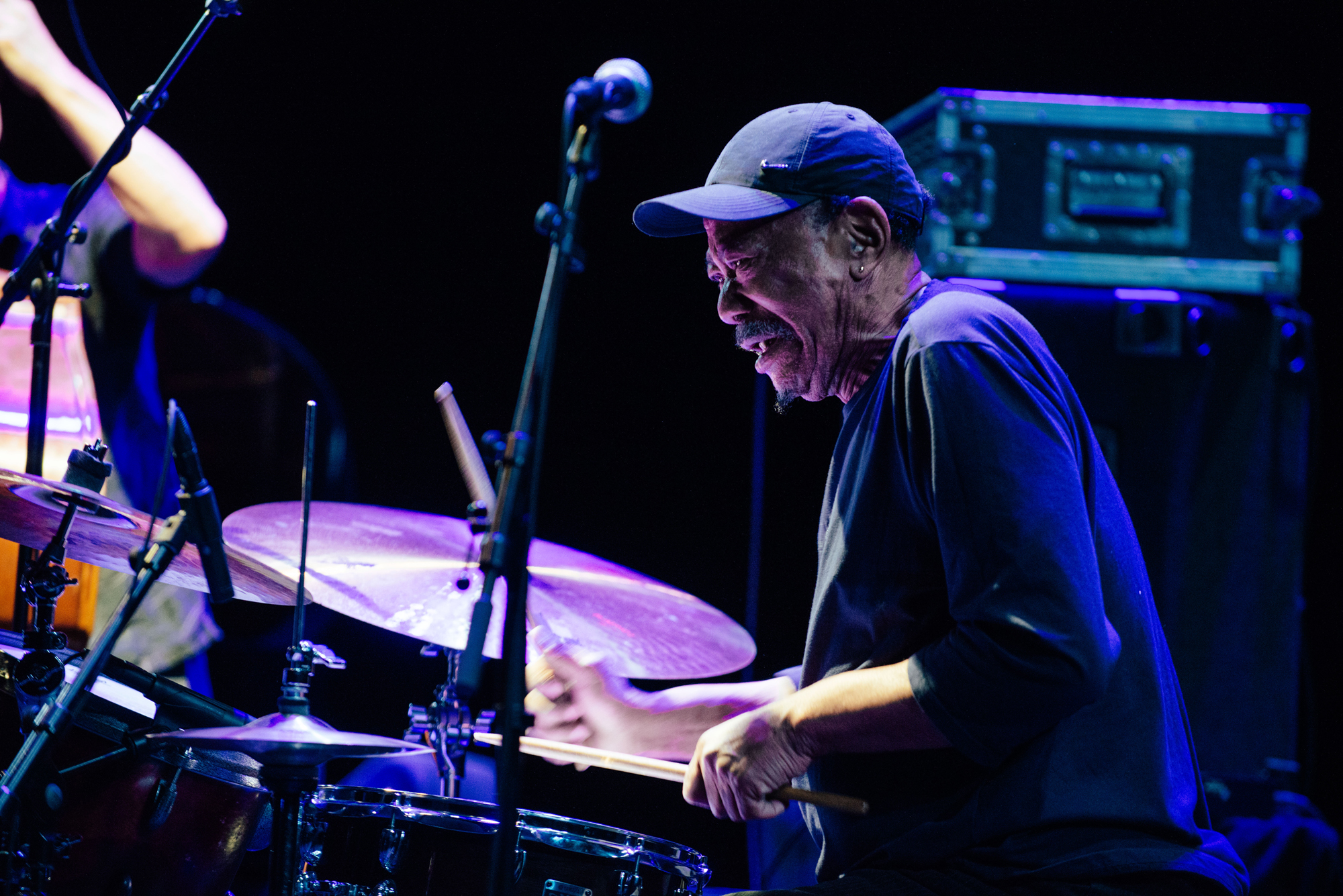
Hart’s album is full of beautifully balanced and flexible interplay between four masters: the drummer with Ethan Iverson (piano), Ben Street (bass) and Mark Turner (tenor saxophone). Ahmed explores her Bahraini heritage in lustrous tunes with the help of singers including Natacha Atlas and Brigitte Beraha. Cline’s quartet, completed by the saxophonist Ingrid Laubrock, the bassist Chris Lightcap and the drummer Tom Rainey, explores the guitarist’s bracing and multi-faceted compositions which, while offering nothing specifically unfamiliar, create an original and constantly stimulating sound-world. Bromander’s Unfolding Orchestra, featuring the fantastic bass clarinetist Christer Bothén, extends the vision of Charlie Haden’s Liberation Music Orchestra with great success.

But for some time now Ambrose Akinmusire has moving towards a music that sounds completely new, finding ways of incorporating elements of hip-hop and contemporary classical music into his compositions. It could be gruesome. Instead, with Honey From a Winter Stone, it’s a quiet revelation.

Has anyone yet used the term Fourth Stream to describe such music? If not, its time might have come. Akinmusire takes the post-Bartókian astringency of the Mivos Quartet and brings to it an improvising musician’s fluency. He draws in a rapper, Kokayi, whose words, tone and rhythms make a flow lucid and persuasive enough to convert any sceptic. And weaving in and out is his own trumpet work, representing in its liquid grace and constant unpredictability a kind of celestial marriage of Booker Little and Don Cherry, supported by two familiar accomplices, the pianist Sam Harris and the drummer Justin Brown, plus the synthesiser and vocals of Chiquitamagic.

Akinmusire has found a way to make all this work, to create from it a coherent and entirely contemporary statement. The longest track, the 29-minute s-/Kinfolks, cycles through various dimensions, from an exploratory opening trumpet flight of sumptuous inventivness through deep grooves, a dramatic change of temperature as Kokayi freestyles, and a passage for the strings that sounds effortless but strikes deep.

As I listened, I found myself thinking back to 1969 and the Art Ensemble of Chicago’s People in Sorrow. What s-/Kinfolks shares with that epic from half a century ago is a combination of rarified beauty, emotional heft (its elegantly understated play of mourning and defiance), and relevance to the present condition. Probably the album of the year already, with the others not far behind.