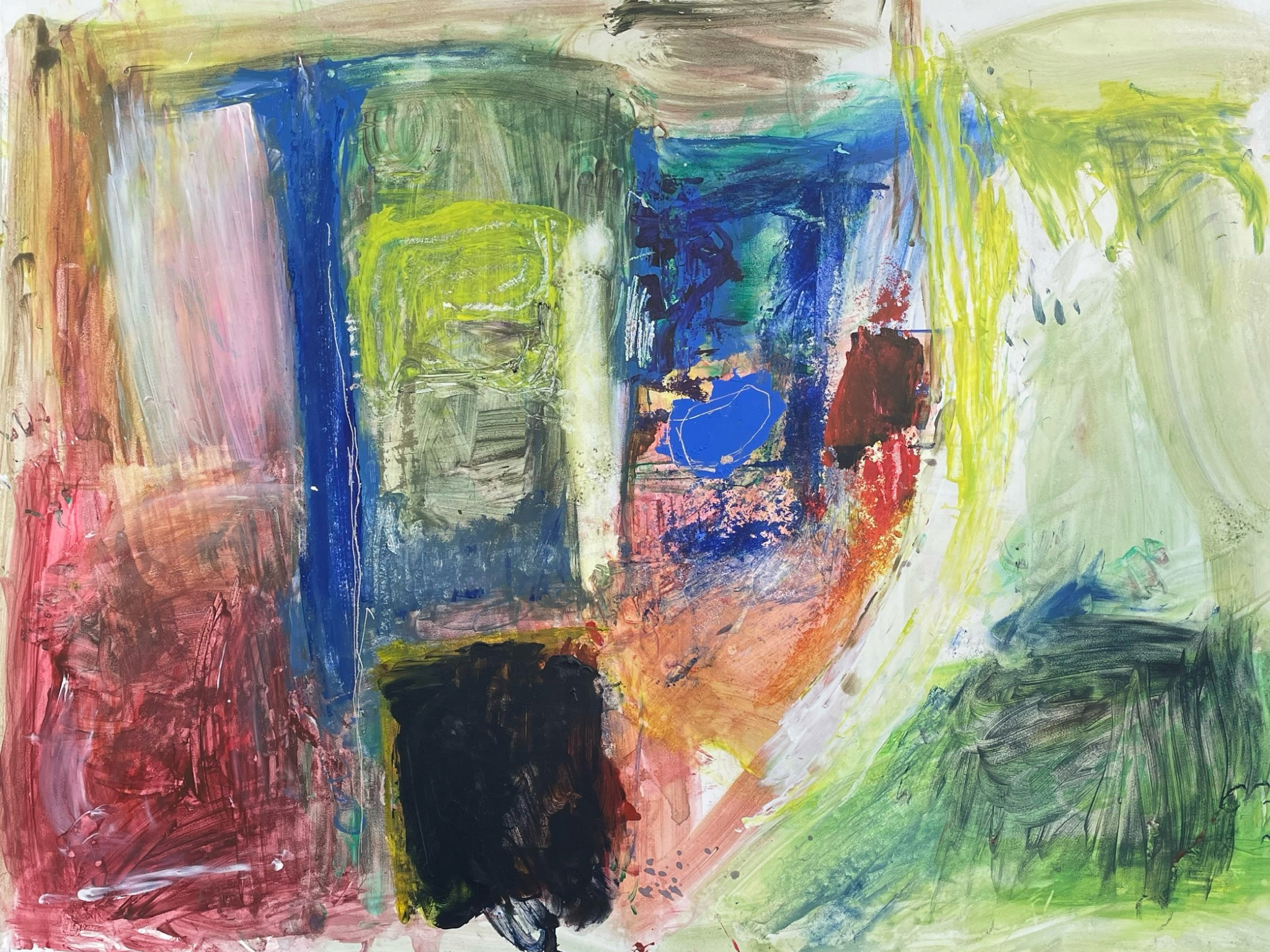
When the painter Penny Marrows was given a diagnosis of terminal cancer in March 2023, her son, the London-based composer and guitarist Billy Marrows, began writing pieces for her. Some of them were recorded and played to her before her death five months later, aged 72. In the aftermath Billy carried on writing and recording, and compiled the pieces in an album, Penelope, for which one of his mother’s paintings provides the cover (you can see it above).
One good reason for buying the album is that the proceeds will go to World Child Cancer, a charity providing help in countries that don’t have the benefit of the sort of organisations that cared for Billy’s mother, such as the NHS and Macmillan Cancer Support. But the music is reason enough.
The aggregation of musicians heard on the album is known as Grande Família. Five of the pieces, interspersed throughout the running order, are for solo guitar or baritone guitar. One is a duo for guitar and viola (Teresa Macedo Ferreira). Another is a trio for guitar, piano (Angus Bayley) and clarinet (Gustavo Clayton Marucci). The remaining three are by a 12-piece chamber-jazz ensemble including trumpet, trombone, French horn, flute, clarinets, saxophones and viola.
I’ve been playing the album a lot over the last few days, and it’s made a friend of me. The solo guitar pieces are pitched somewhere between Bill Frisell (a refined backporch sensibility) and Mary Halvorson (the sparing and subtle use of effects, and a sense that a surprise isn’t far away). The solo version of “Shenandoah” (the only non-original) which provides the album’s coda is lovely; when I do my “Shenandoah” mixtape, it’ll go nicely between Frisell’s interpretation (with Ry Cooder on Good Dog, Happy Man) and Bob Dylan’s (one of the saving graces of Down in the Groove).
The most striking of the ensemble pieces is “L’Heroïsme”, which features the tenor saxophone of Tom Ridout and the trumpet of Mike Soper. You can see them playing it here. But what I really like about the album is how its 10 separate pieces, for all their variety of means and approach, behave as though they belong together, like a family.
* Penelope by Billy Marrows + Grande Família is available as a CD and download. Details here:http://www.billymarrows.com. They’ll be playing at the Pizza Express in Soho on 13 May.Penny Marrows’ painting is used by kind permission.
The first public performance of George Gershwin’s “Rhapsody in Blue” was given 100 years ago this week, on 12 February 1924, at the Aeolian Hall on West 43rd Street in New York City, by Paul Whiteman and his Concert Orchestra, with Gershwin himself at the piano. Whiteman had commissioned the piece from its composer specially for the evening, which was billed as ‘An Experiment in Modern Music’.
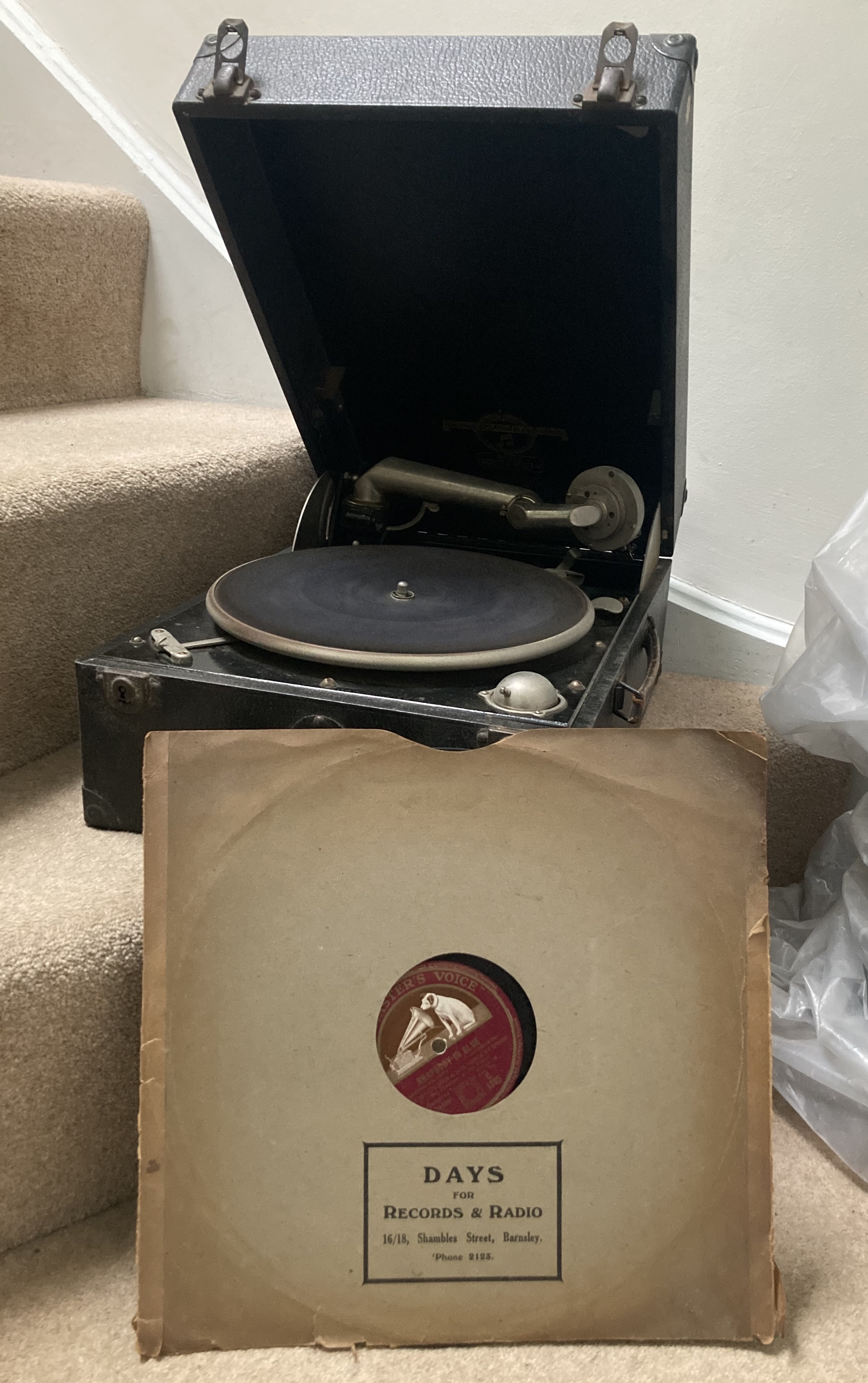
I first heard “Rhapsody in Blue” in childhood, played by the same Whiteman/Gershwin combination, on the 12-inch 78rpm record you see above, which my mother would have bought from a record shop in Barnsley, South Yorkshire, in the 1930s. Nine minutes long, it’s split over both sides of the disc. The gramophone — a Columbia Viva-Tonal Grafonola — is the one on which she played it, along with her other 78s.
To mark the centenary, the pianist Ethan Iverson started a lively debate the other day with a piece for the New York Times in which he examined the artistic impact, then and now, of what he called “a naive and corny” attempt to blend the superficial characteristics of jazz with European classical music. If “Rhapsody in Blue” is a masterpiece, he wrote, it’s surely “the worst masterpiece”: an uncomfortable compromise that blocked off the progress of what would later be called the Third Stream, and with which we are both “blessed and stuck”.
Thanks to my mother’s influence, I view it from a slightly different angle. For me, in childhood, it became a gateway drug. I loved the spectacular clarinet introduction, and the shifting melodies and the hints of syncopation, but more than anything I responded to the tonality that reflected its title, expressed in the exotic flattened thirds and sevenths of the blues scale.
It didn’t take very long before I was following a path that led to Louis Armstrong, Duke Ellington, Charlie Parker, Thelonious Monk, Miles Davis, Charles Mingus, John Coltrane, Ornette Coleman and Cecil Taylor, right up to the Vijay Iyers, Matana Robertses and Tyshawn Soreys of today’s jazz. Pretty soon I’d worked out that an ounce of Ellington was worth a ton of Gershwin’s instrumental music*, but I retain a respectful gratitude to “Rhapsody in Blue” and its role as a gateway, just as I do to The Glenn Miller Story and “Take Five”.
A few weeks after the world première Gershwin’s piece, F. Scott Fitzgerald and his young family would set off for France, where he spent the summer knocking the early draft of his third novel into shape. When The Great Gatsby was published the following April, it contained a vivid scene in which the society guests at one of Jay Gatsby’s Long Island parties were entertained by a band described by the author as “no thin five-piece affair, but a whole pitful of oboes and trombones and saxophones and viols and cornets and piccolos, and high and low drums.”
The bandleader — who is unnamed, but it’s easy to imagine him as Paul Whiteman, with his tuxedo, bow-tie and little moustache — makes an announcement. “At the request of Mr Gatsby,” he says, “we are going to play for you Mr Vladimir Tostoff’s latest work, which attracted so much attention at Carnegie Hall last May.” The piece is known, he adds, as “Vladimir Tostoff’s Jazz History of the World”. I’ve always idly wondered what it would sound like, but I imagine Mr George Gershwin’s “Rhapsody in Blue”, with its bustling bass saxophone eruptions and flamboyantly choked cymbal splashes, is as close as we’ll get.
* A few people have picked me up on this statement, and I tend to agree with them. I was trying to make a specific point, rather clumsily. George Gershwin was a genius songwriter, as any fule kno.
Some jazz clubs are intimidating to the first-time visitor, and maybe that’s how they’re supposed to be. Not all of them, though. I’d been meaning to visit Peggy’s Skylight in Nottingham for ages, and on Saturday afternoon I walked in there for the first time and felt right at home.
A Saturday afternoon might seem an odd time to visit a jazz club. But I’d just got off the train from London, with a couple of hours to spare in my old home town before the start of the football match I’d come up to see, so I walked from the station to George Street, just off Hockley, a narrow but always busy street on the edge of the historic Lace Market.
Peggy’s Skylight occupies the double-frontage of a nice old building. The club was opened in 2018 by Rachel Foster and Paul Deats, and it’s named after Charles Mingus’s “Peggy’s Blue Skylight”; you can see a visual reference above the bandstand in the photo. The Mingus track was recorded in 1961 and featured Roland Kirk, who in 1964 played a concert one street away from where Peggy’s now stands, at the Co-operative Arts Centre on Broad Street (I wrote about it here and here).
On Saturday afternoons Peggy’s has an Unplugged session, with free admission. Deats was playing piano when I walked in. He was sharing the stage with a seriously good local tenor saxophonist, Ben Martin, and they were playing “My One and Only Love”, one of my favourite ballads. The room was full, and I was lucky that they could find me a seat. People of several generations were eating, drinking, chatting and occasionally checking their phones while Martin and Deats produced accomplished, unflashy, nicely proportioned duets that were soon putting me in mind of how Hank Mobley and Tommy Flanagan might have sounded together.
At this session, the music had a different vibe. It was part of a social setting, absorbed in a way that didn’t devalue it at all. If you wanted to listen to as good version of “Alone Together” as you’re likely to find this side of Jo Stafford, or a lively “On the Sunny Side of the Street”, you could do happily do so, joining the warm applause at the end of each tune. But the voices from the tables around you were part of the environment. It wasn’t like that oaf guffawing for posterity over Scott LaFaro’s final notes on the Bill Evans Trio’s sublime version of “Milestones” at the Village Vanguard in 1961. Here, the ambient sounds were perfectly natural and unobtrusive.
Normally I don’t like eating while I listen to music, and I’m not much interested in food anyway. But I was hungry and it seemed fine to enjoy an excellent pan of eggs with harissa while keeping my ears open. (Deats is also a chef, and Peggy’s menu has a North African and Middle Eastern tilt.)
Last year the club’s partners were required to resist plans to sell the building by the local council, which owns the freehold and has recently become one of several around England to announce its own bankruptcy. The day before I walked in had brought news the reduction of the city’s entire culture budget to zero. Nottingham Playhouse, opened with great pride 60 years ago almost to the month and whose artistic directors included John Neville and Richard Eyre, will see its council subsidy, which stood at an annual £430,000 a decade ago, reduced from last year’s £60,000 to £0.
This is mostly due, of course, to the severe reduction, during 14 years of Tory misrule, in the government funding on which local authorities depend. The present generation of Conservative Party politicians seems to regard the arts as something that might open minds and encourage independent thought, and therefore to be stamped on.
On the train from London I’d been reading a depressing piece in the FT about the boom in giant high-tech music arenas — the sort of place where you might go to see Taylor Swift or U2 — being built around the country, paralleled by a crisis affecting small-scale venues, almost one in six of which closed or stopped scheduling music during 2023. That made a first visit to Peggy’s Skylight seem even more precious.
* The very nice new album by the guitarist John Etheridge and his organ trio was recorded live at Peggy’s Skylight. It’s called Blue Spirits, it’s on the DYAD label and appropriately enough it concludes with Etheridge’s solo treatment of a favourite Mingus tune, “Goodbye Pork Pie Hat”. Forthcoming attractions at the club include the saxophonist Tony Kofi and the trombonist Dennis Rollins. Full programme: peggysskylight.co.uk
Martin Davidson, who died just before Christmas at the age of 81, was a valued friend of improvised music in Britain and elsewhere. Most significantly, he ran the Emanem label, which made its debut in 1974 with Steve Lacy’s first album of unaccompanied soprano saxophone pieces. Emanem went on to amass a catalogue of new and archive vinyl releases featuring the first generation of London-based improvisers — John Stevens, Trevor Watts, Evan Parker, Derek Bailey, Paul Rutherford and so on — and then, following its re-emergence as a CD label in the mid-’90s, of their successors and many others.
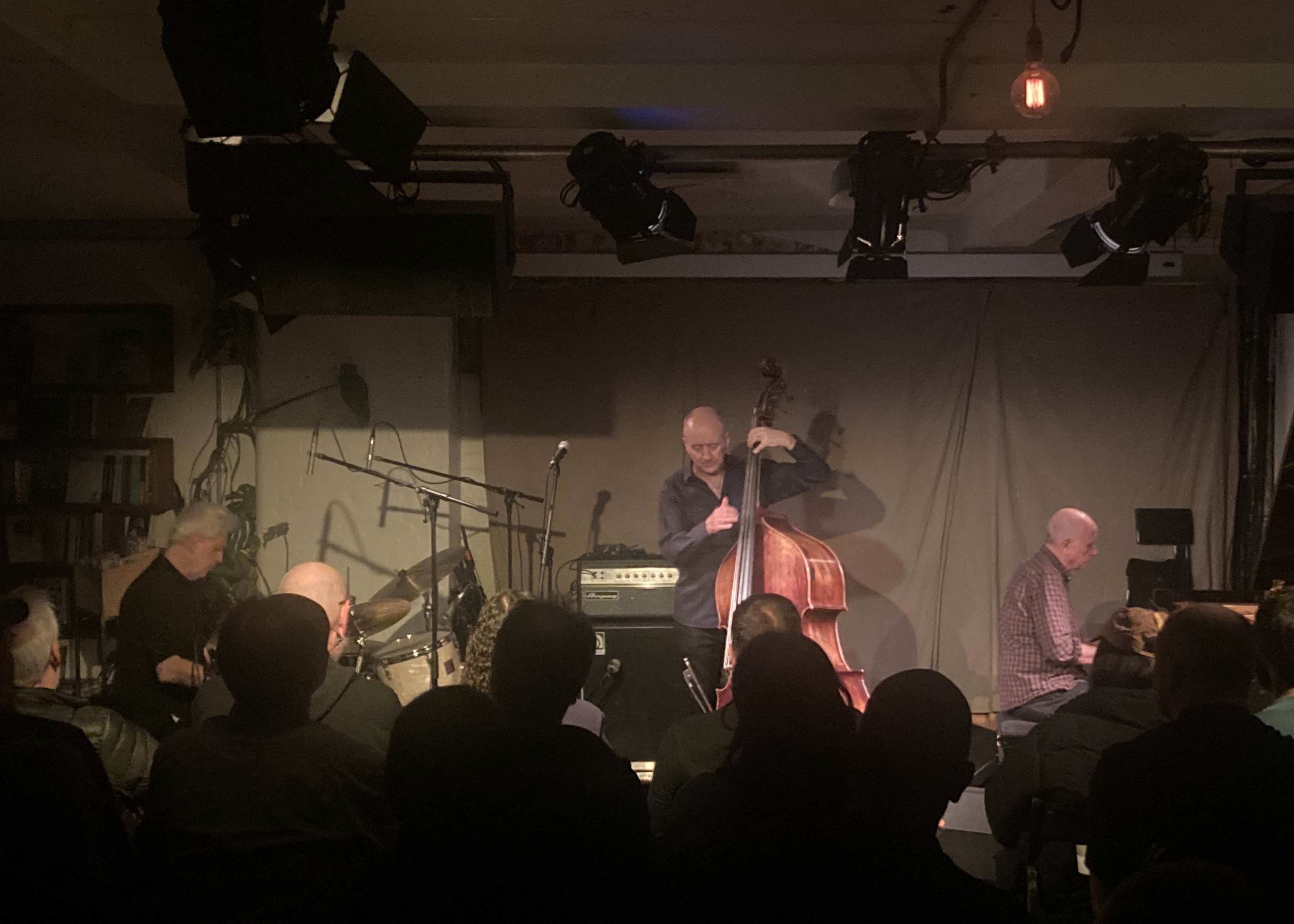
Today at Café Oto and the Vortex many of those artists performed in celebration and commemoration of Martin’s life. It was my privilege to introduce the Café Oto gig, which began with a set from the quartet pictured above during their soundcheck — Parker, Mark Sanders, Hannah Marshall and Matt Wright — and continued with the duo of the altoist Caroline Kraabel and the pianist Veryan Weston before concluding with the 27-strong London Improvisers Orchestra.
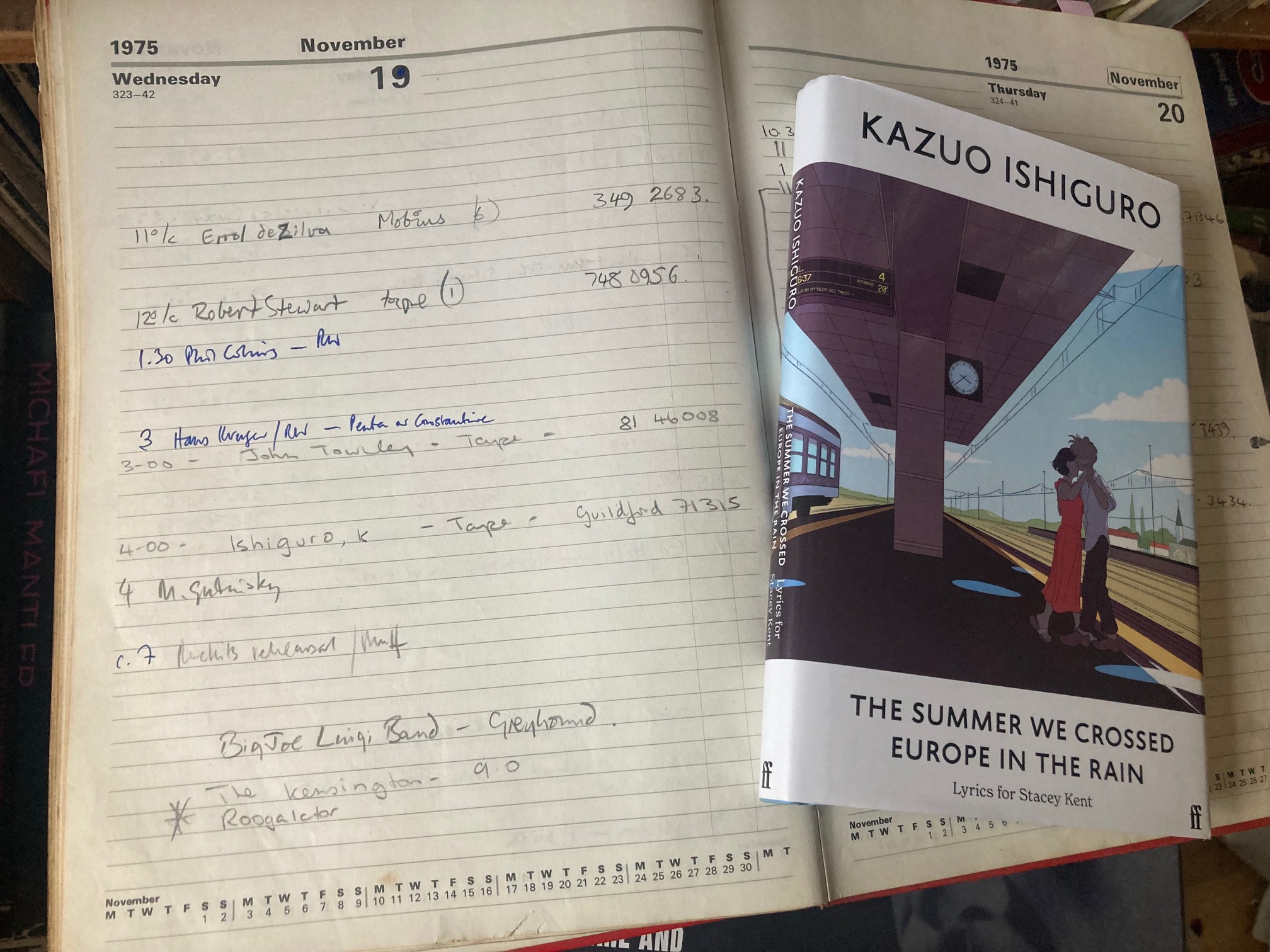
I met him 11 August 1969. I remember it because it was my first day in London, my first day at the Melody Maker, and I was sent to review Mike Westbrook’s band at the 100 Club that night. Martin was the man with a box of very desirable albums for sale, set up on a table in the space between the end of the bar and the stage. I soon learned that he was a man of views that were carefully considered and firmly held, some of them expressed in reviews for the MM over the next couple of years.
I was able to share with the audience a handful of the characteristic aphorisms from his New Musical Dictionary, which he posted online. Easy Listening: Music that is extremely difficult to listen to for anyone who really listens to music.Post-modernism: New things for people who don’t like new things.An Improviser: A musician who combines the roles of both composer and interpreter, yet usually receives less respect and remuneration than either.
At the request of Mandy Davidson, Martin’s widow (and the other Em in Emanem), all the proceeds from the gigs, for which the musicians waived their fees, will go to B’Teselem, a Jerusalem-based non-profit organisation documenting human rights violations in Israeli-occupied Palestine. At the end of the LIO set, which consisted of ensemble improvisations conducted by Terry Day, Ashley Wales and others, Maggie Nichols — who met Martin when she was a member of the SME — read a verse by a Palestinian poet killed in the Gaza fighting. That’s what you can see in the picture below, as she holds up a placard saying CEASEFIRE NOW!!
Vinnie Sperrazza grew up in Utica, New York as the son and great-grandson of drummers. He’s played the drums all his life, while thinking about drums and drumming and drummers. We’ll get to his own playing in a minute, but what first alerted me to his existence were his Substack posts, which appear under the heading of “Chronicles”. They’re not always about drumming, but they’re always interesting. And the ones that are about drumming contain the most perceptive and eloquent writing about drummers that I’ve ever read.
Sperrazza doesn’t describe the art of a drummer with the kind of literary eloquence with which the New Yorker‘s Whitney Balliett could bring, say, a solo piece by Papa Jo Jones to life on the page. (But then Balliett once claimed that Max Roach didn’t swing.) Sperrazza finds different but equally compelling ways to tell you what a Roach, a Gerald Cleaver, a Billy Hart or an Ed Blackwell is doing, and perhaps why, and certainly how it affects the surrounding music.
When I had a cup of coffee with Sperrazza during in London before Christmas, he was keen to hear my memories of seeing Tony Williams, who is his special subject, and about whom he writes with great insight. I was able to tell him about things he’s too young to have seen for himself, like Lifetime’s gigs at Ungano’s and the Marquee, a later edition of the band in Berlin, VSOP at the Grosvenor House and the Albert Hall, the quartet with Herbie Hancock, Ron Carter and Wynton Marsalis in Nice, and Tony’s own great quintet — the one with Wallace Roney, Bill Pierce and Mulgrew Miller — in Camden.
Most of all, I think he liked me describing the unforgettable experience of listening to Tony tuning his drums during the soundcheck for the gig in the Grosvenor House ballroom, for a gig that, believe it or not, was part of the 1977 Columbia Records international sales convention. That music is still in my ears.
Before we parted, he gave me a copy of Sunday, the third album in 10 years by his quartet, which is called Vinnie Sperrazza Apocryphal and also includes Loren Stillman on soprano and tenor saxophones, Brandon Seabrook on guitar, mandolin and banjo, and Eivind Opsvik on double bass — all great players from the contemporary New York scene. Frankly, I didn’t much mind whether I was going to like it or not, because I admire his writing so much and enjoyed his company. But when I put it on, it had me entranced.
The eight pieces making up the album are intended, he says, to depict “the moods and actions of one man in NYC on a random Sunday.” It’s probably typical of Sperrazza that the opening track doesn’t feature him at all: just Stillman’s affectingly human tenor tone, Seabrook’s pinched harmonics and distortions and Opsvik’s rich arco playing in an enticing prologue full of hints of what’s to come. But then the drums have the second track more or less to themselves, creating a subtly shaded, carefully developed, bombast-free soliloquy that Max or Papa Jo would surely applaud.
All four musicians then come together on a low-down, behind-the-beat groove with a blues feeling given its spice by Seabrook’s spacey and increasingly asymmetrical guitar chords, which fade away to the ticking of Sperrazza’s rimshots. Banjo colours the next piece, a solemn chink above shivering bass and sombre drums, shadowing Stillman’s lyrical ruminations, before Seabrook cuts loose with a jittering, jabbing solo.
And those four pieces are just the half of it. Like them, each of the remaining four creates its own microclimate, exploiting the available resources with a sense of variety and wit. When Stillman switches to soprano, something about the open rhythm reminds me of John Coltrane with Steve Davis and Elvin Jones on Coltrane Plays the Blues. There’s a joyful guitar feature with an 8/8 backbeat, not entirely unlike the early Lifetime. The banjo reappears for a quiet piece that could reasonably be described as giving Americana a good name.
It made me think of The President, Wayne Horvitz’s old band, as does a lot of this album, in its ability to to make sure that every track has its own little story to tell, while presenting music that, without compromising its spirit of inquiry, is extremely easy to like.
Named after a 1959 Claude Chabrol film, Les Cousins operated as a folk club from 1964 to 1972, having taken over a basement in Soho run by John Jack as the Skiffle Cellar during the 1950s. On the ground floor was the restaurant of Loukas and Margaret Matheou, immigrants from Cyprus. Les Cousins, down a steep staircase, was run by their son, Andy. On stage at 49 Greek Street every night of the week he presented singers and musicians whose work would create a platform for the folk-rock and singer-songwriter movements of the late 1960s and early ’70s.
There were other important folk venues in London, notably Bunjie’s, just the other side of Charing Cross Road, and the Troubadour in Earl’s Court. But the Cousins had a special place in history, very well memorialised in a new three-CD box from the Cherry Red label, compiled and annotated by Ian A. Anderson, the singer, guitarist and editor of fRoots magazine.
It is, as you’d expect, a splendidly varied selection, starting and ending with big names — Bert Jansch and the Strawbs — and containing both even bigger ones (Paul Simon, Al Stewart, Ralph McTell, Nick Drake, Roy Harper and Cat Stevens) as well as many more of those whose reputations never really escaped the folk world, like the brilliant guitarists Davy Graham, Mike Cooper, John James, Sam Mitchell and Dave Evans.
So far I’ve mentioned only male performers, but the Cousins was a place where women shone: not just Shirley Collins, Sandy Denny, Bridget St John and Maddy Prior but Dorris Henderson, Jo Ann Kelly, Beverley Kutner (later Martyn) and Nadia Cattouse. And, of course, the sublime Anne Briggs. They’re all here, represented among the 72 tracks licensed from labels such as Topic, Island, Transatlantic, Village Thing and Harvest.
There are the traditionalists: Bert Lloyd singing “Jack Orion”, the Watersons delivering “The Holmfirth Anthem”, and Dave and Toni Arthur’s “A Maiden Came from London Town”. And there are the influential Americans: Jackson C. Frank (“Milk and Honey”), Dave Van Ronk (“Baby, Let Me Lay It On You”), and Tim Hardin (“If I Were a Carpenter”).
You can hear the music going off in all sorts of directions, with weirder stuff coming from the Third Ear Band, Kevin Ayers, the Incredible String Band and Dr Strangely Strange. Ron Geesin’s “Two Fifteen String Guitars for Nice People” is in a class of brilliant weirdness all by itself.
The well produced brochure includes facsimiles of a couple of pages from Andy Mattheou’s diary in April 1965, listing the people he’s booked: Sandy Denny for £3 on a Wednesday night, Davy Graham for £15 on the Saturday, Van Morrison for £3 on a Tuesday, the American guitarist Sandy Bull on a Friday for £10 against half the door takings. Sandy Bull! How I wish I’d been there for that.
The programme isn’t predictable. There’s no “Scarborough Fair”, no “May You Never”, no “She Moved Through the Fair”. The sequencing is thoughtful: tracks from John Martyn and Duffy Power follow immediately after those by their respective mentors, Hamish Imlach and Alexis Korner. I’d only quibble with the inclusion of a small handful of songs — including Drake’s “Northern Sky” and Beverley’s “Get the One I Want To” — where the presence of orchestral arrangements takes them away from the mood of a basement folk club.
If I had to pick some personal favourites, the first would be would be the dazzling violin and guitar of Dave Swarbrick and Martin Carthy on “Byker Hill” and the second would be the magical guitar interplay of Jansch and John Renbourn on “Soho”. The third would be the intense voice and bottleneck guitar of Sam Mitchell’s “Leaf Without a Tree”: a hellhound stalking the lanes of Soho, half a century ago.
* Les Cousins: The Soundtrack of Soho’s Legendary Folk & Blues Club is out now on the Cherry Red label. The image is the club’s logo, the wagon wheel a reference to a feature of its décor.
Jan Bang is one of the people responsible for the great wave of creative music from Norway over the past three decades. As a producer and player, he’s collaborated with Dhafer Youssef, Nils Petter Molvaer, Arve Henriksen, David Sylvian, Bugge Wesseltoft and many others. In the fishing port of Kristiansand, where he was born in 1968, he and his friend Erik Honoré founded the annual Punkt Festival, where since 2005 live performances have been subjected to immediate remixes. (I wrote about a visit to the 2019 edition here.)
His new album, Reading the Air, is a sequence of songs with music mostly by himself and lyrics by Honoré. The musicians include Henriksen on trumpet, the singers Simin Tander and Benedikte Kløwe Askedalen, the guitarist Eivind Aarset, the bassist Audun Erlien, the drummer Anders Engen and the percussionist Adam Rudolph.
What does it sound like? I was put in mind of late Blue Nile filtered through Jon Hassell’s Fourth World recordings: fragile-sounding melodies, introspective lyrics, voices singing from some private sphere, gauzy textures shaped and layered with great care, on the edge of decay. Through the 10 tracks, there’s a consistency of mood, elegant and reflective.
Here are the opening lines of Honoré’s lyric for the exquisitely beautiful title song: Moving on /We’re planning our escape / Preparing to leave / The disconnected state / Bridges burned / The tables turned / Reading the air / To reconnect with fate. A piano is played in an empty ballroom. A swaying groove emerges and simmers quietly. Bang’s ruminative vocal is sometimes doubled by a female singing over his shoulder. What sounds like a section of shakuhachis turns out to be overdubbed trumpets played by Henriksen, who steps forward for a lighter-than-air solo. I could easily imagine successful covers of this by Annie Lennox, Bryan Ferry or Beth Gibbons with Rustin Man.
The other track I want to mention is the only non-original composition, a version of the old folk-blues song called “Delia” or “Delia’s Gone”, which exists in many versions. This is not the murder-ballad variant recorded by Bob Dylan on World Gone Wrong in 1993 (credited as “traditional”) or the bloodier iteration that Johnny Cash included on the first volume of his American Recordings in 1994 (credited to Cash, Karl Silbersdorf and Dick Toops). Curiously, it’s the smoother and more lyrical variation that Harry Belafonte sang in 1954 on his debut album, “Mark Twain” and Other Folk Favourites, credited to Lester Judson and Fred Brooks. Judson was a commercial songwriter. Brooks was a temporary nom de plume for Fred Hellerman, a member (with Pete Seeger) of the Weavers, who were then under investigation by the FBI for alleged Communist sympathies.
Bang’s version is a sort of Nordic Americana: the bell of a wooden church in the snow, muffled drums, the refined twang of Arset’s lightly picked guitar. No murders in the lyric, but three-part vocal harmony like a bluegrass family stranded up a fjord, in danger of death from exposure to the cruel elements. The line about “everything I had is gone” can rarely have sounded so final.
* Jan Bang’s Reading the Air is released on 19 January on the Punkt Editions label. The photo of Bang is by Alf Solbakken. You can hear “Delia” on this link: https://janbang.bandcamp.com/album/reading-the-air
Max Roach, a vital link in the chain of jazz drummers that stretches from Baby Dodds to Tyshawn Sorey, was born in North Carolina a hundred years ago today, on January 10, 1924. After moving with his family to New York at the age of four, he played the bugle and the drums in gospel ensembles in Brooklyn. He was still a teenager when he depped for Sonny Greer in the Duke Ellington Orchestra. At 21 he played on the Charlie Parker session that produced the eternally breathtaking “Ko Ko”. After that he was on many of Parker’s celebrated recordings, including “Parker’s Mood” in 1948 and the Massey Hall concert in 1953.
Roach was the one who took Kenny Clarke’s proto-bebop drumming to the next stage, freeing the left hand and the right foot from the obligation of symmetry, enabling them to respond to what a soloist was doing in the moment: enhancing, encouraging, propelling, providing a spontaneous commentary. Just what Parker needed.
All that was in my head — along with his presence in Miles Davis’s historic nonet at the Royal Roost in 1948, his subsequent quintets with the trumpeters Clifford Brown and Booker Little in the ’50s, and the sequence of albums including We Insist: Freedom Now Suite and Percussion Bitter Sweet that he recorded during the civil rights era in the ’60s — when I went to interview him in his hotel during the 1971 Montreux Jazz Festival.
By then he was an elder, and that was how he seemed to me: a man of wisdom, elegance and sophistication, with something reserved and almost austere about him, someone who had been through the fires of the creative life and come out having cast aside all non-essentials, with his humanity intact. He talked freely and eloquently, and said many interesting things. But I what I remember chiefly is just the feeling of being in his presence, in a room with the embodiment of so much history.
At Montreux he was playing with a student orchestra, so I asked him about his history with big bands. “The first big band I played with was Dizzy Gillespie’s,” he said, “which had Charlie Parker, Fats Navarro and Miles Davis, who were very young, Freddie Webster, Kenny Dorham — fantastic trumpet section — Dexter Gordon, Gene Ammons, Leo Parker, Bud Powell…”
Then he corrected himself. “No, the first big band I played with was Duke’s. I remember now. That was at the Paramount Theatre in New York. I was still in school and I played with them for four or five days because Sonny Greer got sick. It was during the war and the reason I played with them was Billie Holiday’s brother-in-law, Jimmy Monroe’s brother Clark, whose protégé I was — he made sure I got in the union and he knew all these people, so when he found that Duke Ellington needed a drummer, he called me for it.”
Clark Monroe’s Uptown House, on West 134th Street in Harlem, was one of the cradles of the bop revolution. By 1942, Roach was the house drummer. Parker played there that year, so perhaps it was where they first met. I wish I’d asked him. I wish I’d asked him a whole lot of things.
I did get him to talk about Clifford Brown. “In my music I’m inspired by human values,” he said, “because I believe that human beings are supposed to live together. As artists, we feed on the past. All the things that we hear today are really extensions of things that were laid down by people who came before — and of course I’ve been fortunate enough to have been associated with many, many great musicians. One that was a turning point in my own career was Clifford.
“The association was one that was full not only of friendship and love for each other as human beings but as musicians we both spent as much time as we could involved in music as a craft. I noticed particularly that Clifford was a human being, number one, which I guess was the reason he could get so much beauty out of playing the way he did at such an early age. To sound so mature before he was 25…
“I can say this: during our whole relationship he was a very dedicated musician and an extremely responsible person as a leader, as young as he was. He was almost 24 hours immersed in music, every aspect of it, from the piano to the drums to his trumpet, and the thing we can all learn from that is that the more time you put in sincerely, the more that you will get out of it in a shorter space of time.”
Luckily, Max was granted a longer span. I was fortunate enough to see him play on a handful occasions, notably in New York in 1972 with M’Boom, his percussion ensemble, and at the Bracknell Jazz Festival about 10 years later with his regular quartet. What was striking was how he played with his back straight and shoulders still, most of the work done by his wrists. He was as crisp and precise as any jazz drummer I’ve ever seen, but without forfeiting a sense of surprise or the inner relaxation vital to swing. Carrying the joy and the responsibility of the music’s history, he was everything you’d imagined him to be.
* The image above is grabbed from a BBC recording of the Max Roach quartet with Abbey Lincoln in London in 1964, performing “Triptych: Prayer/Protest/Peace” from We Insist! The Freedom Now Suite. It’s on YouTube.
There seemed to be an unusually high percentage of people in a sold-out Vortex last night wearing the sort of minimalist beanie hat long associated with Django Bates, who was there to give a rare solo piano recital. Bates talked about his brothers being present, and a son, so maybe it’s clan thing and they were all family. Anyhow, the rest of us could share a joyful evening in which the seriousness of the music was counterpointed by the impish humour of the 63-year-old pianist and composer.
He began with some new pieces. “A Flurry in the Desert” was a rhapsody in blues in E-flat, followed by “Sophie in Detail”, a rhapsodic ballad, both demonstrating a facility and an imagination in exalted balance. The multi-sectioned “Dancy Dancy” contained a Brazilian-tinged part with a la-la vocal and some lovely right-hand lines near the end that reminded me of Wynton Kelly. “Ballo”, dedicated to the saxophonist Iain Ballamy, his old friend from Loose Tubes days, had the quality common to many of Bates’s compositions, at least when performed solo: even when perfectly formed, they give the illusion of being created from scratch in real time, by spontaneous magic.
“Yard Games” was like that, although pivoting around a three-note figure constantly shifting shape and register. So was the older “For the Nurses”, written before the arrival of Covid, which had its melody doubled by whistling. (“It’s not a sentimental piece,” he said. “It’s not a sentimental profession. I imagine it’s bloody hard work.”) Something called, I think, “The Teachings of Dewey Redman” featured a high-velocity single-note boppish line played by both hands, a couple of octaves apart. The encore was another older piece, “Horses in the Rain”, a meditation on stoicism with a lyric by its original interpreter, the Norwegian singer Sidsel Endresen.
Before that, he’d produced the biggest surprise of the set: a couple of choruses of “Bridge Over Troubled Water” dedicated to “anyone with a weirdly unhealthy obsession with Rwanda”. Taking Larry Knechtel’s piano part from the original S&G recording and adding his own depth, weight, shaded voicings and exquisite timing, it was about as perfect as anything could be.
Sometimes it takes me a while to catch up. This year I caught up with my late mother’s fondness for Death Comes for the Archbishop, a novel written by Willa Cather in 1927. A hardback copy had been on her bookshelves since I was old enough to notice, and she spoke often of how much she admired it. When she and my father died a few years ago, within months of each other, I took away her 1933 hardback edition as their house was cleared. And this year I finally got around to reading it.
Set in the mid-19th century, the story of two French priests sent by the Pope to New Mexico shows how Cather could paint on a vast canvas. Born in 1873, she was brought up in rural Nebraska, giving her a feeling for striking and often bleakly beautiful landscape and dramatic weather. The climate and the topography of New Mexico become an intrinsic part of her narrative, as alive as the characters. In that, and in a sudden, unexpected episode of shocking violence, I was reminded of Cormac McCarthy, who died in June, just as I was reading it.
I was reminded of him even more forcefully when I moved on straight away to Cather’s Great Plains Trilogy: O Pioneers!, The Song of the Lark, and My Ántonia, written between 1913 and 1918, all very different, each with its own female protagonist, each casting a spell. McCarthy, of course, wrote a celebrated Border Trilogy in the 1990s: All the Pretty Horses, The Crossing and Cities of the Plain. None of his obituaries mentioned a possible influence, and it’s a long time since Cather (who died in 1947) was fashionable, but I’d be very surprised if he were not familiar with her work.
She could write about music and its effects, too. In The Song of the Lark her protagonist, Thea Kronborg, the young daughter of Scandinavian immigrants settled in the town of Moonstone, Colorado, and destined (although she has no idea of this yet) to become a great opera singer, is invited to a railroad workers’s ball by a character called Spanish Johnny:
The Mexican dance was soft and quiet. There was no calling, the conversation was very low, the rhythm of the music was smooth and engaging, the men were graceful and courteous. Some of them Thea had never before seen out of their working clothes, smeared with grease from the round house or clay from the brickyard. Sometimes, when the music happened to be a popular Mexican waltz song, the dancers sang it softly as they moved. There were three little girls under twelve in their first communion dresses, and one of them had an orange marigold in her black hair, just over her ear. They danced with the men and with each other. There was an atmosphere of ease and friendly pleasure in the low, dimly lit room, and Thea could not help wondering whether the Mexicans had no jealousies or neighbourly grudges as the people in Moonstone had. There was no constraint of any kind there tonight, but a kind of natural harmony about their movements, their low conversations, their smiles.
NEW ALBUMS
1 Billy Valentine and the Universal Truth (Flying Dutchman/Acid Jazz)
2 Matana Roberts: Coin Coin Chapter Five: In the Garden (Constellation)
3 Sylvie Courvoisier: Chimaera (Intakt)
4 Darcy James Argue’s Secret Society: Dynamic Maximum Tension (Nonesuch)
5 Blind Boys of Alabama: Echoes of the South (Single Lock)
6 Fire! Orchestra: Echoes (Rune Grammofon)
7 Vilhelm Bromander: In This Forever Unfolding Moment (Thanatos)
8 Steve Lehman & Orchestre National de Jazz: Ex Machina (Pi)
9 Bob Dylan: Shadow Kingdom (Columbia Legacy)
10 PJEV/Hayden Chisholm/Kit Downes: Medna Rosa (Red Hook)
11 Tyshawn Sorey Trio: Continuing (Pi)
12 Sebastian Rochford: A Short Diary (ECM)
13 Paul Simon: Seven Psalms (Owl)
14 The Necks: Travel (Northern Spy)
15 Ambrose Akinmusire: Beauty Is Enough (Origami Harvest)
16 Cécile McLorin Salvant: Mélusine (Nonesuch)
17 Alexander Hawkins Trio: Carnival Celestial (Intakt)
18 jaimie branch: fly or die fly or die fly or die ((world war)) (International Anthem)
19 Aaron Diehl & the Knights: Zodiac Suite (Mack Avenue)
20 Julian Siegel Jazz Orchestra: Tales from the Jacquard (Whirlwind)
REISSUE /ARCHIVE
1 John Coltrane with Eric Dolphy: Evenings at the Village Gate (Impulse)
2 Mike Osborne: Starting Fires (British Progressive Jazz)
3 Miles Davis: In Concert at the Olympia Paris 1957 (Fresh Sound)
4 Bruce Springsteen: The Live Series: Songs on Keys (nugs.net)
5 Chris Cutler: Compositions and Collaborations 1972-2022 (ReR Megacorp)
6 Evan Parker: NYC 1978 (Relative Pitch)
7 Pharoah Sanders: Pharoah (Luaka Bop)
8 Derek Bailey & Paul Motian: Duo in Concert (Frozen Reeds)
9 Jon Hassell: Further Fictions (Ndeya)
10 Joy: Joy (Cadillac)
LIVE PERFORMANCE
1 Northern Soul Prom (Royal Albert Hall, July)
2 Mette Henriette + Charles Lloyd trios (Barbican, November)