Skip to content

Goodbye, Denny Laine

Denny Laine, who has died at his home in Florida, aged 79, was the best thing about the Moody Blues, even though he was only in the band for a couple of years, from its foundation in Birmingham to his departure two years later. It was his voice that made “Go Now”, their No 1 hit, more than just another British beat group’s cover of an American soul record.

The original of “Go Now”, by Bessie Banks, released in January 1964, was itself a classic. Produced by Jerry Leiber and Mike Stoller, arranged by Garry Sherman, written by Larry Banks (Bessie’s husband) and Milton Bennett, it was first released in the US on the Tiger label. “It shines,” wrote the great enthusiast Dave Godin, who released it in the UK on his Soul City label before including in the second volume of his Deep Soul Treasures series, “like an epic beacon in the history of soul music.”

Alex Murray, a young Decca A&R man, produced the Moody Blues’ version at the label’s West Hampstead studios. Denny Laine said the song had come to them via the journalist James Hamilton, a soul music fan who wrote for Record Mirror and received regular shipments of new records from the New York radio disc jockey B. Mitchel Reed. They speeded it up very slightly and took some of the gospel feel out of the 3/4 rhythm but, crucially, they kept Bessie’s unaccompanied opening vocal line, giving Laine the chance to seize listeners by the lapels: “We’ve already said goodbye…”

“Go Now” was still slipping down the charts when the band I was in supported the Moody Blues at the Dungeon Club in Nottingham in March 1965. No doubt the booking had been made before they hit No 1. In front of an audience of a couple of hundred kids in the basement premises, the Moodies were wearing their early uniform of dark blue Regency-collared double-breasted suits. As they went through their repertoire of covers, including James Brown’s “I’ll Go Crazy”, they were impressively powerful and professional. By the end of the year they were supporting the Beatles on their final UK tour. Two degrees of separation, eh?

22 november 1963

My friend Mark Lewisohn, currently at work on the second volume of his majestic history of the Beatles, broke off from his labours to remind me that today is the 60th anniversary of the UK release of the group’s second LP, an event whose significance might be hard to convey to those who weren’t around at the time.

Within days of its appearance on 22 November 1963, with the beatles was a presence in just about every home in the land containing one or more teenagers, irrespective of social class. For a pop record, that universality was a first. It also arrived just in time for Christmas parties, at which it became a fixture, whether in stately homes or council houses. In my memory, it represents the moment that sealed their acceptance as something much more than just the latest chart sensation.

Unlike Please Please Me, its predecessor, with the beatles was not conceived as a couple of hit singles plus a dozen other assorted tracks. It was a proper album: a package of 14 tracks that sold itself on its own merits. Ignored were “From Me to You” and “She Loves You”, their No. 1s of the spring and summer, and “I Want to Hold Your Hand”, which would come out a week later. That took some commercial nerve, and it paid off, with advance orders of a half a million.

The front cover, which made the album into a new kind of desirable object, is a story of its own. Robert Freeman, a 26-year-old Cambridge graduate who had been working for the new Sunday Times colour magazine, asked Brian Epstein to look at his photos of John Coltrane, Dizzy Gillespie and other jazz musicians. Once he’d been hired to shoot the cover image for the forthcoming album, the Beatles themselves showed him the moody black and white photos Astrid Kirchherr had taken of them in Hamburg. Freeman’s side-lit monochrome multiportrait of four young men holding coolly neutral expressions lifted the group out of the ingratiating banality of glossy publicity images, bringing echoes of French new wave cinema into the lives of young pop fans.

There’s another touch of the avant-garde in the use of all-lowercase sans-serif type for the title. Although by Christmas, like every other 16-year-old, I knew the whole album off by heart, it was years before I really noticed that the black letters had been subtly nudged out of strict alignment, as though they’re dancing.

Sounds from silence

Gerald Clayton, Charles Lloyd and Marvin Sewell at the Barbican 17/11/23

Charles Lloyd’s set with his Ocean Trio at the Barbican on Friday felt like a voyage into the core of jazz. Together they created music full of warmth, humanity, experience and spontaneity, ranging from the gently probing lyricism of Lloyd’s tenor saxophone, flute and tarogato through Marvin Sewell’s stunning essay in Delta blues bottleneck guitar to the brilliant pianist Gerald Clayton’s ability to reinvigorate familiar gospel and Broadway material, enriching it with his own personality.

Lloyd is 85 now, and he wears those years with a hard-won but lightly born combination of wisdom and innocence. This is a man born in Memphis, Tennessee, of African, Cherokee, Mongolian and Irish ancestry, whose employers, friends, collaborators and sidemen have included B. B. King, Howlin’ Wolf, Booker Little, Eric Dolphy, Chico Hamilton, Cannonball Adderley, Keith Jarrett, the Beach Boys, Brad Mehldau, Billy Higgins, Jason Moran, Bill Frisell and Lucinda Williams. Even now, his sense of creative adventure remains undimmed. And what you still feel at one of his concerts, even after he has delivered the benediction concluding with “Om shanti shanti shanti”, is that he can’t bear to stop now.

In one way or another, all music emerges from silence. As part of the 2023 EFG London Jazz Festival, Lloyd’s group was preceded on to the Barbican stage by another trio, that of the tenor saxophonist and composer Mette Henriette Martedatter Rølvåg, whose first album appeared on the ECM label in 2015. On Friday she, the pianist Johan Lindvall and the cellist Judith Hamann played pieces from its follow-up, Drifting, released last year. Maybe none of the company’s releases comes closer than Mette Henriette’s music to the ideal expressed in ECM’s famous early slogan: “The most beautiful sound next to silence.”

This was quiet, patient music constructed from slow lines and careful tonal combinations, but none the less intense for an absence of overt drama. Early in her career, Mette Henriette was being told that she sounded like various prominent free-jazz saxophonists before she had even heard of them, although really she sounds like no one but herself. This was the second time I’ve seen her in concert, and on both occasions she demonstrated through her music as well as her poised presence a marked ability to cast a spell over an audience who may not have known much, if anything, about her in advance.

There was no shortage of drama in the short duo set played by the pianist Pat Thomas and the drummer Tyshawn Sorey at Café Oto on Saturday night: half an hour of relentless dynamic and textural contrasts followed by a spirited encore of “A Night in Tunisia” that lasted barely a minute, so short that it didn’t even reach the middle eight. The intensity with which ideas were investigated and compressed made it seem quite enough to satisfy any listener.

Thomas belongs to the school of jazz pianism that proceeds from Ellington through Monk, Elmo Hope, Herbie Nichols and Andrew Hill, splintering off via Cecil Taylor to Alex von Schlippenbach, Misha Mengelberg and Alexander Hawkins. He’s a player of great intellectual weight but also of emotional power, and his partnership with the extraordinary Sorey produced great dividends.

I once heard Sorey hit a very large gong with unimaginable force and precision, producing a sound of such volume that I feared it was going to bring down the walls of the Haus der Berliner Festspiele. Although some of the climaxes he devised with Thomas were quite ferocious, there was no such threat to the fabric of Café Oto. His command of the dynamic spectrum is such that at one moment, when the dialogue was at its most refined, almost transparent, he spent several seconds waving his wire brushes above his drums and cymbals, striking nothing at all. In the silence, I’ll swear you could hear him playing the air.

In London Town

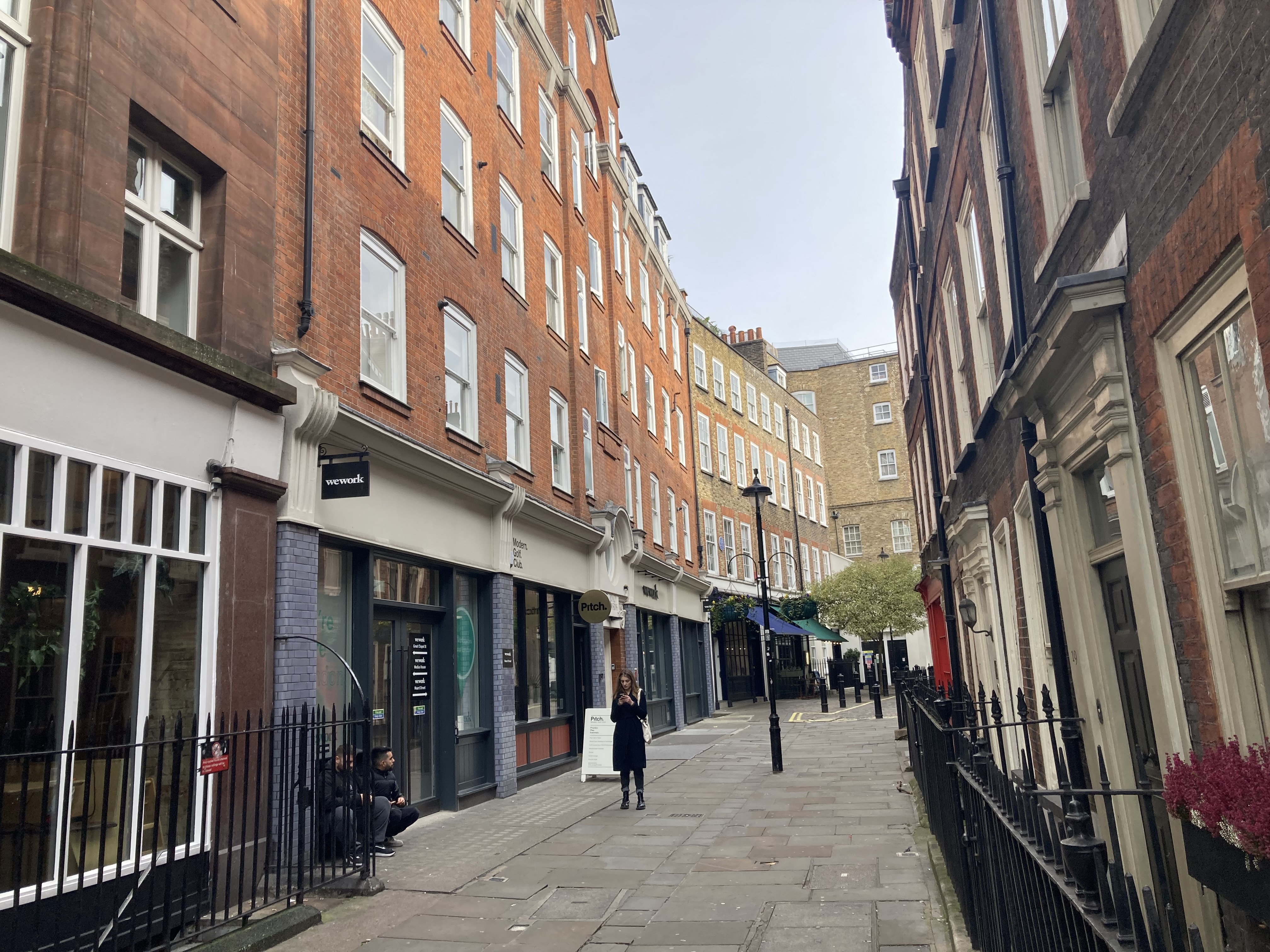
I’ve lived in London since the last days of the 1960s, and I’m still not sure how I feel about it. But there are certainly bits of the city, usually individual streets, where I feel at home. The photo above is of Meard Street, which joins Wardour Street to Dean Street in Soho. If I could, I’d live in one of the Georgian houses on the right-hand side, dating from around 1720. On the left, at No 6, under the blue awning, is the shop of the tailor John Pearse, who opened Granny Takes a Trip at World’s End on the King’s Road in 1966. Beyond it is what was until not all that long ago, and very obviously, a bordello. On the same side of the road, on the corner of Dean Street, was the club first known as Billy’s and then as Gossips, which hosted the weekly Gaz’s Rockin Blues sessions, run by John Mayall’s DJ son, from 1980 to 1995.

That’s the historic London I cherish. Billy’s and Gossips weren’t my scene but on Meard Street I’m a minute or two’s stroll away from the sites of the 2 Is, the Flamingo, the Marquee, the Pizza Express jazz basement on Dean Street, the 100 Club, the Astoria, Les Cousins, Ronnie Scott’s original and current clubs, Bill Lewington’s and Macari’s instrument shops, the record stores of long-gone days — Dobell’s on Charing Cross Road, James Asman’s on New Row, Collet’s on New Oxford Street and its successor, Ray’s Jazz, on Shaftesbury Avenue, One Stop and Harlequin on Berwick Street, and Transat Imports on Lisle Street — and the newsagents on Old Compton Street where you could buy the latest Down Beat.

Two new books — Robert Elms’s Live! and Peter Watts’s Denmark Street — deal, in very different but equally enjoyable ways, with London’s musical history. Elms is best known as a long-standing host on BBC Radio London whose show was unaccountably moved, a couple of years ago, from its daily slot to the weekends. Unlike most people who could be described as professional Londoners, he’s never boring on the subject of his home city. He’s the ideal host: genial without being effusive, genuinely interested in what his guests have to say. And on his show you’re never far away from an excellent piece of music.

He started his career writing for The Face and the NME before becoming a prime mover of the New Romantic movement. We won’t hold that against him. Had he been born 10 years earlier, he would have been a perfect Mod. And his tastes evolved to include all sorts of music, including reggae, jazz, flamenco and tango, all of which he writes about in his new book.

Live! — subtitled Why We Go Out — is an account of his gig-going career filled with the characteristic enthusiasm of a man who describes himself as a gadfly. “I’ve been an honorary member of every passing trouser tribe,” he writes, “sported every silly haircut imaginable and enjoyed almost every style of music, bar heavy metal and opera.”

There are chapters on the time he almost became a member of Spandau Ballet, on his life as Sade Adu’s boyfriend when she was on the way up, on the eternal strangeness of Van Morrison, on his affection for and encounters with the Faces, Bruce Springsteen, Tom Waits, Paul Weller, and Gillian Welch and David Rawlings. He felt his life transformed by witnessing the Jackson 5 at Wembley Arena, saw Little Feat at the Rainbow and now regrets that doesn’t remember much about it, turned up to play football with Bob Marley wearing entirely the wrong sort of kit, listened to the young Amy Winehouse sing in his Radio London studio, and attended the last-ever gig by Dr Buzzard’s Original Savannah Band in New York (how I envy that).

Elms isn’t Lester Bangs or Simon Reynolds. He doesn’t polemicise or analyse. What he’s good at is sharing the thrill of being in the right place at the right time. To me, nowhere is this better conveyed than in his descriptions of falling for flamenco music while living in Spain (he’s sent me off to listen to José Montje Cruz, known as Camarón de la Isla) and the music of Astor Piazzolla while visiting Buenos Aires. Now it’s my turn to make him jealous: when Piazzolla’s Quinteto Tango Nuevo played the Almeida Theatre in Islington for five nights in 1985, I was there for three of them, and the experience was unforgettable.

Peter Watts’s history of Denmark Street is a diligent but also lively and amusing trawl through the origins and evolution of London’s Tin Pan Alley, a narrow street in an area of ill repute in which Lawrence Wright became the first of many music publishers to open an office in 1911. Later, at No 19, Wright would start a weekly paper called the Melody Maker in 1926, followed in 1952 by the New Musical Express, founded by Maurice Kinn at No 5.

Other important addresses on the street were No 9, where a ground floor café called La Gioconda became a meeting place for ambitious young musicians; No 4, where the Rolling Stones recorded “Not Fade Away” and their first album at Regent Sound Studios in 1964; No 24, the home of KPM, specialists in jingles and library music; No 6, where Hipgnosis — Storm Thorgerson and Po Powell — designed elaborate album covers for Pink Floyd and 10cc and where the embryonic Sex Pistols lodged in a back room, later taken over by the embryonic Bananarama; and No 7, where the Tin Pan Alley Club offered a welcome to assorted crooks and gangsters.

Denmark Street: London’s Street of Sound preserves for posterity the story of a piece of London now half-destroyed by a development that has turned the top end of Charing Cross Road into something resembling a cross between Times Square and the Las Vegas Strip: a garish high-tech entertainment facility that could have been born in the imagination of J. G. Ballard at his most dystopian. Like the east side of the bottom end of Charing Cross Road or the east side of Berwick Street, the south side of Denmark Street survives relatively untouched, forced to stare across at its latest iteration.

* Live! by Robert Elms is published by Unbound. Denmark Street by Peter Watts is published by Paradise Road.

Val Wilmer: ‘Blue Moments, Black Sounds’

Val Wilmer is one of the most remarkable people I know, and you’ll know that too if you’ve seen her photographs. Whether it’s Muddy Waters playing cards with Brownie McGhee backstage at the Fairfield Halls in 1964, Archie Shepp sitting beneath a Jimi Hendrix poster in his New York apartment, or a joyful couple whose names we’ll never know at a blues dance in Bentonia, Mississippi half a century ago, she finds the essence of the human spirit.

Those three images are among the several dozen included in Blue Moments, Black Sounds, an exhibition of her photographs which opened this week. It’s on until the end of November at a very nice little gallery in Queen’s Park, North London, which specialises in music photography and where you can also go to get your own pictures framed.

I was particularly moved by the only photograph in the show that has an extended caption, written by Wilmer, in which she tells of going to see Louis Armstrong at Earl’s Court in 1956, when she was a 14-year-old schoolgirl. When Armstrong and the All Stars left the country, catching a plane to Ghana, she and her brother went to see them off at the airport. She took her mother’s Box Brownie camera, asked Louis if she could take his photograph, and got a lovely shot that put her, as she says, “on my way to a lifetime of learning.”

Then she adds something interesting and important: “Through getting to know the musicians, I learnt the importance of positive representation.” That doesn’t mean she learnt how to take PR photographs. It means she learnt to appreciate the importance of immersing herself in the world of her subjects, in order to portray them with greater sensitivity to their lives and to the art that came from it, and to realise that pictures of Ornette Coleman playing pool with Anthony Braxton or members of the Count Basie orchestra snoozing on the band bus can actually tell us more than photos of them on stage.

Those photographs, like most of the ones in the new show, could only have been taken by someone possessing not just painstakingly acquired technical skills but a deep sympathy with the music and the lives of those who make it, and with the courage and humility to take her own place in their world, and to find her unique vantage point.

* Val Wilmer’s Blue Moments, Black Sounds is at the WWW (Worldly, Wicked & Wise) Gallery, 81 Salusbury Road, London NW6 6NH until 30 November: wwwgallery@yahoo.com. Deep Blues 1960-1988, a pamphlet of Wilmer’s photographs from the world of the blues, edited by Craig Atkinson, has just been published by Café Royal Books: caferoyalbooks.com. Wilmer’s As Serious As Your Life: Black Music and the Free Jazz Revolution 1957-1977 is published by Serpent’s Tail.

Sylvie Courvoisier x 2

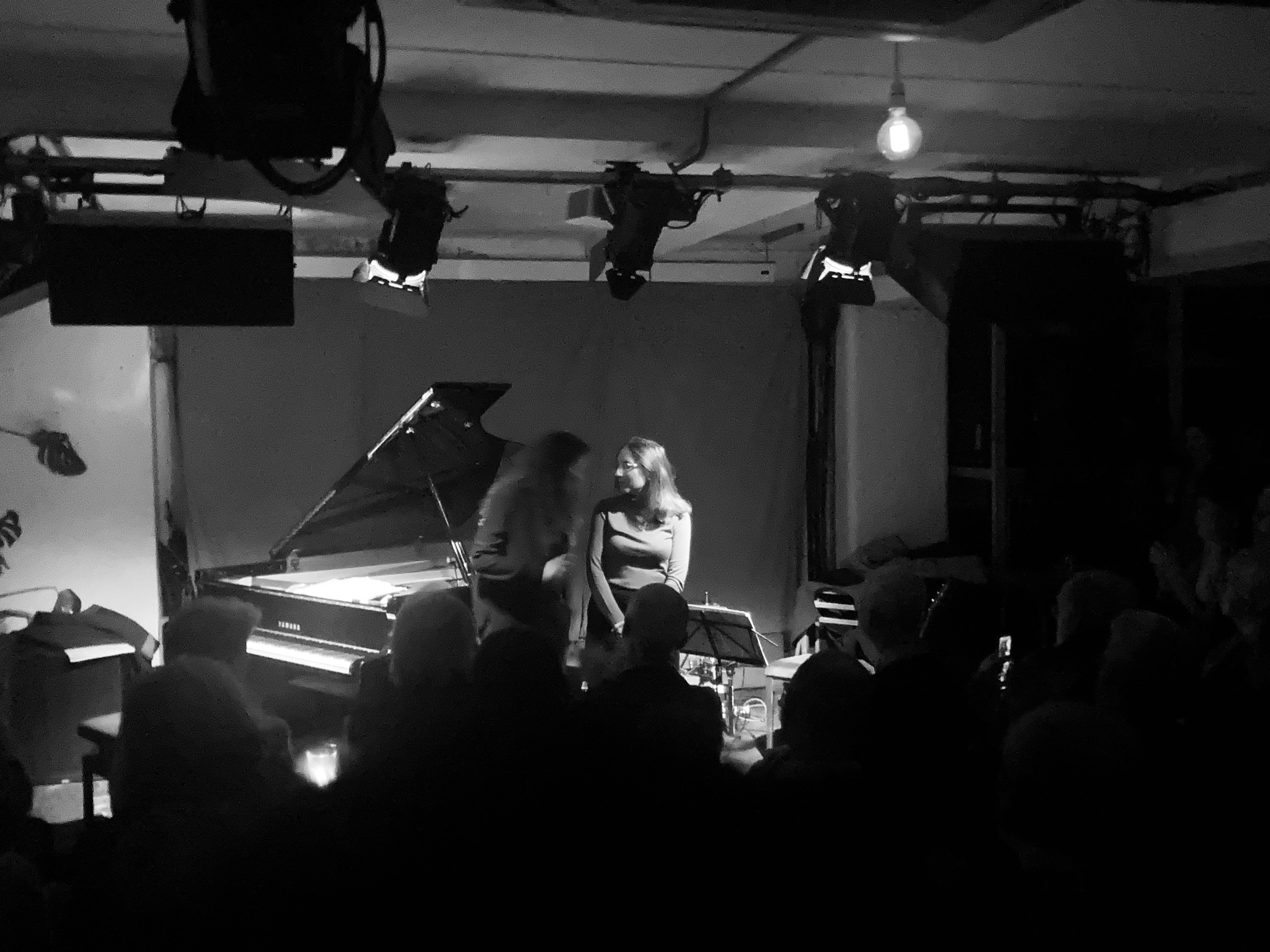
Sylvie Courvoisier and Mary Halvorson at Café Oto 30 October 2023

One way and another, Sylvie Courvoiser’s new album, Chimaera, contains the most sheerly beautiful music I’ve heard this year. Inspired by the paintings and drawings of Odilon Redon (1840-1916), these pieces recall the words of the French artist about his own work: “They place us, as does music, in the ambiguous realm of the undetermined.” Without getting remotely literal about it, Courvoisier finds ways of creating a music parallel to such works as “Partout des prunelles flamboient (Everywhere eyeballs are ablaze)” and “Le pavout rouge (The red poppy)”, summoning dream-like textures that swirl and mingle, float and evaporate, creating pictures of their own.

Courvoisier, the Swiss-born pianist and composer, has lived in Brooklyn for the past 25 years, becoming an important figure in the New York downtown scene. Her band for the new album unites her partners in her regular trio, the bassist Drew Gress and the drummer and vibraphone-player Kenny Wollesen, with the trumpeters Wadada Leo Smith and Nate Wooley and the Austrian guitarist Christian Fennesz, who brings along his array of electronic tools. The broad palette of instrumental colours is used with immense care and subtlety, and with a sense of spatial resolution that invites the listener’s engagement.

She was at Café Oto in London last night with another regular partner, the guitarist Mary Halvorson, to present music based on their most recent album together, Searching for the Disappeared Hour. As piano-guitar duos go, this was neither Bill Evans with Jim Hall nor Cecil Taylor with Derek Bailey, although it contained elements of both those rare partnerships: the elegance of detail of the first and the fearless extended vocabularies of the second. This was music characterised by exactitude and generosity, making its own unique world, in which dizzyingly rapid written passages, never gratuitous, opened out into spellbinding improvised solo passages.

* Sylvie Courvoisier’s Chimaera is on the Intakt label. Couvoisier and Mary Halvorson’s Searching for the Disappeared Hour is on Pyroclastic Records.

Our Island Story

To those who found Chris Blackwell’s 2022 autobiography, The Islander, long on charm but, shall we say, short on detail, The Island Book of Records Vol 1 1959-68 will be the answer to their prayers. Here is the story of the UK’s most charismatic independent label during its formative years, in which the foundations were laid for the company that would later become the home of King Crimson and ELP, the Wailers and Bob Marley, Roxy Music, Bryan Ferry and Brian Eno, Sandy Denny, Sparks, John Martyn, U2 and Grace Jones before Blackwell sold it to Polygram in 1989.

Comprehensively compiled and meticulously edited by Neil Storey, who worked in the label’s press office (and was more recently responsible for the Hidden Masters archive box sets devoted to Chris Wood and Jess Roden), the book’s large square format — handsomely designed by Jayne Gould — enables LP covers to be reproduced at their original size. The scale also allows the enormous amount of information to breathe amid the mass of photographs, press cuttings, record labels and other paraphernalia and ephemera, plus masses of oral history from figures both famous and unknown to the general public but significant to the way the label was run, all deployed to inform and entertain.

After Storey’s discursive and amusing introduction, it begins by describing Blackwell’s origins in Jamaica and the UK, including a Daily Mirror clipping from 1933 showing a picture of his mother on her way to Buckingham Palace be presented as a debutante to King George V and Queen Mary, and his own Harrow School house photo from 1954. Island’s first release, the cocktail pianist Lance Haywood’s At the Half Moon Hotel, Montego Bay, from 1959, is accompanied by quotes from Blackwell, the guitarist Ernest Ranglin, the drummer Clarence “Tootsie” Bear, and the daughter of the hotel’s director, who invited Blackwell — then a water-ski instructor — to listen to the trio performing in the lounge, an encounter on which history hinged.

That’s the degree of depth the reader can expect, whether the subject is Jackie Edwards, Millie Small, Traffic, Jimmy Cliff, Spooky Tooth and the nascent Fairport Convention or the American artists — Ike & Tina Turner, James Brown, Inez & Charlie Foxx, J. B. Lenoir, Billy Preston, Jimmy McGriff, the pre-Spector Righteous Brothers and Huey “Piano” Smith — released on the Sue label by Guy Stevens, the DJ at the Scene club in Ham Yard whose vision was recognised and given free rein by Blackwell, to the lasting benefit of me and many other ’60s teenagers.

The more obscure bands — Wynder K. Frog, Art, Nirvana, the Spontaneous Music Ensemble — are covered in full, as are the projects undertaken to pay the bills while providing a laugh along the way: That Affair (about the Christine Keeler scandal), Music to Strip By (with a lace G-string stuck on to the cover), For Adults Only (comedy) and Big Theo (Johnson)’s Bawdy British Ballads. The company’s first gold disc was apparently secured by Why Was He Born So Beautiful by the Jock Strapp Ensemble, the first of several volumes of rugby songs, at least one of which was recorded at Sound Techniques by the engineer John Wood, who would later record Nick Drake and the other Witchseason artists at the same Chelsea studio.

The making of all these is illuminated by the people who were there, not just the artists but those who were playing important roles in the background, whether by working in the Basing Street office — where everyone sat at round tables, erasing a sense of explicit hierarchy — or by going around the country selling the records, or simply by being Blackwell’s friends. How they all made it up as they went along, and how the founder encouraged and allowed it to happen, is an object lesson in human and cultural dynamics.

“I’m not a collector,” Blackwell says. “I was always looking forward.” Island maintained no real-time archive during his era (which, of course, made Storey’s task of research more demanding and almost certainly more entertaining). When I worked in A&R there, in the mid-’70s, someone told me one morning that the Richmond branch of the Blackwell-owned One Stop Records was closing that evening and that the basement contained a cache of the company’s old 45s. They were going to be chucked out and did I want to do something about them? Collectors had better close their eyes at the next bit: I drove straight down there, found boxes and boxes of mint Sue and white-label Island singles from the ’60s, sorted out two of each — one for the company, one for my office — and sent the rest to be melted down. I have no idea what happened to the ones I saved after I left in 1976. Everyone was looking forward, which is the right way to run a record company.

* The Island Book of Records Vol 1 1959-68, edited by Neil Storey, is published by Manchester University Press (£85).

Nina & Monk, etc

If you happen to be in Paris this week, you might wander along to the little bookshop and gallery of Robert Delpire, tucked away on a street beside the church of Saint-Germain-des-Prés, to see a small show of photographs taken by the Baroness Pannonica de Koenigswater.

Nica, as she was known, took snapshots of many great jazz musicians during her encounters with them in the 1950s and ’60s. To them — the pianists Thelonious Monk and Barry Harris in particular, but many others, too — she was a friend, patron and benefactor, which means that her photographs, taken in dressing rooms and hotel rooms and kitchens, have a rare intimacy and candour.

The photo above, of Thelonious Monk and Nina Simone, is one of about a dozen of the original Polaroids framed and mounted on the walls of the gallery. Many more — of Hank Mobley, Sonny Clark, Coleman Hawkins, Oscar Pettiford, Billy Higgins, Paul Chambers and others — are included in a new book called Dans l’oeil de Nica (Through Nica’s Eye).

Her photos have the tonal richness and warmth characteristic of Polaroids. They were also badly stored for decades and are presented as found, many of them in a semi-distressed condition that inevitably enhances their romantic allure.

The new book is a follow-up to Three Wishes, published in English by Abrams Image in 2006, in which Nica’s photos were accompanied by the answers given to her by dozens of musicians when she asked them the question implied in the title. Many of them are very personal, others poignant, viz. Eric Dolphy: “1: To continue playing music all my life. 2: A home and a car in New York. That’s all!”

* The exhibition is at Delpire & Co, 13 Rue de l’Abbaye, Paris 6, until Saturday 28 October (Wed-Sat 12-6pm). Dans l’oeil de Nica is published by Buchet/Chastel (€44). Nica’s remarkable story is well told in The Baroness, a biography by her niece Hannah Rothschild, published by Virago in 2013.

Kronos at 50

The Kronos Quartet were already well into their second decade when I saw them for the first time, sharing the bill with John Zorn’s Naked City at the Royalty Theatre in London in November 1988. They closed their set with Aarvo Pärt’s “Fratres”, whose hushed, prayer-like cadences were what stuck in my head, and are still there. But they’d become famous for daring to introduce the compositions of Thelonious Monk, Bill Evans and Jimi Hendrix to the format, and for making it clear that they’d be treating those works with the seriousness, rigour and spirit of inquiry that others applied to the standard Beethoven-to-Bartók string quartet repertoire.

Last night at the Barbican, during a year-long tour to mark the 50th anniversary of their creation in San Francisco by the violinist David Harrington, “Purple Haze” was their encore: a shout of joy to celebrate their longevity and the continued relevance of their founding ideal. Harrington and his fellow violinist John Sherba, Hank Dutt on viola and Paul Wiancko, the latest recruit to the cello seat filled so long and so brilliantly by Joan Jeanrenaud, worked their way through a dozen pieces, divided into two sets, coming as close to a career summary as would be possible in two hours for an organisation that, in its lifetime, has commissioned more than a thousand works.

Two guest artists appeared, both on pieces specially written for the quartet: the Indonesian composer Peni Candra Rini to deliver the swooping, chattering vocal lead on her “Maduswara” and the London-born djembe player Yahael Camara Onono to add percussive momentum to Dumisani Maraire’s “Mother Nozipo”. There were reminders of Kronos’s early days in the performance of works by three Americans commonly, if misleadingly, called minimalists: Philip Glass with a piece from the Mishima soundtrack, Steve Reich’s dense and fast-flowing “Triple Quartet”, and Terry Riley with “Lunch in Chinatown”, a light-hearted extract from a new suite featuring the members of the group chatting as if ordering a meal in a restaurant.

For me, the moments of seriousness were the most powerful. The ethereal “God-music” from George Crumb’s Black Angels featured Wiancka coaxing fragile melodies built out of harmonics from his cello while Harrington, Sherba and Dutt each bowed a table full of wine glasses. Dutt took the lead on Jacob Garchik’s arrangement of Antonio Haskell’s “God Shall Wipe All Tears Away”, a setting of a gospel song recorded in 1938 by Mahalia Jackson. This directly followed an excerpt from Zachary James Walker’s Peace Be Still, played against projection of newsreel footage from the Alabama civil rights marches in 1965 and the words of Clarence B. Jones, Martin Luther King Jr’s lawyer and adviser. Jones had helped draft the “I have a dream” speech given at the March on Washington in 1963 — which only took its final form during the speech itself, when Mahalia implored King to break away from his prepared script and tell the crowd of more than 250,000 about his dream.

And then there was their arrangement of Alfred Schnittke’s “Collected Songs Where Every Verse Is Filled With Grief”, which they recorded in 1997, a year before the composer’s death: its skeins of muted melodies and modal harmonic underpinning settled on the hall like a pale but gently glowing mist, much as I remember “Fratres” doing 35 years ago.

Carla Bley 1936-2023

Carla Bley during one of the recording sessions for ‘Escalator Over the Hill’

It seems so true to Carla Bley’s nature, such a characteristically mordant mixture of the sad and the funny, that her last album should have been called Life Goes On. Carla, who was one of jazz’s greatest composers and arrangers, died this week, aged 87. The four pieces recorded in 2019 and making up the short suite that gave the album its name are titled as follows: “Life Goes On” / “On” / “And On” / “And Then One Day”.

And then one day Carla was gone, her death making us think of the music she leaves behind, all of it suffused by her unique personality. In my case, I’m most grateful for the five studio albums she made Charlie Haden’s Liberation Music Orchestra, starting in 1970 with its eponymous debut album, continuing with Ballad for the Fallen (1983), Dream Keeper (1990) and Not in Our Name (2005), and ending with Time/Life in 2016, all of them keeping the precious flame of resistance alight. Carla had grown up listening to her father play the organ in church, and the LMO often brought out her wonderful way of orchestrating hymns and anthems, from Hanns Eisler’s “Song of the United Front” to “Nkosi Sikelel’i Afrika” and Samuel Barber’s “Adagio”, acknowledging the beauty of their aspirations while spiking that beauty with the knowledge of human frailty.

And then there is Escalator Over the Hill, the triple vinyl LP box set released in 1971, the crazily ambitious and magnificently enigmatic “chronotransduction” on with she collaborated with the poet Paul Haines, enlisting a huge cast, perhaps the most extraordinary ever assembled for a single composition. The performers went from Don Cherry, Roswell Rudd and Gato Barbieri through Jack Bruce, Paul Jones and John McLaughlin to Viva, Linda Ronstadt and her own four-year-old daughter Karen, recorded against the odds over a long period of time in several locations, using several levels of technology, subsidised by money begged and borrowed to complete it before its release on JCOA Records, the independent label set up with her then husband, the trumpeter and composer Michael Mantler.

In my copy of Escalator there’s a five-page letter written by Carla to me on yellow legal-pad paper in pencil — “We’re up at our farm in Maine for a rest and we don’t even have running water and electricity, much less typewriters and stationery” — early in 1972, soon after its release. She’d heard from Jack Bruce that the Melody Maker had made it jazz album of the year, or something like that, and she wanted to tell me about how it was now being distributed in the UK as part of a reciprocal arrangement with the saxophonist Evan Parker and the Incus label. Within months she and Mantler would set up the New Music Distribution Service, whose initial foreign partners included Incus and ECM, and which lasted until 1990, having helped disseminate the music of Laurie Anderson, Julius Hemphill, John Adams, David Murray, John Zorn and many others.

The letter is a reminder of Carla’s persistence in championing not just the value of creativity but the rights of the creator and the right to be heard. Others will write about how, as a teenager, she hitched a lift from California to New York to hear Miles Davis and took a job as a cigarette girl at Birdland, and about the enduring qualities of songs like “Sing Me Softly of the Blues”, “Vashkar”, “Ida Lupino” and “Lawns”, and how A Genuine Tong Funeral, the suite she wrote for Gary Burton in 1967, represented the first full exposure of her gifts as well as her sense of humour, beginning as it did with a sequence titled “The End”.

I last saw her at the Cadogan Hall in 2016, an almost spectral figure in black at the side of the stage, sitting down at the piano but also standing to listen as her music was played by the members of the Liberation Music Orchestra during the London Jazz Festival, two years after Charlie Haden’s death. It filled the audience’s hearts and moved me to tears, as she could.