Skip to content

Posts from the ‘Uncategorized’ Category

The great-grandmother’s tale

The series of audio collages that Matana Roberts calls Coin Coin, now reaching its fifth chapter (of a projected 12) with the release of In the Garden, may one day come to be seen as a kind of Bayeux Tapestry of Black American life: an extended narrative portrayal of the struggles, the pain, the joy, the successes and reverses of the successive generations which Roberts, through her own family’s post-emancipation history, can touch and bring back to imagined life.

Each chapter has a theme and here is how, in her sleeve note, she introduces the latest:

There is something quite rancid going on in America right now, more so than any time I have seen… a growing cohort of ghoul-like humans who seem to think that your body does not belong to you. We have seen some of this before, and we eradicated some of the issues. It wasn’t perfect how we did it, but we did it. And yet, like a never-ending train wreck, here we are again.

She is referring to last year’s decision of the US Supreme Court, stacked with conservatives during the Trump administration, to reverse the decision in the case of Roe vs Wade, made in 1973 and guaranteeing every woman’s constitutional right to an abortion. That was a landmark case, won after a long campaign, and its reversal was equally significant in what it said about the prevailing social tides.

She continues: “The lack of access to safe and legal abortion services disproportionately affects marginalised and low-income communities, who often lack the resources and support to obtain safe reproductive health care. Reproductive health care includes abortion. The issue specifically of black folks’ mortality concerning abortion is a complex and sensitive one.” They are, she says, three or four times more likely to die from pregnancy-related causes than their white counterparts.

As usual, Roberts tell stories of women, apparently drawn from her family’s history, affected by those tides: stories of survival in response to oppression, sometimes tragic. This one is based on the story of an ancestor, three generations back, who “perished at a young age, leaving her growing children motherless”. She did not have to die, Roberts says, but “the negative consequences of her death have reverberated down through generations in my family line, in the same way that a similar resounding might happen to someone else’s ancestral line generations from today.”

Her brilliance as a musician is to find the tones and blends that underscore, reflect and amplify these stories, carrying the sounds of both the past and the present in their combinations of reeds, fiddle, tin whistles, percussion, electronics and voices. The turbulent, swirling horns of the mid-’60s “fire music” (including the composer’s own eloquent alto saxophone), the tintinnabulating “little instruments” of the Art Ensemble of Chicago and Corey Smythe’s piano are blended with a simulacrum of the fife-and-drum bands of the 19th century to create an orchestral language that functions as a backdrop to her recitations while richly endowed with the capacity to move to the forefront when required.

Roberts inhabits her ancestor’s story, her voice and the music a palimpsest through which the outlines of history emerge. She is a superb narrator, wry and vigorous, and her alto saxophone solos are a match for her recitations in emotional impact. “At least I know through the eyes of my great-granddaughter [that] I am seen and I have been heard,” she concludes, channeling proudly, and suddenly, in Eliot’s phrase, “all time is eternally present.”

* Matana Roberts’s Coin Coin Chapter Five: In the Garden is released on the Constellation label, available along with its predecessors at https://matana-roberts.bandcamp.com/album/coin-coin-chapter-five-in-the-garden

Exhuming Nico

It was out of sheer curiosity that I went along to Café Oto last night to hear a performance of Nico’s The Marble Index by the string quartet Apartment House (Mira Benjamin and Chihiro Ono on violins, Bridget Carey on viola and Anton Lukoszevieze on cello) augmented by Kerry Yong on piano and other keyboards. The part of Nico was taken by the singer Francesca Fargion.

The room was sold out and the audience expectant. The original album, in which John Cale added his viola, other instruments and post-production touches to Nico’s seven songs, has a special status within the history of rock: barely half an hour long, it arrived as a message from a different world, seemingly shaped by the sensibility of European art-song and the practices of the American classical avant-garde, completely uncompromising in the challenge it offered the listener in 1968.

I suppose the nearest it ever came to being played in concert in its original form during Nico’s lifetime was when she performed a couple of its songs with accompaniment by Cale and Brian Eno at the Neue Nationalgalerie in Berlin in 1974, where they were received with the mixture of applause and outright derision that had greeted the album’s release six years earlier. I certainly never expected to hear the music performed live again after her death in Ibiza 35 years ago.

It was brave of Yong to attempt a modified transcription of the full work, and of Fargion to deliver Nico’s words and melodies. Of course it wasn’t remotely like hearing Nico herself, whose strong, unabashed, wilfully inflexible and uninflected voice defined the music every bit as much as the sound of her harmonium and her strangely memorable melodies, with their echoes of folk tunes and lullabies.

Very wisely, Fargion did not attempt an imitation. But although she is a fine, classically trained singer with a pleasant tone, her interpretations seemed colourless, fading into the strings rather than dominating them. Only “Frozen Warnings”, where the string writing was at its most economical, and “Nibelungen”, a lovely acappella song unreleased until Elektra put out an expanded edition in 1991, allowed the emergence of an attractive poignancy at a worthwhile creative variance from that of the original.

If you wanted to do something really interesting with The Marble Index, to try and match its own inherent challenge, you’d probably have to take it apart and reconstruct it in a different form. This was a careful and respectful performance, observing some of the details of the original, such as the tiny vocal echo on “No One Is There” and a modest version of the pealing piano on “Evening of Light”, although the sound of the harmonium was not heard until “Julius Caesar (Memento Hodie)”, the fifth song in the sequence.

The audience listened intently, and the warmth of their response spoke of the veneration in which this extraordinary piece is now held. In the end, though, what was completely missing was the sense of outright shock and enigmatic purpose that the original artifact itself still conveys, 55 years later, and which is such a part of its eternally untranslatable meaning.

The return of Pete Atkin

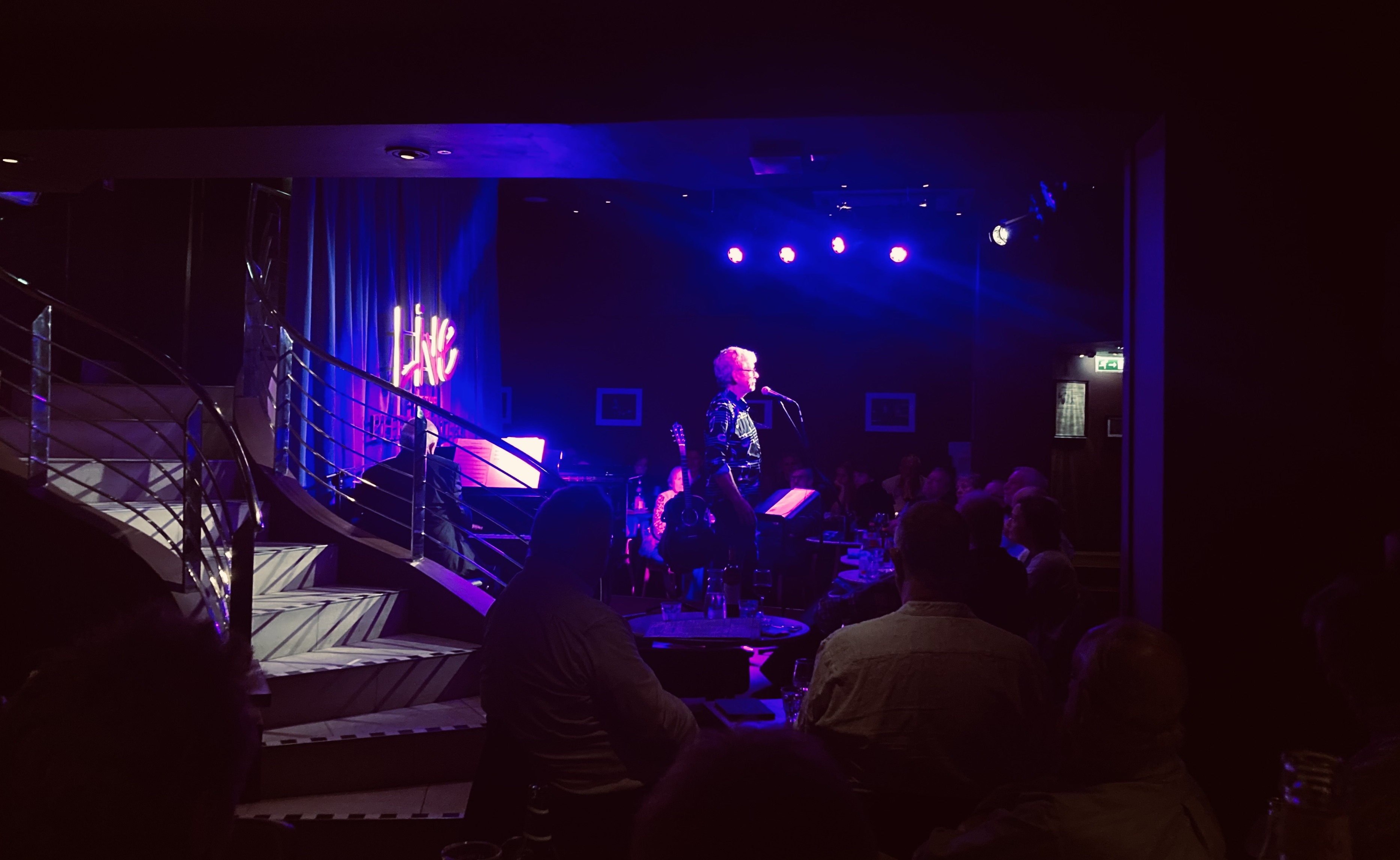
It’s often said, with an air of puzzled regret, that Britain lacks the equivalent of chanson. We certainly had an influential Anglo-Scottish folk tradition, and we had the Beatles and Radiohead. But we didn’t exactly have a Georges Brassens, a Léo Ferré or a Jacques Brel. There never seemed to be a market for that kind of grown-up, ballad-based popular music. Some might say that Jake Thackray, the sardonic, saturnine Yorkshireman who died 20 years ago, came the closest. Others would make the case for Pete Atkin, who emerged at the end of the 1960s singing songs in which he put the melodies to the lyrics of Clive James, and who returned to live performance at the Pheasantry in Chelsea on Saturday night.

For a few years at the beginning of the ’70s, it looked as though Atkin and James, who had met as members of the Cambridge Footlights, might be on the brink of some sort of commercial success with albums such as Beware of the Beautiful Stranger, Driving Through Mythical America and A King at Nightfall. But things tended to get in the way. One example would be Kenny Everett getting sacked from the BBC for making a joke about a cabinet minister just as he was playing one of their songs every week on his Radio 1 show.

Another might be James becoming famous for his weekly Observer TV review, in which he found his comic voice. Polyglot, polymathic, he translated Dante, wrote a series of best-selling memoirs, hosted an annual Formula 1 review on TV, befriended Princess Di, and took tango lessons in Buenos Aires. Atkin, for his part, had a long and award-winning career with BBC Radio as a script editor, producer and head of network radio in Bristol — as well as voicing the part of Mr Crock in a Wallace & Gromit movie. In the early 2000s they reunited and toured together, writing new songs before James succumbed to leukaemia in 2019.

Atkin’s dry, classless English voice was always a long way from the tone of his male singer-songwriter contemporaries produced by the English folk scene, from Ralph McTell to Nick Drake. Lacking any hint of assumed American inflection, his delivery suited James’s agile, witty and erudite lyrics, even though James took so much of his subject matter from American popular culture. Together they aimed for a modern take on the great Broadway songwriting partnerships, absorbing the pop-culture influences of their own time alongside historical references just as their predecessors had. Cole Porter’s “You’re the Top” — “You’re an old Dutch master / You’re Mrs Astor” — might have been their template.

It’s a combination that appealed to a certain sensibility, one well represented at the Pheasantry, where Atkin was making a rare appearance in order to launch a new CD, The Luck of the Draw, the second volume of revisions of some of the old songs and a handful of hitherto unrecorded collaborations (the first, Midnight Voices, was released in 2007).

He sang and played guitar, accompanied for much of the time by Simon Wallace’s beautifully fluent piano. Wallace is one of the musicians on the new album, along with an A-team of Nigel Price on guitar, the bassist Alec Dankworth, Rod Youngs on drums, Gary Hammond on percussion and the saxophonist Dave O’Higgins, together reupholstering the older songs with care and imagination. (Atkin and James always had good taste in musicians: Chris Spedding, Kenny Clare, Alan Wakeman, Tony Marsh and Herbie Flowers were among the supporting cast on the early albums.)

The dramatic highlights of the live set were “Beware of the Beautiful Stranger” and “The King at Nightfall”, two songs for which Atkin, as was his underrated habit, found melodies at least the equal of the beguiling lyrics. The latter’s portrayal of a fallen and hunted despot, its title taken from a line in Eliot’s “Little Gidding”, seems even more resonant today than it was in 1973.

Sometimes James’s erudition could be stretched a bit thin in pursuit of wittiness, as in “I’ve seen landladies who lost their lovers at the time of Rupert Brooke / And they pressed the flowers from Sunday rambles and then forgot which book” (from “Laughing Boy”). During the show Atkin mentioned that the lyricist had self-critically dismissed “The Only Wristwatch for a Drummer” as an example of his own tendency to show off, and I suppose the same charge could be levelled at things like “Screen-Freak”, with its kaleidoscope of Hollywood images, or “Together At Last”, which plays games with pairs (“Two-gether at last / Hearts that beat as one / Swift and Stella, Perry and Della / Dombey and Son”). But they’re audience-pleasers, a facet of a talent that incorporated the audacity required to attempt something like “Canoe”, in which two time-frames, pre-technology and space age, are seamlessly blended.

In my view, James was at his very best at a provider of song lyrics when he was expressing deep emotion in relatively simple language. This was perfectly displayed in three songs Atkin performed at the Pheasantry, each of them a lament for love departed or unanswered. Atkin described the first of them, “An Empty Table”, as resembling a film, shot part in black and white and part in colour, the unadorned lyric perfectly matched by a tune which begins from an unexpected trajectory, then soars and settles with unassuming elegance. The second, “The Trophies of My Lovers Gone”, takes its title from Shakespeare’s Sonnet XXXI, its search for a complex emotional truth reflected in a melody that wanders gracefully. The third, “Girl on a Train”, more typical of James in that the girl he’s yearning after is absorbed in a volume of Verlaine, was presented on Saturday as a final encore, finishing the evening with an elegiac cadence of guitar and piano, drifting into silence.

* Pete Atkin’s The Luck of the Draw is released on the Hillside label (www.peteatkin.com). Ian Shircore’s book Loose Canon: The Extrordinary Songs of Clive James & Pete Atkin, first published in 2016 by RedDoor and now in paperback, is also recommended.

Summer books 3: Ray Connolly

It would surely surprise anyone familiar with London’s Evening Standard only in its shrivelled, almost content-free current version to learn that it was once a substantial newspaper, a proper reflection of the city’s vitality. In the days when it was edited by Charles Wintour, its pages thrummed with big names as well with as the classified ads for flats and cars that paid their salaries: the likes of Alexander Walker, the film critic, Suzy Menkes, the fashion editor, and Sam White, the Paris correspondent, who filed his column from the bar of the Hôtel de Crillon. And, of course, Ray Connolly, who succeeded Maureen Cleave as the byline attached to interviews with the pop stars and other showbiz celebrities of the time. On billboards outside newsagents, “BEATLE TO RETURN MBE” would inevitably refer to one of Connolly’s stories. It was an enviable gig, and he made the most of it.

Although he never gave up journalism, he moved beyond it in the early 1970s when he wrote the screenplays for two films, That’ll Be the Day and Stardust, which examined the years of his own youth with a fondly nostalgic eye and made a star out of David Essex. He went on to write TV and radio plays, novels, and books about John Lennon and Elvis Presley (his radio plays included a smart counterfactual called Sorry, Boys, You Failed the Audition, which imagined a future for the four Beatles had their stars not aligned with success).

Three years ago he caught Covid-19 in a very serious way, spending six months in hospital, most of that time in intensive care. When he emerged alive, somewhat to his own surprise, he needed to relearn some of the things he had previously taken for granted, such as how to walk. He also set to work on a memoir, just published under the title Born at the Right Time.

The story of his journey from a post-war Lancashire childhood (he was born in 1940) to Fleet Street is interesting for the sharp contrasts it draws with today’s world, in which such priority is given to ambition and career planning. But the real value of the book comes when he raids his own cuttings file for excerpts from his interviews with the celebrities of his era. Ray was an exceptionally good interviewer at a time when there were no filters between journalist and subject. A PR person would set the time and place of the appointment, and then retire gracefully. Ray’s gentle but persistent stammer was, he believes, a help in enlisting the sympathy of those answering his questions.

He was the person to whom Ringo Starr described the Maharishi’s ashram in Rishikesh as being “just like Butlin’s”, and to whom Cynthia Lennon confessed that she “didn’t know the tricks” of how to stimulate John. When Ray asked Bob Dylan in 1969 why he always looked so moody, he got this reply: “When I ask photographers how to look, they always say, ‘Don’t smile.’ So I don’t.” Interestingly, when Dusty Springfield spoke to him for the first time about being attracted to girls (and afterwards he drove her back to the house where she was living with Norma Tanega), he and his editor decided not to highlight her responses in a piece that appeared under the headline “Dusty at 30”.

Don and Phil Everly — among his great heroes — talk to him about the origins of their hits. Don on writing “Till I Kissed You” on a place returning from Australia: “I’d fallen in love with a French girl called Liliane and I was afraid I’d never see her again. In those days Australia seemed like the end of the world.” Phil on performing “The Price of Love” in concert: “While Donald plays to the band, I like to look around the audience and maybe pick up a pretty face, a girl I’ll never see again. ‘You talk too much, you laugh too loud. You see her face in every crowd.'”

Away from music, Peter Fonda and Edward Fox behave as if still in character for Easy Rider and Edward and Mrs Simpson. Michael Caine talks while returning to London from Shepperton Studios in his chauffeured Rolls-Royce about his command of French and German and of the craft of acting: “Somehow I seem to have got the image of the world’s luckiest half-wit. But in my view, I’m not half-witted and I’ve never had an ounce of luck in my life.” Well, maybe just a bit when Terence Stamp and Anthony Newley turned down the lead role in Alfie.

Sharp assessments are made without leaving the subjects lying in a pool of blood, as would later become the Fleet Street fashion. Marc Bolan, the teenybop hero of 1972, sits in his flat in Maida Vale and claims that he can fly and make himself invisible. “Bolan was one of those stars who bubbled up in the vacuum left after the Beatles’ dissolution,” Connolly remarks.

There are stories about failures as well as successes in the movie business, the best of them being the protracted and painful saga of trying to get Bianca Jagger to star in the film version of Trick or Treat?, Ray’s 1975 novel, produced by David Puttnam and directed by Michael Apted. “A sort of erotic Chabrol piece about sexual relationships and emotional ambivalences”, it turned into a disaster both predictable and expensive.

Ray’s father was lost at sea during the 1944 landings in France. Unsurprisingly he developed an interest in talking to famous people about their war experiences, from Harry Secombe and Paul Raymond to Tony Benn, Karlheinz Stockhausen and Group Captain Leonard Cheshire, who won the VC for bravery after flying 200 bombing missions to Germany and tells Connolly about being sent by Churchill to observe the nuclear explosion that destroyed Nagasaki: “One part of me was thinking in relief, ‘That’s it. The killing of six years is finished. And another part was thinking about the people who had just died.” Cheshire devoted the rest of his life to charitable work.

In part, this is the sort of memoir you might write because you want your children and grandchildren to know who you really were, trying answer the questions they might never get around to asking. At 80-odd, too, your recall is unlikely to be flawless, and it’s not worth quibbling here about the year Dylan performed in the UK with the Hawks or whether it was Stormy Tempest and the Hurricanes that Ringo played with before the Beatles. The value of the book is elsewhere: in the reminder of how a fine journalist got people to talk, and what happened when he spread his wings.

* Ray Connolly’s Born at the Right Time is published by Malignon.

Ronin at Ronnie’s

Nik Bärtsch’s Ronin at Ronnie Scott’s (photo: Robert Crowley)

Somewhere between an “oh!” and an “ow!”, the abrupt vocal command with which Nik Bärtsch cues his musicians for a shift in musical pattern is the polite zen-funk equivalent of James Brown’s exhortation to take it to the bridge. The reaction is immediate, the players switching from one polyrhythmic cell to another in perfect unison, reframing not just the abstract geometry of metre and tempo but the weight, tone and landscape of the music.

If you own any of the Swiss pianist-composer’s albums, on ECM or his own Ronin Rhythm label, you’ll know that his pieces all go under the bland title “Modul”: “Modul 17”, “Modul 44”, “Modul 55” and so on. I find it rather refreshing not to be primed to think about whether or not a particular piece is a successful portrayal of a nightingale singing in Soho Square. You can just get on and listen to the notes, free from baggage.

But although it may be programmed, there is nothing cold about it. Bärtsch’s music is sometimes attached to such categories and minimalism and systems music, but it’s too abundant to qualify for the former and too warm-blooded for the latter. Any superficial impression of austerity is profoundly misleading. To hear one of his bands live is to share an audience involvement that expresses itself at the end of each long and intense set in a roar of pure exhilaration.

That’s what happened when Bärtsch returned to Ronnie Scott’s Club last week with Ronin, currently a quartet with Jeremias Keller, a relative newcomer on bass guitar, joining the stalwarts Kaspar Rast on drums and Sha on bass clarinet and alto saxophone. Ronin was assembled in 2001 and plays every Monday night at Exil, Bärtsch’s club in Zurich, its members applying their virtuosity to perfecting what their leader calls “ritual groove music”.

I’ve heard Bärtsch’s music in several environments: with Ronin in churches in London and Bremen, solo (with a light artist) at the Barbican, with a horn section at Kings Place and with the Frankfurt Radio big band, orchestated by Jim McNeely, in Berlin. In the set I heard at Ronnie’s, they played the six pieces from their latest ECM album, Awase, blended together into two long sequences, plus an encore. Compared to those earlier performances, this sounded mellower, less edge-of-the-seat, a little more lyrical and reflective, particularly in something like the swooning chordal descent of one section of “Modul 36”.

Even in its gentler moments, however, it was still imbued with that characteristic sense of coiling and uncoiling while still held in tension. And the quality of the playing of all four was extraordinary, with Bärtsch delving into the grand piano’s innards to pluck, strum and damp strings, occasionally striking its frame with a stick, the devoted Sha in the role of Jimmy Lyons to his Cecil Taylor, Rast tireless in nailing down the complex metres and displaced beats, and Keller’s alertness and agility fitting in so well that he might have been with them since the beginning rather than a mere three years.

It was great to see a big crowd assembled to hear this music. Of course the majority of the audience knew exactly what they had come for and received their reward. But also it was interesting to watch the more casual type of customer, the sort who basically turn up for a night at a famous jazz club, as their initial scepticism turned to curiosity and then to intrigue and ultimately to delight, shared with the rest of us.

Summer books 1: Henry Threadgill

As a primer on how to grow up amid communities of creative musicians while asserting and developing your own individuality, Henry Threadgill’s Easily Slip into Another World is exemplary. It also happens to belong, in my view, in the very highest rank of autobiographies by jazz musicians.

One of the great contemporary composers and bandleaders, Threadgill grew up amid the blues, the jazz and the black church music of Chicago in the 1950s, but with an ear open to European classical music. He’s old enough to remember the impact of the lynching of Emmett Till in 1955. Hearing the recordings of Charlie Parker made him want to play the saxophone.

He may be the only Chicago musician of his era to benefit from not having studied under Captain Walter Dyett, the venerated director of music at DuSable High School on the city’s South Side. Threadgill was enrolled at Englewood High, where he played in the school’s concert band but was constantly in trouble. Knowing that Dyett had taught so many of the people he really admired, such as Gene Ammons, Johnny Griffin and Wilbur Ware, he applied for a transfer. Dyett looked at his disciplinary record and turned him down flat. When Englewood let him back in, he resolved to change his ways. I suppose the clearest proof of his success came in 2016, when he became the third jazz musician (after Wynton Marsalis in 1997 and Ornette Coleman in 2005) to receive the Pulitzer Prize for Music, for his composition In for a Penny, In for a Pound.

“Being rejected is the best thing that can happen to you, if you know how to think laterally,” he observes. “I ended up getting a much broader and deeper education.” The scope and volume of his work over the years is astonishing. Many musicians would have made an entire career merely out of the projects he undertook with dancers. Others would have invented the hubkaphone, as he did in 1970 after seeing a display of shiny chrome car hubcaps laid out on a stall in the famous Maxwell Street market, and settled for renown as the creator of the American version of the gamelan orchestra.

He could have pursued a life as an R&B musician, after touring with the Dells and the Chi-Lites in the ’70s, or in Latin music after working with the trumpeter Mario Bauzá in New York. He could even have stayed safely within the circle of Chicago’s AACM. Instead he formed one band after another, following the instinct to push things further. The trio Air, with the bassist Fred Hopkins and the drummer Steve McCall, was followed by many, many others, usually with unorthodox line-ups (e.g. four reeds and four double basses) and sometimes with strange names, such as X-75, Very Very Circus, Zooid and the 14 or 15 Kestra. (Oddly, his latest album, titled The Other One, is by something called the Henry Threadgill Ensemble.)

With the aid of the writer and academic Brent Hayes Edwards, Threadgill tells his story at a relaxed pace and with a depth of detail that is always compelling and never tiresome. The Vietnam section is a serious addition to the literature on that terrible war, from an unusual perspective: about drafted in 1966, thinking he’d done a smart thing by volunteering as a musician, a year later he was the Central; Highlands with his clarinet in one hand and a rifle in the other, encountering the Montagnards and experiencing the African American version of the horror and squalor familiar to some extent from Michael Herr’s Dispatches but here described with even greater clarity and revulsion. “I didn’t shed my war experiences when I got off that plane from Vietnam… Vietnam stayed with me, and it took me to some dark and twisted places even once I returned to Chicago.” But he had survived, and eventually the trauma receded.

Back in the world, his surreal encounter with Duke Ellington in 1971 — with the suggestion that he might have been momentarily lined up as the next Billy Strayhorn — is a Murakami short story in itself. His description of a gig with Cecil Taylor is both hilarious and enlightening: “I was completely befuddled. I was standing there wondering why what we were playing didn’t sound like the piece I remembered rehearsing.” Eventually he discovers, on the stand at Fat Tuesday’s, that “to play Cecil’s music, you had to get to a place where you could let the pieces reconfigure themselves as you went along. It was disconcerting in the moment, but the experience with Cecil impacted the way I came to think about my own bands. It’s important to keep your people a little bit off balance.”

The four pages on his grandfather, Luther Pierce, who often took him to the Maxwell Street market, explain something about Threadgill. Pierce worked in a steel mill but was also the family’s self-taught, trial-and-error electrician, cobbler, plumber, tailor, barber, carpenter, bedbug exterminator and medicine man. “He was resourceful — or reckless — to a degree I have never encountered in any other human being,” his grandson writes. “The most amazing thing about it was his nerve. I think he would have been capable of performing open-heart surgery on one of us had he considered it necessary. Whatever it took, he was ready to do it: nothing was out of bounds. And I suspect that a little of his spirit of radical experimentation rubbed off on me.”

His theory of intervallic harmony was developed for Zooid in the mid-’90s during a stay in Goa, reading about “maths and physics and astronomy and warfare, studying philosophical treatises, reading books about various musical systems.” It resembles George Russell’s Lydian chromatic concept or Ornette Coleman’s harmolodic theory in that it clearly takes a lot of preparation for his musicians to become conversant with the new language, and — although there are several pages of explanation — it’s impervious to casual comprehension. But you’ll probably know it when you hear it.

Simultaneously, while reading Ulysses, he came up with the idea of a 1/4 metre: “James Brown used to talk about getting back to the one. He’d cajole his band, talking about it, calling for it, demanding it — stretching things out to build anticipation. That’s funk in a nutshell: that tantalising expectation of the downbeat. Here it is — and here it is again. With Zooid, the question is almost the opposite: what if you never get off the one? Everything is always the one.”

I’ve quoted at length from the book simply in order to give an idea of the richness contained within its 385 pages. Let’s finish with a piece of typical Threadgill wisdom, fashioned by the tools of thought and experience: “If you look at a book on the history of Western classical music, there’s centuries of background you can read about. Black music in America is relatively young. It’s still just the beginning. And it’s too soon to get upset and start making grand declarations about what you like and don’t like in terms of the directions the music is taking. You don’t have to like it all. What you have to recognise is that it’s not the end of the line. In another hundred years, assuming we’re still here, imagine how much more artistic information will have accumulated from Black music. And it’s not going to be the twelve-bar blues from now until the end of time.”

* Easily Slip into Another World: A Life by Music by Henry Threadgill and Brent Hayes Edwards is published by Alfred A. Knopf. The Other One by the Henry Threadgill Ensemble is out now on the Pi label.

RIP Sinéad O’Connor

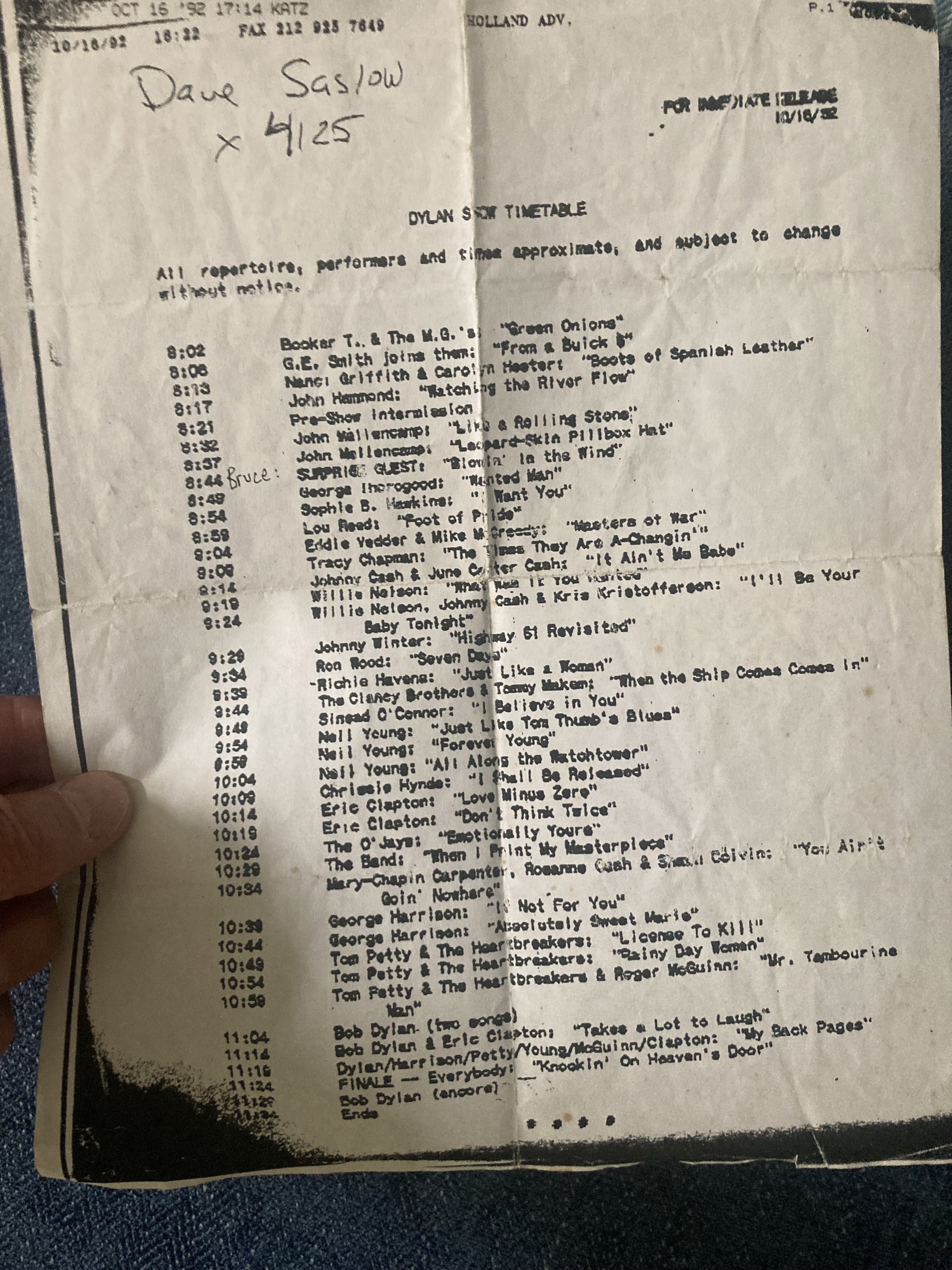
Document handed out to journalists covering the Bob Dylan 30th anniversary concert at Madison Square Garden, New York City, on 16 October 1992.

Adieu, Jane B.

The obituaries of Jane Birkin in this morning’s British newspapers mentioned all the obvious stuff — the BBC ban, the handbags — while neglecting to record two salient features of her career in the public eye. One was her extensive campaigning on behalf of many important causes (including the rights of immigrants and refugees, AIDS, abortion rights and climate change). The other was her music.

She became a singer through her association with Serge Gainsbourg, who gave her many good songs to sing, filled with his love of daft, clever puns and adroit double entendre. She remained faithful to them long after she and Gainsbourg had ceased to be a couple, and five years after his death in 1991 she made an album called Versions Jane, the title indicating its theme: a desire to find her own approaches to his songs.

Since her light, funny, deceptively fragile English-girl-in-Paris voice never changes, the settings are always the key, and for the album’s 15 songs she chose 15 different approaches. It opens with “Ces petits riens”, beautifully sung against animated pizzicato strings arranged by Jean-Claude Vannier. The joviality of “La gadoue” is animated by the sparky ska of Les Negresses Vertes, an accordion playing the role of rhythm guitar, with a cheeky interpolation of the melody from “Je t’aime — moi non plus”. The concert harp of Catherine Michel is the only accompaniment to the haunting “Dépression au-dessus du jardin”. The trio of the veterans Joachim Kühn (piano), Jean-François Jenny Clark (bass) and Daniel Humair (drums) give “Ce mortel ennui” a suave swing reminiscent of a Left Bank jazz club — Le Chat qui pêche, say — in the 1950s.

And on it goes. A full orchestra, arranged by Philippe Delettrez, billows beneath the mad verbal gymnastics of “Exercice en forme de Z”, with its buzzing bestiary of “chimpanzés, gazelles, lézards, zébus buses et grizzli d’Asie.” A slinky electro backing by Bruno Maman and the drummer Patrick Goraguer (son of Gainsbourg’s old musical director) adds a glide to “L’anamour”. The heavy rock of Daren et les Chaises detonates the demureness of “Elisa”. The Hammond organ of Eddy Louiss, once a member of Stan Getz’s European band, chugs beneath “Elaeudanla Téïtéïa”. Swelling strings and a rock rhythm section make a disquieting Euro-pop aria of “Aux enfants de la chance”, Gainsbourg’s warning against angel dust, magic mushrooms, freebasing and dragon-chasing. “Ford Mustang”, the story of a fashionable couple who die (or that’s how I interpret it) while kissing at the wheel of their big American car and crashing into those sturdy plane trees that used to line French routes departmentales, is recited against Boom Bass’s mosaic of samples: free jazz saxophones, random voices, piano, stabs of strings.

Birkin’s travels in pursuit of her various campaigns are recalled by “Couleur Café”, recorded in Dakar, featuring the drumming of the Senegalese griot Doudou N’Diaye Rose, and “Comment te dire adieu”, in which the contribution of the Orkestar Salijević, recorded in a Serbian village, results in a wonky brass band version that Tom Waits would enjoy.

Of the whole collection, the one that has always stuck with me most vividly is “Sorry Angel”. A lover’s ambiguous farewell, its words are half sung, half whispered against the layered guitars of Sonny Landreth, the noted bottleneck exponent in whose Louisiana studio the track was recorded. Floating in a gentle haze between boulevard and bayou, it’s a four-minute movie — and a highlight of the album that perhaps conveys best of any she made the range of her own creative thought.

I knew her a bit around this time and came to understand something of the extent to which she was admired and loved in her adopted country. One evening in Paris I got back to my modest hotel to find the woman at the desk beaming with unusual warmth as she gave me a piece of paper along with my room key. Mme Birkin had dropped by from her house around the corner a little while earlier and left a note about meeting the following day. As the receptionist handed it over, she practically curtsied.

Paul Simon in the waiting room

It’ll be interesting to see how much Paul Simon’s Seven Psalms means to anyone below a certain age, by which I mean the time when the buffers marking the end of the line start to become dimly visible. Simon, now 81, has clearly been reflecting on his own mortality and this new 33-minute strand of seven songs, edited together without breaks, offers his provisional conclusions.

Simon has no privileged knowledge to impart. No one does. Of all the countless billions of people born since homo sapiens emerged in Africa 300,000 years ago, not one has had a credible answer to the question: what happens after we die? Faith-based answers must be respected, but are just that: based on faith, not fact. Otherwise all we can do, all of us, is wait and wonder.

So for someone of my generation it’s interesting to see certain artists we grew up alongside choosing to address the matter, feeling they’re on the brink of finding out for themselves. When David Bowie and Leonard Cohen gave us Black Star and You Want It Darker, they appeared to know that these would be their last words, shared with the public just before they stepped out of this life.

Seven Psalms is Simon’s meditation on what he calls “the great migration”, and of course he can’t avoid the spiritual dimension. The opening sound is that of Harry Partch’s cloud-chamber bowls, a microtone apart, setting up a mood of both meditation and uncertainty before Simon’s distinctive acoustic guitar begins the first song, “The Lord”. It’s an incantation: “The Lord is my engineer / The Lord is the earth I ride on… The Lord is a meal for the poorest / A welcome door to the stranger… The Covid virus is the Lord / The Lord is the ocean rising / The Lord is a terrible swift sword… The Lord is my personal joke / My reflection in the window…”

The song reappears, in briefer form, between the third and fourth and the sixth and seventh songs, as the expression of a man who has no more idea than you or me of what the Lord might be, or if there is one at all, but feels the need to explore the subject and his own vacillation between scepticism and the urge to believe in a higher power, particularly as time gets more pressing.

In the gentle “Love Is Like a Braid”, the shadows of a judgment to come are creeping across the sunlit lawns of childhood innocence: “I lived a life of pleasant sorrows / Until the real deal came / Broke me like a twig in a winter gale / Called me by my name.” Country-blues fingerpicking and the quacking of a bass harmonica carry “My Professional Opinion”, his sardonic take on a world of divided opinions and no common ground: “I heard two cows in a conversation / One called the other one a name / In my professional opinion / All cows in the country must bear the blame.”

“Your Forgiveness” is a lovely song about wonder and doubt, its quasi-medieval tone enhanced by the use of the chalumeau, a precursor of the clarinet, and the theorbo, a 14-string lute used in Baroque music, plus viola and cello. “Trail of Volcanoes” refers briefly to the arc of his own career before coming to a bleak conclusion: “The pity is / The damage that’s done / Leaves so little time / For amends.”

“The Sacred Harp”, some of it sung in duet with his wife, Edie Brickell, is a fable about picking up a pair of hitch-hikers who seem to be on a different journey altogether. The closing “Wait” begins with a thought we might all share one day: “Wait / I’m not ready / I’m just packing my gear / Wait / My hand’s steady / My mind is still clear.”

I have no idea on how near Simon is to the “dreamless transition” in which he wants to believe. But here he shows, as he always has, that he can treat the weightiest of subjects with the lightest and deftest of touches.

* Paul Simon’s Seven Psalms is out now on Owl Records. Here is the official trailer. The photograph is an early publicity shot, taken by Murray Neitlich (thanks to Patrick Hineley for the attribution — see comments).

Songs of the Balkans

Its appeal somewhere between those of Le Mystère des Voix Bulgares, a leftfield favourite in the 1980s, and the collaboration between the saxophonist Jan Garbarek and the singers of the Hilliard Ensemble in the 1990s, Medna Roso is an album taken from a concert in a Cologne church in 2021 by PJEV, a quintet of female singers specialising in the traditional songs of Serbia, Kosovo, Croatia and Bosnia, with the alto saxophonist Hayden Chisholm and the organist Kit Downes.

Chisholm left his native New Zealand in the ’90s to explore the world of music: jazz at a conservatory in Cologne, Carnatic music in Chennai, and the music of the Balkans. I heard him at a festival in Berlin a few years ago, where I admired the distinctive personality of his playing, later enjoyed on a fine album called Breve which he made with the late pianist John Taylor and the bassist Matt Penman, released in 2015 on the Pirouet label.

Downes, of course, is the gifted English pianist known for his work with Empirical, ENEMY, Troyka and the cellist Lucy Railton, among others. His playing on church organs — which he studied at the Royal Academy of Music — has been heard on an album with the saxophonist Tom Challenger under the name Vyamanikal and on his ECM albums Obsidian and Dreamlife of Debris.

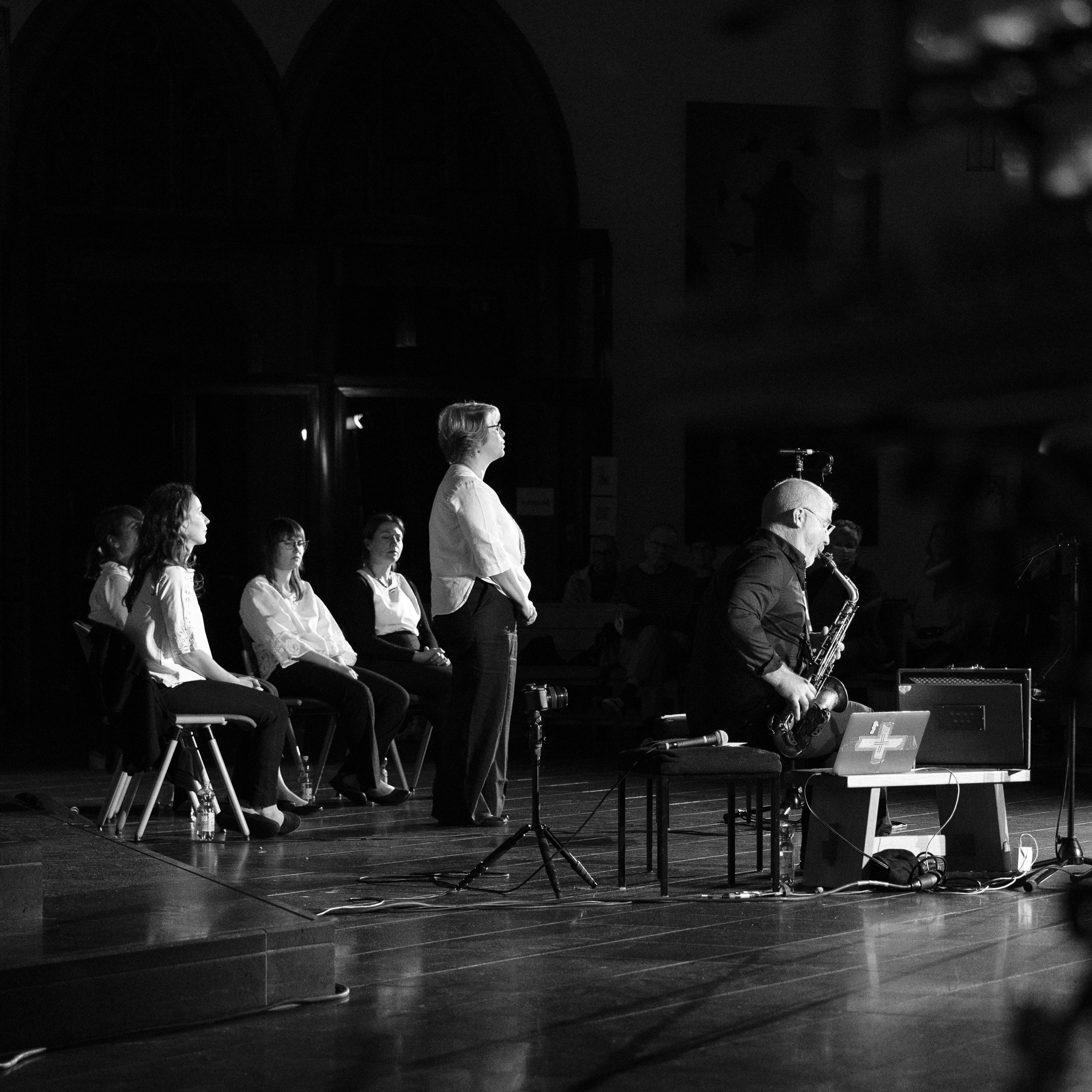
In collaboration with the singers Jovana Lukic, Zvezdana Ostojic, Gloria Lindeman, Lana Hosni and Julijana Lesic, the job of Downes and Chisholm (who also plays analogue synthesisers and shruti box and adds his own throat singing) is to create instrumental textures and interludes, counterpointing, underlining and separating the eight traditional songs that made up the programme for a concert held in St Agnes’ Church as part of Cologne’s JazzWeek.

The voices are plangent, not as lush as the Bulgarian choir, keening and ululating with an ardour and a harsher edge that seems to come from somewhere deep in human history. The songs are about life in mountain villages: families, lovers, the seasons changing (translations are provided in the accompanying booklet). Chisholm and Downes find ways of enhancing their inherent qualities, adding new dimensions and perspectives, providing connective tissue that swells and glows quite beautifully. In the eternal search for music suitable for quiet Sunday mornings, Medna Roso is a valuable discovery.

It’s also the third release on Red Hook, a label founded by the producer Sun Chung, the son of a classical conductor, who grew up in Europe and the US and studied at the New England Conservatory before spending several years at ECM, observing Manfred Eicher’s approach in the recording studio. His label’s debut, a final solo recording by the late pianist Masabumi Kikuchi, called Hanamichi, was one of the finest releases of 2021. Medna Roso will be on this year’s list, no doubt, and deserves a very wide hearing among those likely to respond to its special properties.

* The photograph of PJEV with Hayden Chisholm was taken by Niclas Weber during the concert in Cologne’s Agneskirche. The album is released on 5 May.