Skip to content

Posts from the ‘Uncategorized’ Category

The day the music stopped

Gene Phillips 2It was, without doubt, one of the strangest episodes in the history of the record business. Twice in the 1940s — from August 1942 to November 1944 and from January 1948 to early 1949 — the American Federation of Musicians banned its members from entering the recording studios. On the first occasion James C Petrillo, the union’s president, took action because believed that musicians were losing jobs as places of public entertainment closed and radio became a dominant medium; in compensation, he called for royalty payments by the record companies to the AF of M.

It took a while to get them to the negotiating table. Before the first ban ended, following piecemeal agreements with individual companies for royalties of between 0.25 and 0.5 cents per disc, a great deal of interesting music had gone undocumented. In particular, I think of the young Charlie Parker’s stints with the Earl Hines Orchestra between December 1942 and May 1943 and with the Billy Eckstine Band between April and August of 1944, neither of which were recorded; his fellow members of these fascinating aggregations included Dizzy Gillespie, Benny Harris, Fats Navarro, Wardell Gray, Oscar Pettiford, Shadow Wilson and Art Blakey, while the Eckstine Band’s book included arrangements by Gillespie and Tadd Dameron. An important period in Bird’s career was lost.

(Singers, curiously, were exempted from the ban, which is why Frank Sinatra’s first solo recordings for the Columbia label, made in 1943, featured strictly acapella treatments of such songs as “People Will Say We’re in Love” and “Oh! What a Beautiful Morning”, suavely arranged for the singer and the Bobby Tucker Singers by Alec Wilder.)

By the time the second ban loomed, imposed by Petrillo as a protest against the Taft-Hartley Act, passed in 1947 to restrict the power of labour unions, the labels had their pre-emptive plans in place. The appetite for recorded music was huge, and to stockpile the material that would enable them to meet it they scheduled round-the-clock sessions — with the willing collaboration, it seems, of the musicians whose services were about to be withdrawn. Most of the companies tried to stash away enough material to keep them supplied with new releases for what turned out to be a rather shorter recording hiatus.

Among those getting busy were the Bihari brothers of Los Angeles, who had started their Modern Records label three years earlier, concentrating on making records for the black audience, which Jules Bihari had encountered while servicing juke boxes in Watts. Their first hit, in their initial year, had come with “Swingin’ the Boogie” by Hadda Brooks, an accomplished pianist and a sultry singer, and their roster had expanded to include the Ebonaires, a vocal quartet, the gospel singer Madam Ira Mae Littlejohn and bandleaders such as the guitarist Gene Phillips, the drummer Al “Cake” Wichard, the saxophonist Little Willie Jackson and the trumpeter-singer Butch Stone.

All these were pressed into service to build up a stock of material for however long the ban lasted, but since it ended after barely a year, most of the sides went unreleased. Now Tony Rounce of Ace Records, which has licensed the catalogue of Modern and its associated labels for the past 30 years, has delved into the vault to assemble 49 of the 80-odd tracks recorded during that burst of activity, all but 10 of which are seeing the light of day for the first time, on a two-CD set titled Beating the Petrillo Ban: The Late December 1947 Modern Sessions.

Apart of from its curiosity value, the compilation provides a marvellous snapshot of black popular music at a time of change, when mainstream jazz styles were starting to mutate into early rhythm and blues. So most of the music is an invigorating combination of big, burly blues shouters — half a dozen tracks under Wichard’s leadership feature the young Jimmy Witherspoon — and excellent jazz soloists, all of whom, sadly, go uncredited, since no personnel information has survived the intervening 66 years.

The leaders’ names will be unfamiliar to many people, but the quality of the material and the musicianship is invariably high. So is the recording quality: most of the tracks could have been recorded this week. The offer of a dozen new tracks by the gifted Ms Brooks (born Hattie Hapgood) and her excellent accompanists is too good to refuse, and the four sides by Gene Phillips and his Rhythm Aces (pictured above, in a photograph taken from the well annotated and illustrated CD insert) are notable for the leader’s eloquent guitar playing, particularly on “Gene’s Guitar Blues”, where he plays in a Hawaiian style that Chuck Berry later utilised on his instrumental “Surfin’ Steel”.

But the real find, for me, is Madam Ira Mae Littlejohn, whose six tracks expose us to a gospel singer of quite staggering power. “The technology has only just arrived to allow us to copy what was once an extremely bent and unplayable acetate,” Rounce says, further informing us that these may have been her only recordings. Thank goodness for digital technology, then, allowing us to discover Madam Littlejohn’s raw, throat-tearing delivery, accompanied by rudimentary piano and acoustic guitar and occasionally by a handful of supporting voices. The rest of the set would make a fine addition to the collection of anyone interested in the music of the period, but this is real treasure.

James Caesar Petrillo, by the way, died in 1984, aged 92. He had started life as a trumpeter before devoting himself to union affairs, ran the Chicago branch for 40 years, and once wrote to Benito Mussolini to complain that the city’s Italian consul had hired a non-union band. He took control of the national body in 1940 and the recording bans quickly made him a national figure, but in the mid-Fifties there were attempts to dislodge him, led by Local 47 in Los Angeles and Local 802 in New York — two branches in which jazz musicians were prominent. He resigned from the presidency in 1958 and was ousted from the leadership of Chicago’s Local 10 four years later. The bandshell in the city’s Grant Park bandshell was named after him.

Some thoughts on Bob Dylan

Bob Dylan faces21.
There are 12 works in Face Value, the new Bob Dylan exhibition at the National Portrait Gallery in London, on until January 5 and free to enter. One room, three walls, four paintings on each wall, identical proportions, symmetrically hung. A dozen faces, any or all of whom could have stepped out of his recent songs. He’s given them names, but we don’t know whether “Ivan Steinbeck”, “Ursula Belle”, “Red Flanagan”, “Sylvia Renard” and the rest are real people, or whether they’re products of the imagination that created Lily, Rosemary and the Jack of Hearts. “These are conventional people,” the artist says during a Q&A contained in the slender but handsome £25 catalogue. “One of the men is actually a member of the Sydney Yacht Club. One’s a limo driver.” Well, maybe. It doesn’t matter.

This is not my area of expertise, but Dylan seems to me to have mastered the use of pastels — the chosen medium here — quite well enough to bring his subjects to life. The eyes are the key to a portrait, and every one of these characters has a certain regard of his or her own: they’re looking at you, or past you, or through you, or inside themselves. Each has a subtitle, which might or might not be significant: “Slap in the Face” is the line accompanying “Ken Garland”, who has a broken nose and looks like a prizefighter. They could be the 12 Most Wanted, or they could be a jury. They could be devils or they could be angels. Or a bit of both, like most people.

2.

When you add the illustration on the front of Another Self Portrait: The Bootleg Series Vol 10 to the dozen pictures in Face Value, with which it shares its format, it starts to make more sense. Dylan’s image of himself — if that is what it is — floats between reality and fiction, neither one nor the other.

I bought the four-CD box, mostly because I wanted the disc containing the complete concert at the Isle of Wight in 1969, but I’m glad to have many of the items among the 35 tracks collected on the first two CDs (the fourth disc is yet another remastering of the original Self Portrait, which I didn’t need). As many people have already said, “Tattle O’Day” is a major discovery, a mysterious traditional song beautifully delivered by Dylan with David Bromberg’s guitar and Al Kooper’s piano: the sort of thing that very probably formed the inspiration for the material recorded on the Basement Tapes. There are excellent alternative versions of “Went to See the Gypsy” and “When I Paint My Masterpiece”, and another lovely voice-and-piano treatment of “Spanish Is the Loving Tongue”, a song I’d be happy to hear him sing every day for the rest of my life.

But this version of “House Carpenter”, also with Kooper on piano and Bromberg on guitar, isn’t a patch on the electrifying one he recorded by himself during the sessions for his first album in 1962, with which he began his long tradition of omitting some of his finest work (an omission corrected in 1991 with its inclusion in Vols 1-3 of the Bootleg Series). I don’t like “All the Tired Horses” without its string arrangement, or “New Morning” with banal horns and without Ron Cornelius’s magical guitar solo, or “Time Passes Slowly” done as a homage to Joe Cocker’s “With a Little Help From My Friends”. And so on.

A mixed bag, in other words, just like Self Portrait itself back in 1970, from which the two tracks I play most today, as I did then, are Gordon Lightfoot’s “Early Mornin’ Rain” and Gilbert Becaud and Manny Curtis’s “Let It Be Me”, both completely enchanting.

3.

As I said, I bought the deluxe edition in order to get the full set from the Isle of Wight in 1969, and therein lies the real revelation. Here’s where the remastering has really helped, dispelling the sonic fog that shrouded over the three tracks that were released in a jumble on Self Portrait and, of course, improving even more on the terrible sound of the audience-recorded bootleg LP version I bought a few weeks after the event itself.

Thanks to the impression created by those recordings, and to the general lack of enthusiasm of the contemporary reviews and word of mouth reports, I’d never regretted not making it to that particular IoW festival, even for Bob. Now I do. It becomes clear that Dylan and the Band were in top form, hitting their marks on every song they play together, finding an excellent balance between the driving electrified Hawks of 1966 and the rustic Big Pink sessions of two years later. And when you hear everything laid out in its proper context, Dylan’s four-song acoustic set is wonderful, with “Wild Mountain Thyme” among his very best recordings of traditional material (or any material, come to that).

I can’t help thinking that three factors militated against a proper appreciation of the set by many of those who were there. First, the audience was exhausted, coming to the end of the weekend and having endured a three-hour wait before the Band’s nine-song set and then a further 40-minute hiatus before Dylan made his appearance. Second, after a weeks-long build-up that took hype to new heights, there was an expectation that the main attraction would be joined on stage by, at the very least, all four Beatles and Eric Clapton; it didn’t happen, of course. Third, the musicians’ self-presentation might not have helped: although John Wesley Harding and Music from Big Pink had made it clear that things were changing, I can’t help feeling that if Dylan had come on in a leather jacket, jeans and Wayfarers instead of that white suit, and performed exactly the same songs in exactly the same way, he might have been given a different hearing.

Big hit records

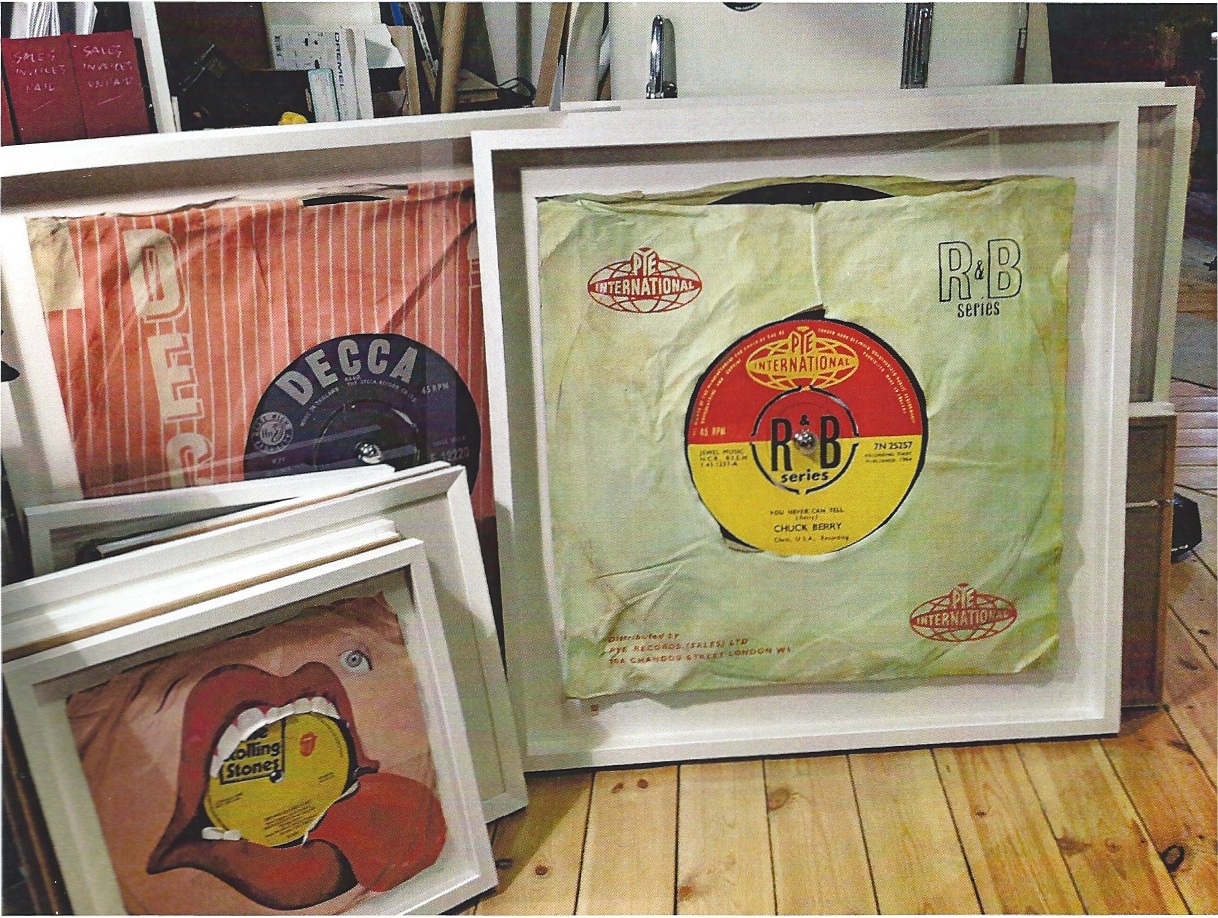
Morgan Howell's 45sMorgan Howell recreates 45s as pieces of art because he wants to make them larger than life. As big, in fact, as the space they take up in your heart and mind. That means making 27-inch discs rather than seven-inch, encasing the enlarged vinyl facsimile in a reproduction of the original paper bag made out of canvas and painting the original graphics and type from the label and the bag, and then mounting the result in a 32×32 frame. But Howell is not trying simply to reproduce the record as it came out of the freshly delivered box of 25 on the record shop counter one Friday morning two or three generations ago. He wants to show the whole history of the individual record: the signs that it has been played and played and played again, treasured and cherished and carried from bedsit to party and onwards through life. So, with infinite care, he reproduces all the creases and tears, all the fading, all the smudges and lipstick smears, and even the traces of a long-since removed sticky label.

Thirty of these three-dimensional objects — several full-scale originals, and some smaller prints — are on show all this month at the Snap Gallery, situated in an arcade between Piccadilly and Jermyn Street in London W1. Among them is Chuck Berry’s “You Never Can Tell”, issued on the gorgeous yellow and red Pye International R&B label in 1964, about which David Hepworth wrote quite beautifully in his blog a few weeks ago (click on http://www.davidhepworth.com/blog.html and scroll down to June 19, 2013). You’ll also find “Shakin’ All Over” (with that marvellous expressionist 1960 EMI bag), “Green Onions” on Stax, “Good Luck Charm” on UK RCA, “My Generation”, the Chiffons’ “Sweet Talkin’ Guy” on Laurie, the original US Columbia issue of “Like a Rolling Stone” and many others.

When Morgan Howell told me that the first one on which he’d tried the technique was Martha and the Vandellas’ “Heat Wave”, borrowed from his big sister’s record collection, I knew he was a man after my own heart. I told him that I could remember precisely where and when I heard that record for the first time, standing beside my parents’ KB valve radio one evening in September 1963: my first blast of the full-strength, fully developed Motown sound. His own favourite is one of which he’s done both the A and B sides: “Get Back” and “Don’t Let Me Down” by the Beatles, which has a special meaning for him since he happened to be sitting in the back of his father’s Ford Zodiac, aged three, when they got stuck on Savile Row in an unexpected traffic jam on January 30, 1969, the day the Beatles played together in public for the last time on the Apple roof.

They’re not cheap: the originals cost £9,600, prints at the same size are £2,000, and the scaled-down versions are £595. In any size they’d be a very nice thing to have on your wall, even if you preferred “Paranoid” or “Hotel California” to “You Never Can Tell”. And, inevitably, you start playing the game of what you’d commission him to paint, if you could afford it. At the moment — and this is a purely imaginary exercise, you understand — I’m thinking Billy Preston’s “Billy’s Bag”, on the UK Sue label, with that fantastic paper bag listing all the label’s artists. Or maybe the Reflections’ “(Just Like) Romeo and Juliet” on Stateside. No, it’s got to be Kenny Dino’s “Your Ma Said You Cried in Your Sleep Last Night”, with my then-girlfriend’s name inscribed in nail polish on its HMV/United Artists label 51 years ago. Now there’s a record that deserves to have its portrait painted.

Rod’s Miura

Rod's MiuraThe last time I saw this car, in May 1971, it was parked outside Morgan Studios in Willesden, North London. Its owner was inside the building, finishing off Every Picture Tells a Story.

That February I’d been on the road with Rod Stewart and the Faces in Boston and Jersey City, writing a story for the Melody Maker. You can imagine it was pretty good fun, as long weekends go. Now here I was, three months later, listening to Rod waxing lyrical about David Ruffin as he put the final touches to his cover of the Temptations’ “(I Know) I’m Losing You”. Then came the wonderful experience of having “Mandolin Wind” and “Maggie May” played back through the studio speakers. Martin Quittenton was in the studio that night, having made a vital contribution to the album as guitarist, mandolinist and co-writer. “Mandolin Wind” remains my favourite of Rod’s recordings, by a distance.

On the way into the studio I’d admired the brand-new yellow Lamborghini Miura parked on the forecourt. There weren’t many of those in London in 1971. This was the first of Rod’s many exotic cars, including a whole string of Lamborghinis, and probably the prettiest of the lot. Who cared that the clutch was unbearably stiff or that it overheated constantly? He’s very funny about it in his droll autobiography, put together last year with the help of Giles Smith. “The Miura was a considerable investment: £6,500,” he recalls. “Bear in mind that the first house I had just bought, in Muswell Hill, had only cost me £5,000. So, for a while there, my car was worth more than my house. And there was no off-road parking, so I had to leave it on the street. Small wonder I couldn’t sleep at night.”

The car over which he lost sleep is now to be auctioned by Bonhams at the Goodwood Revival in September. The picture above is of the sale brochure, and the estimate for the car is between £750,000 and £850,000. A lot of money, but almost certainly a great deal less than the value of whichever of his houses its first owner will be sleeping in tonight.

I’ll save my story about seeing Rod for the first time in 1964, with one of my favourite bands ever, for another day.

Mick Farren 1943-2013

Mick FarrenMick Farren collapsed and died on stage at the Borderline in London on Saturday night while singing with the latest version of his band, the Deviants. After three decades in New York and Los Angeles, he had spent the last few years back in Britain. Here’s a tribute by his old friend and NME colleague Charles Shaar Murray, and here’s my obituary, both from today’s Guardian.

I knew Mick at the end of the ’60s and the beginning of the ’70s, which was probably his best time, and I always enjoyed his company. I’d first clapped eyes on him in Nottingham in 1967, when an enterprising friend of mine organised the city’s first (and only) “happening” at the Rainbow Rooms, and booked the Social Deviants — as they were then called — along with a projector and a print of Kenneth Anger’s Scorpio Rising, a bubble machine and the bits and pieces to make a rudimentary light show. How cool we were, suddenly transformed from mods into hippies! I bought a Tibetan love bell and gave my friend Paul Smith, then managing the men’s floor of a boutique called Birdcage, 25 shillings to get his tailor to make me a royal blue kaftan with floral braid. It looked fine until I tried to dance and discovered that the arm-holes had been made so small that I could barely move. So much for letting it all hang out. (Having some sense of history, I kept the garment; it made a second public appearance in True Brit, the exhibition devoted to Paul’s work at the Design Museum a few years ago.)

The photograph above is taken from the back of the dust jacket of Mick’s excellent memoir, Give the Anarchist a Cigarette, published by Jonathan Cape in 2001. It was taken by Barrie Wentzell, the Melody Maker‘s staff photographer, and it records a round-table discussion at the MM‘s old Fleet Street offices, probably in 1971. The discussion was being moderated by Michael Watts, who has his back to the photographer, and our much-missed colleague Roy Hollingworth, on Watts’s left. Neither of us can remember who the hippie on Hollingworth’s left is. That’s Farren next to the unknown person, with Sandy Denny opposite him at the top of the table (no, it’s not Sandy Denny: see Comments). On Sandy’s left, wearing a cap, is Robert Wyatt. On Robert’s left is another person whom neither of us can identify. We can’t remember what the subject of the discussion was, either. Maybe someone out there can help.

Frances Ha

It’s not often I want to get up and dance in the aisles of a cinema, but that’s how I felt halfway through Noah Baumbach’s Frances Ha the other night, when David Bowie’s “Modern Love” erupted out of the speakers. I’ve never been keen on Bowie (although I admire the stuff from his Berlin period), but “Modern Love” is one of those tracks — like Boffalongo’s “Dancing in the Moonlight”, Danny Wilson’s “Mary’s Prayer” or the New Radicals’ “You Get What You Give” — that automatically quicken the heartbeat and turn the world’s colours up a shade. It doesn’t matter who it’s by. Listen without prejudice, as someone once suggested.

Frances Ha benefits from an excellent soundtrack, including a fine cello-led piece by Joan Jeanrenaud (the Kronos Quartet’s original cellist) and incidental music by Dean Wareham and Britta Phillips. You might or might not remember Wareham from the indie rock bands Galaxie 500 and Luna, in which he was joined by Phillips, to whom he is now married. They’ve also recorded as Dean and Britta, and they contributed music to Baumbach’s first film, The Squid and the Whale, in 2006.

I hadn’t expected to like Frances Ha as much as I did. It’s not nearly as cutesy as this trailer might make it seem. By the end, Greta Gerwig turns Frances into a character with real depth, someone you really care about.

Don’t forget the Motor City

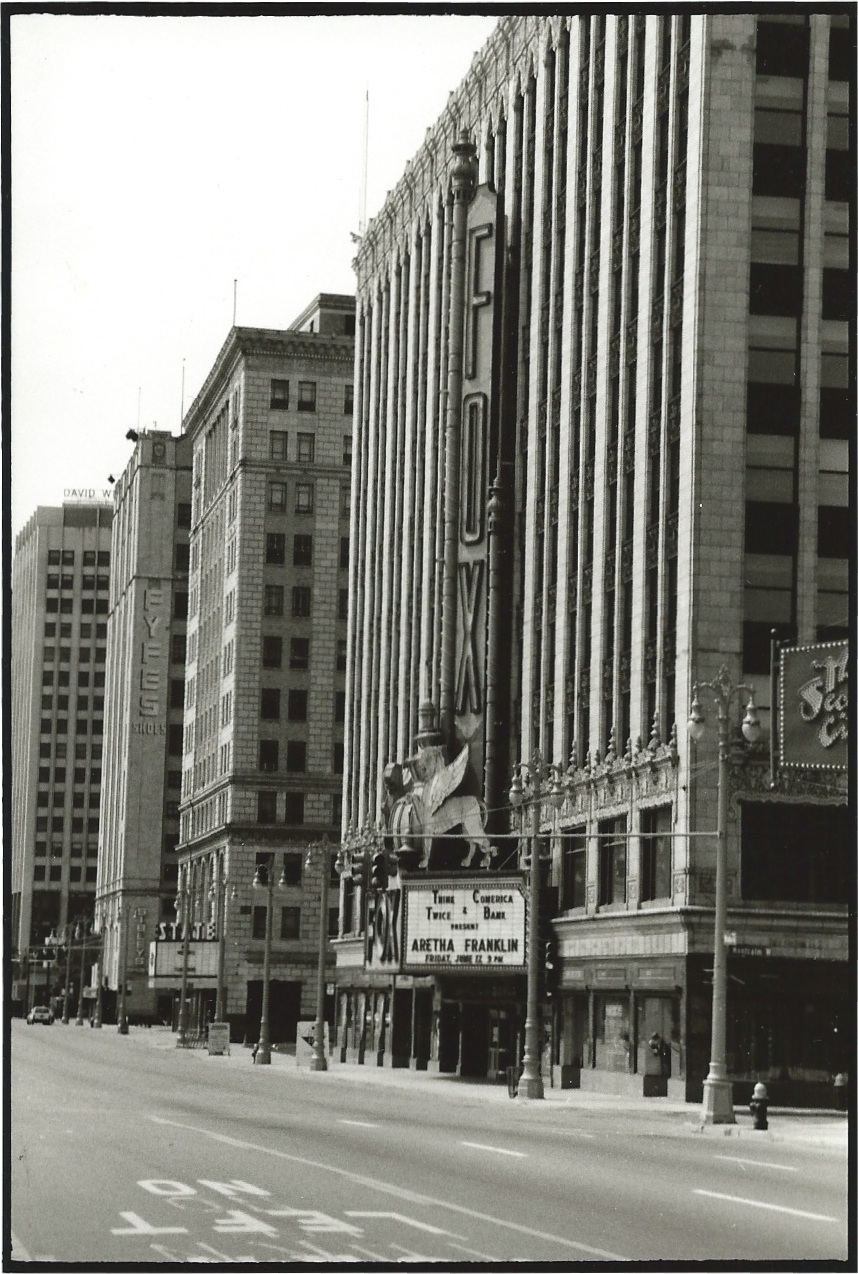
Fox TheatreYou’ll have read that Detroit went bankrupt the other day, and you might have felt more than a twinge of sympathy for the city that gave us so much music. (The Independent‘s Ian Burrell did, and wrote about it very touchingly here.) You might also have seen The Ruins of Detroit, the 2010 book in which Yves Marchand and Romain Meffre photographed the abandoned hulks of factories and municipal buildings, lending them a terrible glamour. I’m currently reading Mark Binelli’s widely praised The Last Days of Detroit, in which a Rolling Stone journalist returns to examine the fate of his home town. It made me go and dig out a photograph I took in 1994, during the World Cup, when I was in Detroit to watch Brazil play Sweden in the Pontiac Silverdome.

This is not a photograph of a ruin. Quite the reverse, in fact. It shows the Fox Theatre, a famous establishment on Woodward Avenue in the downtown area. Opened in 1928, with 5,000 seats, lavishly appointed and built at great expense, it became the world’s first cinema to install sound equipment for the screening of talkies. Live shows were also a part of its programme: Swing Era stars like Benny Goodman packed the place, Elvis Presley played there for three nights in 1956 (his first appearances in the city), and the Motortown Revue got into the habit of taking over the theatre for 10 days over the Christmas period in the ’60s. By the 1980s, however, “white flight” to the suburbs had changed the character of downtown and the heavily dilapidated Fox was showing kung-fu movies. Then along came the family who own the Little Caesars pizza chain, the Detroit Red Wings (ice hockey) and the Detroit Tigers (baseball), who bought and renovated it, re-opening in 1988 with a show starring Count Basie and Smokey Robinson.

The day I passed by with my camera, the marquee was still advertising an Aretha Franklin concert which had taken place a week earlier. (Detroit is also Aretha’s home town: it was where her father, the Rev C.L. Franklin, set up his New Bethel Church in 1946.) A check on the Fox’s website tells me that this year’s future attractions include Steely Dan, John Legend, Get Back: The Beatles Laser Experience, Sarah Brightman and the Moscow Ballet. Aretha sang there again last year.

Hope you like the picture. And good luck to Detroit, whatever its future holds.

New brushes and palette

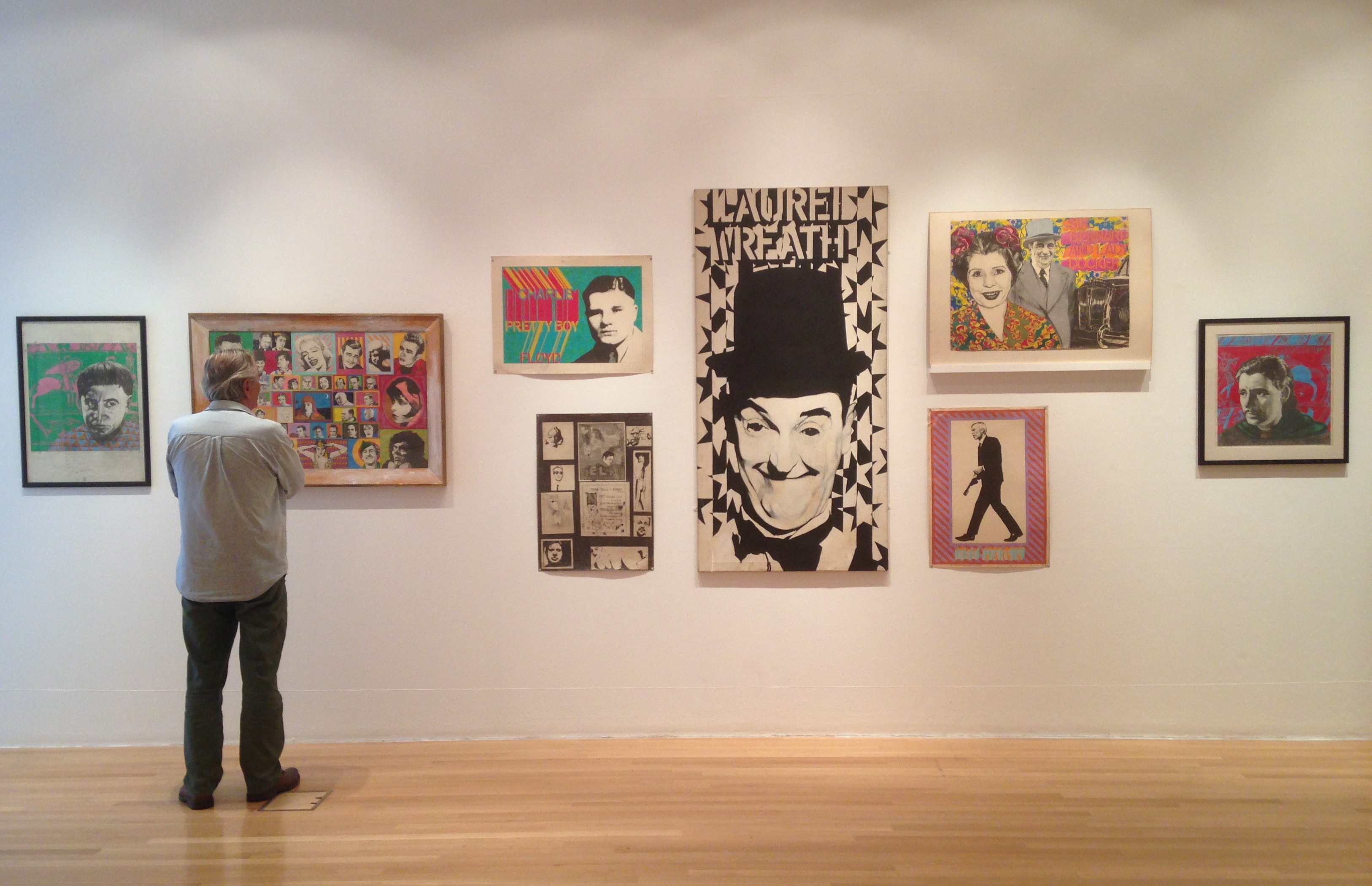
DuryIan Dury may well have been the only pop artist who became his own subject. On the walls of a new exhibition of his paintings, drawings and graphic design at the Royal College of Art in London, where Dury studied in the early ’60s, hang a handful of interesting self-portraits. For his true self-portrait, however, you have to search YouTube for the remarkable official videos for “Hit Me With Your Rhythm Stick” and “Reasons to Be Cheerful, Part 3”, where you will find the artist who invented himself in the medium that best suited him. Nevertheless the RCA show, called More Than Fair, is well worth a visit for the glimpse it provides of a young man who grew up amid the benign ferment of British art colleges half a century ago.

Dury went to Walthamstow School of Art in 1959, studied with Peter Blake, and won a place at the RCA in 1963. This was a time when popular culture was becoming an acceptable subject for fine artists, thanks to the work of Blake, Richard Hamilton and others, and Dury welcomed the opportunity to take on a range of subjects including Hollywood stars, Sonny Liston, celebrity industrialists (Lord and Lady Docker, famous for their Daimler with gold door handles) and the soft-porn nudes who take up just about half the show.

The influence of Blake — who remained a friend — is evident in the presentation of such works as “Flo Diddley” and “Miranda Aureole: The Nipple Princess”, and in the work he did for the Sunday Times Magazine and London Look. Here from the ST Mag (which continually bylined him “Ian Drury”) are spreads devoted to features on “The Immortals” (Bogart, Gable, Harlow, etc) in 1966 and “Lost Heroes” (James Dean) the following year. Rainbow stripes are bursting everywhere, sometimes accessorised with sequins. Titles are roughly stencilled. The energy is unmistakeable, even in the representatives of his commercial work, such as the cover of World Record Club’s “The Wonderful Vera” (Lynn) and the box for EMI’s reel-to-reel tape version of Sinatra Sings of Love.

Four LivesThis didn’t turn out to be the work Dury was put on earth to do, but he was pretty good at it. Curated by Jemima Dury (the artist’s daughter), Julian Balme and Kosmo Vinyl, the show was assembled from the family collection and loans from friends and former colleagues, including Terry Day, the drummer of Kilburn and the High Roads (who contributes a Dury-decorated bass drum head), Davey Payne, the Blockheads’ saxophonist, Andrew King, Dury’s music publisher, and Laurie Lewis, the dance photographer.

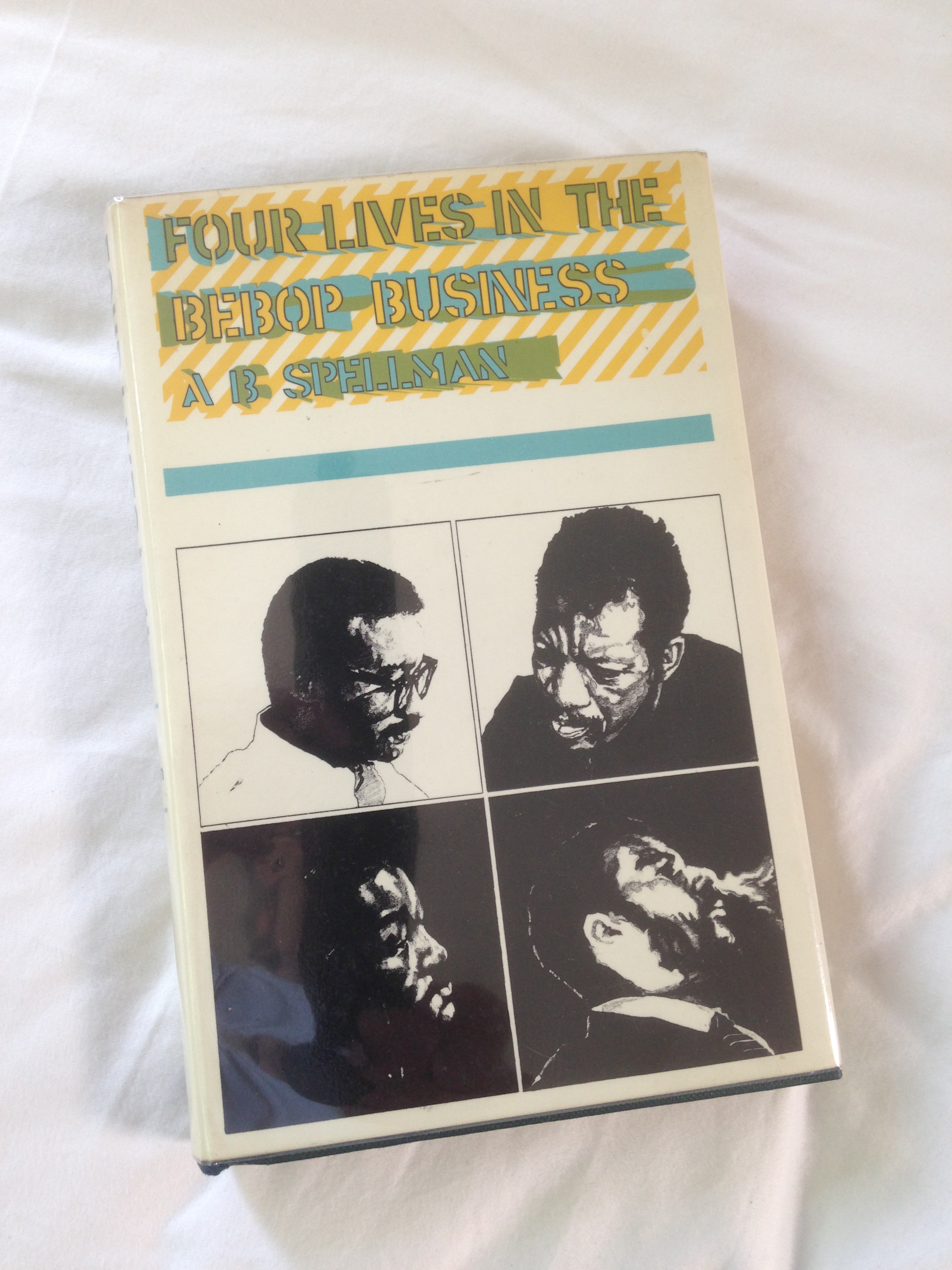
I wish I’d known about the exhibition in advance. Then I’d have lent them my own bit of Duryana: a copy of the first UK edition of A.B.Spellman’s Four Lives in the Bebop Business, published in 1967, for which MacGibbon and Kee commissioned the artist to provide a new cover (above). His ink portraits of Cecil Taylor, Ornette Coleman, Herbie Nichols and Jackie McLean, the subjects of Spellman’s classic quartet of encounters with modern jazz musicians, are perfect, as is the stencilled typography.

The show opened this morning and closes on September 1. Admission is free. Details are here. A new book of Dury’s lyrics, titled Hello Sausages, edited by Jemima Dury and published by Bloomsbury, is on sale in the gallery at a tenner off the £25 price. All in all, it’s worth the trip.

Bert Stern: an eye on jazz

Six weeks before Marilyn Monroe died in the summer of 1962, Bert Stern spent three days in a Los Angeles hotel room taking the photographs that will forever make it difficult to believe that the actress took her own life. Not surprisingly, it was the story of the Monroe sessions that led the obituaries marking his death last week, at the age of 83, such as this one in the New York Times and this one in the Guardian. And here I am, falling for the same temptation.

Four years earlier, however, Stern, then a top advertising photographer, had earned the permanent gratitude of jazz fans when he travelled to Rhode Island to record the Newport Jazz Festival for a feature film titled Jazz on a Summer’s Day. Thanks to him, and his co-director and editor Aram Avakian, we have a beautifully shot first-hand record of how Louis Armstrong, Chuck Berry, Jimmy Giuffre, Thelonious Monk, Mahalia Jackson and many others looked as well as sounded in performance at that point in their careers.

Most of the famous sequences from the film were shot during the hours of daylight, capturing the garden-party atmosphere of the early Newport festivals. That’s certainly what you get in the clip of Anita O’Day above. Look a bit harder on YouTube, however, and you’ll find a night-time sequence of the magnificent Big Maybelle, dressed as if for her own wedding, singing “I Ain’t Mad at You”, with a band led by Buck Clayton, who takes the trumpet solo. For some technical reason I can’t share it with you here, but a simple search should lead you to it. Better still, buy the whole thing on DVD, and say a little thank-you to the late Mr Stern.

La vida tombola

Manu Chao

Despite the urging of various friends, I came late to Manu Chao, and I’ve been trying to make up for it ever since. If I were my kids’ age, I probably wouldn’t have been listening to much else for the past decade. La Radiolina (2007) is one of my very favourite albums of recent years, songs such as “13 Dias” and “Besoin de la Lune” forming an endless source of energy-renewal. So I’m pleased to have been reading Peter Culshaw’s Clandestino, a biography of the singer who, more than anyone, accepted the responsibility of carrying the spirit of Bob Marley into a new century. It’s been telling me most of what I needed to know about the creator of a music that blends first world languages, third world rhythms, and a rebel soul also heavily influenced by the British punk movement of the late 70s.

Subtitled “In Search of Manu Chao”, the book (published by Serpent’s Tail) incorporates a full account of the subject’s life and career from his birth in a Paris suburb in 1961 as the son of Basque and Galician parents and his early life as a street kid through his early success with the band Manu Negra to his solo superstardom. The focus often shifts, however, to become the story of the author’s engagement with the artist and his music, which takes him around the world, from Algeria to Brazil to New York to Brixton, and through many encounters and conversations.

Culshaw never bothers to hide the fact that he is awestruck by Manu Chao, and I can’t find it in me to criticise him for that. His enthusiasm is so transparently genuine that it’s impossible to get too exasperated by paragraphs that begin like this: “I ring up Manu’s management in Paris to try and find out where Manu might be. No word. So I hole up on the beach for a few days, in a fishing village called Prea, a really tranquil place. It’s so beautiful that I feel the urge to express my gratitude to someone, and who better than the deities? Signs and portents seem to be everywhere…” He’s taking a gamble that this discursive approach will match the unstructured existence it describes, and he just about brings it off.

I’m not absolutely certain that Manu Chao’s “La Vida Tombola” (also from La Radiolina) is the best song ever written about a footballer, but I’d suggest that its only rival is Jorge Ben’s “Filho Maravilha”. Maybe that’s just another version of the endless Maradona v Pele debate: Argentina versus Brazil. One day I’ll have more to say about the great Jorge Ben. But here’s Manu Chao serenading the great albiceleste No 10 in person with the song he dedicated to him, in the poignant final scene from Emir Kusturica’s superb film titled Maradona, released in 2008. “If I were Maradona,” the lyric goes, “I’d live like him / A thousand fireworks, a thousand friends, and whatever happens at a thousand per cent / Life is a game of chance…” The subject of the song looks on, the hint of a smile on his lips giving no clue to the thoughts hidden behind his shades.

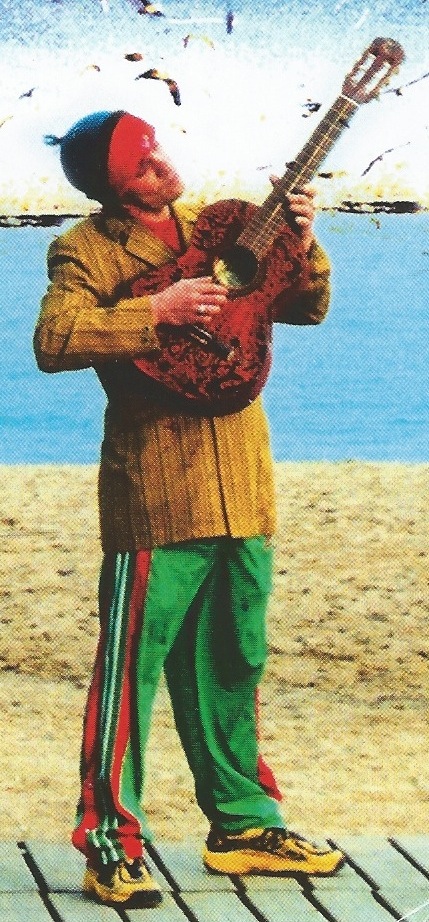
* The photograph of Manu Chao is taken from the cover of Proxima Estacion: Esperanza, his second solo album, released in 2001.