Skip to content

Posts from the ‘Uncategorized’ Category

Island Records: The Greatcoat Years

No record label has ever had its history subjected to the sort of minutely detailed scrutiny on show in the first two volumes of Neil Storey’s The Island Book of Records, the second of which was published just before Christmas. The initial volume examined the label’s earliest years, 1959-68, from the family background of its founder, Chris Blackwell, to the breakthrough into the new rock mainstream with the debuts of Traffic, Jethro Tull and Fairport Convention. The new one deals with just two years, 1969 and 1970. Their successors will, I gather, each focus on a single year**.

The format is that of an LP-size hardback of considerable heft (432 pages of high-grade paper in case of the new one), an oral history with testimony from participants and interested bystanders lavishly illustrated with photos, sleeve artwork, press cuttings, documents, ads and other ephemera. What 1969-70 means is loads of background (and foreground) material beginning with Steve Winwood’s involvement in Blind Faith and ending with King Crimson’s third album, Lizard. Among those featuring heavily are Spooky Tooth, Free and Mott the Hoople, three classic early Island rock bands whose largely student and mostly male following tended to sport ex-army greatcoats, along with plimsolls, loon pants and cheesecloth shirts.

You get their stories in jigsaw form, pieced together with great diligence in mostly bite-sized chunks of testimony. A good example is the treatment of Nick Drake’s Five Leaves Left: the producer Joe Boyd, the engineer John Wood, the bass player Danny Thompson, the guitarist Richard Thompson and the arranger Robert Kirby help describe its making, while Blackwell and his Island colleagues David Betteridge, Tim Clark, Bob Bell and Barry Partlow and the record shop owners John Clare and Eugene Manzi try to explain why it didn’t sell. (When Boyd sold his Witchseason production company to Blackwell in the ’70, it was with the stipulation in the contract that Drake’s three albums should never be deleted.) Others providing testimony include Gabrielle Drake, Nick’s sister, and Victoria Ormsby-Gore, a well connected friend.

There’s too much stuff here for me to begin to do it justice, but the riches include the triumph of King Crimson’s first album, helped by the fact that their two managers, David Enthoven and John Gaydon, were, like Blackwell, Old Harrovians; the debut album by Quintessence, a quintessentially Island band (i.e. Notting Hill hippies) that it turns out nobody in the company really seemed to like; the Fotheringay debacle, which derailed Sandy Denny’s career; the emergence of two ex-Alan Bown Set singers, Jess Roden and Robert Palmer, respectively with Bronco and Vinegar Joe; and the huge success of Cat Stevens, reinvented as a singer-songwriter with Tea for the Tillerman, and of Emerson, Lake & Palmer.

Alongside epochal releases like Traffic’s John Barleycorn Must Die and Fairport’s Unhalfbricking and Liege & Lief, the book features such bit-part players as Dr Strangely Strange (“a poor man’s Incredible String Band”), Blodwyn Pig and McDonald & Giles (respectively offshoots of Jethro Tull and King Crimson), and White Noise’s somewhat prophetic An Electric Storm, which seemed to typify Island’s propensity, in the early days, for backing weird stuff. Nothing is neglected, including the hugely popular and influential compilations, particularly what might be called the greatcoat anthologies: You Can All Join In, Nice Enough to Eat and Bumpers.

The two years covered by this volume pivot around the move from offices on Oxford Street to a former Congregational church on Basing Street in Notting Hill, converted around the time of the First World War into a factory making dressmakers’ showroom busts and wax figures for Madame Tussaud’s. Blackwell bought it and, with the aid of the acoustic engineer Michael Glickman and the studio technician Dick Swettenham, set about converting into a headquarters that incorporated not just offices for the label’s staff but two studios, No 1 on the ground floor, capable of accommodating 80 musicians, and the more intimate No 2 in the basement. This was where a bunch of talented young engineers set to work with Helios 16-track desks and Studer two-inch tape machines, and we hear from some of those hitherto best known as names the bottom of the list of album credits: Brian Humphries, Phill Brown, Richard Digby-Smith (“Diga”) and Phil Ault.

This was a turning point. Basing Street became a creative hub, a 24-hour hang-out, the office business conducted at round tables seating executives and secretaries in a non-hierarchical environment. Guy Stevens, the former DJ at the Scene Club in Ham Yard, for whom Blackwell had created the Sue label, was a maverick A&R presence, introducing Ian Hunter to a bunch of guys from Hereford and giving them the name Mott the Hoople. Lucky Gordon was the resident chef.

I visited Basing Street quite a lot during those early years, sometimes interviewing various people and other times just hanging out, occasionally in the studios. The buzz was terrific. It was, I suppose, a perfect example of hip capitalism in action. Nothing so perfect lasts for ever, but in this volume of his epic and invaluable series — expensive but, to those with an interest, worth every penny — Neil Storey catches it in glorious ascent.

* The Island Book of Records Vol 2: 1969-70, edited by Neil Storey, is published by Manchester University Press / Hidden Masters (£85)

** Not quite right. Apparently Vol 3 (out in the spring of ’26, all being well) will deal with 1971-72. Vol 4 is 1973-76, Vol 5 is probably 1977-79, and Vol 6 could be 1980-83. Neil Storey says he has always thought of the series as consisting of 10 to 12 volumes, so we’ll see.

2024: The best bits

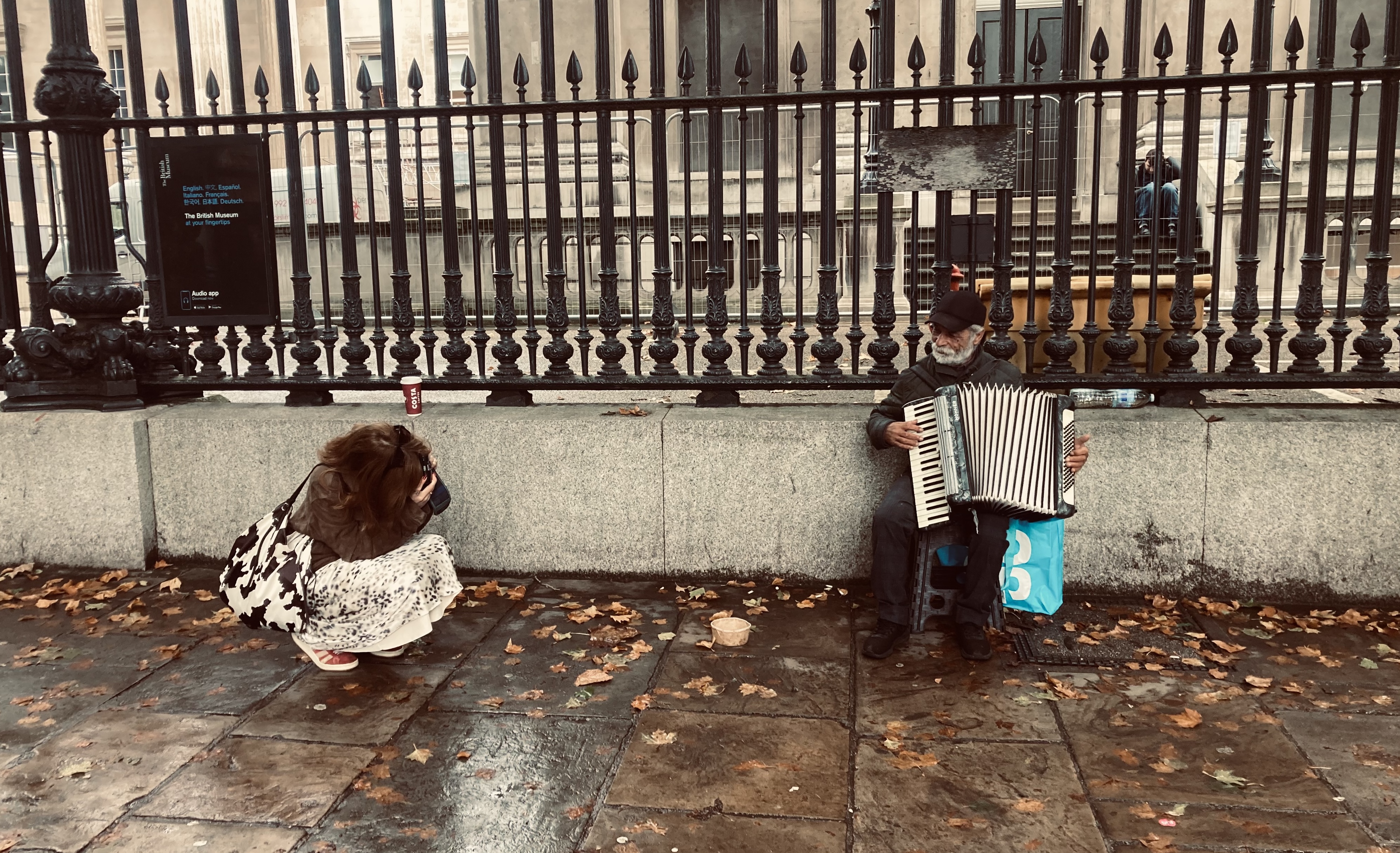
I like street musicians, as long as they’re not using amplification or pre-recorded assistance. Some of them live on in my head. A clarinetist in a tiny garden near Taksim Square in Istanbul in 1968. A singer and an accordionist paying tribute to Carlos Gardel outside a Rosario shopping mall in 1994. A fluently boppish alto saxophonist outside a hamburger joint in downtown Atlanta that same year. An elderly quartet in a park in Sofia 25 years ago.

The accordionist pictured above has a regular pitch outside the British Museum in Bloomsbury. He’s from Romania. One day this autumn I heard him while on my way from a quick lunch at Caffè Tropea, the Italian restaurant inside the park in Russell Square. Probably my favourite un-fancy eating place in London, it’s been run for 40-odd years by a family with roots in Calabria. Immigrants, eh?

On this day the accordionist was playing Nino Rota’s theme from The Godfather. While I was listening, a young woman walked past, stopped, took a small camera out of her bag, and crouched down to take his photograph with a swift economy of movement that suggested she knew what she was doing. I took a single frame with my iPhone and it records one of the year’s happier moments.

NEW ALBUMS

1 Michael Shrieve: Drums of Compassion (7D Media)

2 Meshell Ndegeocello: No More Water: The Gospel of James Baldwin (Blue Note)

3 Wadada Leo Smith / Amina Claudine Myers: Central Park (Red Hook)

4 Beth Gibbons: Lives Outgrown (Domino)

5 Bill Frisell: Orchestras (Blue Note)

6 Alice Zawadski / Fred Thomas / Misha Mullova-Abbado: Za Górami (ECM)

7 Ohad Talmor: Back to the Land (Intakt)

8 Manu Chao: Viva Tu (Radio Bemba)

9 Silkroad Ensemble w/ Rhiannon Giddens: American Railroad (Nonesuch)

10 Giovanni Guidi: A New Day (ECM)

11 Pat Thomas: The Solar Model of Ibn Al-Shatir (Otoroku)

12 The Smile: Wall of Eyes (XL)

13 Mike Westbrook: Band of Bands (Westbrook Music)

14 Daniel Sommer / Arve Henriksen / Johannes Lundberg: Sounds & Sequences (April)

15 The Henrys: Secular Hymns & Border Songs (bandcamp)

16 Gillian Welch & David Rawlings: Woodland (Acony)

17 Lady Blackbird: Slang Spirituals (BMG)

18 Shabaka: Perceive Its Beauty, Acknowledge Its Grace (Impulse)

19 Johnny Blue Skies (Sturgill Simpson): Passage du Desir (High Top Mountain)

20 Kit Downes: Dr Snap (Bimhuis)

REISSUE / ARCHIVE

1 Miles Davis Quintet: Miles in France 1963 & 1964 (Sony Legacy)

2 Art Tatum: Jewels in the Treasure Box (Resonance)

3 Alice Coltrane: The Carnegie Hall Concert (Impulse)

4 Charlie Parker: Bird in Kansas City (Verve)

5 Anne Briggs: Anne Briggs (Topic)

6 Peter Hammill: Incoherence (Esoteric)

7 Bob Dylan and the Band: The 1974 Live Recordings (Sony Legacy)

8 The History of Les Cousins (Cherry Red)

9 Vanilla Fudge: Where Is My Mind? (Esoteric)

10 The Waterboys: 1985 De Luxe Edition (Chrysalis)

SUI GENERIS

Evan Parker: The Heraclitean Two-Step, etc. (False Walls)

LIVE PERFORMANCE

1 Manu Chao (Brixton Academy, September)

2 Bob Dylan (Royal Albert Hall, November)

3 Steve Lehman / Orchestre National de Jazz (Vortex, June)

4 The Necks (Cafe Oto, April)

5 Django Bates (Vortex, January)

6 Sylvie Courvoisier’s Poppy Seeds (JazzFest Berlin, November)

7 Bruce Springsteen (Wembley Stadium, July)

8 Marilyn Crispell (JazzFest Berlin, November)

9 Bill Frisell Trio (St George’s, Bristol, May)

10 Alexander Hawkins / Marco Colonna (Vortex, October)

MUSIC BOOKS

1 Joe Boyd: And the Roots of Rhythm Remain (Faber & Faber)

2 Brad Mehldau: Formation: Building a Personal Canon Vol. 1 (Equinox)

3 Neneh Cherry: A Thousand Threads (Vintage)

4 David Toop: Two-Headed Doctor: Listening for Ghosts in Dr John’s Gris-gris (Strange Attractor Press)

5 Philip Freeman: In the Brewing Luminous (Wolke)

FICTION

Samantha Harvey: Orbital (Vintage)

AUTOBIOGRAPHY

Al Pacino: Sonny Boy (Century)

NON-FICTION

Ekow Eshun: The Strangers (Faber & Faber)

FILMS

1 La Chimera (dir. Alice Rohrwacher)

2 About Dry Grasses (dir. Nuri Bilge Ceylan)

3 Conclave (dir. Edward Berger)

DOCUMENTARIES

1 Dahomey (dir. Mati Diop)

2 Soundtrack to a Coup d’Etat (dir. Johan Grimonprez)

3 Road Diary: Bruce Springsteen & the E Street Band (dir. Thom Zimny)

RADIO

Composer of the Week: Bud Powell (BBC Radio 3/BBC Sounds)

PODCAST

Kate Lamble’s Grenfell: Building a Disaster (BBC Sounds)

THEATRE

Carwyn by Owen Thomas (London Welsh RFC, October)

EXHIBITIONS

1 Pauline Boty (Gazelli Art House)

2 Yoko Ono: Music of the Mind (Tate Modern)

3 John Singer Sargent: Sargent & Fashion (Tate Britain)

4 Gerhard Richter (Neue Nationalgalerie, Berlin)

5 Beyond the Bassline (British Library)

Evan Parker at 80

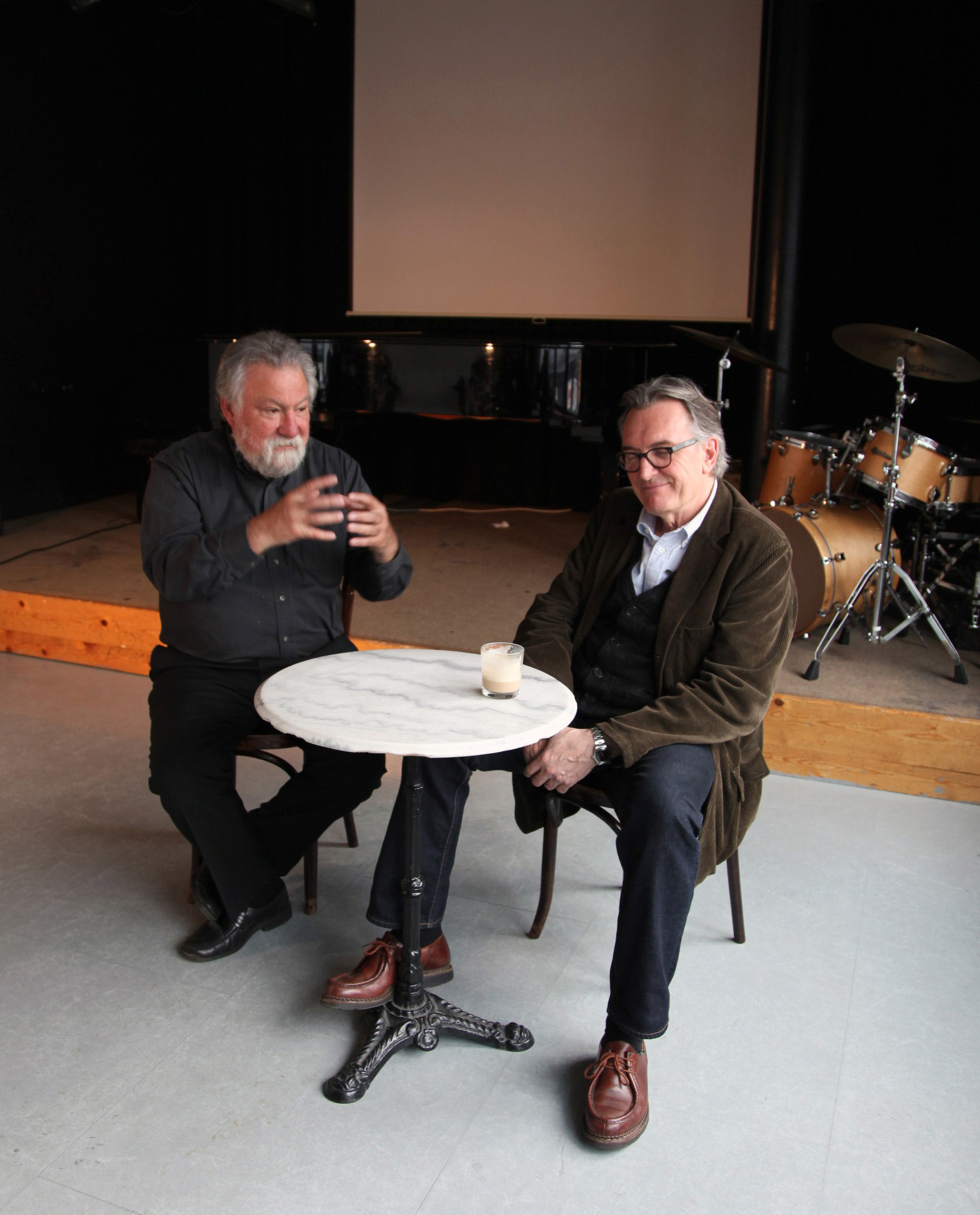
Evan Parker (left) explains the meaning of the universe to the author of this blog

If I write often about Evan Parker in this space, it’s because he’s one of the most original and compelling musicians of my lifetime. He’s also one of the most prolific, always up to something, usually something new. He turned 80 earlier this year, and by way of a slightly belated celebration comes a box set titled The Heraclitean Two-Step, etc., based around four CDs of previously unreleased solo soprano saxophone improvisations with a book containing interviews, musings, his own and other people’s memories, and a section devoted to his very nice collages, made during lockdown on the blank pages of a necessarily unused Musicians’ Union diary.

The first CD opens with a continuous 22-minute improvisation, an extract from a concert in 1994 at the Unitarian Chapel in Warwick. Parker remembered liking it, and decided to pair it on the disc with 40 minutes of new and shorter pieces recorded in 2023 at the same venue. That gave him the idea for the title of the box: it was the Greek philosopher Heraclitus who was reported to have said that you never step in the same river twice. The Unitarian Chapel was indeed not quite the same river: the floor had been renewed. But you get the higher point.

The second of those new pieces, titled “Orwell”, winds itself up to a pitch at which it almost blows your head off. And there are many such outstanding moments throughout these discs, the rest of which were recorded between 2018 and this year at Filipe Gomes’s Arco Barco studio, a converted old harbourside building in Ramsgate, Kent (Parker lives not far away, in Faversham). During “Blériot’s Handshake”, for example, I seemed to feel the ground sliding under my feet — the sensation I sometimes get when listening to Carlo Gesualdo’s choral music.

But the one that I loved most is the 31-minute piece taking up the whole of the second disc, in which Parker approaches the improvisation from several different trajectories, taking his time to pause before switching angle or pace. It’s called “The Path Is Made By Walking”: a most appropriate choice for a man who has followed his own route through the trackless expanses of improvised music for 60 years.

Although the accompanying book isn’t an autobiography, we do learn a lot throughout its various sections. We hear about his relationship with his saxophones, from the first purchase of an old alto at the age of 14, and there’s a semi-technical passage which gives even a non-professional a glimpse of the discipline and study it took to achieve his virtuosity, and still takes to maintain and deepen it. On relationships with other musicians, there are vignettes of Phil Seaman, Dudu Pukwana, Paul Rutherford, Henry Lowther and others, sometimes only a sentence or two but always memorable (“Eat when you can, sleep when you can” was Henry’s valuable early advice about life on the road). When I told Evan he’d made me think about John Stevens, who welcomed him into the SME and the world of the Little Theatre Club in 1967, soon after his arrival in London, and who died 30 years ago, he said: “I think about him just about every day.”

Since Evan has a wider conversational range than almost anyone I know, it’s hardly a surprise to find the text sprinkled with quotes from Borges, Buckminster Fuller, Simone Weil, Idris Shah, Dag Hammarskjöld, Kafka, Iain Sinclair, Chesterton, Koestler, Marcus Aurelius, Hogarth, De Quincey and the Iroquois nation’s address to the 1977 UN Conference on Indigenous Peoples, as well as Eric Dolphy, Steve Lacy and Booker Little. They’re used to support conclusions that are sometimes contentious, always stimulating.

Then I go back and listen again to “The Path Is Made By Walking”. In this wonderful half-hour we hear not just the use he’s made of his evolving technique to create fantastic, mindbending patterns of sound, often mesmerising and sometimes transcendent, but also how he can so fruitfully exploit the acoustical properties of his environment, in this case Arco Barco, and particularly its resonance; he really is “playing the room”, and the result is spellbinding.

Of course I love hearing Evan playing tenor, whether it’s on Tony Oxley’s classic 1969 recording of Charlie Mariano’s “Stone Garden”, or with Spring Heel Jack (John Coxon and Ashley Wales), or with the Necks, or in a big ensemble like the Globe Unity Orchestra. But I’m pretty sure it’s for the solo work on soprano that he’ll be most lastingly remembered. Here, in a fine package benefiting from David Caines’ elegantly austere design, is the evidence of his singularity.

* The photograph of Evan Parker and me was taken by Miranda Little. The Heraclitean Two-Step, etc. is on the False Walls label: http://www.falsewalls.co.uk

Almost like a scientist

“Almost like a scientist.” That’s what someone says near the beginning of Ingredients for Disaster, Julian Phillips’s new 67-minute documentary about the music of the Swiss composer, pianist and bandleader Nik Bärtsch. Almost like a scientist. Well, yes. When Bärtsch talked after a screening in London this week, words like “architectonics” and “topography” entered the conversation. And Phillips chooses to illustrate the polymetric structures of the music through cunningly devised computer graphics that actually illuminate the interior design of pieces which tend have the four players working in different time signatures simultaneously.

On the other hand, not like a scientist at all. Not in effect, anyway. Listening to Bärtsch’s bands, either the “Zen funk” of Ronin or the “ritual groove music” of Mobile, can be a profoundly emotional experience, particular when he gives one of his shouted cues and the whole band changes gear like a sudden shot of adrenalin.

But it’s certainly complex music, particularly in its layered polyrhythms. He made me laugh yesterday when he briefly turned the conversation to good old 4/4. If you work all the time in less conventional metres, he said, then you decide to play something that superimposes 4/4 on, say, 5/4, it’s 4/4 that ends up sounding odd, implying that it gives you something new to work with.

In the film, he talks about some of his influences: the pianists Lennie Tristano (whose polymetric “Turkish Mambo” he recorded on one of his early albums), Ran Blake and Monk, and Stravinsky. In the discussion after the film there was also mention of James Brown’s band and of Zigaboo Modeliste, the drummer with the Meters (drummers are important to Bärtsch; that’s how he started out). But his great success is to have metabolised his influences so thoroughly that they became invisible as, over the years, he developed a music of true and complete originality.

This month marks 20 years since he began his Monday night sessions at the Exil club in Zurich, where the music has taken gradually shape. Ronin currently consists of Sha (Stefan Haselbacher) on bass clarinet and alto saxophone, Jeremias Keller on bass guitar, and the drummer Kaspar Rast, with whom Bärtsch has been working since they were nine or 10 years old. Each of them has something illuminating to say in the film, none more so than Sha, master of the bass clarinet, who demonstrates how one of the parts written for his instrument can lead, as the piece unfolds in its long narrative, to variations such as “ghost notes” and percussive tapping.

Like the Quintet of the Hot Club of France, the MJQ, the MGs, Astor Piazzolla Quintet and the Chieftains, Ronin is a band with a highly evolved, distinctive and patented character. There’s a new album by the basic quartet, called Spin. With the addition of three horns and a guitar, it becomes the Ronin Rhythm Clan, which performed at Kings Place in London a few years ago. I liked that line-up very much, and Bärtsch guided me to a couple of tracks released on Bandcamp earlier this year.

I wrote about Nik when he performed with the London-based visual artist Sophie Clements at the Barbican in 2019, and when Ronin played a night at Ronnie Scott’s last year. Tonight I’m going to see him playing piano duets with Tania Giannouli at the Wigmore Hall, as part of the EFG London Jazz Festival. He’s one of the most interesting musicians around, and it’s a pleasure to keep up with him.

* Ronin’s Spin is released on November 24 on the Ronin Rhythm Records label. The film Ingredients for Disaster will be available to stream on Amazon Prime and Apple+ from November 29. Bärtsch’s book Listening: Music Movement Mind is published by Lars Müller Publishers.

Other sounds 4: ‘Za Górami’

Ladino is a language spoken by Sephardic Jews, with its origins in medieval Spanish, Hebrew and Aramaic. In her wonderful book Ornament of the World, subtitled “How Muslims, Jews and Christians Created a Culture of Tolerance in Medieval Spain”, María Rosa Menocal describes it and its equally Romance language-based Muslim equivalent, Aljamiado, as not just “languages of exile and persecution” but as “quixotically defiant memory palaces”.

Five traditional Ladino songs are included in Za Górami, a new album by Alice Zawadzki, Fred Thomas and Misha Mullov-Abbado, providing a kind of structure for the 11-track sequence featuring Zawadski’s voice, violin and viola, Mullov-Abbado’s double bass and Thomas’s piano, drums and vielle (a fiddle favoured by French troubadours between the 11th and 13th centuries). The remainder of the programme consists of songs taken from a variety of sources.

Here’s what the three London-based musicians say, in a jointly authored sleeve note: “Collected on our travels and taughgt to us by our friends, these are songs we have learnt and loved together. Though our musical and cultural backgrounds encompass Europe, Russia and South America, we were all three born in England. This happenstance was the product of love, war, exile, the arbitrariness of borders and the yearning for a new life.” All those themes, they say, are woven through the songs.

Za Górami is Polish for “behind the mountains”. Other songs come from Argentina (Gustavo Santaolalla’s “Suéltate Las Cintas”), Venezuela (Simón Diaz’s “Tonada De Luna Llena”) and medieval France (“Je Suis Trop Jeunette”). “Gentle Lady” is Fred Thomas’s setting of a text by James Joyce: “Gentle lady, do not sing / Sad songs about the end of love / Lay aside sadness and sing / How love that passes is enough.”

Recorded in Lugano and produced by Manfred Eicher, the music could be said to be a perfect manifesto for the ECM philosophy: the creation of a frontierless chamber music based on the instincts and practices of jazz but entirely porous in its acceptance of other cultures and idioms.

The Ladino lyrics are interesting for their closeness to more familiar languages: “Arvoles lloran por lluvias / Y montañas por aire / Ansi lloran los mis ojos / Por tí querido amante” translates as “The trees weep for rain / And the mountains for air / So weep my eyes / For you, my love.” That’s the closing track, a restrained lament consisting of three haiku-like verses that concludes: “I turn and ask — what will become of me? / I will die in foreign lands.” These are lieder for a modern world in which echoes of the past are inescapable.

If, as it happens, nothing here sounds much like jazz, it couldn’t exist without jazz, either. The clarity and subtle shadings of Zawadzki’s soprano, the handsomely shaped bass sound and calm phrasing of Mullov-Abbado, and Thomas’s reflective piano and subtle percussion work together to create a pan-national music in which elegance, economy and ardour are held in perfect balance. In its quiet way, this is one of the year’s outstanding albums.

* Za Górami is out now on the ECM label: the trio will perform at Kings Place on November 23 as part of the EFG London Jazz Festival. The photo of Mullov-Abbado, Zawadzki and Thomas is by Monika Jakubowska.

Other sounds 3: The Henrys

The instrument in the photograph is a harmonium, sometimes known as a reed organ, or pump organ. Its earliest ancestor was invented by Gabriel-Joseph Grenié in France at the start of the 19th century. It has a sound I love, and this particular example is heard a lot throughout the new album by the Henrys, the Canadian band convened by the guitarist Don Rooke.

No single sound dominates Secular Hymns & Border Songs, although Rooke’s 1920 Weissenborn guitar and Michael White’s plaintive trumpet are prominent voices, but the gentle wheeze of the harmonium underlies it all, even when it isn’t actually present, like the layers of undercoat Mark Rothko applied to his canvases before beginning to paint his blocks of colour, sometimes allowing a little of the background to bleed out at the edge of the finished work.

I’ve been trying to think about how this music sounds. Handmade would be one word. Acoustic, too, in the sense that you’re unusually aware that these gentle, sometimes fugitive sounds are made by vibrations in the air. The listener notes the intimacy but also the feeling of uncrowded space. Most of all, I like the sense that it feels assembled — like something made by a skilled carpenter, working by eye and experience with familiar tools.

Rooke’s slide guitar is the first thing you hear on the opening track, “Garland”. Its tentative phrases barely disturb the air before others join in: Leanna Rutt’s cello, White’s trumpet, Maggie Keogh’s wordless voice, Andrew Downing’s double bass and John Sheard’s harmonium. That’s the basic ensemble, and collectively it has a lovely unfinished, almost skeletal quality: like something produced by a random bunch of musicians left over from a rehearsal by a much larger group, continuing to explore a common store of tunes because their bus home isn’t due for another hour, and because they like it.

There are 11 tracks, and each has its own character, but they move from one to another without significant breaks or changes of attack, just a pause for a breath, so that the whole thing sounds like a single semi-improvised composition. Occasionally, as when you reach “Fairground”, the fifth track, the ensemble coalesces on a melody that rises out of the surrounding mist, and the effect is gorgeous. Same thing on “Parish” (the one that sounds most like a hymn) and “Cortège” (the one that seems to exist most obviously on a border between cultures).

The informality of the music disguises the effort and skill that went into its creation, which is as it should be. As modern music goes, some would probably think it understated almost to a fault. But in the modern world, how could that possibly be a fault?

* The Henrys’ Secular Hymns & Border Songs is released on November 1, available via https://thehenrys.bandcamp.com/album/secular-hymns-and-border-songs

Other sounds 2: Vazesh

The Persian tar is a cousin of the lute, the saz and the oud, a long-necked instrument with three double courses of strings — sort of like half a 12-string guitar, another relative — and an unusual double bowl made of mulberry wood with a membrane of stretched lambskin. Perhaps you already knew that, but I didn’t until I encountered the playing of the Iranian-born tar virtuoso Hamed Sadeghi in Vazesh, a trio in which he’s joined by two Aussies, the saxophonist and clarinetist Jeremy Rose and the bassist Lloyd Swanton.

Their first album, released in 2021, was a live recording at Sydney Opera House and won awards. Its successor, Tapestry, was recorded during a single night of improvisation at an arts centre in Annandale, a suburb of Sydney. Just under an hour long, Tapestry seems to be an unbroken performance, although on the sleeve it’s divided into 14 tracks, each jointly credited and given a single-word title that might be the result of a game in which the three members contributed their favourite words: “Lilac”, “Pagoda”, “Calabash”, “Demitasse”, “Musk” and so on.

It’s a beautiful and unclassifiable record. The individual sounds are exquisite — the tar strummed and plucked with a tiny hint of twang, the reeds (bass clarinet, soprano and tenor saxophones) elegant, the double bass resonant (Swanton, of course, is also one-third of the Necks). But the point is the sense of conversation, ebbing and flowing without rhetoric or exhibition meditative but never passive. When musicians from different cultures can do this together, with so much ease and naturalness, maybe we’re not in such a terrible state after all.

* Vazesh’s Tapestry is released on October 25 on the Earshift Music label: https://vazesh.bandcamp.com/album/tapestry

Autumn books 1: Joe Boyd

“Tango comes from the mud,” Brian Eno told an audience at Foyle’s bookshop the other night. He was conducting a public conversation with the author of And the Roots of Rhythm Remain, an 850-page examination of the forms of popular music with which Joe Boyd has engaged in Cuba, Jamaica, Brazil, Argentina, Bulgaria, Senegal, Albania and elsewhere during his six decades as a successful record producer and enlightened facilitator of musical projects.

For many years now it’s been rumoured that Boyd was writing a history of “world music”, a tale perhaps beginning with his presence at the famous meeting at a London pub in 1987 during which that rubric was invented, with the best of intentions and outcomes, as a way of persuading open-minded listeners to pay as much attention to music from other cultures as they did to their own western idioms. The result is much more interesting than a simple history; its eventual subtitle, “A Journey through Global Music”, conveys a much more accurate impression of what Boyd has taken on.

The quote about tango coming from the mud is to be found on page 483, where it’s identified as an Argentine saying. It was clever of Eno to spot it, because it says something larger about pretty much all the music Boyd considers here. How and when it happened, who made it happen, and to whom it happened are all part of his investigations, whether the music under consideration is Tropicália or townships jazz, Django Reinhardt or Béla Bartók.

I’m still working my way through the book, which will take a while even though Boyd writes in the easy, fluent, open-minded, anecdotal style familiar from White Bicycles, the relatively slender book about his adventures in the ’60s underground, published in 2005 to justified acclaim. Vast as his new one might seem, it’s worth reading with full attention, lest you miss some vital socio-cultural connection or valuable information on the roles played by, for example, the Ghanaian drummer Tony Allen, the Sudanese oud-player Abdel Aziz El Mubarak, Rodney Neyra of Havana’s Tropicana nightclub or the ballet impresario Sergei Diaghilev. (I didn’t know, for instance, that, according to Boyd, the names samba, rumba, mambo, tango and cha-cha all have their roots in Ki-Kongo, one of the languages of the Kongo people living in what are now the Republic of Congo, the Democratic Republic of Congo, Angola and Gabon.) Boyd’s enviable skill is to bring the reader an astonishing level of historical detail while wearing his research lightly and enlivening the narrative with exactly the right seasoning of his own views.

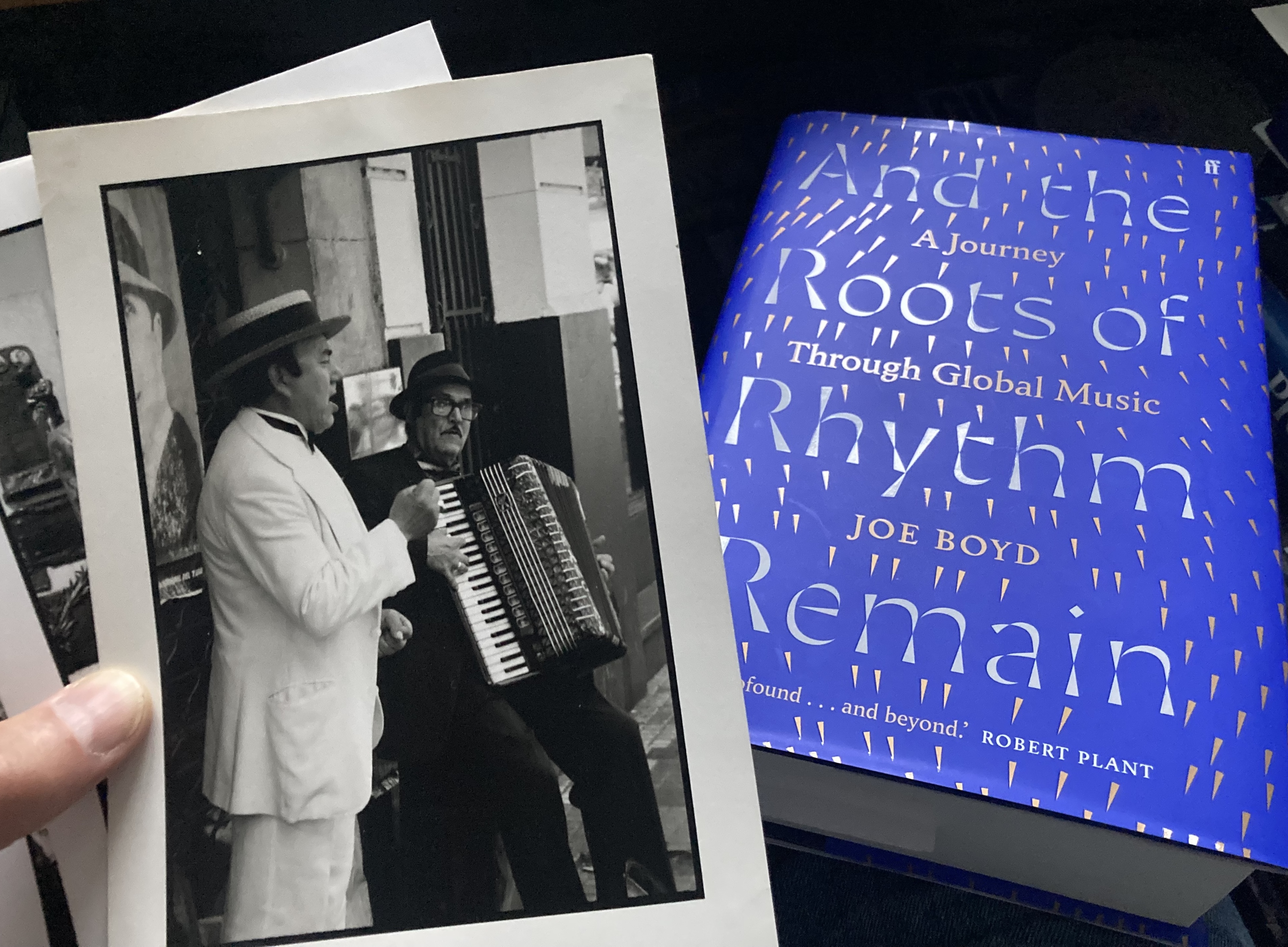
After buying the book at the Foyle’s event and getting it signed, I took it home and went straight to the chapter about tango. I like tango very much, although I once spent an evening in a bar in San Telmo, a Buenos Aires quarter then about to make the jump from funky to gentrified, proving to everyone’s satisfaction that I’ll never be able to dance it. I share Boyd’s enthusiasm for the singer Carlos Gardel to such an extent that I once visited the great man’s tomb in the cemetery of Chacarita in Buenos Aires, observing the ritual of leaving flowers at the base of his statue and placing a lit cigarette in the space left by the sculptor between the index and middle fingers of his raised right hand, because that’s how Gardel always sang until his untimely death in an air crash in 1935.

The photo above is one I took in 1994 on a sidewalk in Rosario, Argentina’s third largest city, the birthplace of Che Guevara and Lionel Messi. I was struck by the elegance and dignity of the street singer and his accordionist, who were serenading appreciative shoppers and other passers-by with a selection of songs made famous by Gardel.

Boyd traces the idiom’s origins in the bars and bordellos of Buenos Aires, examining its sources and tracking its destiny. He doesn’t share my fondness for the late composer and bandoneon virtuoso Astor Piazzolla, who became, he believes, “for tango what John Lewis and the MJQ were to jazz, ‘elevating’ it from the dancefloor and giving it concert-hall respectability.” He’s both right (in the comparison) and wrong (in the implicit criticism). Nobody who went, as I did, to see Piazzolla and his astonishing quintet for three out of their five nights in the intimate environment of the Almeida Theatre in London during the summer of 1985 could accuse them of forfeiting the sensual charms of tango in a pursuit of respectability. For a lot of worthwhile music with roots “in the mud”, the need to get people dancing is no longer a priority. But it’s a good and worthwhile argument to have, and I expect there’ll be many more as I work my way through what is shaping up to be not just an exceptionally enjoyable book but perhaps also an important one.

* Joe Boyd’s And the Roots of Rhythm Remain: A Journey Through Global Music is published by Faber & Faber (£30)

Passion / Compassion

Back in the early 1970s, Santana were my favourite live band. I saw the original line-up — more or less as heard at Woodstock — at the Albert Hall in 1970 and twice the following year, at Hammersmith Odeon and the Olympia in Paris. They were thrilling, and surrounded by a sense of excitement; before the show in Paris, I remember Mick Jagger and Bianca Pérez-Mora Macias sweeping through the backstage bar, a week ahead of their wedding.

Then the music changed, and they became even better. Carlos Santana and Michael Shrieve had been listening to John Coltrane and Elvin Jones and to Miles Davis’s Sketches of Spain and Bitches Brew. Santana’s fourth album, Caravanserai, brimmed over with the effect of those influences, starting with an unaccompanied solo by the saxophonist Hadley Caliman and culminating in the ecstatic nine-minute “Every Step of the Way”, a Shrieve composition. Clive Davis, the president of their record company, called it “career suicide”. At the Wembley Empire Pool in November 1972, just after the album’s release, an expanded line-up rose to a different level, musically and spiritually.

After Wembley they went off to play some concerts in Europe before returning towards the end of the month for dates in Manchester, Newcastle and Bournemouth. On Thursday, November 23 they had a day off in London, and, being American, arranged a small Thanksgiving Day dinner in the private room of a restaurant on Davies Street in Mayfair. I’d raved about Caravanserai in the Melody Maker, so they were kind enough to invite me to join them for what turned out to be a very pleasant evening.

While they were in London I interviewed Shrieve, who talked eloquently and passionately about the changes they’d made in the music, and about the jazz influences inspiring them. He spoke of his admiration for Elvin, Roy Haynes, Philly Joe Jones and Tony Williams and of studying their playing with his friend Lennie White, who had just joined Chick Corea’s Return to Forever. And he said something that struck me when I read the piece again the other day: “What’s so beautiful about the band, apart from the popularity which we know we’re fortunate to have and which we’re grateful for, is that right now it’s the perfect situation to be open. Specially at our age, because we realise that there’s still a lot of time.” Fifty years later, it’s clear the time hasn’t been wasted.

I loved Shrieve’s playing from the start, the way he meshed perfectly with the percussionists José “Chepito” Areas, Mike Carabello, Armando Peraza, Coke Escovedo and James Mingo Lewis. Since then I’ve followed his career mostly from a distance, although we reconnected when I was at Island Records in the mid-70s and he and Steve Winwood were part of Stomu Yamash’ta’s Go project, and then when the label signed Automatic Man, a rock band he was in with the singer/keyboards player Bayeté (Todd Cochran) and the guitarist Pat Thrall, and whose 1976 single “My Pearl” sounds today like a presentiment of Prince. Of his solo albums, I’ve always loved Stiletto, released in 1989 on RCA’s Novus imprint, in which he and a band including the trumpeter Mark Isham and the guitarists David Torn and Andy Summers created a very fine version of Gil Evans’s “Las Vegas Tango”.

If you have a copy of Lotus, the live triple album recorded in Osaka during the Caravanserai tour, you’ll know the 10-minute drum solo called “Kyoto” that shows what a superlative drummer he had already become, at the age of 23. It has none of the bombast of his rock contemporaries and much of the fluency of his jazz heroes. It’s music.

His new album, recorded over a period of years, is called Drums of Compassion — a reference to the hugely popular album titled Drums of Passion recorded in 1959 by the great Nigerian drummer Michael Babatunde Olatunji, who died at his home in Northern California 2003, aged 75, but whose voice is the one you hear first and again from time to time on an album that has been long in the making. Shrieve says that the title is also an acknowledgement of the Dalai Lama’s call for a Time of Compassion.

Of course, percussion instruments play an important role in this music. But the whole thing, although its 39 minutes are sub-divided into nine pieces, some with different composers, is like a lush, constantly shifting sound painting in which other instruments — guitar, saxophone, oud, electronic keyboards — emerge with utterances that seem less like solos than simply part of the fabric.

Shrieve can put together a multi-faceted track (“The Call of Michael Olantunji”) including himself, Jack DeJohnette, Airto Moreira and Zakir Hussain on various percussion instruments without making it sound for a second like an old-fashioned drum battle or a display of egos and techniques, even when Shrieve’s orchestral tom-toms come to the fore. The percussionists’ work is blended into the overall picture, here creating an armature for Olantunji’s voice and Trey Gunn’s guitar.

Shrieve can make the space for one performer alone on the eponymous “The Euphoric Pandeiro of Airto Moreira” (chanting and Brazilian percussion) and “Zakir Hussain” (tablas). He shares another track, the sultry, drifting “Oracle”, in a duet with another Brazilian, the electronic musician Amon Tobin. The ambience swirls and drifts without relaxing its subtle grip.

A steamy tone poem titled “On the Path to the Healing Waters” features the tenor saxophone of Skerik (Eric Walton), a Seattle-based musician who has played with Wayne Horvitz and Charlie Hunter, and who here plays a Wayne Shorter-ish less-is-more role. And I’m particularly happy to lose myself inside “The Breath of Human Kindness”, five minutes of one-chord jam in which the oud of Tarik Banzi makes its single eloquent appearance, a voice from ancient Al-Andalus amid the glistening keyboards of Pete Lockett and Michael Stegner, paced by Farko Dosumov’s stealthy bass guitar riff.

There’s a rare combination of majesty and humility at work in this music, something that speaks of the deep and lasting impact of Coltrane’s influence on Shrieve’s instincts and decisions. More than half a century after Caravanserai, this is an album for listeners who followed Shrieve and Santana on that journey into a wider world, one where frontiers and prejudices dissolve.

* Michael Shrieve’s Drums of Compassion is out now on the 7D Media label and available via Bandcamp: https://michaelshrieve7d.bandcamp.com/album/drums-of-compassion

The sound of London

It’s been exciting to watch the blossoming of a new young UK jazz scene in recent years, and now it’s possible to welcome a historical survey of its emergence. André Marmot’s Unapologetic Expression, published this month, is an insider’s explanation of why and how it happened, by whom and to whom. This is history almost in real time, with the con trails still visible in the sky

Marmot is a musician who has worked for the last few years as agent, promoter and label owner. Perhaps that makes him an unusual person to write such a work. But it also gives him access to the people on the scene, justifying the subtitle: “The Inside Story of the UK Jazz Explosion”. More important, he can really write. Not in a fancy way, but with a clarity of thought and a simple elegance of expression that make it a pleasure to turn from page to page.

It’s a story of the music’s evolution in London; there are a few mentions of Soweto Kinch and GoGo Penguin, but none of Xhosa Cole or Nat Birchall. And its focus excludes the parallel world of free improvisation, the descendants of the SME and AMM. But at least we know where we are, and where the author is coming from.

The narrative takes in United Vibrations, Steez, Brainchild, Total Refreshment Centre, Steam Down, Brownswood and We Out Here, Jazz Re:freshed, Church of Sound, Tomorrow’s Warriors and more. The soundtrack might be Moses Boyd’s “Rye Lane Shuffle” and Yussef Kamaal’s Black Faces. One of the key events might be the appearance of Boyd, Shabaka Hutchings and Theon Cross at South by Southwest in Austin, Texas in 2017, when it became obvious that this scene could gain traction with listeners beyond Peckham and Dalston.

It’s quite a political book, in the sense that Marmot is not afraid to spend time criticising the effect of government policy on the arts and on young jazz musicians in particular, and propounding his belief (impeccable in my eyes) that jazz is essentially a black music in which others are welcome to take part. He puts his arguments concisely and chooses his supporting voices well.

For this is, in large part, an oral history. And whatever the perspective he’s examining — there are chapters called “Jazz Ownership and Appropriation”, “Jazz and Postcolonial London” and “New Industry Models and the End of Musical Tribalism” — he allows the musicians themselves to have their unmediated say. It’s no surprise that people like Sheila Maurice-Grey, Dave Okumu, Poppy Ajudha, Jason Yarde and Emma-Jean Thackray turn out to have interesting opinions.

If those chapter headings make the book sound academic, it isn’t. It’s anything but. It’s as full of life and energy, as sparky and challenging, as the music itself. It might even convert some of those who look with scepticism on audiences — some of whose members perhaps don’t know Lester Young from Coleman Hawkins and may never have heard “West End Blues” or “Parker’s Mood” — dancing and cheering as these musicians play for people who look, think and live like themselves.

But in order to exalt the new, it’s not necessary to denigrate the past, and there are some passages here that may annoy jazz fans of former generations. It’s easy to pour scorn on views expressed in earlier times, which is what Marmot does here with, for example, an autobiography from 1998 in which John Dankworth — who did much to popularise the music in Britain in the past-war decades — claimed that jazz “since its beginnings… [has been] an instrument of goodwill and peaceful and gradual change rather than anything really revolutionary.” I tend towards Marmot’s view rather than Dankworth’s, but I’d caution him that the passage of time can distort as well as clarify.

In between sessions of reading his book, I was listening to two new British jazz albums. The first is the latest from Empirical, who receive only a single slighting mention for their “dressed-up-for-the-wedding, jazz-cliché” look, which he compares unfavourably with the dressed-down, funky-Peckham vibe of Binker Golding and Moses Boyd on the cover of their 2015 debut album. I think it’s a ridiculous criticism, as irrelevant as dissing the MJQ for wearing tuxedos, and — like the Dankworth swipe — unworthy of what is otherwise a valuable piece of work.

Empirical’s Wonder Is the Beginning features the basic quartet with guests Jason Rebello on piano and Alex Hitchock on tenor saxophone. Most of the knotty but engaging tunes are written by Tom Farmer, the bassist, with one apiece from Nat Facey, the alto saxophonist, and Lewis Wright, the vibes player. Anyone who has ever enjoyed their work will find plenty to digest here, in a well established groove that enters the room occupied by Andrew Hill, Bobby Hutcherson and Eric Dolphy in their Blue Note period and pushes the walls out slightly. The addition of the guests enriches the range of tone and gesture without disturbing the group’s fine balance.

Cassie Kinoshi belongs firmly in the generation promoted by Marmot, and is among those providing the author with interesting opinions on his chosen topics. Her latest album finds an 11-piece version of her group Seed operating in partnership with the London Contemporary Orchestra and the turntablist NikNak on a 22-minute, six-part suite called Gratitude (from which the album takes its title), recorded at the Purcell Room in March 2023, and in a 10-piece formation performing a five-minute piece called “Smoke in the Sun” at Total Refreshment Centre in 2021.

This isn’t a long album, then, but it gets a lot of substance into its half-hour duration, thanks to Kinoshi’s fast-developing gift for deploying the instrumental resources at her command. Her music is astringent in its sound and strong in its movements. The strings and woodwind, for instance, carry as much weight as the brass, reeds and rhythm: there’s no danger of anything sounding effete or chamber music-y here. The double bass of Rio Kai and the drums of Patrick Gabriel-Boyle provide both line-ups with a loose-limbed swing.

There is plenty of space in the music, and a great deal of variety. When she clears a space for a soloist, she does it very adroitly: the guitarist Shirley Tetteh, the trumpeters Jack Banjo Courtney and Joseph Oti-Akenteng, and eventually herself, with an improvisation that really soars, leading the sixth and final movement to a dramatic but graceful conclusion. Nothing sounds pasted-in or anything less than organic.

Both these albums, and André Marmot’s book, tell a very encouraging story about the condition of British jazz: not just about the skill and originality of its practitioners, but about their continuing ability to find, expand and stay close to their audience.

* André Marmot’s Unapologetic Expression is published by Faber & Faber. Empirical’s Wonder Is the Beginning is on Whirlwind Records. Gratitude by Cassie Kinoshi’s Seed with NikNak and the London Contemporary Orchestra is on International Anthem.