Skip to content

Posts from the ‘Uncategorized’ Category

Philip Clemo at Kings Place

philip-clemoPhilip Clemo did well to attract Arve Henriksen not only to play on his sixth album but to participate as a member of the octet that launched Dream Maps in Kings Cross last night. The Scottish-born guitarist and composer’s work was greatly enhanced by the contribution of the Norwegian trumpeter and singer, who proved himself an excellent team player as Clemo’s soundscapes unfolded beneath a screen on which film of tundras, mountains and oceans gave an indication of the music’s subtexts.

The cellist Emily Burridge, Sarah Homer on clarinets and soprano saxophone, Steven Hill on guitar, Martyn Barker on drums, Simon Edwards on  bass guitar and the singer Evi Vine were the other members of the octet, which concentrated mostly on pieces from the new album. Gently insistent grooves, to which the combined texture of cello and bass clarinet added an interesting flavour, alternated with jangly folk-like structures in which the guitars came to the fore. Henriksen’s improvisations on regular and pocket trumpet were the highlights, but he also joined Vine and Clemo in vocal passages which made use of distortion, both natural and electronic.

Artfully mixed together with recordings of heartbeats and water by the sound engineer Phill Brown, the music washed gently but insistently over the clearly beguiled near-capacity crowd in Kings Place’s Hall 2. A term like “ambient trance” might have been evoked, but there was substance, too. The occasional rough edge betrayed the fact that this was Clemo’s first live gig in 10 years; its success should encourage him. And Dream Maps — on which Henry Lowther, B. J. Cole, John Edwards and others also make appearances — is well worth investigating by anyone who enjoys the territory explored by the likes of Jon Hassell (with and without Brian Eno), Jakob Bro and Henriksen in his various other guises.
Trygve Seim’s ‘Rumi Songs’


OLYMPUS DIGITAL CAMERA

With the arrival of the long-playing record almost 70 years ago, the art of shaping an improvised solo took a serious hit. All those perfectly proportioned solos of eight or 12 bars turned into 10-minute soliloquies, for good and ill. It’s not a lost art — enough of today’s players have listened to Wayne Shorter to understand the powerful effect of concision — but one of the reasons I’m so fond of the playing of the Norwegian saxophonist and composer Trygve Seim is that he seems to have an inbuilt self-editing mechanism which makes his improvisations all the more powerful and memorable.

Born in Oslo 45 years ago, Seim released an album called Different Rivers in 2000, featuring a variety of line-ups, from two to nine musicians, including the trumpeter Arve Henriksen and the drummer Per Oddvar Johansen. This was patient, luminous, ego-free music, finding a perfect balance between composition and improvisation; it sounded to me then like a modern classic, and it still does.

Since then I’ve looked out for his name on records (usually, like Different Rivers, on ECM) and have seldom been disappointed. I’ve seen him live twice, with Manu Katché’s quintet in Paris a few years ago and with the Oslo Festival Jazz Orchestra (also a quintet!) at Ronnie Scott’s last year, and his playing had even more presence in person than on record. Now there seems to be a flood of Seim: he’s on four new albums from ECM, three of them — Sinikka Langeland’s The Magical Forest, Mats Eilertsen’s Rubicon and Iro Haarla’s Ante Lucem — as a sideman.

Ante Lucem is a majestic piece of writing for symphony orchestra and jazz quintet, a fully realised piece in the spirit of the old Third Stream: not so much a blend of jazz and classical practices as a juxtaposition, but a successful one. In my view it also achieves Haarla’s aim of spiritual transcendence. Rubicon is a sequence of well organised pieces for septet, with Olavi Louhivuori from the excellent Finnish band Oddarrang on drums and Eirik Hegdal playing saxophones and clarinets alongside Seim in a two-man front line. The Magical Forest features delicate and often beguiling settings of Langeland’s songs, in some of which she is joined by the three female singers of Trio Mediaeval.

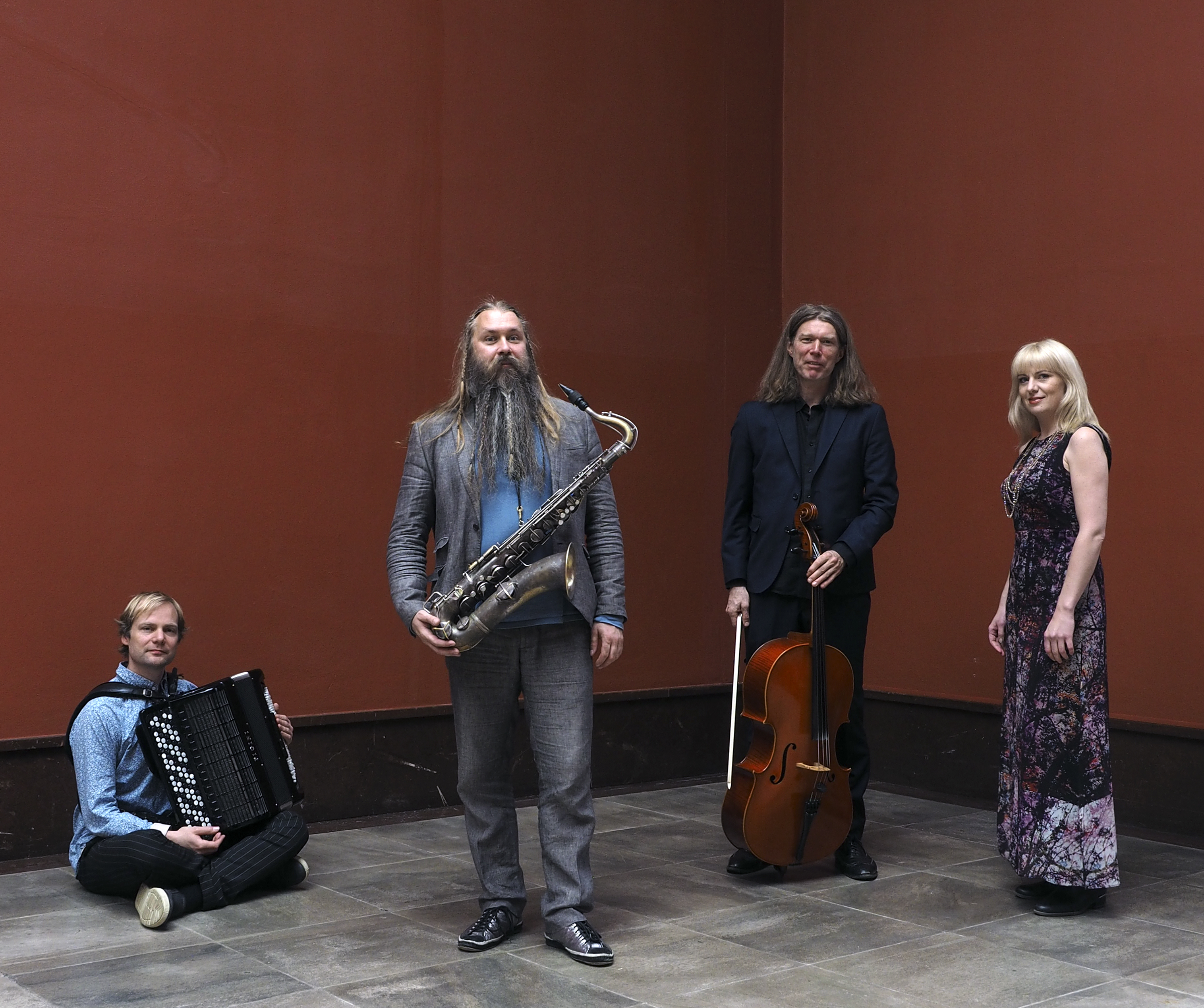
The fourth and last album is Seim’s own Rumi Songs, in which he arranges nine poems by the 13th century Sufi poet for the pure voice of Tora Augestad, the accordion of Frode Haltli and the cello of Svante Henryson. His use of the modern translations by the American poet Coleman Barks will please those who love Barks’s The Essential Rumi, a hugely successful anthology, although I prefer the more traditional renderings of R.A. Nicholson and the more recent and less decorative ones of Nader Khalili.

This is a chamber recital, in which jazz makes its guiding spirit apparent only in the sonorities of Seim’s soprano and tenor saxophones and in the flexibility of the interplay. A tenth track, “Whirling Rhythms”, is an instrumental piece that captures, in less than three minutes, the non-verbal essence of  the project, as well as demonstrating the rewards of Seim’s trips to Egypt and the poet’s birthplace in Anatolia.

It would be a mistake to assume that Rumi’s verses are not suited to the Nordic atmosphere in which these fine musicians operate. If you’re in the right mood, the track called “There Is Some Kiss We Want”, with which the album closes (and which is featured in a little promo clip), might be one of the loveliest things you’ll hear this year.

* The photograph above, by Knut Bry, shows the Rumi Songs band: (from left) Frode Haltli, Trygve Seim, Svante Henryson and Tora Augestad.

Drones for peace

Catherine Christer Hennix 2Catherine Christer Hennix studied with La Monte Young and Pandit Pran Nath, which explains her interest in drones. Her music rejects the 12-step octave in favour of what we westerners would call microtonality. Her new album, Live at ISSUE Project Room, released under the name of the ensemble she calls Chora(s)san Time-Court Mirage, is the most emotionally exhilarating and cathartic long-form piece of music I’ve heard in ages.
Born in Stockholm in 1948 of Swedish and American parents, CCH studied contemporary western classical before meeting Young and Pandit Pran Nath in 1970 at the Foundation Maeght gallery in St Paul-de-Vence, during the famous music festival in which Albert Ayler also took part. That encounter changed her approach, which was also affected by studies of the medieval music of Japan (gagaku) and Europe.

Her most famous work is probably The Electric Harpsichord, a 25-minute piece recorded at a festival of modern music in Stockholm in 1976, on which she is the only performer, playing a keyboard and a sine wave generator. Static but enveloping, it sounds like Nico’s harmonium processed through a machine introducing the sonorities of bells, gongs and finger cymbals, with a gentle undertow of cello-like sounds. It was reissued by Die Schachtel in 2010, in a special edition including several haiku-like poems by Young and an essay by CCH’s friend Henry Flynt (the dedicatee, back in the mid-’60s, of Young’s composition X for Henry Flynt, which John Cale seized upon during his time at Goldsmiths College).

The other albums of which I’m aware are Central Palace Music From 100 Subjects for H, in which Hennix meets Peter Hennix (renaissance oboe) and Hans Isgren (sheng), and Chora(s)san Time Court Mirage’s Live at the Grimm Museum Vol 1, recorded by a five-piece ensemble in Berlin in 2011. Both are released on the Important label, the latter in collaboration with the Dutch festival Sonic Acts.

Live at ISSUE Project Room, also on Important, is a different kettle of fish altogether, a much more extensive exploration of resources. The musicians involved at this Brooklyn concert in 2014 were Hennix, Imam Ahmet Musin Tüzer and Amirtha Kidambi (voices), Amir Elsaffar and Paul Schwingenschlögl (trumpets), Hilary Jeffrey (trombone), Elene Kakaliagou (French horn), Robin Hayward (microtonal tuba) and Stefan Tiedje and Marcus Pal (computers and live electronics).

The single 80-minute piece, which is titled “Blues Alif Lam Mim in the Mode of Rag Infinity / Rag Cosmosis”, begins conventionally enough with tambura-like drones (presumably produced by electronic means) setting the scene for the introduction of elegant vocal ululations. Thereafter the music evolves in long, slow waves, its textures gradually thickening and then being pared away, the brass chorale and electronics coming and going beneath the voices: sometimes delicate and reticent, sometimes reaching a mindquaking intensity. This is a different kind of wall of sound, one on which an ever-changing variety of colours and images can be projected.

The listener might be occasionally made aware of the use of an unfamiliar tonality, but it is never remotely disconcerting. I have no idea of the belief system from which this music originates, but I do know that it stirs and nourishes something in my spirit. In its richness, in its patience, in its emotional generosity, a piece which seems to come from another world ends up feeling like the most natural sound imaginable.

The Sokratic method

Sokratis Sinopoulos's lyraGenerally speaking, the chances of one of the gigs of the year taking place as part of an academic seminar titled “Sounds of the Hellenic World, Ancient & Modern” would probably be pretty slim. But that’s what happened yesterday evening at King’s College London, when the Greek lyra virtuoso Sokratis Sinopoulos brought his quartet — completed by Yann Keerim (piano), Dimitris Tsekouras (double bass) and Dimitris Emanouil (drums) — to make their UK debut in the Great Hall in front of an audience whose members had spent the day discussing Homer, Xenakis, Keats and Satie’s Socrate.

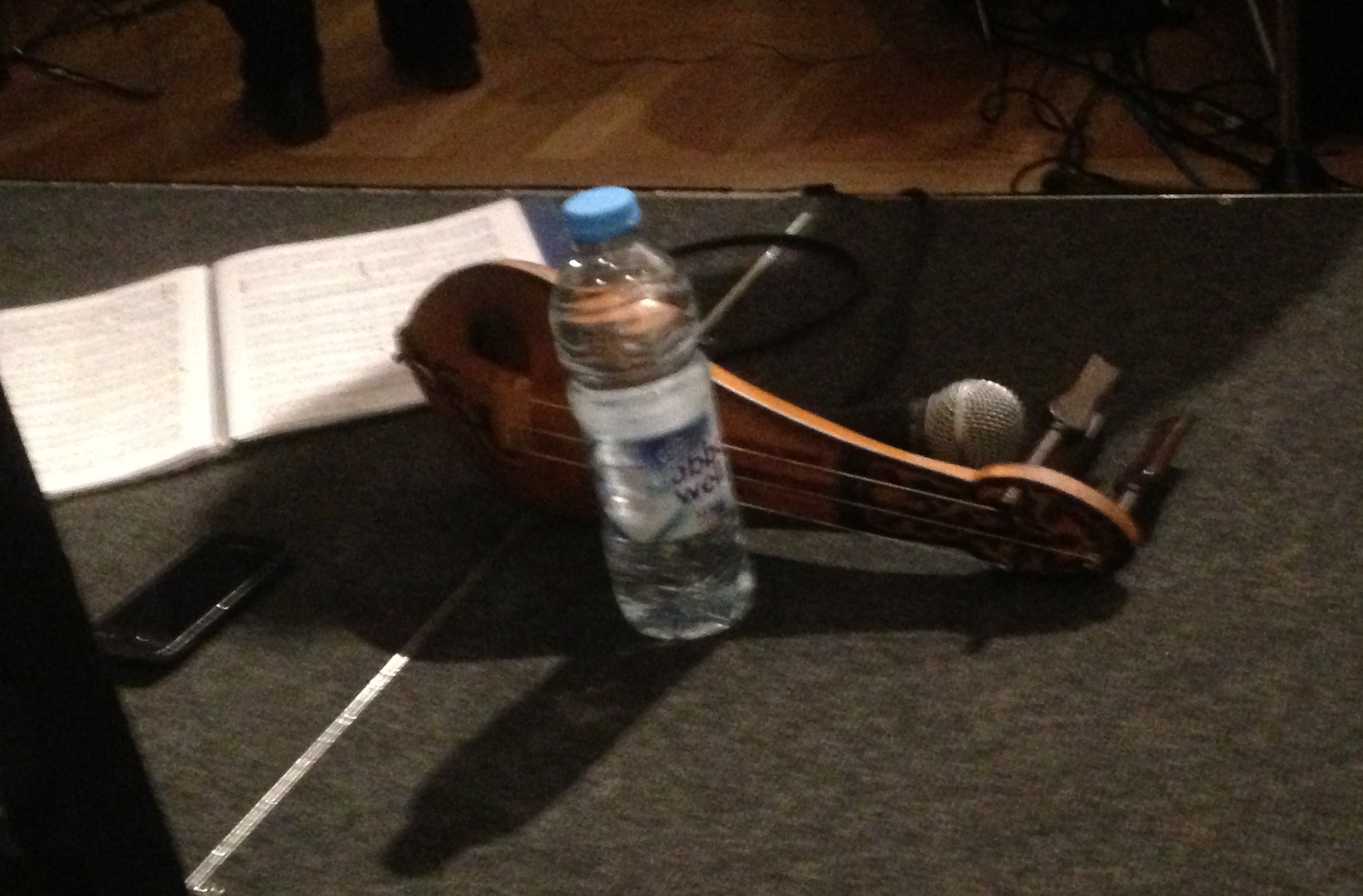
The traditional lyra is a tiny instrument which stirs big emotions. It has three strings, tuned by large wooden pegs, and its pear-shaped body contains its fingerboard. Today’s performers usually tune the strings a fifth apart and play it with a violin bow. Sinopoulos tunes his strings to a fifth and a fourth. (See footnote)

I first heard him as a member of the Charles Lloyd group that performed Wild Man Dance at the Barbican in 2014 and then in Berlin last November (a recording of the piece’s premiere, at the Jazztopad festival in Warsaw in 2013, was released by Blue Note). The lyra added a wonderful extra colour to the band (as did the cembalom of Lukács Miklós), and Sinopoulos’s solos were impressive. So I jumped the opportunity to attend last night’s concert.

The quartet’s first album, Eight Winds, was released by ECM last year, and they played several pieces from it, together with a couple of new ones. The live performance added an extra dimension of immediacy to compositions that had already made a strong impression on record, ranging from keening laments through elegant romantic melodies to exuberant dances.

But it was the sound of the lyra that filled the listeners’ hearts. Played straight, it more or less resembles a violin. Its available range of timbre and texture, however, is very different. Sometimes, when Sinopoulos bows near the bridge, the parched tone makes the instrument sound as though it’s been sitting on a windowsill under a burning Greek sun for a thousand years, left to gather dust and memories.

* In the original version of this post, I described Sinopoulos’s instrument as a Cretan lyra, and said that he followed the modern practice of tuning in fifths. A couple of readers challenged the description, so I checked with Sokratis himself. There are several variants of the lyra, he pointed out. His the very similar  Constantinople lyra — but he adds: “I prefer to name my instrument just ‘lyra’, which for most Greeks connects directly to the Cretan lyra, which is the most popular of all.”

Bernie Worrell 1944-2016

I saw Bernie Worrell twice, and both occasions were memorable. The first time was with Talking Heads at Hammersmith Palais in 1980: after starting the set as the basic four-piece with “Psycho Killer”, they added musicians at regular intervals until they’d become (I think) a 10-piece and were whomping out a kind of supercharged avant-funk. The second was at the Knitting Factory in NYC sometime in the mid-’90s, soon after the club had moved to Tribeca, with Third Rail, a band featuring Bill Laswell on bass guitar, James Blood Ulmer on guitar, Worrell and Amina Claudine Myers on keyboards, and — on this night, as I recall — Ronald Shannon Jackson on drums.

Like everyone, however, I’ve listened to Worrell on countless records. And the one that always sticks out is Parliament’s “Chocolate City”, which he co-wrote in 1975 with George Clinton and Bootsy Collins, and to which he contributes absolutely superlative gospel-funk piano. It’s among the most powerful records of its era, not just musically — taking that fractured funk pioneered by Sly Stone to a new level — but in its message, both tough and witty, about the potential upside of “white flight” from the cities (specifically Washington DC) to the vanilla suburbs:

“And when they come to march on ya, tell ’em to make sure they got their James Brown pass / And don’t be surprised if Ali is the White House / Reverend Ike, Secretary of the Treasury / Richard Pryor, Minister of Education / Stevie Wonder, Secretary of Fine Arts / And Miss Aretha Franklin, the First Lady…”

And this, of course: “They still call it the White House, but that’s a temporary condition, too.”

Listen to it again, and marvel at the sheer creativity involved in piecing the whole thing together. And then listen once more, this time just for the piano, the binding ingredient of the track, digging in against the guitars of Garry Shider, Eddie Hazel and others, and the trumpet and tenor of Randy and Mike Brecker, then dancing free in the last minute and a half. Hard to believe that it’s more than 40 years old.

Bob Dylan’s ‘Fallen Angels’

Bob Dylan walking stickWhen the Great Director pulls back to frame the ultimate long shot of Bob Dylan’s career from start to finish, it will be interesting to see what the perspective tells us about his two albums of standards associated with Frank Sinatra. My suspicion is that last year’s Shadows in the Night and the new Fallen Angels will be seen as parallel works to the pair of albums, Good As I Been To You and World Gone Wrong, with which, in the early 1990s, he revisited the blues.

Those sessions, recorded in the simple solo acoustic format of his first four albums, seemed to declutter his mind. They were followed by Time Out of Mind, Love and Theft and Modern Times, which contained some of his most creative post-’60s work. And I was struck, listening to him at the Albert Hall last October, by how the decision to deal with songs written by the likes of Richard Rodgers and Irving Berlin appeared to have influenced his attitude to the business of singing itself.

You don’t mess around with “Autumn Leaves” or “I’m a Fool to Want You”. You sing them properly or you don’t sing them at all. Dylan seemed to accept that imperative, and to be using it to refine his own delivery. His phrasing has always been exceptionally inventive, but he took the opportunity offered by these old songs to concentrate equally on tonal inflection and the meaning of the lyrics. The effect could be heard in concert when he included a handful of his own songs: “Blowing in the Wind”, “She Belongs to Me” and “Tangled Up in Blue” were treated by their author with a new respect for their original characteristics.

Fallen Angels follows the format of Shadows in the Night, employing his regular small band to create a gentle matrix of guitars and double bass plus brushes. With echoes of Western Swing, the Hot Club of France and Hollywood noir, the format allows Dylan to present these songs from an original point of view. If the new album doesn’t quite match the impact of its predecessor, if it feels a little lacklustre by comparison, that may be something to do with the loss of the element of surprise. But in the greater scheme of things, its significance may not be apparent until we see what he does next.

* A note on the packaging: Ever since Columbia’s art department stopped being in charge of the way Dylan’s new releases look, his albums have been characterised by their shoddy appearance and careless annotation (by contrast with the fastidious approach to the Bootleg Series, of course). Fallen Angels is typical in that respect. It’s all very well being a law unto yourself, but it’s impossible to forgive the failure to credit the composers of such jewels as “Come Rain or Come Shine” (Harold Arlen and Johnny Mercer), “All or Nothing at All” (Arthur Altman and Jack Lawrence),  or “Polka Dots and Moonbeams” (Jimmy Van Heusen and Johnny Burke).

A place of worship

Arve Henriksen 2During a public conversation at the ICA a couple of weeks ago, Brian Eno mentioned his interest in churches as potential performance spaces. After all, he pointed out, they were built with the idea of providing an environment for reflection. The truth of his words was evident in London last night, when the Norwegian trumpeter Arve Henriksen presented the music from his 2014 album Places of Worship in the Jerwood Hall at LSO St Luke’s, the deconsecrated and repurposed Anglican church built in Clerkenwell by Nicholas Hawksmoor and John James in 1733.

Thanks to a painstakingly sympathetic restoration, there isn’t a nicer place in London to listen to music. It certainly provided the perfect setting for Henriksen’s marvellous invention, a sequence of impressionistic pieces inspired by churches, chapels, cathedrals, cemeteries and other such places around the world, in which he was joined for this concert — and for the other dates of a short UK tour — by the guitarist Eyvind Aarset and the sound artist Jan Bang, both of them long-time collaborators, with lighting and projections by the artist Anastasia Isachsen.

Each musician had a table full of laptops and other sound-modifying tools, among them Henriksen’s mini-keyboard  and iPad, Aarset’s filters and looping devices, and Bang’s mixer and various other boxes of tricks, with a grand piano also at hand. There was a great deal of live sampling as they went about the job of re-imagining the pieces from the original album, creating soundscapes over which Henriksen could deploy his regular and pocket trumpets and his poignant counter-tenor voice.

The sounds shifted constantly in light, density and texture, making me wonder why we spend so much time listening to music that sounds the same all the way through — and also why anyone might ever have thought that electronically generated sounds necessarily robbed music of human warmth.

Henriksen’s extraordinary range of exquisite trumpet sonorities, from chapel-band brass to Zen-temple shakuhachi, found their perfect foils in Aarset’s great subtlety (including a perfect solo that consisted of widely spaced pings) and Bang’s artful manipulation of the available sonic material, including the establishment of unobtrusive rhythm beds. As the music and its visual accompaniment took shape over the course of an unforgettable 70 minutes, the hall itself, with its grey stone walls and pale columns, seemed like an equal participant in the act of creation.

Cheering for Little Richard

Little RichardLittle Richard is said by his attorney to be “annoyed” at the rumours of his death which spread this week. He survived a heart attack in 2013 and underwent a hip replacement operation more recently, but apparently he’s otherwise fine at 83. Let’s hope so.

Let’s also take the chance to remind ourselves of one of his finest recordings: “I Don’t Know What You’ve Got But It’s Got Me, Parts 1 & 2”, a deep-soul ballad written by Don Covay and cut for Vee-Jay in the blessed year of 1965, apparently during a touring stopover in Los Angeles. Richard’s gospel roots have never been more apparent than here, accompanied by a version of the Upsetters featuring Jimi Hendrix (who had played on Covay’s “Mercy Mercy” the previous year) on guitar and Billy Preston on organ, both clearly audible. It was produced by Calvin Carter, whose sister Vivian was the “V” in Vee-Jay; he probably didn’t have to do much more on this session than give the engineer the signal to roll the tape.

A girlfriend introduced me to this one soon after its UK release, and the US copy pictured above has a permanent place in the box that holds my all-time Top Hundred 45s. If you don’t know it, you should.

Brian Eno: The Ship

Brian Eno The ShipSomewhere in West London, there is said to be a dealer in second-hand hi-fi equipment whose face lights up every time Brian Eno walks in. Eno’s interest in speakers of all types and sizes was on show this morning in his Notting Hill studio, where a small audience gathered to listen to a 15-channel 3D mix of his new album, The Ship. After the playback, I took the photograph above in order to give a partial sense of the configuration.

Originally commissioned by a gallery in Stockholm, The Ship has also been seen in Barcelona and Geneva in a larger audio-visual form which enables Eno to describe the installation as “songs you can walk around in”. When plans to install it at Somerset House fell apart, Eno decided to present this stripped-down version privately on his own premises, but there are still hopes of a full public treatment in London in the near future. I hope that happens, because to sit in the middle of it — with the sounds coming from all angles and heights, distributed by Eno and his collaborator, Peter Chilvers, according to the individual speakers’ inherent characteristics — was a very worthwhile experience.

This, Eno says, is his First World War album, treating the sinking of the Titanic in 1912 as a prelude to the slaughter that began on the Western Front two years later. To paraphrase him, its subjects are the relationship between hubris and paranoia, and the way the oceans and the land persist while “we pass in a cloud of chatter”. I had no idea of the theme before I sat down to listen, but I couldn’t miss the sense of a threnody running through the two pieces making up the album: “The Ship” itself, 21 minutes long, and a 26-minute suite in three parts called “Fickle Sun”, in which voices and lyrics are allowed to drift in a sea of sounds largely familiar from Eno’s adventures in ambient music.

At first, listening to the slow electronic washes and bleeps and the dislocated recitative of “The Ship”, and noting a tolling bell, I wondered if this was his elegant way of saying goodbye to his friend David Bowie. Wrong there, apparently. But a lovely piece nonetheless, its overlapping layers of synthetic sounds and occasional choirs of distant shadow-voices gradually building a mood of subdued disquiet.

“Fickle Sun” begins with tintinnabulation and flutter, soon thickened by a muffled bass-drum and a wandering rubberised bass line. Eno’s sombre, careful delivery of his stately melody reminds me of Nico singing “Frozen Warnings” or “The End” — at least until organ and staccato synth-brass chords intrude with a faint echo of Holst’s “Mars”, raising the tension before the textures thin out again to support a conversation between the double-tracked natural voice and its synthesised sibling. The short second movement features the actor Peter Serafinowicz reading Eno’s poem “The Hour is Thin” against simple acoustic piano figures: “The hour is thin / Trafalgar Square is calm / Birds and cold black dark / The final famine of a wicked sun…” The suite concludes with a gently paced cover of Lou Reed’s “I’m Set Free”, that famous declaration from the Velvets’ third album, with Eno’s lead vocal, sometimes double-tracked or harmonised, floating on the bell-like keyboards of Jon Hopkins, the guitar of Leo Abrahams and the violin and viola of Neil Catchpole.

Placed at the end of the album instead of being located in the middle of side two, as it was in its original incarnation on The Velvet Underground, this deceptively reassuring song seems even more unsettling. Which, at the end of a cycle of pieces dedicated to investigating the eternal interplay of hubris and paranoia, was presumably the intention.

* The Ship is released on April 29 on the Opal label in various CD and vinyl formats. The full audio-visual installation is travelling to Belgrade, Istanbul, Copenhagen, Mantua and Lodz.

Trondheim Voices in Bremen

Trondheim VoicesThey were only invited at the last minute after their compatriot Mette Henriette had been forced to withdraw from the Jazzahead! festival in Bremen, but the women of Trondheim Voices provided me with what is likely to be the most lasting musical memory from this year’s event. Based in a city famous for the open-minded young musicians produced by the jazz courses taught at its adventurous and well resourced music conservatory, they have been going, with various changes in size and personnel, since 2001. Over the past year they’ve begun to explore the possibilities of individual sound-tailoring devices created by the mixing engineer and sound designer Asle Karstad: the singers wear discreet wireless boxes on their belts, with controls enabling them to modify their own output in real time.

Currently the group consists of nine members, five of whom were in Bremen. Tone Åse, Torunn Sævik, Heidi Skjerve, Anita Kaasbøll and Siri Gjære (their current artistic director) undertook a 30-minute performance collectively improvised from start to finish, using the possibilities provided by Karstad’s Maccatrol system to create a panoply of sounds, from multiple clucking effects to gorgeous echo-laden chorales. While they did so, an element of restrained theatricality was introduced as they moved around the auditorium, making use of a widened central aisle and the steps up to the stage.

All sorts of music were briefly referenced, from the highly melodic Laurel Canyon singer-songwriter mode through to the sort of fragmented expressionism that might be associated with Diamanda Galas and Yoko Ono, but nothing seemed tricksy or contrived. Their long experience of working together was evident in the way the whole thing was spontaneously shaped into a striking dramatic unity.

A deeply affecting finale featured shimmering layers of voices. After its echoes had died away, Siri Gjære told me that normally they like to give site-specific performances requiring a degree of immersion in their surroundings (in June they’ll be spending several days at Munich’s Whitebox art space). On Saturday the wonderful blend of sound and movement made it hard to believe they’d been given only a few days’ notice and a brief sound-check in a relatively bland environment. I can’t wait for further encounters.

* The photograph shows members of Trondheim Voices after their performance in one of the Jazzahead! halls on Saturday. Their Facebook page — https://www.facebook.com/trondheimvoices/ — contains some examples of their work, including a clip of them using the Maccatrol system.