Skip to content

Posts from the ‘Jazz’ Category

Homages to Gil

Gil EvansI often wonder how music would have sounded today had Gil Evans never existed. We celebrated the centenary of Gil’s birth last year, and this year marks the 25th anniversary of his death, but for those of us who love his work he seems ever present, both in the enduring wonder of his own music and in his subtle but persistent influence on others.

A few weeks ago it was announced that Ryan Truesdell’s Centennial, a crowd-funded (via ArtistShare) CD of new recordings of lost or obscure Evans arrangements, had been named record of the year by the US Jazz Journalists’ Association. A New York-based composer, Truesdell secured access to Gil’s archive and delved deep into the arranger’s history for previously unrecorded pieces for Tommy Dorsey (“Dancing on a Great Big Rainbow”) and Claude Thornhill (“Who’ll Buy My Violets?”, “Beg Your Pardon”, “How About You?”), and a version of “Maids of Cadiz” written for Thornhill seven years before it appeared in reworked form on Miles Davis’s Miles Ahead. He does a wonderfully empathetic job of imagining how Gil might have completed work on “Punjab”, a piece which previously only existed in a skeletal rejected version (from the 1964 sessions for the classic The Individualism of Gil Evans).

He also earns my gratitude, in particular, for unearthing a couple of important arrangements written by Gil for a concert with a 24-piece Dream Band at the Berlin Jazz Days in 1971. I was present that night, and I retain a vivid memory of how, although the band was full of excellent musicians, the performance was disappointing and suffered badly from a lack of adequate rehearsal time. Particularly in the days before he espoused electric instruments, Gil’s music was all about nuance and heavily dependent on his musicians’ understanding of his unusual modus operandi, including an approach to conducting that was, shall we say, suggestive rather than prescriptive. Thanks to Truesdell’s diligence, here there are no such problems, and we get an extended 12-minute treatment of “The Barbara Song” (the Kurt Weill tune also featured on The Individualism), now with a thoughtful vibes solo from Joe Locke in place of Wayne Shorter’s immortal tenor saxophone improvisation, and a 19-minute medley of “Waltz”, “Variation on the Misery” and “So Long”. The glistening performances are everything Evans might have wished to hear that night in Berlin, and completely true to his spirit.

If it is one thing to recreate the music he wrote as accurately and sympathetically as possible, it is another to use it as a platform for further exploration, which is what, in his characteristically quiet way, the composer and arranger Mike Gibbs has done on his latest album: Mike Gibbs + 12 Play Gil Evans, released this month on the Whirlwind label. Unparalleled in his devotion to and understanding of Evans’ music, Gibbs has allowed it to colour and inspire his own work for the past 40-odd years, ever since he came to prominence with such compositions as “Family Joy, Oh Boy” and “Sweet Rain”, made famous by Gary Burton and Stan Getz respectively in the late ’60s.

For this new album, recorded in London earlier this year, he takes six of Gil’s arrangements and, rather than using the original charts as Truesdell did, makes his own transcriptions, to which he adds his own variations. I can’t imagine anyone else bringing this off, but from the very start, with “Bilbao Song” (another Weill tune, recorded by Evans on Out of the Cool in 1960), it’s apparent that he is fully capable of adding something new and valuable to what is already a masterpiece. We also get a third great cover version of Gil’s perennially seductive “Las Vegas Tango” (based on Ravel’s “Piece en forme de habanera”), to go with those on Robert Wyatt’s End of an Ear (1970) and Michael Shrieve’s Stiletto (1989), and beautifully enhanced treatments of “Sister Sadie”, “Spring is Here”, “St Louis Blues” and “Wait Till You See Her”.

The album is completed by arrangements of four tunes with no Evans connection: Ornette Coleman’s “Ramblin'”, Carla Bley’s typically enigmatic “Ida Lupino” and Gibbs’ own “Feelings & Things” and “Tennis, Anyone?”. It’s the highest of compliments to say that all 10 pieces maintain a unity of tone, texture and vision, with “Ida Lupino” contrasting a clarinet lead and low brass in a way Gil would surely have loved, while demonstrating just how far from pastiche this exercise is.

The soloists, too, are up to the task. The bassist Michael Janisch, outstanding throughout in partnership with the drummer Jeff Williams, is featured at length on “Bilbao Song”, showing himself to be one of a new breed of player (along with Thomas Morgan and Larry Grenadier) whose renunciation of the desire to play faster, higher and ever more intricate lines acts to the great benefit of the music. Julian Siegel’s tenor saxophone and Mark Nightingale’s trombone are featured to good effect on “Las Vegas Tango”. Robbie Robson adds a light-fingered trumpet solo to “Sister Sadie” and plays the Miles role more than efficiently on “Spring is Here”. The altoist Finn Peters evokes the very different spirits of Coleman on “Ramblin'” and Cannonball Adderley on “St Louis Blues” without being remotely imitative. And the gifted pianist Hans Koller brings his own approach to Evans’ sidelong, minimalist keyboard style.

I’ve gone on at length about these records because, as hard as it been to accept for the past quarter-century, we won’t be getting any more new music from Gil Evans. There wasn’t even nearly enough of it in his lifetime, thanks to the difficulty he always experienced in trying to write quickly or to order. Maybe one way of measuring his stature is to look at what he has inspired in others, and there can’t be much higher praise than to suggest that these two albums belong next to his own.

New brushes and palette

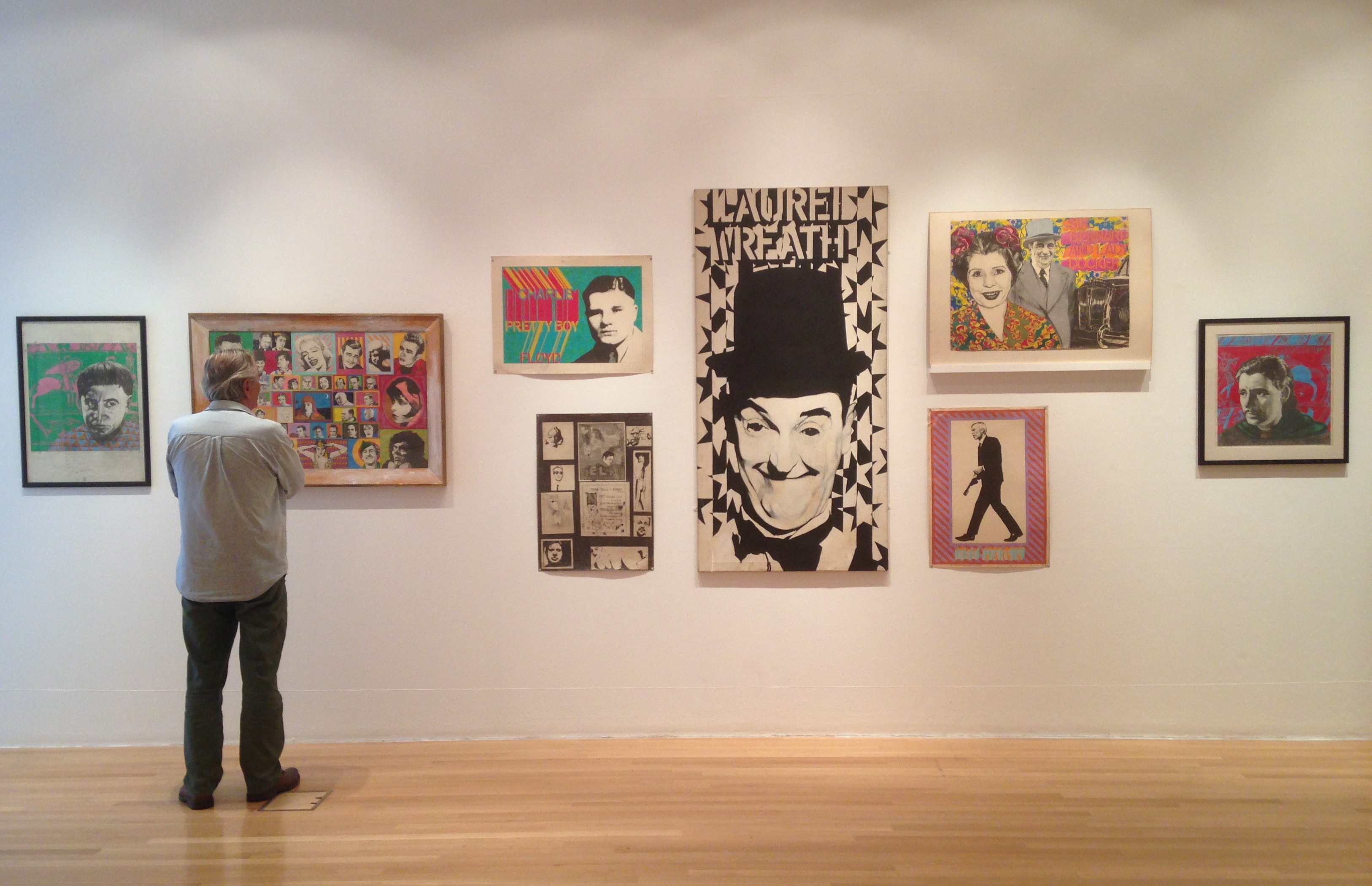
DuryIan Dury may well have been the only pop artist who became his own subject. On the walls of a new exhibition of his paintings, drawings and graphic design at the Royal College of Art in London, where Dury studied in the early ’60s, hang a handful of interesting self-portraits. For his true self-portrait, however, you have to search YouTube for the remarkable official videos for “Hit Me With Your Rhythm Stick” and “Reasons to Be Cheerful, Part 3”, where you will find the artist who invented himself in the medium that best suited him. Nevertheless the RCA show, called More Than Fair, is well worth a visit for the glimpse it provides of a young man who grew up amid the benign ferment of British art colleges half a century ago.

Dury went to Walthamstow School of Art in 1959, studied with Peter Blake, and won a place at the RCA in 1963. This was a time when popular culture was becoming an acceptable subject for fine artists, thanks to the work of Blake, Richard Hamilton and others, and Dury welcomed the opportunity to take on a range of subjects including Hollywood stars, Sonny Liston, celebrity industrialists (Lord and Lady Docker, famous for their Daimler with gold door handles) and the soft-porn nudes who take up just about half the show.

The influence of Blake — who remained a friend — is evident in the presentation of such works as “Flo Diddley” and “Miranda Aureole: The Nipple Princess”, and in the work he did for the Sunday Times Magazine and London Look. Here from the ST Mag (which continually bylined him “Ian Drury”) are spreads devoted to features on “The Immortals” (Bogart, Gable, Harlow, etc) in 1966 and “Lost Heroes” (James Dean) the following year. Rainbow stripes are bursting everywhere, sometimes accessorised with sequins. Titles are roughly stencilled. The energy is unmistakeable, even in the representatives of his commercial work, such as the cover of World Record Club’s “The Wonderful Vera” (Lynn) and the box for EMI’s reel-to-reel tape version of Sinatra Sings of Love.

Four LivesThis didn’t turn out to be the work Dury was put on earth to do, but he was pretty good at it. Curated by Jemima Dury (the artist’s daughter), Julian Balme and Kosmo Vinyl, the show was assembled from the family collection and loans from friends and former colleagues, including Terry Day, the drummer of Kilburn and the High Roads (who contributes a Dury-decorated bass drum head), Davey Payne, the Blockheads’ saxophonist, Andrew King, Dury’s music publisher, and Laurie Lewis, the dance photographer.

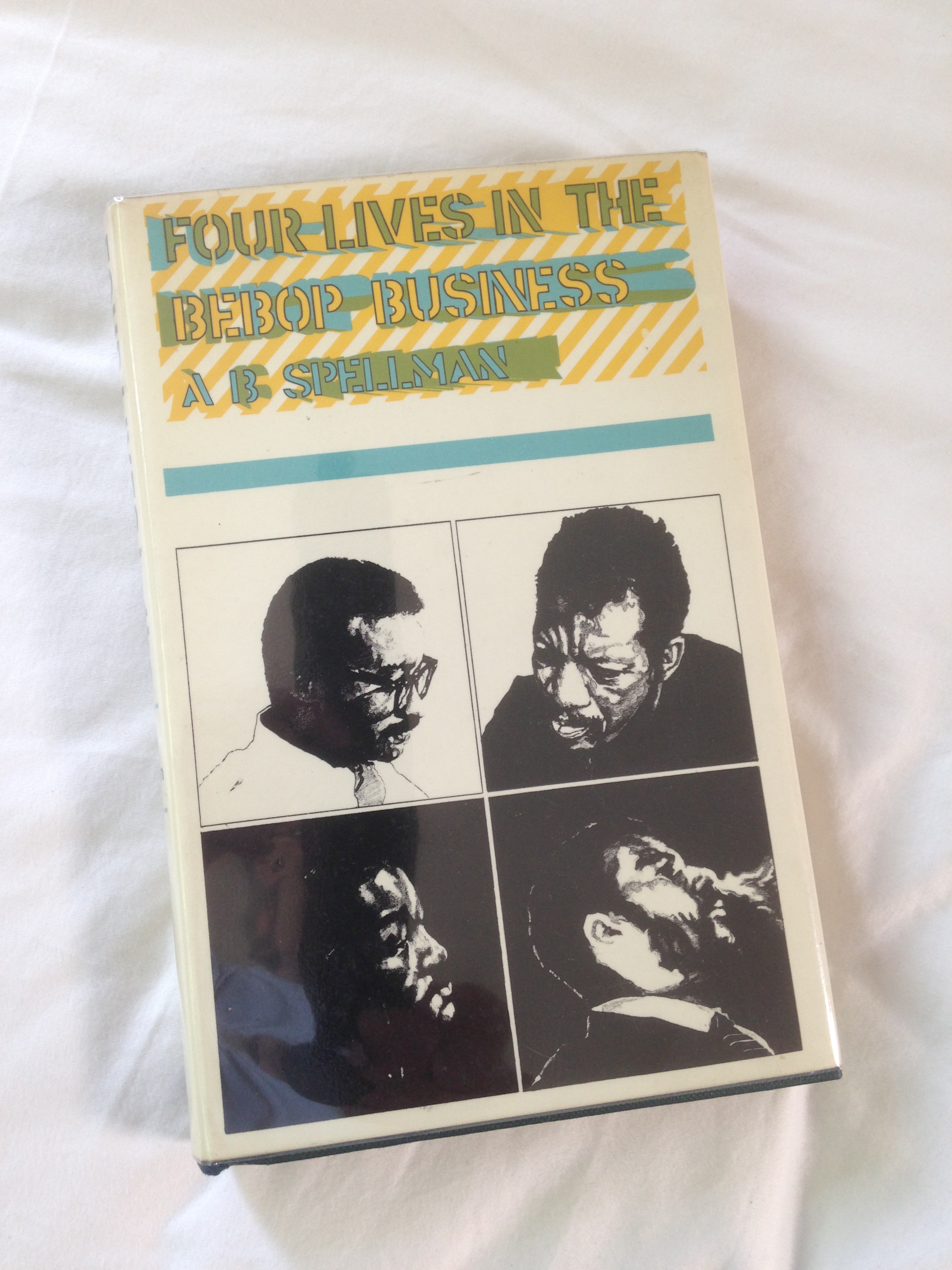
I wish I’d known about the exhibition in advance. Then I’d have lent them my own bit of Duryana: a copy of the first UK edition of A.B.Spellman’s Four Lives in the Bebop Business, published in 1967, for which MacGibbon and Kee commissioned the artist to provide a new cover (above). His ink portraits of Cecil Taylor, Ornette Coleman, Herbie Nichols and Jackie McLean, the subjects of Spellman’s classic quartet of encounters with modern jazz musicians, are perfect, as is the stencilled typography.

The show opened this morning and closes on September 1. Admission is free. Details are here. A new book of Dury’s lyrics, titled Hello Sausages, edited by Jemima Dury and published by Bloomsbury, is on sale in the gallery at a tenner off the £25 price. All in all, it’s worth the trip.

The Brubeck/Bernstein dialogues

Brubeck

It wouldn’t surprise me if you’d never heard, or even heard of, Bernstein Plays Brubeck Plays Bernstein. It isn’t in any of the guides to recommended jazz recordings that I’ve read, and I don’t remember seeing any mention of it in the many excellent obituaries that appeared when Dave Brubeck died, aged 91, last December. Even in an era when his contribution has been handsomely reassessed, it remains a bit of a black sheep in his discography.

Yet it’s always been a record of which I’ve been extremely fond, and it’s a pleasure for me that it has finally made what I believe to be its first appearance on CD (** I’m wrong: see correction below). Even now, however, despite featuring two of Columbia Records’ biggest names of the early 1960s, it has been refused the seal of approval that a release on Sony Legacy represents, and has been shuffled intead down to the budget Hallmark label, which means that although the repackagers have used the original front cover design, today’s buyer isn’t deemed worthy of the sleeve information that came with the original 12-inch LP release.

No matter. The relevant details are to hand. The first side of the album consists of Howard Brubeck’s four-part Dialogues for Jazz Combo and Orchestra,  first performed by the New York Philharmonic and the Dave Brubeck Quartet under the baton of Leonard Bernstein at Carnegie Hall in December 1959 — the month that Brubeck’s Time Out, containing “Take Five”, was released — and recorded the following January 30 at one of Columbia’s two New York studios, probably the deconsecrated Armenian Church on East 30th Street. The second side presents four of Bernstein’s Broadway theatre songs, three of them from West Side Story, recorded a fortnight later by the quartet alone: the classic line-up of Brubeck (piano), Paul Desmond (alto saxophone), Gene Wright (bass) and Joe Morello (drums).

Howard Brubeck was Dave’s older brother, preceding his sibling as a student of the French composer Darius Milhaud at Mills College, a liberal arts institution in the Bay Area (its alumni include Terry Riley, Phil Lesh and Steve Reich). He became Milhaud’s assistant, taught composition at San Diego State College and ended his career as dean of humanities at Palomar Junior College in San Marcos, California. Dialogues appears to be his only recorded composition.

The four movements are titled Allegro, Andante (Ballad), Adagio (Ballad) and Allegro (Blues). Inevitably, the critics of the day assumed that the two Brubecks and their superstar conductor were putting a toe into the waters of the Third Stream, the late-’50s movement created by the musicologist-composer Gunther Schuller, who wanted to find ways of combining jazz with classical music. Most of them criticised it for an absence of obvious musical ambition: what Howard Brubeck did was not to fuse the two forms in an attempt to discover a third, but simply juxtapose them. So for most of the time rather portentous orchestral passages reminiscent of Aaron Copland — stentorian brass, perky woodwind — are succeeded by bits that sound like conventional 1950s jazz-with-strings.

I don’t mind that at all, because the material always feels like it has substance and the players sound as though they’re having fun. I bought it on its release in 1961 and I’ve probably listened to the orchestral piece no more than two or three times in the last 40 years, but I found that I remembered every note. It isn’t profound, but it’s unfailingly intelligent and creative, and sometimes genuinely exciting, and it calls on the full resources of Brubeck and his musicians. Andante (Ballad) has a tune as pretty as brother Dave’s classic “In Your Own Sweet Way”, giving Morello a chance to demonstrate his immaculate brush-work, while Wright sounds pretty much the equal of more highly rated bass-players of the era. Adagio (Ballad) moves from an astringent passage for strings into full-blown romanticism behind Desmond, and the closing movement — although the mention of the blues in the title is a little misleading — finds the quartet achieving a genuine interaction with the orchestra as the intensity builds from a delicious conversation for trumpet and bassoon through angular string figures towards a beautiful moment when the orchestra detonates Desmond into the first of two short but very fine solos over the rhythm section at its swinging best. The closing ensemble climax is prefaced by a 32-bar solo which shows what an unassumingly adventurous pianist Brubeck could be. (It reminded me of a lovely self-deprecatory story he once told about bumping into the avant-garde pianist Cecil Taylor, who told him how much he admired his playing and proclaimed that he saw him as the missing link. “He didn’t say between what and what,” Brubeck said.)

What a pity whoever remastered the recording saw fit to cut off the final chord, leaving no hint of natural reverb — particularly since Columbia’s 30th Street studio was renowned for its inherent properties in that respect. But I suppose that’s what happens when you bang something out on a budget label and flog it for less than a fiver.

Did I say something about the quartet swinging? But isn’t what they were supposed not to do? What rubbish. I saw them at the De Montfort Hall in Leicester during their UK tour in 1962, at the height of their popular success. It was my first direct exposure to American jazz musicians, and they proved that no group including Wright and Morello could fail to swing like the clappers on demand, whatever the material or the environment. And that’s what we find on the tracks minus the orchestra, where their playing is unfailingly excellent, particularly on a luminous version of “Maria”, where — if I’ve got it right — Desmond plays the theme in 4/4 while the rhythm section are playing in three. It’s the sort of rhythmic game for which they became famous with “Take Five”, “Unsquare Dance” and so on, and as usual they settle into a regular four for the solos. The delicacy of Brubeck’s solos throughout these sides is exceptional. He really was a remarkable musician. And Bernstein Plays Brubeck Plays Bernstein doesn’t deserve its obscurity.

* The photograph of the quartet — left to right: Dave Brubeck, Paul Desmond, Gene Wright, Joe Morello — is from the cover of the album.

** Philip Clark (@MusicClerk) kindly points out that Dialogues was reissued in a series of CDs called Bernstein Century, and the whole thing came out in January 2011 via Essential Jazz Classics. I’m afraid I don’t know whether either of those versions preserved a little reverb at the end of the suite.

Catch A Fire redux

Catch A FireLondon felt like an oven as I made my way to the South Bank to watch Gary Crosby’s augmented Jazz Jamaica celebrate the 40th anniversary of Catch A Fire last night. It reminded me of the evening of September 20, 1972, when I landed at Palisadoes Airport in Kingston, Jamaica and experienced Caribbean heat for the first time, about to discover the way it transports you into a different reality.

Chris Blackwell, the founder of Island Records, whom I had not met before, picked me up at the terminal in a Mini Moke, which also contained the American photographer Lynn Goldsmith. We drove along the Palisadoes, the long spit of land than encloses Kingston Harbour, to Port Royal, the old pirate headquarters — or what was left of it by the earthquakes of 1692 and 1907. It was quiet, and it was hot, and we got out of the Moke by the seafront, where goats were settling down for the night and men were selling fish from glass-fronted wooden cases. Blackwell bought us each a piece of fried snapper and a can of cold Red Stripe from a bar made out of corrugated iron sheets. It seemed like heaven

The following day we went to Dynamic Sound studios, where Toots and the Maytals were trying to record “Tumbling Dice”, a task only marginally impeded by the fact that Toots didn’t know the words and was making them up as he went along. This gave me the chance to witness one of the great rhythm sections at work: Hucks Brown (guitar), Gladstone Anderson (piano), Winston Wright (organ), Jackie Jackson (bass) and Winston Grennan (drums), each of them doing exactly what you hoped he’d do. Particularly Hucks Brown, playing those unique little stuttering, flickering single-string fills that had distinguished Paul Simon’s “Mother and Child Reunion” a few months earlier.

I was shown around Trenchtown the next morning by Joe Higgs, the singer who had mentored the young Wailers, teaching them how to sing harmony. Joe was an older man, a calm, charming, deep-voiced Rasta. He gave me a copy of his new 45, “Let Us Do Something”, and took me to Bob’s Tuff Gong record shack at 127 King Street, one block across from Orange Street, where I bought copies of the Wailers’ “Trenchtown Rock” and their latest release, “Satisfy My Soul Jah Jah”. That afternoon Blackwell and I went to Half Way Tree, where he had an appointment at the Aquarius record store with Herman Chin Loy, a young producer, who played us some pretty wild acetates on which he wanted to make a deal; they may have been the ones that surfaced the following year on the first of his Aquarian Dub LPs.

That evening we met up with Harry Johnson — the famous Harry J — who removed a Smith & Wesson from the glove compartment of his Oldsmobile and placed it in a shoulder holster concealed by his lightweight jacket before ushering took us to his studio on Roosevelt Avenue. I remember it as a bungalow surrounded by lawn and trees. Inside, amid a thick fug of ganja, were Bob Marley, Peter Tosh, Bunny Livingstone, Aston Barrett and Carlton Barrett, laying down the track of “Slave Driver”, whose lyric would provide the title for Catch A Fire.

I knew about the Wailers. Back in 1966 I’d bought two of their early singles, “Put It On” and “He Who Feels It Knows It”, on the old Island white label. I loved the songs, the rhythms and, most of all, the harmonies. But this was a quite different sort of experience: thanks to the Barrett brothers (my second great rhythm section in two days), the music had a dark churn of a kind I’d never heard before, somehow lazy and energised at the same time. The vocals were equally stunning: Marley’s lead was mesmerising, the harmony work piercingly gorgeous.

Blackwell had done something unprecedented in the annals of Jamaican music. At a time when musicians sold the rights to their singles for 25 Jamaican dollars, he had advanced the Wailers several thousand pounds in order to make an album, bringing the economics of production and promotion developed in rock music to the world of reggae. And this was his first exposure to the result of what most people in the Jamaican music business saw as an outrageous and hopeless gamble. But Blackwell was always a talented gambler, and almost as soon as he walked through the studio door he knew that this one had come off.

The quickest and simplest way of explaining the effect of all this on me is to say that when I got home, a couple of days later, I sat down to write a piece suggesting that in Bob Marley, Jamaica had a musician whose effect might one day be comparable to that of Marvin Gaye, Sly Stone and Curtis Mayfield. Not wrong there. Catch A Fire came out six months later, in its strikingly ingenious (and expensive) Zippo cover, beginning the process that, within three years, turned Marley into an international superstar and cultural symbol and made reggae into an wordwide lingua franca.

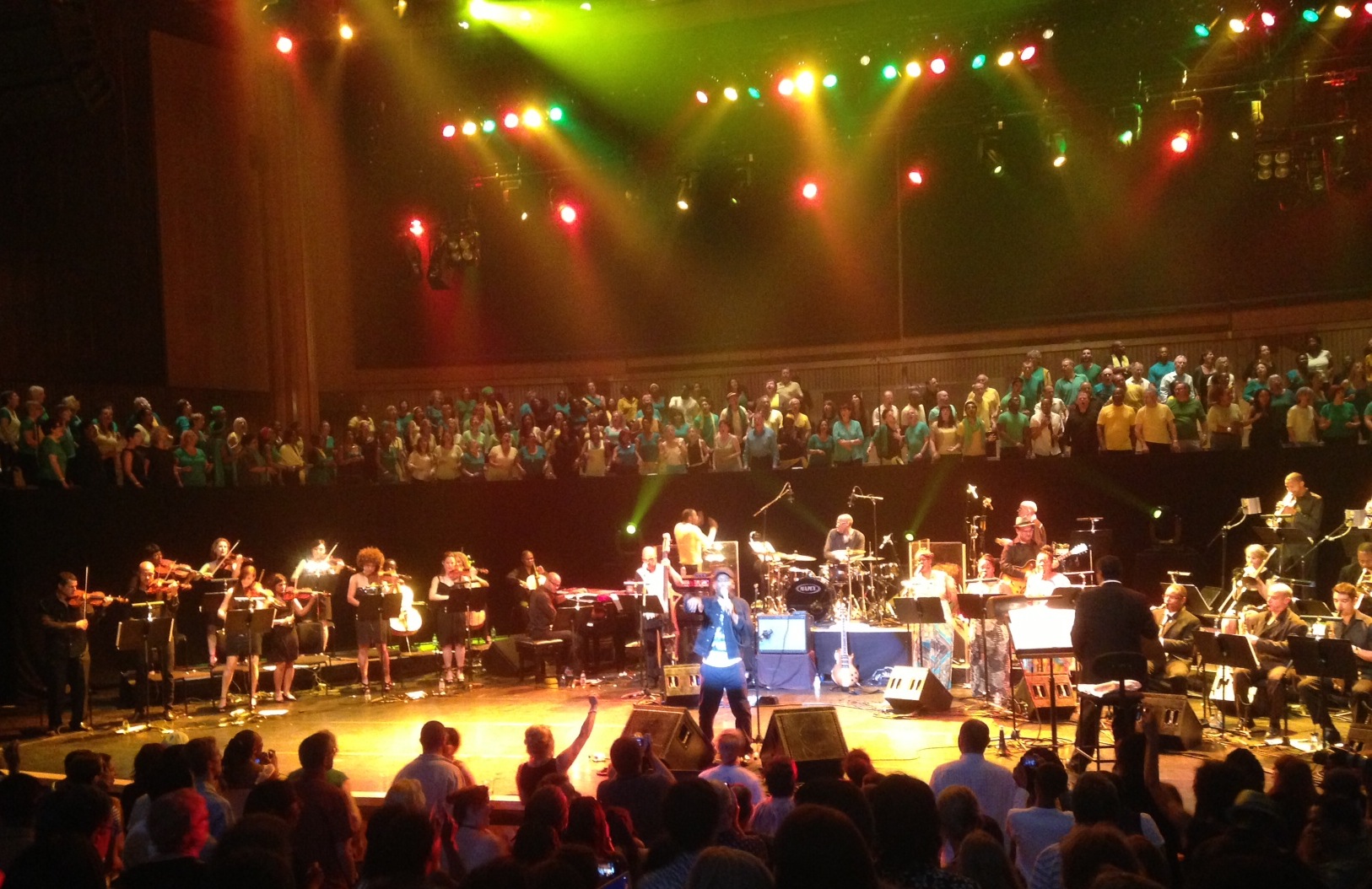
That’s a long way of getting round to talking about last night’s gig at the Festival Hall, but it might help to explain why I found it so moving when the 21-member Jazz Jamaica All Stars, the 12-piece Urban Soul string ensemble, the 240-person Voicelab choir, the conductor Kevin Robinson, the choirmaster Mark De Lisser and the singer-guitarist Brinsley Forde launched into “No More Trouble”. In that moment, in that song’s combination of baleful cadences and stare-down optimism, the summoning of musical and spiritual powers was at its most intense: spine-tingling at the start, overwhelming by the finish.

They played the album all the way through, Jason Yarde’s arrangements making use of all the available resources: the strings on Tosh’s “Stop That Train”, an acapella coda for the three female backing singers (Zara MacFarlane, Keisha Downie and Rasiyah) on “Baby, Baby We’ve Got a Date”, the best guitar solo I’ve heard this year from Robin Banerjee on “Concrete Jungle”, a fine Latin piano solo from Ben Burrell on “Midnight Ravers”, a rousing violin duel between Stephen Hussey and Miles Brett on “Stir It Up”, the tenor saxophone of Denys Baptiste and the trumpet of Yazz Ahmed swapping phrases on another Tosh song, “400 Years”. And the other great solo of the night, by the tenorist Patrick Clahar, on “No More Trouble”.

They finished with three songs from Marley’s later repertoire: “One Love”, “Redemption Song” — sung by Brinsley Forde with just the strings for company — and “Lively Up Yourself”. Brinsley deserves the highest praise for a performance in which he evoked the spirit of the great man without exaggeration and without pushing himself forward, becoming just another member of a unique and hugely life-affirming organism. Quite a night.

A visit to 131 Prince Street

Ornette in SoHo

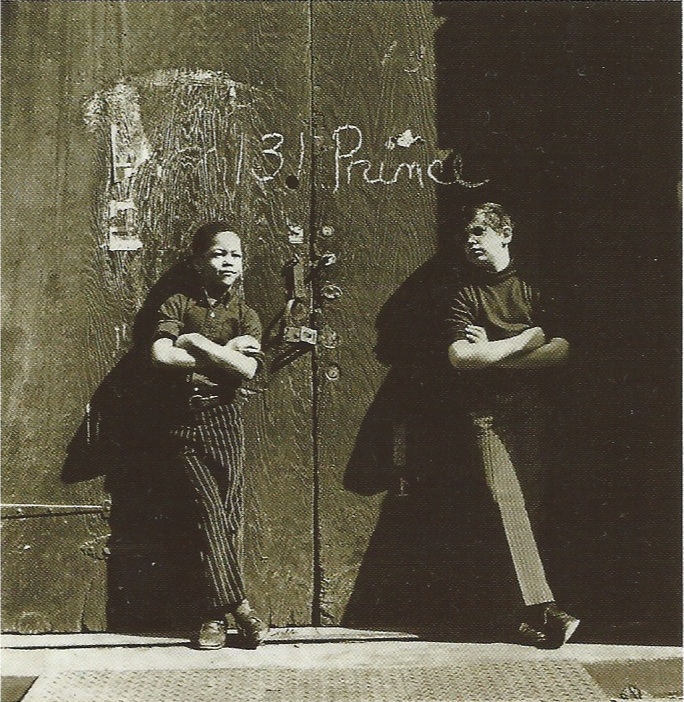
When I visited Ornette Coleman’s SoHo loft in early 1973, the threat of eviction was already hanging over him. The great saxophonist and composer had lived at 131 Prince Street since the late ’60s, when the district’s historic buildings had been under threat of demolition to make way for the proposed Lower Manhattan Expressway. Now the expressway scheme had been abandoned, and the neighbours were getting restless. They didn’t like the idea of a jazz musician living in their midst, it was said. Particularly one who had turned his ground floor into a performance space, which he called Artists House. And real-estate agents were looking for a way of freeing up properties in a district whose beautiful but semi-derelict five-storey cast-iron buildings were about to make the transition from light industry to highly desirable residences and retail spaces.

The next SoHo loft I visited, on Greene Street in 1981, was occupied by David Byrne and Twyla Tharp, who had just collaborated on The Catherine Wheel, and the metamorphosis didn’t stop there. In 1999, Rupert Murdoch and his new wife, Wendi Deng, paid £6.5m for a triplex apartment at 141 Prince Street, five doors from Ornette’s old pad; six years later they sold it for almost $25m. For the last 20 years the streets have been lined with high-end clothes shops and expensive restaurants, and the sidewalks thronged with tourists. Like a lot of places into which developers and exploiters follow artists, SoHo lost its character on the path to prosperity.

One day in 1970, Ornette invited an audience of acquaintances and colleagues to attend a recording by his then-current quartet: Dewey Redman (tenor), Charlie Haden (bass) and Ed Blackwell (drums). The result was issued a couple of years later as an album called Friends and Neighbors on Flying Dutchman, a short-lived label run by the producer Bob Thiele, who had recorded Coleman (and John Coltrane and Albert Ayler) on Impulse in the ’60s. Now Ace Records in the UK has acquired the rights to Thiele’s catalogue, and Friends and Neighbors — which has always been hard to find, although I have a CD of the album reissued by BMG France a dozen years ago — is among the first releases. The photograph above, by Ray Ross, is from the cover.

The album starts in a rather eccentric fashion with the two short parts of the title piece, originally released — unlikely as it may seem — as a 45rpm single. On the first part, the audience chants a simple lyric based on the title, “Give Peace a Chance”-style, over a bouncy Blackwell second-line backbeat, either side of solos from Ornette’s screechy violin and Redman’s saxophone. The second part has no singing, and Ornette switches to alto saxophone; the groove persists, with Haden outstanding despite the murky sound.

The aural fog clears entirely for the remaining four pieces,all devoted to the quartet, among which the two extended tracks, “Long Time, No See” and “Tomorrow”, deserve to occupy an important place in Coleman’s discography. The intimacy of the interplay between alto and drums during Ornette’s six-minute solo on the former track is outstanding even by the standards of these particular players, with Blackwell giving a lesson in medium-up tempo swing. Ornette’s trumpet appears on the brief “Let’s Play” but he returns to the alto for “Forgotten Songs” and for “Tomorrow”, where the always underrated Redman leads off with a striking solo employing multiphonics and Ornette contributes another outstanding improvisation in collaboration with the endlessly stimulating rhythm team.

My visit to 131 Prince Street three years later yielded one of the most singular and intense musical experiences of my life. A group of  half a dozen jazz writers from around the world were paying a visit to Coleman, who responded by inviting his house guest, the great pianist Abdullah Ibrahim, to play for them. If you’ll indulge me, here’s how I described it from memory a few years later, in the introduction to a book called Jazz: A Photographic Documentary:

The South African seated himself at the grand piano in the middle of the light, spacious loft while the visitors drew up their chairs in a semi-circle around him. He placed his hands together, bowed his head for a moment, and then he began. Perhaps he played for 10 minutes, perhaps for half an hour. Nobody in that room would have been able to say which.

He began with a hymn tune tune direct from the African Methodist Episcopal Church in which he worshipped and sang as a child; a slow, wise tune, its melody moving with a graceful inevitability, supported by simple harmonies that resonated with the richness of entire choirs. Then he changed gear, into a dance tune that moved to a swaying, sinuous beat and gathered momentum until it sounded like a whole township stepping out. Changing up again, his hands began to hammer great tremolos at both ends of the keyboard, the air in the room seeming to shimmer and the floor to shudder as his big fingers rolled harder and harder in a gigantic crescendo until suddenly bright treble splashes fell across the dark patterns like bursts of sunlight piercing a storm. Now pure energy took over, the melodies broken into abstract angular figures which leaped and tumbled and fought with a ferocious energy, bypassing the logic centres of the brain to reach some place that responds only to kinetic stimuli. 

Just when it seemed that the intensity might burst the windows, Ibrahim backed off, returned to the double-handed tremolos, rewound slowly and with infinite care through the dance tune and the hymn, and deposited us back where he had found us, in silence — except that the silence now sounded completely different.

Soon after that Ornette was obliged to close Artists House. Around 1975, he was finally evicted altogether.

Roll over, Anton Webern

John O'GallagherThe name of John O’Gallagher was not a familiar one to me when I took his new CD, The Anton Webern Project, out of the packet and slid it into the player. O’Gallagher is a 48-year-old alto saxophonist who was born in California and raised in Washington State; he has spent the last 20 years in New York scene, playing with the likes of Maria Schneider, Tony Malaby and Richie Beirach while pursuing a parallel career as an educator (he has conducted workshops at institutions including the New England Conservatory and the Royal Academy of Music). His speciality appears to be the integration of jazz and serial composition, something I wrote about on this blog back in March while recommending a new recording based on Stockhausen’s Tierkreis by the pianist Brun0 Heinen.

Earlier this year O’Gallagher’s book Twelve Tone Improvisation was published in Germany, and it seems that The Anton Webern Project , released on the Whirlwind label, is a practical demonstration of his theories concerning improvisation on tone rows. If that makes it sound forbidding, it isn’t. I can personally testify that you don’t need an intimate familiarity with the Webern compositions on which these eight pieces are based, or even with dodecaphony in general, in order to enjoy a very stimulating experience.

O’Gallagher’s band consists of himself plus Matt Moran (vibes), Pete McCann (guitar), Russ Lossing (keyboards), Johannes Weidenmuller (bass), Tyshawn Sorey (drums) and Margaret Grebowicz (voice). I’m not sure I’d be able to pick the leader’s playing out of a crowd of contemporary altoists — the closest I can get to a description of his tone is to say that he sounds something like a cross between Ornette Coleman and Phil Woods — but his solos are full of substance and his sidemen are excellent, with Lossing’s imaginative contributions on Hammond organ and Fender-Rhodes electric piano and Sorey’s finely textured work being outstanding. As you might expect, given the source of its inspiration, the music is intense and highly detailed, but it never sounds overwritten or corsetted. Quite often the chamber-jazz mood is completely dispelled: on something like “Five Pieces”, for instance, the players are free to produce something that might have come from Dark Magus-period Miles Davis or even Tony Williams’ Lifetime. On parts of “The Secret Code”, the longest piece of the set, there’s an enormous amount going on, without any sense of overcrowding. The essential spontaneity of jazz pervades this music — which, given the degree of preparation involved, is quite an achievement.

* The photograph of John O’Gallagher is taken from the sleeve of The Anton Webern Project, for which Don Mount and Ben Lieberman took the images. 

* On its first publication, thanks to a bit of authorial brain-fade, this piece said that Tierkreis was composed by Schoenberg rather than Stockhausen. I’ve corrected it.

Farewell to Psi

Gerd DudekThe guests of honour at Evan Parker’s gig at the Vortex in East London last night were Martin and Mandy Davidson, creators and custodians of the Emanem label, founded in 1974 as a vehicle for music by the free improvisers who could loosely be called the Little Theatre Club school: Derek Bailey, John Stevens, Paul Rutherford and so on, plus such non-British soulmates as Steve Lacy, Anthony Braxton and Bobby Bradford. The Davidsons are shortly to leave London for Spain, and although the activities of Emanem will continue from their new headquarters, their departure marks the end of another valuable project: Psi Records, the label founded by Evan Parker in 2001, and run with Martin’s assistance.

Back in the early Seventies it was Parker who, with Bailey and Tony Oxley, formed Incus Records, one of the first musician-owned labels in the free jazz field. Incus released some historic albums before internal disagreements put an end to its story, and Psi was Evan’s next step. Over the past dozen years the label has produced about 80 CDs, many of them featuring Parker but others under the leadership of the likes of Kenny Wheeler, Han Bennink, Alex von Schlippenbach, Ray Warleigh, Agusti Fernandez, Aki Takase and so on. Now Psi’s founder has decided that it’s time to pause and think again.

Like many of the best jazz labels, from Blue Note and Riverside to ECM and Rune Grammofon, Psi developed its own identity, visual and tactile as well as musical. Parker’s concern for the visual side has been apparent in the unified (rather than uniform) design, in which clean typography is married to the fine photographs of Caroline Forbes and, on several recent releases, the very beautiful abstract paintings of Rina Donnersmarck. One such painting can be found on the cover of what turns out to be the very last Psi release, Day and Night by the German tenor saxophonist Gerd Dudek.

I mentioned Dudek in my last post, apropos of the Gordon Jenkins song “Good-Bye”, and it’s good to have another excuse to talk about a veteran who has never received the proper degree of recognition. He graduated from the Kurt Edelhagen band in the mid-Sixties, joining Manfred Schoof’s quintet and then becoming a member of Schlippenbach’s Globe Unity Orchestra, in whose ranks he encountered Parker. Although Dudek never took his playing as far “out” as some of his tenor-playing contemporaries in Europe, such as Peter Brotzmann, Willem Breuker or indeed Parker, he remained a wonderfully creative improviser in the post-Coltrane idiom.

He was 73 when Day and Night was recorded in January last year, in the company of Hans Koller (piano), Oli Hayhurst (bass) and Gene Calderazzo (drums), but his playing has the vigour — physical and intellectual — that you might associate with a musician half his age, although I think his exceptionally handsome tone has softened slightly over the years. It’s never a bad sign when an album starts with one of Herbie Nichols’s deliciously idiosyncratic tunes, in this case “Step Tempest”, and the repertoire is indeed well chosen: Ornette Coleman’s “Congeniality”, Wayne Shorter’s “Blues a la Carte”, Mingus’s “Duke Ellington’s Sound of Love”, Coltrane’s “Blues to You”, two tunes by Kenny Wheeler, and Koller’s arrangement of J.S. Bach’s chorale “Der Tag mit seinem Lichte” (on which Dudek switches to soprano). The quartet had played at the Vortex the night before going into the studio, and the session has a lovely combination of freshness, relaxation, and intense concentration.

Psi is/was a label largely devoted to genres in whose titles the word “free” appears, and by its normal standards this is a relatively conservative album. No instrumental vocabularies are extended here. But when you listen to Hayhurst and Calderazzo playing with the time behind Dudek on “Congeniality”, you know that this is as “free” as music gets.

* The photograph above was taken by Caroline Forbes and appears on the inner jacket of Day and Night. Left to right: Gene Calderazzo, Oli Hayhurst, Gerd Dudek, Hans Koller.

The long “Good-Bye”

Good-ByeAccording to Martha Tilton, a featured singer with the Benny Goodman Orchestra in the late 1930s, Gordon Jenkins wrote “Good-Bye” — which became Goodman’s sign-off theme — after the death of his first wife in childbirth. No wonder Alec Wilder, in his magisterial survey American Popular Song, called it “as sad a song as I know”. It is also, Wilder noted, a thing of remarkable beauty. So beautiful, in fact, that I’ve taken to collecting versions of it, and there are many, since it is a song that appeals strongly to jazz musicians of a certain sensibility, not least for providing the illusion of being through-composed, rather than repeating its individual sections in the AABA manner of conventional standards.

Goodman recorded it for the Victor label in 1935; the label describes it as a Fox Trot, in this case a distinctly gentle and smoochy one (and here it is). Since there is no vocal refrain, nothing except its minor key alerts the listener to the heartbreak inherent in Jenkins’ composition. It’s just the thing for a nice slowish dance to finish a romantic evening at the Glen Island Casino or the Balboa Ballroom, the sort of places that incubated the Swing Era.

But I first heard it, as with many other great American popular songs, in a version recorded by Frank Sinatra, in this case on an LP called Frank Sinatra Sings for Only the Lonely, recorded in Hollywood in 1958. Arranged by Nelson Riddle, the album is the singer’s torch-song masterpiece, and “Good-Bye” is its most exalted moment. Riddle slows the song down almost to a standstill, applying his most sensitive orchestral touch, employing juxtapositions and combinations of cor anglais, cello, bassoon, various kinds of clarinet, tightly muted trumpets, French horns and muted strings as well as great sweeping ensemble flourishes to inspire his singer. Sinatra responds with a performance of concentrated sobriety that puts to perfect use the lessons in bel canto phrasing that he learnt from listening to the trombone playing of Tommy Dorsey and the violin of Jascha Heifetz. All those underwater lengths he swam in order to master his breath-control find their reward here. And, of course, we get the lyric, an essay in elegant despair, fully comprehended by the arranger: as Sinatra sings “So you take the high road, and I’ll take the low / It’s time that we parted, it’s much better so” for the second time, Riddle’s bassoons parp out a jaunty little even eighth-note pattern that underlines the sense of physical parting, the tone of the chosen instrument somehow leaving us in no doubt that the jauntiness is assumed and false. The melody carrying those particular lines, by the way, is as  finely shaped as any I can think of, especially in terms of the relationship of each individual note to its chord — the sort of thing that seldom bothers the little heads of today’s songwriters.

So much, as far as I’m concerned, for vocal versions of “Good-Bye” (I use the hyphen and the second capital letter because that’s how it appeared on the label of Goodman’s original recording, although it’s mostly now rendered as “Goodbye”). After Sinatra, whose version is a certainty for my desert-island selection, I have no interest in listening to those by Ella Fitzergerald or Diane Krall, the latter recorded a couple of years ago with Charlie Haden’s Quartet West. What Sinatra and Riddle did was definitive. Which nevertheless leaves the way open for instrumental treatments.

It’s a song whose modulations clearly appeal to pianists. Among the most interesting versions known to me are those by McCoy Tyner (on Reaching Fourth, his 1962 trio album with Henry Grimes and Roy Haynes), Paul Bley (with Jay Anderson and Adam Nussbaum on If We May, 1994), Keith Jarrett (on his duo album with Haden, Jasmine, recorded in 2007), Bobo Stenson (from the 2005 album Goodbye, with Anders Jormin and Paul Motian), and Bill Carrothers (on the Dave King Trio’s I’ll Be Ringing You, recorded last year, which I wrote about on this blog a couple of months ago). Tyner’s is in some ways the most unusual — he brings to his reading what the English pianist Alex Hawkins, in an email to me the other day, described as “beautifully luminous post-Tatum harmony”. Bley starts off at an even slower pace than Riddle and Sinatra, then takes the risk of doubling the tempo and introducing familiar blues phrases into his variations, and brings it off. Jarrett is Jarrett, in an intimate conversation with an old friend. Stenson is the pick of the bunch, for my money: wonderfully eloquent, lucid and absolutely cliche-free, highly attentive to the song’s ambiance as well as its structure. Carrothers and his partners come up with the most intriguing group-improvisation approach.

The brilliant French tenor saxophonist Barney Wilen loved the song so much that he recorded it at almost every opportunity. I have three of his versions: with a quintet on La Note Bleue (1987), in a duo with the pianist Alain Jean-Marie on Dream Time (1991) and on Double Action in another quintet with the guitarist Jimmy Gourlay (1999). They’re all good but the first has a special luminosity.

Another saxophonist who got something out of Jenkins’ tune was Cannonball Adderley, who recorded it in 1961 on an album called Know What I Mean? with Bill Evans, two years after they had been members of Miles Davis’s Kind of Blue sextet. Not the most obvious of partners, they manage to find the common ground between the altoist’s ebullience and the pianist’s cerebrality. Actually, Evans is the more ebullient of the two here, laying strings of single-note lines at double and triple tempo over the imperturbable MJQ rhythm team of Percy Heath and Connie Kay. The closing chorus is especially lovely.

The interpretations that would have shocked Jenkins most profoundly are probably the two recorded by Jimmy Giuffre’s trio in 1961, the first on the LP Thesis and the second at a concert in Bremen, at a time when the clarinettist was making his own highly original investigation of free and free-ish improvisation in close partnership with Paul Bley and Steve Swallow. The application of their evolving principles to a standard ballad makes for a stimulating experience on both occasions, with Swallow on particularly fine form on the double bass, making one regret for the umpteenth time his decision to abandon the acoustic instrument. Quite probably Giuffre, being a clarinet-player, had first heard the tune in Goodman’s version. He and Bley returned to it in 1975, on an album called Quiet Song, this time with the guitarist Bill Connors rounding out the trio and Bley making slightly strange noises on an electronic keyboard.

Following more directly in Goodman’s footsteps, there have also been further versions by larger ensembles. Chet Baker recorded it successfully in 1953 as part of a septet session arranged by Jack Montrose: the alto, tenor and baritone saxes of Herb Geller, Montrose himself and Bob Gordon provide an attractive chorale behind Baker, who enunciates the melody with evident respect before producing a pleasant and completely appropriate solo (the track is currently to be found on the CD titled Grey December). Maynard Ferguson, a trumpeter at the other end of the scale in terms of technique and taste, recorded Don Sebesky’s arrangement on his album Maynard ’61, at which time the Canadian-born bandleader was approaching the height of his fame. If it’s not particularly subtle, then it’s by no means grotesque, thanks not least to a gorgeous tenor solo from the always underrated Joe Farrell. Much better is the version recorded on an album called Live in Japan ’96 by Alexander von Schlippenbach’s Berlin Contemporary Jazz Orchestra, arranged by Willem Breuker and with a stirring solo by another often overlooked tenorist, Gerd Dudek.

To finish with, a recording suffused with as much sadness as Martha Tilton’s account of the song’s origin: the one made by the great Chicago tenor saxophonist Gene Ammons, the son of the celebrated boogie-woogie pianist Albert Ammons, in March 1974. This was the final tune recorded on the last day of sessions held over three consecutive days for Prestige Records in New York, meaning it was the last piece of music the big-toned tenorist ever recorded (shortly afterwards his cancer was diagnosed and he died four months later, aged 49). Although he had no way of knowing it, this really was his goodbye, and he fills the track’s four and a half minutes with a brusque tenderness that brings another shade of emotion to a song which tends to draw the best out of those who approach it in the proper spirit.

Reading music: jazz + prose

IMG_0922doneI’ve always had a soft spot for jazz and poetry: Jack Kerouac with Zoot Sims, Kenneth Patchen with the Chamber Jazz Sextet, Langston Hughes with Charles Mingus, Christopher Logue with Tony Kinsey, LeRoi Jones with the New York Art Quartet. It must be the beatnik in me, or the hopeless optimist, because not much of it has outlived its time. But here’s something new: jazz and prose. Or, to be more precise, jazz both with and without prose, at the same time. The Moss Project’s What Do You See When You Close Your Eyes?, just released on the Babel label, consists of five pieces of music written by the London-based guitarist Moss Freed and a sixth by his colleague Ruth Goller, recorded by his group, and then given to half a dozen writers to produce short stories or poems inspired by what they’ve heard. A handsome hardback book contains the CD and the printed words (which can also be heard, read by the authors, on a download from the artist’s website).

The writers who responded to Freed’s invitation are Naomi Alderman, Colum McCann, James Miller, Lawrence Norfolk,  Joe Dunthorne and Hanan al-Shaykh. The musicians, apart from Freed, are the members of his quartet (pictured above) — Ruth Goller on bass guitar and double bass, the drummer Marek Dorcik and the singer and violinist Alice Zawadzki — plus a guest, the near-ubiquitous Shabaka Hutchings, on tenor saxophone and bass clarinet. The six pieces are bookended by an brief instrumental prelude and a song for voices and instruments with words and music by Freed.

On a purely musical level, the CD gets better as it goes along: after a somewhat self-conscious beginning with “The Bubble”, the first full-length piece, and the gentle pastorale of “Anniversary”, to which Goller’s double bass makes an outstanding contribution, the blood starts flowing and the playing seems to loosen up. (This may have nothing to do with reality, in the sense of bearing a relationship to the order in which the pieces were recorded, but it happens to be this listener’s experience.) The fourth and sixth pieces, the intricate title track and an adventurous slow invention called “The Angel”, on which Freed explores various instrumental effects, are the picks for me. These are carefully constructed compositions that sound entirely contemporary while generally avoiding the tricksiness — usually expressed as a perversely wilful angularity — that can afflict the current generation of young, conservatory-trained jazz musicians (Freed studied at Edinburgh and Berklee). The blend of the leader’s guitar and Zawadzki’s violin is an extremely happy one, subtly enhanced by the addition of bass clarinet on “Caravans”, while Goller and Dorcik keep the music’s sinews taut (their handling of irregular metres on “What Do You See…” is as calm and frictionless as their switching between time to no-time in “Postscript: Lose Ourselves”).

And the written words? Freed suggests they can be read at the same time as the music is playing, or before, or after, or just listened to in the writers’ recitations (find them at http://www.mossfreed.com). I can’t honestly say that reading them greatly affected my response to the music, but I enjoyed McCann’s meditation on a woman’s visit to an old church (“Anniversary”), which really does fit with its music, and Norfolk’s miniature account of two characters on a slightly tense road trip (“Caravans”). A worthwhile experiment, attractively presented.

* The photograph above is by Barbara Bartz. Left to right: Ruth Goller, Marek Dorcik, Moss Freed and Alice Zawadzki.

Down the Manne-Hole

Shelly ManneWhat I carried away in my head from the only time I saw Shelly Manne in person, at Ronnie Scott’s in the summer of 1970, was the sound of his ride cymbal. It was as close to perfection as you could get, the ideal balance of the dry ping produced by the stick’s tip and a discreet spread of sound that carried the momentum from one stroke to the next. It’s hard to find a cymbal like that, and I remember it as the best of its kind I’ve ever heard.

Very likely it was the same cymbal that he had been playing just under 10 years earlier on an album called Shelly Manne and His Men Play ‘Checkmate’, which I picked up second-hand the other day. I’d never heard it before, although the quintet with which he recorded it has gradually become one of my favourite small modern jazz groups of the era, quite the equal of Art Blakey’s Jazz Messengers or the Horace Silver Quintet, who set the standard for post-bop combos.

In 1959, when the group included the trumpeter Joe Gordon, the tenor saxophonist Richie Kamuca, the pianist Victor Feldman and the bassist Monty Budwig, they were recorded over three nights at the Blackhawk club in San Francisco, leading to a series of five albums on the Contemporary label, Manne’s home for 20 years. Now out of copyright in Europe, they’re all available on a four-CD box released by the American Jazz Classics label, and they stand up very well to a direct comparison with the two LPs recorded by the Miles Davis Quintet at the same venue a year and a half later.

Manne’s group visited Europe in 1960, with Russ Freeman replacing Feldman (there’s a recording of their concert at Manchester’s Free Trade Hall, called West Coast Jazz In England, on the Solar label), and by the time they made another live recording at a West Coast venue, this time at Shelly’s own Los Angeles club, the Manne-Hole, in March 1961, the line-up had undergone further changes. Gordon and Budwig were replaced by Conte Candoli and Chuck Berghofer, with absolutely no diminution of quality. In October of that year the reshaped group went into Contemporary’s little studio on Melrose Place in West Hollywood to record several themes written for a TV detective series by Johnny Williams, a pianist and composer who later became famous (and, presumably, very rich) from his soundtracks to Jaws, Star Wars and Harry Potter.

I have no idea whether or not the series was any good. Set in a San Francisco private detective agency, it ran for two years and 70 episodes, and its guest stars included Charles Laughton, Angie Dickinson, Lee Marvin, Cyd Charisse and the torch singer Julie London. As far as I know, it was never shown in the UK. But Williams composed a series of carefully shaped pieces that provided Manne’s Men with the perfect material on which to exercise their brand of thoughtful, swinging, beautifully turned post-bop.

For me, the star — apart from Manne’s ride cymbal, of course — is Kamuca, who rose to a mild form of prominence in the 1950s as one of a large group of white tenorists heavily under the spell of Lester Young (others included Stan Getz, Zoot Sims and Warne Marsh). He began his career with the big bands of Stan Kenton and Woody Herman, and if you listen to the quartet and octet sides he recorded for the Mode and Hi-Fi Jazz labels in 1956 and ’57 (available on a Fresh Sounds CD called Tenor Ahead), pretty much all you hear is a diligent but unexceptional Young disciple. During his time with Manne’s group, however, he showed himself to have matured into an improviser of exceptional character and poise.

Every note he plays on the Checkmate set is worth hearing. The obvious comparison is with Hank Mobley, a sideman in the Davis group at the Blackhawk, once described as “the middleweight champion of the tenor saxophone”. Showing a similar tone and fluency, but with fewer bluesy inflections in his playing than Mobley, Kamuca reveals himself to be a credible contender for the title. But the tenor-player he makes me think of, more surprisingly, is Wayne Shorter: his approach is more conventional, but there’s something similar about his gorgeous, lightly grained tone and the way he flights his unpredictably shaped but invariably graceful phrases with an airy quality perfectly suited to the sumptuous, clean-lined drive provided by Manne and Berghofer. To compound the pleasure, the quality of the recording made by Howard Holzer, one of Contemporary’s house engineers, has a warmth and a transparency to beat even the great Rudy Van Gelder at his own game, even though the studio also doubled as the label’s packing and mailing room.

Having made his name in California, Kamuca moved to New York for a while in the 1960s and then returned to Los Angeles, where he worked in the studios. He made a handful of albums for the Concord label but his star never burnt as brightly as it had done with Manne, and he died of cancer in 1977, aged 46. The beauty of jazz is that it allows a player of quiet originality to make a lasting mark, and Kamuca, once he had found his own voice, became just such a figure. If you like this kind of modern jazz, then these records by Shelly Manne’s Men, and Checkmate in particular, are as good as it gets.

* The painting of Shelly Manne is from the cover of Checkmate, signed illegibly and uncredited on the CD version reissued in 2002 as part of Fantasy’s Original Jazz Classics series. According to Geoff Winston (see Comments), the credits on the original Contemporary LP jacket reveal the artist to have been one George Deel.