Skip to content

Posts from the ‘Jazz’ Category

Roll over, Anton Webern

John O'GallagherThe name of John O’Gallagher was not a familiar one to me when I took his new CD, The Anton Webern Project, out of the packet and slid it into the player. O’Gallagher is a 48-year-old alto saxophonist who was born in California and raised in Washington State; he has spent the last 20 years in New York scene, playing with the likes of Maria Schneider, Tony Malaby and Richie Beirach while pursuing a parallel career as an educator (he has conducted workshops at institutions including the New England Conservatory and the Royal Academy of Music). His speciality appears to be the integration of jazz and serial composition, something I wrote about on this blog back in March while recommending a new recording based on Stockhausen’s Tierkreis by the pianist Brun0 Heinen.

Earlier this year O’Gallagher’s book Twelve Tone Improvisation was published in Germany, and it seems that The Anton Webern Project , released on the Whirlwind label, is a practical demonstration of his theories concerning improvisation on tone rows. If that makes it sound forbidding, it isn’t. I can personally testify that you don’t need an intimate familiarity with the Webern compositions on which these eight pieces are based, or even with dodecaphony in general, in order to enjoy a very stimulating experience.

O’Gallagher’s band consists of himself plus Matt Moran (vibes), Pete McCann (guitar), Russ Lossing (keyboards), Johannes Weidenmuller (bass), Tyshawn Sorey (drums) and Margaret Grebowicz (voice). I’m not sure I’d be able to pick the leader’s playing out of a crowd of contemporary altoists — the closest I can get to a description of his tone is to say that he sounds something like a cross between Ornette Coleman and Phil Woods — but his solos are full of substance and his sidemen are excellent, with Lossing’s imaginative contributions on Hammond organ and Fender-Rhodes electric piano and Sorey’s finely textured work being outstanding. As you might expect, given the source of its inspiration, the music is intense and highly detailed, but it never sounds overwritten or corsetted. Quite often the chamber-jazz mood is completely dispelled: on something like “Five Pieces”, for instance, the players are free to produce something that might have come from Dark Magus-period Miles Davis or even Tony Williams’ Lifetime. On parts of “The Secret Code”, the longest piece of the set, there’s an enormous amount going on, without any sense of overcrowding. The essential spontaneity of jazz pervades this music — which, given the degree of preparation involved, is quite an achievement.

* The photograph of John O’Gallagher is taken from the sleeve of The Anton Webern Project, for which Don Mount and Ben Lieberman took the images. 

* On its first publication, thanks to a bit of authorial brain-fade, this piece said that Tierkreis was composed by Schoenberg rather than Stockhausen. I’ve corrected it.

Farewell to Psi

Gerd DudekThe guests of honour at Evan Parker’s gig at the Vortex in East London last night were Martin and Mandy Davidson, creators and custodians of the Emanem label, founded in 1974 as a vehicle for music by the free improvisers who could loosely be called the Little Theatre Club school: Derek Bailey, John Stevens, Paul Rutherford and so on, plus such non-British soulmates as Steve Lacy, Anthony Braxton and Bobby Bradford. The Davidsons are shortly to leave London for Spain, and although the activities of Emanem will continue from their new headquarters, their departure marks the end of another valuable project: Psi Records, the label founded by Evan Parker in 2001, and run with Martin’s assistance.

Back in the early Seventies it was Parker who, with Bailey and Tony Oxley, formed Incus Records, one of the first musician-owned labels in the free jazz field. Incus released some historic albums before internal disagreements put an end to its story, and Psi was Evan’s next step. Over the past dozen years the label has produced about 80 CDs, many of them featuring Parker but others under the leadership of the likes of Kenny Wheeler, Han Bennink, Alex von Schlippenbach, Ray Warleigh, Agusti Fernandez, Aki Takase and so on. Now Psi’s founder has decided that it’s time to pause and think again.

Like many of the best jazz labels, from Blue Note and Riverside to ECM and Rune Grammofon, Psi developed its own identity, visual and tactile as well as musical. Parker’s concern for the visual side has been apparent in the unified (rather than uniform) design, in which clean typography is married to the fine photographs of Caroline Forbes and, on several recent releases, the very beautiful abstract paintings of Rina Donnersmarck. One such painting can be found on the cover of what turns out to be the very last Psi release, Day and Night by the German tenor saxophonist Gerd Dudek.

I mentioned Dudek in my last post, apropos of the Gordon Jenkins song “Good-Bye”, and it’s good to have another excuse to talk about a veteran who has never received the proper degree of recognition. He graduated from the Kurt Edelhagen band in the mid-Sixties, joining Manfred Schoof’s quintet and then becoming a member of Schlippenbach’s Globe Unity Orchestra, in whose ranks he encountered Parker. Although Dudek never took his playing as far “out” as some of his tenor-playing contemporaries in Europe, such as Peter Brotzmann, Willem Breuker or indeed Parker, he remained a wonderfully creative improviser in the post-Coltrane idiom.

He was 73 when Day and Night was recorded in January last year, in the company of Hans Koller (piano), Oli Hayhurst (bass) and Gene Calderazzo (drums), but his playing has the vigour — physical and intellectual — that you might associate with a musician half his age, although I think his exceptionally handsome tone has softened slightly over the years. It’s never a bad sign when an album starts with one of Herbie Nichols’s deliciously idiosyncratic tunes, in this case “Step Tempest”, and the repertoire is indeed well chosen: Ornette Coleman’s “Congeniality”, Wayne Shorter’s “Blues a la Carte”, Mingus’s “Duke Ellington’s Sound of Love”, Coltrane’s “Blues to You”, two tunes by Kenny Wheeler, and Koller’s arrangement of J.S. Bach’s chorale “Der Tag mit seinem Lichte” (on which Dudek switches to soprano). The quartet had played at the Vortex the night before going into the studio, and the session has a lovely combination of freshness, relaxation, and intense concentration.

Psi is/was a label largely devoted to genres in whose titles the word “free” appears, and by its normal standards this is a relatively conservative album. No instrumental vocabularies are extended here. But when you listen to Hayhurst and Calderazzo playing with the time behind Dudek on “Congeniality”, you know that this is as “free” as music gets.

* The photograph above was taken by Caroline Forbes and appears on the inner jacket of Day and Night. Left to right: Gene Calderazzo, Oli Hayhurst, Gerd Dudek, Hans Koller.

The long “Good-Bye”

Good-ByeAccording to Martha Tilton, a featured singer with the Benny Goodman Orchestra in the late 1930s, Gordon Jenkins wrote “Good-Bye” — which became Goodman’s sign-off theme — after the death of his first wife in childbirth. No wonder Alec Wilder, in his magisterial survey American Popular Song, called it “as sad a song as I know”. It is also, Wilder noted, a thing of remarkable beauty. So beautiful, in fact, that I’ve taken to collecting versions of it, and there are many, since it is a song that appeals strongly to jazz musicians of a certain sensibility, not least for providing the illusion of being through-composed, rather than repeating its individual sections in the AABA manner of conventional standards.

Goodman recorded it for the Victor label in 1935; the label describes it as a Fox Trot, in this case a distinctly gentle and smoochy one (and here it is). Since there is no vocal refrain, nothing except its minor key alerts the listener to the heartbreak inherent in Jenkins’ composition. It’s just the thing for a nice slowish dance to finish a romantic evening at the Glen Island Casino or the Balboa Ballroom, the sort of places that incubated the Swing Era.

But I first heard it, as with many other great American popular songs, in a version recorded by Frank Sinatra, in this case on an LP called Frank Sinatra Sings for Only the Lonely, recorded in Hollywood in 1958. Arranged by Nelson Riddle, the album is the singer’s torch-song masterpiece, and “Good-Bye” is its most exalted moment. Riddle slows the song down almost to a standstill, applying his most sensitive orchestral touch, employing juxtapositions and combinations of cor anglais, cello, bassoon, various kinds of clarinet, tightly muted trumpets, French horns and muted strings as well as great sweeping ensemble flourishes to inspire his singer. Sinatra responds with a performance of concentrated sobriety that puts to perfect use the lessons in bel canto phrasing that he learnt from listening to the trombone playing of Tommy Dorsey and the violin of Jascha Heifetz. All those underwater lengths he swam in order to master his breath-control find their reward here. And, of course, we get the lyric, an essay in elegant despair, fully comprehended by the arranger: as Sinatra sings “So you take the high road, and I’ll take the low / It’s time that we parted, it’s much better so” for the second time, Riddle’s bassoons parp out a jaunty little even eighth-note pattern that underlines the sense of physical parting, the tone of the chosen instrument somehow leaving us in no doubt that the jauntiness is assumed and false. The melody carrying those particular lines, by the way, is as  finely shaped as any I can think of, especially in terms of the relationship of each individual note to its chord — the sort of thing that seldom bothers the little heads of today’s songwriters.

So much, as far as I’m concerned, for vocal versions of “Good-Bye” (I use the hyphen and the second capital letter because that’s how it appeared on the label of Goodman’s original recording, although it’s mostly now rendered as “Goodbye”). After Sinatra, whose version is a certainty for my desert-island selection, I have no interest in listening to those by Ella Fitzergerald or Diane Krall, the latter recorded a couple of years ago with Charlie Haden’s Quartet West. What Sinatra and Riddle did was definitive. Which nevertheless leaves the way open for instrumental treatments.

It’s a song whose modulations clearly appeal to pianists. Among the most interesting versions known to me are those by McCoy Tyner (on Reaching Fourth, his 1962 trio album with Henry Grimes and Roy Haynes), Paul Bley (with Jay Anderson and Adam Nussbaum on If We May, 1994), Keith Jarrett (on his duo album with Haden, Jasmine, recorded in 2007), Bobo Stenson (from the 2005 album Goodbye, with Anders Jormin and Paul Motian), and Bill Carrothers (on the Dave King Trio’s I’ll Be Ringing You, recorded last year, which I wrote about on this blog a couple of months ago). Tyner’s is in some ways the most unusual — he brings to his reading what the English pianist Alex Hawkins, in an email to me the other day, described as “beautifully luminous post-Tatum harmony”. Bley starts off at an even slower pace than Riddle and Sinatra, then takes the risk of doubling the tempo and introducing familiar blues phrases into his variations, and brings it off. Jarrett is Jarrett, in an intimate conversation with an old friend. Stenson is the pick of the bunch, for my money: wonderfully eloquent, lucid and absolutely cliche-free, highly attentive to the song’s ambiance as well as its structure. Carrothers and his partners come up with the most intriguing group-improvisation approach.

The brilliant French tenor saxophonist Barney Wilen loved the song so much that he recorded it at almost every opportunity. I have three of his versions: with a quintet on La Note Bleue (1987), in a duo with the pianist Alain Jean-Marie on Dream Time (1991) and on Double Action in another quintet with the guitarist Jimmy Gourlay (1999). They’re all good but the first has a special luminosity.

Another saxophonist who got something out of Jenkins’ tune was Cannonball Adderley, who recorded it in 1961 on an album called Know What I Mean? with Bill Evans, two years after they had been members of Miles Davis’s Kind of Blue sextet. Not the most obvious of partners, they manage to find the common ground between the altoist’s ebullience and the pianist’s cerebrality. Actually, Evans is the more ebullient of the two here, laying strings of single-note lines at double and triple tempo over the imperturbable MJQ rhythm team of Percy Heath and Connie Kay. The closing chorus is especially lovely.

The interpretations that would have shocked Jenkins most profoundly are probably the two recorded by Jimmy Giuffre’s trio in 1961, the first on the LP Thesis and the second at a concert in Bremen, at a time when the clarinettist was making his own highly original investigation of free and free-ish improvisation in close partnership with Paul Bley and Steve Swallow. The application of their evolving principles to a standard ballad makes for a stimulating experience on both occasions, with Swallow on particularly fine form on the double bass, making one regret for the umpteenth time his decision to abandon the acoustic instrument. Quite probably Giuffre, being a clarinet-player, had first heard the tune in Goodman’s version. He and Bley returned to it in 1975, on an album called Quiet Song, this time with the guitarist Bill Connors rounding out the trio and Bley making slightly strange noises on an electronic keyboard.

Following more directly in Goodman’s footsteps, there have also been further versions by larger ensembles. Chet Baker recorded it successfully in 1953 as part of a septet session arranged by Jack Montrose: the alto, tenor and baritone saxes of Herb Geller, Montrose himself and Bob Gordon provide an attractive chorale behind Baker, who enunciates the melody with evident respect before producing a pleasant and completely appropriate solo (the track is currently to be found on the CD titled Grey December). Maynard Ferguson, a trumpeter at the other end of the scale in terms of technique and taste, recorded Don Sebesky’s arrangement on his album Maynard ’61, at which time the Canadian-born bandleader was approaching the height of his fame. If it’s not particularly subtle, then it’s by no means grotesque, thanks not least to a gorgeous tenor solo from the always underrated Joe Farrell. Much better is the version recorded on an album called Live in Japan ’96 by Alexander von Schlippenbach’s Berlin Contemporary Jazz Orchestra, arranged by Willem Breuker and with a stirring solo by another often overlooked tenorist, Gerd Dudek.

To finish with, a recording suffused with as much sadness as Martha Tilton’s account of the song’s origin: the one made by the great Chicago tenor saxophonist Gene Ammons, the son of the celebrated boogie-woogie pianist Albert Ammons, in March 1974. This was the final tune recorded on the last day of sessions held over three consecutive days for Prestige Records in New York, meaning it was the last piece of music the big-toned tenorist ever recorded (shortly afterwards his cancer was diagnosed and he died four months later, aged 49). Although he had no way of knowing it, this really was his goodbye, and he fills the track’s four and a half minutes with a brusque tenderness that brings another shade of emotion to a song which tends to draw the best out of those who approach it in the proper spirit.

Reading music: jazz + prose

IMG_0922doneI’ve always had a soft spot for jazz and poetry: Jack Kerouac with Zoot Sims, Kenneth Patchen with the Chamber Jazz Sextet, Langston Hughes with Charles Mingus, Christopher Logue with Tony Kinsey, LeRoi Jones with the New York Art Quartet. It must be the beatnik in me, or the hopeless optimist, because not much of it has outlived its time. But here’s something new: jazz and prose. Or, to be more precise, jazz both with and without prose, at the same time. The Moss Project’s What Do You See When You Close Your Eyes?, just released on the Babel label, consists of five pieces of music written by the London-based guitarist Moss Freed and a sixth by his colleague Ruth Goller, recorded by his group, and then given to half a dozen writers to produce short stories or poems inspired by what they’ve heard. A handsome hardback book contains the CD and the printed words (which can also be heard, read by the authors, on a download from the artist’s website).

The writers who responded to Freed’s invitation are Naomi Alderman, Colum McCann, James Miller, Lawrence Norfolk,  Joe Dunthorne and Hanan al-Shaykh. The musicians, apart from Freed, are the members of his quartet (pictured above) — Ruth Goller on bass guitar and double bass, the drummer Marek Dorcik and the singer and violinist Alice Zawadzki — plus a guest, the near-ubiquitous Shabaka Hutchings, on tenor saxophone and bass clarinet. The six pieces are bookended by an brief instrumental prelude and a song for voices and instruments with words and music by Freed.

On a purely musical level, the CD gets better as it goes along: after a somewhat self-conscious beginning with “The Bubble”, the first full-length piece, and the gentle pastorale of “Anniversary”, to which Goller’s double bass makes an outstanding contribution, the blood starts flowing and the playing seems to loosen up. (This may have nothing to do with reality, in the sense of bearing a relationship to the order in which the pieces were recorded, but it happens to be this listener’s experience.) The fourth and sixth pieces, the intricate title track and an adventurous slow invention called “The Angel”, on which Freed explores various instrumental effects, are the picks for me. These are carefully constructed compositions that sound entirely contemporary while generally avoiding the tricksiness — usually expressed as a perversely wilful angularity — that can afflict the current generation of young, conservatory-trained jazz musicians (Freed studied at Edinburgh and Berklee). The blend of the leader’s guitar and Zawadzki’s violin is an extremely happy one, subtly enhanced by the addition of bass clarinet on “Caravans”, while Goller and Dorcik keep the music’s sinews taut (their handling of irregular metres on “What Do You See…” is as calm and frictionless as their switching between time to no-time in “Postscript: Lose Ourselves”).

And the written words? Freed suggests they can be read at the same time as the music is playing, or before, or after, or just listened to in the writers’ recitations (find them at http://www.mossfreed.com). I can’t honestly say that reading them greatly affected my response to the music, but I enjoyed McCann’s meditation on a woman’s visit to an old church (“Anniversary”), which really does fit with its music, and Norfolk’s miniature account of two characters on a slightly tense road trip (“Caravans”). A worthwhile experiment, attractively presented.

* The photograph above is by Barbara Bartz. Left to right: Ruth Goller, Marek Dorcik, Moss Freed and Alice Zawadzki.

Down the Manne-Hole

Shelly ManneWhat I carried away in my head from the only time I saw Shelly Manne in person, at Ronnie Scott’s in the summer of 1970, was the sound of his ride cymbal. It was as close to perfection as you could get, the ideal balance of the dry ping produced by the stick’s tip and a discreet spread of sound that carried the momentum from one stroke to the next. It’s hard to find a cymbal like that, and I remember it as the best of its kind I’ve ever heard.

Very likely it was the same cymbal that he had been playing just under 10 years earlier on an album called Shelly Manne and His Men Play ‘Checkmate’, which I picked up second-hand the other day. I’d never heard it before, although the quintet with which he recorded it has gradually become one of my favourite small modern jazz groups of the era, quite the equal of Art Blakey’s Jazz Messengers or the Horace Silver Quintet, who set the standard for post-bop combos.

In 1959, when the group included the trumpeter Joe Gordon, the tenor saxophonist Richie Kamuca, the pianist Victor Feldman and the bassist Monty Budwig, they were recorded over three nights at the Blackhawk club in San Francisco, leading to a series of five albums on the Contemporary label, Manne’s home for 20 years. Now out of copyright in Europe, they’re all available on a four-CD box released by the American Jazz Classics label, and they stand up very well to a direct comparison with the two LPs recorded by the Miles Davis Quintet at the same venue a year and a half later.

Manne’s group visited Europe in 1960, with Russ Freeman replacing Feldman (there’s a recording of their concert at Manchester’s Free Trade Hall, called West Coast Jazz In England, on the Solar label), and by the time they made another live recording at a West Coast venue, this time at Shelly’s own Los Angeles club, the Manne-Hole, in March 1961, the line-up had undergone further changes. Gordon and Budwig were replaced by Conte Candoli and Chuck Berghofer, with absolutely no diminution of quality. In October of that year the reshaped group went into Contemporary’s little studio on Melrose Place in West Hollywood to record several themes written for a TV detective series by Johnny Williams, a pianist and composer who later became famous (and, presumably, very rich) from his soundtracks to Jaws, Star Wars and Harry Potter.

I have no idea whether or not the series was any good. Set in a San Francisco private detective agency, it ran for two years and 70 episodes, and its guest stars included Charles Laughton, Angie Dickinson, Lee Marvin, Cyd Charisse and the torch singer Julie London. As far as I know, it was never shown in the UK. But Williams composed a series of carefully shaped pieces that provided Manne’s Men with the perfect material on which to exercise their brand of thoughtful, swinging, beautifully turned post-bop.

For me, the star — apart from Manne’s ride cymbal, of course — is Kamuca, who rose to a mild form of prominence in the 1950s as one of a large group of white tenorists heavily under the spell of Lester Young (others included Stan Getz, Zoot Sims and Warne Marsh). He began his career with the big bands of Stan Kenton and Woody Herman, and if you listen to the quartet and octet sides he recorded for the Mode and Hi-Fi Jazz labels in 1956 and ’57 (available on a Fresh Sounds CD called Tenor Ahead), pretty much all you hear is a diligent but unexceptional Young disciple. During his time with Manne’s group, however, he showed himself to have matured into an improviser of exceptional character and poise.

Every note he plays on the Checkmate set is worth hearing. The obvious comparison is with Hank Mobley, a sideman in the Davis group at the Blackhawk, once described as “the middleweight champion of the tenor saxophone”. Showing a similar tone and fluency, but with fewer bluesy inflections in his playing than Mobley, Kamuca reveals himself to be a credible contender for the title. But the tenor-player he makes me think of, more surprisingly, is Wayne Shorter: his approach is more conventional, but there’s something similar about his gorgeous, lightly grained tone and the way he flights his unpredictably shaped but invariably graceful phrases with an airy quality perfectly suited to the sumptuous, clean-lined drive provided by Manne and Berghofer. To compound the pleasure, the quality of the recording made by Howard Holzer, one of Contemporary’s house engineers, has a warmth and a transparency to beat even the great Rudy Van Gelder at his own game, even though the studio also doubled as the label’s packing and mailing room.

Having made his name in California, Kamuca moved to New York for a while in the 1960s and then returned to Los Angeles, where he worked in the studios. He made a handful of albums for the Concord label but his star never burnt as brightly as it had done with Manne, and he died of cancer in 1977, aged 46. The beauty of jazz is that it allows a player of quiet originality to make a lasting mark, and Kamuca, once he had found his own voice, became just such a figure. If you like this kind of modern jazz, then these records by Shelly Manne’s Men, and Checkmate in particular, are as good as it gets.

* The painting of Shelly Manne is from the cover of Checkmate, signed illegibly and uncredited on the CD version reissued in 2002 as part of Fantasy’s Original Jazz Classics series. According to Geoff Winston (see Comments), the credits on the original Contemporary LP jacket reveal the artist to have been one George Deel.

The Baz Age

gatsbyI’ve a hearty liking for jazz music, especially Irving Berlin’s. It’s most artistic. One of the first principles of dancing is abandon, and this is a quality that jazz music possesses. It’s complex. It will, I believe, occupy a great place in American art.

That’s Zelda Fitzgerald speaking to a reporter from the Baltimore Sun, who paid the celebrated couple a visit in October 1923, 18 months before the publication of The Great Gatsby. The interview took place in their house in Great Neck, Long Island, which Scott Fitzgerald used as the principal setting for his most celebrated novel. Zelda’s opinion of jazz was pretty advanced for its time, even if she did nominate Irving Berlin rather than King Oliver or Jelly Roll Morton to illustrate her enthusiasm. She was certainly right about its place in American art.

I wrote about her husband’s description of the quasi-jazz in Gatsby in a post on this blog a couple of weeks ago (“Yellow cocktail music”, May 5), and now I’ve seen Baz Luhrmann’s film, in which music plays almost as prominent a role as the actors, the script and the locations.

There are things I dislike about it, principally Tobey Maguire’s dorky portrayal of the narrator, Nick Carraway, and the otiose framing device that involves plonking Carraway in a rehab clinic where he writes a novel called The Great Gatsby. Oh, and a one-dimensional Elizabeth Debicki, grievously miscast as Jordan Baker. But there’s a lot I enjoyed, too, particularly the wholly convincing and affecting performances of the two leads, Leonardo DiCaprio and Carey Mulligan, and the general exuberance of the whole thing, to which the music is crucial.

It’s sourced from all over the place and woven into Craig Armstrong’s score in such a way as to create an aural tapestry whose careful balance between light and shade is important to a film that is constantly whacking you in the eye (probably just as true for the two-dimensional version as for the 3D in which I saw it).

I was interested to note that Luhrman and Armstrong use “Rhapsody in Blue” as a stand-in for Fitzgerald’s fictional “Vladimir Tostoff’s Jazz History of the World”. This was obviously an easier solution than getting someone to write a pastiche of such a piece, and it works well enough; there’s no point in quibbling that Gershwin didn’t write his classic piece until two years after the action described in the novel because Jay Z, will.i.am, Alicia Keys, Lana Del Ray and The xx weren’t around then either, but places are found for them in the soundtrack. Lana Del Rey’s “Young and Beautiful” is a particularly good fit, and Armstrong’s orchestral fills allude to Ennio Morricone’s peerless Once Upon a Time in America score, evoking the New York underworld of the early 20th century.

Bryan Ferry, his musical director Colin Good and their Jazz Age orchestra (see my post on February 13) make a subtle but notable impact throughout the film, backdating modern songs such as “Love Is the Drug”, “Bang Bang” and “Crazy in Love” (with a vocal by Emeli Sande). In addition to the regular soundtrack CD, their versions are available on an album called The Great Gatsby: The Jazz Recordings, currently downloadable via iTunes here and soon to be released in hard-copy form. One of my favourite moments in the film arrives during the party sequence in which we hear snatches of “Back to Black” from Beyonce and Ferry: a perfect fit as the mood darkens in the mansion on Long Island Sound.

* The illustration is from the dust jacket of the 1934 Modern Library edition, the first time Gatsby had been republished in the US since the original Scribner’s edition of 1925, which sold a mere 20,000 copies and was accounted a failure. It contains a rueful introduction by the author, then living in Baltimore, Maryland, close to Zelda’s sanitarium, his career at its lowest ebb. I bought it 40 years ago for not very much money at the beloved and now defunct Gotham Book Mart on West 47th Street in New York City: in the heart, appropriately enough, of the old Diamond District.

Chet Baker: comeback and fadeout

chetIt’s 25 years today since Chet Baker was found dead on an Amsterdam pavement, apparently having fallen from the window of his hotel room. Police concluded that his death had been caused by head injuries consistent with a fall from 30ft or so; the reason has never been definitively established. The original assumption of suicide was undermined by the discovery that the window of his third-floor room in the Hotel Prins Hendrik would open no more than 15 or 20 inches: not impossible to squeeze through, but awkward. Traces of heroin and cocaine were found in the room, along with his trumpet. In the long and tragic history of the deaths of jazz musicians from non-natural causes, this was perhaps the least unexpected. The only surprise was that Baker, a junkie on and off since the mid-Fifties, had survived beyond his 58th birthday. The general belief now seems to be that he was murdered after a drug deal went wrong.

It would not have been the first time. When I met him 40 years ago this summer, he was just beginning the long comeback from an incident in San Francisco in which he was beaten so badly that he needed his upper teeth replacing with dentures. He gave me a version of his story about an angry drug dealer setting five thugs on him, and about the subsequent retreat to his mother’s home in San Jose, where he and his family lived on welfare payments and food stamps for several years until he finally decided to give music another go.

Now it was July 1973 and, thanks to the kindness of Dizzy Gillespie, who put in a good word for him, he had secured a couple of weeks at the Half Note club in Manhattan. The club’s owners, the Canterino family, had just moved it from the original location in SoHo to the corner of West 54th Street and Sixth Avenue in midtown. It was perhaps ironic that Gillespie should have done him such a favour: he was one of those bebop pioneers who had suffered 20 years earlier, when Baker regularly topped the magazine polls, named the world’s best jazz trumpeter at their expense.

Baker was never the world’s best jazz trumpeter, but he was a musician of singular lyrical gifts and genuine inventiveness. The night I went to see him at the Half Note, however, little of that talent was in evidence. He had only begun playing again three months earlier, and getting used to the dentures had made it hard for him to develop and strengthen a new embouchure. He was a gaunt figure, very far from the beautiful youth who had come to fame with the era-defining Gerry Mulligan Quartet, and was clearly struggling to reassemble his powers.

“When I tried, the first time again, I couldn’t get a sound out of the horn,” he told me. “I’d got the dentures in, and it’s not easy to start over again as far as your embouchure goes. I’d been playing one way for 26 years, remember, and it’s something that takes trumpeters a long time to develop. It’ll probably be another month or so before my chops really start to get strong. Right now, there’s plenty I can’t do. I have a very limited range, and sometimes when I go for a high passage all you can hear is the valves going up and down, but no sound. I don’t have the strength to tighten the muscles enough to make the sound come out. But then I never did play all that high, so I’m not going to let it worry me.”

His listeners could hardly ignore his frailty, but his persistence was certainly impressive. And he could still sing “But Not For Me” or “My Funny Valentine” in that wispy come-hither voice, which was enough to please those original fans who, surprised to discover that he was still alive, came along to hear him.

It was his first gig in New York since 1957, when one of his countless dope busts cost him his cabaret card, and I asked him if he felt the audiences at the Half Note were turning up to witness a relic. “Some of them, yes,” he said. “Some of them that I’ve talked to haven’t even been to New York for 10 years. One guy hadn’t been in 20 years, but he came because he’d listened to me when he was young. Many of the people who’re coming don’t ordinarily go to jazz clubs very often.”

He sounded cautiously hopeful about the future: “If I can believe what the people around me are saying, the people who run the club and those who’re coming to listen, I might allow myself to think there’s a chance that thing might go very well for me.  Oh, I’m always optimistic.”

He was right to be. The comeback went so well that it kept him in work, more or less, for the next 15 years. Once he’d settled back into his old habit (he had been clean at the Half Note), the tours and the albums paid for the scores that were as important to him as the music. On the shelves of Ray’s Jazz Record Shop in Foyle’s a few days ago I counted 27 Chet Baker CDs in stock, many of them from those later years and most of those from live dates in clubs around Europe.

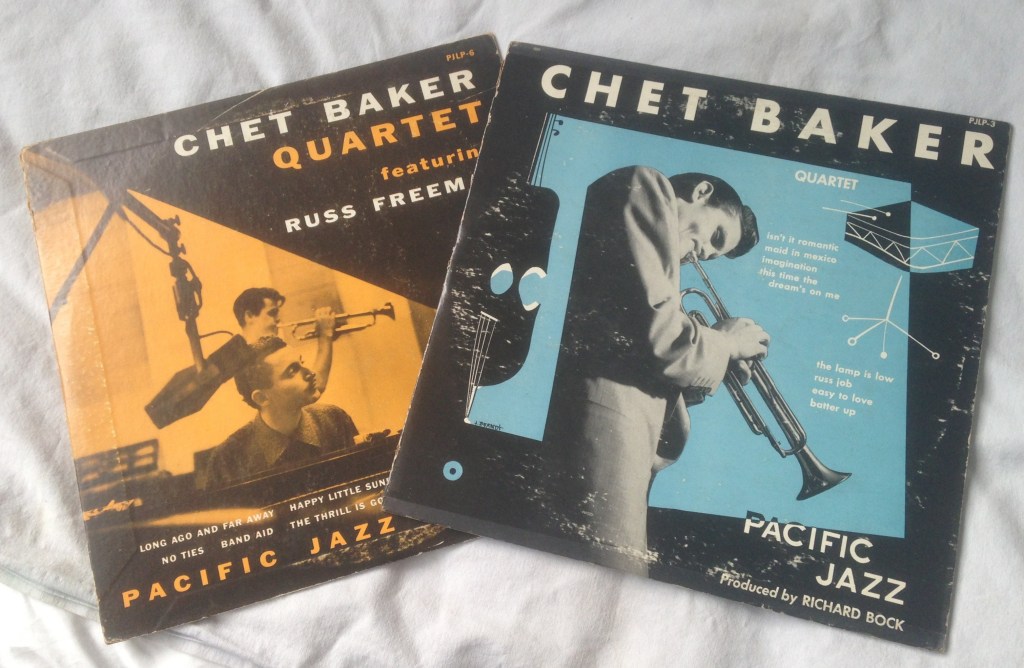
His early records — like my two treasured Pacific Jazz 10-inch albums pictured above, made 60 years ago this summer and the first to be released under his name — still sound marvellous. The mid-Fifties quartet sides with Russ Freeman on piano, whether recorded in the studio or at the Tiffany Club in Hollywood or on a fine album called Jazz at Ann Arbor, and the fascinating recordings with the ill-fated pianist Dick Twardzik, are classics, in particular the set of extraordinary compositions by Twardzik’s friend Bob Zieff which the quartet recorded for Eddy and Nicole Barclay in Paris in 1955. What is less often acknowledged is that after Baker’s comeback in 1973 there were still times when he could match and occasionally surpass the work of his younger self, becoming more than just the style icon immortalised in Bruce Weber’s documentary film Let’s Get Lost, released shortly after his death.

Three of his later albums are of special value to me. The first, Chet Baker in Paris, released in 1997 on the West Wind label, contains half a dozen tracks recorded in 1981 with the fine rhythm section of the pianist Rene Urtreger, who had known him since 1955, the bassist Pierre Michelot and the drummer Aldo Romano, playing selections from his standard repertoire — “But Not For Me”, “My Funny Valentine”, Jimmy Heath’s “For Minors Only” and Miles Davis’s “Down” — with spirit and authority.

The second may well be the best record he ever made. For Chet Baker in Tokyo, recorded 11 months before his death and released on the King label in Japan in 1993 and on Evidence in the US three years later, he is accompanied by Harold Danko (piano), Hein Van Der Geyn (bass) and John Engels (drums), a superbly empathetic rhythm section. Over the course of almost two hours, he pours out relaxed, long-lined, firm-toned improvisations of great beauty and authority, without a hint of fragility. The confidence of his double-time passages and the poise of his ballad playing are the fulfilment of every promise he ever made, providing the most telling of ripostes to the scepticism that hung around his entire career. It’s out of print now. There’s a new copy currently on Amazon for £109 and half a dozen used ones starting at £60, and I’m not entirely surprised by those prices, because it’s that good.

The third is his last formal recording, recorded in Hannover a fortnight before his death and released in 1990 by the Enja label as a 2-CD set titled The Last Great Concert: My Favourite Songs Vol I and II. Here Baker is joined by the 18-piece big band and full-scale symphony orchestra of the Nord Deutschen Rundfunk, the Hannover-based radio station, whose staff arrangers provide arrangements of familiar tunes: “Django”, “All Blues”, “My Funny Valentine”, “In Your Own Sweet Way”, “I Get Along Without You Very Well”, “Sippin’ at Bells”, “Summertime” and so on.

Baker’s own playing isn’t quite at the sublime level of his Tokyo performance, but the whole concert has a very appealing vibe to it — there are guest solos from two old Los Angeles associates, the altoist Herb Geller and the pianist Walter Norris, both then employed by the NDR — and the arrangements, if lacking the sort of character that might have been supplied by the pen of a Gil Evans or a George Russell, do the job perfectly well. We should be grateful to Kurt Giese, the ex-drummer and NDR producer who dreamed up the project, Dieter Glawischnig, the conductor, and Matthias Winckelmann of Enja, who was a student in Paris when he first saw Baker in the mid-Sixties, that the trumpeter was given this last opportunity to take advantage of such lavish resources — even though, having been fully involved in the planning, he didn’t turn up for the rehearsals.

When he did arrive, he was not in good shape. Only a few days earlier, he and his friends had been busking in the centre of Rome to raise money to pay off a dealer. An attendant at the stage door of Hannover’s Grosser Sendersaal at first refused him admission, not believing that such a disreputable-looking character could be the star of the concert. His lower teeth were giving him intense pain. But, as we can all hear, the performance was a triumph. “With every defence shattered, he lived the songs with a painful intensity,” James Gavin wrote in Deep in a Dream, his harrowing 2002 biography of the trumpeter. After the concert Baker jumped into his old Alfa Romeo and headed back to his base in Liege. Two weeks later he was dead.

The essence of Bird

Bird

It’s 25 years since I made the decision to avoid Clint Eastwood’s Charlie Parker biopic. I’d been sent the Bird album, and the discovery that the director had found it necessary to tamper with Parker’s original recordings in order to provide his film with a technically adequate soundtrack made me angry. It seemed outrageous. How could anyone find it acceptable to strip away the piano playing of John Lewis, the bass playing of Tommy Potter and the drumming of Max Roach and replace them with other musicians playing along to the sound of Parker’s alto saxophone in a modern recording studio?  Eastwood may have been motivated by a genuine desire to pay homage to a genius of modern music, but what he and the film’s musical director, Lennie Niehaus, committed was an offence against the idea that these recordings — like any jazz recordings by an ensemble, come to that — are works of collective endeavour to which each individual part makes an essential contribution. Even if the “replacement” musicians included such irreproachable bebop-era veterans as Barry Harris and Ray Brown, it was like taking the Mona Lisa and photoshopping in the Las Vegas skyline as a background instead of the Tuscan hills of the original, just because the modern digital image was sharper. Doing it for the benefit of the film was one thing; releasing the result of this tampering as the soundtrack album compounded the offence.

Earlier this week I heard Eastwood talking about the film with the singer Jamie Cullum, who is presenting a Radio 2 series called Jazz at the Movies. Cullum is one of those “celebrities” nowadays preferred by the BBC as the presenters of radio programmes on jazz, in the decidedly un-Reithian conviction that their mere presence will attract a bigger audience. Such great broadcasters as Charles Fox and Peter Clayton, men who loved jazz, knew a great deal about it, and also knew how to communicate their authority and enthusiasm, must be turning in their graves.

Needless to say, Cullum got nothing interesting out of Eastwood, least of all on the subject of the substitution of the rhythm sections on the soundtrack of Bird. (You can hear their conversation here.) It was all too easy to imagine Fox gently and politely posing a question about the seemliness of  the exercise. But, finally, it persuaded me set my old prejudice aside and watch a DVD of the film.

Like practically all biopics, it is effectively a cartoon, a simplification and an exaggeration of the real story, but not without its merits. Forest Whitaker is a wonderful actor and gives an affecting and finely nuanced performance in a demanding role, although his voice and presence (if not his physical bulk) seem a bit lightweight for Parker, who had a rich baritone speaking voice. The excellent Diane Venora plays Chan Parker, Bird’s last (common-law) wife, whose participation in the making of the film might prompt one to question the degree of objectivity with which she is portrayed. The late scene in which Parker enters a New York theatre and discovers an old rival playing rock and roll to an ecstatic audience of teenagers is a ludicrous and demeaning invention.

I was interested in the character of Audrey (played by Anna Levine), an artist with whom Parker has an affair during his visits to Los Angeles in the 1950s. She is clearly based on Julie Macdonald, who befriended the saxophonist and was with him when he received the news in March 1954 that his infant daughter Pree had died in New York, provoking a collapse that prefaced his final decline and ultimate demise 12 months later.

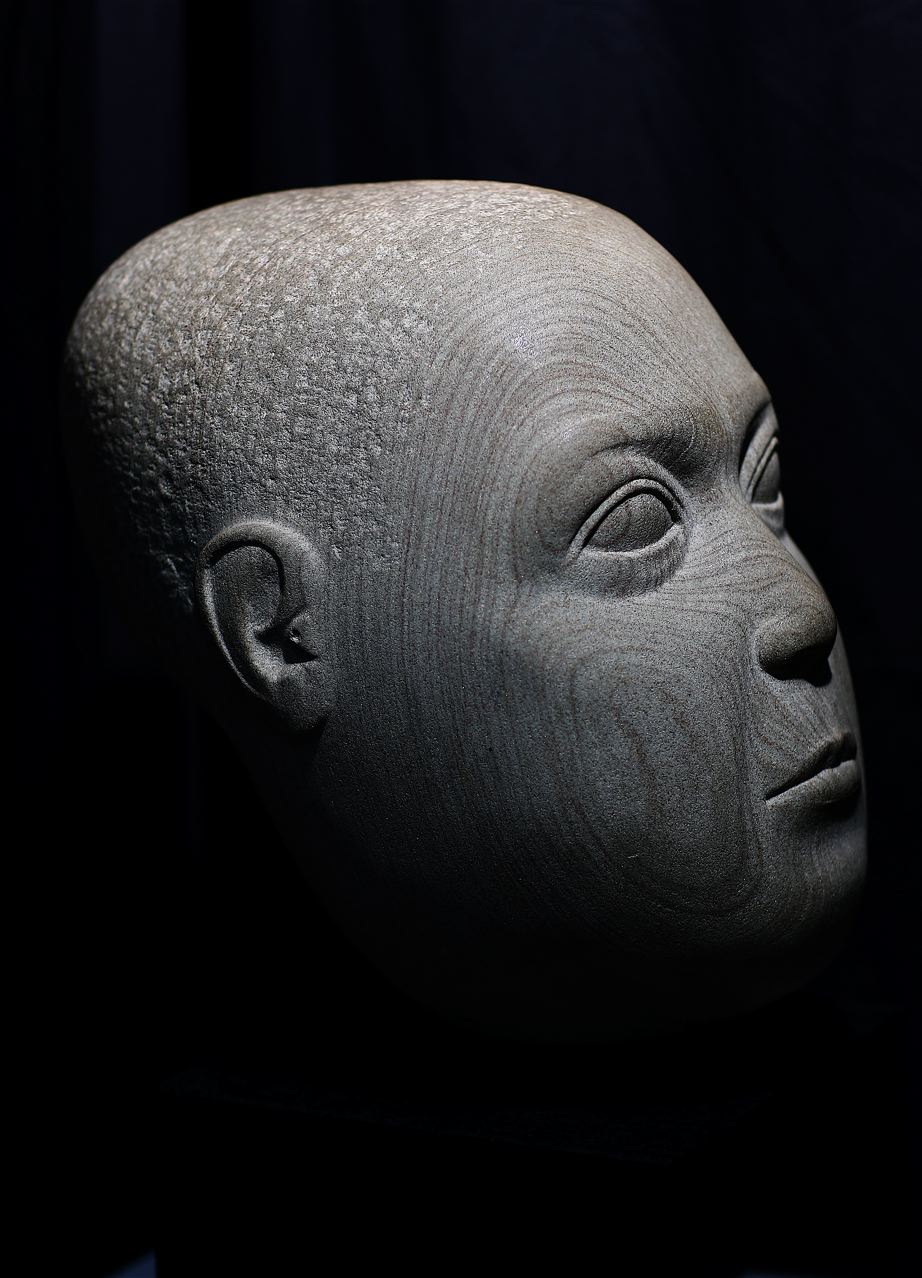
During his stays with Macdonald, they discussed art and classical music and probably much else; whatever else their relationship may have been about, this was also a meeting of minds. She produced at least two remarkable sculptures based on his likeness: one, a full-length study in lignum vitae, a dark hardwood, was last heard of in the ownership of Robert Reisner, who had promoted Parker in New York clubs; the other, pictured at the top of this piece, was carved from a piece of pale, lightly striated Pasadena sandstone and weighs 275lb. She sold it in 1961 to a California collector, apparently to raise the cash to buy a Ferrari, and it is currently in the possession of William Dickson, a retired Edinburgh architect who is now a photographer and a collector of post-war jazz artefacts and memorabilia. Three years ago I wrote a feature about the piece in the Guardian, having gone up to Scotland to see it, and it is through Dickson’s kind permission that his photograph is reproduced here. Bizarrely, given its great importance and direct relationship with such a historic figure, it has never been on public exhibition.

Macdonald took her inspiration from Egyptian heads of the 15th dynasty, which she and Parker had looked at together, and Yoruba carvings of the 14th to the 16th century. In my view she evokes more of her subject’s complex and profound essence than the director of Bird, for all his unquestionably good intentions, could capture in two and a half hours of celluloid. And I’m afraid I still can’t forgive Eastwood for erasing the sound of those great musicians with whom Parker created his masterpieces.

Yellow cocktail music

Paul WhitemanWith a handful of phrases in The Great Gatsby, F. Scott Fitzgerald lets us know that he missed his vocation: he would have made a first-class jazz critic. Consider, for example, his description of the music played by the band during the first of Jay Gatsby’s parties at the mansion on Long Island Sound attended by Nick Carraway, the book’s narrator: “The moon had risen a little higher, and floating in the Sound was a triangle of silver scales, trembling a little to the stiff, tinny drip of the banjoes on the lawn.” Wow. How many opponents of trad jazz must have wished they’d come up with the lethal precision of that “stiff, tinny drip”?

Even better is this, a couple of pages earlier: “The lights grow brighter as the earth lurches away from the sun, and now the orchestra is playing yellow cocktail music…” Yellow cocktail music! Who could not read those words and imagine exactly the sound the author had in mind, or at least its effect?

In Carraway’s words, the orchestra hired to entertain Gatsby’s guests is “no thin five-piece affair, but a whole pitful of oboes and trombones and saxophones and viols and cornets and piccolos, and high and low drums.” Not the Original Dixieland Jazz Band, then, but a more lavish ensemble very much along the lines of the outfit led in the early 1920s by Paul Whiteman, the pioneer of “symphonic jazz”.

The resemblance becomes even more marked when the orchestra leader announces: “Ladies and gentlemen, at the request of Mr Gatsby we are going to play for you Mr Vladmir Tostoff’s latest work, which attracted so much admiration at Carnegie Hall last May. If you read the papers you know there was a big sensation.” The piece, he continued, was known as “Vladmir Tostoff’s Jazz History of the World”.

If we are searching for a real-life inspiration for the fictitious Mr Tostoff, we might alight upon the figure Ferdy Grofé, a pianist and composer who met Whiteman in California in 1919 and worked closely with him until 1933. It was he who orchestrated George Gershwin’s “Rhapsody in Blue”, commissioned by Whiteman, for its concert debut at New York’s Aeolian Hall in 1924, with Gershwin himself at the piano. I still have my mother’s two-sided 12-inch 78 of their studio recording for the Victor label, released in the UK on His Master’s Voice; you can hear and see a later (and rather differently staged) performance here in an extract from the 1930 film King of Jazz.

Fitzgerald began work on Gatsby in 1922 — the year of Gershwin’s one-act opera Blue Monday, which inspired Whiteman to invite him to write a longer work — and made his final revisions in 1925, by which time “symphonic jazz” had become a part of the American music scene. Meanwhile there had been the premiere of Darius Milhaud’s much discussed La Création du Monde, another work which attempted to blend jazz and European classical music. (Milhaud, a French composer who had heard jazz during a visit to Harlem in 1922, later taught at Mills College in Oakland, California, where his pupils included Dave Brubeck and Burt Bacharach.) Grofé’s Mississippi Suite would come along in 1927, part of a phenomenon that withered in the face of critical disdain but provided a pre-echo of the Third Stream movement of the late 1950s and early 1960s.

The Great Gatsby always reminds me of Miles Davis’s Kind of Blue: no amount of mishandling can tarnish the essence of a work of 20th century art that comes as close to perfection as makes no difference. So I’m looking forward to Baz Luhrmann’s new film version, released in the UK later this month, with Leonardo di Caprio as Gatsby, Carey Mulligan as Daisy Buchanan and Tobey Maguire as Carraway, and with music by Jay Z, Beyonce, Bryan Ferry and others. After all, Shakespeare survived Luhrmann’s marvellously inventive 1996 version of Romeo & Juliet, with its gun-toting gangbangers and a soundtrack that included Garbage, the Butthole Surfers and Radiohead.

Paul Whiteman, incidentally, earned the undying disrespect of purists who correctly believed he had no right to the absurd “King of Jazz” title (bestowed by a journalist in 1919 but eagerly seized upon as a marketing slogan), at least as long as Louis Armstrong, Jelly Roll Morton, Duke Ellington and other African American innovators were around. But an unbiased listen to some of his 1920s recordings reveals a man who hired good soloists — including the cornetists Red Nichols and Bix Beiderbecke and the saxophonists Jimmy Dorsey and Frank Trumbauer — and definitely had some sort of a feeling for jazz.

As for “Vladmir Tostoff’s Jazz History of the World”, wouldn’t it be fun if some modern composer with an understanding of the period took it upon himself to imagine the piece into actual life? I’d love to hear it, tinny banjoes and all.

* The photograph of Paul Whiteman’s Ambassador Hotel Orchestra was taken in Atlantic City in 1920; the leader is on the extreme left, a violin under his arm. It is included in the booklet to the CD Paul Whiteman ‘King of Jazz’ 1920-1927, released on the Timeless Historical label.

Pasolini’s Theorem

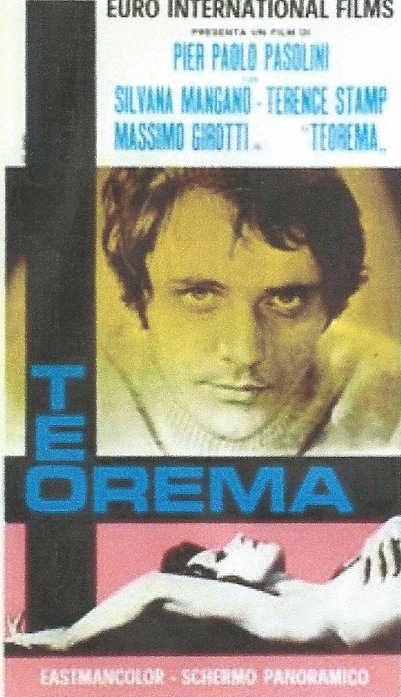
TheoremWhatever your opinion of Pier Paolo Pasolini’s Theorem, which is showing at the BFI South Bank in London over the next few weeks as part of a season devoted to the director’s work, there’s no denying the quality of its soundtrack. Mozart and Morricone are the names on the credits, and both play significant roles in Pasolini’s 1968 drama of a family whose bourgeois lives are torn apart by the passage through their household of a mysterious stranger (played by Terence Stamp).

But the first music you hear, after the newsreel-style prologue set outside the gates of a factory and over a credit sequence shot on the dusty  slopes near the crater of a volcano, is actually “Tears for Dolphy”, a beautiful ballad written by the American trumpeter Ted Curson in 1964 to mourn the passing of his friend and sometime bandmate (in Charles Mingus’s Jazz Workshop), Eric Dolphy. Mystifyingly, it’s uncredited, leading the viewer to assume that it’s by Ennio Morricone, which it certainly isn’t. It was recorded by Curson with Bill Barron (tenor saxophone), Herb Bushler (bass) and Dick Berk (drums) in the year of Dolphy’s death, and initially released a year later in Dutch Fontana’s memorable series of New Thing albums before being reissued first on Arista/Freedom label 10 years later and then by Black Lion in the mid-1990s. (It’s out of print again now, but you can hear it here.) Curson died last November, aged 77; let’s hope he saw some benefit from the use of his piece in a much studied film.

It was certainly a great choice. As I listened to it while the credits rolled last night, it brought to mind the creative use of post-bop jazz in the scores for several important European art movies in the early 1960s, such as Antonioni’s La Notte (Giorgio Gaslini) and Blow Up (Herbie Hancock) and Polanski’s Knife in the Water (Krzysztof Komeda) and Repulsion (Chico Hamilton). Elsewhere in the film, excerpts from Mozart’s Requiem are used effectively to underscore the anti-clerical aspect of Pasolini’s message, while Morricone earns his fee — and reminds us that from the age of 12 he studied composition at the Accademia Nazionale di Santa Cecilia in Rome — by providing jagged post-serialist pieces for string orchestra to accompany scenes of psychological turmoil. But it’s Ted Curson’s piece that carries the greatest emotional weight, its spare contours providing the perfect evocation of the discontents that accompanied Italy’s post-war reconstruction.