Skip to content

Posts from the ‘Jazz’ Category

Punkt postponed

Punkt 1

The news that this week’s Punkt festival in Birmingham has been postponed is no surprise. Live music of any sort in a public setting is going to be unavailable to most people for some time to come, but the loss of this two-day event will be keenly felt. As I discovered at its Norwegian home in Kristiansand last year, Punkt is a very special event, conceived by Jan Bang and Erik Honoré as a vehicle for the exploration of the possibilities of live remixing.

Among those due to perform in Birmingham were the trumpeter/singer Arve Henriksen, the guitarist Eivind Aarset, the singer Maja S. K. Ratkje, the saxophonist Trish Clowes and the drummer Mark Sanders. Also on the schedule was a live remix of The Height of the Reeds, the piece specially commissioned to accompany walks across the Humber Bridge during Hull’s year as Europe’s city of culture in 2017.

I can think of only one direct way of making up for the loss of the festival, and that’s by listening to new albums by some of the Punkt’s principal figures. Snow Catches on Her Eyelashes finds Aarset and Bang creating a series of beguiling soundscapes that feature contributions from the singer Sidsel Endresen, the trumpeter Nils Petter Molvaer, the pianist Hilde Norbakken, the percussionist Anders Engen and the bassist Audun Erlien, with Honoré making an appearance on synthesiser. Bang and Aarset specialise in making electronic music that never forfeits its humanity to science. “Before the Wedding”, featuring Norbakken, has a lyrical simplicity that is as lovely as anything you’ll hear this year.

Arve Henriksen’s The Timeless Nowhere is a box containing four vinyl LPs, each in its own sleeve, each recorded under different circumstances. Towards Language was recorded live at Kick Scene in Kristiansand during Punkt in 2017 with the basic quartet complete by Bang, Aarset and Honoré. Acousmograph is a series of overdubbed solo explorations for trumpet, vocal, keyboards and field recordings. The rapt tone poems of Captured Under Mountainsides make it a close cousin to Henriksen’s classic Places of Worship. And Cryosphere involves Bang in exquisite remixes of pieces from earlier projects.

There are many different strategies here. Henriksen’s music can morph from stateliness to pathos, from reflection to disquiet, sometimes layering contradictory states. But it feels all of a piece: a tapestry of beautiful moments woven together by a unique controlling sensibility of superlative aesthetic instincts.

Meanwhile, the chaos around us at the moment prompts all sorts of thoughts. One is that musicians are going to suffer badly from this enforced hiatus, and a way of continuing to support them is to buy their physical records. Another is this: what happens to music that was never played?

* Snow Catches on Her Eyelashes is on Jazzland Records. The Timeless Nowhere is on Rune Grammofon. The photograph — taken in Kristiansand’s cathedral, the Domkirken, last year — shows (from left) Jan Bang, Arve Henriksen, Eivind Aarset and Erik Honoré.

The state of things

Robert Cray etc 2

One characteristic of despotic governments is an urge to suppress or deride art that does not serve their own purpose; hence Hitler’s persecution of “degenerate art” and Stalin’s enthusiasm for socialist realism. We haven’t quite reached that stage, but the political role of artists of all kinds grows more important in times such as these. Here are four new recordings with something to say.

1 Robert Cray Band: “This Man”

In his excellent new album, That’s What I Heard, Cray and his producer, Steve Jordan, explore a variety of approaches with great success (for example, there’s a gorgeous version of “You’ll Want Me Back”, which Curtis Mayfield wrote for Major Lance in 1966). But one track really stands out. On “This Man” he takes a standard blues trope — a stranger arrives in the singer’s home and tries to steal his woman — and turns it to a different use. The groove is down and funky, the mood ominous. “Who is this man in our house? / Who is this man? Better get him out! / We’ve got a problem, he’s gotta go / If he don’t leave, we can’t live here no more / If we want to save our home, better get him out.” Next verse: “When I come home from work, there he is again / Talkin’ loud, talkin’ trash, and it’s always something about him…” I don’t think it’s hard to identify the connection we’re being invited to make. The refrain goes “Get him out! Get him out! Get him out!” If songs could win elections…

2 Irreversible Entanglements: Who Sent You?

As well as being probably the finest solution yet devised to the eternal problem of how to blend jazz and poetry in a way that satisfies the requirement of both, Chicago’s Irreversible Entanglements are also a great protest band. Camae Ayewa — sometimes known as Moor Mother — rivals Matana Roberts as an eloquent writer and spellbinding declaimer of poetic texts. The musicians — Aquiles Navarro (trumpet), Keir Neuringer (alto saxophone), Luke Stewart (bass) and Tcheser Holmes (drums) — bring the open lines and flexible interplay of Ornette Coleman’s classic quartet and the explicit cultural grounding of Eddie Gale’s Ghetto Music into the 21st century. Who Sent You?, the collective’s second album, presents the coolly controlled sound of an angry and insurrectionary America that will not be silenced.

3 Pat Metheny: From This Place

With “This Is Not America”, co-written with Lyle Mays and David Bowie in 1985 for the movie The Falcon and the Snowman, Pat Metheny created a piece whose resonance has grown over the intervening three and a half decades, whether you’re listening to the original or to the version by Charlie Haden’s Liberation Music Orchestra on the album Not in My Name. The undertone of his latest album, even in its most lyrical moments, is one of disquiet. The oncoming twister pictured on the cover looms as the music begins with a long, complex, multi-sectioned piece called “America Undefined”. There is wonderful playing throughout by the pianist Gwilym Simcock, the drummer Antonio Sànchez and — particularly — the marvellous bassist Linda May Han Oh, against discreet and effective orchestral arrangements on some pieces. Grégoire Maret adds lovely harmonica, and the title track features Meshell Ndegeocello singing Alison Riley’s lyric: “From this place I cannot see / Heart is dark / Beneath rising seas…”

4 Jasper Høiby: Planet B

The Danish bassist and composer probably best known for his work with Phronesis assembles a different multinational trio to tackle climate change and related social issues. The British saxophonist Josh Arcoleo and the French drummer Marc Michel are more than ready for the challenge of the exposed format, helped by the inventiveness of Høiby’s compositions and his subtle use of electronics — and by the sparing inclusion of words spoken by thinkers including Ram Dass, Grace Lee Boggs, Charles Eisenstein and Jiddu Krishnamurti. Their speech is incorporated with the lightest of touches, providing a framework within which the music speaks in its own language. “If we could truly collaborate with our fellow man,” Ram Dass says, “there would be enough to go around for the world.” Music that relies on unselfish collaboration has much to teach tyrants, actual and would-be.

* The Robert Cray Band’s That’s What I Heard is on the Thirty Tigers label. They tour the UK from April 30 to May 16, starting in Bexhill-on-Sea. Irreversible Entanglements’ Who Sent You? is on IARC/Don Giovanni. They play the Corsica Studios, London on March 10. Pat Metheny’s From This Place is on Nonesuch. Jasper Høiby’s Planet B is on Edition Records.

The lost promise of Jesse Belvin

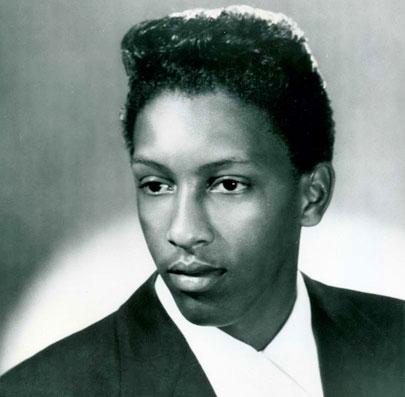
JESSEBEL-Nice15

Sixty years ago last month, the singer Jesse Belvin was travelling with his wife Jo Ann from a show in Little Rock, Arkansas, where he had performed at the city’s first integrated show, to his next engagement in Dallas, Texas, a journey of 300 miles. In the early hours of the morning they were outside Hope, Arkansas on I-30 when their driver, a friend named Charles Ford, veered into the wrong lane and ran head-on into an oncoming car. All three occupants of Belvin’s Cadillac were killed, as were those in the other car, a couple from Milwaukee.

Belvin was 27, already established as a key figure on the Los Angeles R&B scene, with a new RCA Records contract and realistic ambitions of crossing over a much wider audience. His smooth voice and musicianship allowed him to deliver a grown-up Broadway song as convincingly as a greasy teenage ballad. Had he survived, we might never have heard of Sam Cooke — who signed with RCA immediately after Belvin’s death — or Marvin Gaye, whose background and aspirations were very similar.

Born in San Antonio, Texas, Belvin had moved to South Los Angeles with his mother at the age of five. He sang in church, becoming a choir leader during his teens, before gravitating to the local doo-wop scene. At 20, he had a hand in writing “Earth Angel”, a massive hit for the Penguins and a doo-wop template. The song’s authorship was long disputed, but it seems to have had its origins in Belvin’s habit of sketching a snatch of a song and passing it on for other hands to complete. He may even have written the whole thing. The Fiestas’ “So Fine” was his, even though it’s usually credited to Johnny Otis, as was “Dream Girl”, a hit for Belvin in 1952 when recorded for one of the small labels run by the Hollywood record store owner John Dolphin.

He had also joined the band of the popular tenor saxophonist Big Jay McNeely, who had put together a vocal group — three men and one woman — called Three Dots and a Dash . Leaving McNeely in 1953, he re-recorded “Dream Girl” as a duo with Marvin Phillips, a fellow Dot, for Art Rupe’s Specialty label; released under the names of Jesse and Marvin, the song enjoyed even better sales. That success, however, was temporarily derailed by a draft notice.

Two years later, on returning home from army service, he resumed his activities within the LA scene, working with a variety of vocal groups, including the Feathers, the Chargers, the Cliques and the Sheiks, and alongside such ambitious young men as Johnny “Guitar” Watson, Charles Wright and his cousin Tony “Nite Owl” Allen. A set of demos recorded the ’50s show a mastery of a variety of R&B styles to match that of his LA contemporary Richard Berry, the versatile composer of “Louie Louie”.

Late in 1956 he recorded another doo-wop ballad, the gorgeous “Goodnight My Love (Pleasant Dreams)”, for the Bihari brothers’ Modern Records. George Motola had written the outline of the song, but invited Belvin to add a middle eight and polish it up. Declining a credit, Jesse asked instead for $400 — which was provided, in exchange for half the song’s copyright, by another songwriter, John Marascalo. Featured every night as the closing music to Alan Freed’s radio show, it became a long-lasting favourite.

In 1958 he was signed to RCA by the jazz trumpeter and bandleader Shorty Rogers, then in charge of the label’s West Coast A&R department. This was his break, giving access to big budgets and big promotion, with the eye on the audience captured by Nat King Cole. His first album, Just Jesse Belvin, featured rather anonymous MOR arrangements by Ray Martin and Dennis Farnon on songs like “My Funny Valentine” and “Secret Love”. His version of “Volare” was released as a single; not his finest hour, it fared poorly in competition with Domenico Modugno and Dean Martin.

Shorty Rogers put the great Marty Paich in charge of the arrangements for his second album, giving the singer more stimulating settings and a band including such jazz greats as the trumpeters Conte Candoli and Jack Sheldon, the alto saxophonist Art Pepper, the pianist Russ Freeman and the drummer Mel Lewis. The album was titled Mr Easy, and its versions of “What’s New” and “Angel Eyes” stand comparison with the best ballad singers of the era. In this environment Belvin showed immaculate control of his suave tenor voice and a beautifully understated gift for phrasing a line.

I was exaggerating, of course, when I suggested that we’d never have heard of Sam Cooke or Marvin Gaye. But were you to spend a day with Belvin’s legacy, recorded between 1952 and 1959, you might agree that this was an artist of prodigious quality who, until fate struck, was on course for a great career. And there’s no telling where it might have led.

* Jesse Belvin’s recordings are collected on The Blues Balladeer (Specialty); Goodnight My Love (Ace); a fascinating album of unreleased 1958 demos titled So Fine (Night Train); and Guess Who: The RCA Victor Recordings (Ace), which includes Just Jesse Belvin and Mr Easy. The latter is also available coupled on a single CD with Ethel Azama’s Cool Heat on the Fresh Sound label. Much of the information in the above post is gleaned from sleeve notes by Steve Propes, Ray Topping, Jim Dawson and Tony Rounce, whose ischolarship is gratefully acknowledged.

Jon Christensen 1943-2020

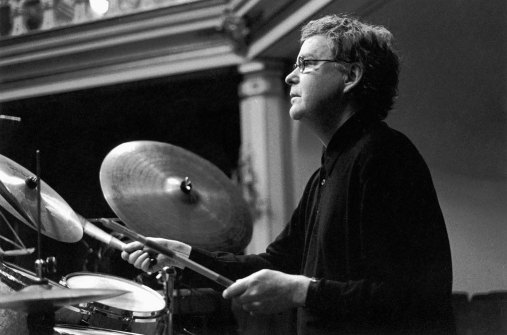
JonChristensen

On two occasions I was fortunate enough to be in very close proximity to the playing of the Norwegian drummer Jon Christensen, who has died at the age of 76 after a distinguished career that included collaborations with Keith Jarrett, Charles Lloyd, George Russell, Bobo Stenson, Jan Garbarek, Tomasz Stanko and many others, most of them gathered under the ECM umbrella.

The first occasion came around 25 years ago when Stenson’s trio, with Anders Jormin on bass, played the Pizza Express. It was with this group — which can be heard on the albums Serenity (1998) and War Orphans (2000) — that Christensen showed how he had added something of Billy Higgins’s lift and swing to the colouristic approach pioneered by Paul Motian. His wonderful subtlety was also evident on the second occasion, at the Jazzahead! festival in Bremen five years ago, when he played with the guitarist Jakob Bro and the bassist Thomas Morgan, two musicians of matching depth and transparency.

He was a master of sticks, mallets and brushes. For Bro, Morgan, Stenson, Jormin and any of the countless other improvisers with whom he played over the decades, I can’t imagine there were many better gifts than the knowledge that you’d be sharing a bandstand with a musician of such profound sensitivity.

* The photograph of Jon Christensen is © Roberto Masotti / ECM Records.

ECM in London

Craig Taborn at RAM

No apologies for returning, one last time, to the continuing celebrations of ECM’s 50th anniversary. For a short festival at the Royal Academy of Music, the director of the jazz programme, Nick Smart, invited several of the label’s luminaries — the bassist Anders Jormin, the pianists Craig Taborn and Kit Downes, the singer Norma Winstone and the saxophonist Evan Parker — to spend a week working with students before presenting the results in two public concerts on Thursday and Friday night.

Jormin’s compositions — very much what many people would think of as archetypal ECM music, with a restrained lyricism that seemed to have its deepest roots in Nordic folk music — were played by a septet notable for the outstanding singing of Ella Hohnen-Ford and Alma Naidu. Downes and his colleagues in the trio called ENEMY, the bassist Petter Eldh and the drummer James Maddren, enhanced their tricky compositions with arrangements for string quartet, three woodwind and two percussionists, of which the most successful were “Last Leviathan”, a piece from Downes’s ECM debut, Obsidian, fetchingly rearranged for strings and piano, and Eldh’s eventful “Prospect of K”, cunningly scored by Ole Morten Vågan.

For the festival’s closing set, Smart led the Academy big band through a sequence of rare and unheard compositions by the late Kenny Wheeler, another ECM stalwart, featuring Winstone, Parker and Stan Sulzmann. The juxtaposition of the two tenors of Parker and Sulzmann created a contrast that exemplified the breadth of Wheeler’s conception — although their thunder was almost stolen by the alto saxophone of Lewis Sallows, a student whose long solo displayed a disinclination to plump for stylistic orthodoxy and a powerfully dramatic imagination. The crisp and flexible drumming of Ed Richardson, an Academy graduate, also took the ear.

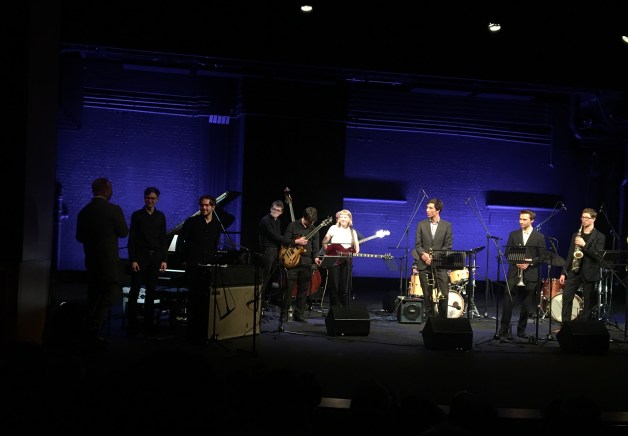
Twenty four hours earlier, Sallows had also been part of the 12-piece band (pictured above) which provided the festival’s highlight. Craig Taborn is already known as one of the most creative and original pianists of the current era; those who were present at the Vortex for his solo gig last year speak of it in awed tones. Friday’s set showed him to rank alongside Steve Lehman, Vijay Iyer, Mary Halvorson and Eve Risser as an adventurous composer-leader who knows how to exploit the resources of a larger ensemble while retaining all the spontaneous interaction of a small group.

Although this was music of great sophistication, there were times when its sheer fire put me in mind of those great Mingus units of the late ’50s and early ’60s, when the members of the Jazz Workshop learnt their parts by ear and took it from there. The trombonist Joel Knee, the trumpeter Laurence Wilkins and the two altoists, Sallows and Sean Payne, threw themselves into the project with enormous skill and gusto, and the ear was also taken by the guitarist Rosie Frater-Taylor, whose opening solo was strikingly thoughtful and who made significant contributions to the riff-ostinatos on which several of the pieces were built.

Taborn’s own solos on acoustic and Fender-Rhodes pianos demonstrated his gift for gathering all the energy once associated with Cecil Taylor and using it to activate the coiled springs of his own imagination. During an unaccompanied introduction, he made the Rhodes roar in a way that completely divested the instrument of its familiar role as a provider of a cool funky background sound. It was one of many moments, individual and collective, that made the event such a success.

Big bands at the Vortex

Calum Gourlay 3

A big band in a small club can be a thrilling experience. The Scottish bass player and composer Calum Gourlay has been playing a monthly gig at the Vortex with his large ensemble for four years now, and last night I finally got around to acting on the advice I’d been getting to check them out. My informants were correct: Gourlay’s band has not only youth and enthusiasm on its side but also a powerful character of its own.

Three trumpets, three trombones, five saxophones, piano, double bass and drums, all arrayed in the conventional style; this is a mainstream-modern band with no fashionable touches. The originality comes from within, which is the usually best place. And in this case it comes from the way Gourlay’s compositions set up his array of fine soloists.

This isn’t surprising, since Duke Ellington is one of his models — and no one ever knew how to write for a band full of soloists like Ellington. Unless it was Charles Mingus, of course, and I felt I heard a lot of Mingus in this band’s freewheeling spirit, not just because the leadership comes from the man with the bass.

He kicked off with “Evening”, a 6/8 tune featuring a take-no-prisoners tenor solo from Riley Stone-Lonergan. “Blue Fugates of Kentucky”, contrasting boppish unison riffs with brief passages of mayhem, contained one of the solos of the night, in which the altoist Alice Leggett tied together slurs, stutters and triple-time flourishes with an impressive sense of architecture. “Ro” showed off Gourlay’s sense of humour and love of sudden dynamic contrasts, and set up an effective skirl behind Kieron McLeod’s forceful trombone solo. The slow, wandering “Solstice” became a feature for James Allsopp’s content-rich baritone improvisation, and the set closed with Tom Rideout’s Shorterish tenor on “New Ears”.

Not everyone writing for big bands realises that you might have three trumpets and three trombones, but you don’t have to use them all the time. It was apparent that Gourlay loves to mix and match elements within the horns, rather as Ellington and Gil Evans did, making couple of passages of straightforward writing for the reed section all the more exhilarating for the contrast they provided.

The second set was an even more impressive demonstration of Gourlay’s skill at creating landscapes for individual soloists. On two pieces by other composers, he employed the tactic of giving the improviser space to say her/his piece, then bring them back for the coda. On a fascinatingly radical recasting of Monk’s “Pannonica” the solo voice was Laura Jurd’s trumpet; on a startlingly different arrangement of Coltrane’s “Naima” it was Stone-Lonergan. Other original compositions featured fine solos from the pianist Alcyona Mick, the trumpeters James Davidson and Sean Gibbs, and the trombonist Owen Dawson. Dave Ingamells was the alert and propulsive drummer.

Davidson and Mick were also featured in another big band gig at the Vortex a week or so earlier, this one celebrating what would have been the 90th birthday of Kenny Wheeler, who died in 2014. Scott Stroman directed the London Jazz Orchestra — of which Wheeler was an early member almost 30 years ago — through the great Canadian’s charts, filled with glowing brass chorales. There were fine solos from Henry Lowther and André Cannière on trumpets, Martin Speake and Pete Hurt on altos, Matt Sulzmann and Tori Freestone on tenors and Stuart Hall on guitar, all urged on by Alec Dankworth on bass and Paul Clarvis on drums.

The second half was taken up by “Sweet Time Suite”, the extended work featured on Wheeler’s classic Music for Large and Small Ensembles, released 30 years ago by ECM. The singer Brigitte Beraha took the role originally performed by Norma Winstone of the lead voice in the flaring ensembles that filled the room with Kenny’s unique lyricism.

* Calum Gourlay has a new quartet album out on the Ubuntu label. Called New Ears, it contains stripped-down versions of several pieces from the big band’s repertoire and features McLeod on trombone, Helena Kay on tenor and James Maddren on drums. It’s highly recommended.

Visions of the abstract

Evan P in Vilnius

The news of the death of the photographer Jak Kilby has saddened all those who called him a friend. I met him in 1969, when he was a year or two into his work of chronicling a section of London’s jazz scene bracketed by two bands: the Spontaneous Music Ensemble and Chris McGregor’s Blue Notes. That lasted through ’70s and into the ’80s, resulting in a valuable record of the work of musicians such as John Stevens, Trevor Watts, Dudu Pukwana, Louis Moholo and many others.

Jak was a warm, kind man, and he was close to the musicians. He shared houses with some of them and drove them to their gigs in, as Trevor Watts told me, a series of vehicles that invariably broke down. He loved the music — and that was how it was always known: the music — because, I think, of its human qualities and a spirituality that was inherent even in the playing of those who did not think of themselves in such terms. (Later he converted to Islam, adopting the name Muhsin, and moved to Malaysia, the base from which he travelled to explore the Muslim world.)

Since the news came through I’ve been listening to a new CD by the saxophonist Evan Parker, the bassist Barry Guy and the drummer Paul Lytton: three musicians regularly captured by Jak’s camera in his early years on the scene. It’s called Concert in Vilnius and was recorded in the Lithuanian capital in October 2017, making it the fruit of almost half a century of collaborations.

Starting out when jazz-based free improvisation was in its infancy, each of them achieved a great deal in terms of expanding the vocabulary of their instruments, which was always part of the project. Now we can listen to them expressing all the wisdom and confidence of their maturity in a language — individual and collective — that they created.

Of the four pieces that make up almost an hour of music, perhaps the most ear-popping is Part III, which opens with a prodigious solo by Guy, using many different resources to make his bass sound like a regiment. It moves into a passage of astonishingly detailed and dynamic percussion/bass dialogue, and then reaches full trio-sized fruition with the arrival of Parker, who unfurls one of his most astonishing tenor improvisations, moving from brusque lyricism to those mind-bending skirls that seem to exist in two or three adjacent dimensions.

The idiom may be half a century old, but it will never be an easy-listening experience; it demands attention and commitment from the listener as well as from the player. What Jak Kilby and other lovers of free improvisation recognised early on is how risk is answered by reward to a degree unavailable in any other kind of music. In those moments it can reach the sublime, touch the infinite.

* Concert in Vilnius is released on a Lithuanian label called NoBusiness Records. The photograph of Guy, Lytton and Parker is from the CD insert and was taken by Vytautas Suslavičius.

ECM at 50

manfred-eicher

By the end of the 1960s, jazz had gone right out of fashion. If it was by no means dead in creative terms, it was no longer good business for the music industry. So the arrival of a new jazz record label was quite an event, which is why I can remember quite clearly the first package from ECM arriving on my desk at the Melody Maker‘s offices in Fleet Street, and opening it to extract Mal Waldron’s Free at Last. I knew about Waldron from his work with Charles Mingus, Eric Dolphy and others. But an album from the pianist, recorded in Europe and packaged with unusual care on an unfamiliar label based in Munich, came as a surprise.

Pretty soon it was followed by Paul Bley with Gary Peacock, and then by Marion Brown’s Afternoon of a Georgia Faun. Before 1970 was out further packages had included an album by the Music Improvisation Company (with Evan Parker and Hugh Davies) and Jan Garbarek (Afric Pepperbird). It became obvious that something special was happening under the aegis of ECM’s founder, Manfred Eicher.

I guess it was in 1971, with solo piano albums from Chick Corea and Keith Jarrett, Terje Rypdal’s first album and two albums of duos teaming Dave Holland with Barre Phillips and Derek Bailey, that the label’s character really became clear. Eicher stood for jazz with a high intellectual content, saw no reason to privilege American musicians over their European counterparts, and set his own high standards in studio production and album artwork. All these things — particularly his fondness for adding a halo of reverb to the sound of acoustic instruments, inspired by how music sounded in churches and cathedrals — were eventually turned against him by the label’s critics. The sheer volume of great music produced over the past 50 years is the only counter-argument he ever needed. His greatest achievement has been to make us listen harder, deeper and wider.

ECM’s golden jubilee is being marked by events around the world. On January 30 and February 1 there will be a celebration over two nights at the Royal Academy of Music in London, featuring the pianists Craig Taborn and Kit Downes, the bassist and composer Anders Jormin and the Academy’s big band playing the music of Kenny Wheeler with guests Norma Winstone, Evan Parker and Stan Sulzmann. I thought I’d add to the festivities by choosing 20 ECM albums that have made a particularly strong impression on me since that first package dropped on my desk half a century ago; they’re listed in chronological order. Although there are many other contenders, I stopped at 19; the 20th is for you to nominate.

1 Terje Rypdal: Terje Rypdal (1971) The guitarist’s debut was an early sign of Eicher’s determination to capture and promote the new sounds coming from northern Europe, and from Norway in particular. Rypdal was one of the first to present himself as a wholly original voice.

2 Paul Bley: Open, to Love (1972) For my money, the finest of ECM’s early solo piano recitals, with Bley examining compositions by Carla Bley (“Ida Lupino”), Annette Peacock (“Nothing Ever Was, Anyway”) and himself.

3 Old and New Dreams: Old and New Dreams (1979) Don Cherry, one of Eicher’s favourites, is joined by Dewey Redman, Charlie Haden and Ed Blackwell in this homage to the music of their former colleague, Ornette Coleman. The 12-minute “Lonely Woman” is astonishingly lovely.

4 Leo Smith: Divine Love (1979) The trumpeter and composer Wadada Leo Smith was among the squadron of American innovators who arrived in Europe at the end of the ’60s and whose influence gradually became apparent in the ECM catalogue. Divine Love is a classic.

5 Bengt Berger: Bitter Funeral Beer (1981) A Swedish ethnomusicologist, composer and percussionist, Berger put together a 13-piece band — Don Cherry being the only famous name — to record this strange and compelling multicultural mixture of jazz and ritual music.

6 Charlie Haden / Carla Bley: Ballad of the Fallen (1983) Fourteen years after the historic Liberation Music Orchestra, Haden and Bley reunited for a second studio album featuring music of resistance.

7 John Surman: Withholding Pattern (1985) A solo album in which Surman developed his skill at overdubbing soprano and baritone saxophones, piano and synths, this opens with “Doxology”, in which Oslo’s Rainbow studio is turned into an English church.

8 Bill Frisell: Lookout for Hope (1988) One of several guitarists whose careers were nurtured at ECM, Frisell recorded this with a lovely quartet — Hank Roberts (cello), Kermit Driscoll (bass) and Joey Baron (drums) — before moving on.

9 Keith Jarrett Trio: The Cure (1991) Includes an eight-minute version of “Blame It on My Youth” in which Jarrett, Gary Peacock and Jack DeJohnette achieve perfection, no matter how many times I listen to it in search of flaws.

10 Kenny Wheeler: Angel Song (1996) In a dream line-up, the Canadian trumpeter is joined by the alto of Lee Konitz, the guitar of Bill Frisell and the bass of Dave Holland.

11 Tomasz Stanko: Litania (1997) The Polish trumpeter interprets the compositions of his compatriot and sometime colleague Krzysztof Komeda. A wonderful group features the saxophonists Joakim Milder and Bernt Rosengren, with a core ECM trio — Bobo Stenson (piano), Palle Danielsen (bass) and Jon Christensen (drums) — as the rhythm section plus Terje Rypdal’s guitar on two of the tunes.

12 Trygve Seim: Different Rivers (2000) Most ECM music is for small groups, but here the Norwegian saxophonist and composer permutates 13 musicians in an exploration of subtle textures and gestures. The great trumpeter Arve Henriksen is among the soloists.

13 Manu Katché: Neighbourhood (2005) Ever listened to Herbie Hancock’s “Maiden Voyage” and wished there had been more post-bop jazz with that kind of relaxed intensity and melodic richness? Here it is. Tomasz Stanko and Jan Garbarek are the horns, Marcin Wasilewski and Slawomir Kurkiewicz the pianist and bassist.

14 Masabumi Kikuchi: Sunrise (2012) Kikuchi, who was born in Tokyo in 1939 and died in upstate New York in 2015, was a pianist of exquisite touch, great sensitivity and real  originality: a natural fit with Eicher, who recorded him with the veteran drummer Paul Motian and the quietly astounding bassist Thomas Morgan.

15 Nik Bärtsch’s Ronin: Live (2012) The label that released Steve Reich’s Music for 18 Musicians in 1978 is the perfect home for the group led by the Swiss pianist and composer, who explores the spaces between minimalist repetition and ecstatic groove, between gridlike structures and joyful improvisation.

16 Giovanni Guidi: This Is the Day (2015) With equal creative contributions from Thomas Morgan and the drummer João Lobo, the young Italian master leads a piano trio for the 21st century: always demanding close attention but never short of refined lyricism.

17 Michel Benita + Ethics: River Silver (2016) Led by an Algerian bassist, a quintet including a Japanese koto player (Mieko Miyazaki), a Swiss flugelhornist (Matthieu Michel), a Norwegian guitarist (Eivind Aarset) and a French drummer (Philippe Garcia) create music that incarnates the ECM ideal of reflective, frontierless beauty.

18 Roscoe Mitchell: Bells for the South Side (2017) A double album recorded live in Chicago in 2015, featuring Mitchell with four trios — including the trumpeter Hugh Ragin and the percussionist Tyshawn Sorey — who finally come together in a memorable celebration of the legacy of the Art Ensemble of Chicago.

19 Vijay Iyer Sextet: Far From Over (2017) Knotty but exhilarating compositions, solos packed with substance from Graham Haynes (cornet), Steve Lehman (alto) and Mark Shim (tenor): a statement of the art as it moves forward today.

20

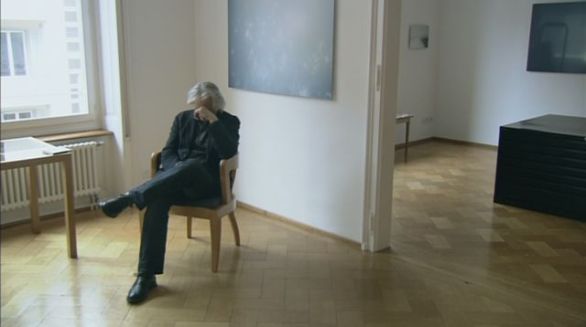
* The photograph is a still from the 2011 film Sounds and Silence: Travels with Manfred Eicher, by Peter Guyer and Norbert Wiedmer. There’s a chapter containing further thoughts on ECM’s place in the evolution of modern music in my book The Blue Moment: Miles Davis and the Remaking of Modern Music, published in 2009 by Faber & Faber.

Namysłoswki at Café POSK

Namyslowski poster

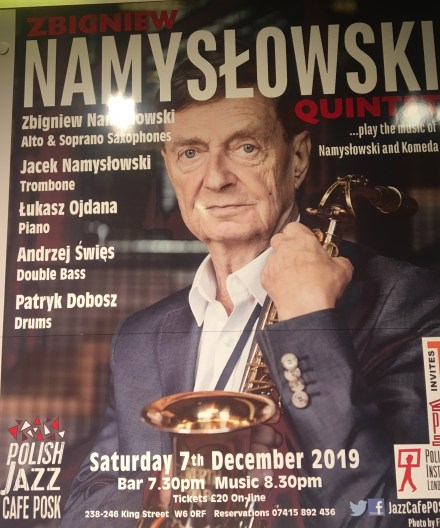
There was quite a stir when Zbigniew Namysłowski arrived in England with his quartet in 1964. He and his musicians were the first of their kind to come here from behind the Iron Curtain; they were young and adventurous, and made quite an impression with their performances at the the Marquee and other places around the country. The producer Mike Vernon took them into Decca’s studios to record an album titled Lola, which showed them to be capable of blending an interest in John Coltrane with a loyalty to the folk melodies of their native Poland. It was an early sign that European jazz could develop its own distinctive range of flavours, and it still sounds good today. Fifty years later Namysłowski’s career provided the inspiration for the male lead in Paweł Pawlikowski’s wonderful Oscar-winning film Ida.

Last night he returned to Britain with a quintet to play a concert divided between his own compositions and those of Krzysztof Komeda, with whom he played in the mid-’60s, mostly notably on the album Astigmatic, alongside the great trumpeter Tomasz Stanko. The venue was the Jazz Café POSK in the basement of the Polish cultural centre on King Street in Hammersmith, which ensured not only decent sound but a large, warm and attentive audience.

Playing alto and sopranino saxophones, Namysłowski was joined by his son Jacek on trombone, Łukasz Ojdana on piano, Andresz Święs on double bass and Patryk Dobosz on drums. The two horns played while seated throughout, which seemed less a concession to the leader’s age — he turned 80 in September — than a hint of the relaxed mood that pervaded the group’s beautifully controlled version of post-bop jazz.

Komeda’s tunes came first, including “Ballad for Bernt” from the soundtrack to Polanski’s Knife in the Water, “Svantetic” and “Kattorna” from Astigmatic, and the less familiar theme from Skolimowski’s Le Départ. By the time the interval arrived, it was clear that we were in the presence of a complete unit of first-rate improvisers: each musician had something to say every time they were called on, and all were so good that you wouldn’t want to single out any of them.

In the second half Namysłowski gave us a string of his own fine and strongly lyrical pieces, including “Jasmine Lady”, “Western Ballad” and “Kujaviak Goes Funky”, some of which re-emphasised his longstanding ability to make 5/4 and 7/4 swing effortlessly. His solos showed that while his tone may have lost some of its youthful tartness, he is in no danger of running short of ideas. In this unusual but highly effective alto-trombone front line (offhand, I can only think recall Mingus’s The Clown as a precedent), his son proved the ideal foil.

Finally, in response to ardent applause, they gave us an encore of Komeda’s gentle theme from Rosemary’s Baby: a gorgeous piece, exquisitely rearranged, demonstrating the effectiveness of short solos when deployed within an imaginative frame, and closing a thoroughly memorable evening.

Joe Pesci sings again

the-irishman-robert-de-niro-joe-pesci-social

In New Jersey sometime in the late 1950s, according to legend, Joe Pesci introduced his friend Frankie Valli to the young songwriter Bob Gaudio, a meeting that gave the Four Seasons their career. Pesci’s own singing career never reached such heights. His fame came from elsewhere, mostly from the terrifying “Do I amuse you?” scene with Ray Liotta in Goodfellas.

If you’ve seen The Irishman, you’ll know that Pesci, on his emergence from a 20-year screen hiatus, steals the film: he sets its temperature and provides its emotional core, without raising his voice once. He has also taken the opportunity to revive a recording career which hitherto produced only two albums: Little Joe Sure Can Sing! in 1968 and Vincent LaGuardia Gambino Sings Just For You — performing as his character from My Cousin Vinny — in 1998.

Pesci… Still Singing sees a return to his first love: singing ballads in the piercing, often anguished style of the late, great jazz-lounge maestro Jimmy Scott. Three years ago I wrote about Pesci’s appearance on two tracks of Scott’s posthumously released album, I Go Back Home. One of those duets, on “The Nearness of You”, reappears here. There are also two pleasant collaborations with Maroon 5’s Adam Levine on a suave “My Cherie Amour” and the cha-cha groove of “Baby Girl”. Otherwise Pesci’s high, soulful voice is alone with a bunch of orchestral arrangements which are lavishly appointed but never to the extent that they turn the music into mush. Anyone with a fondness for the work of Nelson Riddle will appreciate the use of cor anglais on “Falling in Love Is Wonderful”, while space is made for fine trumpet, tenor and guitar solos, and the playing of the rhythm section is beautifully supportive. Only a melodramatic “Exodus” goes over the top.

I wish I could credit the arranger and the musicians properly, but the curse of streaming — the only way this album is currently available — is that you have to do without the sort of information that listeners of earlier generations depended on as we joined the dots in our quest for musical knowledge. Maybe eventually there’ll be a physical manifestation of Pesci… Still Singing, on which these mysteries will be solved and credit properly apportioned. (Since first posting this I’ve been told that the personnel — on some tracks, at least — includes the pianist Kenny Barron, the guitarists Pat Martino and Vinnie Corrao, the bassist Christian McBride and the drummer Lewis Nash, which explains a lot.)

What I can tell you for certain is that Pesci sings with an exemplary attention to meaning, phrasing and tone. He treats some fine songs — “The Folks Who Live on the Hill”, “If I Should Lose You”, “Round Midnight”, “In My Solitude”, “I’ll Be Seeing You” and so on — with the necessary respect, and they repay his courtesy. This is an album made with love. And to those who don’t get the point: it’s entirely your loss.

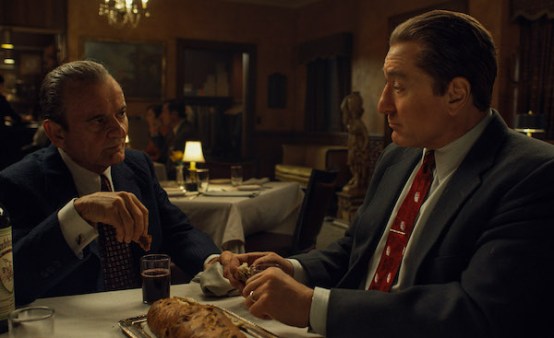
* I streamed Pesci… Still Singing from Amazon Music, at a cost of £7.99. The photograph above is a still from The Irishman, with Joe Pesci as Russell Bufalino and Robert De Niro as Frank Sheeran.