Skip to content

Posts from the ‘Jazz’ Category

Ronin at Ronnie’s

Nik Bärtsch’s Ronin at Ronnie Scott’s (photo: Robert Crowley)

Somewhere between an “oh!” and an “ow!”, the abrupt vocal command with which Nik Bärtsch cues his musicians for a shift in musical pattern is the polite zen-funk equivalent of James Brown’s exhortation to take it to the bridge. The reaction is immediate, the players switching from one polyrhythmic cell to another in perfect unison, reframing not just the abstract geometry of metre and tempo but the weight, tone and landscape of the music.

If you own any of the Swiss pianist-composer’s albums, on ECM or his own Ronin Rhythm label, you’ll know that his pieces all go under the bland title “Modul”: “Modul 17”, “Modul 44”, “Modul 55” and so on. I find it rather refreshing not to be primed to think about whether or not a particular piece is a successful portrayal of a nightingale singing in Soho Square. You can just get on and listen to the notes, free from baggage.

But although it may be programmed, there is nothing cold about it. Bärtsch’s music is sometimes attached to such categories and minimalism and systems music, but it’s too abundant to qualify for the former and too warm-blooded for the latter. Any superficial impression of austerity is profoundly misleading. To hear one of his bands live is to share an audience involvement that expresses itself at the end of each long and intense set in a roar of pure exhilaration.

That’s what happened when Bärtsch returned to Ronnie Scott’s Club last week with Ronin, currently a quartet with Jeremias Keller, a relative newcomer on bass guitar, joining the stalwarts Kaspar Rast on drums and Sha on bass clarinet and alto saxophone. Ronin was assembled in 2001 and plays every Monday night at Exil, Bärtsch’s club in Zurich, its members applying their virtuosity to perfecting what their leader calls “ritual groove music”.

I’ve heard Bärtsch’s music in several environments: with Ronin in churches in London and Bremen, solo (with a light artist) at the Barbican, with a horn section at Kings Place and with the Frankfurt Radio big band, orchestated by Jim McNeely, in Berlin. In the set I heard at Ronnie’s, they played the six pieces from their latest ECM album, Awase, blended together into two long sequences, plus an encore. Compared to those earlier performances, this sounded mellower, less edge-of-the-seat, a little more lyrical and reflective, particularly in something like the swooning chordal descent of one section of “Modul 36”.

Even in its gentler moments, however, it was still imbued with that characteristic sense of coiling and uncoiling while still held in tension. And the quality of the playing of all four was extraordinary, with Bärtsch delving into the grand piano’s innards to pluck, strum and damp strings, occasionally striking its frame with a stick, the devoted Sha in the role of Jimmy Lyons to his Cecil Taylor, Rast tireless in nailing down the complex metres and displaced beats, and Keller’s alertness and agility fitting in so well that he might have been with them since the beginning rather than a mere three years.

It was great to see a big crowd assembled to hear this music. Of course the majority of the audience knew exactly what they had come for and received their reward. But also it was interesting to watch the more casual type of customer, the sort who basically turn up for a night at a famous jazz club, as their initial scepticism turned to curiosity and then to intrigue and ultimately to delight, shared with the rest of us.

Summer books 1: Henry Threadgill

As a primer on how to grow up amid communities of creative musicians while asserting and developing your own individuality, Henry Threadgill’s Easily Slip into Another World is exemplary. It also happens to belong, in my view, in the very highest rank of autobiographies by jazz musicians.

One of the great contemporary composers and bandleaders, Threadgill grew up amid the blues, the jazz and the black church music of Chicago in the 1950s, but with an ear open to European classical music. He’s old enough to remember the impact of the lynching of Emmett Till in 1955. Hearing the recordings of Charlie Parker made him want to play the saxophone.

He may be the only Chicago musician of his era to benefit from not having studied under Captain Walter Dyett, the venerated director of music at DuSable High School on the city’s South Side. Threadgill was enrolled at Englewood High, where he played in the school’s concert band but was constantly in trouble. Knowing that Dyett had taught so many of the people he really admired, such as Gene Ammons, Johnny Griffin and Wilbur Ware, he applied for a transfer. Dyett looked at his disciplinary record and turned him down flat. When Englewood let him back in, he resolved to change his ways. I suppose the clearest proof of his success came in 2016, when he became the third jazz musician (after Wynton Marsalis in 1997 and Ornette Coleman in 2005) to receive the Pulitzer Prize for Music, for his composition In for a Penny, In for a Pound.

“Being rejected is the best thing that can happen to you, if you know how to think laterally,” he observes. “I ended up getting a much broader and deeper education.” The scope and volume of his work over the years is astonishing. Many musicians would have made an entire career merely out of the projects he undertook with dancers. Others would have invented the hubkaphone, as he did in 1970 after seeing a display of shiny chrome car hubcaps laid out on a stall in the famous Maxwell Street market, and settled for renown as the creator of the American version of the gamelan orchestra.

He could have pursued a life as an R&B musician, after touring with the Dells and the Chi-Lites in the ’70s, or in Latin music after working with the trumpeter Mario Bauzá in New York. He could even have stayed safely within the circle of Chicago’s AACM. Instead he formed one band after another, following the instinct to push things further. The trio Air, with the bassist Fred Hopkins and the drummer Steve McCall, was followed by many, many others, usually with unorthodox line-ups (e.g. four reeds and four double basses) and sometimes with strange names, such as X-75, Very Very Circus, Zooid and the 14 or 15 Kestra. (Oddly, his latest album, titled The Other One, is by something called the Henry Threadgill Ensemble.)

With the aid of the writer and academic Brent Hayes Edwards, Threadgill tells his story at a relaxed pace and with a depth of detail that is always compelling and never tiresome. The Vietnam section is a serious addition to the literature on that terrible war, from an unusual perspective: about drafted in 1966, thinking he’d done a smart thing by volunteering as a musician, a year later he was the Central; Highlands with his clarinet in one hand and a rifle in the other, encountering the Montagnards and experiencing the African American version of the horror and squalor familiar to some extent from Michael Herr’s Dispatches but here described with even greater clarity and revulsion. “I didn’t shed my war experiences when I got off that plane from Vietnam… Vietnam stayed with me, and it took me to some dark and twisted places even once I returned to Chicago.” But he had survived, and eventually the trauma receded.

Back in the world, his surreal encounter with Duke Ellington in 1971 — with the suggestion that he might have been momentarily lined up as the next Billy Strayhorn — is a Murakami short story in itself. His description of a gig with Cecil Taylor is both hilarious and enlightening: “I was completely befuddled. I was standing there wondering why what we were playing didn’t sound like the piece I remembered rehearsing.” Eventually he discovers, on the stand at Fat Tuesday’s, that “to play Cecil’s music, you had to get to a place where you could let the pieces reconfigure themselves as you went along. It was disconcerting in the moment, but the experience with Cecil impacted the way I came to think about my own bands. It’s important to keep your people a little bit off balance.”

The four pages on his grandfather, Luther Pierce, who often took him to the Maxwell Street market, explain something about Threadgill. Pierce worked in a steel mill but was also the family’s self-taught, trial-and-error electrician, cobbler, plumber, tailor, barber, carpenter, bedbug exterminator and medicine man. “He was resourceful — or reckless — to a degree I have never encountered in any other human being,” his grandson writes. “The most amazing thing about it was his nerve. I think he would have been capable of performing open-heart surgery on one of us had he considered it necessary. Whatever it took, he was ready to do it: nothing was out of bounds. And I suspect that a little of his spirit of radical experimentation rubbed off on me.”

His theory of intervallic harmony was developed for Zooid in the mid-’90s during a stay in Goa, reading about “maths and physics and astronomy and warfare, studying philosophical treatises, reading books about various musical systems.” It resembles George Russell’s Lydian chromatic concept or Ornette Coleman’s harmolodic theory in that it clearly takes a lot of preparation for his musicians to become conversant with the new language, and — although there are several pages of explanation — it’s impervious to casual comprehension. But you’ll probably know it when you hear it.

Simultaneously, while reading Ulysses, he came up with the idea of a 1/4 metre: “James Brown used to talk about getting back to the one. He’d cajole his band, talking about it, calling for it, demanding it — stretching things out to build anticipation. That’s funk in a nutshell: that tantalising expectation of the downbeat. Here it is — and here it is again. With Zooid, the question is almost the opposite: what if you never get off the one? Everything is always the one.”

I’ve quoted at length from the book simply in order to give an idea of the richness contained within its 385 pages. Let’s finish with a piece of typical Threadgill wisdom, fashioned by the tools of thought and experience: “If you look at a book on the history of Western classical music, there’s centuries of background you can read about. Black music in America is relatively young. It’s still just the beginning. And it’s too soon to get upset and start making grand declarations about what you like and don’t like in terms of the directions the music is taking. You don’t have to like it all. What you have to recognise is that it’s not the end of the line. In another hundred years, assuming we’re still here, imagine how much more artistic information will have accumulated from Black music. And it’s not going to be the twelve-bar blues from now until the end of time.”

* Easily Slip into Another World: A Life by Music by Henry Threadgill and Brent Hayes Edwards is published by Alfred A. Knopf. The Other One by the Henry Threadgill Ensemble is out now on the Pi label.

Climate change

On an unseasonably cold, rainy late-July evening in East London, the trio known as Decoy — Alexander Hawkins on Hammond organ, John Edwards on double bass and Steve Noble on drums — and their regular guest, the indefatigable 83-year-old American saxophonist Joe McPhee, provided all the warmth the audience at Cafe Oto could need, and more.

That’s hardly surprising. Almost a decade and a half since their debut, Decoy + McPhee are the ultimate 21st century iteration of the hallowed organ-and-tenor combo, which at its finest — in such meetings as those of Gene Ammons and Richard “Groove” Holmes, Stanley Turrentine and Jimmy Smith, or Sam Rivers and Larry Young — provided an entire central heating system in itself.

The set I caught last night, the last of their four nights in Dalston, began with Noble marking out a fast 6/8, moving straight ahead, encouraging Hawkins to let rip with a rousing improvisation. McPhee entered with a splintered honk before the tempo slowed to a bluesy lope. A dislocated shuffle followed, powered by Edwards’ thrumming, then a modal section (with a tune I’m sure I know but couldn’t place), a fast Latin passage with chattering percussion, and a quiet gospel-tinged fade to a most elegant closure.

That’s a swift précis of 45 minutes of music full of spontaneous creativity and contrast, in which the freedom of any individual was a given. All four were astonishingly inventive, intuitive in their responses, shaping the parts and the whole with complete assurance. I was struck by the sight of a young woman amid the throng, dancing in the semi-ecstatic way people used to dance to, say, the Third Ear Band at rock festivals 50 years ago. Not something you see at many jazz gigs these days, but a pretty good sign.

The occasional bursts of B3-powered intensity reminded me of the first edition of Tony Williams’s Lifetime, a thought that led me to muse on what the classic John Coltrane Quartet might have sounded like had McCoy Tyner suddenly gone missing and been replaced for one night only by Larry Young, Lifetime’s organist, with instructions to go for it. A bit like Decoy with Joe McPhee, maybe. Anyway, the roar and the prolonged ovation at the end of the set said it all.

Coltrane & Dolphy on the record

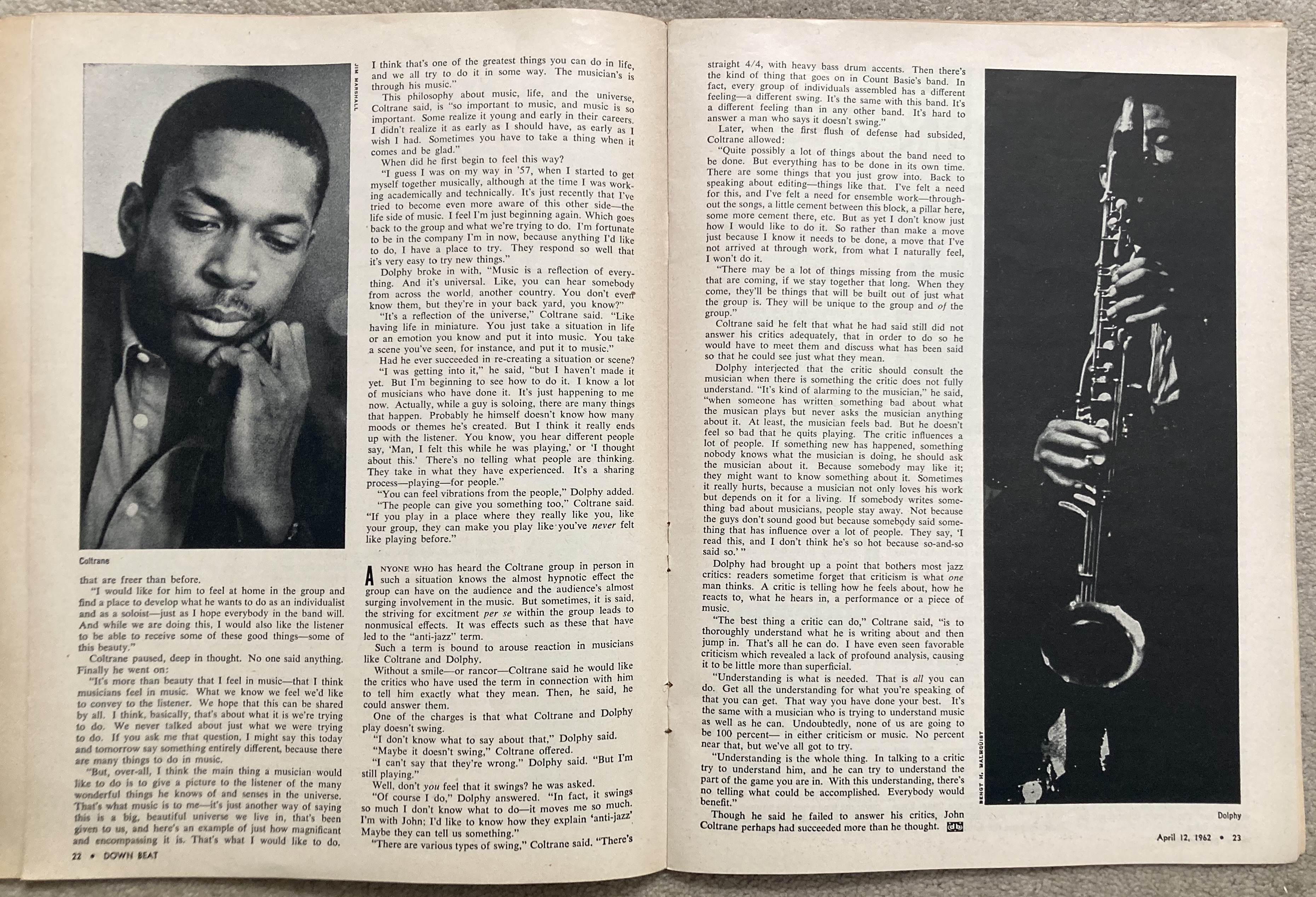
When Uncut magazine invited me to review the newly discovered tapes of John Coltrane and Eric Dolphy at the Village Gate in the summer of 1961, which are released today on vinyl and CD, I went and dug out the 12 April, 1962 of issue of Down Beat. Its striking cover announced that the two musicians had given a joint interview defending themselves against the charge that what they were playing was “anti-jazz”. I was 15 years old when I bought this copy of the magazine and exhilarated by what I saw and read.

Down Beat, essentially a magazine of the jazz establishment, had given a platform to two revolutionaries. Interviewed by Don DeMichael, the publication’s editor, they provided long and fascinating responses to his questions, as you can see below. Their patience is exemplary. Much of what they had to say is as valuable today as it seemed 60 years ago.

The way the cover and the two inside spreads were designed somehow echoed the tone of the piece. Whoever “Roth” was, his charcoal portraits seemed to catch a quality of heroic iconoclasm, as did the extreme cropping of the photographic images (taken by Bill Abernathy of Chicago and the Stockholm-based Bengt H. Malmqvist, who later became Abba’s photographer) on the first inside page. The whole thing made an impression that has never faded.

* Evenings at the Village Gate by John Coltrane with Eric Dolphy is on the Impulse label. The September issue of Uncut is out now.

A Ducal setting

Groups of figures — men in dinner jackets, women in floaty dresses — moving across terraced lawns on a warm midsummer afternoon, carrying picnic baskets and champagne in coolers. An auditorium built into an 18th century Greek Revival mansion sitting above a river in the lovely Hampshire countryside. It’s not hard to imagine that Duke Ellington — who, after all, once dedicated a (rather insipid) suite to Queen Elizabeth II — would have appreciated the idea of his music being played in such a setting, performed by a full orchestra as part of a summer-long festival that also features evenings dedicated to operas by Mozart, Purcell, Glück and Tchaikovsky.

Ellington: From Stride to Strings was the idea of Piers Playfair, an Englishman who is the creative director of 23Arts, based in New York. It was taken up by Michael Chance, the artistic director of the Grange Festival, which was established in 2017 along the lines of Glyndebourne but with, it seems, a more eclectic outlook. Playfair invited the pianist, composer and writer Ethan Iverson to create symphonic versions of pieces written by Ellington in his final decade, and secured the Bournemouth Symphony Orchestra to perform them, under the baton of Gavin Sutherland.

To open the evening, Playfair assembled a sextet of experienced New York musicians, half of them Juilliard graduates, to perform a dozen Ellington favourites in arrangements by their leader, the trumpeter Dominick Farinacci. They kicked off with a solo medley of stride piano pieces by Mathis Picard, French-born with family roots in Madagascar, whose vivacity immediately won the audience’s hearts — and held them at the start of the second half, too, when he performed “New World a-Comin'”, Duke’s playful, rhapsodic piano concerto, with the orchestra.

The sextet began with “Drop Me Off in Harlem”, featuring the clarinet of Patrick Bartley Jr, followed by a cunning combination of “The Mooche” and “East St Louis Toodle-oo”, on which Bartley’s alto saxophone was more Toby Hardwicke than Johnny Hodges, and by Billy Strayhorn’s “Take the ‘A’ Train”, with Farinacci using a cup mute to proper effect. The opening chorus of “In a Sentimental Mood”, played unaccompanied by the vibraphonist Christian Tamburr using only his fingertips on the metal keys, was alone worth the round trip from London. Iverson appeared at the piano for “Creole Love Call” and “Come Sunday”, beautifully sung by the Armenian soprano Anush Hovhannisyan. Bartley’s ebullient vocal on the closing “It Don’t Mean a Thing (If It Ain’t Got That Swing)” sent the audience off for the long dinner interval in marquees around the grounds in very high spirits, having heard the group’s drummer, Jerome Jennings, as light-fingered as Oliver Jackson or Billy Higgins, demonstrate exactly what swing is.

Ellington’s reputation will never be required to stand or fall by his late large-scale compositions, but Iverson’s eight-part suite, titled Valediction, did them honour. Although there were no improvised solos, there was enormous pleasure to be had from hearing the chirping woodwind against walking pizzicato low strings (four cellos, two basses) on “Daily Double”, from The Degas Suite, the brassy groove of “Acht O’Clock Rock”, from The Afro-Eurasian Eclipse, the wistfulness of “King Solomon” (from Three Black Kings) and the moody, blues-inflected “Bourbon Street Jingling Jollies”, from New Orleans Suite. The decision to reset “The Lord’s Prayer”, a piano solo from one of his sacred concerts at Westminster Abbey, for two trombones against bells and strings was wonderfully imaginative. One of Ellington’s train pieces, “Loco Madi”, from The Uwis Suite, began with puffs and whistles and then chuffed along merrily with interlocking phrases for cellos, bassoons, French horns and flutes, before coming to a halt just short of the buffers.

The sextet joined the orchestra for a relatively rowdy “C Jam Blues”, closing an evening that clearly intrigued and delighted a mostly non-jazz audience. It deserves to be repeated in other settings.

The bending of headlights

“We have a new very quiet album out,” Rickie Lee Jones said as she greeted a packed Jazz Café in London last night. I bought Pieces of Treasure, the album in question, a few weeks ago, played it three times, and filed it next to the rest of the evidence of her long and remarkable life in music. It was certainly nice to see her reunited with Russ Titelman, the co-producer of her unforgettable debut album back in 1979 and a careful curator of this new collection of standard songs, but it didn’t make a huge initial impression. Last night she brought it to life.

She’s travelling with a three-piece band: Ben Rosenblum on electric piano doubling accordion, Paul Nowinski on string bass and Vilray Bolles on electric guitar. For the first half of the 75-minute set she just sang a selection of standards, starting with a pin-drop “The Second Time Around”, which she recorded on Pop Pop in 1991, and continuing with “Just in Time”, “One for My Baby” and “September Song”, which are on the new one, then “Up a Lazy River” from 2000’s It’s Like This, “Hi-lili, Hi-lo” from Pop Pop (with the accordionist not just exquisitely replicating but actually improving on Dino Saluzzi’s bandoneon part on the original recording), and “Nature Boy” from the new one.

It didn’t take long to appreciate not just how well she was singing but how beautifully her musicians were creating a matrix for the way she was so thoroughly inhabiting the songs. You might have heard “September Song” a million times, interpreted by some of the greatest singers in the history of popular music, but by bringing herself so close to the song, by eliminating the distance between song and singer, she made you think, as if for the first time, about what it meant.

Later on she did the same with another song worn threadbare by repetition. “There will be other lips that I may kiss / How could they thrill me like yours used to do? / Oh, I may dream a million dreams / But how will they come true? / For there will never be another you.” It was as though she’d just written it.

The groove changed with Steely Dan’s “Show Biz Kids”, which she recorded on It’s Like This. The slinky funk-lite keyboard riff summoned a whole universe of laid-back rock and roll hipness, and the audience enjoyed singing along: “Show business kids makin’ movies of themselves / You know they don’t give a fuck about anybody else.” (And how prophetic was that, written by Walter Becker and Donald Fagen 50 years ago?) She did her father’s song, the lullaby-ballad “The Moon is Made of Gold”, and her own much loved “Weasel and the White Boys Cool”, and finished by returning to the new album for “On the Sunny Side of the Street”, a song her dad taught her in the summer of 1963 (“a big year for me” — she would have been eight years old, and he also taught her “My Funny Valentine” and “Bye Bye Blackbird”). She left to an ovation, on a wave of profound affection.

But earlier, after about an hour, when she had strapped on a guitar, there had been “The Last Chance Texaco”. Those two gentle chords, instantly recognisable, then: “A long stretch of headlights / Bends into I-9…” It’s a movie. It’s a poem. It’s a confessional. It’s a communion. It’s the song that defines her. The one that most fully draws us into her world. “(It) wasn’t like anything I’d ever written,” she remembered in her wonderful 2021 autobiography. “It wasn’t like anything I’d ever heard.” As she sang it, once again the space between then and now collapsed. And when the sound of the car on the highway faded to silence, I might not have been alone in discovering that my cheeks were suddenly damp.

* The photo of Rickie Lee Jones at the Jazz Café is by me. Pieces of Treasure is on BMG/Modern. Her autobiography, Last Chance Texaco, is published in paperback by Grove Press. Thanks to Allan Chase (see Comments) for identifying the musicians.

Peter Brötzmann 1941-2023

I’m listening to Catching Ghosts, a beautiful recording of Peter Brötzmann’s set at the 2022 Berlin jazz festival, in whch he was joined by the Moroccan guembri player Majid Bekkas and the American drummer Hamid Drake. Brötzmann died last week in Wuppertal, his hometown, aged 82; the cause was chronic obstructive pulmonary disease, from which he’d suffered for some time, exacerbated by the arrival of Covid-19. His final public appearances were earlier this year at Café Oto in London.

A formidable figure. Brötzmann was famous for the volume (in every sense) of his saxophone playing: not just the prodigious decibel level but the volume of notes and the volume of energy, urgency and passion that poured out of his alto and tenor saxophones, his clarinet and bass clarinet, and his Hungarian tarogato in countless live appearances and scores of recordings. He lived as hard as he blew, and there’s pathos in the thought that the ferocity of his playing over the course of 60-odd years may have contributed to his fatal illness.

I first set eyes on him in November 1969, when I took time off from covering the Berlin Jazztage to visit what most people referred to as the anti-festival: the second annual Total Music Meeting, held in the Litfass, a café in Charlottenburg. It was the brainchild of the New Artists Guild, a group of young German musicians who objected to the way the line-up of official festival (whose stars that year were Duke Ellington, Miles Davis, Stan Kenton, Sarah Vaughan and Lionel Hampton) was failing to include exponents of the new European free jazz.

I remember hearing the pianist Alex von Schlippenbach there for the first time, and the tenorist Rüdiger Carl. Brötzman was leading a band including three British musicians — Evan Parker, Paul Rutherford and Derek Bailey — along with the German bassist Buschi Niebergall, the Dutch drummer Han Bennink and the Belgian keyboards player Fred van Hove. Without disavowing its influences, this was becoming a truly European idiom.

Several of these musicians had been involved in the recording of Machine Gun, the octet album released the previous year on Brötzmann’s own label. Taking its cue from John Coltrane’s Ascension and Albert Ayler’s Bells, but raising the collective intensity to unprecedented levels, Machine Gun acted as a manifesto. Today it retains, like Jimi Hendrix’s Woodstock version of “The Star Spangled Banner”, its ability to shock and amaze in real time while also carrying the mind back to the conflicts and social turbulence of the time and place in which it was made.

“We saw our task as building a different foundation for music,” Brötzmann told Reinhard Köchl of Zeit Online early this month, in his last interview. Out of that second Total Music Meeting in 1969 came a label called FMP (Free Music Production), the brainchild of Brötzmann and the producer Jost Gebers. Starting a few months later with Manfred Schoof’s European Echoes, FMP went on to release more than 200 albums on vinyl and/or CD — including, in 1971, the first of several reissues of Machine Gun.

It was also the home of several albums by one of my favourite Brötzmann groups, a quartet with the trumpeter Toshinori Kondo, the bassist William Parker and Hamid Drake on drums. Die Like a Dog was the name of their first album, subtitled “Fragments of Music, Life and Death of Albert Ayler”, and it became the name of the band. My favourite of the quartet’s albums is a 1999 session recorded in Berlin and released under the title Aoyama Crows. In an interview included with that album, Brötzmann reflected on mortality. “We’ll just play until we drop,” he said. “It’s not because we’re heroes. We have to. There isn’t much else for us to do but to carry on playing.”

He was not necessarily the easiest person to deal with, even for someone who admired him greatly. When Tyshawn Sorey agreed to be my artist in residence at Jazzfest Berlin in 2017, we discussed possible projects. I suggested that a duo with Brötzmann might be a good idea. Tyshawn was immediately enthusiastic. I made the approach, only to receive a message from Brötzmann saying that he had no intention of being part of “a circus”. That was a pity; it could have been a colossal meeting. Perhaps it was me. Anyway, I’m glad my successor, Nadin Deventer, had better luck in 2022.

By that time the onset of physical limitations may have shorn Brötzmann’s playing of some of the Sturm und Drang elements that characterised his prime years. But exposed to a clearer view in Catching Ghosts is a kind of lyricism which entwines beautifully around Majid Bekkas’s traditional Gnawa chants and the sprung rhythms set up by the guembri (a three-stringed bass lute) and the drums. Brötzmann gave us late work worthy of his long and extraordinary career.

* The photograph of Peter Brötzmann is by Anna Niedermeier. Catching Ghosts is out now on the ACT label.

Old and New Dreams

I may have said this before, but jazz tributes and reunions don’t do much for me. I’d rather hear the music moving on, using its past as the basis for further development. There are exceptions, including the welcome rediscoveries and reinterpretations of Herbie Nichols’ compositions by various musicians, Ryan Truesdell’s meticulous reconstruction of Gil Evans’s lesser known pieces, Alan Skidmore’s lifelong homage to John Coltrane and — of course — Old and New Dreams, four players who convened in 1976 to continue the work they’d done as members of Ornette Coleman’s acoustic quartets.

The trumpeter Don Cherry, the tenor saxophonist Dewey Redman, the bassist Charlie Haden and the drummer Ed Blackwell made three albums together, all for European companies. The first was for Italy’s Black Saint label. The second and third were for ECM, and the first of those will shortly reappear as part of the German company’s vinyl series under the general rubric ‘Luminessence’, along with Gary Burton’s New Quartet. (The first two albums in the series were Kenny Wheeler’s Gnu High and Nana Vasconcelos’s Saudades.)

In the case of Old and New Dreams, it’s good to have the album’s cover, designed by Barbara Wojirsch around the photograph by Herbert Wenn, back in 12-inch form: the calm austerity of the image and the controlled informality of the hand lettering are echt ECM. So is the sound, engineered by Jan Erik Kongshaug at Oslo’s Talent Studio under the supervision of Manfred Eicher, a combination that produced some of the label’s finest recordings throughout the 1970s.

The album begins with a 12-minute version of “Lonely Woman”, the classic ballad Coleman first recorded in Los Angeles in 1959 for The Shape of Jazz to Come, to which it also provided the lead-off track. Cherry and Haden were present for that momentous session (Billy Higgins was the drummer), and their historic connection to the song contributes to the extraordinary richness of this interpretation. If the original was a five-minute miniature in which every note could be committed to memory, here the framework is stretched to incorporate new perspectives. If I could only keep half a dozen tracks from the five decades of ECM, this would be one of them.

The remainder of the album maintains the standard: another Coleman tune (the previously unknown bounce-tempo “Open or Close”) plus Blackwell’s African-flavoured “Togo”, Cherry’s lyrical desert-blues “Guinea”, Redman’s musette feature “Orbit of La-Ba”, and Haden’s eco-anthem “Song of the Whales”, the bassist using his bow to create the sound of the endangered marine leviathans as an introduction to his gorgeous descending theme, which manages to be simultaneously mournful and uplifting.

All four of these musicians are gone now, as are Ornette and Higgins. But the unique music they made lives on, not least in this priceless reincarnation and the epic “Lonely Woman” it contains.

* Old and New Dreams is out in a vinyl edition on the ECM label on June 23. I don’t know who took the photo of the quartet — Charlie Haden, Don Cherry, Ed Blackwell and Dewey Redman — playing together; if anyone has that information, please tell me and I’ll provide a credit.

Astrud (& Gil)

By the time Astrud Gilberto got to sing with Gil Evans, the great arranger had slowed his pace of working. Eventually he would take as long to compose eight bars as some writers took to complete a symphony, but in 1965 he was still able to write 11 arrangements to order for the singer who had shot to unexpected, almost accidental fame with “The Girl from Ipanema” alongside Stan Getz the previous year.

Those 11 pieces, however, amounted to less than 25 minutes of music — enough for one side of a 12-inch LP. Creed Taylor, supervising the album for Verve Records, knew all about Gil’s working habits, having produced two of his classics, Out of the Cool in 1961 and Individualism in 1964. Probably in desperation, he hired the reliable Al Cohn to arrange two more songs which padded the album out to a total of 32 minutes: 15 minutes on one side, 17 on the other, barely respectable.

But you don’t weight the value of Evans’s music with a set of scales, and there were sublime moments on the album, titled Look to the Rainbow and released in 1966. The opening track, “Berimbau”, featured Dom Um Romao — later to join Weather Report — on the eponymous single-string percussion instrument. “Once Upon a Summertime” is a gorgeous ballad that Evans had arranged for Miles Davis on the Quiet Nights album three years earlier (another LP that had to be bulked out, this time with a six-minute quintet track). “A Felicidade” has Evans finding subtle colours to accompany Tom Jobim’s song: listen to the opening unisons and momentary dissonances in the writing for brass and woodwind, and wonder at the combinations. And “I Will Wait For You” is the diaphanous highlight: Evans in excelsis, featuring one of those moments in which he prepared the ground with exquisite care for an incoming improviser, in this case the trumpeter Johnny Coles, one of his favourite soloists.

Astrud wasn’t a great singer, or even a good one in a technical sense; what she had was a presence that transferred itself to tape, apparent to everyone who heard “The Girl from Ipanema” for the first time in 1964, cherishing its evocation of a certain sun-splashed insouciance that suited the times.

When I heard the news today of her death at the age of 83, I thought immediately of my friend George Taylor, who died a couple of years ago. It was George who bought “The Girl from Ipanema” and The Astrud Gilberto Album when they were brand-new, for us to listen to with our girlfriends on warm summer evenings.

* You can get an expanded CD of Look to the Rainbow on Amazon for practically nothing these days. If anyone knows who took the lovely portrait above, I’d be grateful for the information.

The moment of Joy

After a great deal of activity on the British jazz scene of the early 1970s, things were starting to go quiet by the time a quintet called Joy came along. The generation centred on Mike Westbrook, Graham Collier, Keith Tippett, Howard Riley, the Spontaneous Music Ensemble and the Blue Notes had flared brightly before settling down for the longer haul. Around the corner in the next decade would be the media attention given to the new wave of Courtney Pine, Andy Sheppard, Loose Tubes and the Jazz Warriors. Caught in the middle, Joy appeared at a time when the spotlight was pointed elsewhere.

Joy had nothing to do with fashions in jazz. They were untouched by fusion, for instance. They played acoustic music, keeping the flame alive without turning it into the sort of purist mission proclaimed by the Marsalis brothers a few years later. Perhaps they were also among the last young jazz musicians to take the stage wearing what they’d put on when they got up that morning. There was no image, no marketing campaign.

I remember being convinced even before the group came together in 1976 that two of their members in particular, the drummer Keith Bailey and the alto saxophonist Chris Francis, both born in 1948, were destined to become stars. I’d heard Bailey when he followed Ginger Baker and Jon Hiseman into Graham Bond’s band, and felt immediately that he was something special: he had a quality — a lithe swing combined with all the power he needed — that I found again the first time I heard Moses Boyd, 40 years later. The extravagantly talented Francis combined bebop chops with Mike Osborne’s emotionality (filtering Jackie McLean’s sweet sourness) and Dudu Pukwana’s cry. Both spoke their chosen language as if they’d been born to it.

The other members of the band were the draft-dodging American trumpeter Jim Dvorak, the South African bassist Ernest Mothle and the very fine London-born pianist Frank Roberts, the youngest of the five. All except Mothle contributed compositions to the self-titled album they made in 1976 for Cadillac Records, founded by the late John Jack and now celebrating its 50th anniversary. What turned out to be Joy’s only release is among the albums reissued to celebrate the label’s golden jubilee, restored and remastered for CD and digital release with the addition of unedited and unreleased tracks.

As Bailey says in the sleeve notes, Joy played straight-ahead modern jazz, stepping aside from the adventures in freedom in which others were engaged. Imagine a young Horace Silver Quintet, with an infusion of the Blue Notes’ irresistible townships flavour and touches of modal jazz as refined by Herbie Hancock: you could have plonked them down anywhere in the world, from New York to Tokyo, and they would impressed the most sophisticated of modern jazz audiences.

After Joy disbanded, Francis spent some years as a photographer; he now lives in Surrey, where he plays and teaches. Bailey moved to the US in 1980, briefly studied drums with Andrew Cyrille and composition with Morton Feldman, and is based in Santa Fe; he stopped playing regular drums in 1986, in order to concentrate on solo percussion recitals. Frank Roberts remained active on the London scene for many years and is now based in Aarhus, Denmark. Jim Dvorak, having appeared with the Dedication Orchestra and Keith Tippett’s Mujician, continues to play and work in London. Ernest Mothle, whose strength and inventiveness made him the fulcrum of the quintet, appeared with his old friends Hugh Masekela and Jonas Gwanga at Nelson Mandela’s 70th birthday concert at Wembley in 1988 before returning to South Africa, where he died in Pretoria from diabetes-related conditions in 2011.

As young musicians together, for an all too brief span of time in the 1970s, they had something special going. Their album is a pungent and vivid reminder of its time, but more than deserves its place in the present.

* The photograph of Joy is by the late Jak Kilby. Left to right: Jim Dvorak, Ernest Mothle, Frank Roberts, Keith Bailey and Chris Francis. The album is out now on the Cadillac label: cadillacrecords77.com