Skip to content

Posts tagged ‘Tony Levin’

The return of Kenny Wheeler
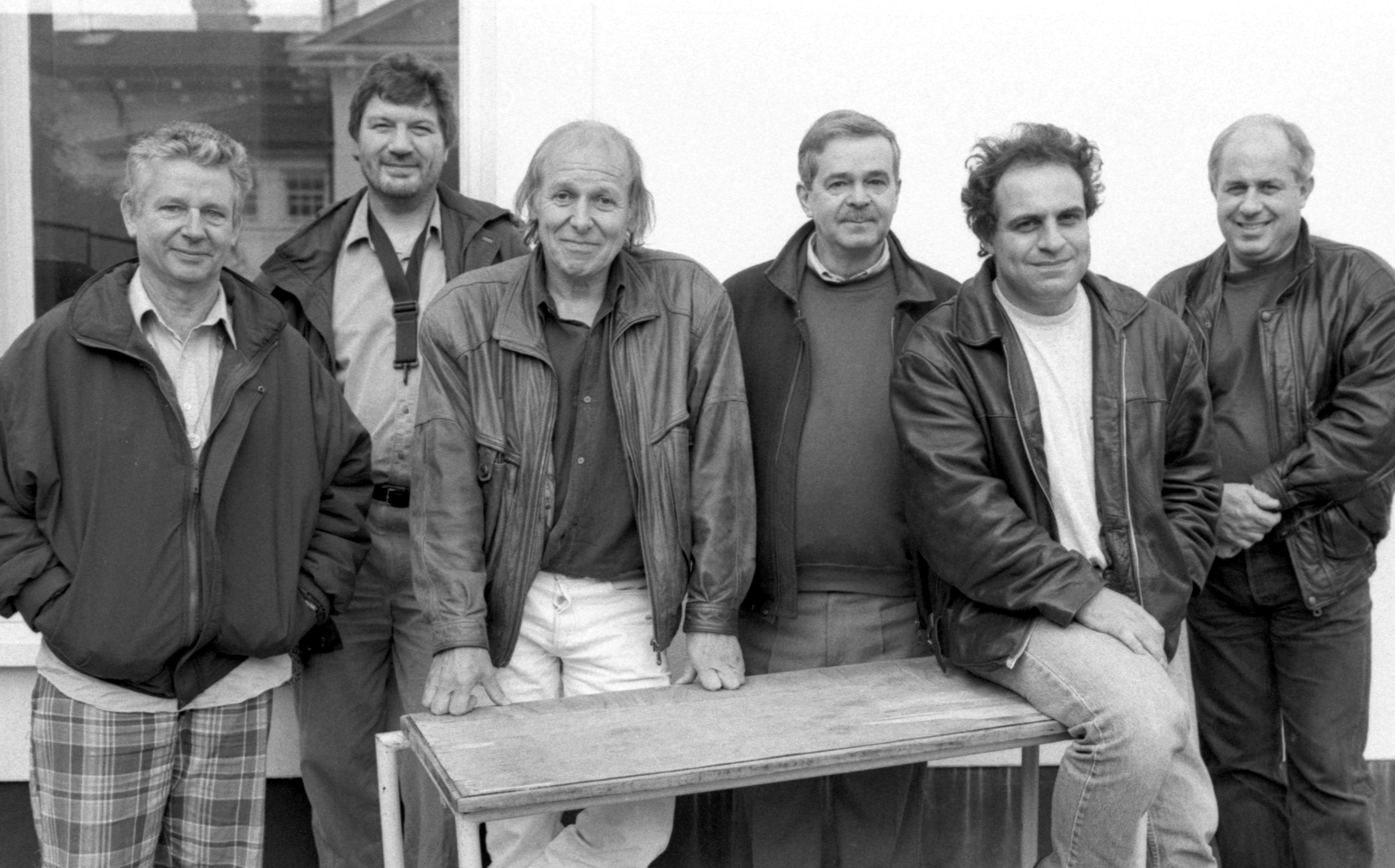
‘What Was’ (from left): Ray Warleigh, Stan Sulzmann, Tony Levin, Kenny Wheeler, John Parricelli, Chris Laurence (photo by Caroline Forbes)

The Toronto-born trumpeter and composer Kenny Wheeler left a big hole when he died in London in 2014, aged 84, after more than 60 years in the UK. A quiet and almost pathologically self-effacing man, he was hugely admired by his peers, who recognised not just the originality of his conception as a player and writer but the quality of his vision, which embraced both purity and open-mindedness. He made the music he wanted to make.

And he hasn’t really gone away. Last year some of his big-band charts were recorded for an album called Some Days Are Better by the Royal Academy of Music’s jazz orchestra and guest soloists, conducted by Nick Smart, Wheeler’s co-biographer; rather wonderfully, it received a Grammy nomination. And there’s also a new album called Vital Spark in which the bassist Dave Holland and the singer Norma Winstone collaborate with the London Vocal Project under Pete Churchill’s direction on performances of Wheeler’s unrecorded settings of poems by Langston Hughes, Stevie Smith, William Blake and Lewis Carroll, with new lyrics by Winstone completing some of Kenny’s late compositions.

Of course many of Wheeler’s own albums, particularly the ECM classics Gnu High (1975), Music for Large and Small Ensembles (1990) and Angel Song (1997), remain available. And now there’s an important new addition to his discography with the appearance of What Was, a sextet album originally recorded by Evan Parker for his Psi label in 1995 at Gateway Studio in Kingston upon Thames and now finely packaged for release.

The line-up is Wheeler on flugelhorn with Ray Warleigh on alto saxophone and flute, Stan Sulzmann on tenor, John Parricelli on guitar, Chris Laurence on double bass and Tony Levin on drums — an A-team of the Canadian’s regular partners. There are seven tracks, amounting to 64 minutes of music, all recorded within a single day in a room that had originally been built by Kingston University as a rehearsal space for the London Sinfonietta before being repurposed as a studio. The sextet sounds both lustrous and sinewy; thanks to the resident engineer, Steve Lowe, the tonal quality and balance are unimpeachable.

As is the music. In the sleeve notes, Sulzmann says this: “It was an old-school recording date where we all turned up on the day, no rehearsals, and we all brought a tune or two to try.” The brilliance of the players ensures that there are few dropped stitches, but the spontaneous nature of the session surely accounts for the freshness that the music radiates.

There are two compositions by Warleigh, two by Sulzmann and one by the pianist Mike Pyne before we reach Wheeler’s own two contributions. It’s fascinating to hear what a difference Parricelli’s imaginative background textures can make to a relatively standard post-bop piece, particularly to Warleigh’s Latin-inflected “Blue Nile”, which draws a fantastically inventive alto solo from the composer — one the finest on record, I’d say, from another figure sadly missed since his death in 2015.

It’s all first-class, until we get to the two Wheeler tunes, where things go up another level again. “What Was” glides teasingly through unpredictable changes, distantly related to the standard “What Is This Thing Called Love”, that provoke these master improvisers into compelling solos, with superlative support from Laurence and Levin, and a marvellous series of exchanges between the flugelhorn and the drummer, wittily leading into a closing statement of “Subconscious-Lee”, Lee Konitz’s take on the same source material. “Kind Folk” is a tune Wheeler returned to in various forms, and is the only previously released track in this set (it appeared in 2003 on Dream Sequence, a Psi album compiled from various Gateway sessions); here it slides in and out of tempo, like water flowing from one pool to another, with Sulzmann in particular benefitting from the reflective mood.

I said there were few dropped stitches. The ones you spot — a tiny hesitation here, a truncated thought there — merely confirm that this music was being made in the moment, with full collective commitment. A precious document indeed.

* What Was is out now on the False Walls label: http://www.falsewalls.co.uk. Some Days Are Better and Vital Spark are on the Greenleaf and Edition labels respectively.

Loud and quiet moments

The car, I find, is a good place to listen to music. Mine is old enough to have a CD player, and I hear lots of new stuff in what is a very satisfactory sound box. But a funny thing happened when I put on the new King Crimson album, a two-CD “official bootleg” of their return to touring in the US between July and September this year. As I drove along, listening to the music, there were noises that made me think something had happened to the car: maybe a piston had blown, or the rear suspension had collapsed.

Wrong. It was the clattering set up by the three drummers who currently make up almost half of the current King Crimson, and whose synchronous but sometimes fairly abstruse playing occasionally gives the impression of a complex machine making its own decisions.

Robert Fripp has form with this sort of thing. Mike Giles, his band’s original drummer, could make 4/4 sound like a study of the calculus of infinitesimals. Later on, the short-lived combination of Jamie Muir and Bill Bruford created a provocative blend of the obsessively precise and the utterly random. Nowadays, when King Crimson take the stage, it is with the three drummers — Pat Mastelotto, Jeremy Stacey and Gavin Harrison — arrayed in front of the other four musicians.

The saxophonist/flautist Mel Collins, the guitarist Jakko Jakszyk, the bassist Tony Levin, and Fripp himself (seated, as always) take up their positions behind the battery of batterie. I don’t know why Fripp chose this configuration, but the music — recorded at two venues, the Anthem in Washington, DC and the Egg in Albany, NY — begins, after a short spoken introduction by the leader, with a thunderous percussion-only barrage that made me think of a 21st century Sandy Nelson, rendered in Warhol-style triplicate.

The rest of the two hours is devoted to King Crimson old and new, from “21st Century Schizoid Man”, “Epitaph” and “Islands” through “Larks’ Tongues in Aspic”, “Starless” “Red” and “Discipline” to a few examples of their more recent work, with which I am considerably less familiar. The respect shown to the greatest hits is absolute; the material is performed with technical excellence and fidelity to the originals but also a spirit that makes the clambering, juddering lines of something like “Level Five” — from 2003’s The Power to Believe — into more than mere exercises, while the rendering of “Starless” has a beguilingly eccentric grandeur that doesn’t seem to take itself too seriously. Jakszyk’s vocals recall those of Greg Lake and John Wetton, the washes of mellotron strings and flutes add an authentic period flavour, and Collins pops up occasionally to remind us what an exceptional and unjustly underappreciated player he has always been.

Arriving in the same package was something very different: a box of eight CDs called Music for Quiet Moments, a compilation of the solo pieces Fripp recorded between 2004 and 2009 in many different venues around Europe and America and released individually as downloads between May 2020 and April 2021. This music proceeds from the experiments that began in the autumn on 1972, when Brian Eno invited me to his flat in Maida Vale to hear something he’d been up to, using two Revox tape machines to record and loop Fripp’s guitar, creating a slow-moving, unusually textured, quietly mesmerising sound that could function as foreground or background. Released the following year under the title (No Pussyfooting) on Island’s low-price HELP label, it was the beginning not just of Frippertronics and Fripp’s more recent Soundscapes but of Eno’s work with ambient and generative music.

These new Soundscapes range in length from a handful of minutes to three-quarters of an hour. Some of the pieces share titles that include “Elegy”, “Pastorale”, “Seascape” and “Evensong”, indicating the moods Fripp is painting with his guitar and its associated effects, often producing sounds resembling slow-moving clusters of violas and cellos. Miraculously, at least to my ears, the risk of passivity is avoided. Some tracks, like “Strong Quiet I and II” from Brussels in 2009, feature an improvised solo guitar line over the drifting clouds of sound: recognisably Fripp, completely lacking in ego-play, always worth following where they lead.

Is this background and/or foreground and/or something in between? Music for listening, or to accompany other activities, or to create a sense of nothingness? From Atlanta in 2006 come pieces titled “Affirmation” and “Aspiration”, a reminder of the names John Coltrane gave to the individual movements of A Love Supreme. And in interviews (such as the one in the December issue of Uncut magazine) Fripp is unafraid to use terms such as “devotional”, “sacred” and “meditative” to describe what’s going on. He isn’t more specific. But the music there to be used, in whatever way you feel appropriate.

* King Crimson’s Music Is Our Friend / Live in Washington and Albany 2021 and Robert Fripp’s Music for Quiet Moments are released on the Panegyric label (www.dgmlive.com). The photograph of Fripp was taken by Tony Levin in Chicago this year.