The Bob look
In her 2008 memoir, A Freewheelin’ Time, Suze Rotolo described how Bob Dylan, her boyfriend between 1961 and 1964, developed his look. Apparently it was Dave Van Ronk, a slightly older Greenwich Village folkie, who urged the 21-year-old Dylan to start paying attention to his image.
In Rotolo’s words: “Such things might have been talked about in jest, but in truth they were taken quite seriously. Much time was spent in front of the mirror trying on one wrinkled article of clothing after another, until it all came together to look as if Bob had just gotten up and thrown something on. Image meant everything. Folk music was taking hold of a generation and it was important to get it right, including the look — be authentic, be cool, and have something to say.”
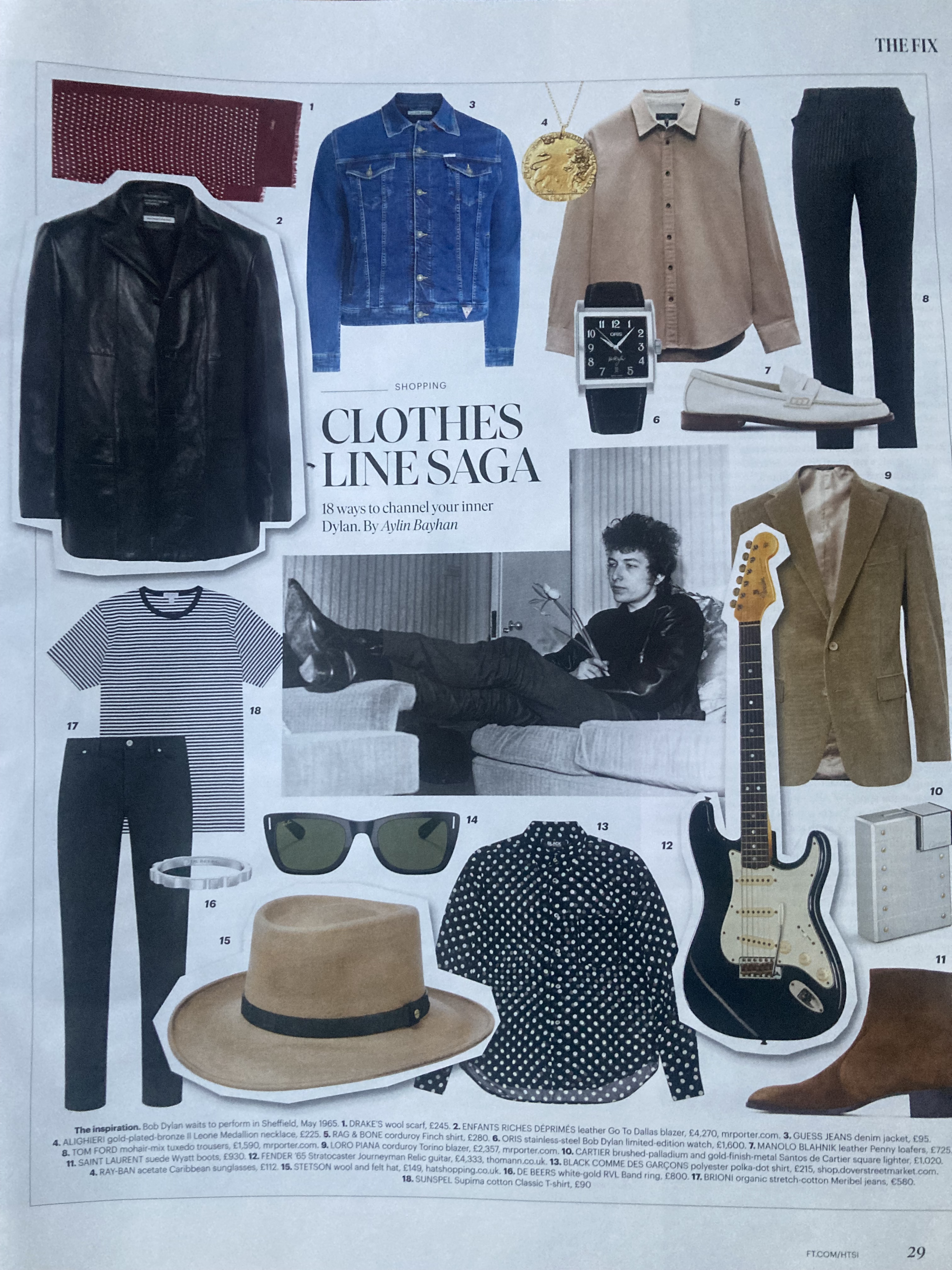
The result was the transfixing sight of Dylan and Rotolo wrapped around each other on the cover of Freewheelin’ in 1963. If you were, say, 16 years old at the time, Don Hunstein’s shot of the couple on Jones Street in Greenwich Village opened up a whole world, and his suede jacket, denim shirt, jeans and boots seemed to offer an easy way in. If you could get hold of them, that is. And now, just six decades later, the Financial Times is telling you how. What you see above is a guide, published in its HTSI (How to Spent It) magazine, showing you to how to look like Bob Dylan.
It’s pegged to the release of A Complete Unknown, James Mangold’s film of Dylan’s life between 1961 and 1965, and it made me laugh quite a lot, for several reasons. The polka-dot shirt they recommend is black and white, which is how it looked in the monochrome photos from the soundcheck at the Newport Folk Festival in 1965; the real thing was green and white — and it was actually a blouse rather than a shirt (the film gets that right). And have you ever seen Dylan in white loafers, never mind 700-quid ones by Manolo Blahnik? The black leather blazer they recommend retails at £4,270. Mine cost a fiver in 1964 from the harmonica player in our band, who was skint at the time and needed rent money. I wish I still had it.

But it’s not just a matter of looking like Bob Dylan. You can try to sound like him, too. The rock critic of The Times went off to the vocal coach who did such good work with Timothée Chalamet in order to try and achieve that distinctive nasal whine. Again it sent me back to 1964 and sitting in my bedroom, strumming an acoustic guitar acquired very cheaply from a girl called Celia and bellowing the words of “The Times They Are A-Changin'” loud enough for my blameless parents to hear: “Come mothers and fathers throughout the land / And don’t criticise what you can’t understand / Your sons and your daughters are beyond your command…”
That was in real time. So was the £5 leather jacket. It was all part of growing up and finding out who you were, and it seems weird now to watch people turn it into a novelty, however good the cause.
As it happens, I enjoyed A Complete Unknown a lot, with only a very few reservations. When Chalamet-as-Dylan sings “The Times They Are A-Changin'” to a festival crowd, Mangold orchestrates the audience’s response in a way that precisely evokes how it felt to experience that song in 1964, with all the emotion of realising that it spoke for you. It was a relief to come out of the screening with the knowledge that I wouldn’t have to be explaining to younger people that it really wasn’t like that at all. Mostly, it was.
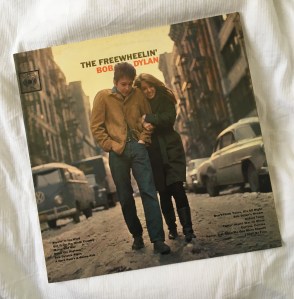 The man who took the photograph that appeared on the cover of The Freewheelin’ Bob Dylan died on March 18, aged 88.
 thebluemoment.com