Skip to content

Posts tagged ‘Stephen Davis’

Alex Hawkins at Cafe Oto
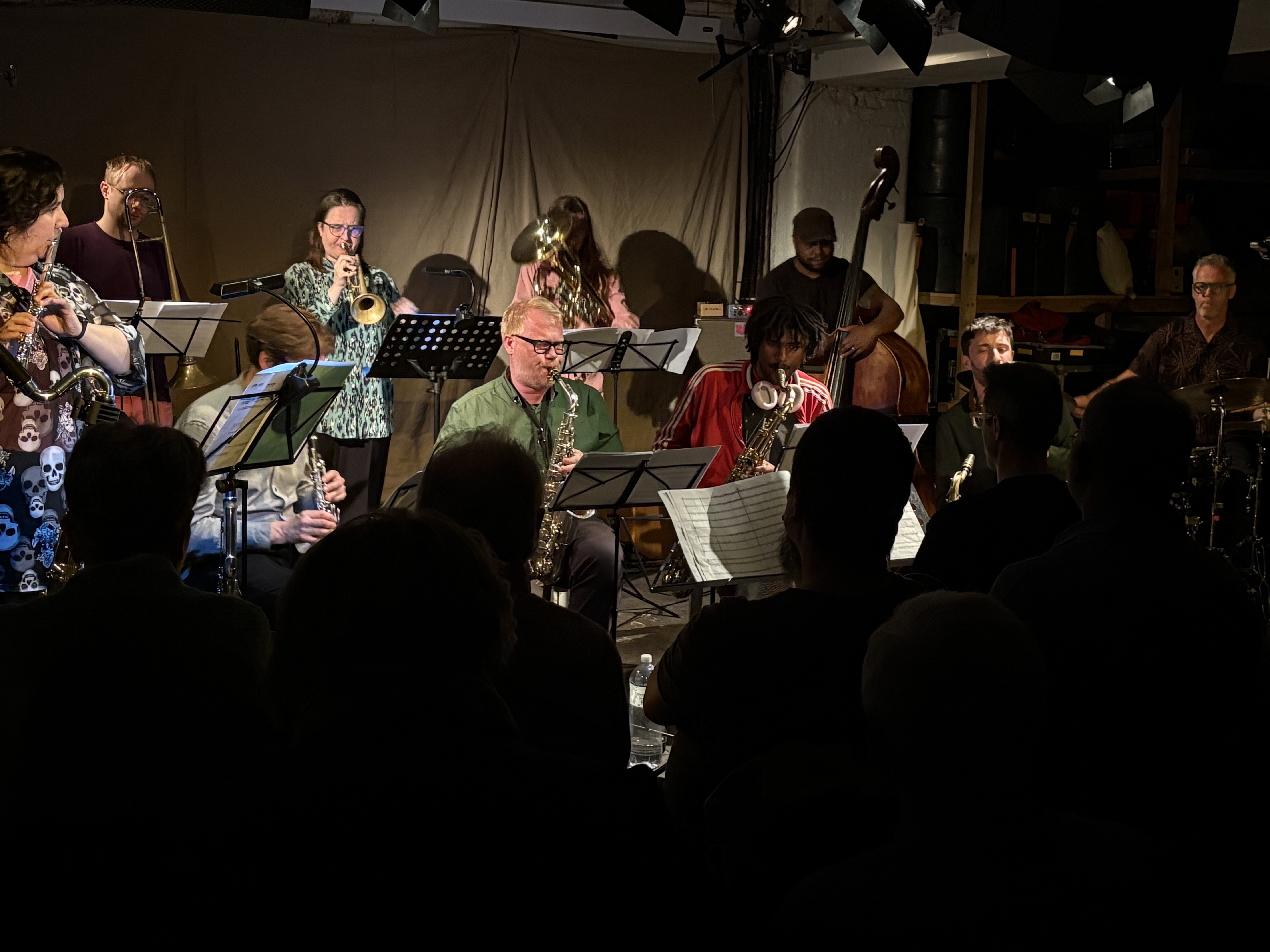
Alexander Hawkins played two nights at Cafe Oto this week with his new 11-piece band before spending two days recording the pieces they played, to which he gives the title Willow Music. If the set I heard on Tuesday is any guide, the resulting album will be worth considerable study.

The opening bars of the first piece the group played made me smile. For a minute I thought that I’d stepped back in time to the Royal Roost in 1948, and here was the Miles Davis Nonet — which became known as the Birth of the Cool band — playing a Gil Evans arrangement of a bebop standard. The feeling didn’t last because the music soon changed into something more identifiably itself, but it was oddly exhilarating while it lasted.

Davis’s nonet was constructed to reflect the range of the human voice, from the top end of the trumpet and the alto saxophone to the bottom of a tuba and a string bass. The Willow Music band achieves a similar spread, but even wider. Here were Alicia Gardener-Trejo on flute, bass flute and bass clarinet; Tom Challenger on flute and alto saxophone; Xhosa Cole on flute and tenor saxophone; George Crowley on flute, tenor saxophone and bass clarinet; Alex Ward on clarinet; Charlotte Keeffe on trumpet; Alex Paxton on trombone; Olivia Hughes on tuba; Neil Charles on bass and Stephen Davis on drums. With Hawkins himself on piano, of course.

With earlier projects, Hawkins has shown himself adept at handling larger ensembles; this one constantly engages the attention through the sheer variety of textures and timbres he draws from it. I was particularly beguiled by a piece that concentrated on the five woodwind players on flutes and clarinets, at first acappella; it reminded me of some of the West Coast recordings of the ’50s by people like Bob Cooper, Bud Shank and Jimmy Giuffre (themselves all inspired by the Birth of the Cool band), but again brought right up into contemporary practice.

It proved to be a perfect platform for soloists who integrate the vocabulary of free jazz into their improvisations. There were outstanding individual contributions, particularly from a rampaging Cole on tenor, the blustery Keeffe and the astonishingly agile Ward, but Challenger, Crowley, Paxton and Gardener-Trejo also made their mark, and there was outstanding work from Hughes, often in unison with Charles, and the infinitely subtle Davis. The composer mostly sat in front of the band, ready to cue and conduct these brand-new pieces when necessary, but he also made the space for some fine piano solos, particularly one on which he used various devices to alter the instrument’s sound, something in which he now specialises.

By the end of a set that lasted well over an hour, I was convinced that Hawkins has come up with something remarkable: a format that encourages him to make new discoveries.

He also has a new album on release, with a different line up. No Nation But Imagination features him on piano, synthesiser and sampler with Nicole Mitchell on flute, Rhodri Davis on harp, Hamid Drake on drums and Matthew Wright on turntables and live sampling. This is a very different sound: an intricately worked open-weave web of softer sounds, with a different balance of composition and arrangement, full of surprises and with a powerful undertow to remove any hint of passivity, and a wonderful gospel-inspired finale. It’s another stage in a remarkable career that is already taking its next step.

* No Nation But Imagination is out now on the Intakt label.

Trio x 3

Ahmad Jamal may have left us recently, but the jazz piano trio — the format to which he gave so much — refuses to die. Although the spurt of intense activity that gave birth to such inventive genre-benders as E.S.T., the Necks, the Bad Plus, the trios of Vijay Iyer and Brad Mehldau, Plaistow, Phronesis and others in the years either side of the beginning of this century may have abated, three new albums demonstrate that a meeting of piano, bass and drums retains every bit of its potential for creativity and diversity.

The Swedish pianist Bobo Stenson recorded his first trio album for the producer Manfred Eicher in 1971. Sphere, made in partnership with the bassist Anders Jormin and the drummer Jon Fält, is his ninth for Eicher’s label, continuing a process of refinement that has seen his music become more meditative in cadence and transparent in texture as the years go by.

In the past, Stenson’s albums have included jazz compositions such as Ornette Coleman’s “War Orphans” and Tony Williams’s “There Comes a Time”, standard ballads like Gordon Jenkins’s “Goodbye” and George Gershwin’s “My Man’s Gone Now”, Latin pieces from Astor Piazzolla and Silvio Rodríguez and classical works by Berg, Purcell and Ives. The repertoire on Sphere is focused almost entirely on Europe: two pieces by Jormin, one by the Danish composer Per Norgard, two by Sven-Erik Bäck, a Swedish composer who specialised in sacred music, one by the Norwegian pianist Alfred Janson, Sibelius’s “Valsette” and the geographical outlier, a contribution by the Korean composer Jung-Hee Woo.

Beginning and ending with limpid versions of Norgard’s “You Shall Plant a Tree”, the trio slide through the nine tracks so fluidly that each becomes a part of the whole, a single mood smoothing out (but not degrading) the very different contours and emotions of Bäck’s “Communion Psalm”, the gentle entanglements of Janson’s “Ky and the Beautiful Madame Ky” and Woo’s “The Red Flower”, a springy waltz. The result is a very personal evolution of the impressionistic approach pioneered by Bill Evans, Scott LaFaro and Paul Motian, the jazz piano trio in its modern classical guise.

Alexander Hawkins is after something different with Carnival Celestial, in which he, the bassist Neil Charles and the drummer Stephen Davis confront the possibilities offered by combining the acoustic piano, string bass and drum kit with synthesisers, samplers and the kind of post-production techniques not often applied in this context. As Bill Shoemaker observes in his sleeve note, there is nothing self-consciously trendy about the way Hawkins approaches these possibilities. It’s easy to hear the unfamiliar sonorities — flutters, pings, shuffling and rustling sounds — as organic outgrowths of the natural sounds, and as another form of connective tissue.

On the hyperactive “Puzzle Canon” and the pensive “Unlimited Growth Increases the Divide”, you can hear the group au naturel, improvising astringent melodies built on reverse angles and sprung rhythms, taking its place in the lineage of piano trios Hawkins loves, including those of Herbie Nichols, Elmo Hope and Andrew Hill (with Monk always in the deep background). On “Canon Celestial”, by contrast, and on “If Nature Were a Bank, They Would Have Saved It Already” (my favourite title of the year, borrowed from a graffito spotted by the Uruguayan writer Eduardo Galeano) and “Echo Celestial”, the electronics and additional percussion are deployed as the sound-bed, the rhythms hinting at the broken beats of contemporary hip-hop. But there’s no dichotomy or divergence here. The plug-in stuff is used not to tart up but to add dimensions. This is new music.

It translates perfectly to live performance, too, as was demonstrated last night in front of an audience at the Vortex in London, the final night of the trio’s short European tour. The moments of peak emotion produced by this power trio were genuinely extraordinary, particularly in a piano solo towards the end of the first set in which the pianist took off on a flight of supercharged mambo variations. Hawkins also inserted brief samples of the voices of Sun Ra, Louis Moholo and Wayne Shorter to striking effect.

Tyshawn Sorey’s Continuing is something different again, seeming to exist both within and beyond any of the usual considerations. The drummer and his colleagues, the pianist Aaron Diehl and the bassist Matt Brewer, take four compositions — Wayne Shorter’s “Reincarnation Blues”, Ahmad Jamal’s “Seleritus”, Harold Mabern’s “In What Direction Are You Headed” and the standard “Angel Eyes” — as material for a meditation on the form itself.

Space is the dominant factor, along with trueness of sound. The notes breathe, the instruments breathe, even when the traffic is at its heaviest, as in the Mabern tune, where Sorey whacks out four-to-the-bar on his snare and Brewer elaborates a kind of Delta blues riff. In “Angel Eyes”, the musicians pursue their thoughts at a pace through which time almost comes to a standstill, forcing the close listener to adjust breathing, heartbeat, depth of focus; interestingly, even this classic ballad is seen through a transparent lens, the sound of the instruments free of the familiar gauze of studio reverb. It may be the compelling slow-motion anatomisation of a commercial song by a piano trio since Cecil Taylor’s “This Nearly Was Mine”.

All the conventional accoutrements of the jazz piano trio are present in Continuing, whose title could be (but probably isn’t) intended to reference its position in a tradition. But the brilliance of the musicians — their ability to burn away layers of sentiment, their willingness to give each other and themselves that extraordinary degree of space, and the adamantine power of their execution — gives it a meaning entirely its own.

* Bobo Stenson’s Sphere is on the ECM label. Alexander Hawkins’s Carnival Celestial is on Intakt Records. Both are out now. Tyshawn Sorey’s Continuing is released on June 24, on the Pi label.