Skip to content

Posts tagged ‘Phil Manzanera’

Antony Price 1945-2025
Of course there was the shock of the music, exquisite to some and befuddling to others. But it was the list of credit on the cover of the first Roxy Music album that really got people going. Concept by Bryan Ferry. Art by Nicholas de Ville. Photography by Karl Stoecker. Clothes, make-up and hair by Antony Price. Something different was going on here.

A lot of it had to do with Antony Price, a Yorkshire-born former Royal College of Art student who got together with Bryan Ferry to devise the group’s look. Price died this week, aged 80, having made a significant contribution to the way the culture around the music evolved in the 1970s. Price made the ruffled satin swimsuit in which Kari-Ann Moller posed on the wraparound gatefold cover image of that debut album, the strapless sheath dress that Amanda Lear wore on the front of For Your Pleasure, and so on all the way through Roxy’s eight studio albums.

Here’s Phil Manzanera, talking to me a few years ago about joining the band in 1972. “I remember getting on the 137 bus from Clapham to go to the photo session for the first album and of course I had no idea about style. My mum sewed some diamante on to a white shirt and I turned up at the session and Antony takes one look at me and says, ‘No, no, no!’ He hands me the bug-eye glasses. ‘Stick these on! And here’s a leather jacket!’ Job done. Fantastic. Antony was a bloody genius.”

Here’s how Ferry remembered putting that first cover together: “I think it was after the recording. Either we were still making, it, or just about finished. I remember calling Antony from a red phone box, I think in the King’s Road, which makes sense because I used to hang around EG (Management)’s offices. I was living in Battersea with Andy Mackay. I remember Antony saying, in his gruff way, ‘I want to hear what it sounds like!’ So I guess I went round to see him.

“Antony had this photographer friend who he’d already done a couple of things with, called Karl Stoecker, married to Errol Flynn’s daughter – a very handsome man, a real ladies’ man. We went to his studio and did this picture. Antony and I talked about it… (he) had this girl called Kari-Ann who he thought was ideal – I wanted a woman, dressed by him. It turned out to be the perfect thing to go with the music.”

What was the cover image saying? “All the ’50s references in the music, late ’50s, early ’60s, were being reflected. It wasn’t that long gone, but it seemed like an age. But although it was a cheesecake kind of thing, it was a bit more knowing. It was all in the details, I think… the make-up, everything, the gold disc – that was a conceit, a cheeky little thing. Yes, it was challenging – and she was looking in a challenging way. It was in the (pre-digital) days when you didn’t know if you had the picture at all. A week later you’d look at the prints. I was so excited.

“Then Andy Mackay found this piece of fabric which we used on the inside cover. Nick de Ville, I got him involved, he was a friend from art college. Finding typefaces and fiddling around with that. Then we liked the idea of the (band) pictures looking like postcards. It was a cottage industry, really. We did a session with Karl Stoecker and Antony, dolling us all up. Eno’s girlfriend made a shirt for him – Carol McNicoll, who was a really brilliant artist working in ceramics – she also did his outfits, the feather things later on. Great, like theatre costumes. Andy’s things were a bit more raunchy. Wendy Dagworthy did Phil’s outfit. And Paul was dressed like a caveman – his sound was quite primitive.”

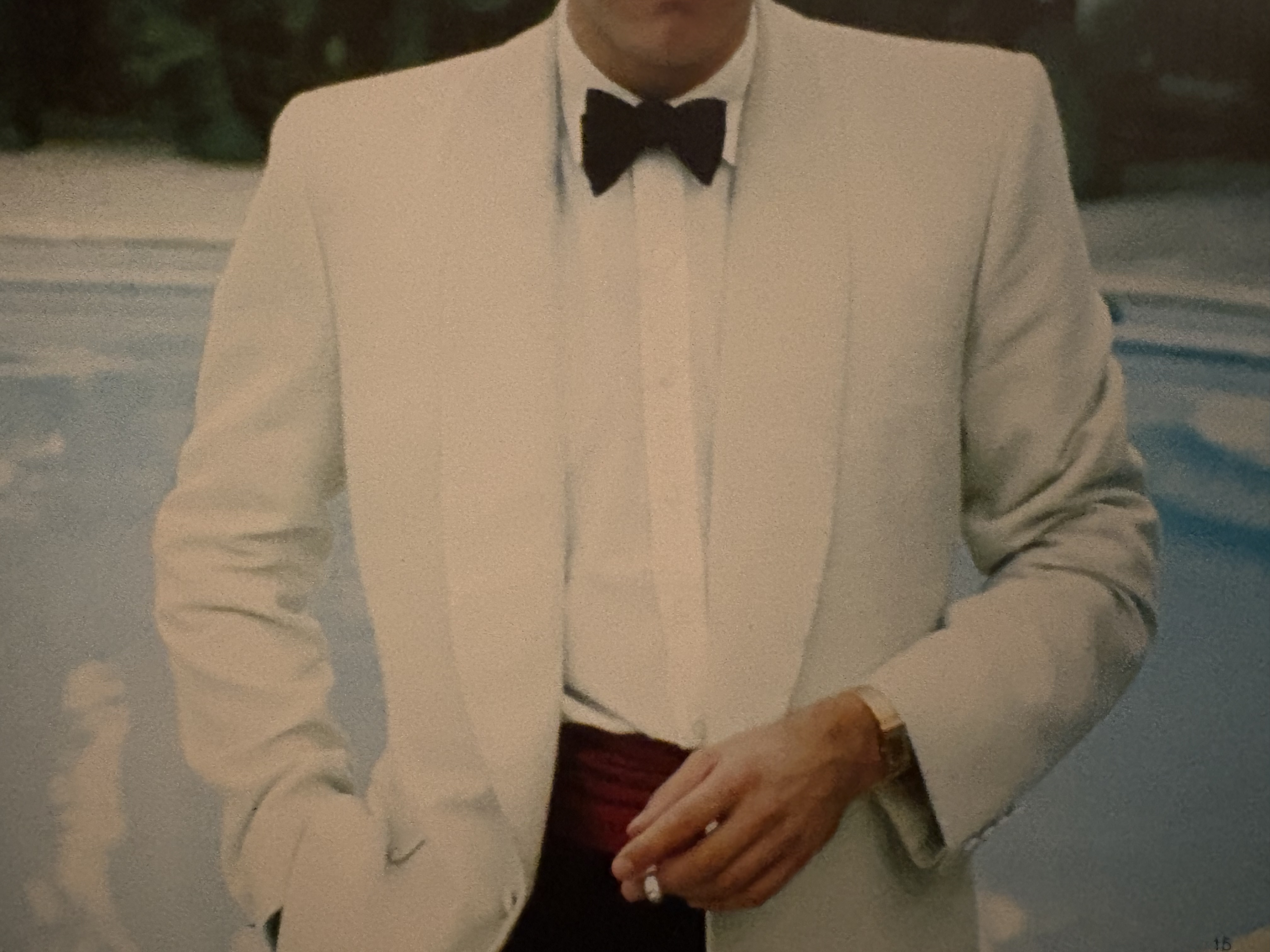
In 1974, for the cover of Another Time, Another Place, Ferry’s second solo album, Antony made two identical white dinner jackets — single-breasted, shawl-collared — for the cover shoot, taken by Eric Boman against a swimming pool, with elegant people in the background. That summer I was going to an Island Records party in the big studio at Basing Street and needed something to wear. Bryan lent me one of those jackets. Nothing has ever felt quite like it.

Diamante visions

Phil Manzanera has been a friend since I first interviewed him during the days of Quiet Sun, the band of school friends he was in before being recruited by Roxy Music in time to play on their debut album in 1972. So I can’t pretend to be completely objective about Revolución to Roxy, his newly published autobiography. But I can be completely honest in saying that it will prove informative and entertaining to anyone who’s followed his career over the past half-century, even from a distance.

Here’s a sample that had me almost collapsing with laughter, when he spins a metaphor out of one of the trappings of early success: a maroon Rolls-Royce coupé whose combination of heavy weight and light steering was guaranteed to induce car sickness in children, making it “completely useless as an everyday family vehicle” and forcing him to keep in storage, bringing it out only on special occasions.

“The car carried a famous brand name,” he writes, “it was sleek, stylish and smooth, and undoubtedly in its own way it was iconic. It was a treat to take out, and whenever I did, it was admired and enjoyed by everyone who experienced it. Eventually, though, the time would come when it needed to go back into the garage and once again be covered by the tarpaulin to keep it well preserved and in good order, ready for the next outing.

“I guess you can see where this is going. There was something about that Roller which felt to me to be a bit like Roxy Music. Eye-catching, stylish and high quality, extremely enjoyable and I was proud to be associated with it. From time to time, it would be an absolute joy to take out for a ride so that it could be admired and appreciated; but the ‘steering’ difficulties and the resultant discomfort meant that its outings were strictly limited. After a while it had to go back under the tarpaulin so I could live my everyday life in my runabout.”

The history of Roxy Music as a kind of artistic Petri dish is, of course, explored in some depth throughout these 300 pages, from Manzanera’s first failed audition through the years of great success to the period in which, he began to feel like “not much more than a session player in my own band” — a band in which “I had to find out what was going on more or less by accident.”

Not least, the book is an interesting exploration of rock-band dynamics, with all the associated uncertainties, insecurities, frustrations and exasperations, and Manzanera has a perceptive take on Bryan Ferry’s legendary penchant for procrastination and prevarication: “His Fine Arts background obliged him to tinker and fiddle way beyond the point where the vast majority of people would long since have settled. I now understand this is about his need to make everything he does artistically beautiful and perfect. I tend to want to do things quickly and I’m not worried if they have a primitive edge, and what I’ve learned is that in Roxy opposites can attract. That’s integral to what makes Roxy music special. Makes it us. Makes us it.”

As musical director of the Guitar Legends festival in Spain is 1991, he had the job of telling Bob Dylan that the organisers expected him to perform “All Along the Watchtower”. How he coped and got there in the end, with the aid of Richard Thompson, is worthy of a place in Ray Padgett’s recent book of interviews with people who’ve worked with Dylan. Recollecting in tranquillity, Manzanera writes: “The way I think about the whole thing is much the same as I used to think about my first visit to various foreign countries. I’m really keen to go, really keen to get to know their individual customs and idiosyncrasies, but having been there and done that, I don’t necessarily ever feel the urge to revisit.”

There are stories about his long collaboration with David Gilmour, a shorter and almost Dylanesque one with the Argentinian hero Fito Paez, a WOMAD tour of South Africa and the Antipodes, his discoveries of the pizzica music of Puglia while directing another festival, his adventures with Jack Bruce in Cuba, his songwriting partnership with Tim Finn and his long relationship with Robert Wyatt. And about 801, that short-lived but incandescent all-star band he created in 1976 with Brian Eno, Bill MacCormick, Francis Monkman, Simon Phillips and Lloyd Watson. And, of course, about those diamante-studded bug-eyed sunglasses created for him in Roxy’s early days by Antony Price.

But, as the man who interviewed Phil for today’s Times observed, this isn’t one of those rock-star biogs where you skip the early chapters dealing with childhood, family and schooldays. In this case, that aspect of the narrative is quite as compelling as the rock-star stuff. Phil was born in London but grew up in Cuba during the run-up to the Castro revolution, the son of an Englishman, Duncan Targett-Adams, who had worked for the British Council in Colombia but now represented BOAC in South America, and a Colombian mother, Magdalena Manzanera. There were mysterious elements on his father’s side of the family — was he a spy? where did an Italian opera singer fit into the picture? — and the Latino influence from his mother’s side on his life and work is interestingly explored.

In a way, though, the most striking passage in the book come when he discusses the phone call from America one day in 2012 in which he was told that Kanye West and Jay Z had sampled a riff from K-Scope, his slightly obscure second solo album, then more than 30 years old. They used it on “No Church in the Wild”, a bleak modern masterpiece and the lead track from their album Watch the Throne, which went platinum in the US and gold in the UK before the track appeared in ads for Audi and Dodge cars. Most significantly of all, as it turned out, it was used by Baz Luhrmann on the soundtrack and the trailer for The Great Gatsby.

“Who knew,” Phil writes, in a sentence that tells you a great deal about the evolution of the music industry in our lifetime, “that I would earn more money from a short guitar riff I wrote one evening on a sofa in front of the telly in 1978 than I ever earned in the entire 50 years as a member of Roxy Music?”

* Phil Manzanera’s Revolución to Roxy is published by A Way With Media (£35)

Fifty years later

Bryan Ferry was kind enough to invite me to contribute the introductory essay to the programme for Roxy Music’s 50th anniversary concerts in North America and the UK, so I went along to the O2 last night to see the closing date of the tour and to witness what might, I suppose, have been their final performance together. I don’t like arena shows, but once the sound had settled down it was possible to enjoy what the four members who played on the debut album in 1972 — Ferry, Andy Mackay, Paul Thompson and Phil Manzanera — and their six auxiliary musicians and three backing singers were up to. And of course there was that funny bitter-sweet feeling you get while watching something you first saw in a basement with a few dozen other people half a century ago scaled up to world-conquering proportions in its ultimate iteration. In the essay I wrote about the inevitability of the process by which what had begun as an experiment would become a performance, but hints of the original art-school excitement and uncertainty managed to survive even today’s production values and resources, and the lighting and the back-projections — endless highways for “Oh Yeah”, Warhol images for “Editions of You” — made it beautiful to watch. The show began with reminders of the slightly gawky early stuff (“Re-make/Re-model”, “Ladytron”) and finished with full-throttle favourites (“Love Is the Drug”, “Virginia Plain”) but in between came a long passage in which the pace slowed to a resting heartbeat as luxuriant textures and romantic descending patterns took over. Introduced by the wordless “Tara”, the sequence of “The Main Thing”, “My Only Love”, “To Turn You On”, “Dance Away”, “More Than This” and “Avalon” swept elegantly by in one long candlelit swoon. Not a bad envoi, if that’s what it was.

Roxy in the Hall of Fame

Roxy demo

Roxy Music will be among the performers tonight at the Barclays Center in Brooklyn, when the Roll and Roll Hall of Fame opens its arms to the latest group of inductees. No one really needs the validation offered by this much derided and arguably unnecessary institution, but it’s like the Oscars or the Booker: at least it gives you something to argue with.

I suppose Roxy are getting in on the strength of Avalon, the band’s only million-selling album in the US. In their home country, their biggest impact was created — as David Hepworth notes in A Fabulous Creation, his new book about the history of the pop LP — by their debut album, which slid a dagger into the heart of progressive rock and endless boogie in the summer of 1972.

Bryan Ferry, Andy Mackay and Phil Manzanera will be there tonight. Brian Eno and Paul Thompson won’t, for various reasons. Nor will Graham Simpson, the original bassist, who left before the first album came out but without whom, as Ferry has said, there would probably never have been a Roxy. Simpson died in 2012; he’s the subject of a forthcoming documentary directed by Miranda Little, several years in the making (here is the trailer).

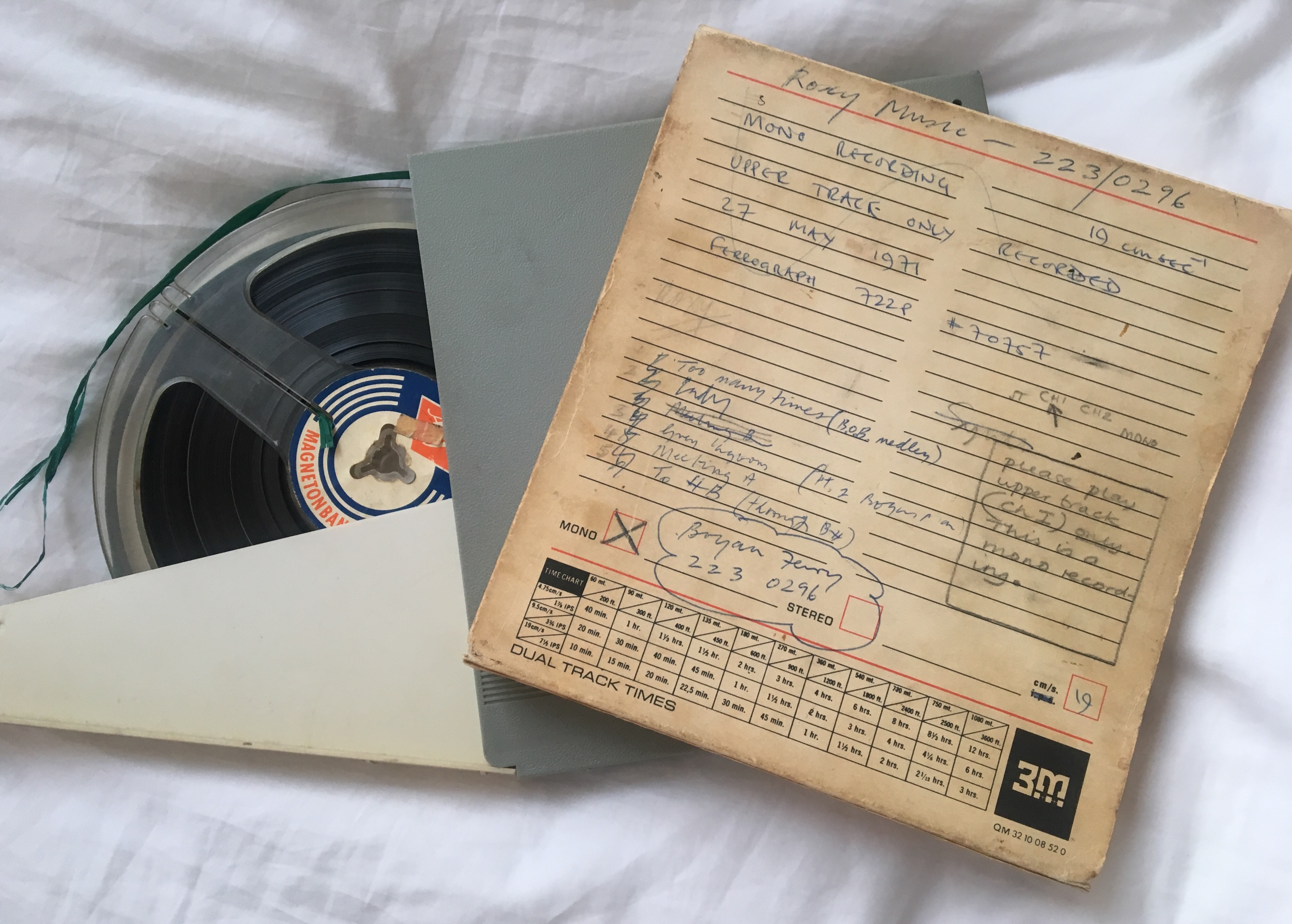
Anyway, just to amuse you, here (pictured above) is the original Roxy demo tape, recorded on May 27, 1971 on Eno’s Ferrograph. Ferry, Simpson, Mackay and Eno were on it, but not Manzanera or Thompson. The guitarist then was Roger Bunn, formerly with Pete Brown’s Piblokto! and Giant Sun Trolley, and the drummer was someone calling himself Dexter Lloyd, a draft-dodging classical percussionist from Chicago whose real name was James Strebing (both would be gone by the end of the summer).

A month later, the demos were dropped off at my flat in Shepherds Bush. “4.30 Brian somebody with tape at home” is the entry in my diary. “Brian somebody” was Ferry. That’s his writing on the box, and his phone number. I just tried calling it, but no one picked up.

David Enthoven: the last goodbye

EG King's RoadOn my way to David Enthoven’s funeral this morning, I walked from Sloane Square down the King’s Road and paused at No 63A, where it all began. The weather was glorious: in the perfect sunshine, it was easy to drift back to the Chelsea of an imagined and sometimes real ’60s.

David died in London last week, aged 72, five days after being diagnosed with kidney cancer. Behind that door and up a flight of stairs, he and Johnny Gaydon, his schoolfriend and first business partner, set up EG Management in 1969, with King Crimson as their first clients. Marc Bolan, ELP and Roxy Music soon joined the roster. They were great days. (And here’s the obituary I wrote for the Guardian.)

When I got to St Luke’s, a large 19th century Anglican church just off the King’s Road, it was already close to packed with people wanting to say farewell to an extraordinary man. As they lingered in the sunlit churchyard after the ceremony, the event had something of the qualities of an English garden party, which was just as it should have been.

Tim Clark, his friend and partner in IE:Music, his second management company, gave an address which stressed the life-enhancing qualities that made David special to every single member of the congregation. Robbie Williams, whose life and career David and Tim had salvaged and remade, sang “Moon River” — a lovely choice — accompanied by the acoustic guitar of Guy Chambers. Lucy Pullin and a choir sang “Angels”, which Williams and Chambers wrote after David and Tim had brought them together. Lamar led the singing of “Jerusalem”.

The congregation included Robert Fripp, the founder of King Crimson, and all five surviving members of Roxy Music from the sessions for the band’s debut album in the summer of 1972: Brian Eno, Bryan Ferry, Andy Mackay, Phil Manzanera and Paul Thompson, who came down for the funeral from Newcastle, where he now plays the drums with Lindisfarne.

One of the morning’s pleasures, over which the man in whose memory we were gathered would certainly have shared a chuckle, was the sight of Fripp, Eno and Ferry (so much history there, from Ferry’s failed audition for King Crimson to Fripp and Eno’s collaboration on No Pussyfooting and beyond) joining the singing of “All Things Bright and Beautiful”. You don’t get that every day.