Skip to content

Posts tagged ‘Patti Smith’

At the London Palladium
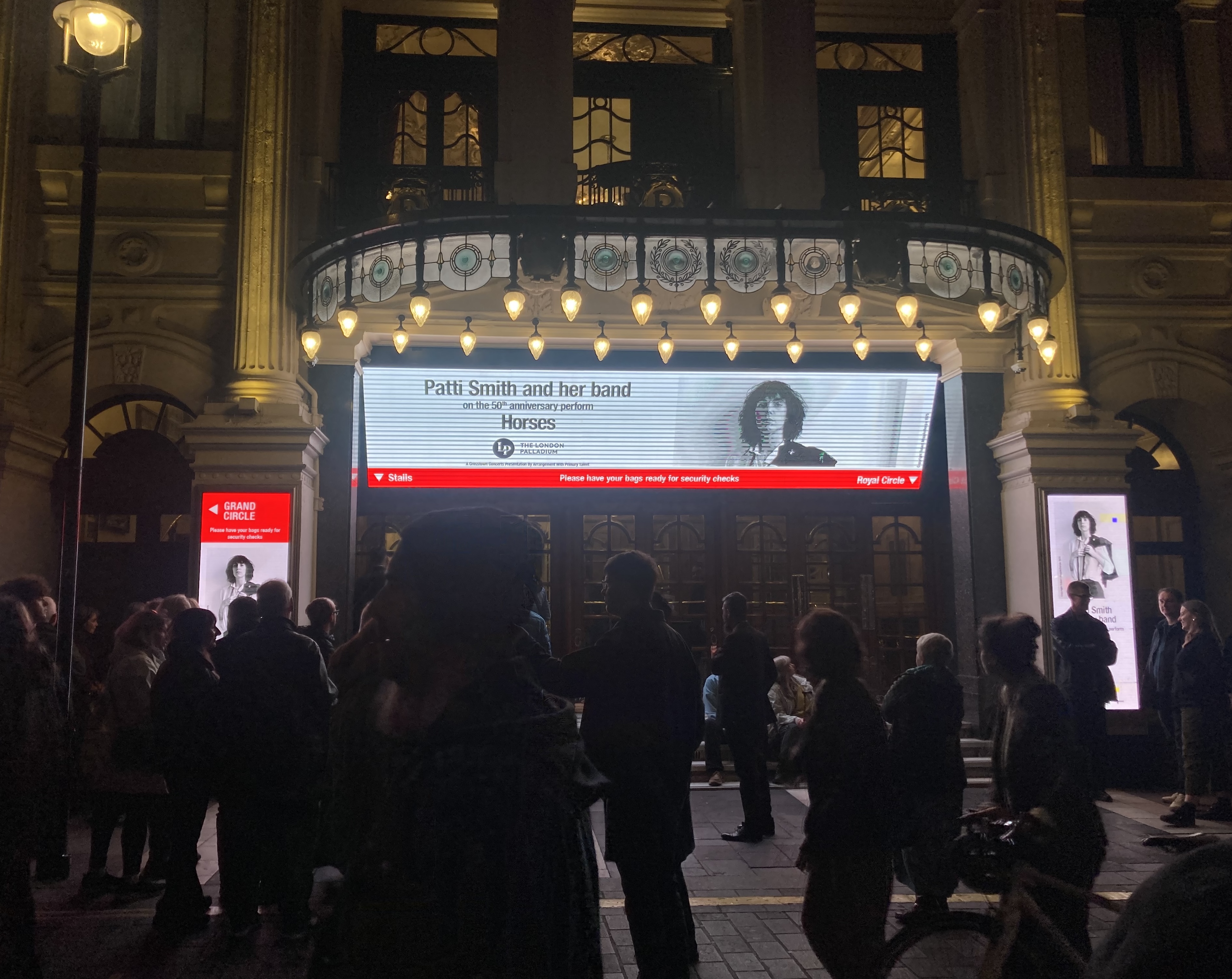
Two poets took the stage at the London Palladium this week. The first, Patti Smith, was celebrating the 50th anniversary of the release of the epochal album Horses by playing it all the way through with a band including two of her original confrères. The second, Al Stewart, had made it part of his farewell tour, and thus his final appearance in the city where he once shared a flat with the young Paul Simon and had a residency at Bunjie’s, a folk club a shortish walk across Soho from where he was saying his goodbyes.

Smith is 78. Stewart is 80. Horses came out in 1975, the year before Stewart enjoyed his biggest hit with the title track from Year of the Cat. Both drew full houses — Smith on two nights running — and performed with a vigour that reanimated the work of their youth.

We know Smith as a poet who rammed literary and musical forms together to great and lasting effect. Stewart’s success in turning big subjects — the Basque separatist movement, the French Revolution, Operation Barbarossa — into long narrative folk-rock songs reflected a creative use of the early impact of Bob Dylan on his songwriting. But where the enduring glamour of the New York era of CBGB and Max’s Kansas City ensures Smith’s continuing credibility, Stewart’s soft-rock associations have probably restricted his following to his original audience. There was no measurable difference in the enthusiasm that greeted both artists on a celebrated stage.

If the guitarist Lenny Kaye and the drummer Jay Dee Daugherty provided valued historical support for Horses, assisted by Jackson Smith and Tony Shanahan on keyboard and bass guitar, Stewart (and his four-piece band from Chicago, the Empty Pockets, plus the saxophonist/flautist Chase Huna) benefited from the guest presence of his old collaborator Peter White, who added beautiful guitar decoration to “Time Passages”, which he co-wrote, and “On the Border”, and remodelled the rhapsodic piano introduction — including “As Time Goes By” — to “Year of the Cat”.

To be honest, I hadn’t listened to Stewart for decades before last night. I bought the tickets as a treat for my wife, who knew him a little in Bristol folk scene of the late ’60s and remembers once giving him a lift to London. But as thrilled as I was to hear Smith declaiming “Redondo Beach” and “Birdland”, I was just as beguiled by Stewart’s “The Road to Moscow” and “The Dark and the Rolling Sea”.

Today Smith, of course, looks even more like a poet than she did in 1975. Stewart, who lives in Arizona, now resembles someone who might be the secretary of the local bridge club. Good on both of them.

Patti Smith at the Albert Hall

When she was 15 or so, the woman said, she’d dreamed about a certain boy, about walking down the street holding his hand. And now here she was, performing at the Royal Albert Hall for the first time, and she was going to sing one of his songs. And at the end of a most elegant version of “One Too Many Mornings”, Patti Smith said quietly: “Bob Dylan.”

The last time I’d seen Patti was in 1995 at the Electric Factory in Philadelphia, when she and Dylan were touring together. She came on to sing “Dark Eyes” with him during his acoustic section, and then she joined him in the encores for “Knockin’ on Heaven’s Door”. It was nice to be reminded last night of the history they share, and she honoured it beautifully on the very stage where, 55 years ago, he sang “One Too Many Mornings” with another band.

But that was just one highlight in a night crammed with them, starting with the lyric to “Piss Factory”, the B-side of her first single in 1974, which she declaimed unaccompanied to start the 90-minute set. That was electrifying, and at the end of the evening my only regret was that she hadn’t done more reading.

But would I have swapped that for the lovely “Grateful”, the driving Velvets drone of “Dancing Barefoot”, the collective exhilaration of “Beneath the Southern Cross”, a most surprising and tender mid-set version of Stevie Wonder’s “Blame It on the Sun”, Lenny Kaye’s dedication of the Stones’ “I’m Free” to Charlie Watts, the cathartic “People Have the Power”, which Patti wrote with her late husband Fred “Sonic” Smith, or the thunderous closing run through “Not Fade Away”, when the instruments cut after the last “I’m gonna tell you how it’s gonna be”, allowing Patti, the band and the entire pan-generational audience to bellow “You’re gonna give your love to me”?

What I also admired was the way she and the band — Kaye and Jackson Smith (guitars), Jesse Paris Smith (piano), Tony Shanahan (bass guitar) and Jay Dee Daugherty (drums) — put on such a well calibrated show while keeping their garage-band rawness and honesty. Jackson Smith’s raga-rock solo on “Dancing Barefoot” was a beauty, as was Daugherty’s ability — probably learnt from reggae drumming — to leave spaces within a bar without losing power.

But I wasn’t really taking notes. I was on my feet, with everyone else.

Revisiting Eric Burdon

Eric Burdon 1

The memory of hearing Eric Burdon sing “House of the Rising Sun” with the Animals at the Odeon, Nottingham one summer night in 1964 — a week or two before it was released as a single — is as clear as yesterday. In some ways it was the precursor of a new kind of rock music. But to Burdon, as he explains in a new biographical documentary shown on BBC4 this weekend, it meant something different. When Alan Price, the group’s organist, took credit for the words (traditional) and the arrangement (borrowed by Bob Dylan from Dave Van Ronk), it damaged the singer’s faith in music as a collective endeavour: all for one and one for all.

Luckily, although the animosity towards Price is still burning fiercely more than half a century later, it didn’t cause Burdon to end his career. As Patti Smith, Bruce Springsteen and Steve Van Zandt testify in the programme, post-Price Animals hits like “We Gotta Get Out of This Place” and “It’s My Life” were nothing short of inspirational to the next generation. But as the decades went by, there was always a sense that Burdon, one of the great English R&B voices of the ’60s, never quite recaptured the same level of fulfilment.

The hour-long Eric Burdon: Rock and Roll Animal, directed by Hannes Rossacher, is a co-production by the BBC with ZDF and Arte. There are interesting passages on his apprenticeship at the Club A Go Go in Newcastle, his relationship with Jimi Hendrix, his time in San Francisco and his collaboration with War — who dumped him, he claims, because he was the white guy in the band (there was actually another, the harmonica-player Lee Oskar). There’s quite a lot of stuff about his 50-odd years of living in California, and we see him cruising through the desert in some ’70s gas-guzzler or other.

We leave him, weathered but unbowed, with his new American band — new in 2018, anyway, when the film was made — preparing to record an album. He sings “Across the Borderline”, the great song written in 1981 by Ry Cooder with Jim Dickinson and John Hiatt for the soundtrack of Tony Richardson’s The Border, a film about immigrants. Originally sung by Freddie Fender, it subsequently found its way into the repertoires of Springsteen, Bob Dylan, Jackson Browne and Willie Nelson. It suits Eric Burdon just fine.

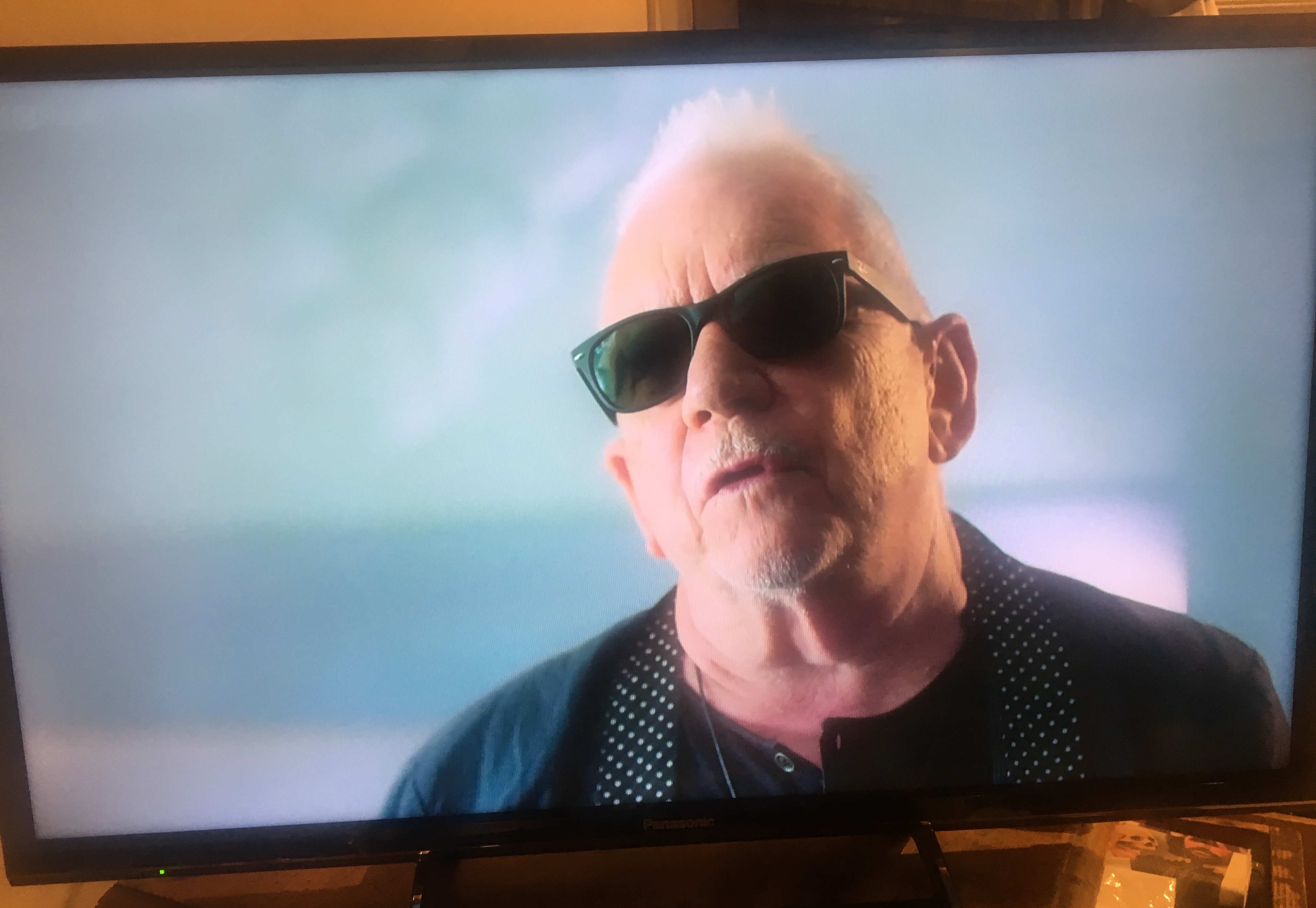
* The screen-grab is from Eric Burdon: Rock and Roll Animal, which can be watched on BBC iPlayer until the end of March.

Nico: the last journey

nico-2Nico died in Ibiza, a place she had loved for many years, one hot July day in 1988. Leaving the rented farmhouse where she was staying with her son, Ari, she headed into town, apparently intending to buy some hashish. At some point in the journey she fell from her bicycle and suffered a head injury. It was not until the following day that Ari called the police, gave them a description, and received the news that she had died in hospital.

Stephan Crasneanscki of Soundwalk Collective is not the only one to have found himself trying to visualise that last journey. With a new album called Killer Road, he and his partners in the band, Simone Merli and Kamran Sadegh, together with the composer Jesse Paris Smith, present a cycle of pieces based on Nico’s songs and poetry in which they attempt to evoke the thoughts and sounds that might have been going through her mind as she pedalled through the heat and the noise of crickets. The words are read by Jesse’s mother, Patti Smith.

There is a historical connection. Patti once rescued Nico’s harmonium from a pawn shop and gave it back to her. She is, however, not an idolator. “It influenced us all, to have such a bold delivery of bold songs by a female singer in that period, the early ’60s,” she writes in the sleeve notes, but explains that she doesn’t “identify” with Nico beyond the admiration of someone who worked to find a way of delivering her poetry through the medium of music. Nevertheless her commitment to the project leads her to deliver the words in a way that reflects Nico’s own manner: “half-singing — like a child singing to themselves,” as she puts it. Her mission, she says, was “to just, somehow, represent a small part of her, even though we have different voice tones and no obvious similarities.”

In the event, it would be hard to imagine a more effective interpreter for this project. Smith’s performing experience allows her to imbue the lyrics of “Evening of Light”, “Secret Side”, “My Only Child” and others with quiet drama, using a mostly whispered delivery (exception: “Fearfully in Danger”, which she sings in a raw New Jersey voice). The approach works perfectly against the brooding, shifting electronic soundscapes created by her collaborators, which often summon (without trying to replicate) the effect of the harmonium, Nico’s signature instrumental sound. The original melodies are entirely eliminated. When Smith recites the lyric to “Saeta” against the tinkling of distant prayer-bells and hovering synthesiser sounds, the tune is nowhere to be heard; yet for those who know the song, Nico’s loveliest, it is inescapably present.

This is a album of ghost music: an attempt to pay tribute by creating something as strange, original, atmospheric and appropriate to the material as the arrangements through which John Cale moulded the great trilogy of The Marble Index, Desertshore and The End into something without precedent. The result is subtle, respectful, and wholly successful.

* Killer Road is released on the Bella Union label. The photograph of Nico is from the cover of the 1981 album Drama of Exile and was taken by Antoine Giacomoni.