Skip to content

Posts tagged ‘Norma Winstone’

On Kit Downes

One night a few weeks ago I was at the Vortex, listening to a hour of free improvisation performed in the downstairs bar by the pianist Kit Downes with the saxophonist Tom Challenger, his familiar colleague, the drummer Andrew Lisle, and two names new to me; the guitarist Tara Cunningham and the bassist Caius Williams. It was a lovely set, full of lyricism and surprises. Downes, Challenger and Lisle are entirely at home in such an environment; it was a pleasure to hear the contributions of Cunningham, making an intriguing adaptation of the innovations associated with Derek Bailey, and Williams, who produced not just supple and responsive lines but the loveliest tone I’ve heard from an upright bass for ages.

Then I went home to resume listening to a new CD sent to me from Amsterdam, where the celebrated Bimhuis club had recorded Downes’s multinational 10-piece band playing an extended piece titled Dr Snap — one of a series of four “composition assignments reflecting the current zeitgeist” commissioned, under the overall heading of Reflex, from four different composers — and to Outpost of Dreams, Kit’s new album of duets with Norma Winstone on the ECM label.

Recorded live at the Bimhuis in November 2022, Dr Snap consists of seven pieces by Downes, one by Challenger and two by the bassist Petter Eldh. It begins in a deceptively mild manner — twitchy rhythms, knotty woodwind themes — before broadening and deepening as it goes on, opening out to expose exceptional work from the trumpeter Percy Pursglove, the saxophonists Ben van Gelder and Robin Fincker, the flautist Ketije Ringe Karahona, the guitarist Reinier Baas, the bassist Petter Eldh, and the drummers and percussionists Sun-Mi Hong, James Maddren and Veslemøy Narvesen, Plus, of course, the composer’s piano.

Like a lot of today’s jazz writing, it requires 11 fingers on one hand and seven on the other if you want to try and decipher the time signatures. But no such technical analysis is required for a simpler enjoyment of the music as it passes by, hastening without rushing, guided through its endless twists and turns by the highly inventive rhythm section.

There’s a lot of variety here, from passages of hustling density to a lovely stretch of serenity in “Pantheon 4”, a feature for Karahona, via the use of free-jazz techniques behind Pursglove on “Snapdraks”. The solos arise naturally, part of the overall design — as they did, for instance, in the recordings of Steve Lehman’s octet. Three-quarters of a century after what became known as the Birth of the Cool sessions, this kind of jazz for medium-sized ensembles continues to evolve in a very stimulating way.

Downes’s duo with Winstone is a meeting of minds as well as generations (he is 38, she is 82). His tunes join those of John Taylor, Ralph Towner and Adam O’Rourke as vehicles for her lyrics, which are full of elegant, often wistful references to nature and the seasons, to sky and light and wind and their effect on the senses. There are also fine versions of “Black Is the Colour of My True Love’s Hair” and of a traditional tune arranged by the late Bob Cornford, titled “Rowing Home”. From the latter, was there ever a more ECM-evoking opening to a lyric than “Upon the lake in winter sun / A sun that bleaches the sky…”?

As further evidence of Downes’s scope, there’s a forthcoming trio LP called Breaking the Shell on which he plays pipe organ with the guitarist Bill Frisell and the drummer Andrew Cyrille. A track called “Este a Székelyeknél”, released on Bandcamp by the Red Hook label this week, suggests that this, too, will be a notable addition to the body of work being assembled by one of the most consistently stimulating musicians of our time.

* Dr Snap is on the Bimhuis label and Outpost of Dreams is on ECM, both albums out now. Breaking the Shell is released by Red Hook on September 27. The photograph of Kit Downes with the Dr Snap band was taken at the Bimhuis by Maarten Nauw.
ECM in London

Craig Taborn at RAM

No apologies for returning, one last time, to the continuing celebrations of ECM’s 50th anniversary. For a short festival at the Royal Academy of Music, the director of the jazz programme, Nick Smart, invited several of the label’s luminaries — the bassist Anders Jormin, the pianists Craig Taborn and Kit Downes, the singer Norma Winstone and the saxophonist Evan Parker — to spend a week working with students before presenting the results in two public concerts on Thursday and Friday night.

Jormin’s compositions — very much what many people would think of as archetypal ECM music, with a restrained lyricism that seemed to have its deepest roots in Nordic folk music — were played by a septet notable for the outstanding singing of Ella Hohnen-Ford and Alma Naidu. Downes and his colleagues in the trio called ENEMY, the bassist Petter Eldh and the drummer James Maddren, enhanced their tricky compositions with arrangements for string quartet, three woodwind and two percussionists, of which the most successful were “Last Leviathan”, a piece from Downes’s ECM debut, Obsidian, fetchingly rearranged for strings and piano, and Eldh’s eventful “Prospect of K”, cunningly scored by Ole Morten Vågan.

For the festival’s closing set, Smart led the Academy big band through a sequence of rare and unheard compositions by the late Kenny Wheeler, another ECM stalwart, featuring Winstone, Parker and Stan Sulzmann. The juxtaposition of the two tenors of Parker and Sulzmann created a contrast that exemplified the breadth of Wheeler’s conception — although their thunder was almost stolen by the alto saxophone of Lewis Sallows, a student whose long solo displayed a disinclination to plump for stylistic orthodoxy and a powerfully dramatic imagination. The crisp and flexible drumming of Ed Richardson, an Academy graduate, also took the ear.

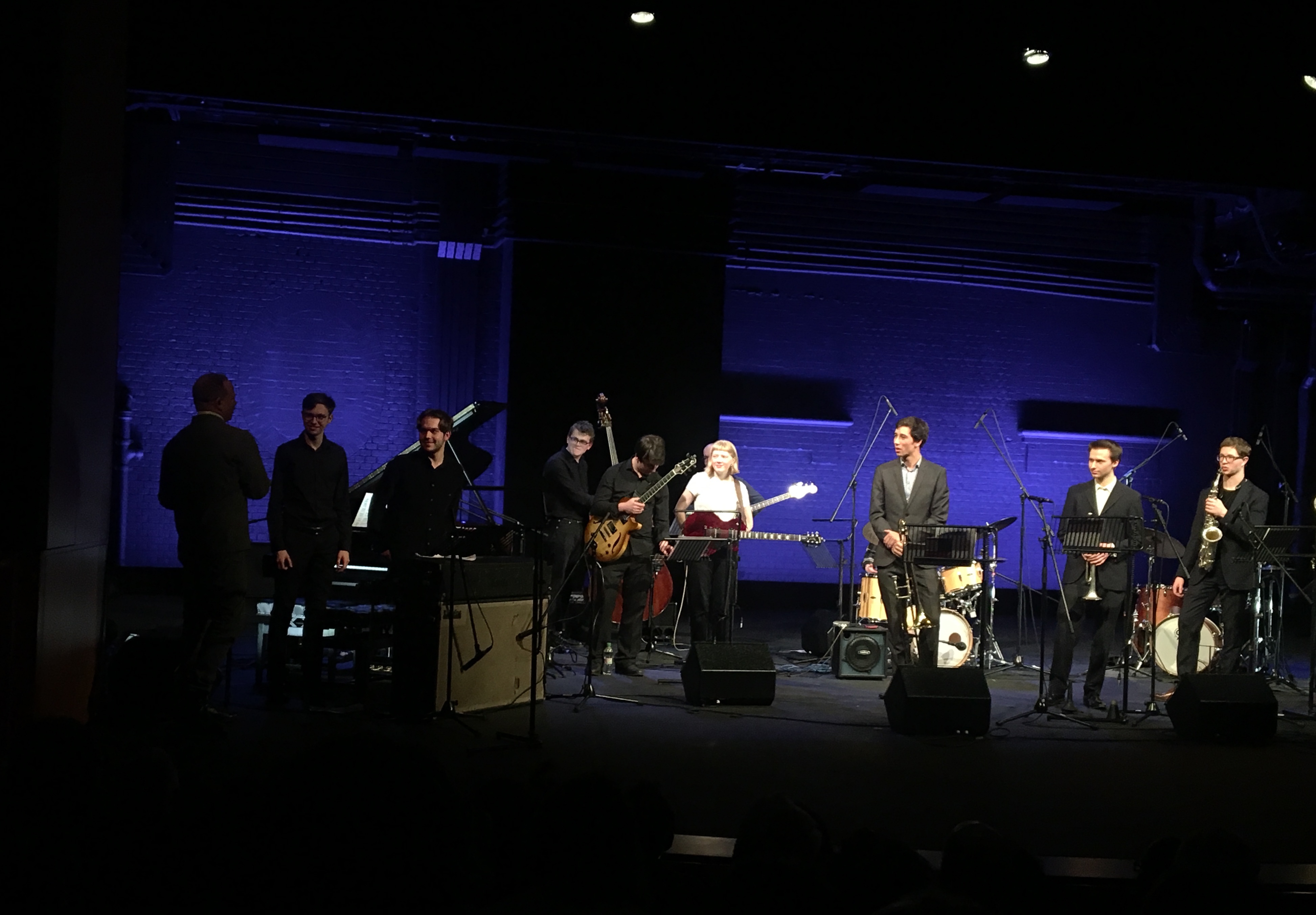
Twenty four hours earlier, Sallows had also been part of the 12-piece band (pictured above) which provided the festival’s highlight. Craig Taborn is already known as one of the most creative and original pianists of the current era; those who were present at the Vortex for his solo gig last year speak of it in awed tones. Friday’s set showed him to rank alongside Steve Lehman, Vijay Iyer, Mary Halvorson and Eve Risser as an adventurous composer-leader who knows how to exploit the resources of a larger ensemble while retaining all the spontaneous interaction of a small group.

Although this was music of great sophistication, there were times when its sheer fire put me in mind of those great Mingus units of the late ’50s and early ’60s, when the members of the Jazz Workshop learnt their parts by ear and took it from there. The trombonist Joel Knee, the trumpeter Laurence Wilkins and the two altoists, Sallows and Sean Payne, threw themselves into the project with enormous skill and gusto, and the ear was also taken by the guitarist Rosie Frater-Taylor, whose opening solo was strikingly thoughtful and who made significant contributions to the riff-ostinatos on which several of the pieces were built.

Taborn’s own solos on acoustic and Fender-Rhodes pianos demonstrated his gift for gathering all the energy once associated with Cecil Taylor and using it to activate the coiled springs of his own imagination. During an unaccompanied introduction, he made the Rhodes roar in a way that completely divested the instrument of its familiar role as a provider of a cool funky background sound. It was one of many moments, individual and collective, that made the event such a success.

Chet Baker at the Canteen

Chet Baker at the CanteenThe Canteen was a jazz club at 4 Great Queen Street, on the eastern fringe of Covent Garden: a narrow single-fronted space on the ground floor, backing on to Parker Street. It functioned for probably not much more than a year in the early 1980s, after which it became Blitz, the headquarters of the New Romantics, then Browns, a sort of celebrity discothèque. Now it’s a “gentlemen’s club” called the Red Rooms. Among the musicians I saw there during its jazz incarnation were Ahmad Jamal, Slim Gaillard, Lee Konitz, Howard McGhee, Bill Perkins and Esther Phillips, who was backed by a tidy little band including Tim Hinkley on keyboards and Mel Collins on tenor saxophone. The club’s energetic publicist was a man called K.C. Sulkin, whose father had been a society bandleader in Boston between the wars.

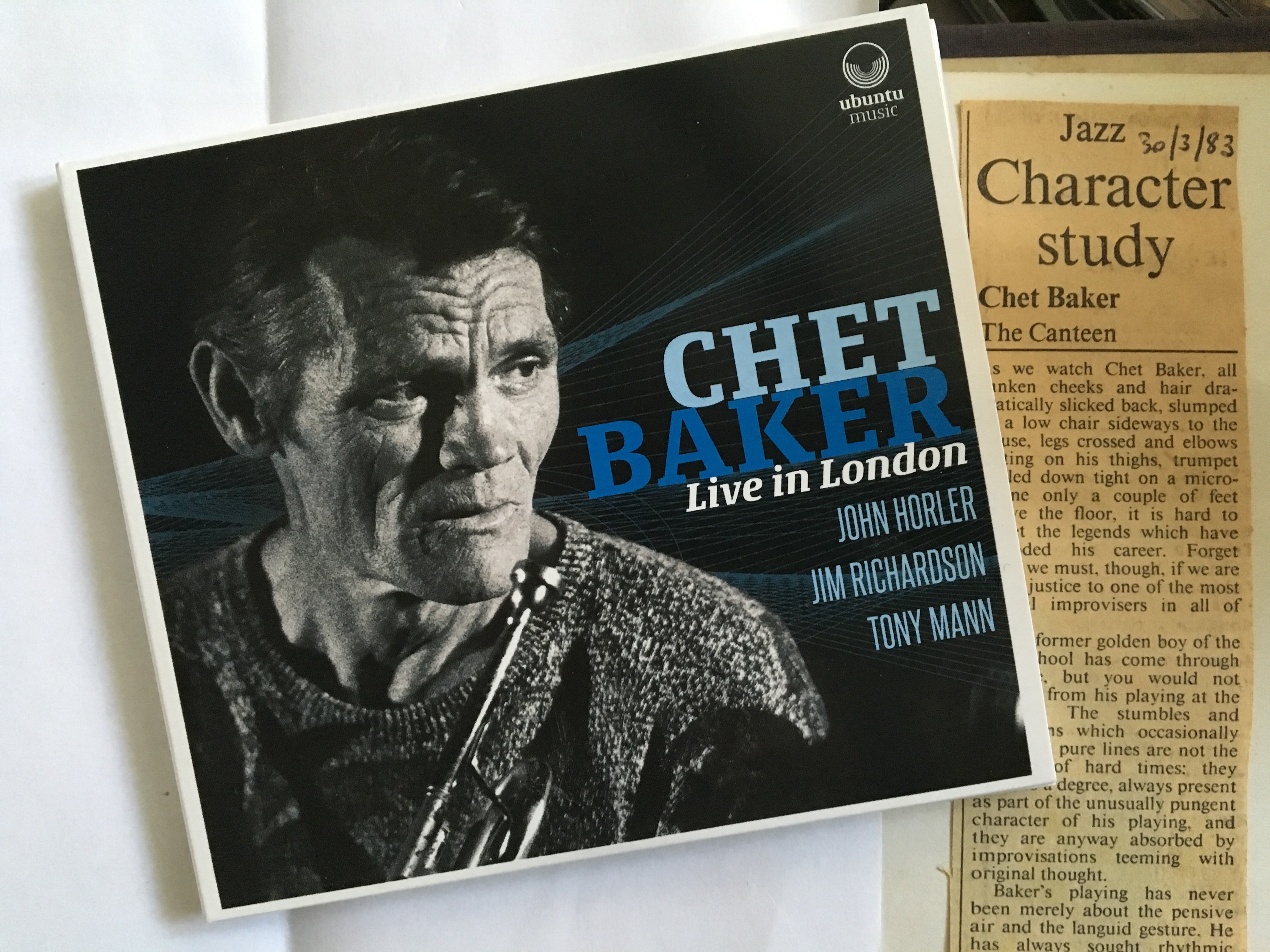
Chet Baker’s week at the club in March 1983 was among the highlights of its short life. If you needed proof that he was always more than just a Great White Hope, here it was. “The former golden boy of the cool school has come through the fire,” I wrote in a review for The Times, “but you would not know it from his playing at the Canteen.” Accompanied by an excellent local rhythm section — John Horler (piano), Jim Richardson (bass) and Tony Mann (drums) — and sitting sidelong to the audience, his improvising was serious and creative and full of substance.

Luckily, and with Baker’s permission, Richardson recorded the engagement on a Sony cassette machine. Now, more than three decades later, the tapes have been disinterred, professionally restored and released as a two-CD set. The sound is excellent and the quality of the playing compares favourably, I would say, with the recordings from Paris, Tokyo and Hannover (1981, 1987 and 1988 respectively) on which I wrote in a post about Chet a while ago.

The trumpeter’s tone on tunes like Sam Rivers’ “Beatrice”, Hal Galper’s “Margarine”, Richie Beirach’s “Leaving” and the standards — including “I’ll Remember April”, “Have You Met Miss Jones?” and “With a Song in My Heart” — is firm and confident, the lines long, the phrasing fluent. By this point in his life, 30 years after first recording it with the Gerry Mulligan Quartet, he had played “My Funny Valentine” so many times that you would have expected his interpretation to be threadbare; here, in the course of a long solo, he investigates its familiar contours as if exploring them for the first time, shaping his double- and triple-time runs with such elegance that it’s easy to forgive him for running out of steam in the closing bars, before handing over to Horler.

The rhythm section is alert and resilient throughout the recording, exemplary in its collective command of the appropriate post-bop approach. So it was a treat to see the trio reassembled for the first time in 33 years at Ronnie Scott’s last week to celebrate the album’s imminent release, and playing just as well. They were joined by the trumpeter Quentin Collins, the tenorist Leo Richardson and the singer Norma Winstone to pay tribute to Baker by reprising the repertoire from the Canteen sessions. Wisely, Collins did not attempt an imitation, evoking the spirit rather than the manner (his personal stylistic compass points him closer to Lee Morgan territory). On “Beatrice”, Richardson’s middleweight sound and mobility reminded me a little of Hank Mobley, which can’t be bad. Winstone delivered “The Touch of Your Lips” and “My Ideal” with characteristic grace.

A few days earlier I’d been to see Ethan Hawke portraying Baker in Robert Budreau’s film Born to Be Blue. Like Don Cheadle impersonating Miles Davis in the recent Miles Ahead, Hawke gives an honest and sincere performance, at times genuinely touching. There are several good scenes, but the apparent need to modify the narrative to fit a Hollywood feature-film template diminishes rather than enhances the story. Your money would be better spent on Chet Baker Live in London, a valuable souvenir of an interesting week.

* Chet Baker Live in London will be released on the Ubuntu label on October 28.