Skip to content

Posts tagged ‘Lenny Kaye’

At the London Palladium

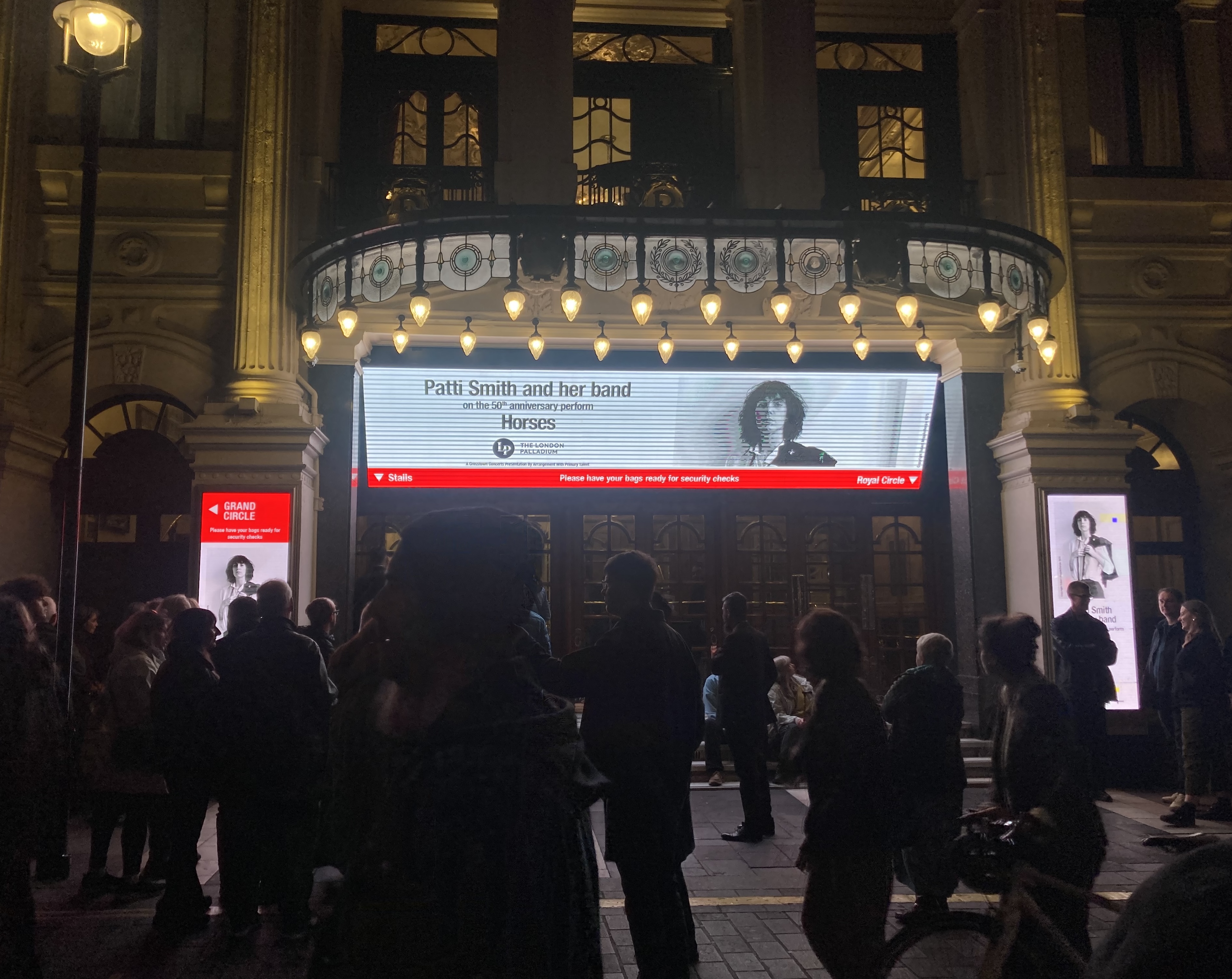
Two poets took the stage at the London Palladium this week. The first, Patti Smith, was celebrating the 50th anniversary of the release of the epochal album Horses by playing it all the way through with a band including two of her original confrères. The second, Al Stewart, had made it part of his farewell tour, and thus his final appearance in the city where he once shared a flat with the young Paul Simon and had a residency at Bunjie’s, a folk club a shortish walk across Soho from where he was saying his goodbyes.

Smith is 78. Stewart is 80. Horses came out in 1975, the year before Stewart enjoyed his biggest hit with the title track from Year of the Cat. Both drew full houses — Smith on two nights running — and performed with a vigour that reanimated the work of their youth.

We know Smith as a poet who rammed literary and musical forms together to great and lasting effect. Stewart’s success in turning big subjects — the Basque separatist movement, the French Revolution, Operation Barbarossa — into long narrative folk-rock songs reflected a creative use of the early impact of Bob Dylan on his songwriting. But where the enduring glamour of the New York era of CBGB and Max’s Kansas City ensures Smith’s continuing credibility, Stewart’s soft-rock associations have probably restricted his following to his original audience. There was no measurable difference in the enthusiasm that greeted both artists on a celebrated stage.

If the guitarist Lenny Kaye and the drummer Jay Dee Daugherty provided valued historical support for Horses, assisted by Jackson Smith and Tony Shanahan on keyboard and bass guitar, Stewart (and his four-piece band from Chicago, the Empty Pockets, plus the saxophonist/flautist Chase Huna) benefited from the guest presence of his old collaborator Peter White, who added beautiful guitar decoration to “Time Passages”, which he co-wrote, and “On the Border”, and remodelled the rhapsodic piano introduction — including “As Time Goes By” — to “Year of the Cat”.

To be honest, I hadn’t listened to Stewart for decades before last night. I bought the tickets as a treat for my wife, who knew him a little in Bristol folk scene of the late ’60s and remembers once giving him a lift to London. But as thrilled as I was to hear Smith declaiming “Redondo Beach” and “Birdland”, I was just as beguiled by Stewart’s “The Road to Moscow” and “The Dark and the Rolling Sea”.

Today Smith, of course, looks even more like a poet than she did in 1975. Stewart, who lives in Arizona, now resembles someone who might be the secretary of the local bridge club. Good on both of them.

Andy Paley 1951-2024

The first time I heard Andy Paley’s name was when my New York friends Richard and Lisa Robinson gave me a copy of the first album by a group called the Sidewinders in 1972. It had been produced by their friend — soon to be mine, too — Lenny Kaye. It was on RCA, where Richard had taken a job as an A&R man.

“Listen to the song called ‘Rendezvous’,” Lisa and Richard told me. I did. I loved it. A sweet slice of early power-pop, inspired by the girl groups of the ’60s. Easy to imagine with a full Wall of Sound production and a Darlene Love vocal. It sounded like a hit, but it wasn’t. Anyway, it’s still in my head today.

A year or so later, Andy came to see me at Island Records in Hammersmith, where I was in A&R. It was just a social call, but he left me with two things: an impression of the charming, very handsome young man he was, and a C60 cassette on which he’d put some of his favourite stuff, as a gift.

I’ve still got it somewhere, but the track that I had to get on vinyl became one of my all-time three favourite girl-group records: the Inspirations’ “What Am I Gonna Do With You (Hey Baby)”, written by Russ Titelman and Gerry Goffin. (And don’t tell me that the Chiffons’ version was better, or the Fleetwoods’, or Skeeter Davis’s, or Lesley Gore’s, or even Carole King’s lovely demo, because you’re wrong.)

The Sidewinders didn’t happen, and Andy just missed being a teenbopper sensation with his brother Jonathan in the Paley Brothers, but he went on to do lots of things in the music business, including working with Jonathan Richman and writing songs for Jerry Lee Lewis and Madonna. But probably the most important contribution he made was to Brian Wilson’s return to action in 1988. Andy and Brian became close, and together they wrote and co-produced some of the songs on the comeback album (Brian Wilson, Sire Records). You can hear the pop sensibility they shared on “Meet Me in My Dreams Tonight” and “Night Time”.

Andy died of cancer last week at his home in Vermont. He was 73. Lenny went up to see him in the last hours. Andy wasn’t conscious, but Lenny sang to him. Among the songs he sang was “Rendezvous”.

* The photo of Andy Paley was taken at CBGB in 1977. I’m afraid I’m unable to credit the photographer.

Lenny the K strikes again

The last time Lenny Kaye put together a compilation album, it changed the world. Well, a significant part of it, anyway. The meticulously assembled double album released in 1972 under the title Nuggets: Original Artyfacts from the First Psychedelic Era 1965-68 became a touchstone for the generation that created the punk movement, first in the US and then in the UK. Listening to the Standells, the Seeds, Count Five and the 13th Floor Elevators, kids who’d been drowning in Tales from Topographic Oceans discovered that pop songs worked best when they were two minutes long and built on a minimum of chords, with lyrics that stuck to the teenage basics.

It’s funny to think that although it made its appearance only four years after the release of its most recent track, Nuggets was — intentionally or otherwise — a historical document. But it has never sounded dated, then or now.

Lightning Striking is something different. A two-CD set, it’s the support act to Lenny’s new book of the same name, subtitled Ten Transformative Moments in Rock and Roll, in which he reminds us of the talent that was lost to music writing when he swapped his Remington for a Stratocaster and threw in his lot with a young poet named Patti Smith in 1971.

I met him the year before that, when he was working at Village Oldies on Bleecker Street — “ten dollars a shift and all the records I could filch,” he writes in the book — and contributing to publications including Rolling Stone and Cavalier, a Playboy rival. His album reviews for Jann Wenner’s rock-culture magazine were outstanding, written with an evident love for the music. We bonded over doo-wop and the Velvet Underground, and In New York in 1971 he showed me where the individual Velvets had taken their places on stage during their nine-week season the previous summer upstairs at Max’s Kansas City, where he’d been to see them many times.

Back in 2004 Lenny wrote a fine book titled You Call It Madness, on an unexpected subject: a study of the crooners of the 1930s, including Rudy Vallee, Russ Columbo and Bing Crosby. Now, a few weeks after his unforgettable appearance with Patti at the Albert Hall, comes his history of rock and roll in a series of very enjoyable vignettes, from Memphis in 1954 to Seattle in 1991 via New Orleans, Philadelphia, Liverpool, San Francisco, Detroit, New York City, London, and Los Angeles and Norway, who share the penultimate chapter (on Metal, of course).

It occurs to me that Lenny and I — born three months apart — belong to the last generation with first-hand engagement in the whole story, from hearing Bill Haley, Elvis Presley and Frankie Lymon before we were into double figures and the Beatles, the Stones and Motown when we were in our early teens. I’m not sure of the deeper significance of this, but in Lenny’s case it certainly informs his writing with a precious first-hand enthusiasm. And I’m glad he’s chosen to frame the story of the music through that lens.

In the chapter called “Liverpool 1962”, for instance, he illustrates the effect the Beatles had on him when the British Invasion was in full spate: “It made me want to find out, or at least feel what it felt like. In the summer of 1964, after patiently absorbing barre chords from a friend who could play some of the diminished progessions that Paul brought to ‘Till There Was You’, I bought a cherry red Gibson Les Paul Special and a Magnatone 280 amp (true vibrato, the same kind Buddy Holly played) from a kid down the street who had given up the calling. On November 7 the Vandals (Bringing Down the House With Your Kind of Music!) debuted at the Chi Psi fraternity on the Rutgers University campus.”

I love how he freewheels through the early history. “How to sing like a girl. In the voice of a girl. That is Philadelphia’s tradition.” That’s true from Frankie Avalon to the Stylistics. By 1966 he’s getting closer to the music. A lyricist uncle bankrolls and co-writes Lenny’s first recording, a 45 called “Crazy Like a Fox”, a folk-rock-protest disc released under the name Link Cromwell. A year later he’s speeding across America with his friend Larry in a ’56 Ford, heading for San Francisco and the Summer of Love, seeing Big Brother and the Holding Company at the Avalon and Quicksilver Messenger Service at the Fillmore. In a chapter called “Detroit 1969” he’s great on the story of the MC5, who foreshadowed so much, and the Stooges, with roles for the likes of John Sinclair, Danny Fields, Jac Holzman and Jon Landau.

Back in New York in 1971, he’s invited to accompany the unknown Patti Smith at St Mark’s Church on 10th Street. It was Sam Shepard’s idea. One rehearsal, in her apartment: “She chanted poems and I followed along, watching how she breathed. Simple chords, all I knew.” The story of how the Patti Smith Group emerged from the scuzzy Downtown scene of the early ’70s, intertwined with those of the New York Dolls, CBGBs, Television and the Ramones, is the centrepiece of the book and worth the price of admission alone. And it was Lenny who, before a show in Detroit in 1976, introduced Patti to the MC5’s Fred “Sonic” Smith, her forever soulmate.

Later on he takes us through Grunge and Death Metal, although the tracks representing those chapters on the album will probably be the least played in my house. But there are some gems: I didn’t know the hair-raisingly direct “I’m Gonna Murder My Baby” by the ’50s Chicago blues guitarist Pat Hare or “Marcella” by the Castelles, a gorgeous slice of Philly doo-wop. And there’s the trick that compilations sometimes pull off, of making you listen to something extremely familiar with fresh ears. In this case, for me, it’s Elvis’s “That’s All Right” and Cliff’s “Move It”, both of which suddenly sounded once again like messages from another planet.

If the album is fun, the book that inspired it is a wonderful extended blast of insider knowledge with outsider perspective, expressed in the language of rock and roll. Lenny’s mission with Nuggets almost 50 years ago was, he says, “to make sure my favourite records kept on living.” Apart from anything else, Lightning Striking shows how well he did his job.

* Lenny Kaye’s Lightning Striking is published in the US by Ecco and in the UK by White Rabbit. The album, compiled by Lenny Kaye and Alec Palao, is on Ace Records.
Patti Smith at the Albert Hall

When she was 15 or so, the woman said, she’d dreamed about a certain boy, about walking down the street holding his hand. And now here she was, performing at the Royal Albert Hall for the first time, and she was going to sing one of his songs. And at the end of a most elegant version of “One Too Many Mornings”, Patti Smith said quietly: “Bob Dylan.”

The last time I’d seen Patti was in 1995 at the Electric Factory in Philadelphia, when she and Dylan were touring together. She came on to sing “Dark Eyes” with him during his acoustic section, and then she joined him in the encores for “Knockin’ on Heaven’s Door”. It was nice to be reminded last night of the history they share, and she honoured it beautifully on the very stage where, 55 years ago, he sang “One Too Many Mornings” with another band.

But that was just one highlight in a night crammed with them, starting with the lyric to “Piss Factory”, the B-side of her first single in 1974, which she declaimed unaccompanied to start the 90-minute set. That was electrifying, and at the end of the evening my only regret was that she hadn’t done more reading.

But would I have swapped that for the lovely “Grateful”, the driving Velvets drone of “Dancing Barefoot”, the collective exhilaration of “Beneath the Southern Cross”, a most surprising and tender mid-set version of Stevie Wonder’s “Blame It on the Sun”, Lenny Kaye’s dedication of the Stones’ “I’m Free” to Charlie Watts, the cathartic “People Have the Power”, which Patti wrote with her late husband Fred “Sonic” Smith, or the thunderous closing run through “Not Fade Away”, when the instruments cut after the last “I’m gonna tell you how it’s gonna be”, allowing Patti, the band and the entire pan-generational audience to bellow “You’re gonna give your love to me”?

What I also admired was the way she and the band — Kaye and Jackson Smith (guitars), Jesse Paris Smith (piano), Tony Shanahan (bass guitar) and Jay Dee Daugherty (drums) — put on such a well calibrated show while keeping their garage-band rawness and honesty. Jackson Smith’s raga-rock solo on “Dancing Barefoot” was a beauty, as was Daugherty’s ability — probably learnt from reggae drumming — to leave spaces within a bar without losing power.

But I wasn’t really taking notes. I was on my feet, with everyone else.