Skip to content

Posts tagged ‘Kit Downes’

Back to Berlin

“A lot of people have died recently,” Otomo Yoshihide remarked to his Berlin audience on Sunday night, halfway through a set by his 16-piece Special Big Band. “This is for them.” The band’s marimba player, Aikawa Hitomi, began to trace out some quiet, limpid phrases, with a sound like pebbles dropping in a pond. One by one, her colleagues joined in. I don’t really know how to explain what was happening, whether or not it was a written composition or completely improvised, but each player added a layer of sadness to the piece until it gradually, and completely without ostentation, reached a critical mass of emotion.

It was amazing. The non-specific nature of Yoshihide’s introduction allowed the listeners — and the musicians, I guess — to direct their mourning wherever they wished. And having created something so sombre and profound, Yoshihide didn’t take the bandleader’s easy option by then lifting the mood with one of the absurdly entertaining rave-ups in which his band specialises, and with which they would eventually send the audience home smiling fit to burst. Instead his accordionist, Okuchi Shunsuke, squeezed out the gentle melody of “Années de Solitude”, a graceful composition by the great Astor Piazzolla. Soon the lonely accordion was joined the baritone saxophone of Yoshida Nonoko, before the other horns entered in a rich arrangement ending with hymn-like cadences.

After that, it was time to change the mood in a set that contained an unusually large proportion of the gamut of human emotions, from cheesy film and TV themes and a perky “I Say a Little Prayer” through a pretty version of Eric Dolphy’s “Something Sweet, Something Tender” and a suitably stirring reading of Charlie Haden’s “Song for Che”. The encore was a completely bonkers piece of Japanese pop music featuring the all-action singing and dancing of three of the group’s women — Hitomi, the electronics player Sachiko M and the saxophonist Inoue Nashie — with a kind of rap from Yoshihide.

For the closing performance of the 2024 JazzFest Berlin, Yoshihide’s ensemble was the perfect choice. Twenty four hours after the Sun Ra Arkestra had occupied the same stage in their tinsel and cooking-foil Afrofuturist costumes, recessing from the stage one by one with a chanted recommendation for Outer Spaceways Incorporated, the men and women of the Japanese band came dressed like refugees from a Comme des Garçons sample sale. Were they from the West, Felliniesque would be one obvious way of describing their presentation. With two drummers, a tuba and a very emphatic bass guitarist, and with the leader’s guitar sometimes throwing in some of the noise elements for which he is well known, they made me think of what might happen if you merged the Willem Breuker Kollektiev with the Glitter Band, with Carla Bley providing the arrangements.

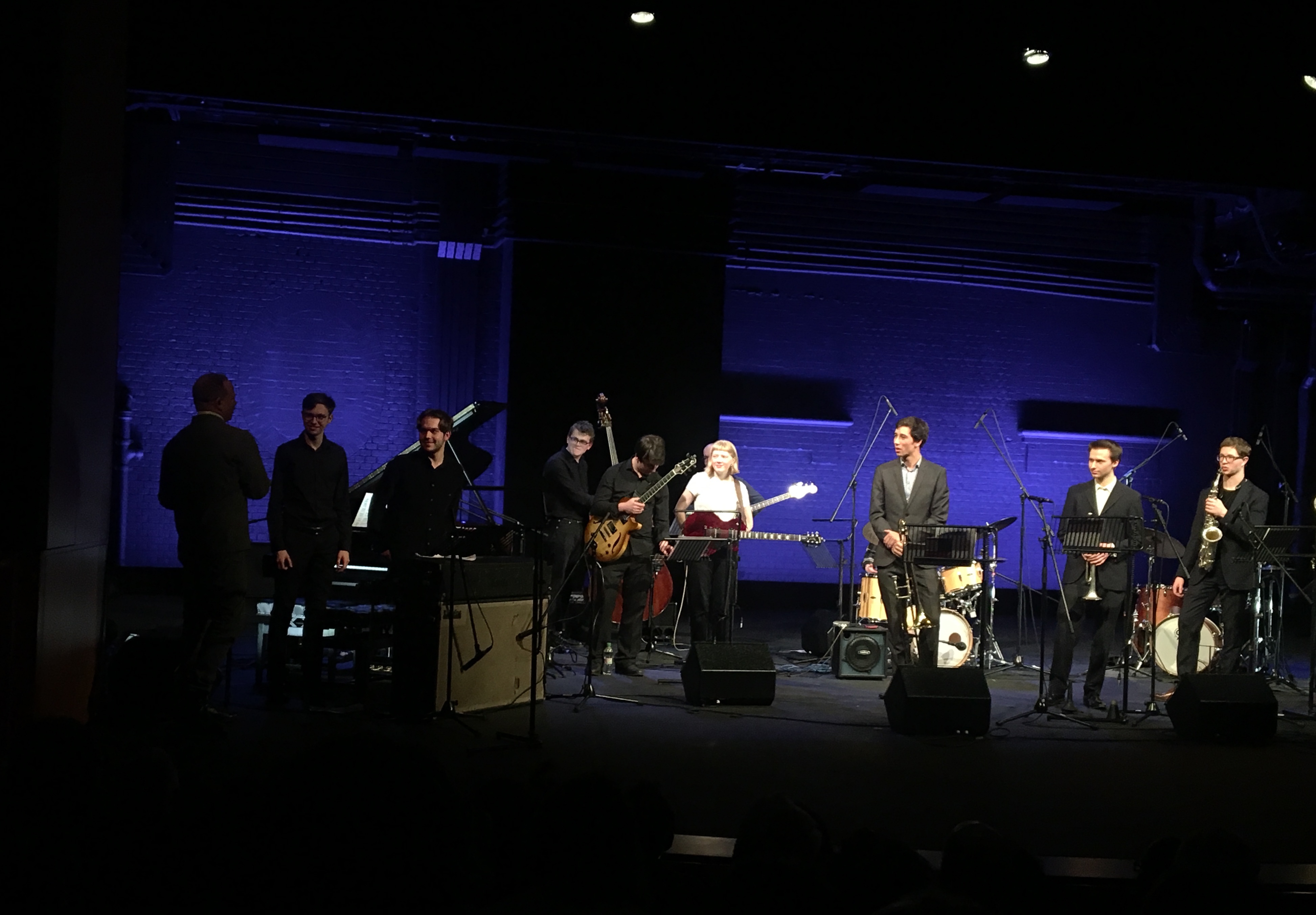
One amusing thing they did in the up-tempo pieces was to have each member leap up to give cues and perhaps conduct a few bars before resuming their places: a kind of daisy-chain of instructions and cheer-leading. It made me think of something I’d seen that morning on stage at the Jazz Institut, where the festival’s Community Sunday, centred on the multicultural Moabit district of Berlin, began with a concert featuring children. While a young piano trio played, a group of kids, perhaps six to 10 years old, stood in front of them, giving the sort of signals — faster! slower! stop! start! — familiar from the techniques of conduction.

It was a good game, everyone enjoyed it, and it made me wonder whether, a few decades ago, someone had tried something similar in Japan, laying the foundations for Otomo Yoshihide’s Special Big Band. Almost certainly not, but there was the same sense of play at work, as it were. And if you give that opportunity to a bunch of kids, there must be a chance that it will open up a world for some of them.

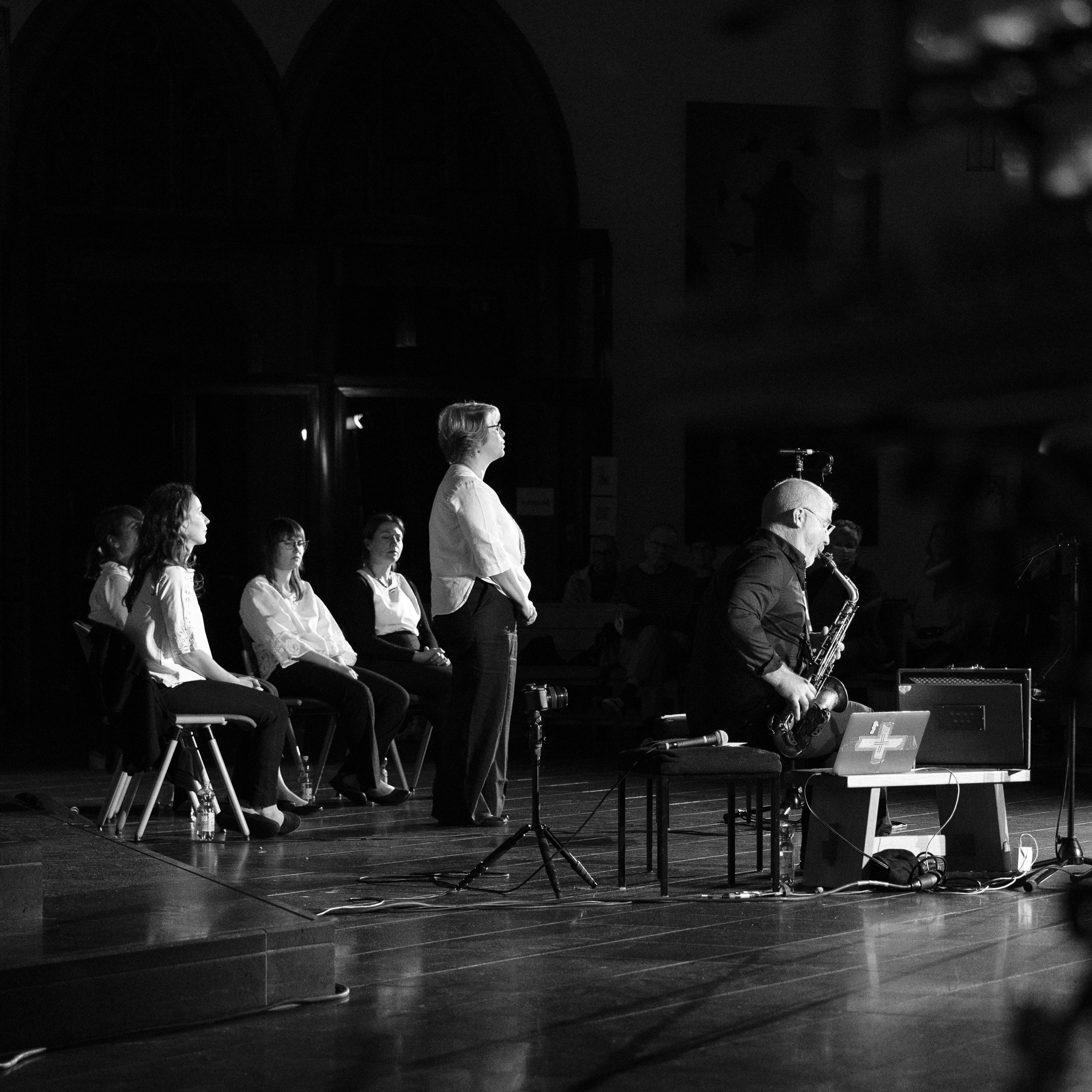
The Moabit adventure continued with a mass walk through the streets, audience and musicians stopping off at various points for pop-up musical events. It ended in a church, where Alexander Hawkins played the organ and members of the Yoshihide band and the Swedish bassist Vilhelm Bromander’s Unfolding Orchestra took part, along with a young people’s choir and local musicians with various cultural backgrounds. The special project of Nadin Deventer, now seven years into her tenure as the festival’s artistic director, it proved to be a brilliant way to involve a community and its children, and deserves to become a permanent feature of an institution celebrating its 60th birthday.

For me, other highlights of the four days included Joe McPhee reading his poetry with Decoy; the French pianist Sylvie Courvoisier’s new quartet, Poppy Seeds, featuring the vibraphonist Patricia Brennan, the bassist Thomas Morgan and the drummer Dan Weiss, playing compositions of great intricacy with superb deftness; and the trio of two British musicians, the pianist Kit Downes and the drummer Andrew Lisle, and the Berlin-based Argentinian tenor saxophonist Camila Nebbia, entrancing a packed A-Trane with warm gusts of collective improvisation. In the main hall on Saturday night there was also a moving ovation for the pianist Joachim Kühn, who made a speech announcing that, at 80, this appearance with his current trio would be his last at the festival, having made his first in 1966, aged 22.

A festival with an ending, then, in more than one sense, but also full of beginnings and new possibilities, just as the visionary jazz critic and impresario Joachim-Ernst Berendt envisaged 60 years ago when he persuaded the West German government that its slice of Berlin, marooned in the GDR, needed something with which to demonstrate a sense of vibrant modernity to the world, and that thing was jazz. In very different circumstances, it still is.

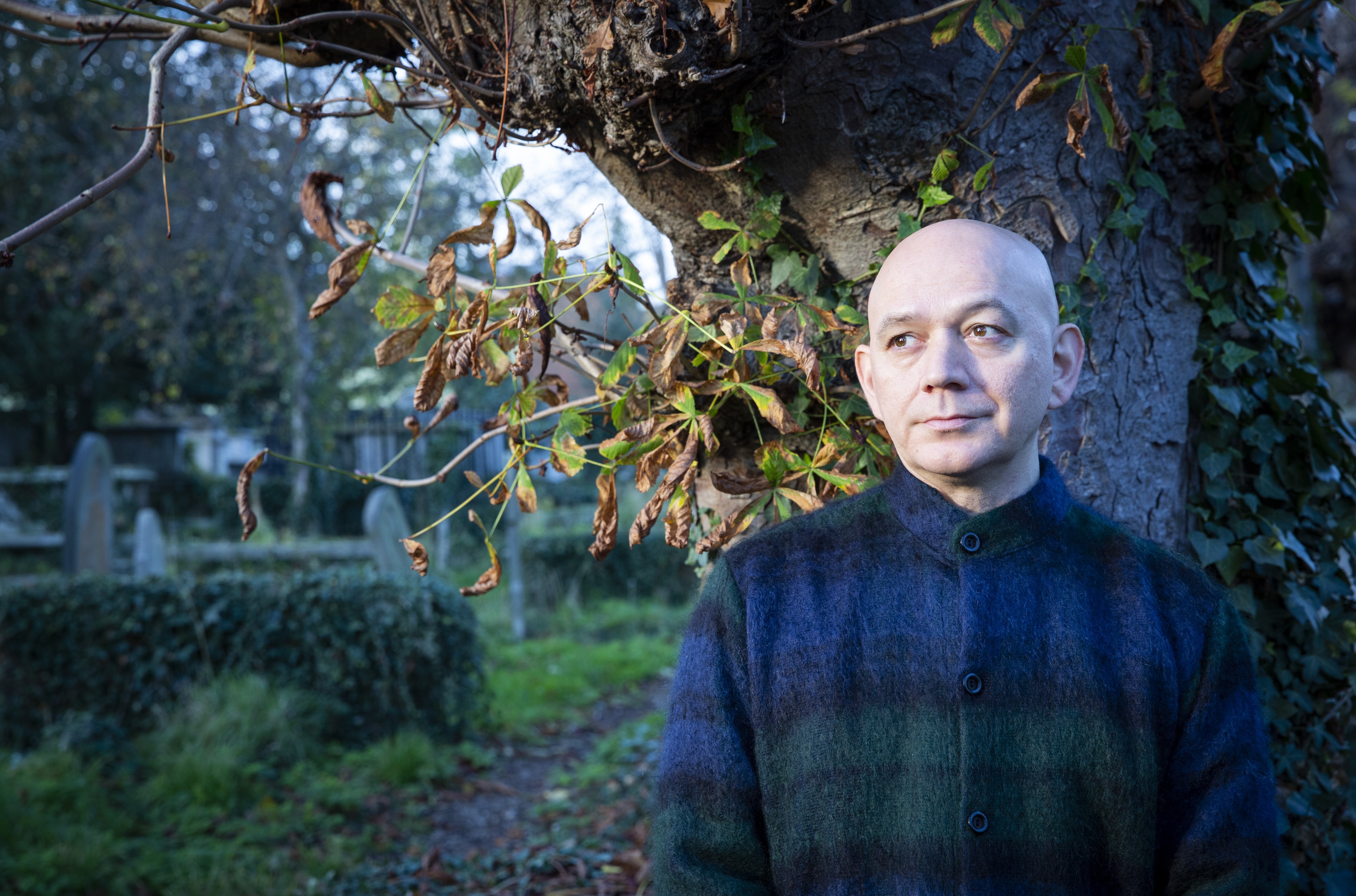
On Kit Downes

One night a few weeks ago I was at the Vortex, listening to a hour of free improvisation performed in the downstairs bar by the pianist Kit Downes with the saxophonist Tom Challenger, his familiar colleague, the drummer Andrew Lisle, and two names new to me; the guitarist Tara Cunningham and the bassist Caius Williams. It was a lovely set, full of lyricism and surprises. Downes, Challenger and Lisle are entirely at home in such an environment; it was a pleasure to hear the contributions of Cunningham, making an intriguing adaptation of the innovations associated with Derek Bailey, and Williams, who produced not just supple and responsive lines but the loveliest tone I’ve heard from an upright bass for ages.

Then I went home to resume listening to a new CD sent to me from Amsterdam, where the celebrated Bimhuis club had recorded Downes’s multinational 10-piece band playing an extended piece titled Dr Snap — one of a series of four “composition assignments reflecting the current zeitgeist” commissioned, under the overall heading of Reflex, from four different composers — and to Outpost of Dreams, Kit’s new album of duets with Norma Winstone on the ECM label.

Recorded live at the Bimhuis in November 2022, Dr Snap consists of seven pieces by Downes, one by Challenger and two by the bassist Petter Eldh. It begins in a deceptively mild manner — twitchy rhythms, knotty woodwind themes — before broadening and deepening as it goes on, opening out to expose exceptional work from the trumpeter Percy Pursglove, the saxophonists Ben van Gelder and Robin Fincker, the flautist Ketije Ringe Karahona, the guitarist Reinier Baas, the bassist Petter Eldh, and the drummers and percussionists Sun-Mi Hong, James Maddren and Veslemøy Narvesen, Plus, of course, the composer’s piano.

Like a lot of today’s jazz writing, it requires 11 fingers on one hand and seven on the other if you want to try and decipher the time signatures. But no such technical analysis is required for a simpler enjoyment of the music as it passes by, hastening without rushing, guided through its endless twists and turns by the highly inventive rhythm section.

There’s a lot of variety here, from passages of hustling density to a lovely stretch of serenity in “Pantheon 4”, a feature for Karahona, via the use of free-jazz techniques behind Pursglove on “Snapdraks”. The solos arise naturally, part of the overall design — as they did, for instance, in the recordings of Steve Lehman’s octet. Three-quarters of a century after what became known as the Birth of the Cool sessions, this kind of jazz for medium-sized ensembles continues to evolve in a very stimulating way.

Downes’s duo with Winstone is a meeting of minds as well as generations (he is 38, she is 82). His tunes join those of John Taylor, Ralph Towner and Adam O’Rourke as vehicles for her lyrics, which are full of elegant, often wistful references to nature and the seasons, to sky and light and wind and their effect on the senses. There are also fine versions of “Black Is the Colour of My True Love’s Hair” and of a traditional tune arranged by the late Bob Cornford, titled “Rowing Home”. From the latter, was there ever a more ECM-evoking opening to a lyric than “Upon the lake in winter sun / A sun that bleaches the sky…”?

As further evidence of Downes’s scope, there’s a forthcoming trio LP called Breaking the Shell on which he plays pipe organ with the guitarist Bill Frisell and the drummer Andrew Cyrille. A track called “Este a Székelyeknél”, released on Bandcamp by the Red Hook label this week, suggests that this, too, will be a notable addition to the body of work being assembled by one of the most consistently stimulating musicians of our time.

* Dr Snap is on the Bimhuis label and Outpost of Dreams is on ECM, both albums out now. Breaking the Shell is released by Red Hook on September 27. The photograph of Kit Downes with the Dr Snap band was taken at the Bimhuis by Maarten Nauw.

Songs of the Balkans

Its appeal somewhere between those of Le Mystère des Voix Bulgares, a leftfield favourite in the 1980s, and the collaboration between the saxophonist Jan Garbarek and the singers of the Hilliard Ensemble in the 1990s, Medna Roso is an album taken from a concert in a Cologne church in 2021 by PJEV, a quintet of female singers specialising in the traditional songs of Serbia, Kosovo, Croatia and Bosnia, with the alto saxophonist Hayden Chisholm and the organist Kit Downes.

Chisholm left his native New Zealand in the ’90s to explore the world of music: jazz at a conservatory in Cologne, Carnatic music in Chennai, and the music of the Balkans. I heard him at a festival in Berlin a few years ago, where I admired the distinctive personality of his playing, later enjoyed on a fine album called Breve which he made with the late pianist John Taylor and the bassist Matt Penman, released in 2015 on the Pirouet label.

Downes, of course, is the gifted English pianist known for his work with Empirical, ENEMY, Troyka and the cellist Lucy Railton, among others. His playing on church organs — which he studied at the Royal Academy of Music — has been heard on an album with the saxophonist Tom Challenger under the name Vyamanikal and on his ECM albums Obsidian and Dreamlife of Debris.

In collaboration with the singers Jovana Lukic, Zvezdana Ostojic, Gloria Lindeman, Lana Hosni and Julijana Lesic, the job of Downes and Chisholm (who also plays analogue synthesisers and shruti box and adds his own throat singing) is to create instrumental textures and interludes, counterpointing, underlining and separating the eight traditional songs that made up the programme for a concert held in St Agnes’ Church as part of Cologne’s JazzWeek.

The voices are plangent, not as lush as the Bulgarian choir, keening and ululating with an ardour and a harsher edge that seems to come from somewhere deep in human history. The songs are about life in mountain villages: families, lovers, the seasons changing (translations are provided in the accompanying booklet). Chisholm and Downes find ways of enhancing their inherent qualities, adding new dimensions and perspectives, providing connective tissue that swells and glows quite beautifully. In the eternal search for music suitable for quiet Sunday mornings, Medna Roso is a valuable discovery.

It’s also the third release on Red Hook, a label founded by the producer Sun Chung, the son of a classical conductor, who grew up in Europe and the US and studied at the New England Conservatory before spending several years at ECM, observing Manfred Eicher’s approach in the recording studio. His label’s debut, a final solo recording by the late pianist Masabumi Kikuchi, called Hanamichi, was one of the finest releases of 2021. Medna Roso will be on this year’s list, no doubt, and deserves a very wide hearing among those likely to respond to its special properties.

* The photograph of PJEV with Hayden Chisholm was taken by Niclas Weber during the concert in Cologne’s Agneskirche. The album is released on 5 May.

Songs for his father

The drummer Sebastian Rochford is one of the ten children of the poet Gerard Rochford, who died in 2019, aged 87. In memory of his father, Seb sat down at his grandfather’s piano in his childhood home in Aberdeen and composed seven short piano pieces, adding an eighth written by his father, and then recorded them with his friend Kit Downes playing the piano and Seb himself occasionally adding a discreet commentary from the drum kit. The resulting album, titled A Short Diary, is the son’s remembrance of his father, a gathering of thoughts and feelings.

Unsurprisingly, the result can feel like a distillation of songs and perhaps hymns heard in childhood, filtered through retrospection and lamentation while quietly radiating a sense of joy and gratitude. The music is spare but not austere, simple yet profound, elegiac but never passive, drifting but not diffuse, melodic but not banal. Sometimes the sounds seem muffled, like the drums in a funeral parade, while clear in tone and articulation; at other times the overtones hang in the air, curling like smoke. ECM’s Manfred Eicher mixed the results, bringing the music — as Seb puts it — into focus, using his studio tools to make the piano sound like itself, allowing its natural resonance to sing out.

The eighth piece, “Even Now I Think of Her”, was initially recorded by Gerard Rochford on his phone and sent to his son, who gave it to Downes. It’s a thing of exquisite beauty, the lovely melody and its gentle harmonic underpinning held aloft by a gentle rustling of brushes and cymbals.

Seb is best known for his work with Polar Bear, Acoustic Ladyland, Sons of Kemet, Adele, Leafcutter John, Brian Eno, Ingrid Laubrock, Damon Albarn and many others. He is a virtuoso. The virtuosity on show here, however, is not of technique but of something deeper and more valuable: the ability to take the deepest, most personal feelings and turn them into wordless music in which everyone can share. This is music without rhetoric or ostentation, in which delicacy and strength find an ideal balance. A quiet masterpiece, I think.

* The photograph of Sebastian Rochford is by Rosie Reed Gold. A Short Diary is released on ECM on January 20.

ECM in London

Craig Taborn at RAM

No apologies for returning, one last time, to the continuing celebrations of ECM’s 50th anniversary. For a short festival at the Royal Academy of Music, the director of the jazz programme, Nick Smart, invited several of the label’s luminaries — the bassist Anders Jormin, the pianists Craig Taborn and Kit Downes, the singer Norma Winstone and the saxophonist Evan Parker — to spend a week working with students before presenting the results in two public concerts on Thursday and Friday night.

Jormin’s compositions — very much what many people would think of as archetypal ECM music, with a restrained lyricism that seemed to have its deepest roots in Nordic folk music — were played by a septet notable for the outstanding singing of Ella Hohnen-Ford and Alma Naidu. Downes and his colleagues in the trio called ENEMY, the bassist Petter Eldh and the drummer James Maddren, enhanced their tricky compositions with arrangements for string quartet, three woodwind and two percussionists, of which the most successful were “Last Leviathan”, a piece from Downes’s ECM debut, Obsidian, fetchingly rearranged for strings and piano, and Eldh’s eventful “Prospect of K”, cunningly scored by Ole Morten Vågan.

For the festival’s closing set, Smart led the Academy big band through a sequence of rare and unheard compositions by the late Kenny Wheeler, another ECM stalwart, featuring Winstone, Parker and Stan Sulzmann. The juxtaposition of the two tenors of Parker and Sulzmann created a contrast that exemplified the breadth of Wheeler’s conception — although their thunder was almost stolen by the alto saxophone of Lewis Sallows, a student whose long solo displayed a disinclination to plump for stylistic orthodoxy and a powerfully dramatic imagination. The crisp and flexible drumming of Ed Richardson, an Academy graduate, also took the ear.

Twenty four hours earlier, Sallows had also been part of the 12-piece band (pictured above) which provided the festival’s highlight. Craig Taborn is already known as one of the most creative and original pianists of the current era; those who were present at the Vortex for his solo gig last year speak of it in awed tones. Friday’s set showed him to rank alongside Steve Lehman, Vijay Iyer, Mary Halvorson and Eve Risser as an adventurous composer-leader who knows how to exploit the resources of a larger ensemble while retaining all the spontaneous interaction of a small group.

Although this was music of great sophistication, there were times when its sheer fire put me in mind of those great Mingus units of the late ’50s and early ’60s, when the members of the Jazz Workshop learnt their parts by ear and took it from there. The trombonist Joel Knee, the trumpeter Laurence Wilkins and the two altoists, Sallows and Sean Payne, threw themselves into the project with enormous skill and gusto, and the ear was also taken by the guitarist Rosie Frater-Taylor, whose opening solo was strikingly thoughtful and who made significant contributions to the riff-ostinatos on which several of the pieces were built.

Taborn’s own solos on acoustic and Fender-Rhodes pianos demonstrated his gift for gathering all the energy once associated with Cecil Taylor and using it to activate the coiled springs of his own imagination. During an unaccompanied introduction, he made the Rhodes roar in a way that completely divested the instrument of its familiar role as a provider of a cool funky background sound. It was one of many moments, individual and collective, that made the event such a success.

Riot in Dalston

Riot in Dalston

There are many worthwhile things going on in jazz at the moment, and one of them is the collaboration with open-minded young musicians from the straight world. Last night at Cafe Oto there were two such efforts, both featuring an eight-piece contingent from the Riot Ensemble, a London-based group who might be compared, I suppose, to Berlin’s Stargaze Orchestra.

The first half of the evening began with two members of the ensemble, Ausiàs Garrigós on bass clarinet and Amy Green on baritone saxophone, playing a fully composed piece called ‘We Speak Etruscan’, written 20 years ago by Lee Hyla, a New York composer who died in 2014. Beautifully conceived as two voices twirling around each other, it was performed with an irresistible momentum and a virtuosity that left plenty of room for the human sound of the instruments.

Then came the other members of the group — Mandira de Saram and Marie Schreer (violins), Jenny Ames (viola), Louise McMonagle (cello), Marianne Schofield (double bass) and Sam Wilson (percussion) — to play a sequence of pieces by Alexander Hawkins, conducted by Aaron Holloway-Nahum, with Hawkins on piano and Evan Parker on soprano saxophone. Parker led off with unaccompanied solo, quietly joined by the strings and a bowed vibraphone, holding a cloud-like chord. Already the textures were new and gorgeous.

The four pieces making the continuous sequence could be played in any order, discreetly cued by the conductor. The music shifted tone and weight constantly, using extended instrumental techniques (including one fantastic passage of drifting harmonics from the strings), and occasionally making space for solos, including one from Hawkins in which he used devices on the piano’s strings to get a kalimba effect. The music was intense and rarified, but never overbearing.

The Riot Ensemble musicians returned for the second half, this time to work with the trio known as ENEMY — Kit Downes on piano, Petter Eldh on bass and James Maddren on drums — on pieces written and arranged by Downes and Eldh. This was a very different formula: much more predetermined, much more vertical and horizontal structure, but enormously dynamic and involving, and greatly appreciated by the audience.

Everything played at Cafe Oto is professionally recorded. This was one of those nights when you leave with the hope that what you’ve just heard will eventually be released, so that you can enjoy it again and think about it some more.

Lewis Wright’s ‘Duets’

Lewis Wright

If he were not already a word-class vibes player, Lewis Wright would make a great commercial songwriter. Unlike most people who write jazz compositions, Wright seems to think first of all in terms of pure melody, and then how that melody can be given the most emotionally satisfying harmonic support. He has the knack of writing tunes that sound both fresh and familiar at the same time. In a previous generation, Benny Golson had the same gift.

Wright is probably best known as a member of Empirical, whose last album, Connection, contained a Wright-penned ballad called “Lethe” which carried distant echoes of Duke Pearson’s “Cristo Redentor” (as recorded by Donald Byrd) and Herbie Hancock’s “Maiden Voyage”. Its lovely gentle swell was used to set up and counterpoint Nat Facey’s urgent alto saxophone solo. The tune sounded like a potential jazz classic, although I’m not sure such a thing still exists now that original material is practically compulsory. After two years of owning the album, and several live exposures to the piece, I still play it all the time and it never fails to improve the prevailing mood.

Now Wright, who is 29, makes his leadership debut on record with an album of his own compositions called Duets for Vibraphone and Piano, on which he is joined by Kit Downes. They launched it last night at the Pizza Express in Soho with a set which showed very clearly how much they enjoy playing together, as they’ve done since they were schoolboys living in adjacent villages in Norfolk (Downes is the elder by two years).

It also confirmed Wright’s compositional talent. The ballads “Sati” and “An Absence of Heart” are winning enough — romantic without being drippy — to remind me of Michel Legrand, a comparison which prompted the thought about commercial songwriting. “Sati”, indeed, sounds as if it’s just waiting for the right film to be made — and, like “Lethe”, it ends with a coda that shows he has imaginative ideas about structure. Up-tempo pieces such as “Tokyo ’81” and “Fortuna” are full of cunning surges and sideslips, rhythmically active enough to remind one that Wright has also made his living as a drummer with the likes of Melody Gardot and Joss Stone but still glinting with faceted melodies as they fly by.

His spectacular improvising is not exactly held in check or kept under wraps here (there’s a dazzling passage on the closing “Kintamani”, for instance), but the real point of the exercise is the integration of compositions, performers and instruments into a form of chamber jazz that is by turns serene, jaunty, athletic and pensive. I’d call it a complete success.

* Duets for Vibraphone and Piano is out now on the Signum Classics label.

Music for cellos, organ and gamelan


Tre Voci 3

The lights were already down as I fumbled my way into a back pew of the Union Chapel last night. Thirty seconds later, the performance began. I’d bought a ticket after seeing that Kit Downes would playing the chapel’s pipe organ in company with Tre Voci, a trio of cellists, and the Southbank Gamelan Players. It sounded like an intriguing combination but I didn’t have time to get any clearer idea of what they’d be doing, and I rushed to find a seat without picking up the A4 sheet giving details of the programme. So I was in a position to let the music come as a complete surprise, which is sometimes the best way.

As I’d hoped, the combination turned out to be a happy one, at its best when there was no real attempt to “blend” the ingredients. Juxtaposition was the most rewarding method. So, in the course of an unbroken hour-long open half, the gamelan ensemble played pieces of their music, the cello group played theirs, Downes played a solo piece, and they came together at various junctures.

It proved to be a rich experience. One piece for the cellos (Alexander, Torun Stavseng and Gregor Riddell) found them bowing phrases entirely in harmonics, skittering in three directions at once: very exhilarating. The four members of the gamelan group — Robert Campion, Helen Loth, Cathy Eastburn and Jonathan Roberts — produced the anticipated meditative sounds from their metallophones and gongs, gently striking and occasionally bowing the bars of their xylophone-like instruments. Downes played a piece I recognised, since it came from his new solo organ album, Obsidian. But it was when they came together that the music was at its most convincing, the players fitting the diverse layers of sound together with great sensitivity as they improvised (so I later learnt) on pieces by John Cage, Tre Voci’s Colin Alexander, and Beni Giles, a young graduate of the Royal Academy of Music’s masters course in composition.

If I found the second half, devoted to the world premiere of a new composition by Bryn Harrison titled “To Shadow”, less compelling, it may have been because the ensemble played together almost all the time in this through-composed hour-long piece. The contrasts of the first half were lost, and with them went the dramatic shifts of timbre and texture. But the evening ended in a moment of great beauty, with Laura Moody — invisible in the gallery above and behind the audience — tapping the body of her cello to provide percussive accompaniment as she intoned Cage’s “The Wonderful Widow of Eighteen Springs”, her treatment of the short song pitched somewhere between those of Cathy Berberian and Joey Ramone.

But I left with my head still in the first half, when the music had held not just greater contrast but, perhaps paradoxically, something of the seductive qualities of Terry Riley’s all-night keyboard concerts and La Monte Young’s Dream House. In this, the surroundings certainly helped. The instrumentation suited the chapel’s acoustic, with lighting that enhanced the meditative atmosphere — particularly when a semi-abstract mandala pattern was projected on to the rose window above the organ chamber. And on the way out I bought Tre Voci’s EP of transcriptions for three cellos of medieval choral works by Ockeghem, Dunstable and Byrd, which turned out to be a perfect souvenir.

* Kit Downes’s Obsidian, recorded on organs at the Union Chapel and in two small churches in Suffolk, is released on the ECM label. To hear recordings of Tre Voci, go to  http://trevocicelloensemble.com/media/ And here’s a larger grouping of the Southbank Gamelan Players at David Byrne’s Meltdown a couple of years ago: https://youtu.be/99B-CrJYG9I

Doubling Downes

Vyamanikal 2

Vyamanikal + 2: Tom Challenger, Alex Bonney, Lucy Railton, Kit Downes

The profound sense of peace that descended over Hall 2 of Kings Place last night as the set by an expanded version of Vyamanikal glided towards its close was unlike anything I’ve encountered all year. The pianist Kit Downes and the tenor saxophonist Tom Challenger, normally a duo in this guise, were joined on the stage by the cellist Lucy Railton and by Alex Bonney, who sat at a laptop. Bonney was processing the music and sounds recorded by Downes and Challenger in 2015 in the small churches of five Suffolk villages, collecting the sounds of organs in various states of repair for an album released last year, and feeding it into the live performance.

In the absence of a church organ, Downes alternated between a piano and a small hand-pumped harmonium. For the better part of an hour the musicians wove tapestries of sound in which individual elements blended seamlessly. There were certainly gorgeous details, but they fade in the memory next to the overall impression of a glowing organic whole.

If there was a kind of English pastoral vibe in the air, it was implicit rather than declarative, and never suffocating. I suppose the most obvious precedent might be some of John Surman’s recordings, from Westering Home onwards, but really this music seemed to stand alone, without need for comparison. As they neared the end, the three instrumentalists stopped playing but the music continued, thanks to Bonney, in a many-layered drone which seemed to distill everything that had been played in the previous 50 minutes. And then came a few moments of silence in which we could find our own way out of the trance.

The first half of the evening had featured Tricko, the duo in which Railton and Downes perform a kind of sui generis cello-and-piano chamber music that manages to be intricate without inducing strain and immediately attractive without becoming winsome. “I’m aware that this music is cripplingly quiet,” Downes said at one point. “If I were listening, I’d probably be asleep by now.” That might indeed be the initial impression. But the longer you listen to them, the more awake you feel.

* Vyamanikal’s album is on the Slip Imprint label. Downes’s solo organ album, Obsidian, will be released by ECM early next year.