Skip to content

Posts tagged ‘Jan Bang’

Silence and slow time

“Silence and slow time…” John Keats’s beautiful phrase finds an echo in some of the music I love, the kind that emerges from a stillness to which it eventually returns, taking its time and not raising its voice to attract attention. Here are five brand-new examples of music with healing qualities, all highly recommended.

1 The Necks: Disquiet (Northern Spy)

Three hours of glorious studio-recorded collective interplay on three CDs. “Rapid Eye Movement” is a 57-minute exploration of densities, starting with Chris Abrahams’ Rhodes piano, punctuated by Lloyd Swanton’s abrupt double bass figures. It changes slowly, like the weather, eventually reaching a passage of single-note cascades from the acoustic piano over Tony Buck’s rumbling tom-toms, leading to an exquisitely tapered ending. “Ghost Net” is 74 minutes of lurching, clattering, gradually darkening polyrhythmic layering, with each musician apparently playing in 12/8, but in three different 12/8s. Using what sounds like a Farfisa organ, it’s as though they’ve suddenly found the sweet spot between Thelonious Monk and ? and the Mysterians. The other two tracks divide an hour between them. “Causeway” opens with echoing guitar and celestial organ and contains a completely intoxicating E minor/B minor/A minor vamp — the Necks’ own three-chord trick — with piano above guitar and organ before a sudden gearchange, involving the addition of thrashing drums, turns a reverie into something soaringly urgent. “Warm Running Sunlight” is an essay in textures and the contemplative space between them: string bass going from plucked to bowed and back, splashing cymbals, Rhodes heavy on the reverb. A lot to take in, but among their very best, I’d say.

2 Tom Skinner: Kaleidoscopic Visions (Brownswood)

The drummer and composer whose Voices of Bishara project I liked so much, in both its studio and live incarnations, takes a slightly different tack here. The music is built around his regular bandmates — the saxophonists Chelsea Carmichael and Robert Stillman, the bassist Tom Herbert and the cellist Kareen Dayes — but with a handful of guests: Meshell Ndegeocello layering her voices on one track, Portishead’s Adrian Utley adding his guitar to a couple more, the singer Contour (Khari Lucas) from South Carolina gently intoning the poetic lyric of “Logue”, and Yaffra (London-born, Berlin-residing Jonathan Geyevu) reciting the poem “See How They Run” over his own piano and Skinner’s overdubbed keyboards, vibes, bass, guitar and percussion. Music without boundaries, full of human feelings, ancient to the future.

3 Jan Bang / Arve Henriksen: After the Wildfire (Punkt Editions)

The two Norwegians devise eight pieces featuring Henriksen’s distinctive trumpet with Bang’s samples, Eivind Aarset’s guitar, Ingar Zach’s percussion, three singers, the Fames Institute Orchestra, a cellist, two Balkan instruments — the tapan (a double-headed drum) and the kaval (an end-blown flute) — and the zurla, a Turkish double-reed instrument. Ravishing from beginning to end, starting with “Seeing (Eyes Closed)”, which made me think that Miles Davis and Gil Evans had been reincarnated as graduates of the contemporary Norwegian jazz scene, to “Abandoned Cathedral II”, a continuation of Henriksen’s classic 2013 album, Places of Worship.

4 Rolf Lislevand: Libro Primo (ECM New Series)

Another Norwegian, this time an exponent of the archlute and the chitarrone, examining the works written for the lute and its variants by the 16th and 17th century composers Johann Hieronymus Kapsberger, Giovanni Paolo Foscarini, Bernardo Gianoncelli and Diego Ortiz. Lislevand’s sleeve essay explains the revolution in which these composers were involved, and he brings them into the present day with free, fluid interpretations that make this music ageless. His own riveting “Passacaglia al Modo Mio” is both a salute and a declaration of possibilities. Anyone with a fondness for Davy Graham or Sandy Bull will enjoy this enormously.

5 Charles Lloyd: Figures in Blue (Blue Note)

For the latest in his series of drummerless chamber trios, the great saxophonist is joined by an old colleague, the pianist Jason Moran, and a newer one, the guitarist Marvin Sewell. This two-CD set begins with what is surely the first version of “Abide with Me” to appear on a jazz album Monk’s Music in 1957 and ends with a exquisite rumination on the standard “My One and Only Love”. In between Lloyd invokes the spirits of Duke Ellington, Billie Holiday, Langston Hughes and Zakir Hussain. On two tracks he also makes fine use of Sewell’s command of bottleneck techniques, leading one to wish that more modern jazz musicians would explore the blues in the way Gil Evans did with “Spoonful” and Julius Hemphill with “The Hard Blues”.

Other sounds 5: Feat. Arve Henriksen

A fugitive sound, soft, glancing, indirect: the Norwegian trumpeter Arve Henriksen has a signature I love, in pretty much whatever context it appears. It could be in his group Supersilent, or with Jan Bang, Christian Wallumrød, Dhafer Youssef, Terje Rypdal, Iain Ballamy or Trygve Seim, or on his own albums, particularly Places of Worship (Rune Grammofon, 2013), which I think of as this century’s Sketches of Spain.

He’s developed the European equivalent of Jon Hassell’s trumpet sound, using electronics and a natural tendency towards understatement to take the instrument out of its normal brassy universe and into somewhere more mysterious. And he finds two soulmates in the Danish drummer Daniel Sommer and the Swedish bassist Johannes Lundberg on Sounds & Sequences, a trio recording made in a Gothenburg studio.

A series of 11 pieces evolving from free improvisations subjected to post-production processes of editing and shaping, this is a very beautiful thing indeed. Sommer’s playing draws the ear throughout, pulling gentle grooves out of the air and adding the finest of detail. Lundberg and Henriksen both contribute electronic beds and textures (Henriksen also uses his counter-tenor voice from time to time), nudging the music towards something that touches the celestial sublime.

The trumpeter pops up in Triage, the new album from Erik Honoré, one of the founders of Kristiansand’s remix-based Punkt festival, which celebrated its 20th edition last month. Deploying colleagues including Sidsel Endresen, Eivind Aarset, Ingar Zach, Nils Petter Molvaer and Jan Bang, Honoré creates little tone poems, some of them used as settings for found texts.

These include Emily Dickinson’s poems “Hope Is a Thing With Feathers” and “Pain Has an Element of Blank”, portions of Ezra Pound’s Cantos — read by Bang — and a section from the US Surgeon General’s undated instructions on early care of combat wounds: “A not uncommon occurrence in the present war are those distressing wounds of the face and jawbones which have attracted particular attention not only on account of the disfigurement which they cause but even more so from the difficulty that was first encountered on dealing with them…”

The use of different readers adds variety and surprise, as if there were not already enough in the music itself, which also makes use of radio samples and field recordings. An instrumental piece called “Prague”, featuring Molvaer’s trumpet over Bjørn Charles Dreyer’s guitar and Mats Eilertsen’s treated double bass, is particularly striking, as is “In the Station of the Metro”, in which Henriksen’s breathy trumpet emerges between Pound’s lines and Honoré’s manipulated samples with typical probing grace.

Finally, Henriksen’s recent album of duets with the Dutch pianist Harmen Fraanje, Touch of Time, is more conventional in terms of exploitation of the available sonic materials, allowing a clearer view of the trumpeter’s playing, with only the occasional effective touch of electronics. Compositions by both men create music that is delicate, pensive, carefully weighted, devoid of affectation or allusion to outside worlds. The closer you listen, the stronger it gets.

* Sounds & Sequences is on the April Records label (www.aprilrecords.com). Triage is on Punkt Editions/Jazzland. Touch of Time is on ECM. All are out now.

Written in air

Jan Bang is one of the people responsible for the great wave of creative music from Norway over the past three decades. As a producer and player, he’s collaborated with Dhafer Youssef, Nils Petter Molvaer, Arve Henriksen, David Sylvian, Bugge Wesseltoft and many others. In the fishing port of Kristiansand, where he was born in 1968, he and his friend Erik Honoré founded the annual Punkt Festival, where since 2005 live performances have been subjected to immediate remixes. (I wrote about a visit to the 2019 edition here.)

His new album, Reading the Air, is a sequence of songs with music mostly by himself and lyrics by Honoré. The musicians include Henriksen on trumpet, the singers Simin Tander and Benedikte Kløwe Askedalen, the guitarist Eivind Aarset, the bassist Audun Erlien, the drummer Anders Engen and the percussionist Adam Rudolph.

What does it sound like? I was put in mind of late Blue Nile filtered through Jon Hassell’s Fourth World recordings: fragile-sounding melodies, introspective lyrics, voices singing from some private sphere, gauzy textures shaped and layered with great care, on the edge of decay. Through the 10 tracks, there’s a consistency of mood, elegant and reflective.

Here are the opening lines of Honoré’s lyric for the exquisitely beautiful title song: Moving on /We’re planning our escape / Preparing to leave / The disconnected state / Bridges burned / The tables turned / Reading the air / To reconnect with fate. A piano is played in an empty ballroom. A swaying groove emerges and simmers quietly. Bang’s ruminative vocal is sometimes doubled by a female singing over his shoulder. What sounds like a section of shakuhachis turns out to be overdubbed trumpets played by Henriksen, who steps forward for a lighter-than-air solo. I could easily imagine successful covers of this by Annie Lennox, Bryan Ferry or Beth Gibbons with Rustin Man.

The other track I want to mention is the only non-original composition, a version of the old folk-blues song called “Delia” or “Delia’s Gone”, which exists in many versions. This is not the murder-ballad variant recorded by Bob Dylan on World Gone Wrong in 1993 (credited as “traditional”) or the bloodier iteration that Johnny Cash included on the first volume of his American Recordings in 1994 (credited to Cash, Karl Silbersdorf and Dick Toops). Curiously, it’s the smoother and more lyrical variation that Harry Belafonte sang in 1954 on his debut album, “Mark Twain” and Other Folk Favourites, credited to Lester Judson and Fred Brooks. Judson was a commercial songwriter. Brooks was a temporary nom de plume for Fred Hellerman, a member (with Pete Seeger) of the Weavers, who were then under investigation by the FBI for alleged Communist sympathies.

Bang’s version is a sort of Nordic Americana: the bell of a wooden church in the snow, muffled drums, the refined twang of Arset’s lightly picked guitar. No murders in the lyric, but three-part vocal harmony like a bluegrass family stranded up a fjord, in danger of death from exposure to the cruel elements. The line about “everything I had is gone” can rarely have sounded so final.

* Jan Bang’s Reading the Air is released on 19 January on the Punkt Editions label. The photo of Bang is by Alf Solbakken. You can hear “Delia” on this link: https://janbang.bandcamp.com/album/reading-the-air

Punkt postponed

Punkt 1

The news that this week’s Punkt festival in Birmingham has been postponed is no surprise. Live music of any sort in a public setting is going to be unavailable to most people for some time to come, but the loss of this two-day event will be keenly felt. As I discovered at its Norwegian home in Kristiansand last year, Punkt is a very special event, conceived by Jan Bang and Erik Honoré as a vehicle for the exploration of the possibilities of live remixing.

Among those due to perform in Birmingham were the trumpeter/singer Arve Henriksen, the guitarist Eivind Aarset, the singer Maja S. K. Ratkje, the saxophonist Trish Clowes and the drummer Mark Sanders. Also on the schedule was a live remix of The Height of the Reeds, the piece specially commissioned to accompany walks across the Humber Bridge during Hull’s year as Europe’s city of culture in 2017.

I can think of only one direct way of making up for the loss of the festival, and that’s by listening to new albums by some of the Punkt’s principal figures. Snow Catches on Her Eyelashes finds Aarset and Bang creating a series of beguiling soundscapes that feature contributions from the singer Sidsel Endresen, the trumpeter Nils Petter Molvaer, the pianist Hilde Norbakken, the percussionist Anders Engen and the bassist Audun Erlien, with Honoré making an appearance on synthesiser. Bang and Aarset specialise in making electronic music that never forfeits its humanity to science. “Before the Wedding”, featuring Norbakken, has a lyrical simplicity that is as lovely as anything you’ll hear this year.

Arve Henriksen’s The Timeless Nowhere is a box containing four vinyl LPs, each in its own sleeve, each recorded under different circumstances. Towards Language was recorded live at Kick Scene in Kristiansand during Punkt in 2017 with the basic quartet complete by Bang, Aarset and Honoré. Acousmograph is a series of overdubbed solo explorations for trumpet, vocal, keyboards and field recordings. The rapt tone poems of Captured Under Mountainsides make it a close cousin to Henriksen’s classic Places of Worship. And Cryosphere involves Bang in exquisite remixes of pieces from earlier projects.

There are many different strategies here. Henriksen’s music can morph from stateliness to pathos, from reflection to disquiet, sometimes layering contradictory states. But it feels all of a piece: a tapestry of beautiful moments woven together by a unique controlling sensibility of superlative aesthetic instincts.

Meanwhile, the chaos around us at the moment prompts all sorts of thoughts. One is that musicians are going to suffer badly from this enforced hiatus, and a way of continuing to support them is to buy their physical records. Another is this: what happens to music that was never played?

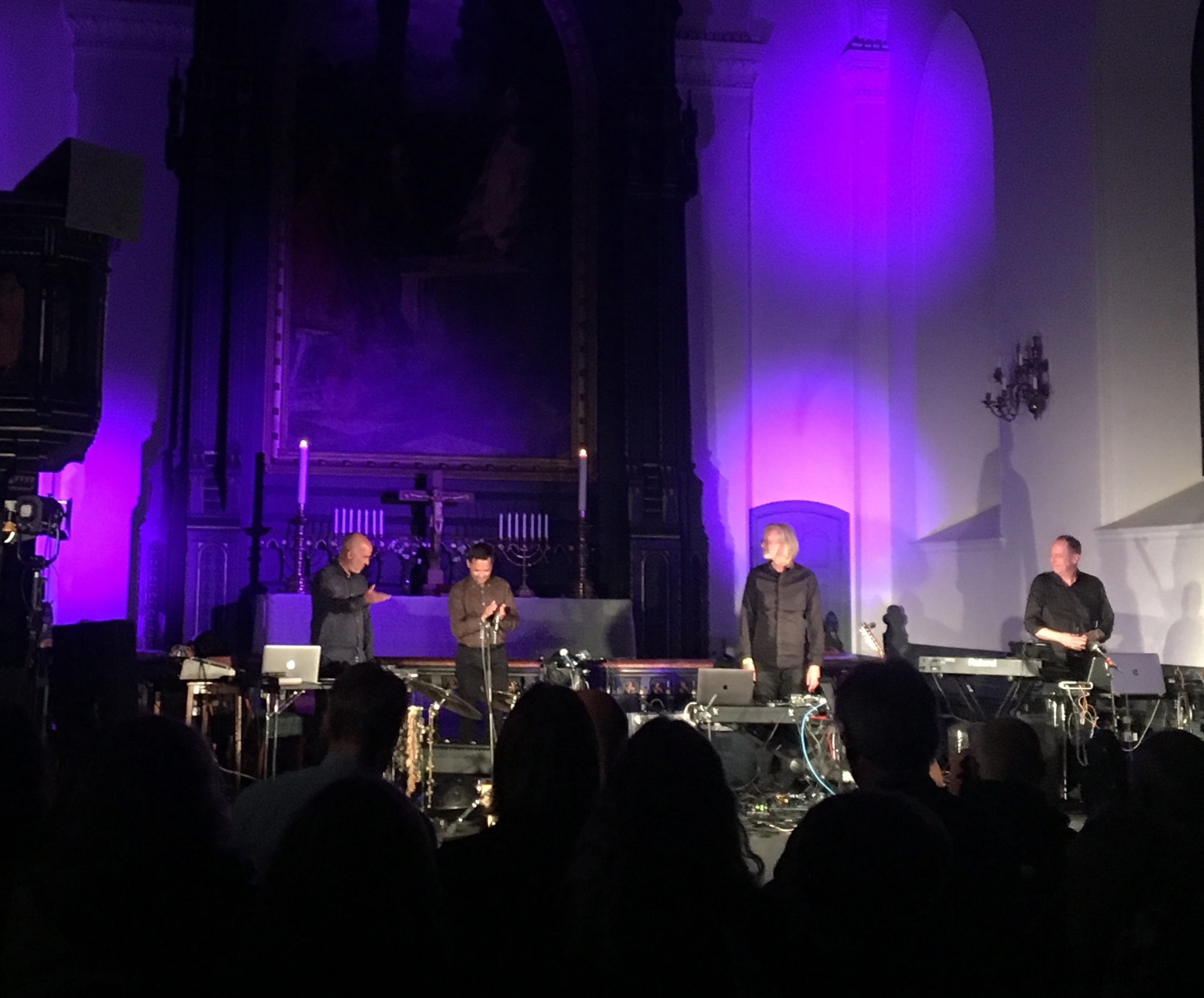
* Snow Catches on Her Eyelashes is on Jazzland Records. The Timeless Nowhere is on Rune Grammofon. The photograph — taken in Kristiansand’s cathedral, the Domkirken, last year — shows (from left) Jan Bang, Arve Henriksen, Eivind Aarset and Erik Honoré.

Punkt 2019

Punkt poster

Kristiansand’s Punkt festival was the brainchild of Jan Bang and Erik Honoré, who had the idea of setting up an annual event featuring instant remixes of every performance. The first edition was held in 2005, and last weekend they celebrated their 15th anniversary with three days of music in the festival’s home, a port on the southern coast of Norway, where the faculty of the university includes Bang as professor of electronic music, with Honoré in a less formal role.

This year Punkt’s group of designated remixers also included the trumpeters Arve Henriksen and Nils Petter Molvær, the guitarist Eivind Aarset, the keyboardist Ståle Storløkken, the producer Helge Sten and the duo of the drummer Pål Hausken and the keyboardist Kåre Christoffer Vestrheim, who called themselves Elektroshop. At each concert one or two of them could be seen onstage seated at their laptops behind or alongside the performers, who included Trondheim Voices in the Domkirken, the city’s cathedral; Thurston Moore’s four-piece band in a club called Kick Scene; and Kim Myhr’s septet and Rymden, the new trio featuring Bugge Wesseltoft, Dan Berglund and Magnus Öström, in the Kilden concert hall on the waterfront.

Immediately after each set the designated remixers would play a set of their own, based on the material they had just recorded. Sometimes they added live instruments: Henriksen’s trumpet and voice, Molvær’s trumpet, Aarset’s guitar, Hausken’s tom-toms and, on one occasion, the voice of Sidsel Endresen. If it wasn’t often easy to detect the salient characteristics of the original material in the remixes, that didn’t seem to matter much.

My favourite example came when Henriksen, Sten and Storløkken — who comprise the long established trio Supersilent — took the thunderous, heavily strummed, highly structured, ecstatic instrumental music created by Moore’s group — with the leader and James Sedwards on electric 12-strings, Deb Googe on six-string bass guitar and Jeb Doulton on drums — and reshaped it into blocks of even more thunderous but harshly fractured noise. During both sets, it was fun to stand behind the conventional mixing desk and watch the decibel meters climbing: peaking above 120dB and inching past an average of 100+. Those who chose to wear earplugs, I felt, lost out on something worthwhile.

Punkt Kim 1

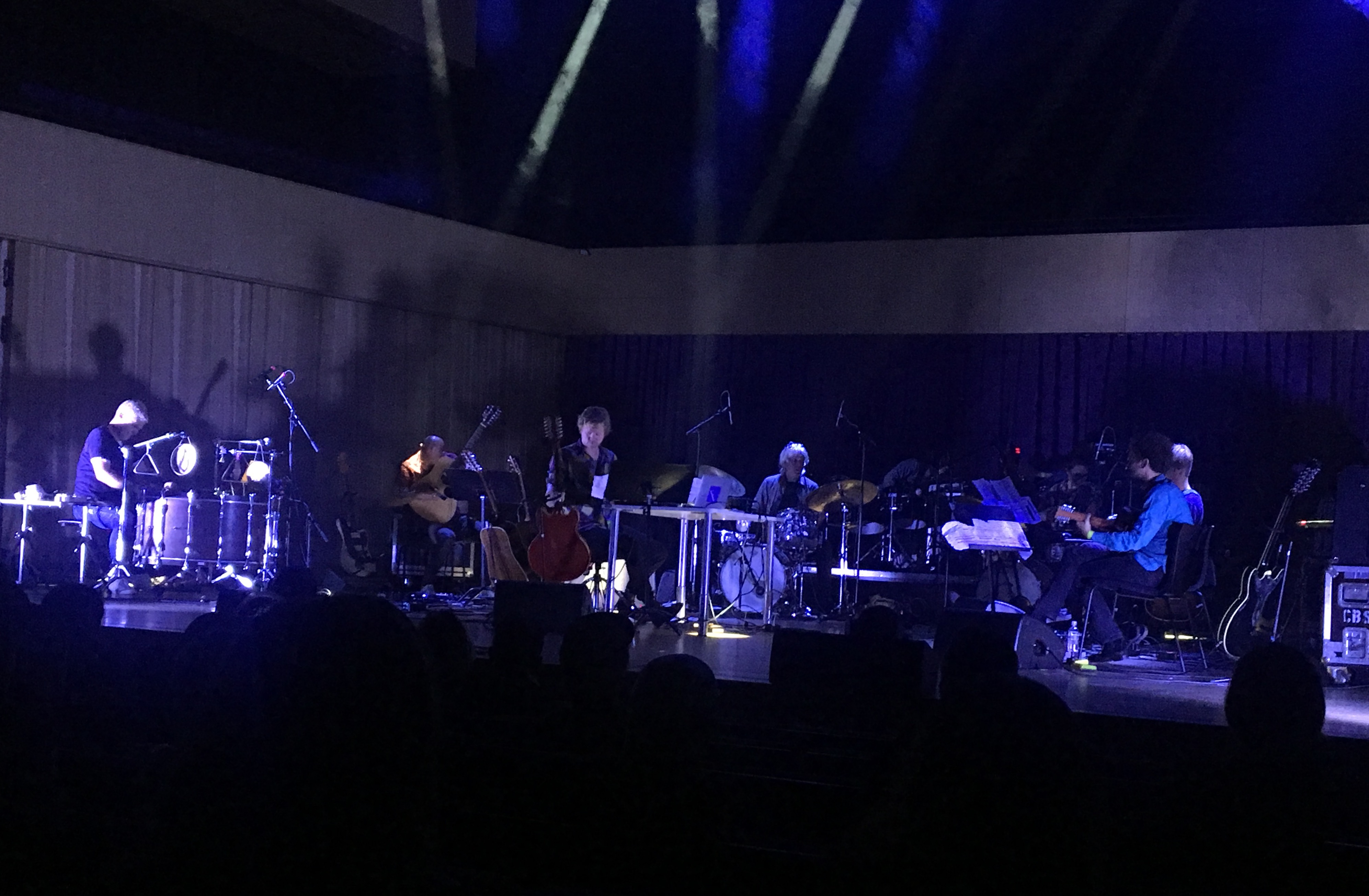
Twenty four hours later, Kim Myhr’s band (above) offered a very different kind of strummed ecstasy while reinterpreting the two long compositions from his 2018 album YOU | ME. Whereas Moore built his chordal symphony on a highly disciplined rock-based, backbeat-driven vision, its transitions strictly defined, Myhr summoned the looser weave of folk music. Just as propulsive but lighter in tone and more subtly textured, the music had a life generated less by the structure of the composition than by the sensation of the individual instruments — the electric and acoustic six- and 12-string guitars of Myhr, David Stackenäs, Daniel Meyer Grønvold and Adrian Myhr, and the drums and percussion of Tony Buck, Ingar Zach and Michaela Antalová — rubbing up against each other. As far as I was concerned the stretchy 9/4 chordal riff of the second half could have gone on all night, its jangling strings and tinkling bells creating a narcotic momentum and going far beyond the recorded version.

For me, the other big highlights of the weekend were provided by Dark Star Safari, a Nordic-noir prog-rock quartet,  in the Sorlandet art museum and by Trondheim Voices in the cathedral. The concert debut of the former, consisting of Bang (transformed into a lead singer), Aarset, Honoré and the brilliant Swiss drummer Samuel Rohrer, was striking enough to send me back to re-investigate their album, released earlier this year.

New ideas on the capacity of the human voice were provided by the nine women of Trondheim Voices, singing “Folklore”, an hour-long composition by Sten and Storløkken (who had prefaced the performance with an extended solo on the pipe organ). Microtonal clusters slid and swerved to thrilling effect and Natali Abrahamson Garner, the latest recruit to this extraordinary group, emerged from the ensemble with a solo passage making staggering use of glottal manipulation. For 40 minutes or so they achieved a transcendent beauty until one of the nine, feeling ill, had to remove herself, requiring the others to react quickly. There were no audible glitches, and they were back at full strength for the closing sequence, but the on-the-fly adustments inevitably disrupted the narrative tension. The release of “Folklore” on the Hubro label later this year will offer a better chance to assess what is obviously a remarkable piece.

Not everything in the weekend worked perfectly. Dai Fujikura’s Symphony for Shamisen and Orchestra, performed by Hidejiro Honjoh and the Kristiansand SO, suffered from an inherent dynamic imbalance between solo instrument and orchestra, I wasn’t moved by the duo of the guitarist Steve Tibbetts and the percussionist Mark Anderson, Rymden had little new to offer, and a set by the Ensemble Modern demonstrated that while classical musicians are better at improvising than they used to be, the demands of free improvisation are better left to specialists. But Punkt is an opportunity to examine various directions in which music is heading and to enjoy the results in sympathetic surroundings. Its ambitions — summed up in Bang’s motto: “If you have some information that is useful, spread it” — have led to projects in more than two dozen other cities around the world, including Shanghai and Montreal, and there will be a three-day Birmingham Punkt Festival, featuring Norwegian and British musicians, next March.

Bang and Honoré, who are both in their early fifties, have worked together since they were teenagers, nurtured by a music-education system that prioritises open-mindedness and in turn passing on the results of their own experiences to an emerging new generation. They can also be very funny. As Bang spoke of their collaboration, he mentioned that in all the years of programming Punkt they have never had an argument. “I’ve been arguing all the time,” Honoré responded. “You just didn’t notice.”

The Height of the Reeds

Humber Bridge 1

Halfway through the 40-minute walk across the Humber Bridge on Saturday,  I started to slow down. Eventually I came to a halt and just stood there, looking out over the water. The reason: I wanted to enjoy the music.

What music? A sound installation titled The Height of the Reeds, a contribution by Opera North to Hull’s year as the UK’s City of Culture. It was composed by and features three of my favourite Norwegian musicians — the trumpeter/singer Arve Henriksen, the sampling wizard Jan Bang and the guitarist Eivind Aarset — in collaboration with the Hull-based sound artist Jez riley French, who made field recordings of the noises emitted by the suspension bridge’s component parts, including the resonances of its vast anchor chambers and the creaking of its many steel wires. The arrangements for Opera North’s orchestra and chorus are by another Norwegian, Aleksander Waaktar. Also embedded in the piece are translations of words by the Norwegian poet Nils Christian Moe-Repstad, read by three Hull voices: the actors Barrie Rutter and Maureen Lipman and seven-year-old Katie Smith, a pupil at a local primary school.

You listen to it on a pair of headphones attached to a small receiver worn on a lanyard. The piece lasts 41 minutes; it’s in eight sections, each transition triggered at a particular point during the 2.2km walk across the bridge. It begins quietly, with some of the sounds recorded by French, and with the young girl’s voice. Thereafter I was too busy listening to take notes, but there are several passages of heart-stopping beauty as the music accompanies your journey from the north to the south shore. Were it available on CD, I’d have bought one as soon as the walk was over, and I imagine many others will feel the same.

As for the bridge itself, you can’t spend time in proximity to such a thing without admiring the genius of the civil engineers who turned an architect’s design into physical reality. I was awed by the sheer mass of the tilted and tiered concrete blocks holding down the structure at either end, the soaring simplicity of the two towers, and — most of all — the sense of countless lines and points of tension held in stasis by spun steel wires (well, not exactly stasis: the centre of the bridge, which carries four lanes of traffic with a walkway on either side, is designed to accept lateral movement of 4m in high winds).

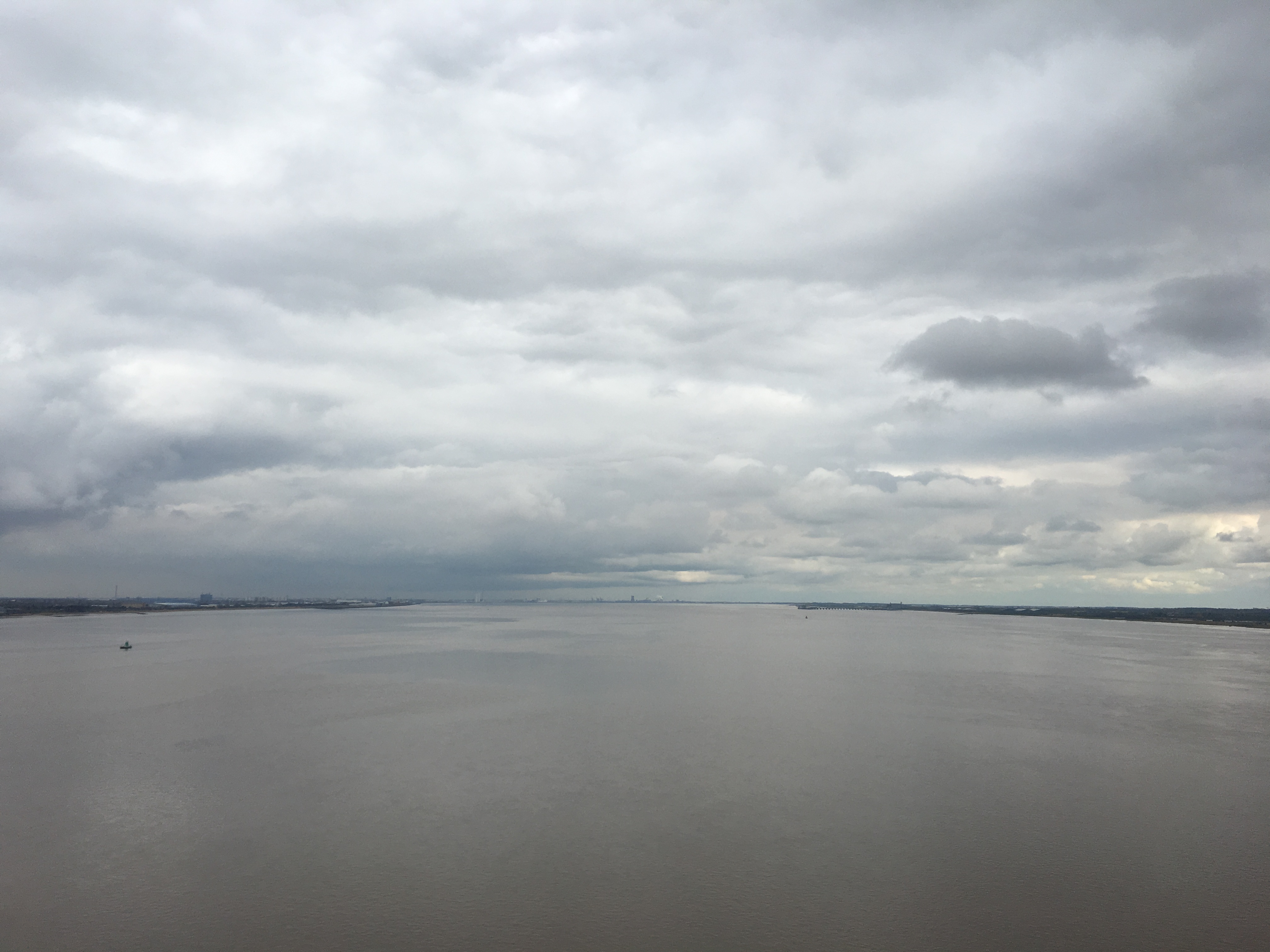
All sorts of thoughts cross your mind: some to do with the weather, which is liable to change during your passage, and others concerning the landscape’s ancient history and its reshaping in the age of human intervention. As you approach the southern shore, you see a bed of reeds, a muted orange against the pale grey-brown river and the dark green of the riverbank. Visible in the far distance are the steel chimneys of an oil refinery, an arrangement of silver pipes looking like some strange percussion instrument from another world.

The good news is that the installation is open to the public for the month of April; the bad news is that all 5,000 tickets have already been sold. In the light of that success, it’s hard to believe that Opera North and the Hull authorities won’t find a way of prolonging its run. The bridge was opened in 1982 and has a design life of 120 years, so future generations could be enjoying this remarkable creative response almost a century hence. I hope they get that chance.

A place of worship

Arve Henriksen 2During a public conversation at the ICA a couple of weeks ago, Brian Eno mentioned his interest in churches as potential performance spaces. After all, he pointed out, they were built with the idea of providing an environment for reflection. The truth of his words was evident in London last night, when the Norwegian trumpeter Arve Henriksen presented the music from his 2014 album Places of Worship in the Jerwood Hall at LSO St Luke’s, the deconsecrated and repurposed Anglican church built in Clerkenwell by Nicholas Hawksmoor and John James in 1733.

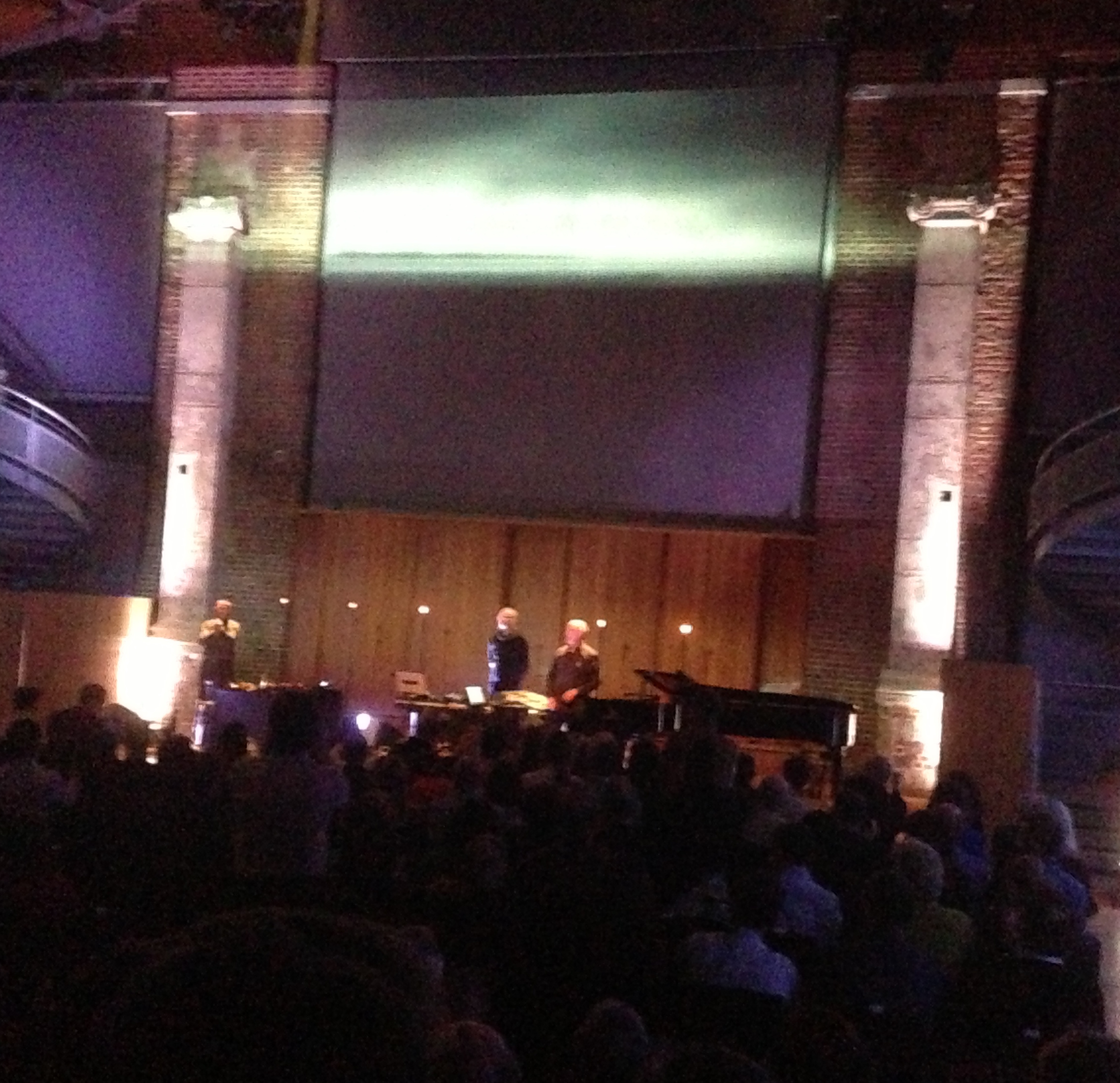
Thanks to a painstakingly sympathetic restoration, there isn’t a nicer place in London to listen to music. It certainly provided the perfect setting for Henriksen’s marvellous invention, a sequence of impressionistic pieces inspired by churches, chapels, cathedrals, cemeteries and other such places around the world, in which he was joined for this concert — and for the other dates of a short UK tour — by the guitarist Eyvind Aarset and the sound artist Jan Bang, both of them long-time collaborators, with lighting and projections by the artist Anastasia Isachsen.

Each musician had a table full of laptops and other sound-modifying tools, among them Henriksen’s mini-keyboard  and iPad, Aarset’s filters and looping devices, and Bang’s mixer and various other boxes of tricks, with a grand piano also at hand. There was a great deal of live sampling as they went about the job of re-imagining the pieces from the original album, creating soundscapes over which Henriksen could deploy his regular and pocket trumpets and his poignant counter-tenor voice.

The sounds shifted constantly in light, density and texture, making me wonder why we spend so much time listening to music that sounds the same all the way through — and also why anyone might ever have thought that electronically generated sounds necessarily robbed music of human warmth.

Henriksen’s extraordinary range of exquisite trumpet sonorities, from chapel-band brass to Zen-temple shakuhachi, found their perfect foils in Aarset’s great subtlety (including a perfect solo that consisted of widely spaced pings) and Bang’s artful manipulation of the available sonic material, including the establishment of unobtrusive rhythm beds. As the music and its visual accompaniment took shape over the course of an unforgettable 70 minutes, the hall itself, with its grey stone walls and pale columns, seemed like an equal participant in the act of creation.