Skip to content

Posts tagged ‘Gerry Goffin’

RIP Margaret Ross

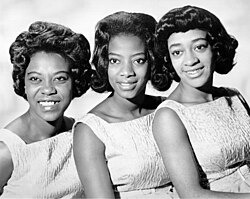
The Cookies: Earl-Jean McRea, Dorothy Jones and Margaret Ross

Margaret Ross was still in high school when she joined her cousin Dorothy Jones and their friend Earl-Jean McRea in the Cookies, a vocal group from Coney Island who became the favourites of the hit-making songwriters in Aldon Music’s Brill Building offices in the early ’60s. They sang on countless demos and provided backup on many hits by other artists.

On their own records, such as “Chains”, “Don’t Say Nothing Bad About My Baby” and “Girls Grow Up (Faster Than Boys)”, they shared the lead vocals between them. But in 1964 it was Margaret who sang lead on the sublime “I Never Dreamed”, a song written by Gerry Goffin and Russ Titelman, one of my three all-time favourite records in the beloved girl-group genre. Arranged by Carole King, it was produced by Goffin, King’s then-husband, and Titelman.

I saw the news of her death at the age of 83 today on Titelman’s Facebook page, which shows how long some old loyalties last. In the same year as “I Never Dreamed”, Margaret also sang lead on two almost equally fine records released under the fictitious name of the Cinderellas: “Baby Baby (I Still Love You)” and “Please Don’t Wake Me”, both written by Titelman with Cynthia Weil, and produced by Titelman with Barry Mann, Weil’s husband and usual writing partner.

Who were the greatest of all the girl-group lead singers? For me it’s Shirley Owens of the Shirelles and Judy Craig of the Chiffons. But Margaret Ross had something special: she could capture the innocence that people like Goffin, Weil and Ellie Greenwich wrote into their stories of young love. She, above all, sounds like a teenager singing on behalf of other teenagers — but with a fine vocal technique that, when matched with the other members of the group, explained their popularity with the writers. “Their ears were so good,” said Neil Sedaka, for whom they sang the background to “Breaking Up Is Hard to Do”.

That day Sedaka took them from Coney Island to the session at RCA studios on East 24th Street in a taxicab. As Ross told Laura Flam and Emily Sieu Liebowitz, the authors of But Will You Love Me Tomorrow?, an oral history of the girl groups: “We learned the song in the taxi. Only took a few minutes to put it together, and once we got in the studio, naturally that’s how it came out.”

It was the Beatles who called time on the girl-group era — ironically, because Lennon and McCartney had been inspired and influenced by those very records, and they covered “Chains”, along with the Shirelles’ “Baby It’s You”, on their first album. Ross was not pleased. “We were furious. Oh, we were mad. I mean, they came over here and they just took over and they pushed us out. And that’s when everything slowed down. They just knocked all of us out.”

She left the music business, got married, had two children, and went to work for the New York City Health Department until her retirement in 1998. In her later years she performed sometimes with a new group of Cookies and sometimes with Louise Murray of the Jaynetts, Lillian Walker-Moss from the Exciters, Beverly Warren from the Raindrops and Nanette Licari from Reparata and the Delrons.

“I love to sing,” Margaret told Flam and Liebowitz. But the schoolgirl could not have imagined, as “I Never Dreamed” went on to the tape in 1964, that she was singing her way into a kind of immortality.

* But Will You Love Me Tomorrow? was published in 2023 by Hachette Books. The Cookies: Chains / The Dimension Links 1962-64 was issued in 2009 on RPM Records and contains their important recordings, under the group name and those of the Cinderellas, Earl-Jean, the Palisades, Darlene McRea and the Honey Bees.


Blue shadows, etc

Chuck-Jackson-LP

Sometimes I think Chuck Jackson’s “Any Day Now” must be the greatest pop record ever made. What could better the elegant turns of Burt Bacharach’s melody, the striking imagery of Bob Hilliard’s lyric (those “blue shadows” falling all over town), the piping organ, muffled tympani and grieving femme chorale of Bert Keyes’ imaginative arrangement, and the deep emotion of Jackson’s restrained baritone, the instrument that made him the epitome of the male mid-’60s uptown soul singer?

The excuse for mentioning it, if one were needed, is the vinyl release of Chuck Jackson: The Best of the Wand Years, an Ady Croasdell compilation for Ace Records, in which “Any Day Now” is just one of 14 treats. “I Keep Forgetting”, with Teacho Wiltshire arranging the staccato boo-bams and tuba on behalf of Jerry Leiber and Mike Stoller, leads the way, and other well known tracks include the beautifully poised “Since I Don’t Have You”, the operatic “Tell Him I’m Not Home” (with Doris Troy singing the title line), and “I Don’t Want to Cry”, Jackson’s first Wand single from 1961, with its sprightly Carole King string arrangement.

My other favourites are a magnificent King/Gerry Goffin song, “I Need You”, which I wrote about here, Van McCoy’s stately “I Can’t Stand to See You Cry”, and the unutterably groovy “Two Stupid Feet”, a song whose writers, Cara Browne and Luther Dixon, manage to feed Jackson the phrase “comfy and cozy” without disturbing his credibility. But really there isn’t a track here that isn’t outstanding, nothing that doesn’t make the world a better place.

Far from dumb

Russ TitelmanGerry Goffin, whose death was announced yesterday, didn’t just write songs with Carole King. Even during their most successful and prolific time together in the mid-’60s he was collaborating with other writers, as I point out here, in my tribute to his lyric-writing genius for the Guardian’s music blog. The one that comes most readily to my mind is Russ Titelman (pictured above), later a staff producer for Warner Brothers and now best known for his work in the studio with Little Feat, Ry Cooder, Randy Newman, Rickie Lee Jones, Eric Clapton, George Harrison, Steve Winwood and others.

Goffin and Titelman wrote two wonderful songs together. First, in 1964, came “I Never Dreamed” for the Cookies, a fabulous girl-group record which they produced together, with King providing the arrangement. Goodness knows how it didn’t follow the group’s other songs into the charts. A year later they wrote “What Am I Gonna Do With You (Hey Baby)“, recorded by the Chiffons, Skeeter Davis, Lesley Gore and finally, in 1967, by the Inspirations on the obscure Black Pearl label. Each of these versions has its fans, but mine is the last of them, in which the echo-heavy production and the lead singer’s delivery mirror the plaintive mood of Goffin’s lyric.

Titelman was born in Los Angeles in 1944. I’m indebted to an interview in Harvey Kubernik’s Turn Up the Radio! for the information that his older sister, Susan (later to marry Cooder), was the girlfriend of Marshall Lieb, a member of the Teddy Bears, who rehearsed in the Titelmans’ lounge on their way to stardom. Phil Spector, their leader, was going out with Susan’s best friend, and young Russ fell under his spell: “He was so smart, and so funny, and so charming, and so incredibly charismatic, and so you were sort of charmed by it all. Then there was the other side of him, which was this dark, murky, scary person, you know, who made shit up.”

He went to work as a songwriter for Lou Adler and Don Kirshner at Screen Gems-Columbia Music, in whose LA offices he met Brian Wilson. Together they wrote “Guess I’m Dumb”, which would have made a great track for Pet Sounds but was instead recorded by Glen Campbell, a future Beach Boy. Wilson is credited as the arranger, conductor and producer of what remains one of his very finest efforts.

Titelman’s early adventures in the LA pop business also included collaborations with the young David Gates (later the founder of Bread), who produced Margaret Mandolph’s utterly sublime version of a Titelman co-composition (with Cynthia Weil) called “I Wanna Make You Happy”. The Titelman/Gates partnership was also responsible for Suzy Wallis’s delightful “Little Things Like That”

On all these records, Titelman’s involvement seemed to guarantee that they would somehow capture the very essence of teenage pop music. They have great hooks and an understanding of how a simple chord change can sell a song. Eventually, of course, he had to grow up, as did his friends and accomplices, including Goffin and Gates. But the stuff they left us from that time continues to give undiminished pleasure decades after its supposed expiry date.