Skip to content

Posts tagged ‘Gary Crosby’

Re-Focus

No single organisation has exerted a more profound or beneficial influence on jazz in Britain than Tomorrow’s Warriors, founded as an outgrowth of the Jazz Warriors big band 30 years ago by Janine Irons and her husband, the bassist Gary Crosby, with the ambition of giving young people from diverse and usually unprivileged backgrounds a chance to play and learn about this music. A few days after the historic Mercury Prize win by Ezra Collective, whose five members first came together in their free workshops, another celebrated Tomorrow’s Warriors graduate, the tenor saxophonist Nubya Garcia, took the stage at the Royal Festival Hall last night in front of a 32-piece all-string version of the Nu Civilisation Orchestra, TW’s shape-shifting large ensemble. Their mission was to perform the music written by Eddie Sauter for Stan Getz in 1961, recorded by Creed Taylor for the Verve label and released as the album titled Focus, instantly setting a new standard for the creative use of a string orchestra in jazz.

Crosby told me that the idea came to him soon after his first encounter with Garcia, 14 or 15 years ago, when she was in her teens. Something about her sound, he said, made him think the combination would work on a reinterpretation of work he’d long admired. Garcia knew about Getz but had never heard Focus. Last night she filled what Sauter called “the holes I left for Stan” with her own sound and style, while fully respecting the tone and approach of the original, a task probably eased by her own early training as a classical violinist.

The suite in seven movements begins with the hectic flurry of “I’m Late, I’m Late”, one of the most arresting album openings imaginable. Last night the part of Roy Haynes, whose urgent brushwork so memorably sparred with Getz, was deftly taken by Romana Campbell. Garcia grew into the performance, adding weight and character to her improvisations as the sequence flowed through “Her”, “Pan”, “I Remember When”, “Night Rider”, “Once Upon a Time” and “A Summer Afternoon”. Her sound reminded me less of Getz’s feathery ethereality than of the firmer tone of his fellow Lester Young disciple Jimmy Giuffre; there was even a passage — during “Pan”, I think — when the combination of the tenor with a folkish motif unexpectedly reminded me of a greatly expanded version of Giuffre’s celebrated “Train and the River” trio. Led by the violinist Rebekah Reid, the strings were immaculate, remarkably so considering that a family illness had prevented the scheduled conductor, Peter Edwards, from taking part. Scott Stroman, the Guildhall School’s professor of jazz, stepped into the breach.

Maybe Focus doesn’t sound as bracingly different today as it did 60 years ago, when it so boldly broke away from the conservative tradition that had dominated the string arrangements for Charlie Parker (by Jimmy Carroll and Joe Lipman) and Clifford Brown (by Neal Hefti). Like George Handy, George Russell, the film composer Bernard Herrmann and one or two others, Sauter’s study of Bartók and Stravinsky had inspired the desire to bring some of their techniques to his own writing. But the result still sounds spectacular, and the London crew more than did it justice in a performance that mixed care and joy in admirable proportion.

* A few days before the concert, Nubya Garcia and the Nu Civilisation Orchestra recorded two of the pieces for Jamie Callum’s Jazz Show on BBC Radio 2. They can be heard here (interview from 17:00, music from 37:00): https://www.bbc.co.uk/sounds/play/m001q5gy — and if you want to give money to help Tomorrow’s Warriors with their valuable work, go here: tomorrowswarriors.org/iamwarrior

Remembering John Stevens

I’d been working at the Melody Maker only a few weeks in the autumn of 1969 when the drummer John Stevens and the saxophonist Trevor Watts arrived to see me, unannounced, at the paper’s offices in Fleet Street. They’d sensed the presence of a writer sympathetic to their music and they’d brought me a copy of the Spontaneous Music Ensemble’s new album, recorded for Giorgio Gomelsky’s Marmalade label. I already knew about them, of course, and over the years I saw John play on many occasions and in many different musical environments. His death from a heart attack in 1994, at the age of 54, deprived the London scene of a musician who, his own great gifts aside, had devoted much of his life to encouraging others to express their creativity.

“John didn’t just change my life — he saved it,” the singer Maggie Nichols said at the Café Oto last night, while introducing an evening of hitherto unseen films featuring Stevens in a variety of contexts. They had been put together by the music and label owner Mark Wastell from a cache of videos owned by John’s widow, Anne, and his children, Ritchie and Louise. There is, as Wastell remarked, so little filmed evidence of John’s life and work available to be seen that anything is to be treasured — and these films brought him back to life in full strength.

Four films were shown. I was able to see the first three, each half an hour long. The first, filmed at the Third Eye Centre in Glasgow in 1976 on a single hand-held camera in black and white, captured a date on a tour by the trio of Stevens, Danny Thompson on bass and John Tchicai on soprano and alto saxophones. This was the bearded, roaring John Stevens with the bearded, roaring Danny Thompson — together in another incarnation as John Martyn’s accompanists — giving Tchicai the most enthusiastic and empathetic encouragement.

The second film, shot at a club in Stavanger by Norwegian TV in 1991, was a far more polished affair in every way. The music produced by this trio, completed by the American bassist Kent Carter and the Norwegian altoist Frøde Gjersted, was just as impassioned, running through different modes of collective improvisation: time, no time, and the sort of pointillism that recalled John’s famous “click pieces”, when the SME or workshop groups were instructed to use the shortest possible sounds to create their improvisations. This film included a joint interview with the three musicians, during which Carter memorably summarised his philosophy of constant renewal: “If the audience can recognise what we’re doing, it’s already been done.”

A year later, in 1991, Channel 4 filmed John’s new quartet, with the saxophonist Ed Jones, the trumpeter Byron Wallen and the bassist Gary Crosby, performing a Stevens composition dedicated to the then recently deceased Dudu Pukwana, called “Dudu’s Gone”. Not a lament but a celebration, recalling Ornette Coleman’s bounciest medium-tempo tunes, it showcased John’s beautiful time playing, with its strong echoes of Max Roach’s drive and Billy Higgins’s float. The unedited takes we were shown included an interview in which John was asked what it took to play free music. “It’s a freedom that demands high discipline and high articulation,” he replied.

Regrettably, I wasn’t able to stay to see the final episode of the evening, a 70-minute film of John playing and talking with Derek Bailey at Jazz Rumours in London in 1992, released in an edited form on video cassette by the Incus label in 1996. But I left with some more of Maggie Nichols’s words in my head, about the experience of being introduced by John to the practice of free improvisation back in the late ’60s: “It was like walking off a cliff — terrifying and ecstatic at the same time.”

The sound of London 2020

Guitarist Shirley Tetteh at Church of Sound during the EFG London Jazz Festival

Half an hour into BBC4’s special Jazz 625 programme on Saturday night, the journalist Emma Warren remarked that everybody in London’s new jazz scene has their own role to play. You might be making your contribution as a musician, or taking the money on the door. Or, she suggested, your role might be as the first person on the dance floor that night, leading the way for the rest of the audience to join in. That sense of collective commitment was strong throughout the programme.

Timed to coincide with the 2020 London Jazz Festival, the 90-minute show featured many of the most prominent names of the current scene: the drummer Moses Boyd and his band Exodus, the tenor saxophonist Nubya Garcia’s quartet, the trumpeter Sheila Maurice-Grey’s irresistible Kokoroko, the singer Poppy Ajudah with a searing Black Lives Matter song, the powerful Ezra Collective, the drummer Sarathy Korwar, the clarinetist Shabaka Hutchings with Sons of Kemet, the tuba-player Theon Cross with the rapper Consensus, and others. There were interludes exploring the work of Gary Crosby’s Tomorrow’s Warriors project in mentoring so many of the new generation, and a shift up to Manchester reflected the contributions of the trumpeter Matthew Halsall and the saxophonist Nat Birchall.

Boyd co-hosted the show with Jamz Supernova, and something he said was also striking. Every young black jazz musician, he remarked, knows what it feels like to play to a room full of middle-aged white people. And that’s fine, he added. But sometimes you want to play to people like yourself. A sequence of clips from Steam Down in Deptford, the Fox & Firkin pub in Lewisham, Total Refreshment Centre in Hackney Downs and other London venues in pre-pandemic times showed what he meant.

This music restores a sense of jazz’s old physicality. While strong on a belief in the tradition, it blends in elements of the music absorbed by younger players: hip-hop and its offshoots, reggae, Afro-beat. In that way, too, it recalls jazz’s origins as a musical broth, a bouillabaisse, a gumbo, embracing influences rather than distilling the flavour out of them.

It believes in rhythm and it believes in warmth. Communication is the priority, but without compromise. Lessons from the more abstract directions of contemporary jazz are deployed as extra tools. There are rough edges and signs of what some older listeners might see as naivety. But to watch and listen to the development of these musicians, to hear them stretching their limbs and discovering their own potential, is a thing of wonder and infinite pleasure.

In Saturday’s show the various groups were playing without an audience and in a socially distanced format. The same was true of the livestreams of the festival gigs I was able to watch. What really impressed me was that a movement nourished by the spontaneity and feedback of an intimate live setting proved able to flourish in a completely different environment. If they were being set a test, they passed it en bloc, with distinction.

The BBC4 programme is available now on iPlayer. Some of the livestreams from the festival are also free to watch, like the Charlie Parker centenary tribute from Church of Sound in Hackney, featuring Gary Crosby’s Groundation, with Nathaniel Facey on alto, Shirley Tetteh on guitar, Hamish Moore on bass and Moses Boyd on drums: a quicksilver set of Bird tunes and originals. Facey’s own quartet, completed by two of his fellow members of Empirical, the drummer Shaney Forbes and the bassist Tom Farmer, and the guitarist Dave Preston, were captured at the Green Note in Camden Town, letting air and light into knotty themes by the leader and the guitarist. And at Total Refreshment Centre the impressive young trumpeter/singer Emma-Jean Thackray led her quintet — Lyle Barton on keyboards, Matt Gedrych on bass guitar, Dougal Taylor on drums and Crispin Robinson on percussion — through a wholly absorbing, convincing and thoroughly contemporary investigation of the moods suggested by Bitches Brew 50 years ago.

Tickets were £12.50 to livestream Cassie Kinoshi’s SEED Ensemble and their guests performing an 80th birthday tribute to Pharoah Sanders at the Barbican, and that’s what it’ll cost you to catch up with it via the Barbican’s website. I can only urge everyone do make the investment, since Kinoshi presents an hour of music of the highest quality, carefully devised and packed with all the best qualities of the new London scene.

The core SEED line-up — Kinoshi (alto), Sheila Maurice-Grey and Jack Banjo-Courtney (trumpets), Joe Bristow (trombone), Hannah Mbuya (tuba), Chelsea Carmichael (tenor, flute), Shirley Tetteh (guitar), Rio Kai (bass) and Patrick Boyle (drums) — kicked off with the ever-hypnotic riff of “Upper and Lower Egypt” before being joined by the clarinet of Shabaka Hutchings (on a beautifully flighted “Astral Travelling”), the pianist Ashley Henry (a heartfelt “Greeting to Saud”), the percussionist Yahael Camara-Onono (“Elevation”) and the singer Richie Seivwright (“Love Is Everywhere”). The horn arrangements were perfect, the rhythm section subtle and skilful, each of the soloists offering something of substance.

“Catch you soon, when life is normal again,” Kinoshi told her invisible audience at the end of the set. But if it was sad not to be able to witness this music in person, to share the experience with the players and to make them feel the listeners’ response, it was wonderful to be able to hear it all, staged and played and recorded so beautifully in all the venues.

If you browse the festival’s website, you’ll find other fine performances available: the trumpeter Yazz Ahmed, the guitarist Hedvig Mollestad and the poet Moor Mother with Irreversible Entanglements are some of them. But maybe watch Jazz 625 first, all the way through. At a time when the streets of the city are drained of life, it’s a reminder of what’s waiting around the corner. If it doesn’t fill you with the kind of optimism that’s been in short supply for the past nine months, I’ll be very surprised.

Love Motown

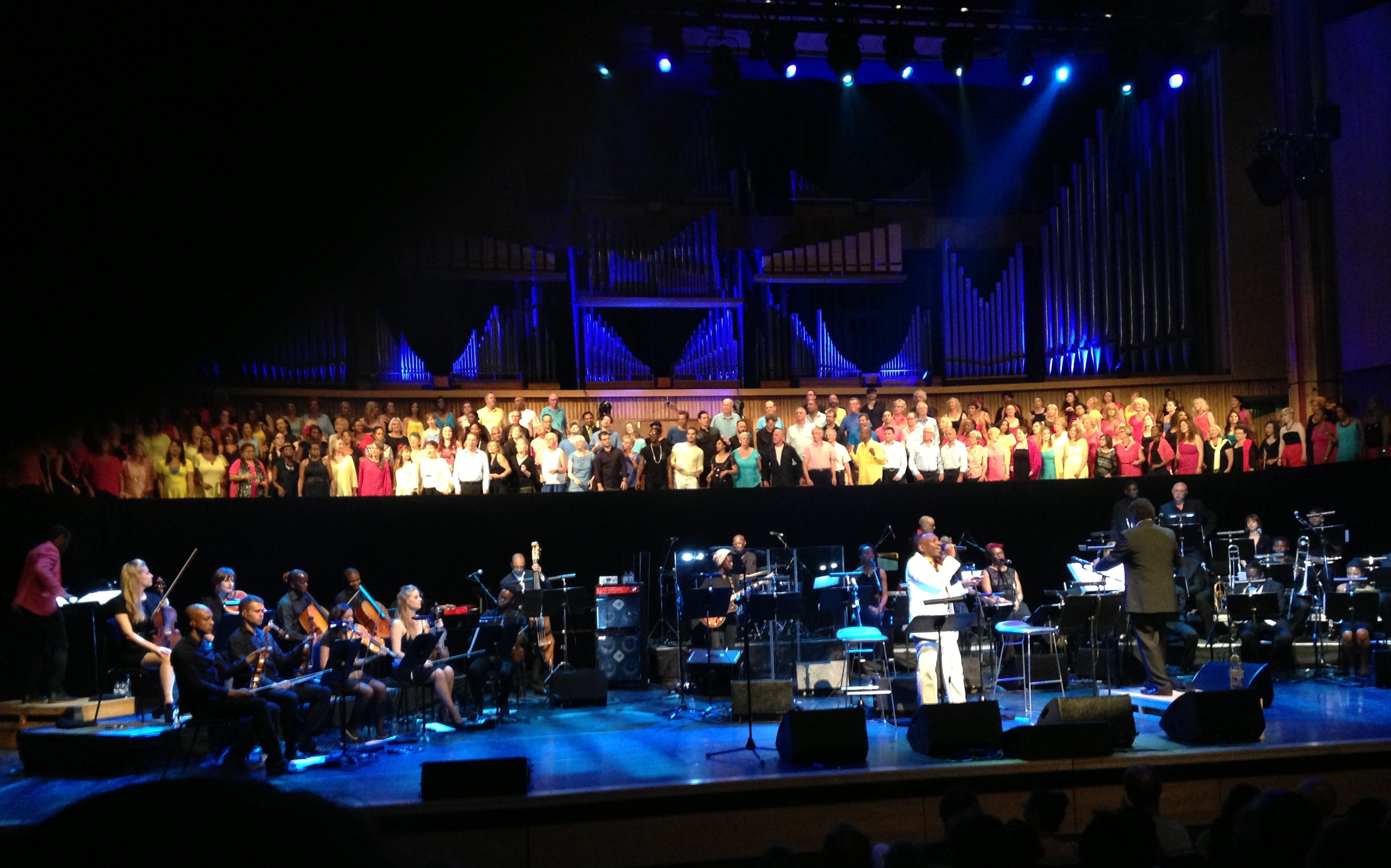
Love Motown“My Cherie Amour” has never been a favourite song of mine. In terms of the Motown catalogue alone, there are scores, probably hundreds, I think of with greater fondness. But Beverley Skeete and Noel McKoy changed that at the Festival Hall on Saturday night, when the Stevie Wonder chestnut was sung by the duo in a captivatingly elaborate arrangement that featured Gary Crosby’s Jazz Jamaica All-Stars augmented by 15 horns and a dozen strings.

The occasion was a concert titled Love Motown, a follow-up both to Jazz Jamaica’s Motorcity Roots album of 2008 and last year’s celebration of the 40th anniversary of the Wailers’ Catch a Fire. Like the latter event, it featured the big band — mostly drawn from Crosby’s Tomorrow’s Warriors project — plus the 200-member Voicelab choir, whose enthusiasm was channelled to good effect.

This was not about cover versions. It was about creative reinterpretation through the lens of an Anglo-Caribbean sensibility, using the special qualities of the Jazz Jamaica musicians. So Crosby’s bass and Rod Youngs’ excellent drumming evoked Aston and Carlton Barrett rather than James Jamerson and Benny Benjamin, often jettisoning the factor that distinguished the original — the riff on which Holland, Dozier and Holland built “This Old Heart of Mine”, for example — and setting the song free.