Skip to content

Posts tagged ‘Charlotte Keeffe’

Alex Hawkins at Cafe Oto
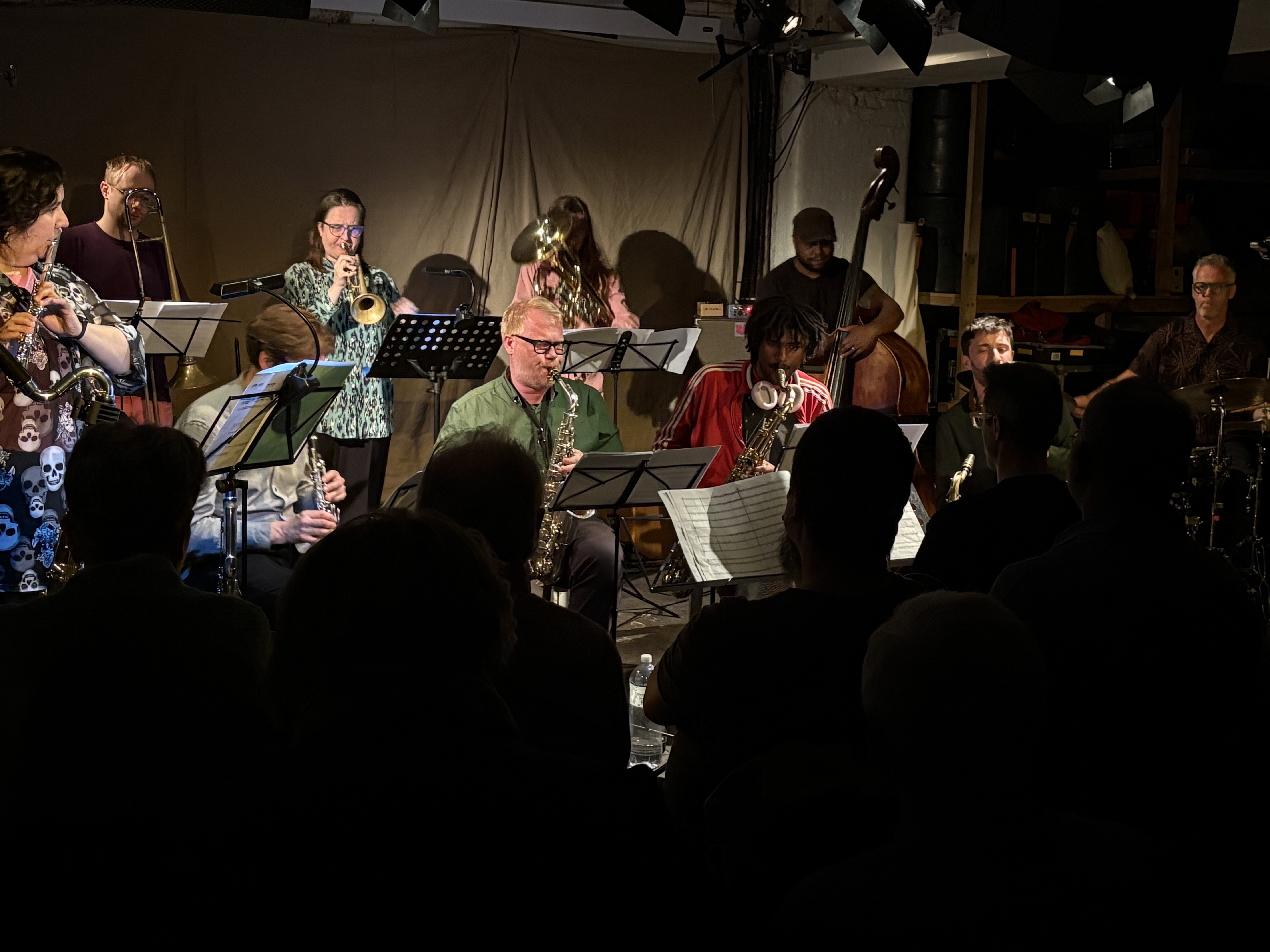
Alexander Hawkins played two nights at Cafe Oto this week with his new 11-piece band before spending two days recording the pieces they played, to which he gives the title Willow Music. If the set I heard on Tuesday is any guide, the resulting album will be worth considerable study.

The opening bars of the first piece the group played made me smile. For a minute I thought that I’d stepped back in time to the Royal Roost in 1948, and here was the Miles Davis Nonet — which became known as the Birth of the Cool band — playing a Gil Evans arrangement of a bebop standard. The feeling didn’t last because the music soon changed into something more identifiably itself, but it was oddly exhilarating while it lasted.

Davis’s nonet was constructed to reflect the range of the human voice, from the top end of the trumpet and the alto saxophone to the bottom of a tuba and a string bass. The Willow Music band achieves a similar spread, but even wider. Here were Alicia Gardener-Trejo on flute, bass flute and bass clarinet; Tom Challenger on flute and alto saxophone; Xhosa Cole on flute and tenor saxophone; George Crowley on flute, tenor saxophone and bass clarinet; Alex Ward on clarinet; Charlotte Keeffe on trumpet; Alex Paxton on trombone; Olivia Hughes on tuba; Neil Charles on bass and Stephen Davis on drums. With Hawkins himself on piano, of course.

With earlier projects, Hawkins has shown himself adept at handling larger ensembles; this one constantly engages the attention through the sheer variety of textures and timbres he draws from it. I was particularly beguiled by a piece that concentrated on the five woodwind players on flutes and clarinets, at first acappella; it reminded me of some of the West Coast recordings of the ’50s by people like Bob Cooper, Bud Shank and Jimmy Giuffre (themselves all inspired by the Birth of the Cool band), but again brought right up into contemporary practice.

It proved to be a perfect platform for soloists who integrate the vocabulary of free jazz into their improvisations. There were outstanding individual contributions, particularly from a rampaging Cole on tenor, the blustery Keeffe and the astonishingly agile Ward, but Challenger, Crowley, Paxton and Gardener-Trejo also made their mark, and there was outstanding work from Hughes, often in unison with Charles, and the infinitely subtle Davis. The composer mostly sat in front of the band, ready to cue and conduct these brand-new pieces when necessary, but he also made the space for some fine piano solos, particularly one on which he used various devices to alter the instrument’s sound, something in which he now specialises.

By the end of a set that lasted well over an hour, I was convinced that Hawkins has come up with something remarkable: a format that encourages him to make new discoveries.

He also has a new album on release, with a different line up. No Nation But Imagination features him on piano, synthesiser and sampler with Nicole Mitchell on flute, Rhodri Davis on harp, Hamid Drake on drums and Matthew Wright on turntables and live sampling. This is a very different sound: an intricately worked open-weave web of softer sounds, with a different balance of composition and arrangement, full of surprises and with a powerful undertow to remove any hint of passivity, and a wonderful gospel-inspired finale. It’s another stage in a remarkable career that is already taking its next step.

* No Nation But Imagination is out now on the Intakt label.

For Jason Yarde

Xhosa Cole and Caroline Kraabel arrive at Café Oto

In the middle of the afternoon, an outsized multicoloured scarf walked through the door into the Vortex, playing an alto saxophone. It turned out, after he had unwrapped himself, to be Xhosa Cole, who carried on playing as he made his way to the stage. There he fitted seamlessly into a free improvisation being devised by the trumpeter Chris Batchelor, the tenorist Julian Siegel, the cellist Shirley Smart and the pianist Liam Noble as part of a three-venue benefit for the saxophonist Jason Yarde.

Yarde, who is one of Britain’s very greatest jazz musicians, collapsed on stage in south-west France in mid-October after suffering a massive stroke. The presence of a couple of medics in the audience may have saved his life, and the process of treatment for a bleed on his brain continued at a hospital in Toulouse. He is recovering at home now, but an appeal for funds to meet his costs has met a predictably warm response, leading to the three jazz clubs in Dalston — the Vortex, Café Oto and Servant Jazz Quarters — getting together to organise a highly unusual benefit.

Starting at two o’clock in the afternoon, several dozen musicians of diverse age, gender and ethnicity spent two and a half hours migrating between the three adjacent venues, joining up for collective improvisation in spontaneously self-selected ensembles. I began my listening at the Vortex, where a group featuring the altoist Caroline Kraabel, the tenorists Dave Bitelli and Harrison Smith, the guitarist Dave Okumu, the bassist Dominic Lash and the drummer Sebastian Rochford surged through free passages into a charging section of unruly swing that reminded me of Charles Mingus’s “Hog Callin’ Blues”. Later Cole joined a group with Loz Speyer (trumpet), Neil Charles (bass) and Rochford again on drums, whose interplay was agile and intuitive.

Arriving at Café Oto, I discovered I’d just missed a line-up featuring Evan Parker and Eddie Prévost. Instead I heard a set by a group including the singer Cleveland Watkiss, the baritone saxophonist Cath Roberts, the trumpeter Charlotte Keeffe and the violinist Benedict Taylor, in which the pianist Veryan Weston played a duet with the improvising tapdancer Petra Hasler. As I was leaving, a re-scarfwound Cole was marching towards the Oto’s entrance, accompanied by Kraabel, together creating al fresco counterpoint for two altos.

Next, over in the basement at Servant Jazz Quarters, I had said hello to the pianist Steve Beresford and heard a couple of minutes of a set featuring the tabla player Ansuman Biswas and several string players. But then, with a loud BANG, the lights went out and the music stopped dead. A water leak from adjacent building works had found its way into the club’s electrics. No injuries but plenty of confusion. End of music.

Back at the Vortex, the altoist Dee Byrne, the pianist Laura Cole, the guitarist Daniel Thompson and the drummer Mark Sanders, with Taylor on violin and Lash on bass, had just got started when Charlotte Keeffe and Cath Roberts arrived to join them, already playing as they made their way up the stairs. Soon they were joined by another violinist, Sylvia Hallett, and together they conjured something that soared at first noisily and then gently before floating to earth in the sort of inspired ending that is one of the joys of free improvisation.

It was the kind of a day when the music really does turn itself into a common property, its barriers dismantled and prejudices abandoned, available to all. A day that fully reflected the qualities of the inspired and inspiring musician to whose recovery it was dedicated.

* For those who didn’t know about Jason Yarde’s stroke, or who couldn’t make it to the benefit, and would like to make a donation, here’s the crowdfunding link: https://www.gofundme.com/f/jason-yardes-stroke-rehabilitation-journey?utm_campaign