Skip to content

Posts tagged ‘Anders Jormin’

Under the same sky

In the 55 years since the discreet arrival of the first ECM album, Mal Waldron’s Free At Last, Manfred Eicher’s label has released somewhere north of a thousand albums. Contrary to a cynical early view, they don’t all sound the same. They are, however, distinguished by the presence of set of qualities — musical, aesthetic and philosophical — that appear, in varying proportions, in just about every one of them. You can detect those qualities in four of their recent releases, each of which exemplifies a certain characteristic taken to the very highest level.

1 Vijay Iyer / Wadada Leo Smith: Defiant Life

American jazz from the tradition continues to make its presence central to ECM’s output. Smith’s trumpet and Iyer’s keyboards and electronics weave their way through spellbinding duets subtextually infused with a sense of history. Smith’s “Floating River Requiem” is a dedication to Patrice Lumumba, the Congolese independence leader murdered by colonial forces in 1961, while Iyer’s “Kite” acknowledges Refaat Alareer, a leading Palestinian poet killed along with two siblings and four nephews during an Israel air strike on Gaza in late 2023. Sorrow and outrage are present in this music, but it also serves, in Iyer’s words, as a statement of “faith in human possibility.”

2 Anouar Brahem: After the Last Sky

Modes from all over the world find their way into the ECM matrix. The Tunisian oud player and composer Anouar Brahem first recorded for the label 35 years ago. On his latest album he is in the company of three of the company’s regulars: the cellist Anja Lechner, the pianist Django Bates and the bassist Dave Holland. Taking its title from a book by the late Edward Said, this album, too, is driven by reflections on the suffering, recent and historic, of the people of Gaza, as outlined in Adam Shatz’s fine sleeve essay. Unfolding with patience and elegance, metabolising elements from Arabic maqam, jazz and European classical music, these quartet pieces ache with grief.

3 Alexander Knaifel: Chapter Eight

By cultivating a widespread audience for the work of the Estonian composer Arvo Pärt via its New Series offshoot, ECM helped create the genre known as “holy minimalism”. Alexander Knaifel (1943-2024), born in Tashkent, studied cello with Rostropovich in Moscow in the 1960s before making a reputation writing operas and film music. A kind of an Uzbek version of Anthony Braxton, he also wrote an extended piece for 17 double basses and another for 35 Javanese gongs. But the pieces on this album, performed by an ensemble of three Latvian choirs and the Swiss cellist Patrick Demenga, are settings of verses from the Song of Solomon. Proceeding with great deliberation under the baton of Andres Mustonen, they achieve the required meditative glow to very satisfying effect, fully exploiting the acoustic resonance of the Jesuit church in Lucerne, where they were recorded in 2009.

4 Arve Henriksen / Trygve Seim / Anders Jormin / Markku Ounaskari: Arcanum

The crucial role played by ECM in the emergence of Nordic jazz needs no acknowledgement. Here are four leading players — the trumpeter Henriksen and the saxophonist Seim from Norway*, the bassist Anders Jormin from Sweden, and the Finnish drummer Ouaskari — at the height of their powers, taking memories of Ornette Coleman’s quartet as a starting point from which to develop conversations of great beauty and originality. All four of these albums are outstanding, but this is the one that sounds to me like a future classic.

* Due to a moment of brain-fade, this piece originally claimed that Henriksen and Seim are Finnish. My thanks to those who noticed and gently pointed out the error.

Trio x 3

Ahmad Jamal may have left us recently, but the jazz piano trio — the format to which he gave so much — refuses to die. Although the spurt of intense activity that gave birth to such inventive genre-benders as E.S.T., the Necks, the Bad Plus, the trios of Vijay Iyer and Brad Mehldau, Plaistow, Phronesis and others in the years either side of the beginning of this century may have abated, three new albums demonstrate that a meeting of piano, bass and drums retains every bit of its potential for creativity and diversity.

The Swedish pianist Bobo Stenson recorded his first trio album for the producer Manfred Eicher in 1971. Sphere, made in partnership with the bassist Anders Jormin and the drummer Jon Fält, is his ninth for Eicher’s label, continuing a process of refinement that has seen his music become more meditative in cadence and transparent in texture as the years go by.

In the past, Stenson’s albums have included jazz compositions such as Ornette Coleman’s “War Orphans” and Tony Williams’s “There Comes a Time”, standard ballads like Gordon Jenkins’s “Goodbye” and George Gershwin’s “My Man’s Gone Now”, Latin pieces from Astor Piazzolla and Silvio Rodríguez and classical works by Berg, Purcell and Ives. The repertoire on Sphere is focused almost entirely on Europe: two pieces by Jormin, one by the Danish composer Per Norgard, two by Sven-Erik Bäck, a Swedish composer who specialised in sacred music, one by the Norwegian pianist Alfred Janson, Sibelius’s “Valsette” and the geographical outlier, a contribution by the Korean composer Jung-Hee Woo.

Beginning and ending with limpid versions of Norgard’s “You Shall Plant a Tree”, the trio slide through the nine tracks so fluidly that each becomes a part of the whole, a single mood smoothing out (but not degrading) the very different contours and emotions of Bäck’s “Communion Psalm”, the gentle entanglements of Janson’s “Ky and the Beautiful Madame Ky” and Woo’s “The Red Flower”, a springy waltz. The result is a very personal evolution of the impressionistic approach pioneered by Bill Evans, Scott LaFaro and Paul Motian, the jazz piano trio in its modern classical guise.

Alexander Hawkins is after something different with Carnival Celestial, in which he, the bassist Neil Charles and the drummer Stephen Davis confront the possibilities offered by combining the acoustic piano, string bass and drum kit with synthesisers, samplers and the kind of post-production techniques not often applied in this context. As Bill Shoemaker observes in his sleeve note, there is nothing self-consciously trendy about the way Hawkins approaches these possibilities. It’s easy to hear the unfamiliar sonorities — flutters, pings, shuffling and rustling sounds — as organic outgrowths of the natural sounds, and as another form of connective tissue.

On the hyperactive “Puzzle Canon” and the pensive “Unlimited Growth Increases the Divide”, you can hear the group au naturel, improvising astringent melodies built on reverse angles and sprung rhythms, taking its place in the lineage of piano trios Hawkins loves, including those of Herbie Nichols, Elmo Hope and Andrew Hill (with Monk always in the deep background). On “Canon Celestial”, by contrast, and on “If Nature Were a Bank, They Would Have Saved It Already” (my favourite title of the year, borrowed from a graffito spotted by the Uruguayan writer Eduardo Galeano) and “Echo Celestial”, the electronics and additional percussion are deployed as the sound-bed, the rhythms hinting at the broken beats of contemporary hip-hop. But there’s no dichotomy or divergence here. The plug-in stuff is used not to tart up but to add dimensions. This is new music.

It translates perfectly to live performance, too, as was demonstrated last night in front of an audience at the Vortex in London, the final night of the trio’s short European tour. The moments of peak emotion produced by this power trio were genuinely extraordinary, particularly in a piano solo towards the end of the first set in which the pianist took off on a flight of supercharged mambo variations. Hawkins also inserted brief samples of the voices of Sun Ra, Louis Moholo and Wayne Shorter to striking effect.

Tyshawn Sorey’s Continuing is something different again, seeming to exist both within and beyond any of the usual considerations. The drummer and his colleagues, the pianist Aaron Diehl and the bassist Matt Brewer, take four compositions — Wayne Shorter’s “Reincarnation Blues”, Ahmad Jamal’s “Seleritus”, Harold Mabern’s “In What Direction Are You Headed” and the standard “Angel Eyes” — as material for a meditation on the form itself.

Space is the dominant factor, along with trueness of sound. The notes breathe, the instruments breathe, even when the traffic is at its heaviest, as in the Mabern tune, where Sorey whacks out four-to-the-bar on his snare and Brewer elaborates a kind of Delta blues riff. In “Angel Eyes”, the musicians pursue their thoughts at a pace through which time almost comes to a standstill, forcing the close listener to adjust breathing, heartbeat, depth of focus; interestingly, even this classic ballad is seen through a transparent lens, the sound of the instruments free of the familiar gauze of studio reverb. It may be the compelling slow-motion anatomisation of a commercial song by a piano trio since Cecil Taylor’s “This Nearly Was Mine”.

All the conventional accoutrements of the jazz piano trio are present in Continuing, whose title could be (but probably isn’t) intended to reference its position in a tradition. But the brilliance of the musicians — their ability to burn away layers of sentiment, their willingness to give each other and themselves that extraordinary degree of space, and the adamantine power of their execution — gives it a meaning entirely its own.

* Bobo Stenson’s Sphere is on the ECM label. Alexander Hawkins’s Carnival Celestial is on Intakt Records. Both are out now. Tyshawn Sorey’s Continuing is released on June 24, on the Pi label.

Jon Christensen 1943-2020

JonChristensen

On two occasions I was fortunate enough to be in very close proximity to the playing of the Norwegian drummer Jon Christensen, who has died at the age of 76 after a distinguished career that included collaborations with Keith Jarrett, Charles Lloyd, George Russell, Bobo Stenson, Jan Garbarek, Tomasz Stanko and many others, most of them gathered under the ECM umbrella.

The first occasion came around 25 years ago when Stenson’s trio, with Anders Jormin on bass, played the Pizza Express. It was with this group — which can be heard on the albums Serenity (1998) and War Orphans (2000) — that Christensen showed how he had added something of Billy Higgins’s lift and swing to the colouristic approach pioneered by Paul Motian. His wonderful subtlety was also evident on the second occasion, at the Jazzahead! festival in Bremen five years ago, when he played with the guitarist Jakob Bro and the bassist Thomas Morgan, two musicians of matching depth and transparency.

He was a master of sticks, mallets and brushes. For Bro, Morgan, Stenson, Jormin and any of the countless other improvisers with whom he played over the decades, I can’t imagine there were many better gifts than the knowledge that you’d be sharing a bandstand with a musician of such profound sensitivity.

* The photograph of Jon Christensen is © Roberto Masotti / ECM Records.

ECM in London

Craig Taborn at RAM

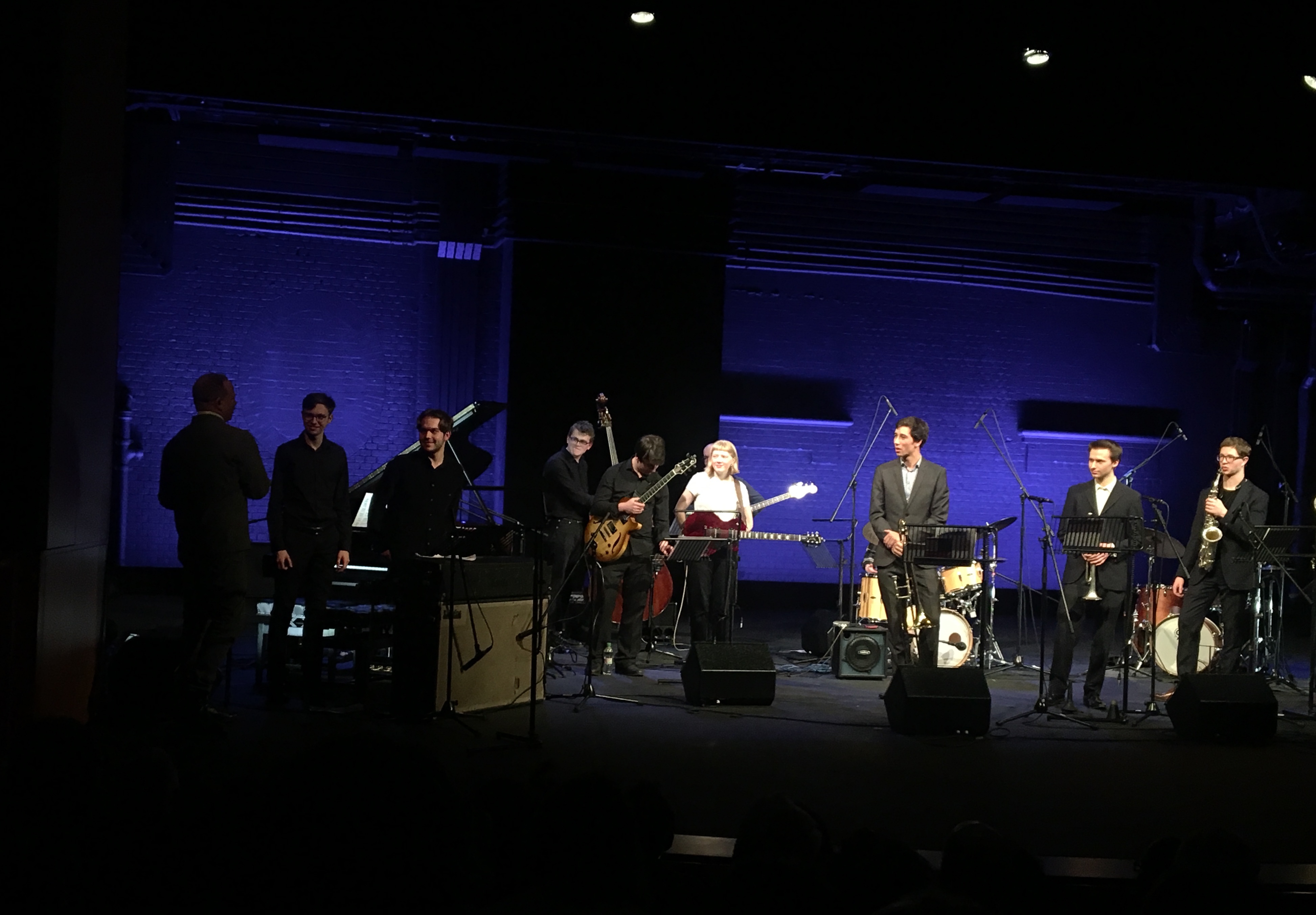
No apologies for returning, one last time, to the continuing celebrations of ECM’s 50th anniversary. For a short festival at the Royal Academy of Music, the director of the jazz programme, Nick Smart, invited several of the label’s luminaries — the bassist Anders Jormin, the pianists Craig Taborn and Kit Downes, the singer Norma Winstone and the saxophonist Evan Parker — to spend a week working with students before presenting the results in two public concerts on Thursday and Friday night.

Jormin’s compositions — very much what many people would think of as archetypal ECM music, with a restrained lyricism that seemed to have its deepest roots in Nordic folk music — were played by a septet notable for the outstanding singing of Ella Hohnen-Ford and Alma Naidu. Downes and his colleagues in the trio called ENEMY, the bassist Petter Eldh and the drummer James Maddren, enhanced their tricky compositions with arrangements for string quartet, three woodwind and two percussionists, of which the most successful were “Last Leviathan”, a piece from Downes’s ECM debut, Obsidian, fetchingly rearranged for strings and piano, and Eldh’s eventful “Prospect of K”, cunningly scored by Ole Morten Vågan.

For the festival’s closing set, Smart led the Academy big band through a sequence of rare and unheard compositions by the late Kenny Wheeler, another ECM stalwart, featuring Winstone, Parker and Stan Sulzmann. The juxtaposition of the two tenors of Parker and Sulzmann created a contrast that exemplified the breadth of Wheeler’s conception — although their thunder was almost stolen by the alto saxophone of Lewis Sallows, a student whose long solo displayed a disinclination to plump for stylistic orthodoxy and a powerfully dramatic imagination. The crisp and flexible drumming of Ed Richardson, an Academy graduate, also took the ear.

Twenty four hours earlier, Sallows had also been part of the 12-piece band (pictured above) which provided the festival’s highlight. Craig Taborn is already known as one of the most creative and original pianists of the current era; those who were present at the Vortex for his solo gig last year speak of it in awed tones. Friday’s set showed him to rank alongside Steve Lehman, Vijay Iyer, Mary Halvorson and Eve Risser as an adventurous composer-leader who knows how to exploit the resources of a larger ensemble while retaining all the spontaneous interaction of a small group.

Although this was music of great sophistication, there were times when its sheer fire put me in mind of those great Mingus units of the late ’50s and early ’60s, when the members of the Jazz Workshop learnt their parts by ear and took it from there. The trombonist Joel Knee, the trumpeter Laurence Wilkins and the two altoists, Sallows and Sean Payne, threw themselves into the project with enormous skill and gusto, and the ear was also taken by the guitarist Rosie Frater-Taylor, whose opening solo was strikingly thoughtful and who made significant contributions to the riff-ostinatos on which several of the pieces were built.

Taborn’s own solos on acoustic and Fender-Rhodes pianos demonstrated his gift for gathering all the energy once associated with Cecil Taylor and using it to activate the coiled springs of his own imagination. During an unaccompanied introduction, he made the Rhodes roar in a way that completely divested the instrument of its familiar role as a provider of a cool funky background sound. It was one of many moments, individual and collective, that made the event such a success.