Skip to content

Posts tagged ‘Alexander Hawkins’

Mind on the Run

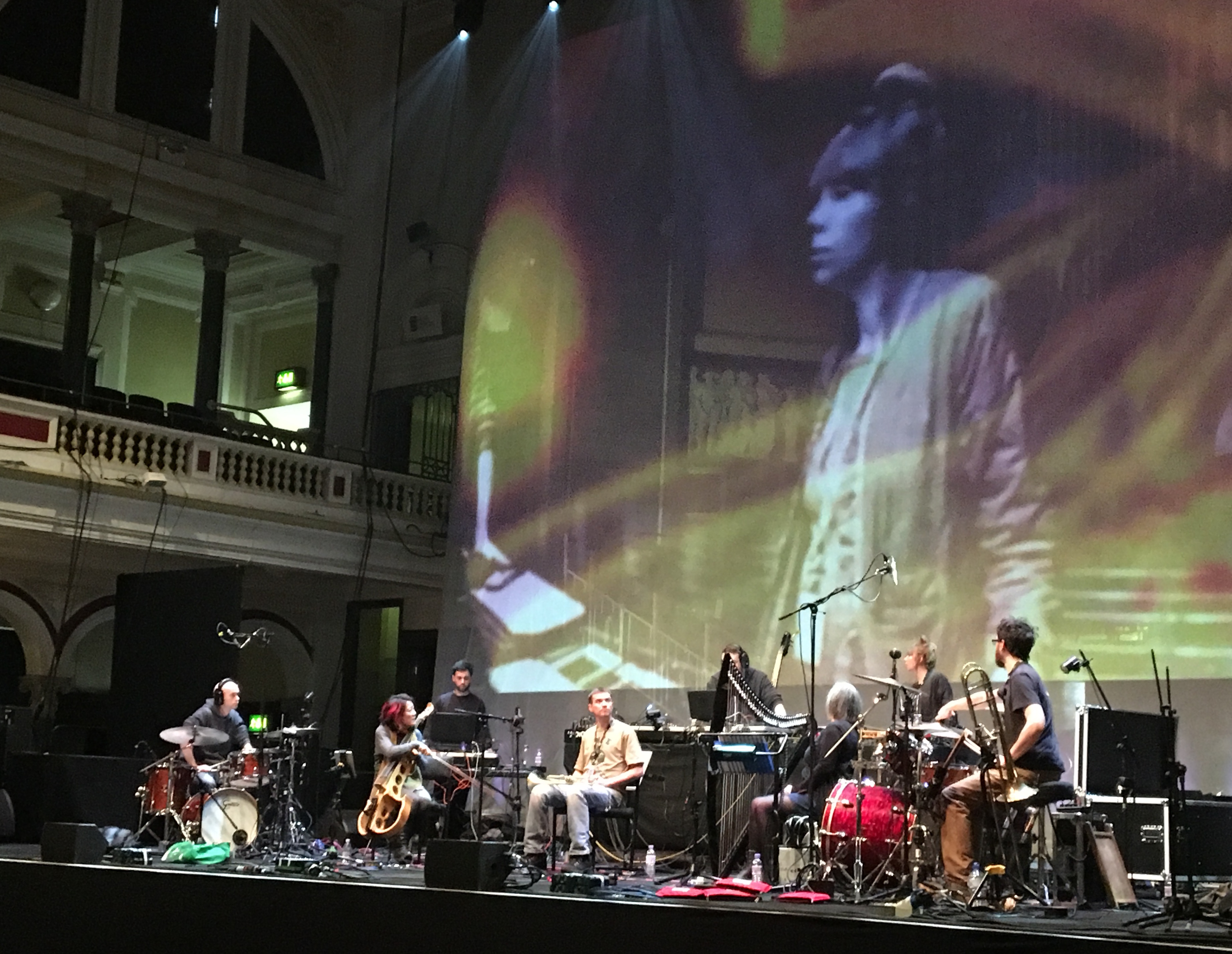
hidden-orchestraIt was with regret that I had to leave Hull after only 24 hours of Mind on the Run, the weekend festival celebrating the life and work of Basil Kirchin, the visionary composer who spent three decades in the city, working in complete obscurity until his death in 2005, aged 77.

When the Guardian asked me to write a piece about the event, the first call I made was to Brian Eno. I had introduced the two men in 1973, while preparing the release of the second volume of Basil’s World Within Worlds on Island’s HELP label. Eno immediately recognised the value of his work with manipulated tapes of organic sounds, and more than 40 years later he was happy to talk about the impression it made.

The festival, held in the City Hall as part of Hull’s 2017 UK City of Culture programme, was quite brilliantly curated to include contributions from Matthew Herbert, Goldfrapp’s Will Gregory (with a contingent of the BBC Concert Orchestra, conducted by Clark Rundell), Wilco’s Jim O’Rourke, Bob Stanley and Pete Wiggs of Saint Etienne, Evan Parker with Adam Linson and Matt Wright of his Electro-Acoustic Ensemble and Ashley Wales and John Coxon of Spring Heel Jack, and a DJ set of Kirchin’s library music by Jerry Dammers.

On the first evening I heard a spirited set by a local five-piece band led by DJ Revenu (Liam van Rijn), heavy on imaginative electronics. That was followed by the High Llamas’ Sean O’Hagan with a piece inspired by several of Basil’s themes and performed by an nonet — including the outstanding harpist Serafina Steer — in a style that made me think of what might happen were Steve Reich to get it into his head to reinterpret those miniature tone poems that Brian Wilson used to drop into mid-period Beach Boys albums: things like “Fall Breaks and Back to Winter” from Smiley Smile and the title track of Pet Sounds. O’Hagan’s music was minimalist, lyrical, unhurried and unrhetorical, with a fragile charm. (Just after it had finished I told a friend that I was particularly attracted to the way the music felt, even now and then, as though it might be about to fall apart; during a conversation an hour or so later O’Hagan mentioned, unprompted, that this was precisely the effect he’d been after.)

I enjoyed taking part in one of the panel discussions, alongside Bob Stanley and  Jonny Trunk, and listening to another that featured Matt Stephenson, co-director (with Alan Jones and Harriet Jones) of a 45-minute documentary film which did an excellent job of summarising Basil’s extraordinary life through interviews with those who had known him at various stages of his career. It also featured a wonderful film clip of the Ivor Kirchin Band in the early ’50s, with the leader’s young son as the featured drummer, from a time when dance band musicians wore cardigans and sensible slacks. (When someone in the audience likened Basil’s skin-pounding, cymbal-flaying antics to those of Animal from the Muppet Show, Matt was able to regale us with the priceless information that the real drummer of the Muppets had been the great session man Ronnie Verrell — who, in an earlier incarnation, had replaced the man who replaced Basil on the drum stool in Ivor’s band…)

Trunk, who has done so much over the past decade to create interest in Basil’s work, also mentioned that the handful of CDs released on his label represent no more than a glimpse of the tip of the iceberg. There is much more to come from the archive of Kirchin soundtracks and library music.

Among Basil’s credits was the score to The Abominable Dr Phibes, the truly bizarre 1971 British horror film in which Vincent Price played the eponymous villain, who celebrated his dreadful deeds by letting loose on a pipe organ. The film was screened on Friday night, with the figure of a caped Alexander Hawkins emerging through a gauze screen from time to time, playing the music live on the City Hall’s mighty organ: the third largest in England, it is said, and the possessor of a massive 64ft pipe which, if unleashed at full volume, would probably turn the Victorian building’s foundations to dust.

Before leaving Hull I also managed to creep into the soundcheck of Joe Acheson’s Hidden Orchestra (pictured above), and was beguiled by the grooves and textures of a band featuring two drummers, violin, cello, harp, trumpet and keyboards. If you want to know more about that performance, and others, read Tony Dudley-Evans’s report for the London Jazz News website.

It was interesting to discover how Hull, a victim first of the Luftwaffe and then of the Cod Wars, is making use of the opportunity to present a new face to those lured by the year of cultural events. There are five excellent Francis Bacons on temporary loan at the refurbished Ferens Gallery in the main square, which is dramatically spanned until March 18 by a 75-metre aluminium wind-turbine blade created by Nayan Kulkarni. An exhibition devoted to the story of COUM Transmissions, the renegade art collective founded in Hull in the early ’70s by Genesis P. Orridge, Cosey Fanni Tutti and others, is at the Humber Art Gallery in the streets of the former Fruit Market, where all sorts of hipster enterprises are springing up.

It’s not all great, of course. Take a bow, “Sir” Philip Green, for the vacant hulk of the striking early-’60s building until recently occupied by British Home Stores. But if you can imagine a cross between Copenhagen and Hoxton, that seems to be how Hull is attempting to reshape itself, and the audiences who flocked to Mind on the Run demonstrated the potential of this culture-led Humberside renaissance. I hadn’t been to the city since a single visit in 1965. Now I can’t wait to go back and do some more exploring.

Musica franca

Evan & Alex 1 Alexander Hawkins and Evan Parker were two of the winners at the recent Parliamentary jazz awards: the former for being the instrumentalist of the year, the latter for, well, being Evan Parker. Last week they appeared together at the Vortex. Alex is 35; Evan is 72. What they gave us was a demonstration of the special ability of jazz-based free improvisation to span the generations without forcing the younger man to play the older man’s music, or vice versa. Musica franca = lingua franca, you might say.

I heard one and a half sets. The first reminded me of what those famous Cecil Taylor quintet tracks on Into the Hot, “Pots” and “Bulbs”, might have sounded like if you’d taken out Jimmy Lyons, Henry Grimes and Sunny Murray, leaving only Taylor and Archie Shepp. Evan was a little gruffer than usual, while Alex produced octave-doubled figures that leapt and darted with precise aim. The whole 40-odd minutes sounded like two painters working their brushes in rapid up-strokes. It was urgent and practically unstoppable — until they contrived the most elegant of endings.

The first half of the second set was more mellow and discursive, with a stronger sense of an underlying blues tonality, putting me in mind of how Charlie Rouse and Thelonious Monk might have sounded without a rhythm section. I don’t usually like this shorthand way of writing about music, by describing one musician in terms of another. But those comparisons were what went through my head when I was listening, and they’re only intended in the most impressionistic sense.

Anyway, you can hear for yourselves what they sound like, in all the many dimensions that they bring to their dialogue through a quite magical degree of empathy, in a very fine CD called Leaps in Leicester, recorded last year at Embrace Arts in that city. A long track called “The Shimmy”, dedicated to the late Tony Marsh, contains powerful elements of the approach I heard in the first set.

During the interval they joked that, given the recent success of Leicester’s football team, they should plan a European tour to take in all the places where City are drawn to play in next season’s Champions’ League. Which, who knows, might mean a gig in Cardiff next May, to coincide with the final. (Anyone who finds analogies between jazz and football frivolous or distasteful is directed to an observation by Jean-Luc Godard, who said that listening to free jazz reminded him of the great Hungarian side of the 1950s. So maybe the best comparison is between Evan Parker and Ferenc Puskás. I can’t imagine Evan objecting to that.)

* Leaps in Leicester is out now on the Clean Feed label.

Jazz in the Round

Jazz in the Round 1Jez Nelson’s monthly Jazz in the Round nights at the Cockpit Theatre in Marylebone are as good a way to hear improvised music in London as anyone has yet devised. A couple of hundred listeners settle themselves down in mini-bleachers on all four sides of the floor, where the musicians set up to face each other, creating an unusual degree of intimacy radiating through 360 degrees. As a member of Empirical — I think it was Nathaniel Facey, the alto saxophonist — told last night’s audience, it makes you play differently. In a good way.
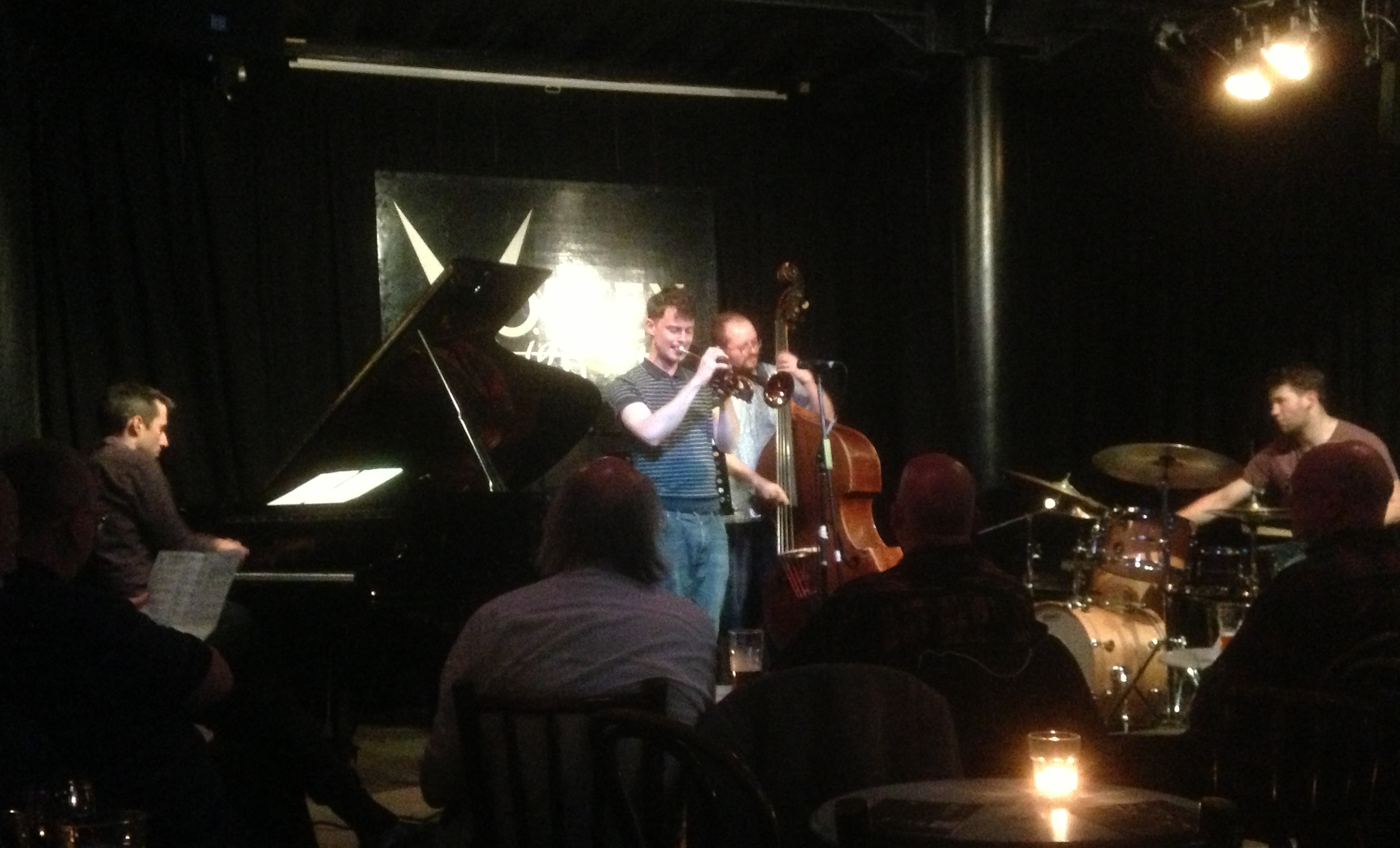
Facey and his colleagues kicked off what turned out to be a special night even by the standards of this excellent series. The evening was being recorded for transmission (on March 28) as the last-ever Jazz on 3, which Nelson presents, and after 18 years he was understandably emotional as he introduced a bill handpicked to represent the programme’s philosophy over the years. After Empirical came Django Bates, who gave the solo performance that traditionally separates the evening’s two bands, followed by a set of free improvisation from a multi-generational quartet assembled specially for this event: Laura Jurd (trumpet), Alexander Hawkins (piano), Orphy Robinson (marimba) and Evan Parker (tenor saxophone).

Empirical were coming off a week of thrice-daily gigs in a pop-up revue at Old Street tube station: a wheeze that apparently worked as well as it deserved to, attracting crowds of passers-by intrigued by what they heard. They’re an exceptional band and they played a fine set of striking new compositions by each of the four members, ending with “Lethe”, a quietly beautiful slow tune by the vibraphonist Lewis Wright. I’ve heard them play it before, and it stuck in my head. I was delighted to hear it again, and to discover that it’s on their new album, Connection.

Bates had just arrived from Switzerland, where he is a professor of jazz at Bern’s University of the Arts. He began by singing, to his own deft kalimba accompaniment, a little song about the anxiety of a man introducing himself to a piano (which turns out to be female). Then he sat down at the keyboard to play a piece in which he doubled his improvised single-note lines in the treble register with whistling of virtuoso standard. A tenor horn solo preceded a final stint at the keyboard, which included some gorgeous gospel figurations and a song about a London pub transformed by a developer into empty luxury apartments. “Empty luxury,” he repeated, sotto voce but with emphasis.

The members of the final improvising group were chosen to show how Jazz on 3 has always reflected the way this music spans the generations, with the accent on new developments. They had never played together as a unit, but the shared qualities of musicianship and sensitivity ensured that they created a genuine conversation that not only gripped their listeners but enfolded them in the act of creation. It was, as Nelson pointed out, the best possible way to demonstrate that, in the hands of such people, the music’s future is safe.

* The photograph of Empirical at the Cockpit Theatre was taken by Steven Cropper, and is used by kind permission. His blog, with more of his fine images, is at http://www.transientlife.uk. Jazz on 3 will be replaced on BBC Radio 3 by Jazz Now, presented by Soweto Kinch. Jez Nelson’s Somethin’ Else will be on Jazz FM on Saturday nights from April 2. Jazz in the Round takes place on the last Monday of each month: http://www.thecockpit.org.uk/show/jazz_in_the_round_0.

Dick Twardzik 30/4/31–21/10/55

Dick_TwardzikTomorrow evening it will be exactly 60 years since the pianist and composer Dick Twardzik was found dead in his room at the Hôtel de la Madeleine on the Rue de Surène, in Paris’s 8th arrondissement. He was on tour in Europe with the Chet Baker Quartet, and the previous night they had played at the Club Tabu, where they were joined by the great Swedish baritone saxophonist Lars Gullin. After returning to the hotel in the early hours, they were due to reconvene at 4pm for a recording session at the Pathé-Magellan studio. When, after an hour, he hadn’t showed up, a search party went back to the hotel and his body was discovered. A heroin overdose had killed him. He was 24 years old.

Twardzik was a prodigy. Born in Boston, the son of two artists, he had studied with Madame Margaret Chaloff of the New England Conservatory of Music, a renowned teacher who is better known to jazz fans as the mother of Serge Chaloff, one of the great post-war baritone saxophonists. Serge and Dick would play and record together. And share a heroin habit that eventually killed the other man, too.

By the time Twardzik was 21, he was good enough to play with Charlie Parker. You can hear the results on Boston 1952, a Parker album compiled from radio broadcasts recorded at the Hi-Hat Club and released on the Uptown label a few years ago. Symphony Sid Torin, the radio show’s announcer, can’t get the young man’s name right, but listen to the wonderful inventiveness of the piano solo on a relaxed “Don’t Blame Me”, to the way he spins out his double-time lines, shaping them so beautifully, allowing them to float and curl and wind before moving into a passage of contrapuntal and parallel lines, followed by the lightest of block chords. By that time, he had already been using heroin for three years.

After Bud Powell, he might have become Parker’s most stimulating keyboard partner, if they’d both lived and been given time to develop their partnership. Twardzik’s ear and imagination, and his knowledge of modern classical music, would surely have appealed to Bird, and might have inspired an escape from the bebop cul-de-sac into which Parker was heading by the time of his own death in 1955.

But that’s speculation. What we know is that Twardzik made a brilliant set of trio recordings for the Pacific Jazz in October 1954, half a dozen tracks first issued as one side of an LP called Trio which he shared with the group of Russ Freeman, his predecessor as Baker’s pianist, who had brought him to the attention of the label’s boss, Dick Bock. The tracks, with one addition, were later released by themselves as The Last Set. There are three standards — “Round Midnight”, “I’ll Remember April” and “Bess You is My Woman” — along with three of his own compositions, all of them immediately striking, and not just for their titles: “Albuquerque Social Swim”, “Yellow Tango”, “A Crutch for the Crab”. They’re as full of playful character and unexpected twists as those of Herbie Nichols — a comparison that also strikes Alexander Hawkins, the English pianist, who is a student of such matters and a confirmed Twardzik fan. Thinking you might like a break from my views, I asked Alex for a few words. Here’s some of what he sent me:

For me, he fits squarely within that magical clutch of pianists from mid-century who are just so wonderfully sui generis (Monk, Powell, Hope, Nichols, and a few years later, the likes of Hasaan etc). I think it naturally comes out most clearly in his compositions; and to me it’s extraordinary to reflect that we can get such a strong sense of a radical original from so few works. However, it’s also fascinating to listen to him play standards: his arranger’s touch was such that he could make such a ‘standard’ standard as “I’ll Remember April” all his own – in the way he mysteriously stalks the notes of the first eight bars of this over the swinging drums, I hear a weird pre-echo of Misha (Mengelberg) and Han (Bennink).

I love the headlong intensity and clarity of purpose, despite such knotty compositions: in this I hear a real kinship with Bud Powell (“Glass Enclosure”, etc). There’s also clearly an affinity with Bartok, Hindemith, and so on; and I hear elements of Bernstein and Sondheim, too. I can also hear a possible line through to early Cecil Taylor. In the way both composers graft together different melodic/rhythmic strands, I hear some deep similarity with (especially pre-Unit Structures) Cecil: in particular, I’m thinking of the session which produced ‘Pots’, ‘Bulbs’, and ‘Mixed’, and also tunes like ‘Excursion on a Wobbly Rail’. I also hear a kinship with Cecil in the love of contrary motion figures.

The historical context also fascinates me too: just like with Bird, Hasaan, Nichols – where on earth could this music have gone had he lived? It’s so much at the vanguard of what seemed possible at the time that trying to put oneself in contemporary shoes as far as possible and hearing the future directions is completely baffling, and as such, deeply inspiring as a player and composer.

After Twardzik arrived in Le Havre on the liner Île-de-France on September 13 with the rest of Baker’s rhythm section — the bassist Jimmy Bond and the drummer Peter Littman — and met up with the trumpeter, the band began their tour at the Concertgebouw in Amsterdam (supported by the Tony Crombie All Stars!) and continued through Germany, Switzerland, Belgium and France. There were 10 concerts in all, several of which were recorded and are available on various bootlegs. In Paris on October 11 and 14 they also recorded the nine tracks — eight compositions by Bob Zieff, a friend of Twardzik’s from Boston, and one by the pianist himself — that would make up one of the most remarkable small-group records of the 1950s.

Zieff’s cool little pieces have wonderful beatnik titles: “Rondette”, “Mid-Forte”, “Sad Walk”, “Pomp”, “Brash”. Perfectly balanced and slightly formal modernist mechanisms, they’re clean-lined but unpredictable, absolutely devoid of any hint of cliché (jazz or otherwise), stretching the musicians — particularly the trumpeter and pianist — in interesting ways without inducing contortions. It’s no surprise to discover that Gil Evans later became a fan of the composer, and a terrible shame that he was destined to remain in obscurity. And Twardzik’s tune, “The Girl from Greenland”, is typically intriguing and memorable.

Issued on the Barclay label in France soon afterwards, this set is still available and is, I’d say, essential — not just for itself, but also because it represents the last view we would ever get of a great talent taken away, like so many others, by a plague that is still with us, and still taking lives.

* If you want to know more, I warmly recommend Jack Chambers’ excellent biography, Bouncin’ with Bartok: The Incomplete Works of Richard Twardzik, published in Canada by the Mercury Press in 2008, from which the photograph is taken. There’s also an interesting CD of Twardzik’s home rehearsal recordings called 1954 Improvisations, all variations on standards, released by the New Artists label in 1990. Recordings of the Baker Quartet’s concerts in Cologne, Amsterdam and elsewhere are available on various bootlegs.

Trumpet + rhythm

Nick Malcolm QuartetBe it Chet Baker with Russ Freeman on Pacific Jazz or with Dick Twardzik on Barclay, Booker Little on Time, Joe Wilder on Savoy, Tony Fruscella at the Open Door, The Musings of Miles, Lee Morgan’s Candy, Freddie Hubbard on Herbie Hancock’s Empyrean Isles or Tomasz Stanko’s Soul of Things and Suspended Night, the line-up of trumpet, piano, double bass and drums has a great attraction for me. There’s something clean and uncluttered about it. That certainly struck me again last night, while listening to the Nick Malcolm Quartet at the Vortex.

Malcolm teaches trumpet at Wells Cathedral School and he has a lovely bright, rounded tone that any student would do well to emulate. He also has an outstanding rhythm section: Alexander Hawkins (piano), Olie Brice (bass) and Ric Yarborough (drums). The gig was part of a short UK tour arranged to coincide with the release of their second album, Beyond These Voices, on the leader’s own Green Eyes label, which was recorded with the band’s earlier drummer, Mark Whitlam, and also features guest appearances by the outstanding vibraphonist Corey Mwamba.

The quartet began with a piece yet to be recorded, a long slow blues anchored by a deep, sinewy bass line with a clever rhythmic twist. Malcolm started conservatively but balanced his phrases quite beautifully, while Hawkins found the common ground between Monk and gospel music with some rousing two-handed phrases. I wanted to hear it again straight away.

There would be other new compositions alongside material from the album (and its predecessor, 2012’s Glimmers). Brice and Whitlam underscored the ingenious arrangements with enthusiastic precision, always attuned to the occasional need for silence but deploying, when appropriate, a momentum that encouraged the trumpeter and pianist to loosen up as the set progressed. Malcolm incorporated growls, flutters, microtones and other effects into his lines, occasionally unfurling long, seamless legato phrases reminiscent of Kenny Wheeler and on one occasion, while playing an unaccompanied interlude, blowing directly at the open lid of the club’s Steinway, the sound reflecting down to produce sympathetic tones from the piano’s strings. Hawkins, freed from the responsibility of leadership, seemed to enjoy himself enormously, unleashing a homage to Erroll Garner on a boppish piece called “There’s Lead in Their Pencils” and elsewhere deploying his range of techniques with such elan that his hands disappeared into a blur.

The only non-originals were interesting choices: the sombre title piece from Andrew Hill’s 1999 septet album Dusk and Ornette Coleman’s bouncy “Checkout Time”, from Love Call (1968). Both proved to be ideal material for this line-up, the latter inspiring Hawkins to a brilliant extended solo consisting of one unbroken single-note line from his right hand while the left lay completely idle, creating a sense of spaciousness that was both unusual and quite typical of a thoughtful ensemble whose consistently compelling work deserves wider attention. Not “trumpet and rhythm” at all, of course, but a highly evolved mechanism in which four voices create a sense of perfect integration.

Blown away in Dalston

Louis Moholo 1Listen to them play their hymn-like ballads, township dances, venerable standards, riff tunes, pop songs. Hear them move from one to the other in seamless but brilliantly negotiated transition, sometimes splintering the elements of one before introducing and blending in pre-echoes of the next. Experience the sensation of being blown away by the waves of emotion, whether overwhelmingly ecstatic or exquisitely refined. And most of all, perhaps, listen to the Louis Moholo Moholo Quartet to understand how, in this music, the individual and the collective can simultaneously attain equal importance: a most elevated state of being.

They returned to Café Oto in Dalston this week and once again there were long stretches of time during the evening when I found myself wondering why I would ever bother to listen to anything else. That’s not a response that withstands interrogation, but you probably know what I mean: on a really great live music occasion, that’s how it gets you. In this case it was justified by the sheer inclusiveness of the music made by Louis and his colleagues: Jason Yarde (saxophones), John Edwards (double bass) and Alexander Hawkins (piano). It seemed to contain just about everything you could ever want to hear. Again, a sort of illusion; but what a noble and magnificent one.

This is a band that forces you to drop whatever guard you had up when you arrived, and almost everything they played in their course of two long sets was a highlight. The bits I particularly remember included a surging version of Pule Pheto’s “Dikeledi Tsa Phelo”; a wonderful deconstruction of “If I Should Lose You”, composed by Ralph Rainger for the 1936 remake of Cecil B. DeMille’s Rose of the Rancho; a gorgeous irony-free version of “What a Wonderful World”; and one of the greatest of all modern jazz ballads, Dudu Pukwana’s “B My Dear”. The audience’s response was as wholehearted as the music.

All four musicians seemed to be operating at a level where personal freedom and group interdependence achieve a perfect unity. The way they negotiated the transitions made it very hard indeed to believe that they have played only a handful of gigs as a unit, with Moholo and Hawkins keeping a particularly sharp eye on each other as visual and verbal cues were exchanged. Yarde, who started both sets on a black-lacquered baritone saxophone before moving up the registers to alto and soprano, was consistently impressive, channelling the spirits of Bird and Dudu through his broad-grained sound. And what a treat it was to hear the mighty Edwards slip into passages of driving, huge-toned 4/4, walking his lines like Paul Chambers or Leroy Vinnegar.

You need big chops and big ears to play like this, and an even bigger heart.

Discovering Alexander Hawkins

For the past couple of years the pianist and composer Alexander Hawkins has been fêted as one of the most interesting young musicians on the London improvsed music scene. I first heard him playing very unorthodox Hammond organ in a free-jazz trio called Decoy, with the bass player John Edwards and the drummer Steve Noble, who occasionally appear with guest soloists. One particularly good night at the Café OTO with the veteran saxophonist Joe McPhee was released by the Bo’Weavil label, and I can recommend it despite the fact that I wrote the sleeve note.
A couple of weeks ago I went back to the same East London venue to hear Hawkins in a trio context, this time playing piano with the bassist Neil Charles and the drummer Tom Skinner. It was only their second gig together, and the rough edges were evident as they worked through a series of angular, unpredictable tunes, but it was also clear that, given time, they could develop something linking them to the special strand of piano-trio jazz associated with Herbie Nichols, Thelonious Monk, Elmo Hope and Andrew Hill (a couple of whose tunes they included).
Hawkins works with all kinds of units and he is back at the Café OTO twice in February: on the 24th in a trio with the bassist Guillaume Viltard and the former People Band percussionist Terry Day, and on the 26th with his own octet, featuring compositions for a line-up of brass, strings and woodwind. This is a good time to catch him.