Trio x 3

Ahmad Jamal may have left us recently, but the jazz piano trio — the format to which he gave so much — refuses to die. Although the spurt of intense activity that gave birth to such inventive genre-benders as E.S.T., the Necks, the Bad Plus, the trios of Vijay Iyer and Brad Mehldau, Plaistow, Phronesis and others in the years either side of the beginning of this century may have abated, three new albums demonstrate that a meeting of piano, bass and drums retains every bit of its potential for creativity and diversity.
The Swedish pianist Bobo Stenson recorded his first trio album for the producer Manfred Eicher in 1971. Sphere, made in partnership with the bassist Anders Jormin and the drummer Jon Fält, is his ninth for Eicher’s label, continuing a process of refinement that has seen his music become more meditative in cadence and transparent in texture as the years go by.
In the past, Stenson’s albums have included jazz compositions such as Ornette Coleman’s “War Orphans” and Tony Williams’s “There Comes a Time”, standard ballads like Gordon Jenkins’s “Goodbye” and George Gershwin’s “My Man’s Gone Now”, Latin pieces from Astor Piazzolla and Silvio Rodríguez and classical works by Berg, Purcell and Ives. The repertoire on Sphere is focused almost entirely on Europe: two pieces by Jormin, one by the Danish composer Per Norgard, two by Sven-Erik Bäck, a Swedish composer who specialised in sacred music, one by the Norwegian pianist Alfred Janson, Sibelius’s “Valsette” and the geographical outlier, a contribution by the Korean composer Jung-Hee Woo.
Beginning and ending with limpid versions of Norgard’s “You Shall Plant a Tree”, the trio slide through the nine tracks so fluidly that each becomes a part of the whole, a single mood smoothing out (but not degrading) the very different contours and emotions of Bäck’s “Communion Psalm”, the gentle entanglements of Janson’s “Ky and the Beautiful Madame Ky” and Woo’s “The Red Flower”, a springy waltz. The result is a very personal evolution of the impressionistic approach pioneered by Bill Evans, Scott LaFaro and Paul Motian, the jazz piano trio in its modern classical guise.
Alexander Hawkins is after something different with Carnival Celestial, in which he, the bassist Neil Charles and the drummer Stephen Davis confront the possibilities offered by combining the acoustic piano, string bass and drum kit with synthesisers, samplers and the kind of post-production techniques not often applied in this context. As Bill Shoemaker observes in his sleeve note, there is nothing self-consciously trendy about the way Hawkins approaches these possibilities. It’s easy to hear the unfamiliar sonorities — flutters, pings, shuffling and rustling sounds — as organic outgrowths of the natural sounds, and as another form of connective tissue.
On the hyperactive “Puzzle Canon” and the pensive “Unlimited Growth Increases the Divide”, you can hear the group au naturel, improvising astringent melodies built on reverse angles and sprung rhythms, taking its place in the lineage of piano trios Hawkins loves, including those of Herbie Nichols, Elmo Hope and Andrew Hill (with Monk always in the deep background). On “Canon Celestial”, by contrast, and on “If Nature Were a Bank, They Would Have Saved It Already” (my favourite title of the year, borrowed from a graffito spotted by the Uruguayan writer Eduardo Galeano) and “Echo Celestial”, the electronics and additional percussion are deployed as the sound-bed, the rhythms hinting at the broken beats of contemporary hip-hop. But there’s no dichotomy or divergence here. The plug-in stuff is used not to tart up but to add dimensions. This is new music.
It translates perfectly to live performance, too, as was demonstrated last night in front of an audience at the Vortex in London, the final night of the trio’s short European tour. The moments of peak emotion produced by this power trio were genuinely extraordinary, particularly in a piano solo towards the end of the first set in which the pianist took off on a flight of supercharged mambo variations. Hawkins also inserted brief samples of the voices of Sun Ra, Louis Moholo and Wayne Shorter to striking effect.
Tyshawn Sorey’s Continuing is something different again, seeming to exist both within and beyond any of the usual considerations. The drummer and his colleagues, the pianist Aaron Diehl and the bassist Matt Brewer, take four compositions — Wayne Shorter’s “Reincarnation Blues”, Ahmad Jamal’s “Seleritus”, Harold Mabern’s “In What Direction Are You Headed” and the standard “Angel Eyes” — as material for a meditation on the form itself.
Space is the dominant factor, along with trueness of sound. The notes breathe, the instruments breathe, even when the traffic is at its heaviest, as in the Mabern tune, where Sorey whacks out four-to-the-bar on his snare and Brewer elaborates a kind of Delta blues riff. In “Angel Eyes”, the musicians pursue their thoughts at a pace through which time almost comes to a standstill, forcing the close listener to adjust breathing, heartbeat, depth of focus; interestingly, even this classic ballad is seen through a transparent lens, the sound of the instruments free of the familiar gauze of studio reverb. It may be the compelling slow-motion anatomisation of a commercial song by a piano trio since Cecil Taylor’s “This Nearly Was Mine”.
All the conventional accoutrements of the jazz piano trio are present in Continuing, whose title could be (but probably isn’t) intended to reference its position in a tradition. But the brilliance of the musicians — their ability to burn away layers of sentiment, their willingness to give each other and themselves that extraordinary degree of space, and the adamantine power of their execution — gives it a meaning entirely its own.
* Bobo Stenson’s Sphere is on the ECM label. Alexander Hawkins’s Carnival Celestial is on Intakt Records. Both are out now. Tyshawn Sorey’s Continuing is released on June 24, on the Pi label.


 If I were given the freedom to design a place at which people could gather for the purpose of playing and hearing music, it would probably end up very much like Cafe Oto. Some of the Dalston venue’s features include an entrance straight off an interesting side street, chairs and tables on the pavement for use during the intervals between sets, large picture windows to give passers-by a glimpse of the goings-on inside, an informal and intimate performance space with no stage, with discreet lighting and perfect sound, a good piano, the option to sit or stand, unselfconscious interaction between musicians and listeners, excellent refreshments, bike parking. And, most important, an audience equipped with open ears and minds, not drawn from a single demographic.


 The title of this two-part series is a homage to John Muir, a friend of 40-odd years ago. As a BBC radio producer, Muir saved John Peel’s career at the corporation in 1968 by giving him a Radio 1 show called Night Ride. He also booked Roxy Music for their first broadcast on Sounds of the Seventies, and supervised a series titled Jazz in Britain, devoted to the emerging generation of John Stevens, John Surman, Tony Oxley, Trevor Watts, Howard Riley and so on. John died recently, aged 80. I thought of him as being the best kind of BBC person: calm, civilised, culturally literate and unobtrusively fearless. Here are eight new albums by artists he would certainly have booked for a series of Jazz in Britain in 2017. Together they demonstrate that we are experiencing a new golden age of British jazz.
 Everyone has their own Sun Ra. Mine is the one who made the Heliocentric Worlds albums for the ESP label in the mid-’60s, and whom I saw a few times in the early ’70s — at the Berlin Philharmonie, the Festival Hall and the Village Gate. Jez Nelson, the host of the monthly Jazz in the Round series at the Cockpit Theatre, had barely heard of him before interviewing him for Jazz FM in 1990, but quickly embraced the whole Sun Ra trip and gave us some lovely stories at the tribute evening he organised on Monday, as did Gilles Peterson, who came along with a bag full of rare Ra vinyl to play in the bar during the interval.
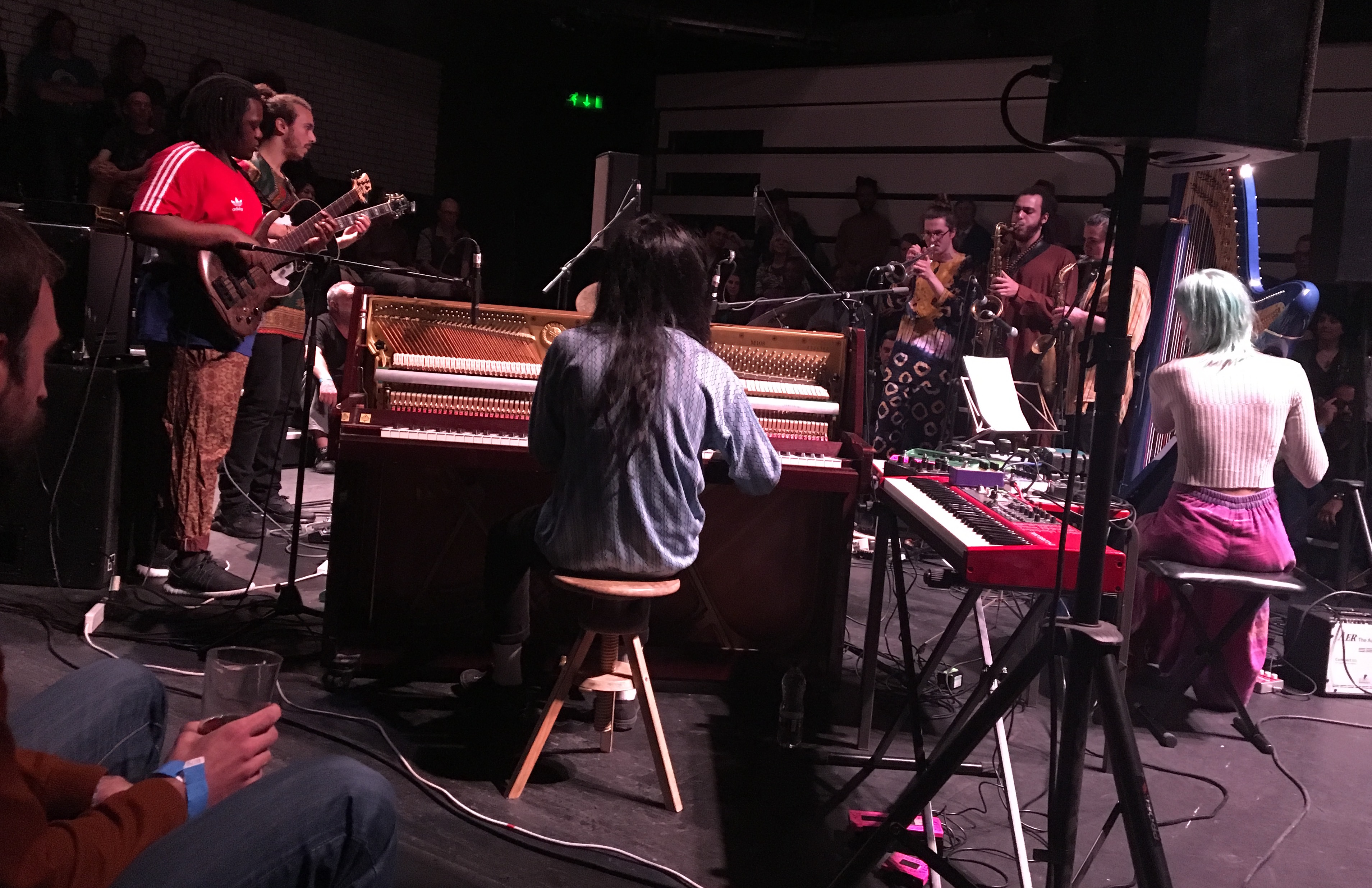 After Peterson’s DJ set came Where Pathways Meet, a nine-piece band comprising Axel Kaner-Lidstrom (trumpet), Joe Elliot (alto), James Mollison (tenor), Amané Suganami (keyboards and electronics), Maria Osuchowska (electric harp), Mark Mollison (guitar), Mutale Shashi (bass guitar), Jake Long (drums) and Kianja Harvey Elliot (voice). Named after a Sun Ra tune, and dedicated to making music animated by a reverence for his spirit, they went about their work with energy and enthusiasm. Any rawness in the execution seemed unimportant by comparison with the good feeling they imparted.
 It was with regret that I had to leave Hull after only 24 hours of Mind on the Run, the weekend festival celebrating the life and work of Basil Kirchin, the visionary composer who spent three decades in the city, working in complete obscurity until his death in 2005, aged 77.
 thebluemoment.com