 It’s 25 years today since Chet Baker was found dead on an Amsterdam pavement, apparently having fallen from the window of his hotel room. Police concluded that his death had been caused by head injuries consistent with a fall from 30ft or so; the reason has never been definitively established. The original assumption of suicide was undermined by the discovery that the window of his third-floor room in the Hotel Prins Hendrik would open no more than 15 or 20 inches: not impossible to squeeze through, but awkward. Traces of heroin and cocaine were found in the room, along with his trumpet. In the long and tragic history of the deaths of jazz musicians from non-natural causes, this was perhaps the least unexpected. The only surprise was that Baker, a junkie on and off since the mid-Fifties, had survived beyond his 58th birthday. The general belief now seems to be that he was murdered after a drug deal went wrong.
It would not have been the first time. When I met him 40 years ago this summer, he was just beginning the long comeback from an incident in San Francisco in which he was beaten so badly that he needed his upper teeth replacing with dentures. He gave me a version of his story about an angry drug dealer setting five thugs on him, and about the subsequent retreat to his mother’s home in San Jose, where he and his family lived on welfare payments and food stamps for several years until he finally decided to give music another go.
Now it was July 1973 and, thanks to the kindness of Dizzy Gillespie, who put in a good word for him, he had secured a couple of weeks at the Half Note club in Manhattan. The club’s owners, the Canterino family, had just moved it from the original location in SoHo to the corner of West 54th Street and Sixth Avenue in midtown. It was perhaps ironic that Gillespie should have done him such a favour: he was one of those bebop pioneers who had suffered 20 years earlier, when Baker regularly topped the magazine polls, named the world’s best jazz trumpeter at their expense.
Baker was never the world’s best jazz trumpeter, but he was a musician of singular lyrical gifts and genuine inventiveness. The night I went to see him at the Half Note, however, little of that talent was in evidence. He had only begun playing again three months earlier, and getting used to the dentures had made it hard for him to develop and strengthen a new embouchure. He was a gaunt figure, very far from the beautiful youth who had come to fame with the era-defining Gerry Mulligan Quartet, and was clearly struggling to reassemble his powers.
“When I tried, the first time again, I couldn’t get a sound out of the horn,” he told me. “I’d got the dentures in, and it’s not easy to start over again as far as your embouchure goes. I’d been playing one way for 26 years, remember, and it’s something that takes trumpeters a long time to develop. It’ll probably be another month or so before my chops really start to get strong. Right now, there’s plenty I can’t do. I have a very limited range, and sometimes when I go for a high passage all you can hear is the valves going up and down, but no sound. I don’t have the strength to tighten the muscles enough to make the sound come out. But then I never did play all that high, so I’m not going to let it worry me.”
His listeners could hardly ignore his frailty, but his persistence was certainly impressive. And he could still sing “But Not For Me” or “My Funny Valentine” in that wispy come-hither voice, which was enough to please those original fans who, surprised to discover that he was still alive, came along to hear him.
It was his first gig in New York since 1957, when one of his countless dope busts cost him his cabaret card, and I asked him if he felt the audiences at the Half Note were turning up to witness a relic. “Some of them, yes,” he said. “Some of them that I’ve talked to haven’t even been to New York for 10 years. One guy hadn’t been in 20 years, but he came because he’d listened to me when he was young. Many of the people who’re coming don’t ordinarily go to jazz clubs very often.”
He sounded cautiously hopeful about the future: “If I can believe what the people around me are saying, the people who run the club and those who’re coming to listen, I might allow myself to think there’s a chance that thing might go very well for me. Oh, I’m always optimistic.”
He was right to be. The comeback went so well that it kept him in work, more or less, for the next 15 years. Once he’d settled back into his old habit (he had been clean at the Half Note), the tours and the albums paid for the scores that were as important to him as the music. On the shelves of Ray’s Jazz Record Shop in Foyle’s a few days ago I counted 27 Chet Baker CDs in stock, many of them from those later years and most of those from live dates in clubs around Europe.
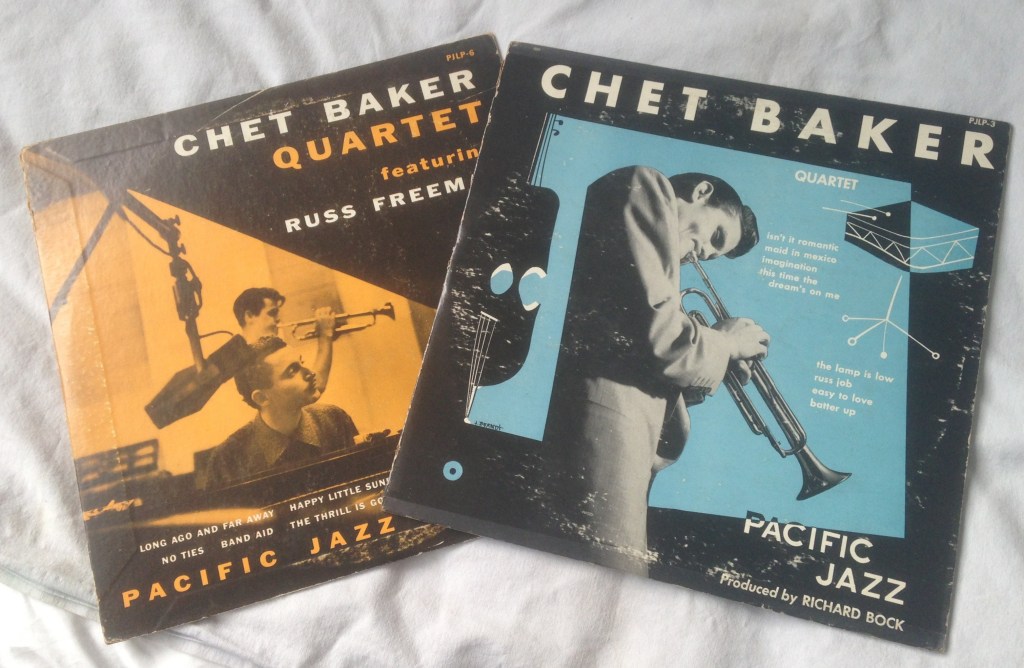
His early records — like my two treasured Pacific Jazz 10-inch albums pictured above, made 60 years ago this summer and the first to be released under his name — still sound marvellous. The mid-Fifties quartet sides with Russ Freeman on piano, whether recorded in the studio or at the Tiffany Club in Hollywood or on a fine album called Jazz at Ann Arbor, and the fascinating recordings with the ill-fated pianist Dick Twardzik, are classics, in particular the set of extraordinary compositions by Twardzik’s friend Bob Zieff which the quartet recorded for Eddy and Nicole Barclay in Paris in 1955. What is less often acknowledged is that after Baker’s comeback in 1973 there were still times when he could match and occasionally surpass the work of his younger self, becoming more than just the style icon immortalised in Bruce Weber’s documentary film Let’s Get Lost, released shortly after his death.
Three of his later albums are of special value to me. The first, Chet Baker in Paris, released in 1997 on the West Wind label, contains half a dozen tracks recorded in 1981 with the fine rhythm section of the pianist Rene Urtreger, who had known him since 1955, the bassist Pierre Michelot and the drummer Aldo Romano, playing selections from his standard repertoire — “But Not For Me”, “My Funny Valentine”, Jimmy Heath’s “For Minors Only” and Miles Davis’s “Down” — with spirit and authority.
The second may well be the best record he ever made. For Chet Baker in Tokyo, recorded 11 months before his death and released on the King label in Japan in 1993 and on Evidence in the US three years later, he is accompanied by Harold Danko (piano), Hein Van Der Geyn (bass) and John Engels (drums), a superbly empathetic rhythm section. Over the course of almost two hours, he pours out relaxed, long-lined, firm-toned improvisations of great beauty and authority, without a hint of fragility. The confidence of his double-time passages and the poise of his ballad playing are the fulfilment of every promise he ever made, providing the most telling of ripostes to the scepticism that hung around his entire career. It’s out of print now. There’s a new copy currently on Amazon for £109 and half a dozen used ones starting at £60, and I’m not entirely surprised by those prices, because it’s that good.
The third is his last formal recording, recorded in Hannover a fortnight before his death and released in 1990 by the Enja label as a 2-CD set titled The Last Great Concert: My Favourite Songs Vol I and II. Here Baker is joined by the 18-piece big band and full-scale symphony orchestra of the Nord Deutschen Rundfunk, the Hannover-based radio station, whose staff arrangers provide arrangements of familiar tunes: “Django”, “All Blues”, “My Funny Valentine”, “In Your Own Sweet Way”, “I Get Along Without You Very Well”, “Sippin’ at Bells”, “Summertime” and so on.
Baker’s own playing isn’t quite at the sublime level of his Tokyo performance, but the whole concert has a very appealing vibe to it — there are guest solos from two old Los Angeles associates, the altoist Herb Geller and the pianist Walter Norris, both then employed by the NDR — and the arrangements, if lacking the sort of character that might have been supplied by the pen of a Gil Evans or a George Russell, do the job perfectly well. We should be grateful to Kurt Giese, the ex-drummer and NDR producer who dreamed up the project, Dieter Glawischnig, the conductor, and Matthias Winckelmann of Enja, who was a student in Paris when he first saw Baker in the mid-Sixties, that the trumpeter was given this last opportunity to take advantage of such lavish resources — even though, having been fully involved in the planning, he didn’t turn up for the rehearsals.
When he did arrive, he was not in good shape. Only a few days earlier, he and his friends had been busking in the centre of Rome to raise money to pay off a dealer. An attendant at the stage door of Hannover’s Grosser Sendersaal at first refused him admission, not believing that such a disreputable-looking character could be the star of the concert. His lower teeth were giving him intense pain. But, as we can all hear, the performance was a triumph. “With every defence shattered, he lived the songs with a painful intensity,” James Gavin wrote in Deep in a Dream, his harrowing 2002 biography of the trumpeter. After the concert Baker jumped into his old Alfa Romeo and headed back to his base in Liege. Two weeks later he was dead.
 Now here’s a find, picked up for a tenner out of the vinyl racks at Ray’s Jazz Shop in Soho yesterday. I’m no longer a vinyl hound, but I couldn’t resist this well-preserved original US Atlantic copy of an album by a singer who influenced Billie Holiday and Frank Sinatra, with its elegant typography and an artfully out-of-focus photograph by Jay Maisel, who shot the cover of Miles Davis’s Kind of Blue.