Skip to content

Empress of the supper club

Mabel MercerNow here’s a find, picked up for a tenner out of the vinyl racks at Ray’s Jazz Shop in Soho yesterday. I’m no longer a vinyl hound, but I couldn’t resist this well-preserved original US Atlantic copy of an album by a singer who influenced Billie Holiday and Frank Sinatra, with its elegant typography and an artfully out-of-focus photograph by Jay Maisel, who shot the cover of Miles Davis’s Kind of Blue.

By the time I saw Mabel Mercer, she was in her early seventies and performing from an ornate armchair to audiences at the St Regis Hotel in New York City, in a room that held around 75 people. She was giving two shows a night on Tuesdays, Wednesdays and Thursdays, and  three on Fridays and Saturdays, with Sundays and Mondays off, and she was filling the place. At each show she performed around two dozen songs with her long-time accompanist, Jimmy Lyon, at the grand piano.

She could no longer sing. Instead she more or less talked her way through her repertoire, which was based on the classic American songbook: the theatre songs of Gershwin, Rodgers and Hart, Jerome Kern and so on, sprinkled with more recherche items from the likes of Alec Wilder or Cy Coleman, sometimes written specially for her. But in the way she spoke the lyrics, in the understated dramatic precision of her phrasing, you could easily see why other singers admired her so much.

Strangely enough, the woman who came to epitomise the civilised entertainment to be found in Manhattan’s mid-century supper clubs was born in Burton upon Trent, the daughter of a white English music-hall artist and a black American who is sometimes referred to as a jazz musician — although, since we are talking about the year 1900, that description might have been slightly premature. At any rate, she never knew him, and she was still a child when her mother and stepfather left for the United States, leaving her to board at a Manchester convent, where her colouring and short, dark hair led her fellow pupils to nickname her “Golliwog”.

At 14 she left to join her aunt’s song-and-dance troupe, beginning a career in show business that took her to London in the 20s, to Paris in the 30s, to the Bahamas in the early 40s, and eventually to New York, where she settled. In each of those cities, her audiences included the A-list celebrities of the day: film and theatre people, literary stars, fellow musicians, royalty. But it was in New York that she found her niche and secured a recording contract with Atlantic Records; here’s an example of this remarkable artist in her prime, singing “Les Feuilles Mortes” on one of her earlier albums, produced by the label’s founders, Ahmet Ertegun and Herb Abramson. She usually performed solo but Whitney Balliett, the New Yorker‘s nonpareil jazz critic, saw her share the Philharmonic Hall stage with Stan Getz  during the Newport Jazz Festival in 1973 and remarked that she induced the saxophonist to play “in a hymnlike manner he hasn’t shown in years”. There’s a black and white clip of her, a year later, performing Lerner and Lane’s “Wait ‘Til We’re 65” and Sondheim’s “Send in the Clowns” at a benefit concert. She appeared twice at Carnegie Hall in the mid-70s with the great cabaret singer Bobby Short, a musical soul-mate, and in 1983, the year before her death, she travelled to the White House to receive the Presidential Medal of Freedom from Ronald Reagan.

Alec Wilder, contributing a sleeve note to The Art of Mabel Mercer, released by Atlantic in 1965, described the human variety to be found among those who came to listen to her: “From pompous executives to wild-eyed hepcats; from fragile Victorian spinsters to bumptious banner-bearing avant-gardists; from graphologists to trumpet-players; from Back Bay to Broadway; from conservative to radical — behaving with respectful quiet in the presence of Mabel’s songs.” There’s isn’t much of an audience any more for what she did. A fair proportion of those following the links above will probably find her care for diction alone hopelessly old-fashioned. They should listen to her languid, lustrous version of Cole Porter’s “So in Love”, recorded in 1954: if it was good enough for Lady Day and Ol’ Blue Eyes, it’s good enough for me.

The Baz Age

gatsbyI’ve a hearty liking for jazz music, especially Irving Berlin’s. It’s most artistic. One of the first principles of dancing is abandon, and this is a quality that jazz music possesses. It’s complex. It will, I believe, occupy a great place in American art.

That’s Zelda Fitzgerald speaking to a reporter from the Baltimore Sun, who paid the celebrated couple a visit in October 1923, 18 months before the publication of The Great Gatsby. The interview took place in their house in Great Neck, Long Island, which Scott Fitzgerald used as the principal setting for his most celebrated novel. Zelda’s opinion of jazz was pretty advanced for its time, even if she did nominate Irving Berlin rather than King Oliver or Jelly Roll Morton to illustrate her enthusiasm. She was certainly right about its place in American art.

I wrote about her husband’s description of the quasi-jazz in Gatsby in a post on this blog a couple of weeks ago (“Yellow cocktail music”, May 5), and now I’ve seen Baz Luhrmann’s film, in which music plays almost as prominent a role as the actors, the script and the locations.

There are things I dislike about it, principally Tobey Maguire’s dorky portrayal of the narrator, Nick Carraway, and the otiose framing device that involves plonking Carraway in a rehab clinic where he writes a novel called The Great Gatsby. Oh, and a one-dimensional Elizabeth Debicki, grievously miscast as Jordan Baker. But there’s a lot I enjoyed, too, particularly the wholly convincing and affecting performances of the two leads, Leonardo DiCaprio and Carey Mulligan, and the general exuberance of the whole thing, to which the music is crucial.

It’s sourced from all over the place and woven into Craig Armstrong’s score in such a way as to create an aural tapestry whose careful balance between light and shade is important to a film that is constantly whacking you in the eye (probably just as true for the two-dimensional version as for the 3D in which I saw it).

I was interested to note that Luhrman and Armstrong use “Rhapsody in Blue” as a stand-in for Fitzgerald’s fictional “Vladimir Tostoff’s Jazz History of the World”. This was obviously an easier solution than getting someone to write a pastiche of such a piece, and it works well enough; there’s no point in quibbling that Gershwin didn’t write his classic piece until two years after the action described in the novel because Jay Z, will.i.am, Alicia Keys, Lana Del Ray and The xx weren’t around then either, but places are found for them in the soundtrack. Lana Del Rey’s “Young and Beautiful” is a particularly good fit, and Armstrong’s orchestral fills allude to Ennio Morricone’s peerless Once Upon a Time in America score, evoking the New York underworld of the early 20th century.

Bryan Ferry, his musical director Colin Good and their Jazz Age orchestra (see my post on February 13) make a subtle but notable impact throughout the film, backdating modern songs such as “Love Is the Drug”, “Bang Bang” and “Crazy in Love” (with a vocal by Emeli Sande). In addition to the regular soundtrack CD, their versions are available on an album called The Great Gatsby: The Jazz Recordings, currently downloadable via iTunes here and soon to be released in hard-copy form. One of my favourite moments in the film arrives during the party sequence in which we hear snatches of “Back to Black” from Beyonce and Ferry: a perfect fit as the mood darkens in the mansion on Long Island Sound.

* The illustration is from the dust jacket of the 1934 Modern Library edition, the first time Gatsby had been republished in the US since the original Scribner’s edition of 1925, which sold a mere 20,000 copies and was accounted a failure. It contains a rueful introduction by the author, then living in Baltimore, Maryland, close to Zelda’s sanitarium, his career at its lowest ebb. I bought it 40 years ago for not very much money at the beloved and now defunct Gotham Book Mart on West 47th Street in New York City: in the heart, appropriately enough, of the old Diamond District.

C’est Chic, encore

Norma JeanIt was while watching the series of YouTube mini-interviews with the collaborators on Daft Punk’s new album, Random Access Memories, that I started thinking about Nile Rodgers and found myself catching up with The Hitmaker, Martyn Stevens’s hour-long bio-documentary on the co-founder of Chic, made last year for BBC Wales. One of the people Stevens interviewed was Norma Jean Wright, Chic’s first lead singer when Rodgers and Bernard Edwards put the band together in New York in 1976. Norma Jean sang on “Dance, Dance, Dance”, their first hit, and then became the first singer to have them serve as the writers and producers on her own record, thus becoming the precursor of David Bowie, Madonna and many others.

Her first single with them, “Saturday“, became a club hit and still sounds great. It has all the Chic trademarks, including a characteristic of their earliest records: as well as Rodgers’s rhythm guitar licks, Edwards’s tentacular bass lines and Tony Thompson’s perfect four-on-the-floor drumming, there was often a distinctive keyboard or tuned percussion sound. In the case of Chic’s “I Want Your Love”, for instance, it was a set of tubular bells; with “Saturday” it was a vibraphone, played by the jazz musician Dave Friedman. On the original 12-inch disco mix, you don’t hear much of Friedman for almost four minutes: he restricts himself to sounding the chord changes, the traditional role for the vibes in Motown-and-after soul music. But then, at 3:56, he eases out of the rhythm section with a solo that adds a lovely cool new flavour to the track, a kind of mentholated sophistication. It isn’t jazz, exactly, but there’s no surprise that it comes from a guy who studied at Juilliard and recorded with Chet Baker, George Benson and others. (In the same year that he laid down his part on “Saturday”, he also recorded an album for ECM with Double Image, the band he co-led with his fellow vibist Dave Samuel.)

Nile Rodgers has done many wonderful things, but I still love that early stuff. If you haven’t already seen it, here’s the BBC documentary, in full: http://youtu.be/VVmAXWZu_PQ

A feudal horn

Feudal horns

They were playing Blood on the Tracks in the shop I wandered into yesterday. “Lily, Rosemary and the Jack of Hearts” was halfway through: a song that always lightens my step. The choice of music in shops is an underrated business and although I didn’t really want to buy anything, their sound system was good enough to make me stick around to listen to some more of Bob. Two songs later it was “Shelter from the Storm”, with that quietly impassioned vocal set against the strumming acoustic guitars and the halved-time bass guitar.

An hour later I was in a restaurant, having lunch with a friend who loves Dylan as much as I do, and I mentioned that I was always amused by a line in the seventh verse: “And the one-eyed undertaker, he blows a feudal horn…” No, no, she said. That’s not it. It’s funeral horn. Undertaker. Funeral horn. Get it? Well, I said, I’d always thought it might be flugelhorn, with a slightly mangled pronunciation, but “funeral horn” sounded too literal, particularly for Bob. So she got out her smartphone and went on to bobdylan.com and discovered just here that the official version is “futile horn”.

Not for me it isn’t, and nor will it ever be. Do we really imagine, I said to my friend, that Bob Dylan transcribes his own lyrics? That’s just some devoted functionary getting it wrong. In fact there’s an entire website devoted to mishearings of Dylan lyrics (find it here) and sure enough someone agrees with me on the matter of the one-eyed undertaker’s “feudal horn”. (Someone else also thinks it might be “flugelhorn”; there appears to be no recorded corroboration of my friend’s “funeral horn”. Only Dylan could be the subject of four conflicting versions of a single word.) To settle the matter, take a listen to the driving version on Hard Rain, from the Rolling Thunder tour in 1976: the vocal is very clear, and that’s a “d”, not a “t”. And I know exactly what a feudal horn sounds like, even though I’ve never heard one. So does Bob.

James Jamerson: a hidden masterpiece

James JamersonYou don’t need me to tell you about James Jamerson, the first of the Motown session musicians to be recognised for his outstanding individual contribution to the Sound of Young America. It was Jamerson who revolutionised the use of the bass guitar in popular music, yanking it away from a restricted role by creating the mobile, often melody-rich lines that got us dancing to Marvin Gaye’s “Ain’t That Peculiar”, Kim Weston’s “Take Me in Your Arms (Rock Me a Little While)”, the Supremes’ “Love is Here (And Now You’re Gone)”, the Four Tops’ “Reach Out, I’ll Be There”, Jr Walker’s “(I’m a) Road Runner”, the Isley Brothers’ “Tell Me It’s a Rumour, Baby”, the Temptations’ “(I Know) I’m Losing You”, Barbara Randolph’s “I Got a Feeling” and so many others (those eight tracks comprise just a rather obvious selection of my own particular favourites from the golden age of Hitsville USA).

Every now and then a previously hidden gem of Jamerson’s art emerges, and one such is to be heard on Finders Keepers: Motown Girls 1961-67, a compilation of hitherto unconsidered trifles put together by Keith Hughes and Mick Patrick for Ace Records. Containing non-hit tracks by such luckless thrushes as LaBrenda Ben, Hattie Littles, Carolyn Crawford, Anita Knorl, Linda Griner, Thelma Brown and Liz Lands as well as rejected tracks by the hit-making Supremes, Gladys Knight and the Pips, Brenda Holloway, the Marvelettes, the Velvelettes and the Miracles (with Claudette Rogers singing lead), it is not, one has to say, an absolutely essential purchase. Although there are a handful of genuine highlights, notably the Velvelettes’ Northern beauty “Let Love Live (A Little Bit Longer)” and the one well-known track, Mary Wells’ “What’s Easy For Two”, in general the selection confirms the shrewdness of Gordy’s quality control department, whose stern judges assessed songs for single or album release.

But there is one moment which more than justifies the album’s existence, and that moment is “No More Tear Stained Make Up”, a Smokey Robinson song recorded by Martha and the Vandellas in 1966 and previously released only on their LP of the same year, Watchout!, where it languished until this resurrection. I confess that I never noticed the special quality of this song, which resides chiefly in the fact that it functions as a vehicle for some of Jamerson’s most inventive playing

Some may also enjoy Smokey’s lyric: “I’ve had no use to wear a / Pair of lashes or mascara / And my eyes have natural shadows from the crying / That I’ve done so much of lately / Cos it really hurt me greatly / When I found the love you vowed was only lying…” I’m certainly among them, particularly for the “to wear a”/”mascara” rhyme. But the true beauty of the track is the way Jamerson exploits the cool medium-paced swing of the rhythm — not unlike the airy, hip-swivelling groove of the Miracles’ “I Like It Like That” from two years earlier — with what amounts to a running commentary on the top line and the chord changes, exposing his wonderful instinct for the best way to embellish a simple song without cluttering or overwhelming it.

Born in 1936, Jamerson learnt to play the double bass while a pupil at Detroit’s Northwestern High School and spent the early years of his career playing with jazz groups. He switched to the electric instrument in 1961, at just about the time he was starting to work in the Motown studio, but on many of his recordings you can hear the influence of his grounding in jazz in the fluency of his double-time fills and run-ups, the passing notes, the register leaps, a willingness to add syncopation through the use of rests, and — on a track like this — the ability to “walk” a 4/4 rhythm. There are even times on some of the early Motown tracks, such as “A Love Like Yours (Don’t Come Knocking Everyday)”, the B-side of Martha and the Vandellas’ “Heat Wave”, recorded in 1963, when it sounds as though he was still using the upright instrument. And listen to him on the Supremes’ magnificent “Love Is Here (And Now You’re Gone)” from 1966, how he reshapes what must have begun life as a basic four-on-the-floor stomper with leaping triplet-based figures and a lovely, almost acoustic tone that would not have shamed Charles Mingus.

I wish I had the skill and patience to transcribe his playing on “No More Tear Stained Make Up”. Ranging up and down the stave and across the bar-lines, it would probably look as beautiful as it sounds.

* The photograph is taken from Standing in the Shadows of Motown: The Life and Music of the Legendary Bassist James Jamerson, the self-published book by Dr Licks (Allan Slutsky) which first appeared in 1989 and sparked the interest that led to a Grammy-winning documentary film in 2002 and the highly successful reunion tours of the Funk Brothers, as the Motown session men called themselves — too late, alas, for Jamerson, who died in 1983, aged 47.

Chet Baker: comeback and fadeout

chetIt’s 25 years today since Chet Baker was found dead on an Amsterdam pavement, apparently having fallen from the window of his hotel room. Police concluded that his death had been caused by head injuries consistent with a fall from 30ft or so; the reason has never been definitively established. The original assumption of suicide was undermined by the discovery that the window of his third-floor room in the Hotel Prins Hendrik would open no more than 15 or 20 inches: not impossible to squeeze through, but awkward. Traces of heroin and cocaine were found in the room, along with his trumpet. In the long and tragic history of the deaths of jazz musicians from non-natural causes, this was perhaps the least unexpected. The only surprise was that Baker, a junkie on and off since the mid-Fifties, had survived beyond his 58th birthday. The general belief now seems to be that he was murdered after a drug deal went wrong.

It would not have been the first time. When I met him 40 years ago this summer, he was just beginning the long comeback from an incident in San Francisco in which he was beaten so badly that he needed his upper teeth replacing with dentures. He gave me a version of his story about an angry drug dealer setting five thugs on him, and about the subsequent retreat to his mother’s home in San Jose, where he and his family lived on welfare payments and food stamps for several years until he finally decided to give music another go.

Now it was July 1973 and, thanks to the kindness of Dizzy Gillespie, who put in a good word for him, he had secured a couple of weeks at the Half Note club in Manhattan. The club’s owners, the Canterino family, had just moved it from the original location in SoHo to the corner of West 54th Street and Sixth Avenue in midtown. It was perhaps ironic that Gillespie should have done him such a favour: he was one of those bebop pioneers who had suffered 20 years earlier, when Baker regularly topped the magazine polls, named the world’s best jazz trumpeter at their expense.

Baker was never the world’s best jazz trumpeter, but he was a musician of singular lyrical gifts and genuine inventiveness. The night I went to see him at the Half Note, however, little of that talent was in evidence. He had only begun playing again three months earlier, and getting used to the dentures had made it hard for him to develop and strengthen a new embouchure. He was a gaunt figure, very far from the beautiful youth who had come to fame with the era-defining Gerry Mulligan Quartet, and was clearly struggling to reassemble his powers.

“When I tried, the first time again, I couldn’t get a sound out of the horn,” he told me. “I’d got the dentures in, and it’s not easy to start over again as far as your embouchure goes. I’d been playing one way for 26 years, remember, and it’s something that takes trumpeters a long time to develop. It’ll probably be another month or so before my chops really start to get strong. Right now, there’s plenty I can’t do. I have a very limited range, and sometimes when I go for a high passage all you can hear is the valves going up and down, but no sound. I don’t have the strength to tighten the muscles enough to make the sound come out. But then I never did play all that high, so I’m not going to let it worry me.”

His listeners could hardly ignore his frailty, but his persistence was certainly impressive. And he could still sing “But Not For Me” or “My Funny Valentine” in that wispy come-hither voice, which was enough to please those original fans who, surprised to discover that he was still alive, came along to hear him.

It was his first gig in New York since 1957, when one of his countless dope busts cost him his cabaret card, and I asked him if he felt the audiences at the Half Note were turning up to witness a relic. “Some of them, yes,” he said. “Some of them that I’ve talked to haven’t even been to New York for 10 years. One guy hadn’t been in 20 years, but he came because he’d listened to me when he was young. Many of the people who’re coming don’t ordinarily go to jazz clubs very often.”

He sounded cautiously hopeful about the future: “If I can believe what the people around me are saying, the people who run the club and those who’re coming to listen, I might allow myself to think there’s a chance that thing might go very well for me.  Oh, I’m always optimistic.”

He was right to be. The comeback went so well that it kept him in work, more or less, for the next 15 years. Once he’d settled back into his old habit (he had been clean at the Half Note), the tours and the albums paid for the scores that were as important to him as the music. On the shelves of Ray’s Jazz Record Shop in Foyle’s a few days ago I counted 27 Chet Baker CDs in stock, many of them from those later years and most of those from live dates in clubs around Europe.

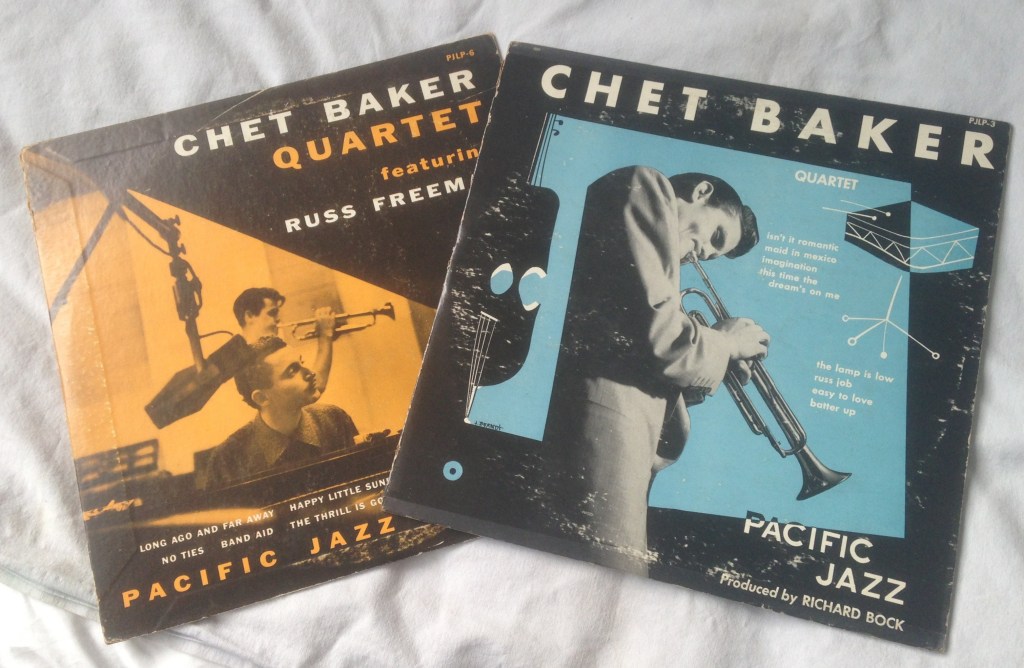
His early records — like my two treasured Pacific Jazz 10-inch albums pictured above, made 60 years ago this summer and the first to be released under his name — still sound marvellous. The mid-Fifties quartet sides with Russ Freeman on piano, whether recorded in the studio or at the Tiffany Club in Hollywood or on a fine album called Jazz at Ann Arbor, and the fascinating recordings with the ill-fated pianist Dick Twardzik, are classics, in particular the set of extraordinary compositions by Twardzik’s friend Bob Zieff which the quartet recorded for Eddy and Nicole Barclay in Paris in 1955. What is less often acknowledged is that after Baker’s comeback in 1973 there were still times when he could match and occasionally surpass the work of his younger self, becoming more than just the style icon immortalised in Bruce Weber’s documentary film Let’s Get Lost, released shortly after his death.

Three of his later albums are of special value to me. The first, Chet Baker in Paris, released in 1997 on the West Wind label, contains half a dozen tracks recorded in 1981 with the fine rhythm section of the pianist Rene Urtreger, who had known him since 1955, the bassist Pierre Michelot and the drummer Aldo Romano, playing selections from his standard repertoire — “But Not For Me”, “My Funny Valentine”, Jimmy Heath’s “For Minors Only” and Miles Davis’s “Down” — with spirit and authority.

The second may well be the best record he ever made. For Chet Baker in Tokyo, recorded 11 months before his death and released on the King label in Japan in 1993 and on Evidence in the US three years later, he is accompanied by Harold Danko (piano), Hein Van Der Geyn (bass) and John Engels (drums), a superbly empathetic rhythm section. Over the course of almost two hours, he pours out relaxed, long-lined, firm-toned improvisations of great beauty and authority, without a hint of fragility. The confidence of his double-time passages and the poise of his ballad playing are the fulfilment of every promise he ever made, providing the most telling of ripostes to the scepticism that hung around his entire career. It’s out of print now. There’s a new copy currently on Amazon for £109 and half a dozen used ones starting at £60, and I’m not entirely surprised by those prices, because it’s that good.

The third is his last formal recording, recorded in Hannover a fortnight before his death and released in 1990 by the Enja label as a 2-CD set titled The Last Great Concert: My Favourite Songs Vol I and II. Here Baker is joined by the 18-piece big band and full-scale symphony orchestra of the Nord Deutschen Rundfunk, the Hannover-based radio station, whose staff arrangers provide arrangements of familiar tunes: “Django”, “All Blues”, “My Funny Valentine”, “In Your Own Sweet Way”, “I Get Along Without You Very Well”, “Sippin’ at Bells”, “Summertime” and so on.

Baker’s own playing isn’t quite at the sublime level of his Tokyo performance, but the whole concert has a very appealing vibe to it — there are guest solos from two old Los Angeles associates, the altoist Herb Geller and the pianist Walter Norris, both then employed by the NDR — and the arrangements, if lacking the sort of character that might have been supplied by the pen of a Gil Evans or a George Russell, do the job perfectly well. We should be grateful to Kurt Giese, the ex-drummer and NDR producer who dreamed up the project, Dieter Glawischnig, the conductor, and Matthias Winckelmann of Enja, who was a student in Paris when he first saw Baker in the mid-Sixties, that the trumpeter was given this last opportunity to take advantage of such lavish resources — even though, having been fully involved in the planning, he didn’t turn up for the rehearsals.

When he did arrive, he was not in good shape. Only a few days earlier, he and his friends had been busking in the centre of Rome to raise money to pay off a dealer. An attendant at the stage door of Hannover’s Grosser Sendersaal at first refused him admission, not believing that such a disreputable-looking character could be the star of the concert. His lower teeth were giving him intense pain. But, as we can all hear, the performance was a triumph. “With every defence shattered, he lived the songs with a painful intensity,” James Gavin wrote in Deep in a Dream, his harrowing 2002 biography of the trumpeter. After the concert Baker jumped into his old Alfa Romeo and headed back to his base in Liege. Two weeks later he was dead.

Welcome back, Shuggie Otis

shuggie otisThe 14 previously unreleased tracks tacked on to Sony Legacy’s new reissue of Shuggie Otis’s cult-classic 1974 album Inspiration Information, most of the extra material collected as a second disc under the title Wings of Love, remind us of what a singular talent has lain half-hidden for most of the past 40 years.

The son of Johnny Otis, the remarkable bandleader, songwriter, vibraphone player, talent scout, record producer, disc-jockey, civil rights activist, local politician and author who died just over a year ago at the age of 90, Shuggie made his first trip from California to London in August 1972, arriving as an 18-year-old guitarist with his father’s rhythm and blues troupe. Before they played a memorable gig at the 100 Club, I interviewed Johnny for the Melody Maker and asked him to tell me how Shuggie’s talent had emerged.

In 1967, he said, a fallow period in his own career came to an end when a promoter offered him a gig. He needed to put a band together, and there wasn’t much money involved, so he asked his son to make up the numbers. “Shuggie knew T-Bone Walker and all them guys as a little boy — he was always under my chair, and I didn’t realise how much of an impression they’d made on him,” he said. “So we got a show together, and lo and behold the young white audience turned up, asking me for tunes that they shouldn’t know about!” And they responded to Shuggie’s prodigious talent — as, soon, did Al Kooper, who recorded with him and got him his first deal with Columbia Records. Before long he was turning down an invitation to join the Rolling Stones.

Shuggie is 59 years old now, and turned up in London again before Christmas to play at the Jazz Cafe, receiving this rather lukewarm review from Dorian Lynskey in the Guardian. But, great blues-rock guitarist as he undoubtedly is, his most fruitful environment has always been the recording studio, where he can overdub himself on the many instruments at his command and weave gorgeous tapestries around his unassuming but memorable songs.

Inspiration Information was his third album, following Here Comes Shuggie Otis! (1969) and Freedom Flight (1971), the latter introducing the world to the sublime “Strawberry Letter 23”, which became a hit for the Brothers Johnson. Shuggie claims that the subsequent silence was not of his own volition. “There were little lapses here and there, little breaks from time to time,” he says in the sleeve notes to the new package, “but I never stopped playing, writing, recording. I was still going round to record companies, still pitching my tapes.”

The conventional wisdom is that he had a lot in common with Sly Stone and Stevie Wonder, and echoes of his music would permeate that of Prince. The third album’s best known tracks are the title song, where his slow funk resembles that of Sly without the dark undertow, and “Aht Uh Mi Hed”, whose cool organ stabs remind me of Timmy Thomas’s immortal “Why Can’t We Live Together”. It’s followed by “Happy House”, which lasts no more than 1min 21sec, probably for the very good reason that it doesn’t need to be any longer to make its point. The album finishes in an unorthodox way with three modest but charming home-made instrumentals, mostly  keyboards and the drum machine Shuggie so loves. “XL-30” and “Pling!” are mood pieces, almost tone poems: like an R&B musician’s equivalent of “Fall Breaks and Back to Winter” from the Beach Boys’ Smiley Smile. The concluding “Not Available” is a lovely exercise in bright-eyed funk.

The tracks on the second disc, gathered under the title Wings of Love, were recorded — with one outstanding exception — between 1975 and 1990, and although most of the work was again done by Shuggie, they are rather more elaborate in approach and texture, also making use of strings and horns, which he arranged. The song “Wings of Love” is an 11 and a half minute epic ballad from a 1990 session, bookended by ocean sound effects, and “Give Me a Chance”, recorded three years earlier, sounds like a great lost disco classic, as if bathed in the light of a giant glitter ball, with a raging old-school rock-out finale on which Shuggie’s guitar battles with his Hammond B3.

The one that really pins my ears back, though, is “Black Belt Sheriff”, a spellbinding solo performance for voice and acoustic guitar recorded during a concert 13 years ago in Long Beach, the city from where his father broadcast his influential R&B radio show on KFOX in the 1950s. It’s a six and a half minute reverie of self-examination in the form of a conversation with a friend (possibly one of his brothers, to whom it is dedicated), the singer’s thoughts drifting through the dreamscape of a Los Angeles night, with glimpses of cars, bars, girls and celebrities as he vows to “give up my dreams and transgressions”. There’s a fine bottleneck interlude, followed by a tantalisingly enigmatic closure: “I’d like to stay and tell you what it’s all about / Hear you play, brother, laugh, sing and shout / But I got to go turn around again / So I’ll see you soon…” This has nothing to do with his mastery of studio overdubbing technology or his ability to play many different instruments. It’s his equivalent of Lennon’s “Working Class Hero” or Marley’s “Redemption Song”: the artist stands alone and unadorned, his true power revealed.

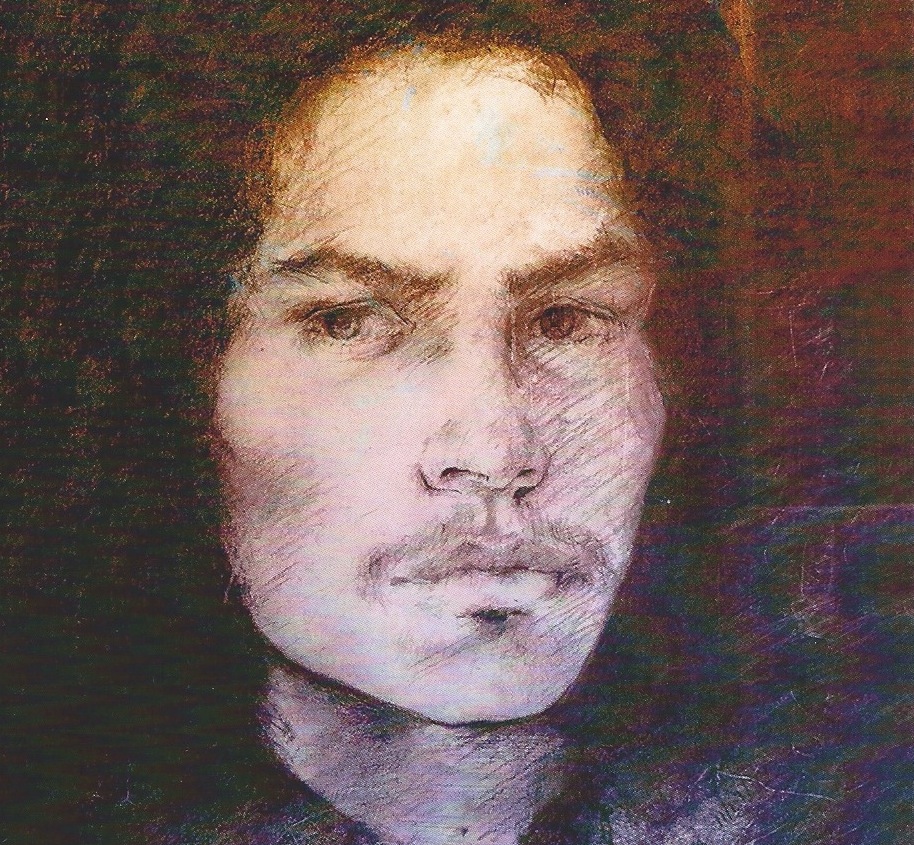
* The portrait of Shuggie Otis was made 1971 by his wife, Teri, who happens to be the daughter of the great composer and bandleader Gerald Wilson. It’s taken from the insert in the Inspiration Information/Wings of Love 2-CD set.

The essence of Bird

Bird

It’s 25 years since I made the decision to avoid Clint Eastwood’s Charlie Parker biopic. I’d been sent the Bird album, and the discovery that the director had found it necessary to tamper with Parker’s original recordings in order to provide his film with a technically adequate soundtrack made me angry. It seemed outrageous. How could anyone find it acceptable to strip away the piano playing of John Lewis, the bass playing of Tommy Potter and the drumming of Max Roach and replace them with other musicians playing along to the sound of Parker’s alto saxophone in a modern recording studio?  Eastwood may have been motivated by a genuine desire to pay homage to a genius of modern music, but what he and the film’s musical director, Lennie Niehaus, committed was an offence against the idea that these recordings — like any jazz recordings by an ensemble, come to that — are works of collective endeavour to which each individual part makes an essential contribution. Even if the “replacement” musicians included such irreproachable bebop-era veterans as Barry Harris and Ray Brown, it was like taking the Mona Lisa and photoshopping in the Las Vegas skyline as a background instead of the Tuscan hills of the original, just because the modern digital image was sharper. Doing it for the benefit of the film was one thing; releasing the result of this tampering as the soundtrack album compounded the offence.

Earlier this week I heard Eastwood talking about the film with the singer Jamie Cullum, who is presenting a Radio 2 series called Jazz at the Movies. Cullum is one of those “celebrities” nowadays preferred by the BBC as the presenters of radio programmes on jazz, in the decidedly un-Reithian conviction that their mere presence will attract a bigger audience. Such great broadcasters as Charles Fox and Peter Clayton, men who loved jazz, knew a great deal about it, and also knew how to communicate their authority and enthusiasm, must be turning in their graves.

Needless to say, Cullum got nothing interesting out of Eastwood, least of all on the subject of the substitution of the rhythm sections on the soundtrack of Bird. (You can hear their conversation here.) It was all too easy to imagine Fox gently and politely posing a question about the seemliness of  the exercise. But, finally, it persuaded me set my old prejudice aside and watch a DVD of the film.

Like practically all biopics, it is effectively a cartoon, a simplification and an exaggeration of the real story, but not without its merits. Forest Whitaker is a wonderful actor and gives an affecting and finely nuanced performance in a demanding role, although his voice and presence (if not his physical bulk) seem a bit lightweight for Parker, who had a rich baritone speaking voice. The excellent Diane Venora plays Chan Parker, Bird’s last (common-law) wife, whose participation in the making of the film might prompt one to question the degree of objectivity with which she is portrayed. The late scene in which Parker enters a New York theatre and discovers an old rival playing rock and roll to an ecstatic audience of teenagers is a ludicrous and demeaning invention.

I was interested in the character of Audrey (played by Anna Levine), an artist with whom Parker has an affair during his visits to Los Angeles in the 1950s. She is clearly based on Julie Macdonald, who befriended the saxophonist and was with him when he received the news in March 1954 that his infant daughter Pree had died in New York, provoking a collapse that prefaced his final decline and ultimate demise 12 months later.

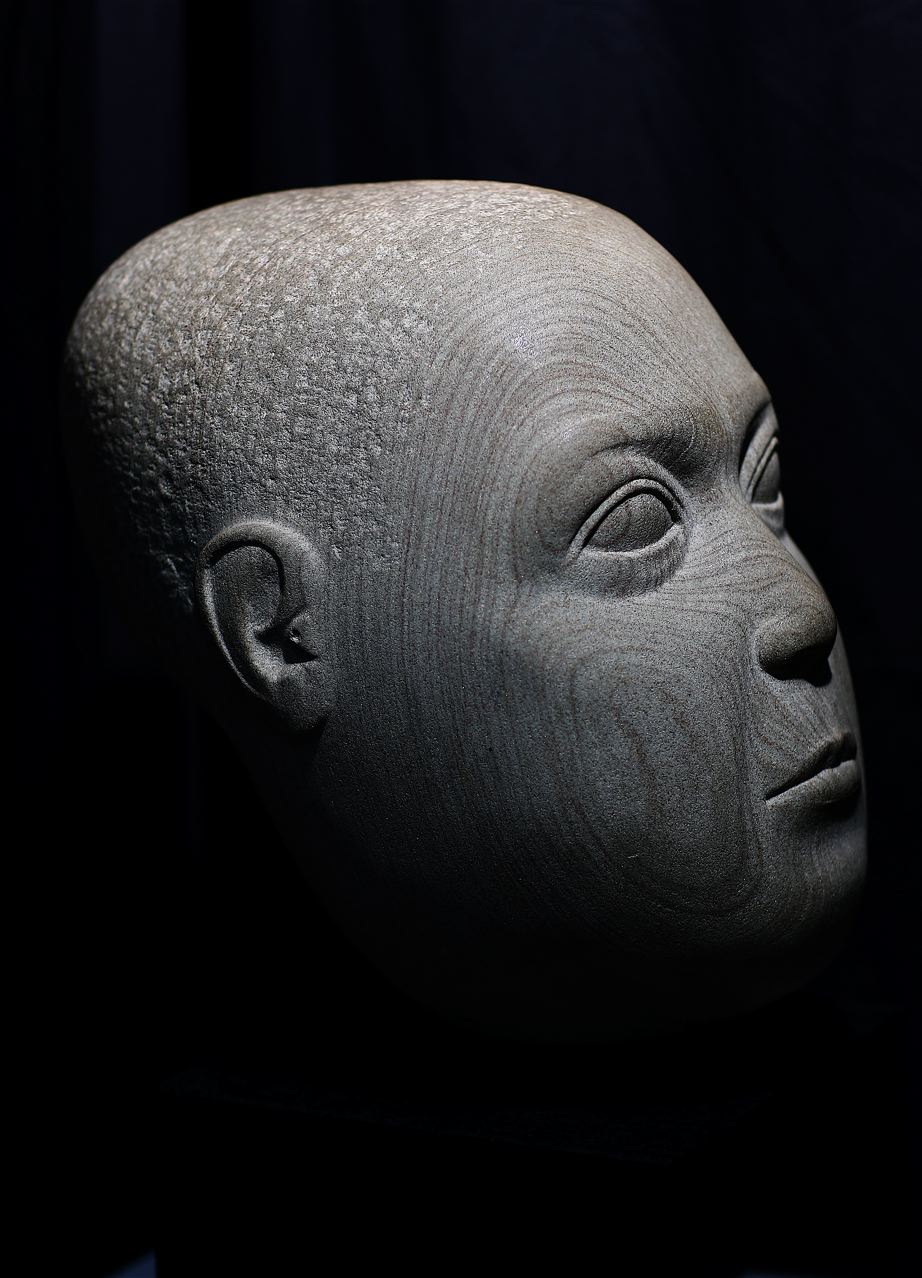
During his stays with Macdonald, they discussed art and classical music and probably much else; whatever else their relationship may have been about, this was also a meeting of minds. She produced at least two remarkable sculptures based on his likeness: one, a full-length study in lignum vitae, a dark hardwood, was last heard of in the ownership of Robert Reisner, who had promoted Parker in New York clubs; the other, pictured at the top of this piece, was carved from a piece of pale, lightly striated Pasadena sandstone and weighs 275lb. She sold it in 1961 to a California collector, apparently to raise the cash to buy a Ferrari, and it is currently in the possession of William Dickson, a retired Edinburgh architect who is now a photographer and a collector of post-war jazz artefacts and memorabilia. Three years ago I wrote a feature about the piece in the Guardian, having gone up to Scotland to see it, and it is through Dickson’s kind permission that his photograph is reproduced here. Bizarrely, given its great importance and direct relationship with such a historic figure, it has never been on public exhibition.

Macdonald took her inspiration from Egyptian heads of the 15th dynasty, which she and Parker had looked at together, and Yoruba carvings of the 14th to the 16th century. In my view she evokes more of her subject’s complex and profound essence than the director of Bird, for all his unquestionably good intentions, could capture in two and a half hours of celluloid. And I’m afraid I still can’t forgive Eastwood for erasing the sound of those great musicians with whom Parker created his masterpieces.

Abba: my part in their rise to world domination

Agnetha 1A new museum dedicated to Abba is opening this week in Stockholm, in the presence of 75 per cent of the group: Bjorn Ulvaeus, Benny Andersson and Anni-Frid Lyngstad. I have three things to say about this.

1.

Here’s a memory from one day in 1980, when a review copy of their new single, “The Winner Takes It All”, arrived at the Melody Maker office, then located in a Nissen hut just south of Blackfriars Bridge in London. This was long before Abba acquired any sort of hipster credibility, or even the respect due to people who make great pop records, but I’d loved “Dancing Queen”, “Knowing Me, Knowing You” and “The Name of the Game” and I wanted to hear this one. So I dashed towards the listening room and opened the door. Already in there was Ian Birch, one of the paper’s writers, sitting with a couple of people whose backs were towards me. I couldn’t see  who they were.

“Sorry, Ian,” I said, “but I really have to listen to this — it’s the new Abba single.” A look of horror crossed his face. The two people with him swung round in amazement. They were Phil Oakey and Joanne Catherall from the Human League, then at the very beginning of their journey to pop stardom. With Ian, they were doing something called Blind Date: a weekly feature in which a pop star was played a bunch of new records without being told what they were, and was invited to comment. I’d interrupted their seance, and they clearly thought they were in the presence of a madman. I couldn’t have seemed more utterly uncool had I said I wanted to listen to a klezmer remake of “We’ll Gather Lilacs”. I made my excuses and left.

2.

We all want to leave a footprint on history, and here is mine, as recorded in Bright Lights Dark Shadows: The Real Story of Abba, by Carl Magnus Palm, published by Omnibus Press in 2001. Palm tells the story of how Michael Tretow, then a young studio engineer, was working with Bjorn and Benny, and wanted to make their records sound better. No one in Sweden, however, understood the techniques used by American and British record producers. There was no literature available. Then, one day…

One of the more open-minded booksellers was located in central Stockholm, he writes. Michael would pop in every now and then to see if any interesting titles were available. One day in the autumn of 1972 he finally found the book he’d been dreaming about. It was called Out of His Head: The Sound of Phil Spector. The author was Richard Williams, the assistant editor of Britain’s Melody Maker magazine, and the volume had just recently been published. Michael didn’t hesitate, and headed straight for the cashier with this find before anyone else snapped it up.

Bjorn, Benny and Michael were all roughly the same age, and like most of their generation had discovered rock through Elvis Presley. They were also big fans of the records made by the producer Phil Spector in the early Sixties. His “wall of sound” had been the foundation for dozens of legendary recordings he had produced for several American girl groups, as well as artists like the Righteous Brothers and Ike and Tina Turner.

What Michael wanted to know was how Spector achieved that enormous sound. Although he was not entirely sure, he thought he had a hunch — and now Out of His Head revealed all the secrets. “Then He Kissed Me” by the Crystals used “a whole gang of guitars”, the book established. On the following pages, a section about the Ronettes’ classic “Be My Baby” went into even greater detail. “The orchestra, outrageously gigantic, had pianos and basses arrayed in ranks in the studio,” wrote Williams, “and everyone joining in to play the percussion which Spector had arranged with almost militaristic precision.”

Michael nodded to himself. “That explained why it sounded like five guitars,” he recalled. “It was because Spector really did use five guitars.” But having several guitarists, pianists, bassists and so on in the studio at the same time would have been far too expensive for comparatively low key Swedish productions. If a similar effect was to be achieved, they would have to do several overdubs of each of the instruments instead. Michael knew he simply had to try it sometime. 

The opportunity arrived soon enough, for the Metronome studio had been booked for Wednesday, January 10, 1973. That was when Bjorn and Benny were going to record “Ring Ring”, their new song for the Eurovision Song Contest. The night before the session, the three friends met at Michael’s place, discussing the best way of recording the song. Michael told them what he’d read about Phil Spector’s recording techniques. Wouldn’t that be a good thing to try on this new song, to record the backing track at least twice? Bjorn and Benny enthusiastically agreed.

And the rest is history, as Palm goes on to describe. “Ring Ring” gave them their breakthrough hit in several countries. It didn’t win the Eurovision Song Contest, but in terms of shaping their sound it served as a template for the one that did, “Waterloo”, and for the hits that followed.

So there it is. I didn’t make this up. And I’m sorry, but I’ve been dying to tell someone about it. You know: 310 million albums and singles, all those sold-out concerts, 42 million tickets for Mamma Mia!, an official museum in Stockholm — it might never have happened.

3.

Agnetha Faltskog won’t be at the opening the museum because she’s out of the country, promoting her new solo album. It’s her first since 2004, when she released My Colouring Book, consisting of cover versions of songs that meant a lot to her, particularly when she was a young girl. I liked it straight away for its wistfulness and its authenticity: this really does sound like a woman of a certain age recalling the important feelings of her youth and honouring the records that reflected her adolescent emotions. All her versions are excellent, and some are exceptional, beginning with the title track, which she first heard in Dusty Springfield’s version. On Jackie De Shannon’s “When You Walk in the Room” she outdoes every previous version, including those by the composer, the Searchers and Bruce Springsteen (who performed it at Hammersmith Odeon in 1975). “What Now My Love” has the epic quality of a Spector classic, but with modern textures. It was brave of her to accept the challenge of reinterpreting the Shangri-Las’ “Past, Present and Future”, and she does justice to a masterpiece. Over the years My Colouring Book has become nothing less than one of my favourite pop albums.

* The photograph of Agnetha Faltskog is taken from the cover of My Colouring Book, and is by Jimmy Backius.

* It’s been pointed out to me that the incident at the Melody Maker can’t have taken place in 1979, as I originally wrote, since “The Winner Takes It All” was released in 1980. So I’ve made the correction. I’m delighted that the blog is attracting such eagle-eyed readers as @marcellocarlin.

Yellow cocktail music

Paul WhitemanWith a handful of phrases in The Great Gatsby, F. Scott Fitzgerald lets us know that he missed his vocation: he would have made a first-class jazz critic. Consider, for example, his description of the music played by the band during the first of Jay Gatsby’s parties at the mansion on Long Island Sound attended by Nick Carraway, the book’s narrator: “The moon had risen a little higher, and floating in the Sound was a triangle of silver scales, trembling a little to the stiff, tinny drip of the banjoes on the lawn.” Wow. How many opponents of trad jazz must have wished they’d come up with the lethal precision of that “stiff, tinny drip”?

Even better is this, a couple of pages earlier: “The lights grow brighter as the earth lurches away from the sun, and now the orchestra is playing yellow cocktail music…” Yellow cocktail music! Who could not read those words and imagine exactly the sound the author had in mind, or at least its effect?

In Carraway’s words, the orchestra hired to entertain Gatsby’s guests is “no thin five-piece affair, but a whole pitful of oboes and trombones and saxophones and viols and cornets and piccolos, and high and low drums.” Not the Original Dixieland Jazz Band, then, but a more lavish ensemble very much along the lines of the outfit led in the early 1920s by Paul Whiteman, the pioneer of “symphonic jazz”.

The resemblance becomes even more marked when the orchestra leader announces: “Ladies and gentlemen, at the request of Mr Gatsby we are going to play for you Mr Vladmir Tostoff’s latest work, which attracted so much admiration at Carnegie Hall last May. If you read the papers you know there was a big sensation.” The piece, he continued, was known as “Vladmir Tostoff’s Jazz History of the World”.

If we are searching for a real-life inspiration for the fictitious Mr Tostoff, we might alight upon the figure Ferdy Grofé, a pianist and composer who met Whiteman in California in 1919 and worked closely with him until 1933. It was he who orchestrated George Gershwin’s “Rhapsody in Blue”, commissioned by Whiteman, for its concert debut at New York’s Aeolian Hall in 1924, with Gershwin himself at the piano. I still have my mother’s two-sided 12-inch 78 of their studio recording for the Victor label, released in the UK on His Master’s Voice; you can hear and see a later (and rather differently staged) performance here in an extract from the 1930 film King of Jazz.

Fitzgerald began work on Gatsby in 1922 — the year of Gershwin’s one-act opera Blue Monday, which inspired Whiteman to invite him to write a longer work — and made his final revisions in 1925, by which time “symphonic jazz” had become a part of the American music scene. Meanwhile there had been the premiere of Darius Milhaud’s much discussed La Création du Monde, another work which attempted to blend jazz and European classical music. (Milhaud, a French composer who had heard jazz during a visit to Harlem in 1922, later taught at Mills College in Oakland, California, where his pupils included Dave Brubeck and Burt Bacharach.) Grofé’s Mississippi Suite would come along in 1927, part of a phenomenon that withered in the face of critical disdain but provided a pre-echo of the Third Stream movement of the late 1950s and early 1960s.

The Great Gatsby always reminds me of Miles Davis’s Kind of Blue: no amount of mishandling can tarnish the essence of a work of 20th century art that comes as close to perfection as makes no difference. So I’m looking forward to Baz Luhrmann’s new film version, released in the UK later this month, with Leonardo di Caprio as Gatsby, Carey Mulligan as Daisy Buchanan and Tobey Maguire as Carraway, and with music by Jay Z, Beyonce, Bryan Ferry and others. After all, Shakespeare survived Luhrmann’s marvellously inventive 1996 version of Romeo & Juliet, with its gun-toting gangbangers and a soundtrack that included Garbage, the Butthole Surfers and Radiohead.

Paul Whiteman, incidentally, earned the undying disrespect of purists who correctly believed he had no right to the absurd “King of Jazz” title (bestowed by a journalist in 1919 but eagerly seized upon as a marketing slogan), at least as long as Louis Armstrong, Jelly Roll Morton, Duke Ellington and other African American innovators were around. But an unbiased listen to some of his 1920s recordings reveals a man who hired good soloists — including the cornetists Red Nichols and Bix Beiderbecke and the saxophonists Jimmy Dorsey and Frank Trumbauer — and definitely had some sort of a feeling for jazz.

As for “Vladmir Tostoff’s Jazz History of the World”, wouldn’t it be fun if some modern composer with an understanding of the period took it upon himself to imagine the piece into actual life? I’d love to hear it, tinny banjoes and all.

* The photograph of Paul Whiteman’s Ambassador Hotel Orchestra was taken in Atlantic City in 1920; the leader is on the extreme left, a violin under his arm. It is included in the booklet to the CD Paul Whiteman ‘King of Jazz’ 1920-1927, released on the Timeless Historical label.