Skip to content

The meaning of the Strypes

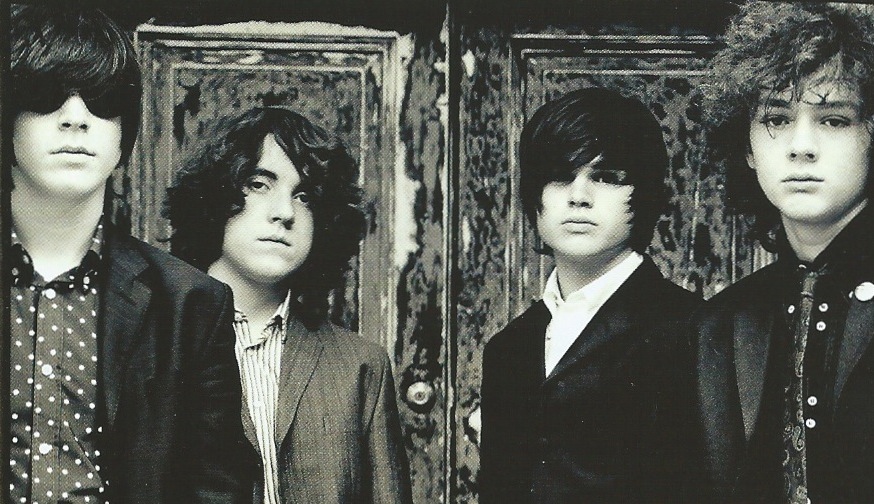
The StrypesMy friend Mats Olsson, a columnist with the Swedish daily paper Expressen, asked me an interesting question the other day, knowing that I was listening to Snapshot, the debut album from the Strypes: “Any theories why a young, British, Dr Feelgood-ish band comes along every 20 years or so?”

I gave him a slightly facetious answer: “To remind Americans of their heritage, probably.” But even if Mats’s chronology was a big askew, along with his geography (Cavan, the Strypes’ home town, is in the Republic of Ireland), it’s certainly worth thinking about why this quartet of teenagers has come along to evoke so precisely the spirit of the Rolling Stones, the Pretty Things, the Downliners Sect and the Eel Pie Island scene back in 1963 and the Canvey Island sound of the Feelgoods and Eddie and the Hot Rods in the mid-Seventies.

It’s a matter in which I have a personal interest, since — like hundreds of others — back in the early Sixties I was a member of one of those first-generation English R&B bands, with a repertoire largely borrowed from Chuck Berry, Bo Diddley, Muddy Waters and Jimmy Reed. And a decade later, working as an A&R man for Island Records, I made the decision not to pursue an interest in Dr Feelgood — something that’s caused me the occasional sleepless night over the past 30-odd years, and certainly every time that excellent Julien Temple documentary Oil City Confidential gets shown on TV.

There were three reasons why I didn’t try to sign the Feelgoods. First, they were virtually promised to United Artists’s Andrew Lauder, who had been courting them with some ardour. Second, I wasn’t convinced by their original material. Third, I couldn’t really see a proper long-term future for something that, in essence, I felt we’d all lived through a decade earlier.

I was wrong on the last count in particular. I was certainly waiting for something new to happen, a sense of frustration mounting by the month as I waded through unsolicited prog-rock and singer-songwriter demo tapes, but I failed to recognise that the Feelgoods represented an important first stage on the route to whatever that new something was going to be. They didn’t need to be the last word in original thought.

Something similar could turn out to be true of the Strypes, whose music is based firmly on those earlier templates. The first thing to be said is that Ross Farrelly, Josh McClorey, Pete O’Hanlon and Evan Walsh may be aged 16 and 17, but so were we, back in 1964, and it didn’t stop us from having a decent stab at this kind of R&B. And the quartet from Cavan are very good at it, indeed better than we were in their versions of both sides of a great Diddley 45, “You Can’t Judge a Book By Its Cover” and “I Can Tell” (in which they replace the great original guitar riff with their own, equally good).

Farrelly clearly has what it takes to be a convincing front man, and the playing is sharp and smart, suggesting in the extended version of “Rollin’ and Tumblin'” that they may have the musical imagination to create something worthwhile when they venture beyond the basic forms into new territory — as the Stones, the Yardbirds, the Who and the Kinks once did. Even at this extremely early stage, their original songs sound fine — and will sound even better to young audiences inevitably unfamiliar with the roots of this music.

So they’ve got the sound, the energy and the look (hair long, shirts polka-dot or striped, trousers and ties narrow). It’s a living heritage, and they’re making the most of it.

* The photograph of the Strypes, taken by Jill Furmanovsky, is from the cover of Snapshot (Virgin EMI Records).

The day the music stopped

Gene Phillips 2It was, without doubt, one of the strangest episodes in the history of the record business. Twice in the 1940s — from August 1942 to November 1944 and from January 1948 to early 1949 — the American Federation of Musicians banned its members from entering the recording studios. On the first occasion James C Petrillo, the union’s president, took action because believed that musicians were losing jobs as places of public entertainment closed and radio became a dominant medium; in compensation, he called for royalty payments by the record companies to the AF of M.

It took a while to get them to the negotiating table. Before the first ban ended, following piecemeal agreements with individual companies for royalties of between 0.25 and 0.5 cents per disc, a great deal of interesting music had gone undocumented. In particular, I think of the young Charlie Parker’s stints with the Earl Hines Orchestra between December 1942 and May 1943 and with the Billy Eckstine Band between April and August of 1944, neither of which were recorded; his fellow members of these fascinating aggregations included Dizzy Gillespie, Benny Harris, Fats Navarro, Wardell Gray, Oscar Pettiford, Shadow Wilson and Art Blakey, while the Eckstine Band’s book included arrangements by Gillespie and Tadd Dameron. An important period in Bird’s career was lost.

(Singers, curiously, were exempted from the ban, which is why Frank Sinatra’s first solo recordings for the Columbia label, made in 1943, featured strictly acapella treatments of such songs as “People Will Say We’re in Love” and “Oh! What a Beautiful Morning”, suavely arranged for the singer and the Bobby Tucker Singers by Alec Wilder.)

By the time the second ban loomed, imposed by Petrillo as a protest against the Taft-Hartley Act, passed in 1947 to restrict the power of labour unions, the labels had their pre-emptive plans in place. The appetite for recorded music was huge, and to stockpile the material that would enable them to meet it they scheduled round-the-clock sessions — with the willing collaboration, it seems, of the musicians whose services were about to be withdrawn. Most of the companies tried to stash away enough material to keep them supplied with new releases for what turned out to be a rather shorter recording hiatus.

Among those getting busy were the Bihari brothers of Los Angeles, who had started their Modern Records label three years earlier, concentrating on making records for the black audience, which Jules Bihari had encountered while servicing juke boxes in Watts. Their first hit, in their initial year, had come with “Swingin’ the Boogie” by Hadda Brooks, an accomplished pianist and a sultry singer, and their roster had expanded to include the Ebonaires, a vocal quartet, the gospel singer Madam Ira Mae Littlejohn and bandleaders such as the guitarist Gene Phillips, the drummer Al “Cake” Wichard, the saxophonist Little Willie Jackson and the trumpeter-singer Butch Stone.

All these were pressed into service to build up a stock of material for however long the ban lasted, but since it ended after barely a year, most of the sides went unreleased. Now Tony Rounce of Ace Records, which has licensed the catalogue of Modern and its associated labels for the past 30 years, has delved into the vault to assemble 49 of the 80-odd tracks recorded during that burst of activity, all but 10 of which are seeing the light of day for the first time, on a two-CD set titled Beating the Petrillo Ban: The Late December 1947 Modern Sessions.

Apart of from its curiosity value, the compilation provides a marvellous snapshot of black popular music at a time of change, when mainstream jazz styles were starting to mutate into early rhythm and blues. So most of the music is an invigorating combination of big, burly blues shouters — half a dozen tracks under Wichard’s leadership feature the young Jimmy Witherspoon — and excellent jazz soloists, all of whom, sadly, go uncredited, since no personnel information has survived the intervening 66 years.

The leaders’ names will be unfamiliar to many people, but the quality of the material and the musicianship is invariably high. So is the recording quality: most of the tracks could have been recorded this week. The offer of a dozen new tracks by the gifted Ms Brooks (born Hattie Hapgood) and her excellent accompanists is too good to refuse, and the four sides by Gene Phillips and his Rhythm Aces (pictured above, in a photograph taken from the well annotated and illustrated CD insert) are notable for the leader’s eloquent guitar playing, particularly on “Gene’s Guitar Blues”, where he plays in a Hawaiian style that Chuck Berry later utilised on his instrumental “Surfin’ Steel”.

But the real find, for me, is Madam Ira Mae Littlejohn, whose six tracks expose us to a gospel singer of quite staggering power. “The technology has only just arrived to allow us to copy what was once an extremely bent and unplayable acetate,” Rounce says, further informing us that these may have been her only recordings. Thank goodness for digital technology, then, allowing us to discover Madam Littlejohn’s raw, throat-tearing delivery, accompanied by rudimentary piano and acoustic guitar and occasionally by a handful of supporting voices. The rest of the set would make a fine addition to the collection of anyone interested in the music of the period, but this is real treasure.

James Caesar Petrillo, by the way, died in 1984, aged 92. He had started life as a trumpeter before devoting himself to union affairs, ran the Chicago branch for 40 years, and once wrote to Benito Mussolini to complain that the city’s Italian consul had hired a non-union band. He took control of the national body in 1940 and the recording bans quickly made him a national figure, but in the mid-Fifties there were attempts to dislodge him, led by Local 47 in Los Angeles and Local 802 in New York — two branches in which jazz musicians were prominent. He resigned from the presidency in 1958 and was ousted from the leadership of Chicago’s Local 10 four years later. The bandshell in the city’s Grant Park bandshell was named after him.

Some thoughts on Bob Dylan

Bob Dylan faces21.
There are 12 works in Face Value, the new Bob Dylan exhibition at the National Portrait Gallery in London, on until January 5 and free to enter. One room, three walls, four paintings on each wall, identical proportions, symmetrically hung. A dozen faces, any or all of whom could have stepped out of his recent songs. He’s given them names, but we don’t know whether “Ivan Steinbeck”, “Ursula Belle”, “Red Flanagan”, “Sylvia Renard” and the rest are real people, or whether they’re products of the imagination that created Lily, Rosemary and the Jack of Hearts. “These are conventional people,” the artist says during a Q&A contained in the slender but handsome £25 catalogue. “One of the men is actually a member of the Sydney Yacht Club. One’s a limo driver.” Well, maybe. It doesn’t matter.

This is not my area of expertise, but Dylan seems to me to have mastered the use of pastels — the chosen medium here — quite well enough to bring his subjects to life. The eyes are the key to a portrait, and every one of these characters has a certain regard of his or her own: they’re looking at you, or past you, or through you, or inside themselves. Each has a subtitle, which might or might not be significant: “Slap in the Face” is the line accompanying “Ken Garland”, who has a broken nose and looks like a prizefighter. They could be the 12 Most Wanted, or they could be a jury. They could be devils or they could be angels. Or a bit of both, like most people.

2.

When you add the illustration on the front of Another Self Portrait: The Bootleg Series Vol 10 to the dozen pictures in Face Value, with which it shares its format, it starts to make more sense. Dylan’s image of himself — if that is what it is — floats between reality and fiction, neither one nor the other.

I bought the four-CD box, mostly because I wanted the disc containing the complete concert at the Isle of Wight in 1969, but I’m glad to have many of the items among the 35 tracks collected on the first two CDs (the fourth disc is yet another remastering of the original Self Portrait, which I didn’t need). As many people have already said, “Tattle O’Day” is a major discovery, a mysterious traditional song beautifully delivered by Dylan with David Bromberg’s guitar and Al Kooper’s piano: the sort of thing that very probably formed the inspiration for the material recorded on the Basement Tapes. There are excellent alternative versions of “Went to See the Gypsy” and “When I Paint My Masterpiece”, and another lovely voice-and-piano treatment of “Spanish Is the Loving Tongue”, a song I’d be happy to hear him sing every day for the rest of my life.

But this version of “House Carpenter”, also with Kooper on piano and Bromberg on guitar, isn’t a patch on the electrifying one he recorded by himself during the sessions for his first album in 1962, with which he began his long tradition of omitting some of his finest work (an omission corrected in 1991 with its inclusion in Vols 1-3 of the Bootleg Series). I don’t like “All the Tired Horses” without its string arrangement, or “New Morning” with banal horns and without Ron Cornelius’s magical guitar solo, or “Time Passes Slowly” done as a homage to Joe Cocker’s “With a Little Help From My Friends”. And so on.

A mixed bag, in other words, just like Self Portrait itself back in 1970, from which the two tracks I play most today, as I did then, are Gordon Lightfoot’s “Early Mornin’ Rain” and Gilbert Becaud and Manny Curtis’s “Let It Be Me”, both completely enchanting.

3.

As I said, I bought the deluxe edition in order to get the full set from the Isle of Wight in 1969, and therein lies the real revelation. Here’s where the remastering has really helped, dispelling the sonic fog that shrouded over the three tracks that were released in a jumble on Self Portrait and, of course, improving even more on the terrible sound of the audience-recorded bootleg LP version I bought a few weeks after the event itself.

Thanks to the impression created by those recordings, and to the general lack of enthusiasm of the contemporary reviews and word of mouth reports, I’d never regretted not making it to that particular IoW festival, even for Bob. Now I do. It becomes clear that Dylan and the Band were in top form, hitting their marks on every song they play together, finding an excellent balance between the driving electrified Hawks of 1966 and the rustic Big Pink sessions of two years later. And when you hear everything laid out in its proper context, Dylan’s four-song acoustic set is wonderful, with “Wild Mountain Thyme” among his very best recordings of traditional material (or any material, come to that).

I can’t help thinking that three factors militated against a proper appreciation of the set by many of those who were there. First, the audience was exhausted, coming to the end of the weekend and having endured a three-hour wait before the Band’s nine-song set and then a further 40-minute hiatus before Dylan made his appearance. Second, after a weeks-long build-up that took hype to new heights, there was an expectation that the main attraction would be joined on stage by, at the very least, all four Beatles and Eric Clapton; it didn’t happen, of course. Third, the musicians’ self-presentation might not have helped: although John Wesley Harding and Music from Big Pink had made it clear that things were changing, I can’t help feeling that if Dylan had come on in a leather jacket, jeans and Wayfarers instead of that white suit, and performed exactly the same songs in exactly the same way, he might have been given a different hearing.

The girl who cried champagne

Carla BleyThe photograph above, taken by Caterina di Perri, comes from the insert to Carla Bley’s new album, Trios, the latest instalment of her collaboration with the bass guitarist Steve Swallow and the saxophonist Andy Sheppard. It’s the pianist/composer’s first album for ECM — and, she says, the first in which she has submitted herself to the demands of a producer (Manfred Eicher, the label’s founder) other than herself.

I’d started listening to the album when, while doing a bit of research into another subject entirely, I found an early mention of her in an issue of Down Beat dated September 5, 1965, from a review of a concert in the garden of New York’s Museum of Modern Art by the Jazz Composers Orchestra and the New York Art Quartet. The magazine’s reviewer was evidently having trouble with what was then known as “the new thing”, with only Ms Bley’s appearance to give him relief from what he clearly found to be an ordeal. Here’s what he wrote:

The evening did have three points of interest, all visual. The first was scored before a note was blown, when (John) Tchicai appeared, conventionally garbed, but with his face decorated with warpaint and what looked like chickenbones stuck into his cheeks. The second was (Milford) Graves, continually assaulting his drums and kicking at his cymbals in a manner that had, so far as I could tell, nothing to do with anything else that was going on. The third, and greatest, was Mrs Bley at the piano in the second half, one of the most authentically ravishing women you ever clapped eyes on, with nothing lacking of slim grace and brooding intensity to complete the picture of musical genius as only a Hollywood director would have the nerve to present it — a vision that, while it lasted, almost compensated for the regrettable noises that went with it.

I’m not going to name the critic in question. History has a way of making fools of all of us from time to time.

Anyway, Trios is an exceptional recording, in which she and her collaborators revisit some familiar themes — including the ever-entrancing “Vashkar”, first recorded in a standard piano trio format by her then-husband, Paul Bley, for the Savoy label 50 years ago this month. “Les Trois Lagons (d’apres Henri Matisse)”, “Wildlife” and “The Girl Who Cried Champagne” will all be familiar to her fans in various other versions; the opener, “Utviklingssang”, has previously been recorded by a nonet, a duo (Ms Bley and Swallow) and an octet, but I’d be surprised if this is not the definitive treatment of a gorgeous hymn-like tune.

For me, the surprise of the album was the way it converted my hitherto rather guarded admiration for Sheppard’s playing to a much warmer response, and made me drop my normal resistance to Swallow’s work on bass guitar. I’m afraid I could never understand why the man who was so articulate on the double bass on those classic George Russell Sextet albums from the early ’60s (and on the Paul Bley session that produced the original “Vashkar”) would want to devote himself full-time to an instrument far less appropriate to jazz. In this exposed setting, however, he plays with a guitar-like fluency and lyricism, the lack of the acoustic instrument’s tonal flexibility never hampering his contribution in the way it has — possibly to my ears alone — in the past.

And “The Girl Who Cried Champagne”? That’s a private joke between Bley and Swallow, who are long-time partners. It’s her.

A voice to remember

Maybe you’ve heard the sad news that Linda Ronstadt will never sing again. She announced it a week or so ago, letting the world know that Parkinson’s disease has taken her voice. Today I read an interview with her, in the International Herald Tribune, in which she tells Sam Tanenhaus about her illness and the other problems that have dogged her life in recent years.

Things were pretty different when I interviewed her for the Melody Maker in January 1971. She’d had her first hit with the Stone Poneys’ great “Different Drum”, she was already making solo albums for Capitol Records (Hand Sown… Home Grown and Silk Purse), and she was starting to move in the right kind of circles. But she was still a few years away from the superstardom that arrived when Peter Asher took control for the run of hit albums that began with Heart Like a Wheel.

She was smart, funny, serious about serious things, and completely beguiling. She told me how she’d made the move from her home in Tucson, Arizona in 1965, when she was 18, after a friend called from Los Angeles, saying there was a band out there for her to sing with. “I jumped into a car with my boyfriend, who played steel guitar, and we drove straight there. I think the boy went straight back. I never saw him again.”

A free spirit, then and always, but she was fretful about one thing. “I’ve had trouble finding material,” she said. “I don’t write. I’ve never been able to write even a paragraph. And I can’t do songs that have been done well by the people who wrote them.”

That changed, with Asher’s help. She turned out to be a wonderful reinterpreter of the very finest material. I didn’t really follow her through the years in which she collaborated with Nelson Riddle on albums of standards and then delved back into her Mexican roots, but I loved the recordings she made with Dolly Parton and Emmylou Harris. The YouTube clip above is of an exquisite song from their second album, Trio 2, called “High Sierra”. It features Linda. She composed it, too. So she could write a paragraph, after all.

Joe Locke’s respite music

Joe LockeJoe Locke says his new album, Lay Down My Heart, is intended “to provide respite for folks who work hard every day and need an opportunity to slow down and be reacquainted with that certain something which eludes most of us in the midst of the whirlwind which is modern life”. We can all do with some of that from time to time.

After Bobby Hutcherson, who performs less frequently nowadays, Locke has a plausible claim to being thought of as the leading contemporary exponent of the vibraphone. In a recent post I wrote of being impressed by his playing on Centennial, Ryan Truesdell’s album of rediscovered Gil Evans arrangements, and by his solo on “The Barbara Song” in particular, and I was sorry to miss him in London recently, when he performed with the orchestra of the Royal Academy of Music. This new recording provides a clear sight of the 54-year-old Californian’s maturity and inventiveness.

It’s a quartet album, and although you probably wouldn’t be able to pick the pianist Ryan Cohan, the bassist David Finch and the drummer Jaimeo Brown out in an identity parade, that doesn’t always matter: their playing here is perfectly attuned to the leader’s conception, and sometimes, even in jazz, you don’t need to be original to sound sparklingly fresh.

The programme starts with a measured version of Bill Withers’ “Ain’t No Sunshine” that sounds like the sort of intelligently soulful jazz that might result if you could get Milt Jackson guesting with the old Ramsey Lewis Trio. But it’s the ballads that are the core of the album, particularly a lovely treatment of “I Can’t Make You Love Me”, a definition of heartbreak from the repertoire of Bonnie Raitt; a reading of Bobby Troup’s “The Meaning of the Blues” that carries only the faintest echoes of the versions Gil Evans devised for Miles Davis’s trumpet (on Miles Ahead) and George Adams’s tenor saxophone (on There Comes a Time); and the slinkiest version of “Makin’ Whoopee” since Dr John and Rickie Lee Jones gave it a whirl a few years back.

I’m going to file this one next to Hutcherson’s Happenings, a 1967 album on Blue Note with a similar quartet format, featuring Herbie Hancock, Bob Cranshaw and Joe Chambers, ready for use on Sunday mornings and in times of stress. It’s not an album to challenge the listener (although a version of Frank Foster’s “Simone” has the darker, more convoluted intensity of some of Hutcherson’s other Blue Note quartet work — on Andrew Hill’s Judgment, say, or his own Oblique). On its own terms, however, it is perfectly satisfying. And, as promised, good for whatever ails you.

* The photograph of Joe Locke was taken by Joseph Boggess and comes from the sleeve of Lay Down My Heart, which is released on the Motema label. 

Ten Freedom Summers / 1

Wadada Leo SmithFifty years ago, a wholehearted embrace of American culture made even those of us 3,000 miles away feel we had a stake in the country’s destiny. So although we may have been neither American, nor black, nor even socially or economically disadvantaged, the March on Washington — which took place on August 28, 1963 — in some way felt as though it involved us, too, even if all we could do was cheer from the sidelines.

Tens of thousands of people gathered in Washington DC this weekend to mark the anniversary. What I’ve been doing is reading my sometime colleague Gary Younge’s fine new book The Speech, which describes the process by which the Rev Martin Luther King came to write his “I Have a Dream” address, and listening to Ten Freedom Summers, a suite by the trumpeter and composer Wadada Leo Smith. If you don’t already know the latter, this is a set of four CDs containing four and a half hours of music divided into 19 individual movements based on themes from the civil rights struggle, performed by Smith’s quartet/quintet and a nine-piece chamber ensemble. Recorded over a three-day period in November 2011 and released last year on the Cuneiform label, it was one of three finalists for this year’s Pulitzer Prize.

The titles of the individual pieces are sometimes suggestive — “Black Church”, “Democracy” — but usually more explicit in their references. “Dred Scott: 1857” is the first movement, referring to the Missouri slave who unsuccessfully sued for his freedom in that year. “Rosa Parks and the Montgomery Bus Boycott: 381 Days” is another. There are references in other titles to Medgar Evers and Emmett Till, to JFK and LBJ, to the Supreme Court justice Thurgood Marshall and to Malik Al Shabazz, better known as Malcolm X.

Unlike some of the music that accompanied the civil rights struggle, from John Coltrane’s miniature masterpiece titled “Alabama” (a threnody for the four black schoolgirls killed in the Birmingham church bombing in September 1963, barely a fortnight after the March on Washington) to Bob Dylan’s “The Lonesome Death of Hattie Carroll”, there is nothing in Smith’s work here that explicitly evokes his subject, no overt gestures that would indicate a relationship to his chosen titles. This does nothing to diminish its extraordinary power.

Smith, who was born 71 years ago in Leland, Mississippi, first came to notice at the end of the ’60s, as a member of the Association for the Advancement of Creative Musicians in Chicago, along with Roscoe Mitchell, Anthony Braxton, Muhal Richard Abrams and others. His bands included the Creative Construction Company, with Braxton and the violinist Leroy Jenkins, and New Dalta Ahkri, whose personnel included  Henry Threadgill, Oliver Lake and Anthony Davis. Along with other members of the AACM, he spent time in Paris in 1969 and became acquainted with the new generation of European free jazz musicians. His many recordings have appeared on the Kabell, Nessa, ECM, Leo and Tzadzik labels, as well as Cuneiform.

As a trumpeter, he had his own character from the beginning. If you wanted a shorthand description, I suppose you could say that he occupies the space between Don Cherry and Lester Bowie. But the originality and substance of his playing are more than enough to command the attention all the way through this mammoth undertaking, in which his is necessarily the dominant voice. I’ve always liked his tone, open or muted, and the crisp assertiveness of his phrasing, and the sense of poise he conveys.

The long-standing nature of his partnership with the pianist Anthony Davis, who appears here, is evident in the closeness of their dialogues. Like Smith, Davis is a quietly original musician who, in his own compositions as well as his playing here, demonstrates complete comfort with the idea of bringing together elements from African American and European musical practices. The basic group is completed by John Lindberg, an exceptional bassist, and two drummers, Susie Ibarra and Pheeroan Ak Laff, who alternate on some pieces and play together on others.

Sometimes Smith employs gestures immediately identifiable as drawn from jazz: “Thurgood Marshall and Brown vs Board of Education” finds Lindberg anchoring the piece with a slow-grooving funky bass figure, while the interplay between Davis and Ibarra on “The Little Rock Nine” is outstanding. Elsewhere the climate resembles that of classical chamber music: passages for flute, harp and strings in “Medgar Evers: A Love Voice of a Thousand Years’ Journey for Liberty and Justice” have a watercolour delicacy that reminds me of Toru Takemitsu. But more often it seems, to employ Duke Ellington’s phrase, beyond category. The chamber group — basically a string quartet plus harp, clarinet, flute, percussion and an extra violin — appears both by itself and with the quartet/quintet. So organic and unselfconscious is Smith’s writing that the frontier between the two groups disappears, as does the line between composition and improvisation.

The prevailing mood, not surprisingly, is soberly reflective. Even so many years after the events Smith is commemorating, there is much to reflect on. This is not a bruising experience;  the writing and playing are characterised by a sustained lyricism. Nevertheless few  will want to absorb all four and a half hours in at one sitting, and it may a take listener years to become as familiar with these individual pieces as with the much shorter jazz classics of earlier eras. But that doesn’t seem to matter. Smith’s work exists on its own terms, a marvellous tribute to its immense subject.

* The photograph of Wadada Leo Smith was taken by Steve Gunther and is from the booklet accompanying Ten Freedom Summers. Gary Younge’s The Speech is published by Guardian Books.

A poem by Roy Kelly

Roy Kelly’s work appears from time to time in the kind of magazines that still print poetry (there’s one of his in this week’s Spectator). He was born in 1949, and Peterloo Poets published a collection of his work under the title Drugstore Fiction in 1987. Having read my piece on Chet Baker, he sent me this. I wanted to publish it before the summer ends, and he was kind enough to give me permission.

THE COOL SCHOOL

The folded parasols stand guard and stand by,

sentinels of the pool and sunbeds, swathes

of white material fluttering, gathered, ready to spring

up and out, defending this tender skin which bathes

in water, and also in damaging rays that fly

through millions of miles to inflame and sting.

And in the pool a figure is moving through

the ruffled, bubbled surface, the illusory

blue depths, trying to improve a swimming action

while remembering a Chet Baker solo,

the shapely lovely logic of all he blew,

placed note by note, as if physical effort had no

part in his disciplined, pretty perfection,

and the needle life some other loser’s story.

Puffing and chugging the salty outdoor pool

the swimmer tries at least to get the breathing right,

economical, smooth, under the watchful white

umbrellas, and Mr Chet, lyrical, pure and cool.

Where the Stones were fourth on the bill

Odeon, Nottingham

If you look carefully at the top of the building in the photograph, you’ll see the faintest shadow of the long-gone neon sign that read ODEON. I took the picture on a rainy day a couple of winters ago, while passing through Nottingham, my old home town. How many of the hundreds of people walking along this pavement every day know that it was here, in this cinema on Angel Row, a hundred yards or so up from the Old Market Square, that the Beatles and the Rolling Stones played, in 1963 and ’64? And now it’s finally vanished. The demolition crew have done their job and the construction workers are in, filling the space with a building apparently intended to provide housing for students.

Buddy Holly played the Odeon in 1958: three shows on the night of March 8, during his only UK tour. I missed that one, being only 10 at the time (although I’d already saved up to buy the Crickets’ “That’ll Be the Day” on 78), but three years later I saw Cliff Richard and the Shadows, just after Brian Bennett took over from Tony Meehan on drums — a source of some regret, since Meehan was my first drumming hero. The screaming meant that not much could be heard. But at least Hank Marvin gave me my first sight of a Fender Stratocaster in action, and they were still doing the famous Shadows walk, much copied by we schoolboys in front of bedroom mirrors.

OK, I’ll own up: I missed the Beatles there — three times, on the first occasion with Roy Orbison — and the Stones. Absence of cash, I expect. I wouldn’t have been able to hear them above the hysteria anyway, although I’ve always kicked myself for not making it to the Stones’ show in October 1963, since it also featured the Everly Brothers, Little Richard and Bo Diddley, all of them above the Stones on the bill when the tour started. My friend Phil Long remembers Little Richard’s set: “One of the best I’ve ever seen. He jumped off the stage, ran all the way round the theatre, then got back on the stage and started taking his clothes off and throwing them to the audience… there was a riot.”

The most memorable concert I did manage to attend at the Odeon was on May 12, 1964, the fourth date of a 22-night package tour headlined by Chuck Berry, with support from Carl Perkins, the Animals, the Nashville Teens and King Size Taylor and the Dominos. It was great merely to see Chuck, who provided so many of us with the inspiration for our own bands, but he gave a pretty uninterested performance. He was accompanied by King Size Taylor’s excellent band, and I seem to remember that about half the set consisted of throwaway instrumentals; has any great songwriter ever taken a less obvious pride in his achievements? But it was enough to hear those guitar intros ringing out, and to witness his perfunctory demonstration of the duck walk.

Carl Perkins was not exactly spectacular, either, in his very short set. And so, curiously, the musical highlights were provided by two English bands. The Animals, of course, were excellent. “Baby Let Me Take You Home”, copied from “Baby Let Me Follow You Down” on Bob Dylan’s first album, was nudging the Top 20, and their act still had the R&B edge honed in Newcastle’s Club A Go-Go. But they also played their epic four and a half minute version of another song from Dylan’s debut: “House of the Rising Sun”. It hadn’t yet been released, or heard on the radio, and its arrangement — featuring Hilton Valentine’s arpeggiated guitar, Alan Price’s wailing Vox Continental organ and Eric Burdon’s baleful vocal — was nothing short of stunning. Five weeks later it would enter the charts, on its way to No 1.

It was the same with the Nashville Teens, whose set included John D Loudermilk’s “Tobacco Road”: another dramatic song, its structure and mood inspired by the compositions Willie Dixon provided for Muddy Waters and other blues stars. The group, from the Surrey stockbroker belt, did an enthusiastic job of impersonating the sound of the Chicago stockyards, and by July they were on their way to the UK Top 10. By August “The House of the Rising Sun” was on its way to No 1 in Billboard‘s Hot 100, while “Tobacco Road” topped out at No 14 in the US a month later. Heard for the first time in live performance, both made an immediate impression.

And now the Odeon has disappeared. I suppose it’s not exactly like losing the Cavern or the Marquee. But it would be nice, when they finished its replacement, if someone thought it worth putting up a plaque to remind passers-by of former glories. Buddy Holly, The Beatles. The Rolling Stones. The Everly Brothers. Little Richard. Bo Diddley. Chuck Berry. Not bad, eh?

A weekend with Booker T

Booker T

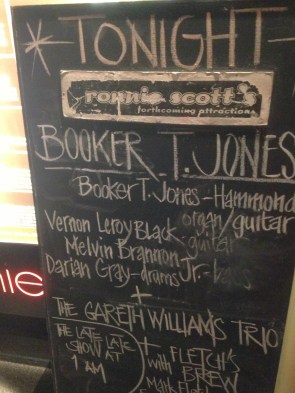
It was a warm evening, and the air conditioning had packed up. An hour before midnight last Friday, Ronnie Scott’s Club was like a sauna. “That’s when it started to feel authentic,” Booker T Jones would say later. “Just like the places I used to play.” But the air-con failure wasn’t the only good omen.

When there’s a Hammond organ in the house, the best place to be is as close as possible to one of its Leslie speakers — those pieces of wooden furniture, the size and shape of a small refrigerator, containing rotating horns which, at the flick of a switch, provide the instrument with its distinctive and heart-stirring whirr and churn.

It’s a lesson I learnt during my teenage years, when the clubs were small and the stages were low and you could get up close to the likes of Georgie Fame, Graham Bond and Zoot Money. So I was extremely pleased when the maitre d’ at Ronnie’s led me to a seat at the side of the stage, a few feet away from one of the two Leslies hooked up to Booker T’s B3. What would normally have been a rather indifferent vantage point suddenly seemed like the best spot in the house.

Booker T Jones is one of my all-time heroes. Like many, I remember the thrill of hearing “Green Onions” for the first time; its special magic has never faded. And its B-side, a sinuous slow blues titled “Behave Yourself” (originally intended as the A-side), hinted at other dimensions of musicianship. As the years passed I discovered that every note he recorded was worth hearing. All the original MGs’ Stax albums, from Green Onions in 1962 to Melting Pot in 1971, contained something wonderful — and I’m very fond of the two reunions that followed Al Jackson Jr’s tragic death, Universal Language (Asylum, 1977) and That’s the Way It Should Be (Columbia, 1994), with Willie Hall, Steve Jordan and James Gadson replacing the peerless Jackson at the drums. Booker went on to prove, with Bill Withers’ Just As I Am in 1971, Willie Nelson’s Stardust in 1978 and the Blind Boys of Alabama’s Deep River in 1992, that he is a producer of marvellous sensitivity. He remained a wonderfully sympathetic sideman, too: for the proof of that, just listen to “Sierra”, a gorgeous song from Boz Scaggs’s 1994 album, Some Change.

So he’s someone I always look forward to seeing, and on Friday — at the second of four nights (and eight shows) on Frith Street — he delivered a 75-minute set that ranged through his entire history, from that imperishable first hit (recorded when he was a 17-year-old high school student) and the MGs’ great “Hip Hug Her” through Stax/Volt favourites like “I’ve Been Lovin’ You Too Long”, “Born Under a Bad Sign” and “Hold On, I’m Comin'” to pieces from his recent albums: “Hey Ya” from Potato Hole, “Walking Papers” and “Everything is Everything” from The Road From Memphis, and “Fun”, “Feel Good ” and “66 Impala” from the new one, Sound the Alarm. His three-piece band, recruited from the Bay Area, supplied plenty of energy and all the right licks. He sang a bit, in a range-limited voice, and played guitar on a few of the tunes. But when he let the Hammond and the Leslies rip on an encore of “Time is Tight”, the speaker horns spinning faster inside those plywood cabinets, I was somewhere close to heaven.

On Saturday afternoon he returned to the club for a question-and-answer session in front of an audience, showing himself to be a thoughtful and genial man. Sitting at the Hammond, he played snatches of “Green Onions” and “Ain’t No Sunshine”, and just a handful of bars from each was enough to send a thrill through his listeners. Among the things we were told was that Ray Charles’s “One Mint Julep” was the record which led him to conclude that the electric organ would shape his destiny. And there was an interesting answer to a question from my friend Martin Colyer (check his blog: http://www.fivethingsseenandheard.com), who wanted to know how he had come to play bass guitar on Dylan’s “Knockin’ on Heaven’s Door” in 1973. As part of his explanation, Booker told us that he had first been recognised in the Memphis music community through playing bass in the house band at the Flamingo Room on Beale Street, and at that stage — despite his proficiency on keyboards, oboe, clarinet, baritone saxophone and trombone — it was as a bass player that he originally expected to make his career.

Four years ago, when the magnificent Potato Hole came out, I interviewed Booker for the Guardian (it’s here, accompanied by Eamonn McCabe’s fine photograph, taken the same day). Meeting your heroes for the first time is always a perilous business, but I came away from the encounter feeling I now admired the man as much as the musician.

Some bits of the interview didn’t make it into the paper, for reasons of space, so here, for the first time, are his remarks on a couple of topics. First, I asked him whether, as a teenage musician with an inquiring mind in the clubs of Memphis, he’d been familiar with the generation of gifted local modern jazz players that had included the saxophonists Frank Strozier and George Coleman, the trumpeter Booker Little and the pianist Harold Mabern. His answer was unexpectedly illuminating.

“I did,” he said. “They were two or three years ahead of me. Same town, same neighbourhood. I knew who they were. We went through the same doors. But I reached a day, one day, I don’t remember exactly when it was, that I had to ask myself, ‘Can I do this? Will I, in my lifetime, be able not only to play the music but live the lifestyle? Is that who I am?’ I realised, no, it’s not who I am. That’s who Jimmy Smith is, or John Coltrane. I don’t have the resolve, I don’t have the discipline. But even if I did, is that me? No, because I also like to play piano and guitar and trombone and I like to arrange and I also like country music and classical music — so I’m somebody else. I’m not that. And I stopped the pursuit at an early age.

“It broke up some friendships that I had, but I knew it was the right thing for me to do. A very close friend said to me, ‘What are you doing, man? How can you go over to Stax and play that stuff? Is it the money?’ If I’d been hanging out with a Sonny Stitt, that’s what he would have said to me. It was like a club, almost. I talked to Herbie Hancock about it, and to the bass player Stanley Clarke, and I know I couldn’t have done it. I’d have been able to get the technical chops, with practice, but I couldn’t have lived the lifestyle.”

So instead of another Memphis bebopper, we got a man capable of creating something like the arrangement of Willie Nelson’s “Georgia On My Mind”, its wonderful simplicity capped by a coda in which the rhythm and strings are joined by a horn section, vamping gently through the fade-out. He was delighted when I mentioned it as a special favourite.

“I’m so glad you said that,” he responded, “because it took so much time and money to put that on, but I could not get away from the inclination to do that. We went through the whole song with just the band and some strings, but at the very end I just needed to do that. It was expensive — a full complement of horns, and I don’t think we did any other songs at the session. It was an indulgence. At the time it wasn’t a big-selling record. It was a little bit of a struggle and I really appreciate that you like it.”

Even when he adds a horn section to the budget, however, the idea of excess is completely alien to Booker T’s temperament. He is a musician whose presence guarantees a measure of restraint and economy, the hallmarks of all those wonderful MGs records. “I don’t think it could have been any four guys,” he said of the band with whose name his own will be forever linked. “The one thing we had in common was a commitment to making the music simple and funky. It never got so complicated that it was inaccessible to most people. Not to say that complex music isn’t accessible or beautiful, but one way to access beauty is through simplicity.”

On the way out of Ronnie Scott’s on Friday night I bumped into Bryan Ferry, who was with three of his four sons and their girlfriends. He had taken them to listen to a musician he himself had first seen on the legendary Stax/Volt tour in 1967. Now that’s my idea of good parenting.