Skip to content

Liberation Music Orchestra

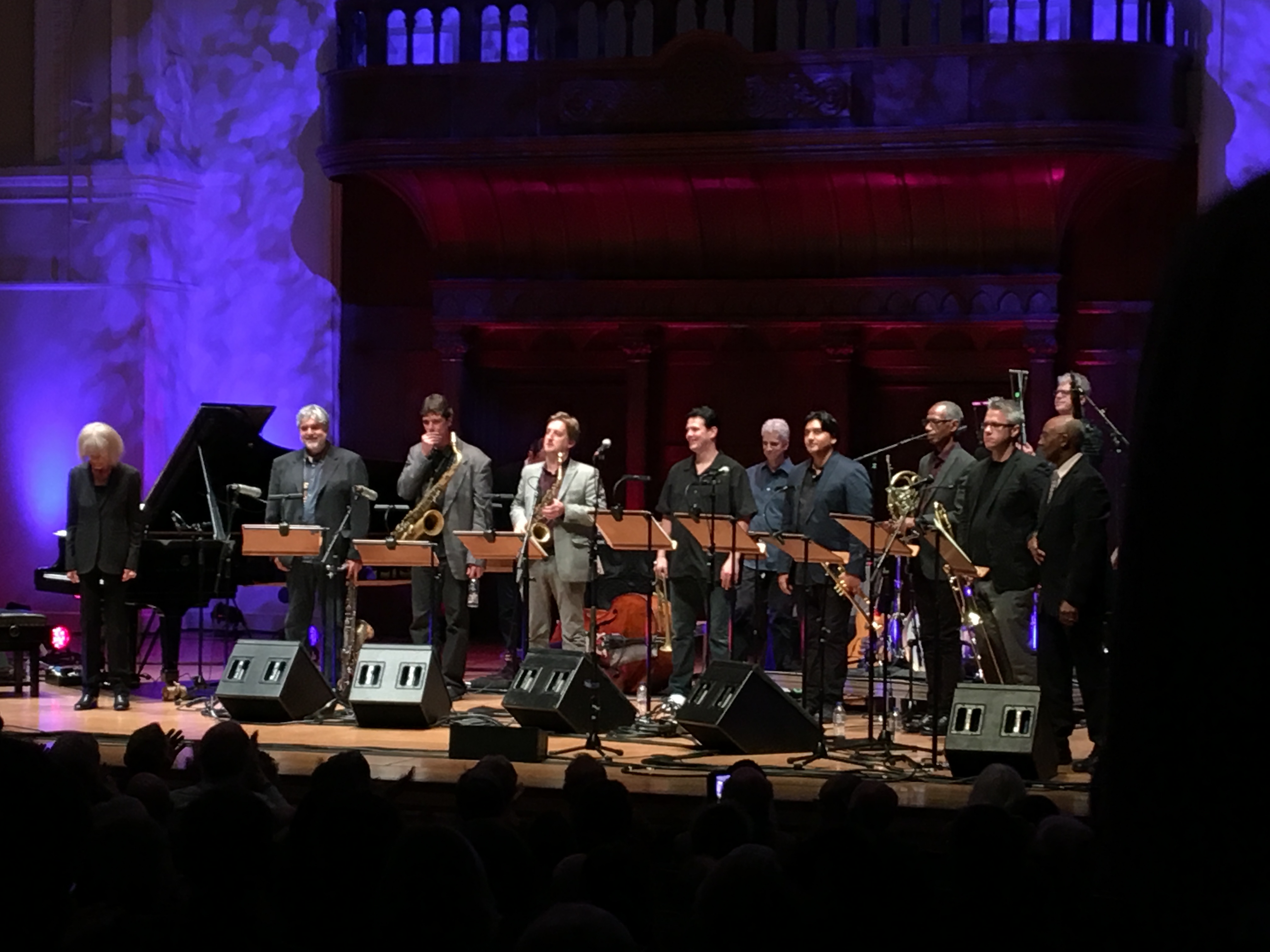
liberation-music-orchEight years ago I was fortunate enough to be at the Blue Note in Greenwich Village to hear Charlie Haden’s Liberation Music Orchestra on the night of the US presidential election, and then again the following night after it had been confirmed that Barack Obama would be serving as America’s first black president. The anxious optimism of the first night and the joy and relief of the second could hardly have formed a greater contrast with the current mood of the world, in which the orchestra — minus Charlie, who died two years ago, and now directed by his long-time collaborator Carla Bley — arrived in London to play at Cadogan Hall as part of the EFG London Jazz Festival.
I don’t think I was the only one to find their music even more emotionally charged than usual, which is saying something for a band that began life in 1969 delivering an uncompromising musical protest against the evils of the age, with a line-up including Don Cherry, Gato Barbieri and Roswell Rudd. Tonight’s 90-minute set maintained the tradition by concentrating on the concerns of the hour and consisted of material from their last two studio recordings: Not in My Name (2004) and the new Time/Life (Song for the Whales and Other Beings), the environmental album on which they were working before Haden’s death, and which was completed under Bley’s supervision. All of it resonated powerfully.

The new pieces included Bley’s beautifully plain arrangement of “Blue in Green”, her own “Silent Spring” and Haden’s “Song for the Whales”, which featured a lovely passage for Seneca Black’s trumpet, Tony Malaby’s tenor saxophone, Darak Oles’s double bass and Matt Wilson’s drums. Bill Frisell’s gorgeous, slow-burning “Throughout” made a lovely encore. The evening was sprinkled with fine solos from Malaby and his fellow tenorist Chris Cheek, Loren Stillman on alto, Michael Rodriguez on trumpet, Marshall Gilkes on trombone, Vincent Chauncey on French horn, Earl McIntyre on tuba and Steve Cardenas on guitar. Oles, who perhaps had the hardest gig of the night, did the right thing by playing Haden’s parts and evoking his spirit without trying to be him.

But the heart of the concert came in the long, carefully wrought medley of “America the Beautiful”, “Lift Every Heart and Sing” and Ornette Coleman’s “Skies of America”, and particularly in the arrangement of “Amazing Grace” to which Bley brings every bit of her great and precious expertise at making highly schooled musicians sound like the world’s greatest town brass band. As they played it, investing every note with humanity, I couldn’t help thinking of Obama’s sudden decision, during his address to the funeral of the Reverend Clementa Pinckney, a US senator, at the Emanuel African Methodist Episcopal Church in Charleston, South Carolina in June last year, to sing the song as part of his eulogy to the priest and the eight other victims murdered by a white supremacist during a Bible study class. It’s a different world now.

* Time/Life is out now on the Impulse label.

Mike Westbrook at the piano

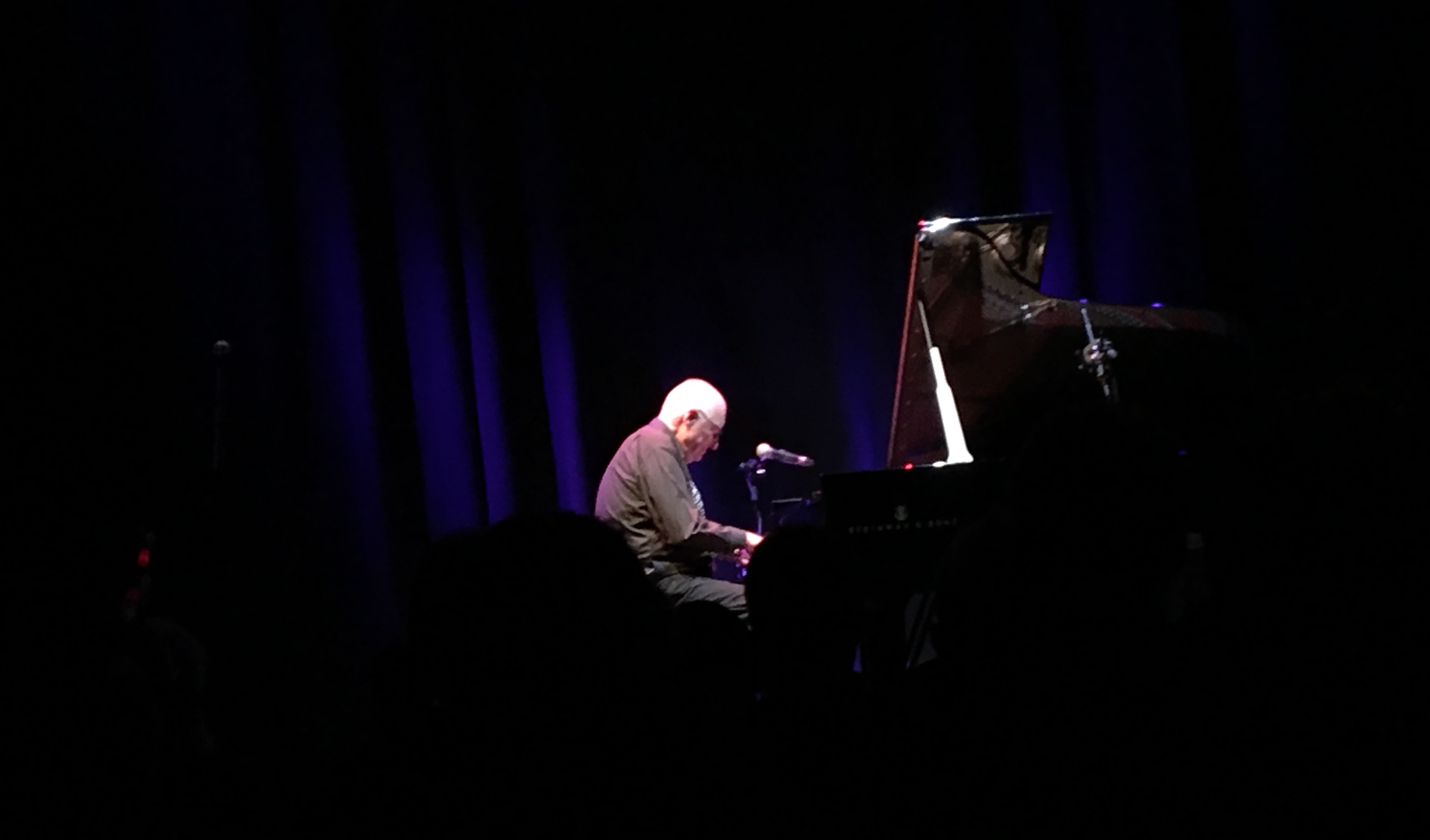
mike-westbrook-kp2In the days leading up to Mike Westbrook’s solo recital at Kings Place on Saturday afternoon, part of the EFG London Jazz Festival, I’d attended a run of performances by several younger pianists — Kit Downes, Michael Wollny, Giovanni Guidi and Jason Moran — of great reputation and achievement. Spending just over an hour listening to Westbrook as he stitched together songs that have meant much to him over the years provided a useful reminder of what age can bring.
Westbrook turned 80 this year. Afterwards, in conversation with Philip Clark, he spoke of the way a prolonged examination can change the material: “a deep process”, he called it, and one which he applied with equal success to songs by Duke Ellington (“Sophisticated Lady”) and Thom Bell (“You Make Me Feel Brand New”) and to pieces from his own pen, including some from his works inspired by Blake, Goethe and Lawrence.

“You don’t have too much respect for the material,” he observed. “You use it. You find harmonies that interest you more than the original. You layer one chord on top of another to make it more magical, or more beautiful, or even to throw a spanner in the works. But it’s not random. It’s logical.” The reharmonisation of some of these pieces was striking. “It’s no secret,” Westbrook said, “that when you’re writing arrangements at the piano, you become a master at holding down chords while you reach for a pen to write them down. I’ve developed a piano style almost out of that.”

It’s his version of what used to be called “arranger’s piano”, the spare approach associated with Tadd Dameron and Gil Evans, among others. And you could hear very specifically what he meant when he struck thick, dark chords and allowed them to resonate and bounce off the lid of the 7ft Steinway Model B in the silence between “You Make Me Feel Brand New” and “A Nightingale Sang in Berkeley Square”.

The mood was reflective, sometimes elegiac, particularly when he included a First World War poem in the first of the long, loosely themed sequences into which the recital was divided. Throughout the hour I loved the sense of a man playing these pieces for the thousandth time but still searching for new angles, new shapes, and new combinations of notes with which to deepen his investigation of their wordless essence. There was not a wasted note, not a superfluous gesture, not the tiniest hint of display for its own sake.

Much of the programme reflected the structure of his new solo album, which is titled Paris and was recorded earlier this year in an art gallery and performance space near the Porte d’Orléans. In his online notes to the album (to be found at http://www.westbrookjazz.co.uk), he says this while introducing the sequence of pieces grouped under the heading of Bar Room Music: “I often enjoy playing the piano in a crowded room where people are talking. Though almost no one is paying any attention to the music, it nevertheless affects the general atmosphere.”

Those words reinforce his strong sense of the social function of music, made explicit in the past in the work he and his wife Kate have done with street theatre groups and with their brass band. But the Kings Hall recital was at the opposite end of the spectrum: a carefully focused performance in an optimum listening environment, in front of a rapt full house. As always with Westbrook, a massive authority was lightly worn– but its presence was never in doubt, and the result was unforgettable.

* Paris is out now on the ASC label.

‘The Woman at the End of the World’

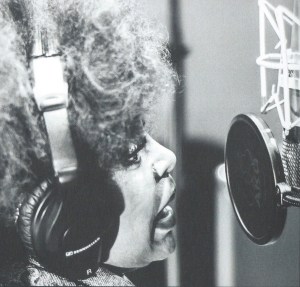
elza-soaresThe 79-year-old singer Elza Soares was in London last week, wearing a purple wig and a skintight leather dress as she sang from a golden throne on stage at the Barbican. I missed the gig, but I’ve been belatedly catching up with A Mulher do Fim do Mundo, the album she released this summer, and I’m pretty sure it’s going to end up very high on my best-of-the-year list.
“The Woman at the End of the World”: it sounds like a film by Pedro Almodóvar, and the music is not short of the kind of drama the Spanish director would relish. The project was conceived and produced in Rio de Janeiro, Soares’s home city, by Guilherme Kastrup, with the aid of Celso Sim, Romulo Fróes and a group of musicians and songwriters who collaborated to create a wonderfully modern setting for a voice that carries the marks of age but also an ageless energy.

Having begun with Soares singing a ballad called “Coraçoa do Mar” unaccompanied, the album ends with a minute and a half of silence interrupted by the distant sound of her singing to herself, as if you’d just left her house and, as you walked away, could hear her starting to get on with her daily tasks. In between comes music animated by some sort of special life-force, a mixture of samba and trip-hop and new wave and other stuff, brilliantly focused into something with great variety but a pungently identifiable character.

If I had to make a comparison, I’d say it mixes the elegant precision of Paula Morelenbaum’s great album Berimbaum, a 2004 updating of bossa nova, with some of the glorious anarchy of Os Mutantes: a rough poetry of wild guitars, horns anchored by a growling baritone saxophone, chattering (sometimes battering) percussion, songs very explicitly celebrating a raw need for sex (“Pra Fuder”), describing a police raid on a crack house (“Benedita”), and issuing threats to an abusive lover (“Maria da Vila Matilde”: “When the cops come, I’ll show them my black and blue arm / I’ll show them your cards, your game, your loaded dice…”). And a voice to break your heart. A magnificent piece of work, all told.

* The Woman at the End of the World is released on the Mais um Discos label. The photograph of Elza Soares is by Alexander Eca.

Mose Allison 1927-2016

mose-allisonWhen we were just a bunch of white boys barely out of school, falling in love with the sounds of Muddy Waters, John Lee Hooker, Jimmy Reed and Bo Diddley and wondering if we’d found a language that we could somehow call our own, Mose Allison showed how it could be done. Allison had been born in Mississippi and grew up on a cotton farm, the son of a piano-playing general store owner and a schoolteacher. He had a directly acquired knowledge of the culture of African American people, and he knew that the way to adopt their language while retaining some sort authenticity was to be yourself. Among those who learnt that lesson were Georgie Fame and Pete Townshend.
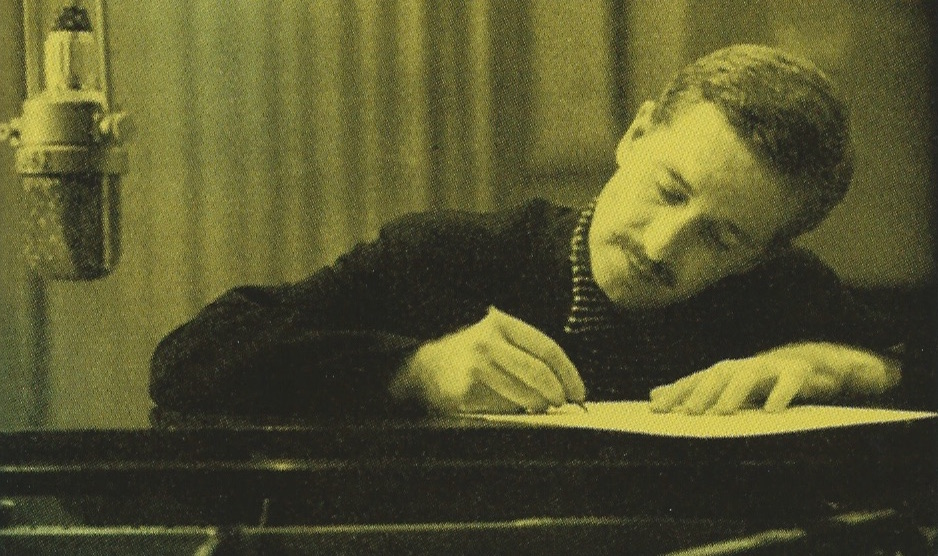
The first Mose Allison record I owned was an EP containing tracks from Back Country Suite, his first album, recorded for Prestige in 1957. All but one of the tracks were piano-trio instrumentals: miniatures with titles like “New Ground”, “Train” and “Warm Night”, somehow evoking the sights and sounds of the Delta, with Allison demonstrating a keyboard touch that blended the deftness of bebop with something earthier. The exception was a track called “Blues”, on which he sang in a voice that was high, light, and barely inflected: “Well, a young man ain’t nothin’ in this world today.” He didn’t sound like any of the blues singers I’d been listening to, but he sounded real.

Of course it was the singing that would make him famous: with his own compositions, like “Parchman Farm”, “Everybody Cryin’ Mercy” and “Your Mind Is on Vacation”, and with those of others, like Sonny Boy Williamson’s “Eyesight to the Blind”, Percy Mayfield’s “Lost Mind”, Mercy Dee’s “One Room Country Shack” and Willie Dixon’s “Seventh Son”. His songs sounded like theirs, and theirs sounded like his. What they shared was a wry, rueful, plaintive, homespun wisdom.

He played the trumpet, too, having taught himself and worked with a Dixieland band. There’s a lovely short version of “Trouble in Mind” on his second album, Local Color; he plays it tightly muted, in a traditional style, with just bass and drums, and you know this was someone who worshipped Louis Armstrong

But it’s his piano-playing that I come back to nowadays, to the lightness of those early sketches and to the much denser textures of his later improvisations, heard to great effect when he finally became a regular visitor to London in the 1980s. There’s a mostly instrumental Atlantic album from 1962 called Swingin’ Machine which features a stellar quintet line-up — Jimmy Knepper (trombone), Jim Reider (tenor saxophone), Addison Farmer (bass) and Frank Dunlop (drums) — and provides another demonstration of what a fine player he was.

* Mose Allison’s first six albums are collected on a two-CD set from the Fresh Sound label: Complete Prestige Recordings 1957-59. Two dozen of his vocal recordings from 1957 to 1971 are anthologised in a new BGP set titled I’m Not Talkin’: The Song Stylings of Mose Allison.

Music and Murakami

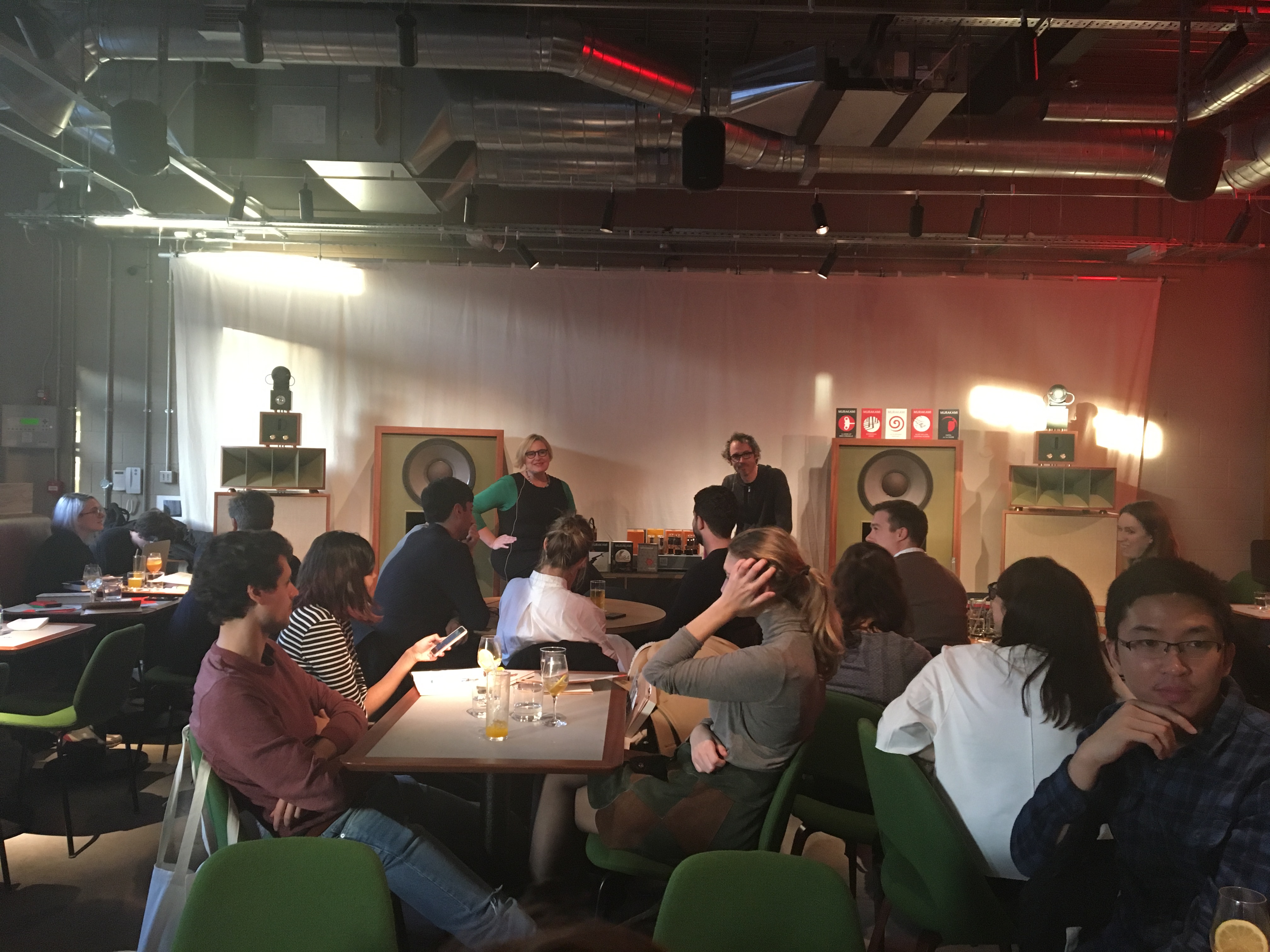
murakami-on-musicYou don’t have to be a hi-fi nut or a vinyl fetishist to enjoy a place like Spiritland, the listening club/café tucked away in the redeveloped King’s Cross buildings that also house Central St Martin’s art college. It’s the perfect place to hold something like yesterday’s event at which the great Japanese novelist Haruki Murakami’s connection to music was discussed, to tie in with the new book of his conversations with the conductor Seiji Ozawa. I imagine the jazz bar called Peter Cat which he and his wife, Yoko, ran in Tokyo before he became a full-time writer had a similar atmosphere: comfortable and chilled, with the music of Red Garland or Duke Ellington coming out of a high-end sound system.

Murakami’s love of music is well known and is frequently threaded into his stories as motif or incidental colouration, from Percy Faith’s “Go Away Little Girl” in After Dark through Wilhelm Backhaus’s interpretation of Beethoven’s Sonata No 32 in Sputnik Sweetheart and Cream’s “Crossroads” in Kafka on the Shore to Janáček’s Sinfonietta in 1Q84. He’s a collector of rare jazz LPs, and when I interviewed him for the Guardian in 2003, the final question I asked him was this: if his house caught fire, which three albums, from his library of several thousand, would he save? He thought for a minute. “I give up,” he said finally. “I couldn’t choose three. So I let it burn. Everything. I save the cat.”

Yesterday I was rather hoping to hear “Star-Crossed Lovers”, from Ellington’s Such Sweet Thunder, a piece which plays a role in Murakami’s South of the Border, West of the Sun, through Spiritland’s sound system, but the house DJ, Tony Higgins, didn’t play it in the couple of hours I was there. He did play Curtis Amy, Gene Ammons, Oliver Nelson and many other good sounds, but the principal memory I left with was that of the classical pianist James Rhodes delivering a blazing attack on the British government’s attitude to music education in schools.

Just off a flight from Barcelona, where he had been performing Chopin and Beethoven, Rhodes was scheduled to discuss the topic of “deep listening and literature” with Alex Clark. Having read the book, he was impressed by the knowledge and understanding of classical music that enabled Murakami to engage in discussions with Ozawa that ranged across many musical topics, including the variations between the way orchestras of different nationalities typically interpret the same composition.

Before long, however, he had detoured into what is obviously a serious preoccupation. He spoke of how absurd it was to build another concert hall in London at a cost that would subsidise many years of music education. He described offering to subsidise such lessons for pupils at a school in Basildon, only to be told by the head teacher that if the money were made available, it would have to be spent on English and maths in order to satisfy the priorities of Ofsted, the government’s education watchdog. His tone as he told this story was pleasingly intemperate.

Clark prefaced one of her questions by saying, “If you were the Jamie Oliver of music education…” In a sane world, that is exactly what he would be.

* The photograph above shows Alex Clark and James Rhodes in conversation at Spiritland. Rhodes is the author of Instrumental, a memoir published in 2015 by Canongate, and of How to Play the Piano, published last month by Quercus. Absolutely Music by Haruki Murakami and Seiji Ozawa is published by Vintage.

Jazz Abstraction

evan-parker-at-raAs I was on the way to see the blockbuster Abstract Expressionism show at the Royal Academy the other day, it was pointed out that jazz and AbEx seem to share a special relationship. I suppose that has something to do with synchronicity. Franz Kline and Mark Rothko were creating their revolutionary canvases at the same time as Charlie Parker and Thelonious Monk were making the music that changed everything, and the two developments seemed to share a sensibility. It’s easy to imagine Kline or Rothko playing “Ornithology” or “Well, You Needn’t” while working on a canvas in a Greenwich Village studio.

Easy, but probably misleading. I seem to remember reading that Jackson Pollock listened to Brahms while working on his drip paintings. Yet when Nesuhi Ertegun, the producer of Ornette Coleman’s Atlantic recordings, asked the collector and gallerist Sidney Janis for permission to reproduce Pollock’s “White Light” on the cover of Free Jazz in 1961, he was establishing a link that seemed to contain an emotional truth, if not a literal one. And Coleman’s double-quartet recording was by no means the only modern jazz album to make use of abstract expressionism on its cover: see the art of Martin Craig on the pianist Herbie Nichols’ two 10-inch LPs for Blue Note in 1955, The Prophetic Herbie Nichols Vols 1 & 2, for example.

At the RA, the breathtaking Pollock rooms are the strongest part of an exhibition that also gave me a greater appreciation of Robert Motherwell and Sam Francis. The much-vaunted assembly of giant Clifford Still canvases left me curiously unmoved, and the round space devoted to Rothko resembles an oligarch’s car-boot sale. The final couple of rooms are curiously incoherent. But of course it has to be seen.

The link with jazz was reaffirmed last night when, as one of the opening events in this year’s EFG London Jazz Festival, Evan Parker gave a short solo concert and a conversation with David Ryan under the heading “Jazz Abstraction”– a title adapted from that of a 1961 Atlantic album by Coleman, John Lewis, Gunther Schuller and others (and which, come to think of it, also has an abstract expressionist painting by John Jagel on the cover).

Parker’s improvisations were as astounding as ever in their combination of fine detail and hurtling momentum. Later he remarked, non-judgmentally, that one difference between the AbEx painter and the free improviser is that in the case of the music, the process is the work.

The conversation also produced a couple of self-deprecatory gems. If La Monte Young, while still playing sopranino saxophone, had discovered circular breathing as a means of tying together the repeated motifs with which he was working, the world might never have heard of Evan Parker (who then gave us a demonstration of practising the breathing technique). And had the artist Alfreda Benge not introduced Evan to John Stevens one night in 1966, he might, as he put it, “still have had my nose pressed against the window”. Or so he claimed.

What the painters and the jazz musicians of Parker’s generation and slightly earlier had in common was not just the reassurance of an environment in which they could afford to live cheaply but a powerful belief in the value of their work, whatever valuation the world initially placed upon it. It’s just a pity that today’s commercial market doesn’t view them in the same light.

* Abstract Expressionism is on at the Royal Academy of Arts, Burlington House, Piccadilly, London W1 until January 2. Evan Parker’s latest album is As the Wind, with Mark Nauseef (percussion) and Toma Gouband (lithophones), released on the Psi label. The photograph is of Parker (right) and David Ryan at the RA.

Coltrane’s ‘Alabama’ in the time of Trump

ravi-coltrane1Probably I’m not supposed to write about the music at a festival I curate, but something happened in Berlin on Saturday night that made me want to ignore the rules of etiquette. It occurred during the hour-long set by the trio of Jack DeJohnette, Ravi Coltrane and Matthew Garrison, when they slipped into the theme written by John Coltrane as a response to the deaths of four schoolgirls — Addie Mae Collins, Cynthia Wesley, Carole Robertson and Carol Denise McNair, all aged between 11 and 14 — in the bombing of the 16th Street Baptist Church in Birmingham, Alabama by white supremacists on September 15, 1963.

John Coltrane called his piece “Alabama”, and included a studio version on the album titled Live at Birdland in 1964, released as he was approaching the height of his fame. Sombre and stately in its lamentation, with moments that hint at violence and others in which a great healing serenity breaks through, the piece is one of his finest creations: an artist protesting against against intolerance in the best way he knows how. It’s like a great war poem or painting, a “Guernica” in miniature.

DeJohnette played with John Coltrane. Ravi is John’s son. Matthew Garrison is the son of Jimmy Garrison, the bassist with the great Coltrane quartet. DeJohnette has known the two younger men since they were children. Together they took “Alabama”, stretched and turned it gently, made allusions to and abstractions of the theme, and turned it into a hymn for the era of the Black Lives Matter movement. When DeJohnette swapped his sticks for mallets, you knew he was thinking of the way Elvin Jones played on the original. And when Ravi hinted at the theme, the echo of his father’s voice filtered through the son’s own tenor saxophone sound was enough to make the scalp tingle.

In this of all weeks, when the future seems to depend on whether a man who symbolises intolerance can succeed in lying and bullying his way into power, the music took on an almost unbearable weight of feeling.

* The photograph of Ravi Coltrane at the Haus der Berliner Festspiele during Jazzfest Berlin was taken by Camille Blake.

The house of Buddy Bolden

buddy-boldenThe other day I read two stories about famous people’s homes. One was about the house in Austria in which Adolf Hitler was born. Finally the authorities are thinking of razing it to the ground, to prevent its use as a neo-Nazi pilgrimage site (although they’re nervous about it being interpreted as an attempt to erase the country’s dark past). The other was about Buddy Bolden’s house in New Orleans, which is lying derelict in the grounds of a mega-church and could be demolished at any moment to make way for car parking.

A piece by John McCusker in The Lens, a New Orleans news website, depicted the single-storey wooden house at 2309 First Street in Central City, a once poor quarter now in the process of rapid gentrification. It was where the great cornetist lived with his mother and sister until he was taken away to spend the last 25 years of his life in the Louisiana State Insane Asylum, where he died in 1931, aged 54.

Anyone familiar with Michael Ondaatje’s great book Coming Through Slaughter, a wonderfully vivid imagining of Bolden’s life, will feel something stirring while looking at McCusker’s photographs of the house. They might even feel moved to write to Bishop Paul Morton of the Greater St Stephen Full Gospel Baptist Church, which shows no sign of making good on its promise to restore the building in recognition of its history — or even simply to stop it falling to bits and put up a commemorative plaque.

Gil Evans once told me that Louis Armstrong told him that Miles Davis’s tone reminded him of the way Bolden sounded. Armstrong, of course, had heard Bolden at first hand. You and I have no idea of whether he really was, as his legend suggests, the first jazz musician. But there are enough verifiably true elements of the legend to make him a valuable symbol of America’s great art form. Is there still time for Barack Obama to make some sort of presidential decree?

The People’s Palace

roundhouse-1The last few things I’ve seen at the Roundhouse —  Willie Colón on his farewell tour, Bob Dylan on good form, a wonderful performance on authentic instruments of Monteverdi’s L’Orfeo, the reformed Television, and John Cale — seem pretty typical of the musical variety the circular brick building at Chalk Farm has been offering London since Arnold Wesker had the idea of repurposing the old engine shed as a centre for the arts in 1966. Earlier first-hand memories of the place include Nico’s first London concert, the Art Ensemble of Chicago, the Ramones, a Company week featuring Derek Bailey with assorted friends, Gil Evans’s British band, and a Fairport Convention night with Fotheringay and Matthews’ Southern Comfort.

Tomorrow night an excellent BBC4 Arena documentary titled The Roundhouse: The People’s Palace tells the building’s story, starting in 1847, when it began 10 years of service to the railway before being sold to Gilbey’s for use as a gin warehouse, a function it maintained for 100 years. Anthony Wall, the programme’s director, assembles some marvellous archive film, both performance and interview, including footage of the Dialectics of Liberation conference in 1967, with a platform featuring Stokely Carmichael, Allen Ginsberg, Emmett Grogan and a sinister-looking R. D. Laing. Others who flash past through the years include Gyorgy Ligeti, James Brown, Peter Brook and the Clash.

The Roundhouse has struggled to survive at various times during its half-century as a home for arts, but the purchase of the building by the toy manufacturer Sir Torquil Norman began a process that led to the reopening in 2006 and seems to have guaranteed it a future. The film’s climax comes with Vanessa Kisuule reading “Identity Jenga”, the stirring poem with which she won first prize at the Roundhouse’s Poetry Slam competition in 2014. Its impact ensures that the programme does not fade away into nostalgia but properly reflects the role the building plays in the cultural life of contemporary London.

Bob Dylan and Barbara Allen

bob-dylan-1962-2

Not surprisingly, I’ve spent more than the usual amount of time over the last two or three days listening to Bob Dylan, although it wasn’t because I needed to persuade myself that he deserved the Nobel committee’s 2016 prize for literature. Funnily enough, the track I’ve ended up playing constantly is one that he didn’t write: the Anglo-Scottish ballad “Barbara Allen”, which dates back to the mid-17th century. It is said to have been a staple of his repertoire in his early days in the Greenwich Village folk clubs, and he has credited it as one of the traditional ballads which taught him that songs could be more than three minutes long. In that sense it played a part in the creation of “Desolation Row”, “Sad Eyed Lady of the Lowlands”, “Tangled up in Blue”, “Isis”, “Brownsville Girl”, “‘Cross the Green Mountain” and his other epics.

A live performance of the song from his apprentice years is included on Live at the Gaslight 1962, taped in the MacDougal Street basement in October that year, while he was in the middle of recording Freewheelin’. There are three things that give it a prominent place in my list of secret Dylan favourites (alongside “House Carpenter”, “Yeah Heavy and a Bottle of Bread”, “Going, Going, Gone”, “Changing of the Guard” and the live version of “Queen Jane Approximately” with the Grateful Dead).

The first and most obvious is his tone, for which only the word “tender” will do, and which is perfectly suited to a tale that ends with the entwining of a red rose and a briar growing out of the graves of the two protagonists. As so often from his performances in this period, you can only wonder at the depth of feeling with which the 21-year-old imbues the song. The second is the artful way he handles the song’s cadences, using his voice and guitar to create tension by stretching and releasing the lines in the way that would become an important factor in some of his best songs (e.g. “It’s Alright, Ma”).

The third is tiny but, to me at least, significant. Most people singing this ballad, including Joan Baez, Emmylou Harris and Dolly Parton, begin with the lines “Twas in the merry month of May / When the green buds all were swelling / Sweet William on his death bed lay / For love of Barbara Allen.” Dylan prefers an alternative version, which was also known before the song made its Atlantic crossing, and which usually goes thus: “In Scarlet Town, not far from here, / There was a fair maid dwelling / And her name was known both far and near / And her name was Barbara Allen.” Then he sings the verse with which others open it. I like his way of opening it better: it’s more direct, more compelling.

But he does something else. He changes “Scarlet Town” — which apparently may originally have been a play on the name of the English town of Reading — to “Charlottetown”. It turns out that there are only two places of that name recorded in the Times Atlas of the World. One is in Guyana. The other is on Prince Edward Island in Canada, which turns out to be on the same latitude — just a little above the 46th parallel — as Duluth, Minnesota, Dylan’s birthplace.

They’re 1,350 miles apart, as the black crow flies, but unless somebody can tell me that other singers before Dylan made the same substitution, I’m going to think of it as a conscious choice with an intention behind it. To me, it’s an early example of how he was starting to construct his own songs by reassembling, reshaping and repurposing existing materials, a modus operandi sustained from “Hard Rain” to “Early Roman Kings”. For that reason, I find it unusually moving. And after all, more than 50 years later, on Tempest, his most recent album of his own songs, he included a piece which began “In Scarlet Town, where I was born…”

* The photograph above was taken in 1962 by Joe Alper, whose other images of Dylan can be found at http://www.wallofsoundgallery.com.