Skip to content

‘Alone with Chrissie Hynde’
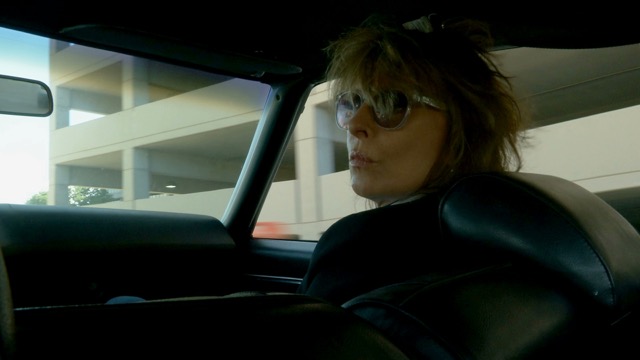
chrissie-in-car-in-akron-1There’s an hour-long Arena documentary about Chrissie Hynde on BBC4 this week. During a preview of a longer 90-minute version the other day, I remembered that what I always liked about her was the subtlety underlying the ferocious four-piece rock and roll attack of the Pretenders’ music. It was present in February 1979, when — at the urging of my friend and Melody Maker colleague Mark Williams — I went to see them at the Railway Arms in West Hampstead, a room once known as Klooks Kleek but then renamed the Moonlight Club.

Mark had seen them a week before and had already written a rave review in the paper. I followed up with another one a week later — somewhat unusual, certainly for an unknown band, but they were so extraordinary that it seemed worthwhile. Before the end of the month Mark had written a terrific feature, outlining their background: how Chrissie had left Akron, Ohio for London, hooked up with the NME crowd and the punks congregating at the McLaren/Westwood Sex shop in the King’s Road, formed a band with three guys from Hereford, and copped a deal with Real Records, which had the Warner-Elektra-Atlantic promotional muscle behind it. Mark’s piece went on the cover, giving them greater prominence than the news of Dylan’s forthcoming UK tour, a piece on Siouxsie Sioux in Berlin, an interview with Dennis Bovell, and an examination of the future of disco by Davitt Sigerson.

It’s always nice to be knocked out by something new. The set I heard in West Hampstead featured the razor-sharp rock and roll of “The Wait” and “Tattooed Love Boys”, but the song that really grabbed my attention, and suggested that there might be a real originality at work, was “Private Life”. A hypnotic song set against a slow, spare reggae rhythm, it had a brusquely dismissive lyric that demonstrated Hynde’s gift for skewering complex, uncomfortable and sometimes unreliable or contradictory emotions: “Attachment to obligation through guilt and regret / Shit, that’s so wet…” Grace Jones did a good version a couple of years later, with Sly and Robbie, but the original was the one that cut deepest.

Hynde could be brutal, but the subsequent hit singles “Brass in Pocket” and “Kid” quickly showed us the unusual variety of emotional shadings — including tenderness — at her command. She was already a great singer, her strong, deep voice given its impact by a distinctive quaver and an ability to make a note that you didn’t think she was going to reach. And she looked the part, of course: a monochrome dream of black fringe, waistcoat and jeans against a ruffled white shirt.

When she was approached to make the documentary, Hynde said she wouldn’t talk about personal topics since she had covered all that ground in her recent autobiography (Reckless, Ebury Press, 2015). But she agreed to spend time with the director, Nicola Roberts, and the cameraman/editor, Alex Jones, last summer, inviting them not just to her home in London but on trips to Paris, New York and Nashville, and back to Akron, where she could hardly help but talk about her early years, although she is at her most interesting when reflecting on her life today.

Throughout the film she’s as sharp as you’d expect, occasionally self-mocking and, in an appearance on the comedian Sandra Bernhard’s radio show, endearingly silly. There’s a lot of music, with a bias towards the songs from the Pretenders’ latest album, some of them played with the current line-up, but also rewarding stuff from the archive, like a storming version of “Whatcha Gonna Do About It” with the original quartet augmented by Steve Jones of the Sex Pistols.

It’s more than a little sad to watch the footage in which James Honeyman-Scott, one of the most creative lead guitarists of his generation, and Pete Farndon, the bass guitarist, are visibly diminished by the addictions that would end their lives, Honeyman-Scott at 25 in 1982 and Farndon — who brought the musicians into Hynde’s orbit — at 30 the following year. That first band was a wonderful outfit, full of the spirit and inventiveness so apparent in their recordings together.

There’s another noise you hear in this film: the subdued growl emanating from the V8 engine of the metallic green 1970s Pontiac in which Hynde tours Akron, revisiting the topography of her adolescence. It’s the almost-vanished soundtrack of the American highway.

* An hour-long cut of Alone with Chrissie Hynde is on BBC4 this Friday, February 10, at 9pm. The full 90-minute version will be transmitted later in the year.
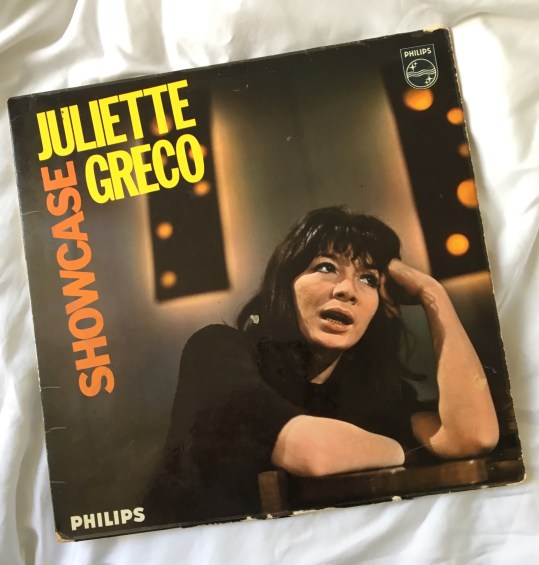
Juliette Gréco paints her nails

juliette-greco

Juliette Gréco is 90 today. When ill-health forced her to cancel last summer’s concert at the Barbican, I consoled myself with the memory of having seen her at the Royal Festival Hall in the early ’70s, when she was still in her compelling prime. I listened again to some of her countless recordings — the album (above) I bought when I was a teenager and  the early classics such as “Déshabillez-moi”, “Je hais les dimanches” and “Les Feuilles mortes”, from the era when she sang for Jean Cocteau and Albert Camus at the Tabou and her friends and admirers included Jean-Paul Sartre and Boris Vian, Jacques Prévert and Léo Ferré, Georges Brassens and Miles Davis.

And I listened to my all-time favourite, a wonderful song called “Mickey travaille”, which appeared on a 1993 album called just Juliette Gréco, written and produced for her by the great Étienne Roda-Gil, whom she had encountered in Paris at a meeting at the Ministry of Culture, where artists had been invited to discuss the imminent threat to the historic Olympia music hall (where she had sung for the first time in 1954). In her memoir, Je suis fait comme ça, published in 2012, she described the impression he made: “An outpouring of generosity and affection, a man of refinement and culture, attentive to others. But also fragile.” When she visited his apartment on the rue Cassini, he showed her the studio of his late wife, an artist. He had left it untouched since her death: “Even the roses, wilted, remained in their vases.”

She called him “a painter with words”, and for “Mickey travaille” he gave her an unforgettable entrance. Accompanied by the acoustic guitar of Caetano Veloso, strumming a light samba rhythm, she whispers: “Je peins mes lèvres et mes ongles en noir…” If the thought of Juliette Gréco painting her lips and nails black while awaiting her lover’s return doesn’t stir you, well…

* The version of “Mickey travaille” I’ve embedded here is not the one from the album, but a recording from a concert at the Olympia in Paris.

Earth Air Water… and Fire

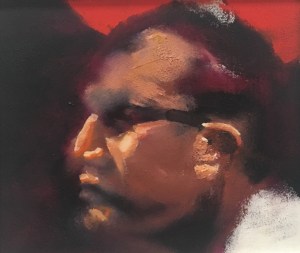
michael-andrews-arthur-brownIt came as a bit of a surprise to walk into a high-end London art gallery this week and discover a small portrait of Arthur Brown, the madcap rocker of the late ’60s, taking its place in an extensive exhibition of the work of the late English painter Michael Andrews.
Andrews was born in Norwich in 1928 and died in London in 1995. A friend and contemporary of Lucian Freud, Frank Auerbach and Francis Bacon, in 1962 he painted a famous group portrait of the denizens of Muriel Belcher’s Colony Room in Soho, for which he also provided a large Tuscan landscape of irregular shape, to be hung on a wall. He was particularly good at social groups and party scenes (as in The Deer Park, All Night Long, and the triptych Good and Bad at Games, none of them, unlike the two Colony Room pieces, included this exhibition).

In later years, however, he concentrated on landscapes and paintings of the natural world, which is why the exhibition of 61 of his works at the Gagosian gallery is titled Earth Air Water. There are several large paintings of Ayers Rock (nowadays also known by its Aboriginal name, Uluru), the River Thames and the Scottish moorlands, where he painted men in tweeds stalking and shooting deer. The intention of the show must be raise his status closer to that of his more celebrated fellow regulars at the Colony Room, something probably denied him by his own modest nature.

He was a perceptive portraitist, and one of the most striking works in the show is a self-portrait from 1988, that of a man with pleasant but unremarkable looks wearing an expression of restrained anxiety. The painting of Brown was made in 1967, when the extrovert singer was still an underground hero and a few months away from an appearance on Top of the Pops, promoting his latest release with flames apparently emerging from his head. Given the theme of that record, Brown’s one big hit, the exhibition’s curator might have added a fourth element to the title of his show: Fire.

I recognised Brown’s distinctive features straight away, of course, but an adjacent portrait — of similar size and vintage — puzzled me.

michael-andrews-dave-brubeck

Then I looked at the catalogue: it was Dave Brubeck, painted from a photograph. Both portraits are listed as “studies” for works on a larger scale. They play very minor roles in the show, but it was certainly nice to bump into them on a rainy morning in Mayfair.

* Michael Andrews: Earth Air Water is at the Gagosian gallery, 20 Grosvenor Hill, London W1, until March 25. The painting of Arthur Brown is from a private collection; that of Dave Brubeck is owned by the Arts Council Collection.

In the groove with Dennis Coffey

denniscoffey1_courtesy-of-clarence-avant---interior-music-corpDennis Coffey is still playing Tuesday nights at a Detroit club called the Northern Lights Lounge. It’s what he and his 1963 Gibson Birdland have been doing for the best part of 50 years. He started making a local reputation as a session man in the mid-’60s when he played on Darrell Banks’s “Open the Door to Your Heart” and the classic sides on the Golden World label by J. J. Barnes and others. Later in the decade he was absorbed into the Motown studio band, adding the rock-influenced sounds of a wah-wah pedal and a fuzz box to the more classic approaches of the established Hitsville USA guitarists: Robert White, Eddie Willis and Joe Messina.

It was Coffey who played on Norman Whitfield’s psych-soul productions, like the Temptations’ “Cloud Nine” and “Ball of Confusion” and Edwin Starr’s “War”, as the Motown Sound updated itself to suit a new era. He had his own hit, the funky instrumental “Scorpio”, which highlighted his interest in effects. But he was still playing in the clubs, as we can hear from the rather wonderful product of the latest piece of successful treasure-hunting among previously unknown tapes by the Resonance label: an album titled Hot Coffee in the D: Burnin’ at Morey Baker’s Showplace Lounge, recorded in 1968 with a trio completed by the Hammond organist Lyman Woodard and the drummer Melvin Davis.

Woodard and Davis were musicians with local reputations. The organist went on the road with Martha and the the Vandellas as their musical director. The drummer also toured with Vandellas, and with the Temptations. Like many of the members of the Funk Brothers, they could also be found in the night spots, entertaining their predominantly black listeners with a style of jazz that was heavy on the groove and on the feeling of the blues.

So what we have here is just under an hour of what you’d have heard if you’d wandered into this particular club in 1968: a brand of social music mixing jazz, funk and R&B, completely devoid of pretension, being delivered by highly sophisticated players with a wonderful directness and without any hint of strain. This recording features a handful of lively originals, ultra-cool instrumental versions of Bacharach’s “The Look of Love” and Jimmy Webb’s “By the Time I Get to Phoenix”, and a nice reading of Herbie Hancock’s “Maiden Voyage”. The rhythms are deep in the pocket and the solos aren’t about showing off.

Whenever you’re lucky enough to find yourself in such an environment, you  know that no boundaries are being stretched and no rules are being rewritten. But it doesn’t matter. There are truths in this kind of music that are no less valuable for being relatively simple. And while it’s happening you want it to go on for ever.

* The photograph of Dennis Coffey is from the booklet accompanying Hot Coffey in the D, which includes valuable interviews and background material.

January 20, 2017

us-flagWith three hours to go until the inauguration of Donald J. Trump as the 45th president of the United States, the coffee shop I frequent was playing the Staple Singers’ “Respect Yourself”. That’s a record with a lot of American history in it, one way and another: a message delivered by a mixed group of black and white singers and musicians, showing how music can provide encouragement, comfort and even guidance.
The saxophonist Charles Lloyd and the singer Lucinda Williams have chosen to mark today’s events by releasing an eight-minute version of Bob Dylan’s “Masters of War”, streamable on Spotify here. It was recorded live at the Lobero Theatre in Santa Barbara, California, on November 28 last year, three weeks after the election, with Bill Frisell on guitar, Greg Leisz on pedal steel, Rueben Rogers on bass and Eric Harland on drums. That’s a real A Team, and together they give Dylan’s song the full treatment: harsh, menacing, an ebb and flow of emotions but underneath simmering with rage.

As a teenager in Memphis in the 1950s, Lloyd played with B. B. King, Howlin’ Wolf and Bobby Bland. He is 78 years old now, and has performed in public through 12 presidencies, counting this latest one. “The world is a dog’s curly tail,” he says in the press statement accompanying the release. “No matter how many times we straighten it out, it keeps curling back. As artists we aspire to console, uplift and inspire. To unite us through sound across boundaries and borders and to dissolve lines of demarcation that separate us. The beautiful thing is that as human beings, even under the most adverse conditions, we are capable of kindness, compassion and love, vision and hope. All life is one. Who knows, maybe one day we’ll succeed. We go forward.”

Little Jimmy & Little Joe

jimmy-scott-joe-pesciWhen the great ballad singer Jimmy Scott returned to action in the early ’90s, in a rediscovery primed by appearances on Lou Reed’s Magic & Loss and in David Lynch’s Twin Peaks, the surge of interest resulted in his recordings becoming widely available. They ranged from carefully curated collections of his work for Decca and Savoy in the 1950s (when he was known as Little Jimmy Scott) to new albums produced for Sire and Milestone by Tommy LiPuma, Mitchell Froom, Todd Barkan and others. There was also, finally, the reappearance of two legendary albums from the 1960s suppressed when Herman Lubinsky, the notoriously vindictive owner of Savoy, claimed that Scott had recorded them in breach of an existing contract: Falling in Love is Wonderful, produced in 1962 by Ray Charles for his own Tangerine label, and The Source, supervised by Joel Dorn for Atlantic in 1969.
Lubinsky’s action cost the singer what should have been the prime years of his career, but we were lucky to have him for the last 20 years of his life, until his death in 2014 at the age of 88. In that final phase, hardly surprisingly, his pipes were not what they had once been, but it wasn’t mawkish to feel that the signs of ageing added an extra poignancy to his interpretations. His marvellous phrasing was certainly unimpaired, and the wide vibrato still touched the heart.

Now, three years after his death, comes an album called I Go Back Home, the fruit of his final recording sessions, held in 2009, in which the German producer Ralf Kemper surrounded him with sympathetic musicians, arrangements, and guests. Sometimes, as in “Poor Butterfly”, Scott speaks the lyric, allowing the French harmonica player Grégoire Maret to add melodic decoration. Elsewhere, as on “Sometimes I Feel Like a Motherless Child” and “How Deep is the Ocean”, his singing has a surprising strength. There are duets with Dee Dee Bridgewater on “For Once in My Life”, with Oscar Castro Neves on “Love Letters”, and with Renee Olstead on “Someone to Watch over Me”. There are tracks featuring other distinguished instrumentalists: the pianist Kenny Barron, the organist Joey DeFrancesco, the tenorist James Moody, and the trumpeter Till Brönner (who displays a delicate lyricism on “If I Ever Lost You”). There are gentle and wholly appropriate string and woodwind arrangements by Mark Joggerst. There is a beautifully warm and clear mix by Phil Ramone.

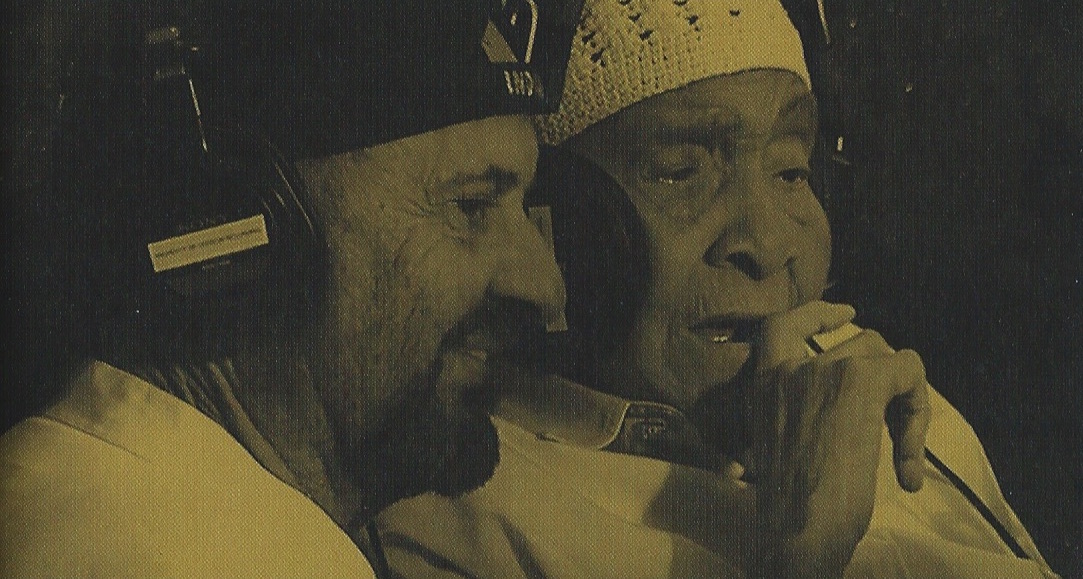
The big surprise, however, comes in one of the two songs that do not feature Scott at all but are billed as “tributes” by other singers. It’s a version of “The Folks Who Live on the Hill”, the Kern/Hammerstein song that Scott recorded — featuring the seldom-sung introduction — during a 1972 Dorn-produced session which remained unheard until the release of a Rhino/Atlantic album titled Lost and Found in 1993. But this time the singer, paying tribute to his old friend and influence, is the actor Joe Pesci.

We know that Pesci grew up in New Jersey alongside Frankie Valli, and that he had early ambitions as a singer. In 1968 he released an album under the name Joe Ritchie titled Little Joe Sure Can Sing! on the Brunswick label, produced by Artie Schroeck (who arranged Valli’s “Can’t Take My Eyes Off You”), featuring covers of things like the Bee Gees’ “To Love Somebody”. When it didn’t make waves he switched first to stand-up comedy and then to an acting career that took him to the heights of Raging Bull, Goodfellas and Casino.

His dead-slow version of “The Folks Who Live on the Hill” — one of my very favourite ballads — is good enough to make you wonder what might have happened had he stuck with the singing thing. His delivery is very much in Scott’s pleading high-tenor register, with subtle echoes of that distinctive vibrato, and occasional manipulations of timbre that seemed to echo the muted-trumpet obligato provided on the track by DeFrancesco, switching to his second instrument. Joggerst’s arrangement exudes a glowing serenity, particularly when the rhythm section lays out for a rubato statement of the six-bar bridge before Barron’s piano, the bass of Michael Valerio and Peter Erskine’s brushes pick it up for the final 12 bars.

I never thought I’d hear a treatment of this song to rival the enchanting version recorded by Peggy Lee with Nelson Riddle in 1957. This one does. I’ve been playing it for friends, without divulging the identity of the singer. They’ve all been amazed.

Pesci also appears in a duet with Scott on “The Nearness of You”, and if you’re only half-listening you might not even notice where one begins and the other ends. So that’s an unexpected reason for investigating I Go Back Home, which stitches the final notes of a fabulously gifted and original singer, one matched as an interpreter of torch songs only by Billie Holiday and Shirley Horn, with tender care into a loving hour-long tapestry of sound.

* The photograph of Joe Pesci and Jimmy Scott together in the studio is from the booklet accompanying I Go Back Home, which is released on January 27 on the Eden River label.

Winter in America

darcy-james-argue-secret-society

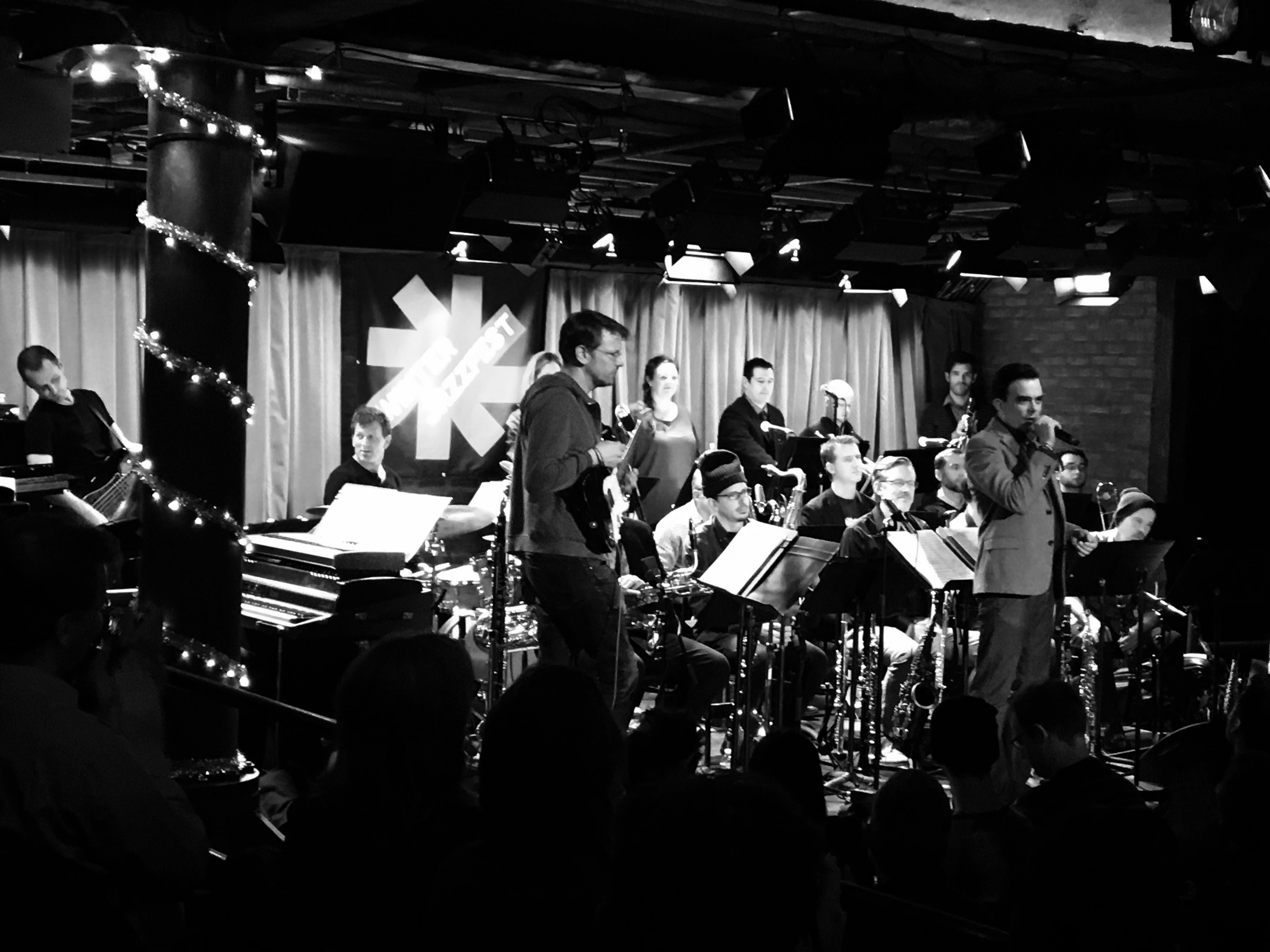
Darcy James Argue introduces Secret Society during the 2017 Winter Jazzfest in New York

“Welcome to the resistance,” Darcy James Argue said on Friday night to the packed audience at Subculture, a basement club on Bleecker Street. Then the Canadian-born, New York-based composer and bandleader  turned to his 18-piece ensemble, Secret Society, and, with deft flicks of his wrists, guided them into the opening of Real Enemies, his cycle of pieces based on the theme of state-sponsored paranoia. A few hours earlier, in another part of New York City, Donald Trump had been forced to listen to the representatives of the CIA and the FBI presenting evidence that Russia’s government and secret services had helped to get him elected as president of the United States.

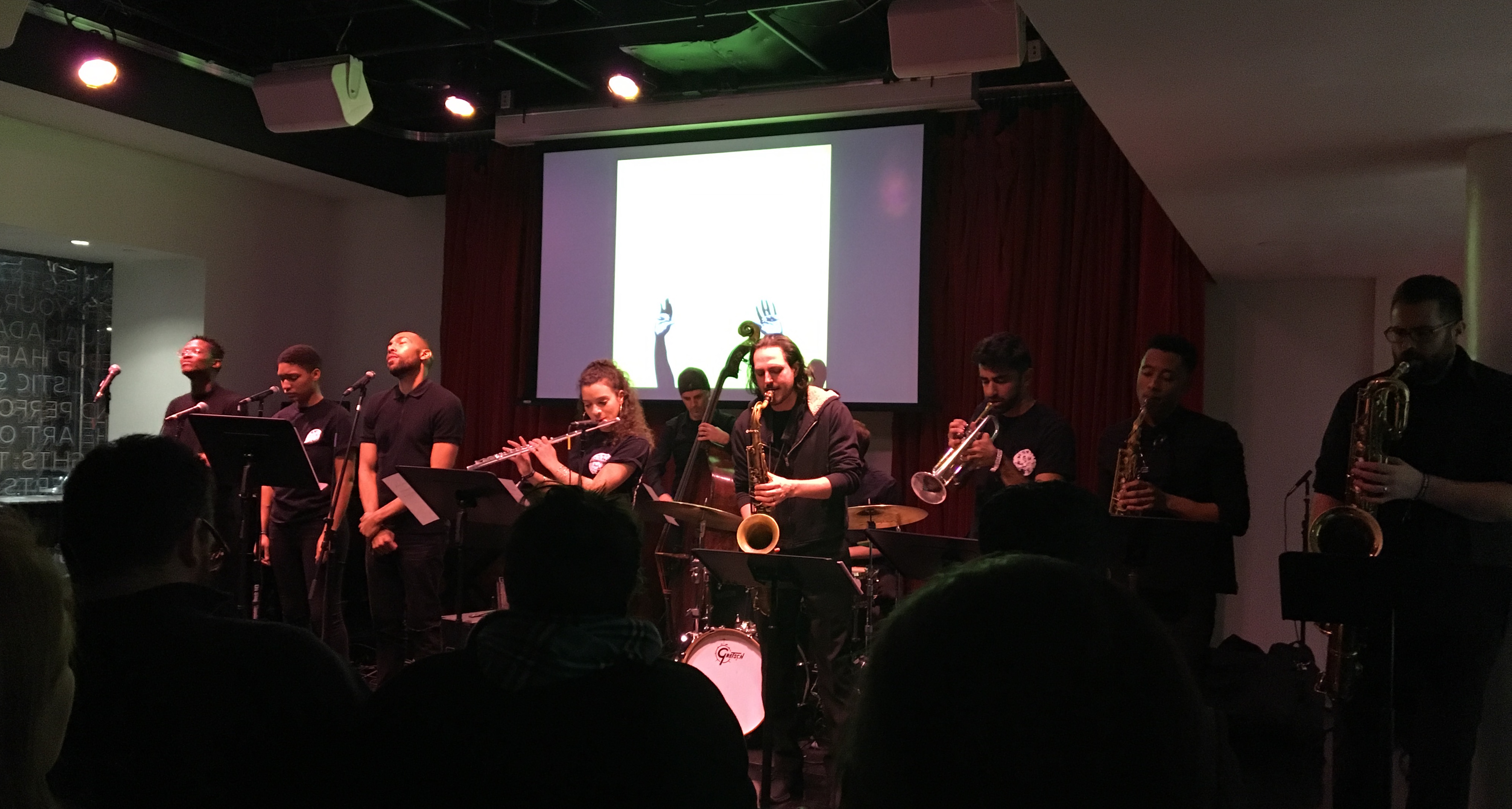
“Social justice” was the theme of the event in which Argue was participating: the 2017 edition of Winter Jazzfest, the annual showcase featuring a two-day marathon of more than 150 groups at about a dozen venues centred on Greenwich Village. Different bandleaders expressed their attitude to the topic in different ways. The pianist and composer Samora Pinderhughes led his 11 musicians through an extended piece titled The Transformations Suite, a profoundly moving contemporary take on themes no less relevant than when they were explored half a century ago in Max Roach’s We Insist! Freedom Now Suite. The Indian-American singer and harmonium player Amirtha Kidambi performed a piece inspired by the death of Eric Garner at the hands of NYPD officers in 2014; she announced that all proceeds from that night’s sales of the new CD by her quartet, Elder Ones, would go to the fund supporting four members of the NAACP arrested earlier in the week for protesting against Trump’s nomination for attorney general of a man who has campaigned against voting rights. The trumpeter Peter Evans called for the recognition of musicians — he gave Matana Roberts as an example — who have a record of campaigning on these issues.

Others preferred to let the music speak for itself, but there was never any doubt of the continuing role that jazz musicians have to play in exposing issues, raising consciousness, and maintaining morale in difficult times. Their inherent independence of spirit, their understanding of the need to reconcile individual and collective action, their roots in an idiom that came from suffering and exploitation, and their acceptance of the need to fight against the commercial odds make them ideally suited to the task.

To get back to the music, Argue is a young man with an intriguing approach both to personal style (he looks as though he might relax at the weekend by putting on a cravat) and to finding new solutions to the problems inherent in playing jazz with a large ensemble. Throughout the performance of Real Enemies, he used a tablet to trigger sound bites from such people as Oliver North and Dick Cheney. With Ingrid Jensen among the trumpeters and Chris Speed among the reeds, the writing contained echoes of Elmer Bernstein, Bob Graettinger and Gil Evans: lots of drama, lots of complexity, lots of variety (particularly in the instrumental colours: a grouping of piccolo, flute, two clarinets and a bass clarinet, for instance, or a trumpet lead supported by four flugelhorns). It would be an important and pathfinding work at any time, never mind now.

samora-pinderhughes

From left: Vuyo Sotashe, Jules Latimer, Jeremie Harris, Elena Pinderhughes, Clovis Nicolas, Lucas Pino, Riley Mulherker, Braxton Cook and Tony Lustig perform The Transformations Suite

Pinderhughes’ The Transformations Suite did not enjoy the same degree of attention when the recorded version came out last year, but it made a deep impression in the New School’s Glass Box space late on Friday night. There was nothing ironic here: the wounds of 400 years of slavery and its aftermath were allowed to bleed openly in the poems and lyrics delivered by the actor Jeremie Harris (who wrote some of the words), the wonderfully soulful South African-born singer Vuyo Solashe, and most of all by Jules Latimer, a young Juilliard drama student who took the considerable risk of acting out grief and fear without restraint. “Swing Low, Sweet Chariot” occasionally popped up as a leitmotif, and Pinderhughes’ lean but succulent writing for his five-piece horn section provided a platform for improvisations by his extravagantly talented 21-year-old sister Elena, who might just be on her way to becoming the finest flautist jazz has produced, the tenorist Lucas Pino, and Braxton Cook, who took the roof off the place with a roaring alto solo.

monkestra

MONK’estra with John Beasley at the piano, James Genus on bass and Greg Tardy on tenor

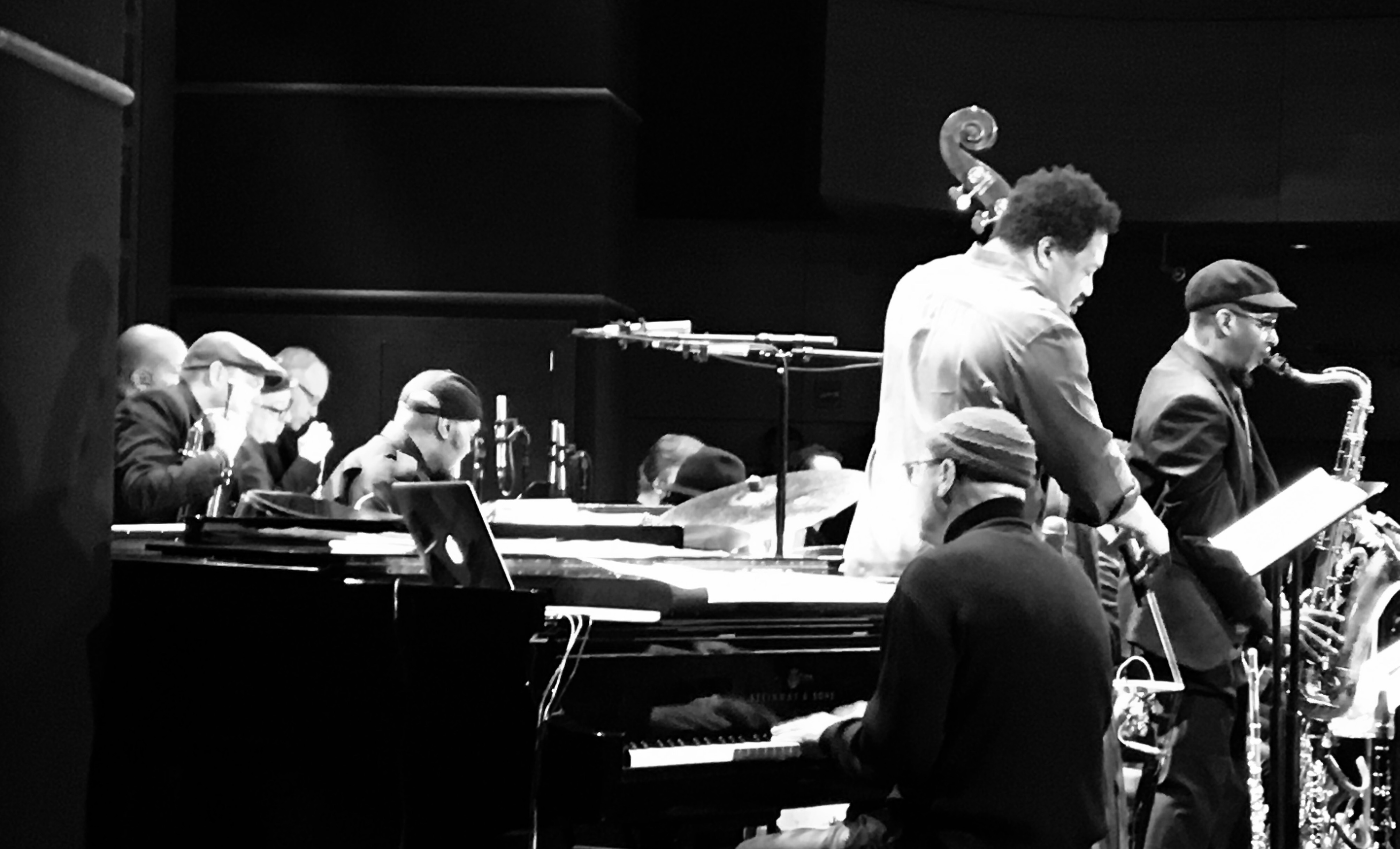
John Beasley’s MONK’estra performed their empathetic, swinging and sometimes hiphop-tinged revisions of Thelonious Monk tunes at Dizzy’s Club Coca-Cola in Lincoln Centre on Thursday night, in front of a window with a view of Trump Tower. Luckily the arrangements and the solos — notably by the always creative tenorist Greg Tardy, the trombonists Frank Lacy and Conrad Herwig, and a guest from France, the fine harmonica player Grégoire Maret — were more than enough to divert attention away from the new epicentre of American values. And, as Beasley reminded us, Monk himself had grown up literally only a stone’s throw away, on West 63rd Street.

mary-halvorson-octet

Mary Halvorson (left) with Jonathan Finlayson, Jon Irabagon, Ingrid Laubrock and Jacob Garchik at the New School

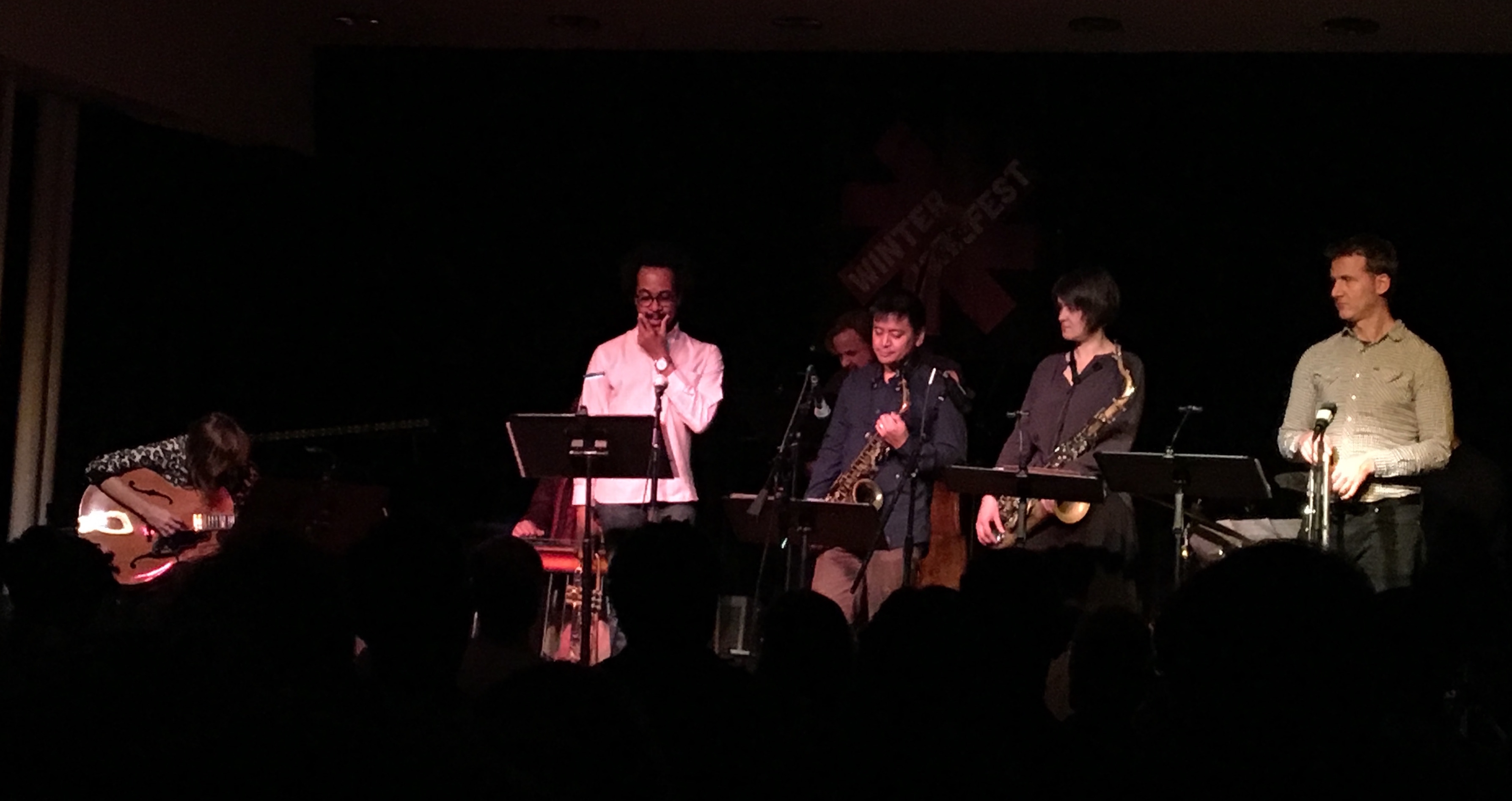
As impressive as anything I heard during three crowded days was the octet led by the guitarist Mary Halvorson, which features not just a bunch of great players (including the trumpeter Jonathan Finlayson and the tenorist Ingrid Laubrock) but the leader’s extraordinary interplay with the pedal steel player Susan Alcom, which elevates the music to a whole different realm of texture and emotion. Halvorson’s compositions are fascinating enough in any case: sounding as though they are through-written, they have the impact of great short stories, full of surprising twists of plot and mood, never quite ending where you expect but always resolving brilliantly.

While the festival was taking place, the great jazz critic Nat Hentoff died in New York at the age of 91. Through his liner notes, his pieces for Down Beat, the Jazz Review and the Village Voice, and books such as Hear Me Talkin’ To You (co-authored with Nat Shapiro) and Jazz Is, he helped shaped the view of several generations of listeners. He was also a lifelong fighter for social justice. And in 1960, for his own short-lived label (which released classic albums by Charles Mingus and Booker Little), he produced Cecil Taylor’s sublime trio version of “This Nearly Was Mine”, which alone would earn him a place wherever the good ones go.

* All the music mentioned above is out now on CD. Darcy James Argue’s Real Enemies is on the New Amsterdam label. Samora Pinderhughes’ The Transformation Suite is on Gray Area. John Beasley’s MONK’estra Vol. 1 is on Mack Avenue. The Mary Halvorson Octet’s Away With You is on Firehouse 12. “This Nearly Was Mine” is on The World of Cecil Taylor, on the Candid label.

“Hi, everybody, I’m Archie Bell…”

archie-bell-1

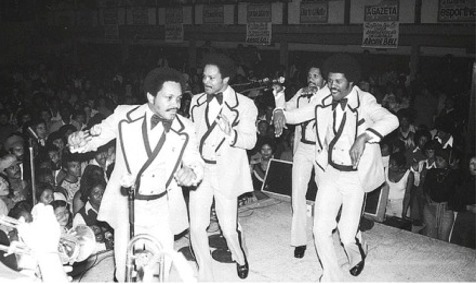
Among the select group of great pop singles that last no more than two and a quarter minutes, “Here I Go Again” by Archie Bell and the Drells stands pretty much supreme. From Bobby Eli’s electric sitar opening to the jammed fade, not a single one of its 135 seconds is wasted.

It was written and produced in Philadelphia in 1969 by Kenny Gamble and Leon Huff, and arranged by Bobby Martin and Thom Bell. The principal musicians will have been Eli and his fellow guitarist Norman Harris, Ronnie Baker on bass guitar, Earl Young on drums and Vince Montana on vibes (or possibly, in this instance, xylophone). I give them special prominence because the heart of the record is not to be found in the vocal verse and chorus but in the little four-bar instrumental interludes that punctuate the song so memorably.

The record starts with a 12-bar intro featuring Eli’s Danelectro Coral electric sitar before going into the 16-bar verse and the eight-bar chorus, all built on an E flat-A flat-B flat sequence and a blithe backbeat with double-time bass guitar fills. That’s followed by the first of the four-bar interludes, in which the rhythmic emphasis changes subtly but significantly, driving deeper into the “one”, anchored by a grunting baritone saxophone; more important, there’s also a radical harmonic shift from the E flat base (by my amateur musical forensics, which someone more expert might well correct) to a G-B-A-D pattern*. The combined effect of the two elements gives an exhilarating lift to this mini-break, somehow heightened by the absence of a solo instrument.

The effect is like suddenly changing the lighting in a room — and then back again, just as suddenly, when the tension is released by a return to the original mode. They run through the 16-8-4 pattern again, and then the chorus is repeated once more before the instrumental section returns and is played three times, with Archie Bell wailing on top this time, to the fade. And then it’s over, quite abruptly, and you want to play it again.

When it came out on a 45 in the US in 1969 it was as the B-side to “A World Without Music”, which failed to make the US Top 1oo. Three years later, however, it was discovered by Northern Soul dancers, who took it into the UK pop charts, where it peaked at No 11. Archie told Blues & Soul magazine that when he was informed of its belated and unexpected success, he had trouble recalling the song.

It’s included in Let’s Groove: The Archie Bell & the Drells Story, a new 2-CD anthology on Big Break Records. The compilers include the obvious hits, beginning with the first from 1967, introduced thus: “Hi, everybody, I’m Archie Bell and the Drells, from Houston, Texas. We don’t only sing, but we dance just as good as we want.  In Houston, we’ve just started a new dance called the Tighten Up. This is the music we Tighten Up with…” That rough but irresistible debut single, “Tighten Up Pt 1”, duly went to No 1 in the pop and R&B charts.

I confess that I never kept the closest watch on their career, and among the 44 tracks are many that are new to me, including “A Soldier’s Prayer 1967”, a ballad in which Archie — who was wounded in Vietnam — sings about the experience of thinking about his family while preparing to go into combat. (This turns out not to be quite true: see the comment below from Blaise Pascal.) There’s also the charming “Archie’s in Love”, written by Philip Mitchell, produced by Brad Shapiro and Dave Crawford, and introduced with a nostalgic snatch of a country waltz before snapping into a hip-swinging 1971 disco beat.

The second disc includes a selection of the dancefloor favourites they recorded for Gamble and Huff’s Philadelphia International label in the second half of the ’70s, many of them produced by John Whitehead and Gene McFadden. In”Let’s Groove”, “The Soul City Walk”, “Dance Your Troubles Away” and the rest, the textures are smoother, the grooves slinkier, and the instrumental breaks much longer. It’s the generic disco music of its time, washed in the spangled rays of a mirror ball, beautifully executed and captured by a great bunch of session musicians and studio engineers. But nothing, I have to say, beats the magical 135 seconds of “Here I Go Again”.

* It’s quite possible that the speed of the track was altered during mixing or even mastering, and that the respective chord sequences might originally have been E-A-B and A flat-C-B flat-E flat.

A Christmas No 1

Some strange magic makes Davitt Sigerson’s “It’s a Big Country” my favourite Christmas record, narrowly ahead of Booker T and the MGs’ “Winter Wonderland”, Elvis’s “Merry Christmas Baby”, Leon Russell’s “Slipping Into Christmas” and James Brown’s “Santa Claus, Go Straight to the Ghetto”.

I met Davitt in 1977, when he was a charming 20-year-old New Yorker just down from Oxford University and deeply immersed in soul music, and I was editing Time Out. He suggesting contributing a weekly column of disco listings: a great idea, although there was stern resistance from a majority of the rest of the editorial staff, who were basically into pub-rock and a bit of punk. Anyway, we went ahead. The following year I moved to the Melody Maker and he wrote pieces for me there, too, including a terrific early piece on Chic, for whom we shared a great admiration.

In 1980 he started making records himself, for Michael Zilkha’s Ze label. His first single, “I Never Fall in Love”, seemed bound to be a hit, and I’m not the only one who still finds himself humming it, savouring the witty lyric, and wondering why the hell it wasn’t. (And somewhere I think I’ve still got a box of the 45s, just in case its time comes around.)

What neither “I Never Fall in Love” nor “It’s a Big Country” — which was featured (alongside the Waitresses’ “Christmas Wrapping”, Alan Vega’s “No More Christmas Blues” and Cristina’s “Things Fall Apart) on The Ze Christmas Record in 1981 — shows is that he had a great feel for a white-boy version of street-funk. When he didn’t get a hit he moved on to writing songs for other artists and to producing, his credits including the Bangles’ third album, Everything, which included the hit “Eternal Flame”. In the ’90s he served briefly as president of Polydor and EMI/Chrysalis, and as chairman of Island in the US.

At some point I remember him telling me that he was writing speeches for politicians, and in 2004 he published a novel called Faithful, which was probably intended to make him the successor to Jay McInerney and Brett Easton Ellis. That was the last I heard of him.

So what is it that I like so much about “It’s a Big Country”? It’s the way the writer, like Chuck Berry and Hal David, uses American place-names to signpost the narrative, which is then guided by a very nice jangling rhythm track at a tempo that is not exactly hurried but suggests that the protagonist might still have more cards to write and calls to make. It’s the conversational tone, and the mention of “me and Ann” (I’ve spent quite a lot of time over the years trying to decide whether she should have an e, like L. M. Montgomery’s Anne Shirley, or not, like Ann Sevier in Hans Koningsberger’s An American Romance). And it’s the fact that whenever I hear “Got an uncle in Los Angeles / Beverly Hills, to be precise,” it makes me smile.

If you’re out there, Davitt, merry Christmas. And to everyone else, as well.

2016: The best bits

The Nobel Prize in Literature

To live outside the law, you must be honest.

He not busy being born is busy dying.

She knows there’s no success like failure, and that failure’s no success at all.

Sometimes even the president of the United States must have to stand naked…

Like William Shakespeare, whom he mentioned in his acceptance speech at the Nobel awards ceremony, Bob Dylan has lodged more phrases in the collective consciousness than you could begin to count. To me, that’s one cast-iron argument in favour of awarding him the Nobel Prize in Literature. The announcement met some opposition, much of it incoherent, but it seemed to me like one of the very few bright public moments in a notably dark year.

The appearance of Dylan’s friend Patti Smith at the ceremony in Stockholm, performing “A Hard Rain’s A-Gonna Fall”, was wonderfully moving, and her description of the experience was equally affecting. As she delivered the line “I saw guns and sharp swords in the hands of young children,” I thought of the report I’d read that morning about the two girls, possibly as young as seven or eight, said to have been used as suicide bombers in the market of Maiduguri, a city in north-eastern Nigeria, the previous day. While I can’t imagine Dylan ever thinking in terms of prophecy, his words have a way of retaining, even deepening, their resonance through time and space. And that’s what literature does.

(Another occasion on which an old song seemed to find a new place in history was Bruce Springsteen’s intense performance of “American Skin (41 Shots)” at Wembley Stadium in June. Written after the killing of Amadou Diallo and now rededicated to Trayvon Martin, it formed a stark interlude in the middle of an otherwise euphoric concert on a warm midsummer evening. I’m hoping, without much confidence, that next year’s most memorable moments will be unshadowed by such concerns.)

Live performances

1. Eve Risser’s White Desert Orchestra (Cité Universitaire, Paris, January)

2. Matana Roberts’s ‘For Pina’ (Martin-Gropius-Bau, Berlin, November)

3. Arve Henriksen / Jan Bang / Eivind Aarset (LSO St Luke’s, May)

4. Liberation Music Orchestra (Cadogan Hall, November)

5. Bruce Springsteen & the E Street Band  (Wembley Stadium, June)

6. Mike Westbrook (Kings Place, November)

7. Ches Smith Trio (New School, NYC, January)

8. The Necks (Union Chapel, April)

9. Laura Jurd / Evan Parker / Orphy Robinson / Alexander Hawkins (Cockpit, March)

10. Oddarrang (Jazzahead, Bremen, February)

11. Christian Lillinger’s Grund (Tiyatrom, Berlin, August)

12. Oslo Jazz Festival Band (Ronnie Scott’s, January)

13. Twelves (Vortex, July)

14. Wadada Leo Smith (Cafe Oto, July)

15. Orphy Robinson’s Bobby Hutcherson tribute (St James the Great, East London, September)

16. Terry & Gyan Riley (Barbican Hall, September)

17. Moses Boyd (Phonica, October)

18. Jason Moran’s ‘The Wind’ (Milton Court, November)

19. The Enemy (Vortex, November)

20. Elephant 9 (Ronnie Scott’s, May)

New albums

1. Catherine Christer Hennix: Live at ISSUE Project Room (Important)

2. Tyshawn Sorey: The Inner Spectrum of Variables (Pi)

3. Elza Soares: The Woman at the End of the World (Mais um Discos)

4. Masabumi Kikuchi: Black Orpheus (ECM)

5. Radiohead: A Moon-Shaped Pool (XL)

6. Beyoncé: Lemonade (Parkwood)

7. Ossatura: Maps and Mazes (ReR)

8. Andrew Cyrille: The Declaration of Musical Independence (ECM)

9. Darcy James Argue: Real Enemies (New Amsterdam)

10. David Bowie: blackstar (Columbia)

11. Philip Clemo: Dream Maps (All Colour Arts)

12. Leonard Cohen: You Want It Darker (Columbia)

13. Steve Lehman & Sélébéyone (Pi)

14. Anna Lena Schnabel: Books, Bottles & Bamboo (ENJA)

15. Jason Palmer / Cédric Henriot: City of Poets (Whirlwind)

16. Charlie Haden’s Liberation Music Orchestra: Time/Life (Impulse)

17. Empirical: Connection (Cuneiform)

18. Laurence Crane + Asamisimasa: Sound of Horse (Hubro)

19. Paolo Conte: Instrumental Music (Decca)

20. Applewood Road (Gearbox)

Archive/reissue albums

1. Georgie Fame: Survival: A Career Anthology 1963-2015 (Universal / Polydor)

2. Stan Getz & Joao Gilberto: Getz / Gilberto ’76 (Resonance)

3. Albert Ayler Quartet: European Radio Studio Recordings 1964 (hatOLOGY)

4. Ray Charles Orchestra: Zurich 1961 (Montreux Jazz)

5. Various: Jon Savage’s 1966 (Ace)

6. John Surman: Morning Glory (Fledg’ling)

7. Don Cherry / Irene Schweizer / JohnTchicai: Musical Monsters (Intakt)

8. Shirley Horn: Live at the 4 Queens (Resonance)

9. Chet Baker: Live in London (Ubuntu)

10. Various: The Motortown Revue in Paris (Tamla)

Books: Fiction

1. Emma Cline: The Girls (Chatto & Windus)

2. Patrick Modiano, trans. John Cullen: Villa Triste (Daunt Books)

3. Christine Otten, trans. Jonathan Reeder: The Last Poets (World Editions)

Books: Non-Fiction

1. William Finnegan: Barbarian Days (Little, Brown)

2. James McBride: Kill ’em and Leave (Weidenfeld & Nicolson)

3. Damon Hill: Watching the Wheels (Macmillan)

Feature films

1. The Assassin (dir. Hou Hsaio-Hsien)

2. Paterson (dir. Jim Jarmusch)

3. Our Little Sister (dir. Hirozaku Korea)

4. Love and Friendship (dir. Whit Stillman)

5. Victoria (dir. Sebastian Schipper)

Documentary films

1. Don’t Blink (dir. Laura Israel)

2. I Called Him Morgan (dir. Kasper Collin)

3. What Happened, Miss Simone? (dir. Liz Garbus)

Exhibitions

1. Abstract Expressionism (Royal Academy, October)

2. Alex Katz (Serpentine Gallery, June)

3. Picasso portraits (National Portrait Gallery, October)