Arthur Jafa at Store Studios
Perhaps you’ve already seen Soul of a Nation: Art in the Age of Black Power at Tate Modern. If you haven’t, you should. It’s full of marvellous things, from the paintings of Romare Bearden, Wadsworth Jarrell and Bob Thompson to the photographs of Roy DeCarava and Beuford Smith via posters and murals and a vitrine full of covers of The Black Panther newspaper. One or two of the later rooms aren’t so compelling, and I was unpleasantly jarred by the mystifying inclusion of Andy Warhol’s portrait of Muhammad Ali. But the whole exhibition, curated by Mark Godfrey and Zoe Whitley, tells a great story and seethes with life.
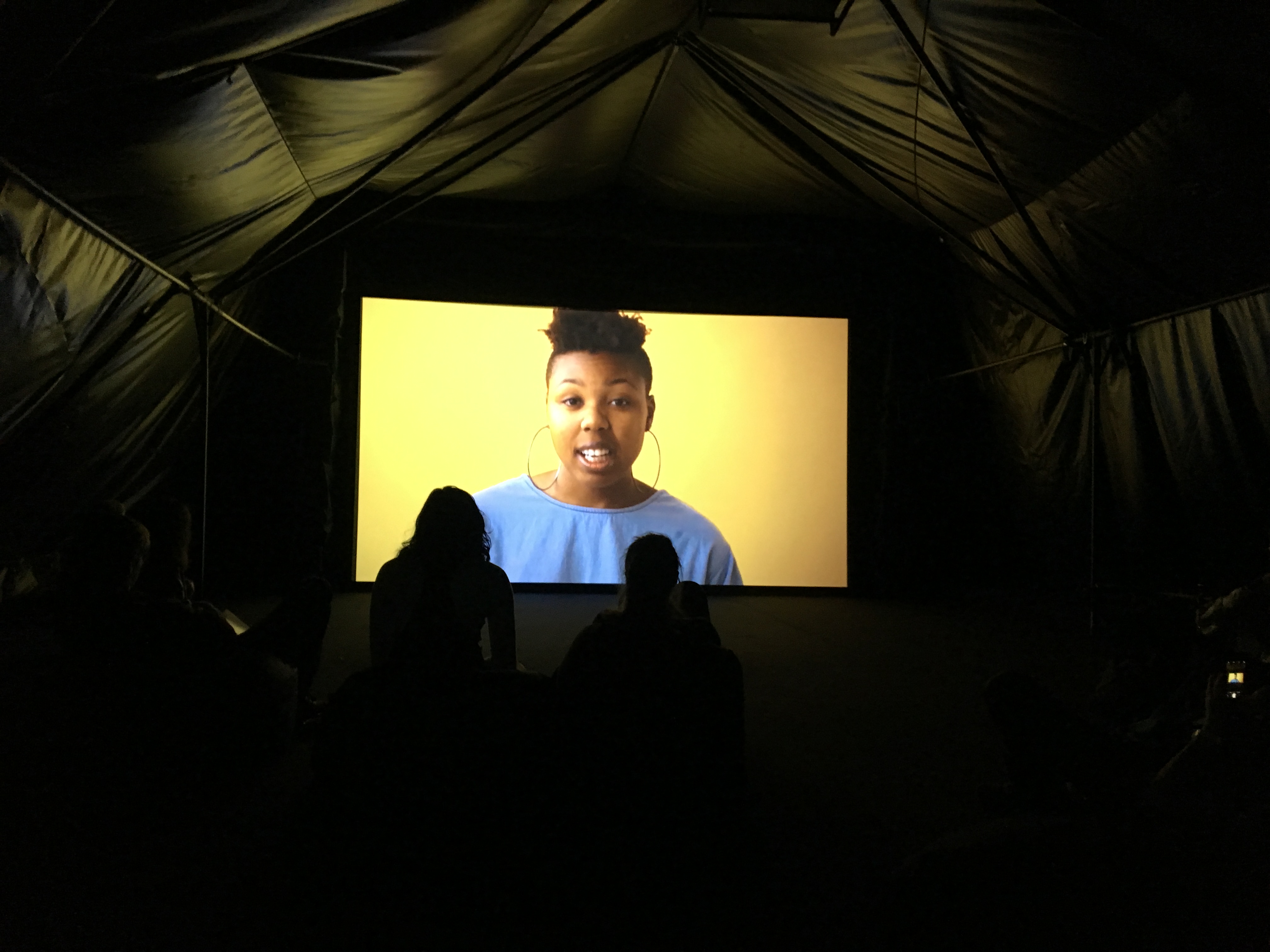
On the other side of the Thames, there’s something strongly related. Installed in a black tent-like structure on the roof of Store Studios as part of Everything at Once, a kind of de luxe pop-up show in an old brutalist office building at 180 The Strand, overlooking the Shard and the National Theatre, Arthur Jafa’s Love Is the Message, the Message is Death is very different in nature and scale but, because of its contemporaneity, even more affecting.
This is a seven-minute collage of snippets of film from all kinds of sources, set to Kanye West’s “Ultralight Beam”. For those, like me, previously unfamiliar with his 30-year career, Jafa is a cinematographer who was born in Mississippi, lives in Los Angeles, has worked with Spike Lee, directed a couple of the videos for Solange’s masterpiece A Seat at the Table in 2016, and exhibited earlier this year at the Serpentine Gallery.
His new work uses newsreel and found film of black Americans marching, worshipping, performing, dancing, and being threatened, beaten and shot by officers of the law. These images are juxtaposed with footage of heroes: Nina and Aretha; Martin and Malcolm; Miles and Trane; Louis and Jimi; the two MJs, Jordan and Jackson; Serena and Lebron; Ali and Louis Farrakhan; and a 17-year-old Biggie Smalls rapping on a Bedford-Stuyvesant streetcorner. Having started with a clip of Barack Obama at the funeral of the murdered Rev. Clementa Pinckney in Charleston, South Carolina, it ends with James Brown in his ’60s prime.
The whole thing has the rawness of a crude assemblage of video grabs. Hardly anything lasts more than a few seconds, an exception being a harrowing sequence of a mother in distress as she’s ordered from her car by police at night and is handcuffed before her young son makes his way towards them with his hands raised. Jafa occasionally intersperses his chosen clips images with close-ups of the sun and footage from monster movies, whose relevance I don’t really understand. (There’s also a curious decision to include the famous clip of Derek Redmond, the British 400-metre runner, limping to the finish of the Olympic semi-final with a torn hamstring, supported by his father, in Barcelona 25 years ago.)
I suppose I could say that Love Is the Message, the Message Is Death doesn’t tell me anything really new, or make me feel any different. But the cumulative power of the collage is moving and shocking, and Kanye West’s spare, gospel-drenched piece provides the perfect musical accompaniment for the emotions evoked by the sometimes beautiful, sometimes brutal images juxtaposed on the screen. In the Observer, the art critic Laura Cumming called it “a devastating ode to black America”, and I can’t do better than that. I watched it through several times without a break, and I expect I’ll go back for more before it disappears.
* Everything at Once, which is organised by the Lisson Gallery and the Vinyl Factory, also includes work by Ai Weiwei, Marina Abramović, Anish Kapoor, Richard Long, Julian Opie and others, and is on until December 10. Soul of a Nation closes on October 22; there’s a CD of music put together by the Soul Jazz label, featuring appropriate music from Don Cherry, Gil Scott-Heron, Joe Henderson and others. There’s a very good interview with Arthur Jafa here, from Interview magazine earlier this year.
 It’s been my experience that no time spent checking out the Kronos Quartet’s latest activity is ever wasted, and the group’s new album, Ladilikan, in which they accompany Mali’s Trio Da Kali, is a beauty. The meeting between the voice of Hawa Diabaté, the balafon of Lassana Diabaté and the bass ngoni of Mamadou Kouyaté and the violins of David Harrington and John Sherba, the viola of Hank Dutt and the cello of Sunny Yang turns out to sound like something that has always existed, somewhere in the universe.
 Jazz never had a more faithful friend than John Jack, who died on September 7 and whose life was celebrated at the 100 Club yesterday, following a committal at the Islington and Camden/St Pancras crematorium. Among those musicians and poets queuing up to pay tribute by through performance were Mike Westbrook and Chris Biscoe (pictured during their duet), Evan Parker and Noel Metcalfe, Jason Yarde and Alexander Hawkins, Steve Noble (with Hogcallin’, one of John’s favourite British bands), Pete Brown and Michael Horovitz. Many others were present, along with scores of faces familiar from countless nights in dozens of clubs down the years, all of us having trouble believing that we won’t be seeing John again with his beloved Shirley at their usual table in the Vortex.
 As the shops started to close and the street-food vendors began to disperse, twilight was falling on Deptford High Street. Arriving an hour early for last night’s concert by Mike Westbrook’s Uncommon Orchestra at the Albany Theatre, I heard a strange sound and walked towards it.
 Even though it meant missing the first set of Michael Gibbs’ 80th birthday concert at the Vortex, the idea of hearing Donald Fagen’s first solo album played by the new intake of students on the jazz course at the Guildhall School on Monday night was impossible to resist. The Nightfly is a wonderful album, made by a man in early middle aged in the era of Reagan looking back at how things felt as the era of Eisenhower shaded into that of Kennedy, in that brief period of illusory optimism when prosperity and progress seemed to be the prevailing forces, before the Cuban missile crisis, the civil rights marches and the Vietnam protests took over. I thought it might be interesting to see how it sounded in the era of a president whose name I don’t even want to type out on this blog.
 Two years ago I presented Cécile McLorin Salvant and her trio at the Berlin jazz festival. At that point, most of the audience hadn’t heard of the young Franco-Haitian singer who was brought up in Miami before studying classical and baroque music at the conservatory in Aix-en-Provence. To say they were impressed by her performance would be an understatement.
 It had been an enjoyable enough concert for the first 40 minutes or so, but when Lucinda Williams dismissed her band and introduced “The Ghosts of Highway 20”, the mood of the evening deepened. “I’ve been filled with the need when I’ve sung this song lately to say that not everybody from the South is a bad person,” the woman brought up in Louisiana, Mississippi and Arkansas told the crowd at the Shepherd’s Bush Empire. They knew what she was getting at.

 thebluemoment.com