Bye bye, Johnny
 On this side of the English Channel, we spent decades laughing at Johnny Hallyday. He was the eternal proof that the French couldn’t do rock ‘n’ roll. At all. But if there was one quality that defined Johnny, apart from his obsession with American popular culture, it was persistence. And eventually I saw past the dreadful cover versions of US hits (“Viens danser le Twist”) and found myself starting to enjoy and even admire what he did.
The turning point was a composition by Michel Berger called “Quelque chose de Tennessee”, featured in Johnny’s 1985 album, Rock ‘n’ Roll Attitudes. It’s a beautiful song with really wonderful words, and it enabled Hallyday to find the perfect balance between his oft-thwarted desire to sing with the emotional abandon of an American rocker and his heritage in the more dignified cadences of French chanson. The ambiguity of the title — Berger was writing about Tennessee Williams, but since this is Johnny we’re listening to, there’s also an implicit hint of Memphis — helps to set up a genuinely great performance.
Five years ago, that song gave me an unforgettable moment. It was October 2012, and Johnny was playing the first proper UK concert of his entire career. The Royal Albert Hall was packed to the rafters, and I seemed to be one of only a very small number of English people present (remember that London — for the moment, at least — has a French population of somewhere around 300,000). It was a gig I really didn’t want to miss, for cultural as much as musical reasons.
Johnny did his thing in front of an excellent band, singing with a power and an energy astonishing in a man of his age and with his medical history. And when he delivered “Quelque chose de Tennessee”, the audience rose to join him, singing Berger’s tune and lyric with great feeling. So did I, and if I tell you it was like joining in with Springsteen when he does “Hungry Heart”, you’ll probably know what I mean. Both songs address a yearning for something beyond our ordinary little lives, and Johnny evoked that feeling as effectively as Bruce.
His death was announced today, at the age of 74. His country will be in mourning for a man who had his first hit in the month that Elvis was demobbed and half a year before John, Paul, George and Pete made their first trip to Hamburg. No more Paris-Match cover stories. No more buying the paper on holiday in France to check out the itinerary of his latest annual summer tour, with its sports stadiums and Roman amphitheatres. Adieu, Jean-Philippe Smet. Bye bye, Johnny.
 This is the line of ticket-holders waiting to enter Cafe Oto for the Necks’ sold-out lunchtime concert today. It might have seemed an unusual time of day to experience the intensity of free collective improvisation, but the Australian trio’s music tends to work its unique magic at any time of day or night, in any location.
 Abrahams began the first set with tentative piano figures, joined by Buck’s bass drum and, eventually, Swanton’s arco bass. The pianist tended to hold the initiative throughout, creating arpeggiated variations that slowly surged and receded, gradually building, with the aid of Buck’s thump and rattle and the keening of Swanton’s bow, to a roaring climax — including, from unspecified source among the three, a set of overtones that gave the illusion of the presence of a fourth musician — before tapering down to a perfectly poised landing.
 I wish I’d had longer to talk to Isaac Hayes back in January 1971, and that I’d been able to get him to talk in more detail about his childhood and his family background, which involved picking cotton and extreme poverty. That day in Memphis, in his extraordinary office in the Stax corporate HQ, white-hot from the success of Hot Buttered Soul and To Be Continued, sitting in a white egg-shaped chair suspended by a chain from the ceiling, he talked about his plans for the imminent recording of what would become Black Moses, the double album released at the end of that year, with its extraordinary cruciform fold-out cover art.
 Darcy James Argue’s Real Enemies is a piece for our time, unfortunately. The Canadian composer’s 90-minute suite for his Secret Society big band is a reflection of the creeping paranoia that began in the post-war years of Joe McCarthy, J. Edgar Hoover and Area 51, and is once again in full spate.
 Petula Clark turns 85 today. When I saw that information in the Birthdays column of the Guardian this morning, I thought immediately of an album called …in other words, recorded in 1962. That record, not her No 1 hit with “Downtown” two years later, is the reason I think fondly of her.
 If the EFG London Jazz Festival were ever required to stand up in a court of law and produce a convincing justification for its existence, it could point to its habit of bringing Paolo Conte to the South Bank on a regular basis. Last night the 80-year-old former lawyer from Asti was greeted with applause so warm and prolonged that it practically stopped the show on several occasions and was brought to an end only when the singer drew a forefinger across his throat to indicate that there was no more to give.
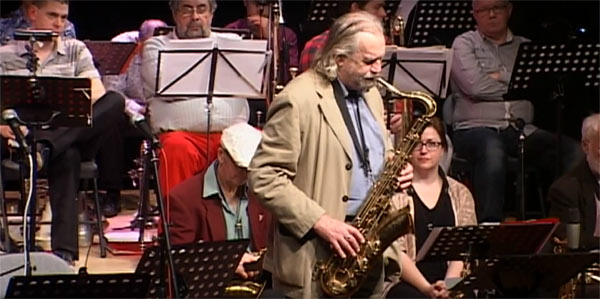 Lou Gare held his tenor saxophone aslant, like Lester Young, whose light-fingered articulation and disdain for the obvious he shared. Gare was born in Rugby but it was in Plymouth in the early 1960s that he first played with the band of the young Mike Westbrook, alongside the even younger John Surman. In London in 1965 he became a founder member, with Eddie Prévost, Cornelius Cardew and Keith Rowe, of AMM, one of the seminal groups of the first generation of British free improvisers. Lou was on their debut album, AMMMusic, recorded at Sound Techniques in Chelsea and released by Elektra Records in 1966. Six years later, with the group reduced to a Gare-Prévost duo, they performed at Harvey Matusow’s International Carnival of Experimental Sound event in London, their set released initially in part on an Incus EP as AMM at the Roundhouse and then in full on a Matchless CD under the same title.
 If you’re ever at a loose end in Berlin on a Monday night, my advice would be to head for A-Trane, the jazz club in Charlottenburg, where Andreas Schmidt, a pianist, composer and teacher at the city’s Jazz Institut, holds a weekly free-admission session featuring a changing cast of friends and students.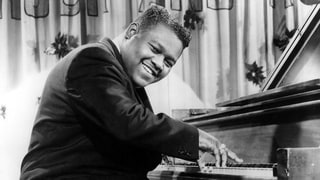

 thebluemoment.com