
Skip to content

Lio sings Caymmi

Lio

Every now and then an album wanders in and becomes part of the furniture, always there in times of need. Lio Canta Caymmi, an album of songs by the Brazilian composer Dorival Caymmi interpreted by the Portuguese singer Lio, seems likely to become one of those.

Curiously, its predecessors for me include two albums of Brazilian music by female singers: The Astrud Gilberto Album from 1965 and Paula Morelenbaum’s Berimbaum from 2004. It’ll take a couple of years before I can be sure that Lio Canta Caymmi shares their status, but on the basis of a few weeks’ listening to an advance copy, I’ve got a feeling that it will.

The album was the idea of Jacques Duvall, a French lyricist who has worked with Lio and many other artists. Caymmi, who died in 2008 at the age of 94, was a key figure in the establishment of Brazilian popular music in the twentieth century. Although not as well known outside Brazil as Tom Jobim, his songs — many of them written in his twenties — helped lay the foundations for the arrival of bossa nova in the 1960s. Duvall enlisted the aid of his compatriot Christophe Vandeputte to create new settings that employ modest means — guitar, accordion, bass, drums, percussion, the occasional wash of synthesised strings  — with great sensitivity.

Lio — born Vanda Maria Ribeiro Furtado Tavares de Vasconcelos in Lisbon — was a pop star in France and Belgium in the 1980s before becoming a film actress. Her earlier musical collaborators included Telex, Sparks and John Cale, but the extroversion apparent on YouTube clips from those days is held in check here. Her delivery of lovely songs such as “Tão Só” and “É Doce Morrer No Mar” (also a favourite of the late, great Cesária Évora) is restrained and unaffected, allowing the gentle, beautifully shaped melodies to shine through, along with the extra verse in French tacked on to each of the original Portuguese lyrics by Duvall. The arrangements include the occasional surprise: the beach sounds and laughter prefacing “Sábado em Copacabana”, a dab of organ making a late entry to underpin the delicate funky groove of “Nunca Mais”, hand-drums animating the humming bossa of “Samba da Minha Terra”.

Nothing here is going to rearrange your life, but it forms a graceful, imaginatively conceived and beautifully executed tribute to a great figure in Brazilian culture. And when you want to let a little sunlight into the room, it might be just the thing.

* Lio Canta Caymmi is released on March 30 by Crammed Discs. The photograph of Lio is by Jane Who.
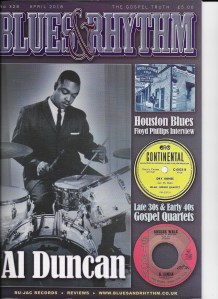
The story of Al Duncan

Al Duncan

Long before I knew his name, I was hooked on Al Duncan’s playing. In the autumn of 1963 the Impressions’ “It’s All Right” came on the radio, with its beautiful drum fills. Over the next couple of years there followed a procession of Curtis Mayfield-written songs by the Impressions and Major Lance, driven — like “Delilah” and “I Need You” — by that very distinctive drumming, so clean and relaxed.

Along with Motown’s Benny Benjamin in Detroit and Stax’s Al Jackson Jr in Memphis, Duncan propelled the cream of mid-’60s soul. Eventually I discovered his name, along with the information that he played a lot of blues, R&B and soul sessions in Chicago for Vee-Jay, Chess and other labels before being supplanted by a younger man, Maurice White (later, of course, the co-founder of Earth Wind & Fire). But I didn’t know anything else until this week, when I bought the new issue of Blues & Rhythm, the fine British monthly magazine, and there he was on the cover.

The story is an interview taped in 1975 in Santa Monica by the writer Bill Greensmith, and never previously published. Duncan talks at length about his entire career, from his early days as an aspirant jazz drummer in Texas and Kansas City, playing with the bandleaders Ernie Fields and Jay McShann, to his collaborations with Mayfield, Little Walter, John Lee Hooker, Jimmy Reed, Willie Dixon, Phil Upchurch and many others, and his move in the 1970s to Los Angeles, where he played with people like Red Holloway but seemingly failed to break into the session scene.

He died on January 3, 1995, aged 68. For me, this interview is priceless testimony from a man whose playing has been part of my life for more than half a century. So thanks, Bill Greensmith, for disinterring it, and to the editors of Blues & Rhythm for not only publishing it but making Al Duncan their cover star.

Buell Neidlinger 1936-2018

Buell Neidlinger w CT at Newport 57

Buell Neidlinger (bass) and Cecil Taylor (piano) at Newport in 1957

What turned out to be Buell Neidlinger’s final contribution to this blog arrived on March 9, in response to a piece about Keith Jarrett’s latest release. Buell had seen the accompanying photograph of Jarrett, Gary Peacock and Jack DeJohnette relaxing on stage at Boston’s Symphony Hall: “Thought I recognised the floor… worked there for three years,” he wrote. In 1967 he had joined the Boston Symphony Orchestra and also the faculty of the New England Conservatory of Music, where he taught bass and chamber music and, with George Russell, established the first jazz department of a major music school.

It astonished me when Buell sent some words to this blog, commenting on something I’d written about Cecil Taylor. His participation in Cecil’s trio version of “This Nearly Was Mine” made a huge impression on me when I first heard it in the early ’60s. It remains a favourite, not least for the way Buell’s bass shadows Taylor’s piano inventions with such devotion and beautiful note-choice.

As a young cello prodigy, born in New York City and brought up in Connecticut, Buell studied with Gregor Piatigorsky and had lessons from Pablo Casals. After switching to double bass, he played with Billie Holiday and Lester Young, with Hot Lips Page and Herbie Nichols, with Igor Stravinsky and Leopold Stokowski, with Cecil Taylor and Ornette Coleman, with Barbra Streisand and Frank Sinatra, with John Cage and George Crumb, with Duane Eddy and Roy Orbison, with Sir John Barbirolli’s Houston Symphony and Neville Marriner’s LA Chamber Orchestra, with the Beach Boys and Earth Wind & Fire, with Frank Zappa and the Eagles.

The instrument he played on “This Nearly Was Mine” was the same one he used on “Hotel California”. Once owned by King George III, it had been played in the first performance of Handel’s Messiah. “I sold it years ago to a girl in Hollywood for $15,000,” he told me during the course of our only conversation, on the telephone from his home in Washington State.

He also talked about his friendship with James Jamerson, whom he had met in a Hollywood studio. Buell had acquired his first bass guitar in 1953, but by the time he bumped into Jamerson on a Michael Jackson date he had become a first-choice double bassist in the studio orchestras. “Basically he was through already,” Buell said. “When Berry Gordy moved to LA, he basically signed the death warrants of a bunch of great musicians.”

Neidlinger remembered the Motown studio in Hollywood as the first place he worked where they had a transmitter. “You’d cut your shit,” he said, “and you’d go out to the car park and listen to it on the radio. If it didn’t sound good, you’d go back and do it again.”

He also remembered Jamerson’s addiction to alcohol. “He was living in a motel on Hollywood Boulevard. It was pretty ugly. After we had a meal on Santa Monica Boulevard, he invited me back. Whisky and gin bottles everywhere. He had a sliding closet. There weren’t many clothes in there, but there was his upright bass with no case. He played Fender bass on the Motown hits, of course, but really he was an upright bass player.”

Buell had strong views about everything, including bass players. He thought Paul Chambers was the greatest bass player who ever lived. He liked players who didn’t try to play the instrument as if it were a guitar, playing too many notes at the top of the instrument’s range. (This was a man whose first paying job in New York was as a dep for the ailing Walter Page, who had been the bassist in Count Basie’s pre-war band.) When Maurice White died, he sent a note to the blog saying that the EW&F man was the greatest drummer he’d ever recorded with.

In his later years Buell moved to Washington State, where he lived with his wife, Margaret Storer, another bassist. He had a group called Buellgrass, including the fiddler Richard Greene, which played his version of bluegrass music, and he and Margaret played baroque music with friends — he back on cello, she on violin.

Did I mention that he depped in Thelonious Monk’s quartet for a night at the Five Spot in 1957, alongside John Coltrane and Shadow Wilson? And for Charlie Haden in Ornette’s quartet in 1959, also at the Five Spot? And that his first No 1 was Tony Bennett’s “I Left My Heart in San Francisco”, on which he played in the string section? He seemed to have cherished every note, every encounter, every experience. I’m not sure there’s ever been anyone quite like him, or will be again.

Keith Jarrett’s ‘After the Fall’

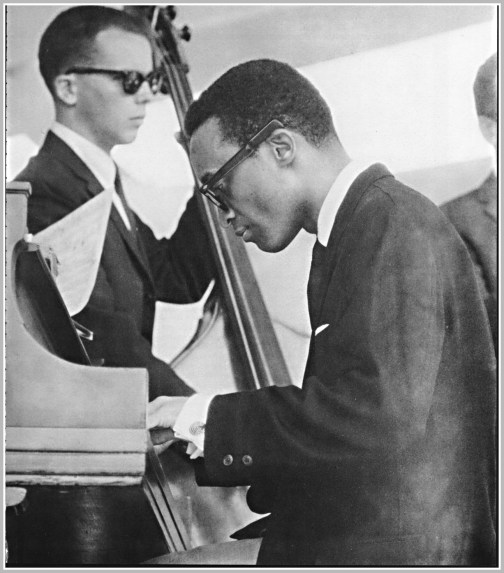
Keith Jarrett TrioIn the summer of 2000 I spent an hour across a table from Keith Jarrett in a rooftop restaurant overlooking the Baie des Anges in Nice. Infuriatingly, he chose to conduct the conversation while wearing mirror shades. An interviewer tries to establish some kind of rapport with his/her subject, in which eye contact plays a part; the shades meant that I spent the hour staring at reflections of myself. I thought it was discourteous, and possibly a bit passive-aggressive. Somewhat wryly, I thought back to the morning 30 years earlier when he had wandered unannounced into the offices of the Melody Maker, a couple of days after his appearance with Miles Davis at the Isle of Wight, hoping to persuade someone to interview him.
Anyway, he talked interestingly. He was in Nice with Gary Peacock and Jack DeJohnette, his fellow members of what had become known as the Standards Trio. They were on their first tour since Jarrett’s recovery from a bout of chronic fatigue syndrome, which had left him unable to play for two years. His gradual recovery had been indicated by the release of a solo album titled The Melody At Night, With You. Its gentle, almost unadorned treatments of standards and folk tunes, recorded at his home, make it a special favourite of mine. “I learnt something about playing the piano,” he told me when I asked him about it. “The heart determines where the music comes from, and there was more heart in that recording than there was virtuosity, but what I had as a pianist I put into the heart place, and that can translate into other contexts.” (You can read the whole interview, published by the Guardianhere.)

Now we have a new release of a trio album made during that period (in November 1998, in fact) at the New Jersey Performing Arts Centre in Newark, not far from Jarrett’s home. Called After the Fall, it’s a document — like The Melody at Night — of a man testing the state of his physical powers, on this occasion with the support of his two musical soulmates.

Wanting to keep things simple, they stuck to bebop and standards. “When I first came back to playing, I didn’t want to play as hard,” Jarrett told me in Nice. “I didn’t want to dig in to the piano as much. Bebop was the right thing to do, because there’s a lightness to it.” But isn’t bebop a notably athletic and competitive idiom, perhaps unsuited to convalescent therapy? “Yes, but it’s light-footed, if you think about it. Playing in large halls with the trio, and trying to project to the people, I ended up playing hard, and I didn’t want to do that. With bebop the phrasing is more like a voice phrasing, because most of the bebop players – except maybe Bud – were horn players. I wanted to have a chance to phrase like that.”

There’s no sense of frailty in evidence. Instead there’s a leanness and a clarity that make it exceptional. Jarrett is a great bebop player: a passage six minutes into Bud Powell’s “Bouncin’ with Bud” finds him unspooling a line that would make the tune’s composer stand and applaud, and there are moments of similar exhilaration on Charlie Parker’s “Scrapple from the Apple” and John Coltrane’s “Moment’s Notice”. He plays the blues elegantly on Pete La Roca’s “One for Majid”, produces characteristically lustrous ballad readings of “Late Lament” and “When I Fall in Love”, and exposes his sense of humour on “Santa Claus Is Coming to Town”. A 15-minute version of “The Masquerade Is Over” devolves from its medium-up tempo through a beautiful collective transition into the coolest lope imaginable, while a 13-minute “Autumn Leaves” ends on a glorious Latin groove, rocking along to Peacock’s bass riff .

The fact that many of these tunes feature on the trio’s earlier albums shouldn’t deter anyone from investigating After the Fall. This is Jarrett with the shades off, the defences down, temporarily shorn of the extremes of his virtuosity but looking us straight in the eye. The music’s limitations, such as they may be, turn out to be the foundation of its strength.

* After the Fall is out now on the ECM label. The photograph of Jack DeJohnette, Keith Jarrett and Gary Peacock is by Patrick Hinely.

‘Rhythm & Reaction’

Rhythm and Reaction 3

William Waldorf Astor, the richest man in America, had made a new home in England by the time he bought the late-Victorian Gothic mansion known as Two Temple Place in 1895. Set on the north bank of the Thames between Waterloo and Blackfriars bridges, it became the headquarters for his various business and philanthropic interests. At a cost of $1.5m — imagine how much that would represent in today’s money — he turned the interior into a riot of mahogany staircases, ebony pillars, marble floors, cedar panelling and staggering stained glass. He was 71 when he died in his bath at home in Brighton in October 1919, six months after the Original Dixieland Jazz Band had arrived in London to play at the Palladium, the Hippodrome and Hammersmith Palais and, astonishingly, at Buckingham Palace for King George V.

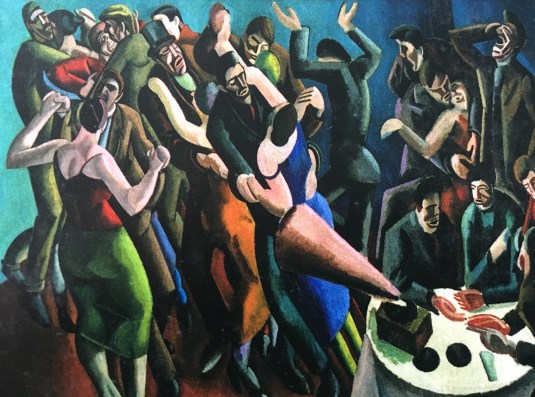
A century later, there’s a less tenuous connection between the building and the band. Rhythm & Reaction: The Age of Jazz in Britain is an exhibition illustrating aspects of Britain’s embrace of the music in its early decades, from minstrel shows to the end of the inter-war period. Curated by Professor Catherine Tackley, head of music at Liverpool University, it does a pretty good job of conjuring the atmosphere of Britain in the Jazz Age, via ancient banjos and drum kits, 78rpm discs, books (including Al Bowlly’s guide to crooning), blown-up photographs (Ellington arriving at Southampton docks in 1933, for example), early copies of publications such as the Melody Maker and Rhythm, paintings (including William Patrick Roberts’s “The Dance Club” of 1923, above), fabrics and ceramics, bakelite wirelesses, and Wyndham Lewis’s 1912 design for the programme and menu at the Golden Calf, a West End cabaret club.

Rhythm and reaction 4

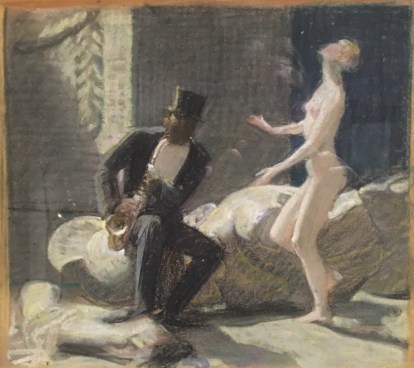
Perhaps the most haunting exhibit is a pastel study for a work called “The Breakdown”, painted in 1926 by the Scottish artist John Bulloch Souter for the summer exhibition of the Royal Academy of Arts. At least one of the layered meanings of this study of a formally dressed black saxophonist sitting on a broken piece of classical statuary as a naked white woman dances to his music was provocative enough to upset the Colonial Office, which complained that it was “obnoxious to British subjects living abroad in daily contact with a coloured population.”

The Melody Maker had already joined in with an extraordinary editorial which, after admiring the artist’s technique, inveighed on behalf of dance-band musicians against “the habit of associating our music with the primitive and barbarous negro derivation…” The painting, it claimed, was “not only a picture entirely nude of the respect due to the chastity and morality of the greater part of the young generation but in the degradation it implies to modern white women there is the perverse anger to the community and the best thing that could happen to it is to have it… burnt!”

Forced to withdraw his painting, Souter destroyed it, leaving only the pastel study (above) and a version he recreated in oils in 1962, which is also on show.

Almost every aspect of Rhythm & Reaction deserves study in greater depth — e.g. minstrelsy, “jazz” motifs in the decorative arts, the “rhythm clubs” formed by the music’s early adherents — but as it stands the exhibition does an effective job of prompting reflection on an important phenomenon. It would be of particular interest, I think, to young members of the newest and highly multicultural generation of British jazz musicians, who might find it enlightening and (despite the fate of “The Breakdown”) even inspiring.

* Rhythm & Reaction is on show at Two Temple Place until April 22, daily except Tuesdays (information on opening hours and special events: https://twotempleplace.org). “The Dance Party” is on loan from Leeds Museum and Art Gallery. The pastel study of “The Breakdown” is from a private collection. Those who want to know more about the subject should read the late Jim Godbolt’s A History of Jazz in Britain 1919-1950, republished in 2010 by Northway Books.

Elaine Mitchener’s ‘Sweet Tooth’

Elaine MitchenerThe architect Nicholas Hawksmoor completed St George’s, Bloomsbury, one of his half-dozen London churches, in 1730, at a time when the transport of slaves from Africa to the New World was booming, with Britain the biggest trafficker. It was built to serve a prosperous parish, although its tower can be glimpsed in the background of Hogarth’s ‘Gin Lane’ engraving of 1751, the artist’s depiction of the low-life inhabitants of the Rookery, as the tenements of nearby St Giles were known. More recently, in 1937, the church welcomed Emperor Haile Selassie at a requiem for the dead of the Second Italo-Abyssinian war, a particularly bloody three-year conflict featuring the use of mustard gas by Mussolini’s troops on the Ethiopian army.
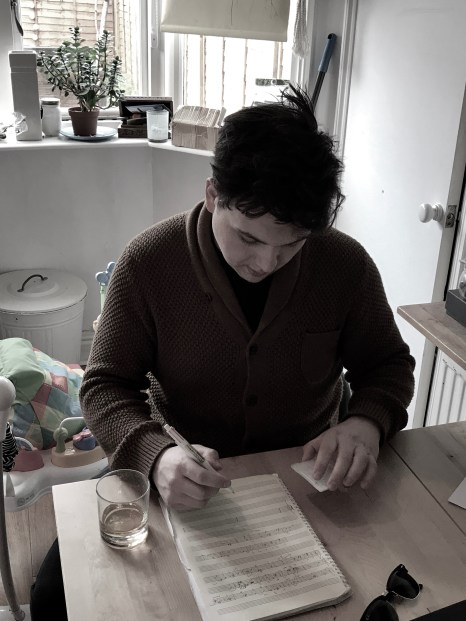
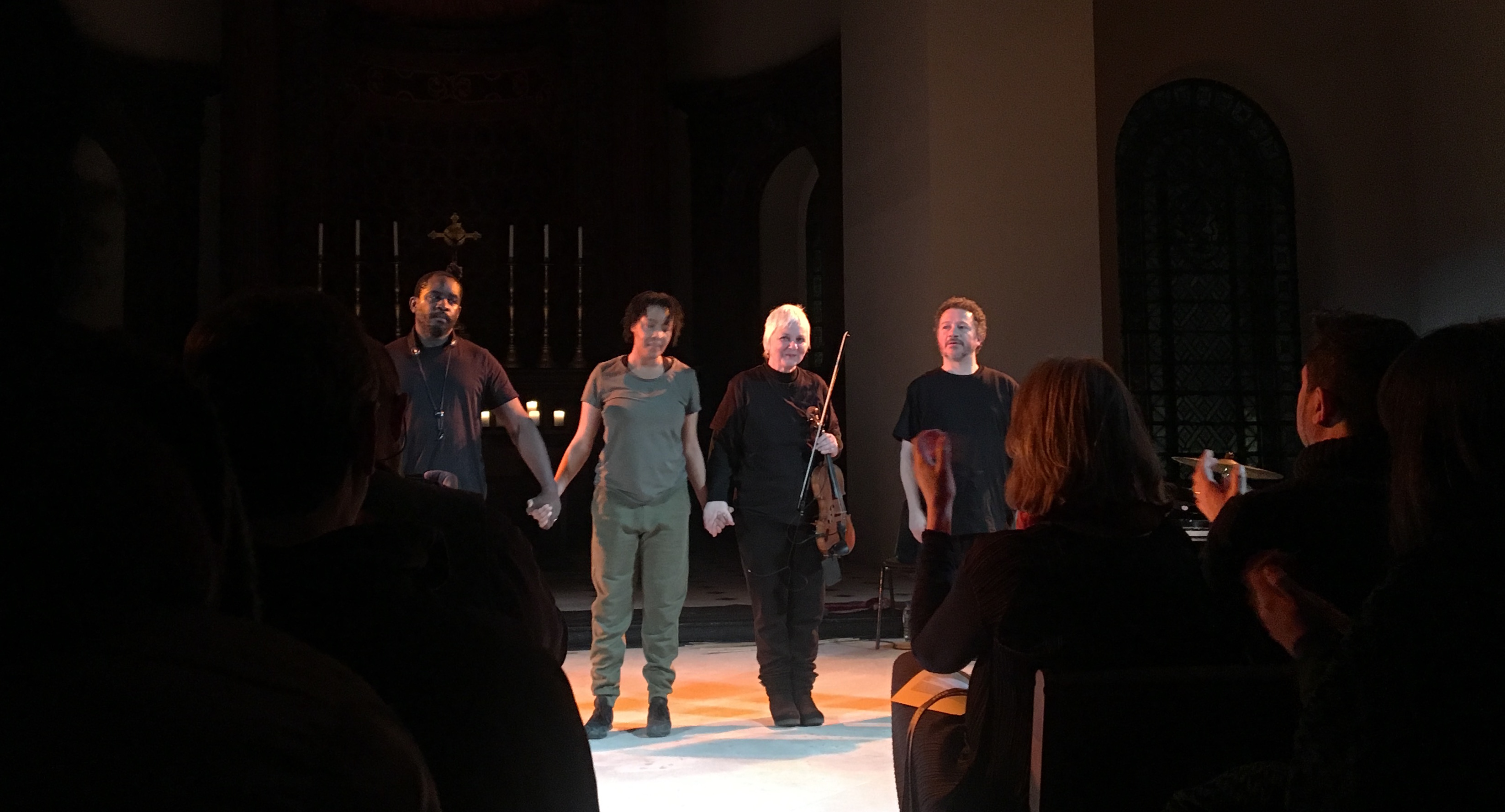
Slavery and, by association, colonialism are the subjects of Elaine Mitchener’s “Sweet Tooth”, which received its first London performance in the beautifully restored interior of St George’s last night. A theatre piece, specifically related to the use of slaves in the sugar industry, it makes use of Mitchener’s talents as singer, dancer and actor, as well as those of three distinguished improvisers: the violinist/accordionist Sylvia Hallett, the saxophonist Jason Yarde and the drummer Mark Sanders. All four become performers in the piece, choreographed by Dam Van Huynh and lit by Alex Johnston.

Hallett began alone, accompanying her scraped double stops with strange amplified vocal ululations. Mitchener entered, wailing and shrieking in a wordless expression of fear and anguish, writhing as if resisting the constraint of chains, joined in duets first by the yelps and barks of Yarde’s baritone saxophone and then by Sanders’s small hand drums.

The piece proceeded through six “chapters”. In one, Mitchener re-enacted an auction by reciting the names, attributes and prices of individual slaves, at one point continuing to list them while lying face-down on the stone floor of the central aisle. In another, she used the third finger of each hand to stretch her mouth, creating the terrifying effect of the “scold’s bridle”; this went on for several minutes as the distortion reduced her attempts to speak to a whimper (and you feared her mouth might never return to its proper shape). Towards the end each performer took up a bundle of thin canes, using them to brush the floor and whip the air as they moved freely around the space. Some of the music — which included passages of intense free improvisation — was inspired by an invocation song collected by musicologists in Jamaica and traced back to the BaKongo tribe of West Central Africa.

It was highly dramatic, of course, and at times harrowing, as it needed to be. Mitchener — who recently collaborated with the pianist Alexander Hawkins on an album of material including songs by Jeanne Lee, Archie Shepp and Patty Waters for the Intakt label, titled UpRoot — is a performer of great passion and uncompromising commitment. Those qualities, allied to a technical command of her various disciplines, are likely to make her a significant presence in the years to come. Last night she made Hawksmoor’s old stones shake.

* There is a further performance tonight — Friday, February 23 — at the John Hansard Gallery in Southampton. ‘Sweet Tooth’ was commissioned by Bluecoat, Liverpool; the Stuart Hall Foundation; and the International Slavery Museum.

Reuben Fowler’s ‘Black Cow’

reuben fowler 2

In my experience, jazz musicians tend to approve of Steely Dan. The mixture of sardonic outlook, funny chords and respect for fine improvisers seems to do it. Herbie Hancock, Ahmad Jamal, Christian McBride and Mel Tormé were among those who covered their songs. A few months ago I enjoyed hearing the students of the Guildhall School of Music’s jazz course performing variations on Donald Fagen’s classic album, The Nightfly. Now comes Reuben Fowler, a gifted young London-based trumpeter, composer and arranger, with a download-only big band version of “Black Cow” — track one of the Dan’s album Aja — whose proceeds will go to Cancer Research’s oesophageal cancer unit, in memory of Walter Becker.

Steely Dan’s music wasn’t jazz. A rock body with a jazz head, maybe. Anyway, it responds well to being played by jazz musicians, as it usually was on the original albums, as long as they don’t try to play tricks with it. Fowler’s “Black Cow” is respectful to the work put in on the slinky groove of the original by the likes of Joe Sample, Victor Feldman, Larry Carlton, Chuck Rainey and Paul Humphrey. Jason Rebello (Fender Rhodes piano), Rob Luft (guitar), Lawrence Cottle (bass guitar) and Ian Thomas (drums) hit all the marks, while Paul Booth’s muscular tenor solo loses nothing by a comparison with Tom Scott’s original. The Average White Band’s Hamish Stuart does a great job with the enigmatic lyric — a little hoarser and more wearied than Fagen, but that works, too. Fowler’s arrangement wisely plays it cool until the finale, when the power of four trumpets, four trombones and eight reeds filters through to stirring effect.

I’m not normally a fan of downloads and streaming, for reasons mostly to do with the shamefully inadequate way they remunerate the artists. In this instance, however, the music and the motive make it a must. It’s also a nice way to celebrate Aja‘s 40th anniversary (which was actually last September). And at some time in the future Fowler — who was born 12 years after that album made its appearance — might put together a whole album of this stuff, which would be a very nice thing indeed to have.

* “Black Cow” by the Reuben Fowler Big Band is released on the Ubuntu label and can be found on the regular download and streaming platforms, including Apple Music, Spotify, Deezer and Tidal. The photograph of Fowler is by James Gardiner Bateman.

Muddy Waters: Behind the sun

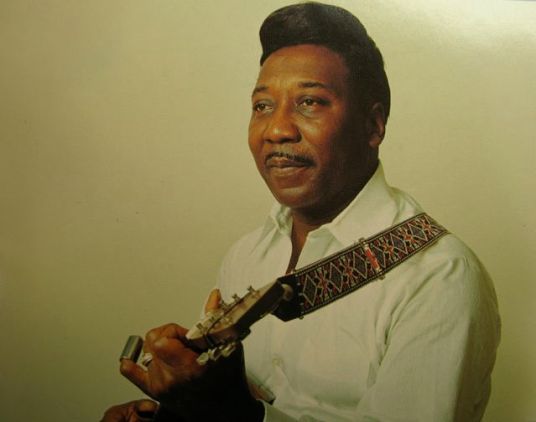
Muddy Waters

A new compilation of Muddy Waters’ recordings for the Chess label got me listening obsessively this week to “Louisiana Blues”, one of my favourite pieces of American music. The pleasure was enhanced by the fact that the mastering of Can’t Be Satisfied: The Very Best of Muddy Waters 1947-1975 gives the music, recorded on primitive equipment at the Chess Studio in Chicago almost 70 years ago, a new clarity without compromising its grainy warmth.

Recorded on October 23, 1950 with Little Walter Jacobs on harmonica, Ernest “Big” Crawford on string bass, the drummer Elgin Evans tapping something (possibly a washboard) almost subliminally, and an unknown second guitarist, “Louisiana Blues” has the subtlety and intricacy of chamber music. Opened by Muddy’s quivering unaccompanied bottleneck guitar, it eases quickly into a graceful pattern that switches between a light-footed stride and a funkier half-time rhythm as the instrumental lines wind around each other.

The time is hard to follow: there’s a basic 4/4, but Muddy throws in individual bars of 2/4 and 3/4. Unlike John Lee Hooker, however, he doesn’t do it because the symmetry of the conventional 12-bar blues is of no consequence to him. He does it because that’s what the natural cadence of the song, whose melody line echoes the bottleneck phrases, is demanding. You know that nothing was ever written down on a piece of manuscript paper that day in 1950, but this is nevertheless a fully composed piece.

If you’re trying to count the bars, it’s hard to follow — for me, anyway. And that’s what gives the record its everlasting mystery. It won’t stand still for you. It keeps moving to its own multi-layered momentum, seeming to slide out of your grasp while simultaneously pulling you forward with it.

Muddy wrote it, and I have a particular fondness for the first verse: “I’m going down in Louisiana / Baby, behind the sun / Well I just found out / My troubles just begun…” Behind the sun? That’s the poetry of the blues right there, in an image that leaps beyond literal meaning into the realm of the imagination. And the firm but gentle way he bends those words, laying them against the warping harmonica and bottleneck phrases, shows a supreme musicality at work.

(Another bluesman, Louisiana Red, used the phrase to introduce himself a dozen years on his first album, The Lowdown Back Porch Blues: “I am Louisiana Red / And I come from behind the sun…” Were they Muddy’s original words, or had he already borrowed them from someone else? I have no idea. But he makes them belong to him.)

Anyway, this three-minute act of perfection, characterised by a wonderfully delicate balance of interplay which we white boys of the 1960s could hope to do no more than crudely approximate, gave Muddy his first Top 10 hit in the R&B chart in February 1951, which says something about the good taste of his public. Now it’s hard to imagine a time when people all over the world won’t still be listening to it.

* Can’t Be Satisfied is a 2CD set, released on Universal’s Spectrum imprint. Its 40 tracks, selected by Russell Beecher, include material from many of Muddy’s single and album releases during his time with Chess, including selections from his 1960 Newport live album, Muddy Waters: Folk Singer, Folk Festival of the Blues, Electric Mud, Live at Mr Kelly’s and The London Muddy Waters Sessions. Listening to it sent me back to Robert Gordon’s Waters biography, also called Can’t Be Satisfied, published by Jonathan Cape in the UK in 2002 and still highly recommended.

Music for cellos, organ and gamelan


Tre Voci 3

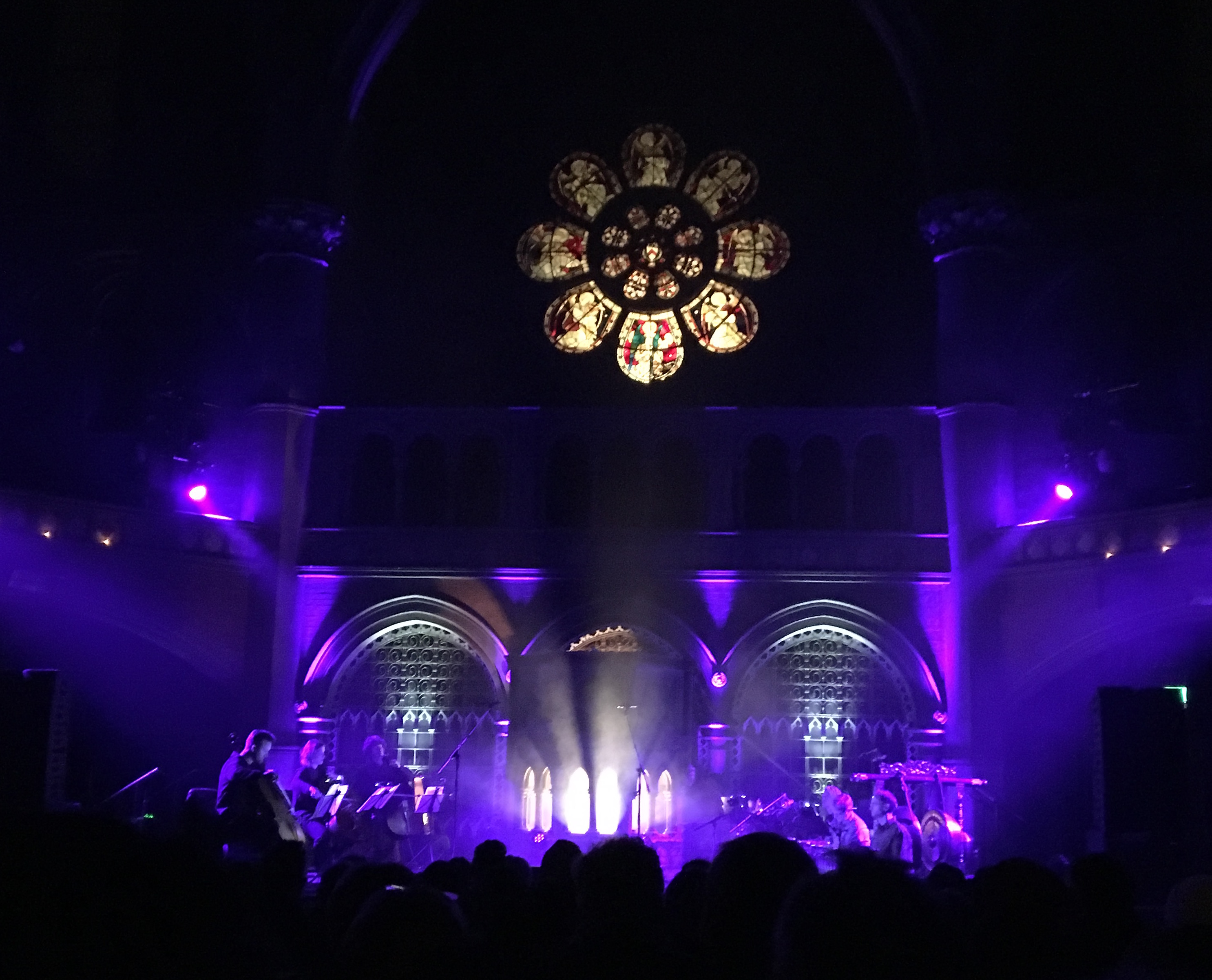
The lights were already down as I fumbled my way into a back pew of the Union Chapel last night. Thirty seconds later, the performance began. I’d bought a ticket after seeing that Kit Downes would playing the chapel’s pipe organ in company with Tre Voci, a trio of cellists, and the Southbank Gamelan Players. It sounded like an intriguing combination but I didn’t have time to get any clearer idea of what they’d be doing, and I rushed to find a seat without picking up the A4 sheet giving details of the programme. So I was in a position to let the music come as a complete surprise, which is sometimes the best way.

As I’d hoped, the combination turned out to be a happy one, at its best when there was no real attempt to “blend” the ingredients. Juxtaposition was the most rewarding method. So, in the course of an unbroken hour-long open half, the gamelan ensemble played pieces of their music, the cello group played theirs, Downes played a solo piece, and they came together at various junctures.

It proved to be a rich experience. One piece for the cellos (Alexander, Torun Stavseng and Gregor Riddell) found them bowing phrases entirely in harmonics, skittering in three directions at once: very exhilarating. The four members of the gamelan group — Robert Campion, Helen Loth, Cathy Eastburn and Jonathan Roberts — produced the anticipated meditative sounds from their metallophones and gongs, gently striking and occasionally bowing the bars of their xylophone-like instruments. Downes played a piece I recognised, since it came from his new solo organ album, Obsidian. But it was when they came together that the music was at its most convincing, the players fitting the diverse layers of sound together with great sensitivity as they improvised (so I later learnt) on pieces by John Cage, Tre Voci’s Colin Alexander, and Beni Giles, a young graduate of the Royal Academy of Music’s masters course in composition.

If I found the second half, devoted to the world premiere of a new composition by Bryn Harrison titled “To Shadow”, less compelling, it may have been because the ensemble played together almost all the time in this through-composed hour-long piece. The contrasts of the first half were lost, and with them went the dramatic shifts of timbre and texture. But the evening ended in a moment of great beauty, with Laura Moody — invisible in the gallery above and behind the audience — tapping the body of her cello to provide percussive accompaniment as she intoned Cage’s “The Wonderful Widow of Eighteen Springs”, her treatment of the short song pitched somewhere between those of Cathy Berberian and Joey Ramone.

But I left with my head still in the first half, when the music had held not just greater contrast but, perhaps paradoxically, something of the seductive qualities of Terry Riley’s all-night keyboard concerts and La Monte Young’s Dream House. In this, the surroundings certainly helped. The instrumentation suited the chapel’s acoustic, with lighting that enhanced the meditative atmosphere — particularly when a semi-abstract mandala pattern was projected on to the rose window above the organ chamber. And on the way out I bought Tre Voci’s EP of transcriptions for three cellos of medieval choral works by Ockeghem, Dunstable and Byrd, which turned out to be a perfect souvenir.

* Kit Downes’s Obsidian, recorded on organs at the Union Chapel and in two small churches in Suffolk, is released on the ECM label. To hear recordings of Tre Voci, go to  http://trevocicelloensemble.com/media/ And here’s a larger grouping of the Southbank Gamelan Players at David Byrne’s Meltdown a couple of years ago: https://youtu.be/99B-CrJYG9I

Nubya Garcia takes off

Nubya Garcia

I was planning to write about Nubya Garcia anyway, but today seems particularly appropriate, this being the centenary of the bill that gave women the right to vote in Britain. In 2018, one in three MPs in the House of Commons is now a woman, and I’d say that we’re getting close to that kind of gender split at the creative end of jazz. Garcia, a young tenor saxophonist and composer who came through Tomorrow’s Warriors and the Royal Academy of Music’s junior programme, is an example of a trend also exemplified by the likes of Matana Roberts, Eve Risser, Linda Oh, Kaja Draksler, Sarah Tandy, Mary Halvorson, Anna Lena Schnabel, Susana Santos Silva, Alice Zawadzki, Jaimie Branch, Ingrid Laubrock, Lucia Cadotsch, Tomeka Reid, Shirley Tetteh, Sylvie Courvoisier, Lucy Railton and many, many others.

I’m at the point now that when I go to see a band made up entirely of male musicians, it feels like there’s something wrong, something out of balance, something old-fashioned going on. And there certainly aren’t many bands that wouldn’t be improved by Garcia’s presence.

Nubya’s 5ive is her first album, and it’s a scorching debut. She’s riding the wave of a new interest in young British jazz musicians, exposed in a recent feature by Giovanni Russonello in the New York Times, and her disc is useful evidence — along with two of last year’s best albums, Shabaka and the Ancestors’ Wisdom of Elders and Binker & Moses’ Journey to the Mountain of Forever — that this is no hype. Here we have a version of smart modern jazz that knows what’s going on around it but also knows better than to deal in fashionable tricks and artificial grafts.

One thing I like about Garcia is that she doesn’t sound like Coltrane or Shorter. She has a commanding tone, pliable, fibrous and full of power, and she digs hard into the grooves established here by her excellent band on tunes that are strong and memorable. Each of the individuals takes an opportunity to stand out: Daniel Casimir with a compelling solo introduction to “Lost Kingdoms”, Joe Armon Jones with a boiling acoustic piano solo on “Contemplation”, the hugely promising Theon Cross with a tuba improvisation on “Hold”, Sheila Maurice-Grey with a bold trumpet solo on “Red Sun”, and Moses Boyd with a display of thrillingly flexible drumming all the way through (joined on a couple of tracks by Femi Koleoso).

This is a snapshot of a scene that is currently humming with excitement, giving London a kind of vibe it hasn’t had since the Jazz Warriors and Loose Tubes broke through in the mid-’80s. Most important of all, it seems to be finding a new audience, attracted by its energy and its inclusiveness. Not all of it is going to be ground-breaking, but it’s here and now and it needs to be noticed.

* Nubya’s 5ive is released on the Jazz:Refreshed label.