Skip to content

The essential Terri Lyne Carrington

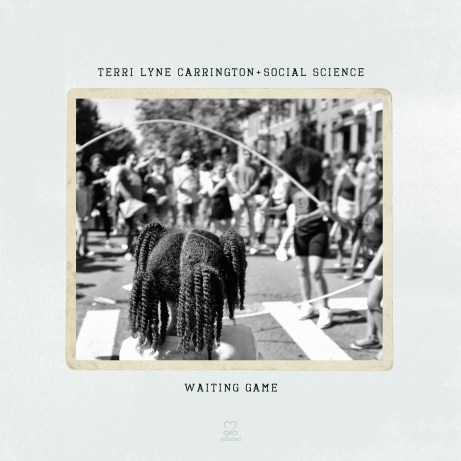
TLC Waiting Game Cover3000R

What does it mean when a critic describes an album as “essential”? After all, you can live a full and satisfying life without ever hearing A Love Supreme, Eli & the Thirteenth Confession or Blood on the Tracks, all of which would justify the conventional use of that epithet. But sometimes it’s the word that’s closest to what you want to suggest. And that’s how it is with Waiting Game by Terri Lyne Carrington + Social Science, an album which looks deep into the soul of 21st century America and comes up with something that, like all the best protest music, locates sparks of hope amid the darkness and despair it portrays.

For those unfamiliar with Carrington, she is a 54-year-old drummer, composer and bandleader noted for her work with Cassandra Wilson, Wayne Shorter, Herbie Hancock and many others. She began playing drums at home in Massachusetts, aged seven, on a kit handed down from her grandfather, who had played with Fats Waller. At 11 she received a scholarship to Berklee College of Music in Boston; at 18 she was in New York and playing at the highest level.

Waiting Game is a suite that, blending songs of protest with cutting-edge African American music, takes its place in the line stretching from Max Roach’s We Insist: Freedom Now Suite through Marvin Gaye’s What’s Going On to Ambrose Akinmusire’s Origami Harvest. To the core six-piece Social Science band — Debo Ray (vocals), Kassa Overall (MC), Morgan Guerin (saxophones, bass, EWI), Matthew Stevens (guitar) and Aaron Parks (piano and keyboards) — Carrington adds guest appearances from singers, rappers and MCs including Mark Kibble, Rapsody, Meshell Ndegeocello, Raydar Ellis and Maimouna Youssef, plus the trumpeter Nicholas Payton, the bassists Esperanza Spalding and Derrick Hodge, and others.

The songs are contributed by all the members of the group. Although the words  — dealing with oppression and the rights of women, gay people, Native Americans, political prisoners (in the widest definition of the term) and others — are often confrontational, the music is easy to love. The grooves are slinky, the textures have a warm glow, the voices often soothe and seduce. While Rapsody fires up “The Anthem” with righteous fervour, Debo Ray croons Joni Mitchell’s “Love” (which applies gender reassignment to the famous verses from 1 Corinthians Ch. 13) with the sweetness of a Minnie Riperton. Stevens’s lucid guitar improvisations are a frequent delight, particularly on his own composition “Over and Sons”, which runs on the kind of perfectly lubricated rollers that would have Donald Fagen purring.

That’s the first CD. There’s a second, containing a 42-minute instrumental suite in four sections, titled “Dreams and Desperate Measures”. It seems to have been improvised by Carrington, Parks, Stevens, Guerin and Spalding, with the addition of a very spare orchestration — by Edmar Colón — for three violinists, a cellist, a clarinetist and a flautist. Ebbing and flowing quite beautifully, slowly changing with the light, it quietly compels the listener’s attention. You feel like you’re sitting in the middle of an intimate conversation, or — in places — a chamber-music version of Bitches Brew.

“Music transcends, breaks barriers, strengthens us, and heals old wounds,” Carrington says in a statement accompanying the album. If that’s a proposition which can ever be proved, here — in an album as good as anything I’ve heard all year — is some persuasive evidence.

* Terri Lyne Carrington will be at Kings Place on Saturday as part of the EFG London Jazz festival, she and Social Science Community performing Waiting Game at a 7pm concert before being joined by British guests — including the saxophonist Soweto Kinch and the trumpeter Emma-Jane Thackray — for a 9pm show. Information: efglondonjazzfestival.org.uk

Me, me, me

Elton John

Big disappointment, that Elton John. I’d been expecting his autobiography, Me, to contain a chapter gratefully acknowledging all the people who wrote about him with warmth and enthusiasm in the British music weeklies at a time when he couldn’t get arrested on Denmark Street. I’m thinking of Penny Valentine, Lon Goddard, Caroline Boucher. And, yes… me.

How soon, how completely, they forget.

For the benefit of readers who don’t get British irony: I’m joking. To an extent, anyway. But I interviewed him several times in 1970, his annus mirabilis; the first occasion, on April 7, seems notable in retrospect because he actually made his way by himself to the Melody Maker office on Fleet Street in order to be interviewed. He was that obscure. He was also a nice chap: quiet, seemingly modest and happy to talk about the music he loved, particularly the Band and Robbie Robertson. Later in the summer I bumped into him backstage at a rock festival — it might have been the one in early August at Plumpton racecourse — and after we’d said hello I asked him how things were going. I’ve never forgotten the substance of his reply.

Well, he said, he’d been giving it some thought and he’d decided to make his act more dramatic, more extrovert, more theatrical. More like the Jagger with the Stones, maybe. You know, get some costumes, leap about a bit more. He liked that kind of thing.

I was a bit flabbergasted. I looked at him. He was wearing his usual gear, something completely unobtrusive in that dressed-down environment, maybe jeans and some sort of brown jacket. I might even have said, “What on earth do you want to do that for?” But he was insistent. Heigh ho, I thought. Fair enough, if that’s really what he wants. But it seemed a bit of a shame. It wasn’t really the way the world was going.

Two years later he was at the Hollywood Bowl in an outfit covered in white marabou feathers, taking a stage occupied by five grand pianos whose lids flew open to release dozens of white doves, with an audience going wild. So there we are.

I never saw any of the tours where his love of flamboyance was on full display. In fact the two best Elton John gigs I ever attended were memorable for everything except his own performance. The first of them is something else that doesn’t get a mention in Me.

It was on October 30, 1970 at the Revolution Club in Bruton Place, just off Berkeley Square — a Mayfair alternative to the Speakeasy as a late-night hangout for rock musicians on the way up, and also sometimes a place where record companies put on showcase gigs. This night was a double showcase. Elton and his band — Dee Murray on bass and Nigel Olsson on drums — had just returned from their breakthrough in the US, where every star in Hollywood had turned up to see them at the Troubadour. (“Dylan Digs Elton!” was the front-page headline in the Melody Maker — a Ray Coleman special.) They were about to go back the next day, but their record label wanted the British media to see them in their new, confident flowering.

The evening was shared with Randy Newman, brought over by Warner Brothers to promote his second album, the great 12 Songs. By that time I was a lot more interested in Randy Newman than Elton John, so I turned up in a mood of great anticipation. By the time Randy came on the drinks had been flowing for a while and the assembled company — all embroidered denim, satin loon pants and Anello & Davide snakeskin boots — had been tucking into the free canapés. The waitresses were dashing round filling glasses and taking orders. Seated at ringside tables, the audience chattered away.

Randy sidled on to the stage and sat down. He gave no sign of being impressed by the significance of the occasion. He had his owlish glasses on, and his pursed expression, and he seemed to be in the clothes he’d worn on the flight over from LA. He started into his first song without ceremony, and then did another one. I’m pretty sure they were “Mama Told Me Not to Come” and “Lover’s Prayer”. They were wonderful. He hadn’t said a word. But the conversations were still going on, and the waitresses were still circulating busily.

Still without a word, he changed the mood, going back to his first album for “I Think It’s Going to Rain Today”, a song of despair for the human condition. First verse: quiet, intense, spellbinding if you happened to be listening. Still the ringside noise went on. Second verse: “Scarecrows dressed in the latest styles / With frozen smiles chase love away…” And he lifted his hands from the keyboard, paused for a couple of seconds, very quietly said, “That’s all, folks,” and got up and walked off. Most of the audience barely noticed his departure.

I’ve never admired Randy Newman as much as I did that night. For me, it was a perfectly judged reaction to the environment in which he found himself. Extraordinarily brave, too, in the circumstances. That’s not how a new artist with a major record company behind him is expected to behave when they’ve been flown 5,000 miles for a showcase gig. A little while later Elton and his band were rocking out, getting an ovation from people keen not to be missing out on what looked like being the latest sensation.

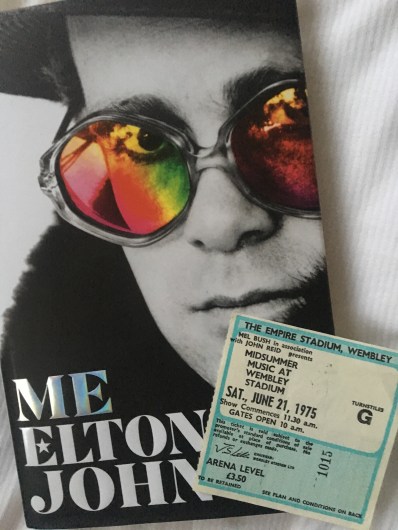
Elton owns up to the second memorable gig, at Wembley Stadium on June 21, 1975, a night when he topped the bill but might as well not have turned up at all. On that glorious midsummer’s afternoon the Beach Boys grabbed the sunshine and simply wiped out the headliner. It became a music-business legend how, after their exhilarating surf-ride from one hit to another, Elton’s attempt to present the unfamiliar songs from the brand-new Captain Fantastic and the Brown Dirt Cowboy turned into a catastrophe. Almost from the start the audience were making for the exits like thousands of iron filings drawn by powerful magnets.

Maybe it was a kind of widescreen karmic revenge for the time at the Albert Hall, five years earlier, when he’d done to Sandy Denny and Fotheringay what the Beach Boys did to him. That’s something else he owns up to in Me, which is so expertly ghostwritten by Alexis Petridis, the Guardian‘s chief rock critic, that the reader never pauses to consider that the vividly remembered anecdotes, so amusingly drenched in self-mockery, aren’t coming directly from the man whose name is on the cover.

You’ve probably read the extracts and the reviews, which concentrate — understandably enough — on the vast quantities of coke and sex and some of the dafter things that can happen to a chubby boy from Pinner, like dancing to “Rock Around the Clock” with the Queen of England and having an epic row with Tina Turner. It’s a cracking read on that level alone. But in the final chapters you’ll find a lot of very moving stuff about less exotic subjects: doing the school run, getting treated for cancer, that kind of thing.

I wanted more detail about what was discovered when he subjected his dealings with his longest-serving manager to an independent audit in 1998. I also think it would have been a graceful gesture to have identified the local-paper journalist who tipped him off in 1974 that Watford FC could do with his help, since it led to a period of great personal happiness. And I wish he’d said a bit more about the music, and the musicians who worked with him along the way and never became famous. But that’s just me.

* Me is published by Macmillan.
A Nordic Sunday

Hubro 1

Why, I asked Andreas Mæland today, did he call his record label Hubro? “It’s a North European eagle owl,” he said. “I thought we should name it after an endangered species, because this is endangered music.”

Mæland was in London to celebrate Hubro’s 10th anniversary, bringing with him from Norway three of the label’s groups. For members of an endangered species, they sounded in pretty good condition as they played short sets at the Spice of Life, a Soho pub whose basement is a regular venue for jazz.

Like his compatriot Rune Kristofferson, the founder of Rune Grammofon, Seth Rosner of Pi in New York and Patrik Landolt of Intakt in Zurich, Mæland has succeeded in demonstrating that record labels still have a significant role to play in documenting important music, building trust with listeners along the way through the taste of their producers. Kristoffersen and Mæland both served an apprenticeship working for Manfred Eicher’s ECM company: in fact Mæland succeeded Kristoffersen as ECM’s label manager in Norway, whose music Eicher has done much to promote. Eventually Mæland wanted to start his own label. “I released Christian Wallumrød’s first solo album,” he told me between sets. “And then it wasn’t possible to be ECM’s label manager any more.” Over the past decade he has released 120 albums by artists such as the percussionist Håkon Stene, the harmonium player Sigbjørn Apeland, the bassist Mats Eilertsen, the trio Moskus, the multi-instrumentalist Geir Sunstøl and the mixologist Erik Honoré.

The first of the three bands — all trios — to perform at the Spice of Life was led by Erland Apneseth, a specialist in the Hardanger fiddle, accompanied by the bass guitarist Stephan Meidell and the drummer Øyvind Hegg-Lunde. As is usual with this generation of Norwegian musicians, the music floated free of genre but was strongly rooted in the cadences and modes of folk music. It was delicate but adventurous: in one passage all three musicians were bowing something — a violin, a bell, the bass guitar — to create an texture that seemed somehow appropriately early-Novemberish The closing section of an absorbing set was underpinned by Meidell’s use of a handheld single-bladed electric propeller to strike the strings in rapid succession, controlling the rate and weight of the notes with precision.

Building Instrument featured Mari Kvien Brunvoll on voice, zither and sampler, Åsmund Weltzien on keyboards and Hegg-Lunde on drums. Brunvoll is an intriguing singer, the purity and flexibility of her voice particularly well suited suited to a long passage in which her zither and Weltzien’s ability to reproduce the sound of Mellotron flutes evoked the baroque-psychedelic phase of British pop circa 1968. At times the whole trio sounded appealingly like a melting Chinese musical box.

Last came Bushman’s Revenge, a sort of power trio fronted by the guitarist Even Helte Hermansen, with the noisest and most assertive music of the afternoon. Their regular bassist is recovering from a broken arm, so Meidell stepped into the breach; there were times when the music made me think of how I’d like Cream to have turned out, freed from the thumping repetition of witless blues clichés. The group’s most recent album, Et Hån Mot Overklassen, is more of an essay in resraint and texture: lots of heavily reverbed Stratocaster with rolling tom-toms, that kind of thing (and it includes a track titled “Ladies Night at the Jazz Fusion Disco”).

The little woodcut of a flying owl on the album jackets, the naïve hand-lettering and the snapshot photography of the covers give Hubro albums a visual signature as distinctive as, but quite distinct from, ECM and Rune Grammofon. What the signature says is that the contents are likely to be worth hearing, as today’s showcase amply demonstrated.

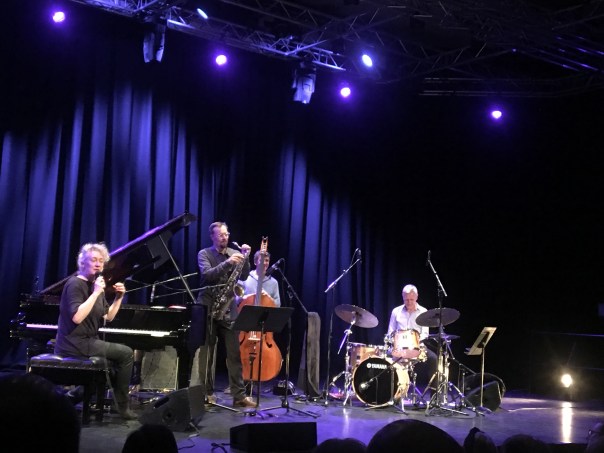
* The photograph shows (from left) Stephan Meidell, Øyvind Hegg-Lunde and Erland Apneseth.

The Uptown Soul of Teddy Randazzo

Teddy Randazzo

What do we mean when we speak of Uptown Soul? A mixture of early-’60s R&B and lush pop that featured gospel-trained voices, big orchestral arrangements, often a Latin tinge to the rhythm, a hint of girl-group sweetness, and an echo of Broadway craftsmanship in the songwriting, all of it bathed in the neon glow of the city. A kind of grown-up music for teenagers, or possibly vice versa. Its presiding geniuses and their protégés included Burt Bacharach (Dionne Warwick and Lou Johnson ), Jerry Ragovoy (Garnet Mimms and Lorraine Ellison), Bert Berns (Solomon Burke and Barbara Lewis) and Teddy Randazzo, whose work is featured in a new Ace Records compilation called Yesterday Has Gone.

Like Bacharach, Randazzo wrote the melodies, created the arrangements, and produced the records. Other people wrote the words: among his regular collaborators were Bobby Weinstein on Little Anthony and the Imperials’ “I’m on the Outside (Looking In)” and “Goin’ Out of My Head” (the latter heard here in Warwick’s version), Weinstein and Lou Stallman for the Royalettes’ “It’s Gonna Take a Miracle” , and Victoria Pike for Mel Tormé’s “Better Use Your Head”.

Born on Brooklyn in 1935, Alessandro Carmelo Randazzo was a good-looking Italian-American boy who started out as a singer, first with vocal groups and then as a solo artist. He made records under his own name until the late ’60s (one of them, the excellent “You Don’t Need a Heart”, is included here), but he preferred the business of making records and in 1964 the commercial success of his work with Little Anthony Gourdine and the Imperials set him on his way.

The 25 tracks of the Ace album, recorded between 1964 and 1976, for a variety of labels, include nothing that is less than cherishable, from the soulful saloon-bar heartbreak of Derek Martin’s “You Better Go” through the froth of the Kane Triplets’ “Buttercup Days” and the proto-Northern Soul of Porgy and the Monarchs’ “Think Twice Before You Walk Away” to the gorgeous balladry of Frank Sinatra’s “Rain in My Heart”. Timi Yuro, Tony Orlando, Esther Phillips, Billy Fury and the Stylistics are among others to benefit from the attentions of a master of his craft.

At the moment my particular favourites from this set are Howard Guyton’s “I Watched You Slowly Slip Away”, a great 1966 dance track with an undertow of sadness, and the Manhattans’ lovely “A Million to One”, from five years later, both of them demonstrating the composer’s wonderful instinct for building into a song the sort of chord-changes that functioned as hooks. He may have been less overtly ambitious than Bacharach in musical terms, with more of a pop sensibility, but he never lacked sophistication.

Randazzo died in 2003, having retired to Hawaii and Florida with his family. It’s wonderful to have this anthology, compiled by Mick Patrick, as evidence of his contribution to a genre that continues to cast a spell.

* Yesterday Has Gone: The Songs of Teddy Randazzo is out now on the Ace label. The photograph of Randazzo is from the booklet accompanying the CD.

Binker in the Round

Binker in the Round 1

It takes a brave bandleader to offer Sarah Tandy the first solo of the set. And when the pianist was presented with that opportunity while depping for Joe Armon-Jones in Binker Golding’s quartet at Jazz in the Round at the Cockpit Theatre on Monday night, she made the most of it. As she can do, she simply took flight, pulling together the strands of the opening theme, focusing the efforts of the whole band and raising the intensity to a level sustained for the next 40 minutes.

It took four of them to bring that off, of course. Not just Tandy or Golding, whose playing seems to have reached a new level of authority in the past year, but the band’s bassist, Dan Casimir, who deploys a huge tone and a massive drive, and its drummer, Sam Jones, who is loose and sharp at the sane time and has a lovely way of infusing eights with a triplet-based feel (and who managed to make an adroit recovery when his bass-drum pedal flew off just as Golding’s tenor solo was building in the climactic “Fluorescent Black”).

They played tunes from Golding’s new album, Abstractions of Reality Past and Incredible Feathers, whose delightful title owed something, he said, to the poet Emily Dickinson: “‘Hope’ is the thing with feathers — That perches in the soul — And sings the tune without the words — And never stops — at all — ” It was, he added, the result of his desire to make something more melodic than the music he created in his duo with the drummer Moses Boyd and its various extensions.

How well he has succeeded. The album is like a modern version of a tenor-and-rhythm session by someone such as George Coleman or James Clay at the zenith of the hard-bop era: original themes that are strong and complex, full of immediately attractive twists and turns, blowing that is fierce but constantly aware of the need to build a narrative. Occasionally, as in “Exquisite She-Green”, there is a Monkish angularity that seeps into the solos. A ballad like “You, That Place, That Time” is not afraid to explore a glowing but always alert lyricism. Others, like “Fluorescent Black” and the Latin-inflected “I Forgot Santa Monica”, have a built-in swing that allows the musicians to take off and show us the extent of their old-school chops while making it clear that they have new things to say.

Tandy on the live gig provided a rewarding contrast with Armon-Jones’s work on the album: the former constantly launching her combination of soulfulness and rhapsody, fingers flying as she goes deeper and deeper, the latter a virtuoso of funky feeling, with a surprise in every bar and making each one count towards the whole.

The gig had the Cockpit audience roaring its approval. The album is a beautiful (and very beautifully recorded) document capturing a young London musician’s discovery that there’s more than one way for his generation to wreck the house. Most highly recommended.

* Abstractions of Reality Past and Incredible Feathers is out now on the Gearbox label.

Ancestral voices

Coin Coin 4


Run, baby, run — run like the wind.

That phrase is a recurring motif of Coin Coin Chapter Four: Memphis, the latest instalment of Matana Roberts’ meditation on personal history and cultural memory. The words are those of “Daddy”, and they appear in various contexts, from schoolyard races to a sighting of men in strange robes and hoods.

The emotional loading of that phrase and the image of a black child running, whether out of pleasure or terror, is at the centre of Roberts’s latest piece of “panoramic sound quilting.” Each chapter so far (she plans an eventual total of 12) has had a different trajectory and texture, and this is no exception.

The narrative core is drawn from the story, told to Roberts by her maternal grandmother, of a Memphis woman named Liddie  — “who for moment of a long lifetime ago, lived in a Tennessee wood, alone, a small person yet ungrown/unknown… her father murdered by weak men in white hoods, her mother dying somewhere unknown… alone…”

Roberts is a beautiful reader and narrator, as anyone who has attended her solo concerts will know. Her strong, alert voice rises naturally out of the music and can render sombre material powerful but never portentous or hectoring. Here she devises settings that fall somewhere between the black country brass and string bands of the early 20th century — braying trombone, rollicking fiddle, wheezing accordion, twanging jaw harp — and the free jazz of the 1960s. There’s an Aylerish exultation to the use of traditional cadences, most obviously in the flights of Roberts’ own alto playing and the scrabbling, plicketing electric guitars of Hannah Marcus and Sam Shalabi. (The bassist Nicolas Caloia and the drummer/vibraphonist Ryan Sawyer are the other members of the core group.)

Snatches of folk songs and gospel hymns slip in and out of this sound-quilt, alongside hints of “St Louis Blues”, “This Little Light of Mine” and “Tennessee Waltz”. They are the ghosts of an unquiet past in a restless, troubled present, brilliantly evoked in the latest episode of this monumental work.

* The photograph is of Matana Roberts’s grandmother and is from the front cover of Coin Coin Chapter Four: Memphis. The album is out now on the Constellation label. I’ve made a couple of factual corrections to this piece in response to Matana Roberts’s comment.

Terry Riley’s ‘Sun Rings’

Kronos Sun Rings

Back in 2002 I was fortunate enough to be present when Sun Rings, an extended composition written by Terry Riley for the Kronos Quartet and a 60-voice choir, was given its world premiere in the University of Iowa’s Hancher Auditorium. The partnership between the composer and the quartet celebrates its fortieth anniversary next year; among Riley’s works premiered and recorded by the group have been Sunrise of the Planetary Dream Collector, Cadenza on the Night Plain, Salome Dances for Peace, The Cusp of Magic and Requiem for Adam. But Sun Rings was something different: the musicians and singers were accompanied by sounds harvested from space by the scientists at NASA as their Voyager probes hurtled past Saturn, Uranus and Neptune.

The sound of space — strange chattering, howling and chirruping — was originally captured by Don Gurnett, a research scientist at the university in Iowa City who designed the plasma-wave equipment carried by the probes to record the noises — called “whistlers” — made by electrons whizzing about in the magnetic fields surrounding the planets. Gurnett told me that while their existence had been detected by a German scientist during the First World War, he was the first person to retrieve them from space and to turn the signals into sound.

He had given cassettes of the recordings to Riley, divided under headings like “auroral hiss”, “electron plasma oscillation” and “electron cyclotron harmonic emissions”. The composer chose the ones he liked and made them an integral part of the piece, triggered in real time by the four members of Kronos using fibre-optic wands. The hour-long work, commissioned as part of NASA’s long-standing arts programme, featured lighting and back-projections created by Willie Williams, a Yorkshireman who worked with Deaf School, Stiff Little Fingers and others before joining U2 for the Zoo TV tour and then moving on to collaborate with the Stones and Bowie.

After the Iowa concert, which was quite an experience, the work was given its European premiere at the Barbican. Now an album, recorded in a studio in 2017, makes the piece available to everyone.

Here’s what David Harrington, Kronos’s leader, has to say about Riley in the notes to Sun Rings: “There is no other composer who has added so many new musical words to our vocabulary, words from many corners of the musical world. Terry introduced Kronos to Pandit Pran Nath, Zakir Hussein, Bruce Connor, La Monte Young, Anna Halprin, Hamza El Din, Jon Hassell, Gil Evans… I have never once heard him say an unkind word about another musician. In a crazed world laced with violence and destruction, he has consistently been a force for peace. Through his gentle leadership, a path has emerged. Terry sets the standard for what it means to be a musician in our time.”

All that is apparent in the 10th and final section of Sun Rings, titled “One Earth, One People, One Love”. Those words belong to the writer Alice Walker, and a recording of her voice intoning them is the leitmotif of a piece which begins with a description of the astronaut’s experience of looking at Earth from space by Eugene Cernan, the commander of the Apollo 17 mission. This extraordinarily beautiful nine-minute piece is slow-paced, the strings moving gently through the sounds of space, with Sunny Yang’s lyrical cello prominent as the passing of time is marked by what might be a tuned drum and a damped bell. Bringing us back home, this is music that speaks to everyone.

* Sun Rings is out now on the Nonesuch label. The photograph of the Kronos Quartet performing the piece in Krakow in 2014 is from the accompanying booklet and was taken by Wojciech Wandzel.

Ronnie Scott’s at 60

Ronnie's

It was in search of some old and occasionally neglected jazz feelings that I went to Ronnie Scott’s this week to hear Joey DeFrancesco’s trio. Temporarily, I’d had enough of watching brilliant young conservatory-trained jazz musicians squinting at sheet music. And enough of entire evenings of jazz without a single bar in a swinging 4/4. A temporary condition, as I say. But it demanded a fix of something different.

I was also thinking about the club’s 60th anniversary, which falls on October 30. I never went inside the original Gerrard Street basement premises, although as a teenager on a trip to London I was able to stand on the street one night, by the top of the stairs, and listen to the sound of Sonny Rollins whenever the door opened. From 1969 on, however, I was a regular visitor to 47 Frith Street, usually on Monday nights, when a new band would begin its season of two, three or sometimes four weeks and I’d be along to review it for the Melody Maker or The Times.

The first of countless memorable nights there was to hear the star-studded Thad Jones-Mel Lewis Big Band. Another early one, in July 1971, was the opening of a fortnight by Herbie Hancock’s Mwandishi sextet: a night no one present is likely to have forgotten. First for the exalted music produced by a group rounded out by Eddie Henderson (trumpet and flugel), Julian Priester (trombone), Benny Maupin (tenor), Buster Williams (bass) and Billy Hart (drums), second for the Swahili names Hancock had persuaded them to adopt, and third for the fact that they were the first jazz group to travel with their own sound system and mixing engineer. The sound at Ronnie’s was always decent, but this, in terms of subtle gradations of individual and collective timbre, was on another level.

So there was a nice historical echo in seeing the great Billy Hart at the drums with DeFrancesco this week, doing exactly what I hoped and knew he’d do, which was to swing like mad. It made me think of all the great drummers I’d seen on that stage, from Kenny Clarke through Art Blakey and Elvin Jones to Billy Higgins, while standing beside the bar that used to run alongside the left-hand wall of the club.

That bar isn’t there any more. Neither are Ronnie or Pete King or the other members of staff, front of house and backroom, who were fixtures in those days. The club went through a bad time when Pete sold it to Sally Greene and her partners after Ronnie died, but the new owners saw it through some difficult years and kept the faith. The booking policy gradually recovered its integrity and the audiences came back. Now it’s full just about every night with listeners who — unlike many of the expense-account businessmen of the ’70s — respect the music, respond with enthusiasm and don’t chatter during the quiet bits.

Inevitably, it’s more expensive than it used to be. But have you tried running a jazz club in Soho, where cherished institutions disappear every week, thanks to the greed and ignorance of landlords and developers? The fact that it’s not just surviving but flourishing is remarkable, as is the willingness of the management to supplement the main programme with jam sessions and showcases for younger musicians — something that Ronnie and Pete always tried to do. I’m not sure I’ll ever quite get used to having to sit down in a place where I spent several decades leaning against the bar, but it’s no great hardship.

The pianist Robert Glasper was making a serious point a couple of years ago when he said that by filling the walls of a jazz club with framed photos of dead musicians, you kill the music’s spirit. You can see why a young musician would come to that conclusion. But when I walk in from Frith Street nowadays, I can still feel the spirits of Ronnie and Pete and the disturbingly glamorous Roxy Beaujolais on the front desk and dapper Jimmy Parsons the greeter and Martin the maitre d’ and Fat Henry Cohen in the cloakroom and Gypsy Larry, whose role was a mystery, as well as those of the musicians in the pictures, all of whom went to make it what it was — and, quite miraculously, still is.

Bill Frisell at Cadogan Hall

BillSolo_Adjusted

“If somebody makes a so-called mistake,” Bill Frisell says near the end of the promotional film for his new album, “that can be the most beautiful thing that happens all night, if everybody’s open to what that sound is and embraces it and makes it sound good. If everyone’s watching out for each other and everyone feels like they can take a risk, it gives the music a chance to keep going and evolving.”

Last night at Cadogan Hall it was his turn to flub an ending, the mistake quickly finessed by his three colleagues — the singer Petra Haden, the cellist Hank Roberts and the bass guitarist Luke Bergman — with grace and smiles. And right there was the humanity of any music in which Frisell has a hand.

His mission to demonstrate and explore the consanguinity of all forms of American vernacular music — from Charles Ives to Thelonious Monk, from Hank Williams to Henry Mancini, from Muddy Waters to the Beach Boys — was accomplished many years ago, but with Harmony, the title of his first album on the Blue Note label, it seems to have reached another peak. The empathy, flexibility and modesty of this quartet make it an ideal vehicle for another exercise in creative juxtaposition.

The concert began quietly, with Haden’s beautifully plain voice enunciating the wandering, wordless, childlike line of Frisell’s “Everywhere”. The first high point came with Stephen Foster’s “Hard Times”, on which Roberts and Bergman joined Haden in the sort of three-part Appalachian harmonies guaranteed to strike instantly at a special place in the emotions. There was a wholehearted ovation for that. “Lush Life”, fiendishly difficult to sing, was another highlight; also included in last year’s solo concert at the same venue and on Epistrophy, his recent live duo album with the bassist Thomas Morgan, Billy Strayhorn’s great ballad is clearly a preoccupation, and its intense chromaticism brought out the Jim Hall influence in Frisell’s work on his double-cutaway semi-acoustic instrument.

There was an interesting recasting of “On the Street Where You Live” (from My Fair Lady) and a lovely harmonised version of the traditional “Red River Valley”, interspersed with little instrumental pieces making sparing use of the guitarist’s loops and effects. The set ended with a segue from Pete Seeger’s “Where Have All the Flowers Gone” into David Bowie’s “Space Oddity”, rendered in full and apparently without ironic intent. For an encore, demanded with fervent enthusiasm, they returned to stand at the microphones and deliver “We Shall Overcome”, inviting us to join in; well, at least now they know what English hymn-singing sounds like.

It was a mystery that, for the latest project from this great musician, a hall which was packed for his solo appearance a year ago should be so thinly populated last night. Perhaps the concert was badly advertised. The album is not yet out, which probably didn’t help. But anyone who wasn’t there missed a quietly remarkable night.

* Harmony is out on November 1. Epistrophy was released by ECM earlier this year. The photograph of Bill Frisell is by Monica Frisell.

Seeing ‘Western Stars’

Western Stars

“This is my 19th album,” Bruce Springsteen says towards the beginning of the film Western Stars, “and I’m still writing songs about cars.” But then he excuses himself by explaining how cars can become a metaphor for all kinds of things, including travelling without getting anywhere.

Western Stars is a performance film, but much more than that. Recorded over two days in front of a small audience in the hayloft of the 19th century wooden barn on his property in New Jersey, it features the 13 songs from the recent album of the same name, played by around 30 musicians: a basic band of various guitars, keyboards, bass and drums, plus two trumpets, two French horns, a string orchestra of violins, violas and cellos, and four or five female backing singers, discreetly directed by the album’s orchestrator, Rob Mathes.

There are a few differences from the album versions, but the sound of Bob Clearmountain’s mix is so close to the lush Californian warmth of the original recordings that I found myself frequently checking for signs that the musicians were miming. An inability to spot anyone playing the glockenspiel part on “Drive Fast” provided the only evidence that post-production work had been undertaken.

Having seen the trailer, I worried in advance that the film — directed by Springsteen with his long-term collaborator Thom Zimny — would include too much footage of wild ponies cantering in slow-motion through desert landscapes beneath spectacular open skies, close-ups of silver and turquoise jewellery on weathered hands, and El Camino pick-ups raising dust on long, lonesome dirt roads. There’s some of that, particularly in the early sequences, but the visual clichés recede as more serious matters come to the fore in what Springsteen calls “interstitial material”, the snatches of home movies and found footage with voiceovers in which he introduces the songs and reflects on their themes of life, love, loss and longing.

On the face of it, the songs on Western Stars aren’t about Springsteen. One protagonist is a stuntman, another a fading movie actor. But, as he said during a Q&A session that followed the screening I attended this morning, “When I write a song in character, it’s a way of exploring your own life and struggles.”

After feeling initially indifferent towards much of the album, it came as a surprise to discover how rewardingly the film illuminates their qualities, both via Springsteen’s commentary and the performances. “Sleepy Joe’s Café” was a song I quite disliked until seeing it contextualised in a social setting. “Somewhere North of Nashville” acquires greater depth. “Stones”, sung as a duet with Patti Scialfa, his wife of 30 years, is now almost unbearably moving in its evocation of the undercurrents of a long marriage. (“I should have had Patti on the record,” Springsteen said during the Q&A.)

The songs I already liked gain a new lustre. “Moonlight Motel” adds a couple more shades of gorgeous soul-weariness. The soaring “There Goes My Miracle” is introduced with a rumination on “losing the best thing you ever had — the perfect formula for a pop song.” Or maybe it was “the formula for a perfect pop song”, which it is. Watching the string players tear into it with such joy, I thought of how I’ve always believed the special E Street secret is making every person in the audience feel as though they’re up on stage, playing in the band, sharing that special exhilaration; this lot made me wish I’d carried on with violin lessons.

* This weekend’s London Film Festival screenings of Western Stars are sold out. It will be in cinemas around the UK on October 28, three days after the release of the soundtrack album.