Skip to content

The Beatles in 1962

“The deeper you dig,” Mark Lewisohn said, “the higher you fly.” He was introducing a preview of his new stage show about the Beatles in 1962, and talking about the methodology behind the research into the group’s history that has been his life’s work. And then he spent two hours proving his point.

Among the many amusing moments of the show is his speculation on what might have happened if Decca had made a deal with Brian Epstein and his band instead of signing Brian Poole and the Tremeloes. Since Decca immediately put the Tremeloes to work as the studio backing group for some of their other artists, it might have meant the Beatles accompanying Jimmy Savile on his 45rpm single of “Ahab the Arab”. Which, 60 years later, would not have looked great on their collective CV.

Where memories fade, he points out, documents are the key. And he has documentary evidence for lots of things, including a letter demolishing the story that Decca turned down the Beatles, showing that an offer was made and rejected by Epstein.

His shows, of which this is the second, tend to have rather odd titles. This one is called Evolver:62. It follows the success in 2019 of Hornsey Road, in which he celebrated the 50th anniversary of Abbey Road, and which I wrote about in the Guardian. The new one takes us through the calendar year of 1962, including the death in Hamburg of Stuart Sutcliffe, the approaches to Decca and EMI, the signing with the latter and the first encounters with George Martin, the replacement of Pete Best by Ringo Starr, and a week in August when something extraordinary happened every day, including Ringo’s debut with the band, Liverpool FC’s first match on their return to the old First Division under Bill Shankly, and John Lennon’s marriage to Cynthia Powell.

Lewisohn narrates the show on stage, an engaging presenter who finds clever ways to illustrate the story. Talking about how the US rights to “Love Me Do” were turned down successively by Capitol, Liberty, Laurie and Atlantic, he shows us mock-ups of what the 45s on those labels would have looked like, while pointing out that Jerry Wexler, who did the deed on Atlantic’s behalf, never had to suffer the sort of scorn that, probably unjustly, followed Decca’s Dick Rowe to the grave.

I’m not going to give much more away, because the surprises are part of the fun. Suffice it say that Lewisohn knows more than McCartney remembers about the inspiration behind “I Saw Her Standing There”. And he delighted me by discovering the first newspaper or magazine in which the Beatles, Bob Dylan and the Rolling Stones were mentioned in the same issue: a Melody Maker of late December 1962, when “Love Me Do” was in the charts, the American folk singer was in London to appear in Madhouse on Castle Street for the BBC, and a new R&B band were advertised as playing a gig at Sandover Hall in Richmond.

The preview I attended was full of that kind of stuff (including the postcard in the photograph above, the first known example of all four Beatles autographing a single object). Lewisohn is doing the show to finance his continuing work on the second volume of his epic trilogy, All These Years, which can legitimately be thought of as the definitive Beatles history. One of the things I like about him is that although he’s gone to enormous lengths to acquire all this information, he never seems proprietorial about it. He likes sharing his treasure, using it to enrich everyone else’s enjoyment of a story that will never be repeated. So while it’s for a worthy cause, it’s also a really entertaining couple of hours.

* Mark Lewisohn’s Evolver:62 is at the Bloomsbury Theatre in London for three shows on October 7 and 8, 2022. Tickets: http://www.ucl.ac.uk/bloomsbury-theatre-studio. Tune In, the first volume of his trilogy, is published by Little, Brown.

Angus Gaye (Drummie Zeb) 1959-2022

As I recall, just two members of a band called Aswad arrived at the Hammersmith office of Island Records with a cassette tape one day in the summer of 1975. They were Brinsley Forde, the singer and rhythm guitarist, and George Oban, the bass player. There wasn’t much on the tape beyond a few scratchily recorded rhythm tracks. But I liked what I heard and I wanted to know more and to meet the rest of them. We arranged for them to return a few days later, at five o’clock on the afternoon of Tuesday, July 15.

The timing was important because one member of the band was still at school. That was Angus Gaye, their drummer, who turned up along with Brinsley, George, Donald Griffiths, the lead guitarist, and Courtney Hemmings, the keyboards player. They were young — Angus was 16 — and they had a nice combination of energy (particularly Angus) and seriousness (particularly George). I liked the fact that they chosen a name that meant “black”.

It was obvious that they worshipped Bob Marley and the Wailers, who would be playing their historic gig at the Lyceum two nights later, on Thursday, July 17. Their song titles would make the influence explicit: “I A Rebel Soul”, “Concrete Slaveship”. I liked the idea of a young British reggae band taking that as their inspiration and doing something of their own with it, infusing their songs with their own experience as the children of immigrants from the Caribbean. There wasn’t yet a Steel Pulse or a Misty in Roots on the scene, while Greyhound and Matumbi were still basically pop rather than roots reggae bands.

A combination of memory and diaries tells me that we gave them some time in the rehearsal room and the studio to make demos, and eventually I played something to Chris Blackwell on one of his visits to London and told him I wanted to sign them. He was fine with that, so we gave them a contract. They went into the studio at the back of our building on St Peter’s Square, with Tony Platt — who had worked with Blackwell on Catch a Fire and Burnin’ — as their engineer and co-producer, and came out with the 16-track tapes that they and Platt mixed at Basing Street into a debut album that was something to be proud of.

By the time it came out they were adopting new names. Angus would become Drummie Zeb. He sang lead on “Back to Africa”, the track that was pulled from the album to make the first single, and eventually he became the group’s main lead singer. I left Island soon after the album was released, just as they were starting what I believe to have been the first experiments by a band using dub techniques in live performance. I was able to watch in admiration from afar as they made great records like “Three Babylon” and “Warrior Charge”, as they backed Burning Spear on his concert dates, as Angus played drums on Marley’s “Punky Reggae Party”, as — much later — they had their No 1 hit with “Don’t Turn Around”, and as they played big gigs like Nelson Mandela’s 70th birthday celebration at Wembley and Reggae Sunsplash in Montego Bay.

Angus/Drummie died last Friday, September 2, aged 62. I think of him and his band, and of their youthful enthusiasm on the day they came to see me at St Peter’s Square, with great fondness.

* The portrait of Angus/Drummie was taken by Dennis Morris for the cover of Aswad, the band’s debut album.

Gumbo on the King’s Road

Along with the Chelsea Potter, John Sandoe Books and Peter Jones, the Pheasantry is a rare reminder of how the King’s Road used to be before it was ruined by retail and food chains, a process that started in the 1970s. I hadn’t been there for many years until a couple of friends invited me to go with them to hear Jon Cleary on one of three sold-out nights this week.

It’s a Pizza Express now, and like the ones in Dean Street and Holborn it has a thriving music programme in the basement, taking over the cabaret function of the old Pizza on the Park. Cleary, the English-born singer and pianist who has lived in New Orleans for many years, was an ideal choice to perform solo on the club’s Steinway in the intimate, 70-seat environment.

To say he has metabolised the music of New Orleans during his decades in residence, and particularly that of its great pianists, is no exaggeration. In the first set, he started with Huey ‘Piano’ Smith and then mixed it all together in a great gumbo whose ingredients included Jelly Roll Morton, Professor Longhair, James Booker, Mac Rebennack and Allen Toussaint. He did the Booker thing of bringing Brahms to the boogie-woogie and the rumba to Rachmaninoff, wandering along the highways and byways of the keyboard to find lurid climaxes, crafty turnarounds and outrageous false endings that brought spontaneous cheers.

The second set was something else. This was about the songs. And not just the fine covers of “Lucille”, “Talk to Me, Talk to Me” and “Blueberry Hill” but his own compositions. One, the soulful “Frenchmen Street Blues”, was heard in season two of Treme. Another, a lovely wistful blues-ballad called “All Or Not At All”, is something he’s apparently been working on for years. A third, “When You Get Back”, is a strutting blue-eyed soul song that I can’t get out of my head. A very good night indeed.

The Aretha Prom

Bad idea, I thought. Just think of how many ways it could fail.

Wrong. Completely wrong.

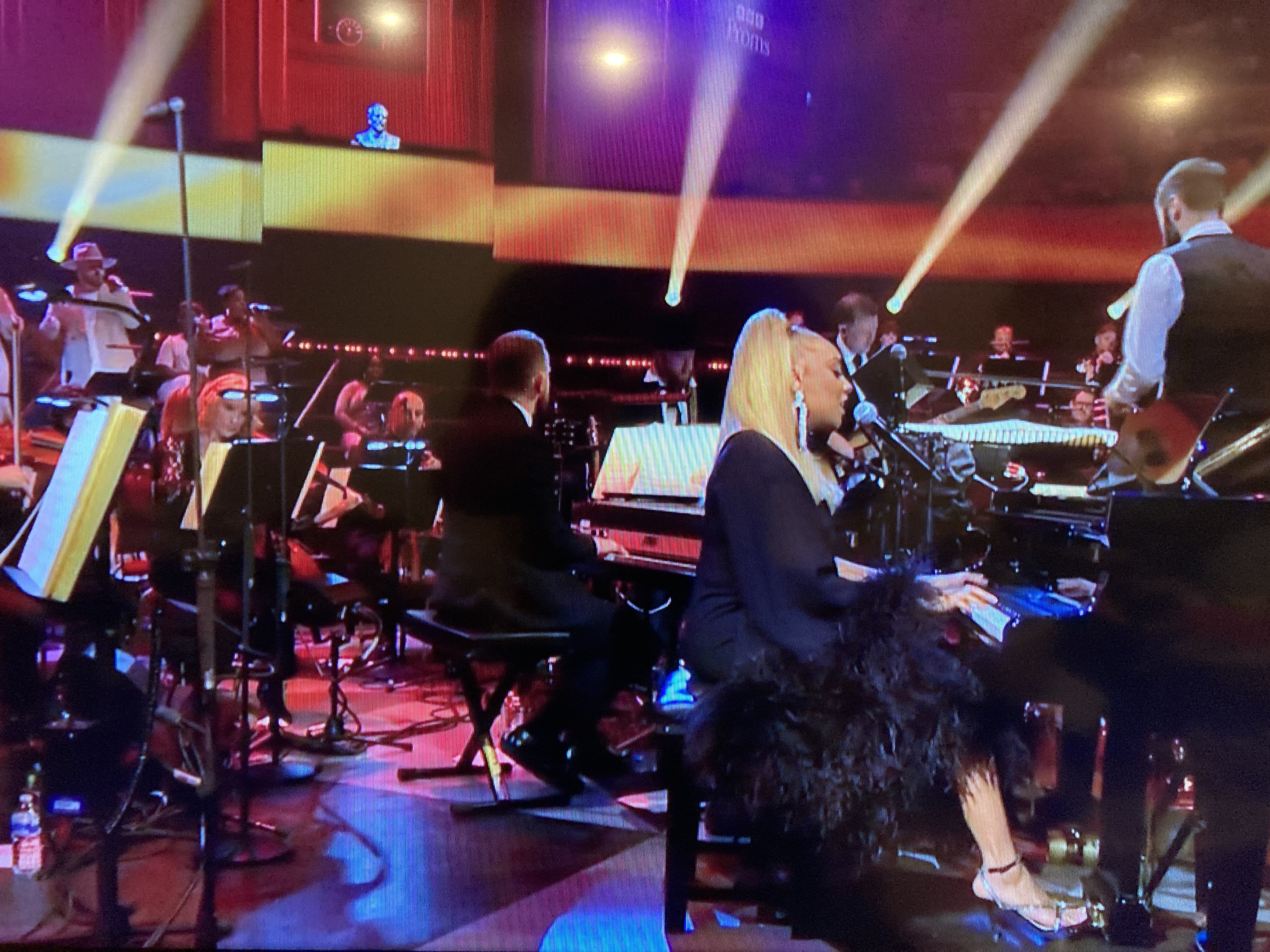
The Aretha Franklin Promenade Concert at the Royal Albert Hall last week, shown on BBC4, was an absolute triumph from beginning to end. No, it wasn’t Aretha. She’s gone. But it was a fine, sensitive, sympathetic and rousing homage, brilliantly performed and presented.

The American singer Sheléa took the central role and pitched it just right: you could hear Aretha in her voice, but what she did wasn’t an imitation. She sang beautifully and played beautifully, too. When she sat at the piano and accompanied herself on “Dr Feelgood”, my mind went back to seeing Aretha in 1980 at the New Victoria Theatre in London, when that song provided the one moment of luminous transcendence in an otherwise lacklustre evening (and how much it still pains me to say that).

The conductor Jules Buckley put together the programme and the ensemble for the Prom. The resources were considerable, making me wish, of course, that Aretha herself could have been given such treatment more often during her career. The core band on stage might not have been Cornell Dupree, Richard Tee, Chuck Rainey and Bernard Purdie, but it did the job with skill and understanding. The horns punched hard on “Rock Steady” and the orchestra was immaculate throughout, most notably during Quincy Jones’s glorious arrangement of “Somewhere” and Arif Mardin’s string chart for “Natural Woman”. There were fistfuls of funky B3 on “Chain of Fools”. “I Say a Little Prayer” provided an opportunity to admire the way Sheléa wisely resisted the temptation to over-emote.

The concert began with a spine-tingling pianissimo “Precious Memories”, taking us straight to church with the aid of Vula Malinga’s singers, who backed Sheléa with verve and had their own showcases on “Spanish Harlem” and “Day Dreaming”. Among the finest moments, surprisingly, was the gorgeously restrained version of Hoagy Carmichael’s “Skylark”, which Aretha recorded during her pre-Atlantic days, when no one at Columbia really knew what to do with her. And the Albert Hall may never have come together in prayer as movingly as it did in “Amazing Grace”.

When the credits rolled, I waited to see the names of the fine musicians — the flautist, the tenorist, the rhythm section, the harpist, the members of the orchestra. But nothing. Just a scroll through the production credits: three people for hair and make-up, someone who took care of legal affairs, a production runner, lots more like that. All playing vital roles, no doubt, but hey, come on.

We were shown pre-recorded interviews with Buckley, Malinga and Everton Nelson, the concertmaster, during the interval, and also with the young drummer, Dexter Hercules from South London. At least he was identified. He said he’d been listening to Aretha’s records and paying attention to the drummers. “They sound really connected to the music,” he said. The best compliment I can pay to the Aretha Prom is to say that that’s how he and everyone else on stage sounded, too.

* Prom 47: Aretha Franklin — Queen of Soul can be seen on BBC iPlayer for the next 11 months.

The last of AMM

It seemed fitting that the final performance of AMM, the pioneering London-based improvising ensemble, should have featured two of the musicians who started the group in 1965. Eddie Prévost, with a small array of gongs, cymbals and drums, and Keith Rowe, originally a guitarist but now manipulating small boxes to trigger and modify samples or electronic signals, appeared together at Café Oto in Dalston last night in the fourth and last event held in celebration of Prévost’s recent 80th birthday.

AMM, whose name remains defiantly undecoded, started out with the saxophonist Lou Gare alongside Rowe and Prévost in a trio that quickly began to unshackle itself from the musicians’ jazz roots. Soon additional members — the pianist/cellist Cornelius Cardew, the accordionist/cellist Lawrence Sheaff, the percussonist Christopher Hobbs, the pianist John Tilbury, the cellist Rohan de Saram — were coming and going. There were occasional guests, such as the saxophonist Evan Parker and the pianist Christian Wolff. Sometimes they were a quartet, sometimes a quintet, often a duo — Prévost and Gare, Prévost and Tilbury, Prévost and Rowe. Tilbury was to have made it a trio last night, but health considerations intervened.

Prévost began and ended the hour-long set with the sound of bowed cymbals, gongs and bowls, an art of which he is a master. Snare and bass drums were used as additional timbral devices, activated by beaters or an electric toothbrush. Rowe deployed his resources with great economy, dropping in samples of male, female and brass chorales, the absent Tilbury’s piano and fragments of speech alongside the radio-scanner cracklings and howls. A packed room listened intently and in complete stillness. At the end, the applause went on for several minutes. This was not just in recognition of the significance of the event, to which Prévost had alerted us beforehand, but in response to the degree and intensity of emotion evoked by the sounds — so seemingly austere, so demanding of listeners, so resistant to any form of literal interpretation — that the two men created together. As a farewell, it could not have been bettered.

* AMM’s first album, AMMusic, was recorded for the Elektra label in 1966 and subsequently reissued in both CD and vinyl formats. Other recordings have been released on the Matchless label (www.matchlessrecordings.com). Eddie Prévost’s books on AMM and related historical and dialectical issues include No Sound is Innocent (1995) The First Concert (2011), and his autobiography, An Uncommon Music for the Common Man (2020), all published by Copula.

Mingus at 50

Today — 22 April 2022 — is the centenary of Charles Mingus’s birth. He was 50 when I interviewed him in London in the summer of 1972. The great composer, bassist and bandleader had been a hero of mine since I bought Blues & Roots as a schoolboy, a dozen years earlier. Since then I’d seen gigs that represented his highs and lows. It was the sort of encounter you don’t forget.

Charles Mingus was late. The hotel switchboard, he said, had forgotten his wake-up call. It was getting on for two o’clock in the afternoon and he’d been playing until three the previous night with his band at Ronnie Scott’s Club and now he was hungry. Wearing a blue and white striped seersucker blazer, patterned black velvet trousers and a carefully knotted green cravat, he wandered out of the lobby of the Mayfair Hotel and into the old narrow streets of Shepherd Market, a figure of vast bulk carving a bow-wave through the eddying currents of lunchtime strollers.

He paused to buy four fresh peaches from a barrow boy, and appeared shocked by the virulent response when he told the trader that the fruit he had bought there the previous day had been rotten. Clutching the bag of peaches, he set off against the tide, looking for a shellfish restaurant. As he peered through the window of one establishment, he commented unfavourably on the size of the live lobsters in the tank before moving on and finally settling down, with some grumbling, at a pavement table outside a sandwich bar.

Then he started talking. And over the course of a largely one-way conversation occupying the next hour, he proved that, behind an increasingly Buddha-like façade, the fires of rebellion were still burning bright.

My first mistake was to ask him a rather vague question about the contract he had recently signed with a major label, Columbia Records, which had produced a terrific big-band record called Let My Children Hear Music, full of complex, fascinating pieces with typically vivid titles, such as “Don’t Be Afraid, the Clown’s Afraid, Too” and “The Shoes of the Fisherman’s Wife Are Some Jive-Ass Slippers”.

“I don’t see the importance of that question,” he said.

Well, I said, already feeling somewhat uncomfortable, did his decision mean that it was no longer possible for a musician to run his own record label, as he had occasionally tried to do in the ’50s and ’60s?

“It’s impossible for me, because I’m not educated to do that. I used to have a woman with me who did that. I don’t have nobody like that now. I’d rather not have to think about it. It can be done, though. Oxtail soup, please. And leave the menu. I’ll just go through it one thing at a time.”

So what was it like, working with Columbia?

“It’s just like being with a record company. I don’t see them doing much promotion on me. They don’t push jazz like they should. They push everything else. Unknown groups get a publicity party for each record they make. But it’s not just so-called jazz. If they pushed symphony enough, more people would buy it. And if you push shit, they buy shit. I tell you what, last night McPherson” — Charles McPherson, his gifted and highly experienced alto saxophonist — “played the worst he can play, and he smiled, and people applauded. He was making noise. He played quarter-notes for two choruses. Can you imagine a saxophone playing a quarter-note solo? They applauded and yelled. Do you see where the people are at? They don’t know. So immediately what you do is get a bunch of guys to play the worst they can, put a lot of publicity on it, and sell it. Play out of tune, anything you want. In this country, in America, everywhere, put a pretty cover on it, say a lot of pretty words, and it sells.”

It was nothing new, he said. “It’s always been true. If you smile and dance along, and be a clown. You couldn’t fool serious people, though. You couldn’t fool a classical audience into thinking he was playing good, someone who’d had a prior musical education. But the way the kids have been brainwashed, you can fool them.”

He went back to an event held a decade earlier, during the time when the New Thing — the avant-garde jazz of people like Ornette Coleman and Albert Ayler — was drawing the attention of critics and the public away from his own generation. In retaliation, he had put a bunch of children behind a curtain at the Village Vanguard and got them to play out of sight, while his own musicians mimed.

“Those kids were just beginning to learn the instruments,” he said. “They took the solos, and man, they broke the house up. They thought we had found some new Ornette Colemans. These kids were eight or nine years old, and they didn’t even know the notes they were playing. Or they were just sliding notes. It didn’t matter. If you blow any horn, some note will come out.”

His words may have been confrontational but the tone of his voice was soft. Sometimes he would lower the volume to let the words slide out in a rapid slur, as though he were talking to himself. Even when he got angry, there was a gentleness about him. Nevertheless his presence was powerful enough to make passers-by stop to listen as the intensity of his harangue rose and fell.

Let’s take painting, he continued. “Some painters draw seriously. They draw precise lines and certain perspectives that correspond with something you’ve seen before. Then you get guys who throw paint at a canvas, throw some sand on top of it. and they say they paint. Some people let monkeys and little children use their fingers on it, and they call it a good painting.” He looked up from his oxtail soup and fixed me with a sort of amiable glare. “It’s time for guys like you to decide what you want: bullshit, or something real.”

So did he fell that the increasing popularity of intelligent rock music had diminished the audience for jazz?

“Nobody’s going to make money in jazz, not even Louis Armstrong. Nobody expects to make any money. They’re playing it because they like to pay it. I don’t know anybody who expects to make a million dollars playing what you’d call jazz. But I do know some people who expect to make a good living once you drop the word jazz and integrate fair employment into music, so the white kids won’t copy the niggers. That’s all they’re doing. They’re minstrels, to me. I haven’t heard any white kids yet that could come up and play something from their own culture — although in a way the Beatles did, they used English music, and that’s why I respect them, and they’re just kids. Although I’m not sure they did it. I think they had some very clever people, learned people, not just one of them. Somebody said that Bacon wrote Shakespeare. I think it was a bunch of guys like Bacon that got together and said, ‘Let’s make one genius man.’ That’s what I think the Beatles were. They evolved from certain types of American music, and certain types of English music, but it was original. It was conceived mathematically. I can hear that. Like ‘Eleanor Rigby’. That wasn’t accidental. One thing that came out was a lot of good words. Bob Dylan, too. He said something, a little something, about his culture.

“But I haven’t heard any so-caed jazz guys from England that have any English culture in their playing. They’re still playing from Lennie Tristano, from Eric Dolphy and myself, the kind of things we did in that band we had, from Ornette Coleman, and based on Charlie Parker. Which is the most difficult of all to play. They haven’t played that yet. I don’t hear anything in their playing to say that they’ve found a culture in their own country to speak of. They’re still speaking of a music that came out of our culture, which is not theirs and they know nothing about it. They’ve only heard the surface and they don’t now what the guys have lived, the pains they’ve gone through to come up with this music.”

His principal argument with the younger players was against their lack of training and their ignorance of the roots. “These guys who want to pay ‘free music’ and can’t even play a melody or even play their solos exactly the same way twice… In the old days, Coleman Hawkins would play ‘Body and Soul’ and he’d play the solo that was on the record, and then he’d play a new one for you, or two or three new ones. Because he had this one solo that was considered like a Picasso, you know, a Picasso solo, and he was capable of doing it again. When I hear guys doing that, I respect them. But I haven’t seen any of them capable of doing the same thing twice, except the melody. I’m not saying that they’re not serious. They’re very serious. You can be crazy and be serious.

“But I think we’re trying to show that civilisation has given us an attunement of the self, a calmness, a peace of mind, and an inventiveness. You shouldn’t go on the bandstand, meditating and praying in front of the audience all the time. That’s what ‘free music’ is. Like a drone, an Indian religious meeting. Difference is, it’s probably a bunch of atheists playing. Meditating with the devil. And the main thing I’m trying to say is that they’re probably all in one key. I don’t hear them change key. I don’t hear no B natural, no E, no A, no F sharp. It’s mainly around C and D flat. Like Ornette Coleman, a pedal-point C. I was with Phineas Newborn when I first heard Ornette, and Phineas said, ‘What key’s that in?’ Sounded like C. He started playing with Ornette. He said, ‘That’s all it is, man. The key of C.’ I don’t know, man, but have you heard Ornette play any melodies? I know before he was successful he had a band with a piano-player, and he played some melodies. But he sounded like a beginner playing saxophone, trying to copy Charlie Parker. On the very next record he had a thing with no piano on it, and I could see where he became very happy. When there’s no chord structure, the guy can pay anything he wants to play.”

A dozen years earlier, Mingus had greeted Coleman’s arrival on the scene with scepticism, although they had played together at the famous Newport Rebels concert at Cliff Walk Manor on the shore of Rhode Island Sound, when a group of disaffected musicians got together and decided to make a protest against the programming of the official Newport Jazz Festival by staging their own alternative event.

“I don’t want to sound like I don’t like Ornette Coleman,” Mingus said now. “He’s one of the nicest people in the world. And I don’t want to say I don’t understand him. I’ve heard him discuss musical theory, and he has a different approach to that. He’s added a different feeling, a different embellishment, a different mood. I think that’s good. Some of the beboppers need to learn it. For instance, I don’t think they know that you can play sad on one note, or happy. You can play the same bridge happy, or sad, or angry, or frustrated. You should be able to play hate, love, anger, fear. Bird did it, but these kids never heard him in person, they only heard the notes off the records, and they don’t know that Bird played tearful some nights, for just one or two bars, he’d cry on one note.

“Guys today know how to play like a very hip old guy or a very hip young guy. They’re afraid to be unhip. To be a musician, you should be able to play hip, unhip, sad, happy, or like the devi, and with imagination a creative person should even be able to play like a saint. It’s too bad that this may be lost in this camouflage of so-called free music, where everything is distorted into sounding like chaos, or another way it sounds is like guys praying or being high or being some place doing something no one else has done, yet if you listen, it’s been done. I haven’t heard nothing yet that hasn’t been done in the so-called avant-garde except that they all do it together. I’m going to have to go back and repeat myself and do what these guys call avant-garde, because I’m sure I was one of the guys that started it, along with Jelly Roll Morton and Duke Ellington. I’m sorry I never had a group that believed in me enough to play my music properly, because that’s exactly what’s always missing in my music, except it did happen when Eric Dolphy was there, because he had so many moods in his playing. But most guys don’t.”

But didn’t jazz have to find a route away from the rigid chord structures of standard ballads and the blues?

“I didn’t say you have to use chord changes, man. It’s just so hip. There’s a thousand chords in one chord, anyway. So why call it a chord? That’s just for dumb piano players, block-chording. If you listen to Duke Ellington, you don’t hear chords all the time. He plays linear things, rhythm patterns, one note, bass note, pedal-point. Bud Powell did it, too. You weren’t conscious of the exact chord changes every time. Nor with Monk, either. I heard some things that Monk did in 1940 that sounded like Ornette, or let’s say the avant-garde. But he didn’t do it for the whole piece. You can do it on the introduction and the ending, and it sounds nice. But not the whole thing.

“I’ve worked in clubs with bands who’ve played that shit for a whole set, and it’s annoying. I’m not concerned about a guy’s sickness, because he’s meditating and praying to some kind of Allah or Buddha. He can go to church in his closet at home, like the Bible says. When you pray, pray in your closet. When you’re on the bandstand, play some music. And if you’ve got a bunch of guys all playing what they want, then everybody’s right, aren’t they? If you’ve got appendicitis, you don’t want no doctor that’s never studied. You want a doctor that can handle that knife and cut you open properly. You don’t want no ad lib free-form doctor to cut you open, no avant-garde jazz doctor improvising by ear. I want a guy who’s studied from the very beginning.”

He talked about his own youth, and how he had to prove his ability to play solos recorded by men like Jimmy Blanton and Slam Stewart before he was allowed to improvise.

“You had to study until you knew where to go on your own. They used to do that at Minton’s, too. Before you could get on the bandstand to play with Charlie Christian, you had to do through an audition. I liked Jimmy Blanton’s playing, so I tried to find out what he was doing. I discovered that he had studied legitimate bass to learn to play properly. So I followed that. One day I came to take a solo, and in those days when you were training it meant you had to play a solo that someone had already played. So I went out and tried something of my own. They told me to go back and study Blanton and Stewart.

“I think the kids today don’t really love the music they copy. They choose them because they’re popular. It’s the latest thing, and it’s going to make them a dollar. When I was young, nobody told me that Duke Ellington made any money. I turned on the radio and heard something that I loved and I followed it until I found out what it was. Ask me and Duke to make an avant-garde record, and we’d cut everybody. Me and Duke, Clark Terry, Jerome Richardson, Buddy Collette, Cat Anderson — don’t ask nobody to be weird, man. We’ll make you sick. Make ’em all put their horns away.”

At several points in the conversation, during the oxtail soup and the plain salad — lettuce, tomato, cucumber — that followed it, I tried to get Mingus to talk about the music he’d been playing recently. This was not well received.

“Why do you always have to ask a guy about his music? You should talk to Mal Waldron, and you can talk to me about his music. He’s made some good comments about my music, about what I’ve contributed. Duke even said it one time. I went up to him and said how much I loved his music, and he said, ‘Well, you did this, and you did that.’ He mentioned two or three things that I did. He called me the Two-Beat Waltz King. He knew how I loved and respected his music.’ And the memory of that caused Mingus to smile, for the first time in almost an hour of virtually unbroken monologue.

But he would talk a bit about the future. “Complication is progress,” he said. “That’s one way of getting rid of the amateurs. For instance, on the trumpet it’s a little difficult to make very wide intervals. Now if you start working those intervals into jazz, the public would realise that this is a technician who has control of his instrument and can make melodic sense on it. I’m working on it now, music with a wider range. Pretty soon it’s going to cancel out all the guys who say, ‘I play trumpet,’ and have a trumpet and a case but don’t master their instrument.

“Same thing goes for saxophone players. They got harmonics on it, they can play chords on it, also wider intervals. It’s the way for good musicians to show that they’re superior to the guys who call themselves avant-garde. It’ll also help the guys who’re avant-garde to make more precise leaps and be more in tune with what they’re doing. Advance the thing technically and people will appreciate it more. It may not be as soulful at first, because it’ll be a hell of a mechanical chase to see who can do this kind of playing. Even piano players, you have to be as good as the guys who play classical. When you get to that point, then you’re really something.”

He had just written a string quartet, he said. “The guys played it at sight. And I rehearsed my music for months with the big band, but that music hasn’t been played yet. But the string quartet was nine thousand times more difficult. If that’s the kind of musicianship they have, where string quartets get played in one day, then I’m going to quit right now and write string quartets. And we call ourselves virtuosos. Think about that. I’m even going to have to do a little woodshedding myself, because I’m writing music I can’t play. I’ve got to do it because all these little kids, they’re all great bass players now. I’ve got to find something they can’t do. I’ve got one thing they can’t do, but if I do it, they’ll be doing it on a record before I get to do it myself. That’s why I don’t play solos on jobs, not until I come to Europe. If I do that in New York, I go to a record date and hear what I played already.

“It’s not funny. Oscar Pettiford told me the same thing. I didn’t believe it. Lester Young told me the same thing. He had a record the next day, and he was in a hotel with Stan Getz, and he heard Stan playing this solo that he’d played the night before, and he wanted to record it. So he had to go and work a new one out. What a nice world it would be if Jewish guys played music from their heredity, from their environment, from what their families had given them. Or if the Scottish guys would do it, or ex-slaves, black men, if the Africans would do it, improvise, but play music from their own culture. The Spanish people do it, with flamenco — see how great that is? Because it’s pure. Flamenco is about their people, Spanish gypsies, and their suffering. The Indians are doing it, too, Americans and them other Indians. But all the so-called civilised countries are copying what came from the past of jazz. It’s not real, man. can’t make it.”

And with that he got up and lurched away, seeming to block out the daylight as he headed up an alley towards Curzon Street, people coming in the opposite direction having to squeeze past on either side of him. I stayed at the table, ordered a cup of coffee and thought about the anger, the sweetness, the love of music and musicians (even, deep down, those of whom he seemed to disapprove), the frustration and the joy that flowed out of his character, and how it had all been poured into his astonishing music.

* The photograph of Charles Mingus was taken in 1959 by Lee Friedlander, and is from the cover of Blues & Roots. A new three-CD set from Resonance Records, The Lost Album from Ronnie Scott’s, documents Mingus’s season at the Frith Street club in August 1972.

Ornette and the skies of London

Fifty years ago today, at 10 o’clock on the morning of Monday 17 April 1972, the photographer Val Wilmer and I arrived at Abbey Road Studios to hear Ornette Coleman recording The Skies of America with the London Symphony Orchestra. It was the first of four three-hour sessions, held on consecutive days, during which the entire work was committed to tape. Here’s one of Val’s pictures, reproduced by her kind permission, and my report, published in the Melody Maker later that week.

“This is The Skies of America, take one.” The smoothly modulated voice of Paul Myers, the head of CBS Records’ classical department, halts a conversation among the second violins.

David Measham, the conductor, counts off a bar, and the orchestra launches itself into a jagged ensemble in which it’s hard to perceive a lead voice. But Measham hears a goof, and drags it to a halt.

“We’ll do it without the trumpets and trombones,” he says. “Are the horns comfortable with this?”

“No more uncomfortable than anywhere else,” mutters a youngish, bespectacled musician, one hand wedged firmly up the bell of his French horn.

He seems to be expressing the consensual view of the London Symphony Orchestra. Mild bewilderment and a certain amount of genteel exasperation are mingled with rather smaller amounts of genuine interest and curiosity about the nature of the work that confronts them this morning in the famous Studio No 2.

This is quite an unusual day in the life of the LSO. The Skies of America is a new work, and they are recording it in the presence of the composer, Ornette Coleman. It’s his first symphonic piece. And it seems to be quite unlike anything the musicians have had to face before.

Some of the problems have been caused by the composer. Certain passages of the work, which consists of 21 short sections and will last about 40 minutes, are almost impossible to play. The strain on the trumpeters, for instance, is such that they’ve made an agreement between themselves to alternate the high-note passages, in order to save their lips from damage.

This is the first day of recording. Last week there were three days of rehearsal, but the parts are still causing trouble. Poor copying, for example, has led the tuba-player to confuse his sharps and flats. “You just have to approximate it,” he sighs. Is it hard? “Bloody impossible.”

The work was to have been recorded with the LSO and Coleman’s quartet, but Musicians’ Union restrictions prevented the use of the American players. “So then we wanted to take the tapes back to New York and overdub the quartet,” Coleman explains, “but they wouldn’t let us even do that. And I always thought electronics were supposed to make things quicker and easier, didn’t you?”

During the takes, Ornette sits on his upturned saxophone case, next to the conductor’s rostrum. He’s wearing a charcoal mohair suit with a flared flap in the back, and a silky cream shirt. His boots are made of multicoloured patchwork leather. As has been his habit for many years, he designed them himself. Beside him, there’s a table. On it lie his packet of Gauloises, his cup of coffee, a red telephone which connects him with the producer in the control room, and his alto saxophone.

Every so often he makes quiet suggestions to Measham or goes over to the drum booth to discuss some point or other with Mike Frye, the LSO’s young percussionist, who is playing a part intended for Ed Blackwell. Frye has never heard of Blackwell, the brilliant drummer from New Orleans who played in the quartet with which Coleman set the jazz scene on its ear a dozen years ago. But he’s doing fine, particularly in view of the fact that what he’s being called upon to play bears only the most tenuous of explicit relationships to the patterns written for the rest of the orchestra.

“We need three conductors, really,” he remarks gravely to Ornette, who nods.

At one point, Ornette takes up the sticks to give Frye a practical demonstration of what he wants. He plays a couple of brief phrases on the snare and top tom-tom, and the immediate resemblance to Blackwell’s unique top-of-the-beat style is startling.

Seated around Coleman, Measham and Frye are 26 violins, 10 violas, eight cellos, six double basses, four flutes, four oboes, four bassoons, four clarinets, four trumpets, four trombones, four French horns, a tuba, a harp and a tympanist. It is, of course, the biggest ensemble Coleman has ever been involved with. This is a man who played on the chitlin’ circuit in his youth, honking out the simple phrases of rabble-rousing rhythm and blues, and who then became the most compelling figure to emerge from the avant-garde of the late ’50s, when his quartet made a series of recordings that seemed to embody both extreme complexity and a love of unfettered melody and irresistible rhythm, implying that perhaps sophistication and naturalness were not polar opposites but could co-exist within music. In the ’60s he also took his first steps into music written for chamber groups — which, on the rare occasions it was recorded or performed in concert, was generally received with a mixture of bafflement and disapproval.

As the orchestra struggles through another section, it’s hard to describe how the music sounds. There are broad melodies which seem never to repeat themselves, and fast staccato phrases which give the trumpets no end of trouble. But in the control booth, even in this rough state, the impression is hugely striking.

“It’s not meant to be a symphony orchestra playing,” Ornette explains, in his characteristically elliptical way, during a break. “Not that particular sound. It’s just supposed to be the way these instruments sound when they play together. In fact it’s not supposed to sound like particular instruments at all. It’s written so that you can’t tell who’s playing what. Listen to that high note. You can’t tell whether it’s the strings or the brass.”

In the booth, he talks about his attitude to melody. He prefers to work with instrumental melody because it allows a more open interpretation. Listeners have to put something of themselves into it in order to get something out. “It’s like this part, here. If you and I were singing it, we’d probably sing different notes, because it sounds different to each of us. You can’t do that with song form. I think that’s one reason why classical music is so unpopular. Working people don’t have the time to put themselves into this music.”

The orchestra returns. While some of the musicians tune up, others read books and magazines propped on their music stands. A few of them return to their reading matter even during eight-bar rests.

Next they’re going to tackle a section that begins with a small section of the strings and the woodwind, playing a long seamless line that wanders without retracing its steps. The spare voicing and muted timbre make it sound like something by Charles Ives — Central Park in the Dark, maybe. Gradually the rest of the orchestra joins in, building on the slow line in a lengthy and deliberate crescendo which has an air of wonderment and discovery. “Like a flower opening,” Ornette remarks.

They get a good take, and Ornette rushes up to the booth. “That part after the melody — where it’s reversed — does it sound too dark? It’s supposed to be like night, with the stars shining through.”

No, he’s told, it’s fine. Even Measham agrees, although he’s been constantly troubled by a conductor’s score that doesn’t tally with some of the individual parts. “It’s such a waste of time when that happens,” he says. “It costs a of money on a session this size. But Ornette is amazing. He knows every note of music on this score by memory. And there’s a lot of music in it.”

The digital clock flicks over to 13:00 and the session is at an end. The musicians pack up and head for the door. Ornette hooks his alto to his sling and walks around the emptying floor, playing a handful of lyrical phrases in that tone which prompted a participant in one of his early recording sessions, the drummer Shelly Manne, to say that “he sounds like a person laughing, and a person crying.”

He pauses and takes the horn from his mouth. “Hey,” he says. “We’re getting there, aren’t we? And we’ll do better tomorrow.”

* The following evening, at the BBC TV Centre, I interviewed Ornette live on an edition of The Old Grey Whistle Test that also featured music by the Stooges, Manfred Mann’s Earth Band and Linda Lewis. Two months later I heard him play The Skies of America with his quartet and the American Symphony Orchestra at Philharmonic Hall in New York, a world premiere coinciding with the album release. In 1988, before a London performance of a revised version with Prime Time and the Philharmonia Orchestra, Ornette told me about how the idea for the piece had come to him on a visit to a Native American reservation in Montana in the 1960s: “I participated in their sacred rites, and it made me think about the many different elements existing in America, in relation to its causes, purpose and destiny. For some reason, I got that feeling from the sky. I feel that everything that has ever happened in America, from way before the Europeans arrived, is still intact as far as the sky is concerned.”

A period of silence (2)

To my amazement, this blog is now 730 posts old. I’m grateful for the interest of those who’ve been reading it since the start in January 2013, or who’ve come in along the way. It’s nice to know that the pleasure I get from it is shared.

Four years ago I put it on hold for a few months in order to give myself the time I needed to finish a book. Now I’m doing it again, and once more the writing that’ll keep me occupied until mid-summer has nothing to do with music. It’s going to be hard to deny myself the opportunity to listen to as many albums and (circumstances permitting) go to as many gigs, but that’s how it has to be.

Meanwhile, a happy new year to one and all, and see you down the road apiece.

— Richard Williams

Doo-wop in the SoCal sun

What skiffle was to British kids in the 1950s, doo-wop music was to their US equivalents, from New York to Los Angeles: the entry point to a new world, for teenagers only. Unlike skiffle, however, to these ears doo-wop still sounds fabulous more than 60 years later, its vibrant innocence undimmed. And there are unheard gems to be discovered by the idiom’s devoted archaeologists, as we find in This Love Was Real, a new collection of two dozen tracks by LA vocal groups from 1959 to 1964.

Unlike their counterparts in Brooklyn and the Bronx, the kids of Watts, South Central and El Monte didn’t have subway tunnels in which to practise their harmonies. But they had long warm evenings and street corners and sock hops in school gyms, and budding music-business operatives like Dootsie Williams, Johnny Otis, John Dolphin, Gary Paxton and George Motola to herd them into a studio and capture their naive hopes and dreams on tape. Among the greatest hits of Southern California doo-wop were the Penguins’ genre-defining “Earth Angel”, Marvin and Johnny’s “Cherry Pie”, the Cuff Links’ “Guided Missiles” and the Paradons’ “Diamonds and Pearls”, but you won’t find any of those here. This Love Was Real is devoted to the ones who didn’t make it, often for no good reason.

For example, I can’t tell you how happy I am to make the acquaintance of the Cezannes, who — “featuring Cerressa” — recorded “Pardon Me” at Motola’s studio in 1963. Composed by Kent Harris, who wrote the original “Shoppin’ for Clothes” (later adapted for the Coasters by Jerry Leiber) and released on the obscure Markay label, the record has the perfect proportions: a gentle 12/8 rhythm, a four-bar chord sequence that falls perfectly into place every time, a high lead vocal cruising above rudimentary harmonies, and even a goofy spoken section.

Nobody remembers much about the Cezannes, beyond the fact that they were a sister (Cerressa) and her brother and cousin, all students at Jefferson High School in South Central LA. The record wasn’t a hit, and as far as anyone knows they went back to resuming normal lives. But thanks to Ady Croasdell, the compiler of this collection, and the set’s expert annotators, Steve Propes and Alec Palao, they live again.

As do all the other tracks, some of which are seeing the light of day for the first time — such as “The Letter”, apparently a product of a session recorded in Philadelphia in 1959 by Adolph Jacobs, the 20-year-old guitarist with LA-based Coasters, with whom he was on tour at the time, having left another popular local group, the Medallions, to join them. Like the previously unreleased “This Wilted Rosebud” by Bobby Sheen (soon to become Phil Spector’s Bob B. Soxx) and the Pharoahs’ “Here Comes the Rain”, it’s a beauty.

Among complete unknowns like the Valaquans, the Cordials, the Precisions and the Five Superiors, we find a sprinkling of familiar figures: the 18-year-old Danny (Sly) Stewart, for example, later known as Sly Stone, then a member of the Viscaynes, singing his heart out on “A Long Time Alone”, released in 1961 on the Luke label after being recorded during what the singer apparently believed was nothing more than a demo session. And Dorothy Berry, wife of Richard Berry, the composer of “Louie Louie”, who leads the Swans through “Hold Me” and would later become one of Ray Charles’ Raelettes.

And then there’s Arthur Lee Maye, a star baseball player at Jefferson High when he recorded for a couple of labels. He hung out with the likes of Jesse Belvin and Richard Berry, and is said to have sung the bass part on Berry’s original version of “Louie Louie” in 1957. Cutting his name down to Lee Maye, he went on to spend 13 years with major-league clubs, six of them with the Milwaukee Braves and the rest with the Houston Astros, the Cleveland Indians, the Washington Senators and the Chicago White Sox. Baseball, he felt, got in the way of his singing career, which he resumed briefly in the 1980s before dying of cancer in Riverside, California in 2002, aged 67.

Maye and his group, the Crowns, are represented on this anthology by “Last Night”, a cheerful, up-beat song of unknown original recorded for John Dolphin’s Cash label in 1959. Arranged by the guitarist Arthur Wright to a busy Latin beat, it was left unreleased and unheard until an acetate in Wright’s possession came to light. “I am the best singing athlete that ever lived,” Arthur Lee Maye once said, and I’m still trying to think of an example with which to contradict him.

* This Love Was Real: L.A. Vocal Groups 1959-1964 is on the Ace label. For those wanting a helping of what happened next in the street music of Los Angeles, I can recommend another new 24-track compilation, Lowrider Soul Vol 2, just out on Ace’s Kent subsidiary, featuring the Larks, the Hesitations, the Manhattans, Darrow Fletcher, Barbara Mason and others.

Where Jimi led

If you’re interested in guitar-playing, you probably need to know about Ava Mendoza. I first heard her at Subterranea in New York in 2016, during the Winter Jazzfest, when she played with a band led by the trombonist Jacob Garchik and including two other guitarists, Mary Halvorson and Jonathan Goldberger, and a drummer, Vinnie Sperrazza. You can see them in the photograph; she’s on the extreme left, with the Fender Jaguar.

Even in the company of the great Halvorson, Mendoza caught my ear. Born in Miami, Florida in 1983, she studied with Fred Frith at Mills College in Oakland, California before moving to New York in 2013. She seemed to have found a way of feeding the sound of early rock and roll guitar — think Dick Dale, Watkins Copicat echo units, and a time before tremolo arms became known as whammy bars — into the kind of thinking shared by the several generations of guitarists freed from the orthodoxies of jazz guitar by Jimi Hendrix, a list going from Sonny Sharrock, John McLaughlin, Ray Russell, Vernon Reid and David Torn to Bill Frisell, Elliott Sharp, Marc Ribot and Kim Myhr. She showed strength, inventiveness and confidence.

That first impression is confirmed on a new album which features her in a trio under the leadership of the veteran bassist William Parker, completed by the drummer Gerald Cleaver. It’s called Mayan Space Station, and it’s the sort of music you can easily imagine Hendrix making if he were still around today: loose, improvisatory, inspired, collective, which are all the words that come to mind when you think of his playing from more than 50 years ago on tracks like “Manic Depression”, “Love or Confusion” and “Third Stone from the Sun”, carried into the 21st century.

I was thinking about Hendrix anyway, since I’ve been enjoying a newly published book called Voodoo Child, in which two Los Angeles-based writers, my old Melody Maker colleague Harvey Kubernik and his brother Kenneth, compile an oral history of the guitarist’s life and work. It’s not a biography in the usual sense but a sort of 360-degree journey around the short but extraordinary life of the man who arguably had more influence on contemporary music than any individual instrumentalist since Charlie Parker.

The vast majority of the interview material is new, culled from dozens of conversations with those who knew, observed or were affected by Hendrix. They range from Brian Auger, John Mayall and Andrew Loog Oldham through John Echols of Love, Robby Krieger of the Doors, Ed Cassidy of Spirit, Marty Balin of Jefferson Airplane and James Williamson of the Stooges to Michelle Phillips, Ernie Isley, Michael Des Barres, Kim Fowley, Jerry Wexler, Billy Cox, Jim Keltner, Nils Lofgren, Patti Smith, Nels Cline and many others. Of course there’s lots of stuff about Monterey, Woodstock and the Isle of Wight, as you’d expect. But the authors aren’t afraid to dive into less obvious areas. In one of the later sections several witnesses, including Hugh Banton, the Van der Graaf Generator organist, and John Etheridge, the Soft Machine’s guitarist for the past few decades, have interesting things to say about the specifics of the equipment Hendrix used.

If I have a criticism, it’s that — like most Hendrix books — it doesn’t follow the money or go deeply into the late period when he became involved with black artists and activists such as the singer Emmaretta Marks and the percussionist Juma Sultan, getting closer to the world where free jazz intersected with political action. But as a kaleidoscopic assembly of impressions from an orbit around Planet Jimi, it has a value of its own.

The eminent composer and flautist James Newton, a professor of jazz studies who has taught a Hendrix course at UCLA, talks about Hendrix’s relationship to jazz: “Check out the floating quality in ‘(Have You Ever Been to) Electric Ladyland’. When Hendrix hits the guitar three times to establish the tempo, I’m thinking, ‘Okay, it’s in 3 but not really — most people hear it in 4/4… a polyrhythm is established, which is not something you hear in pop music, then or now. It’s Mitch (Mitchell) channelling Elvin (Jones).”

That was something you couldn’t miss when you heard Are You Experienced or saw Hendrix live in 1967, at least if you were conversant with the work of the John Coltrane Quartet in the first half of the decade. Mitch had clearly paid attention to Elvin’s sense of time — the 3-against-2 which is at the heart of the rhythms that came from Africa and became what we call swing. And Hendrix, who hadn’t (as far as I know) played jazz during his early career on the R&B circuit, responded to what he was doing. In that sense, Mitch was a liberating influence on Jimi.

It’s interesting to speculate on what would have happened had Chas Chandler recruited a more four-square British rock drummer of the time — say, Aynsley Dunbar (who was under consideration), Keef Hartley or John Steel, his former colleague in the Animals — to the Experience, as might easily have happened. John Mayall points out that “Jimi came to England and a blues world… going back to Cyril Davies and Alexis Korner, who started the blues boom. This attracted a lot of musicians who now had something new to inspire them.” But it was not just a purist’s blues world. Korner’s absolutely seminal Blues Incorporated was packed with jazz musicians, from Ginger Baker and Danny Thompson to Dick Heckstall-Smith and Art Themen, as were Georgie Fame’s Blue Flames and the Graham Bond Organisation. Even had Hendrix never listened to Coltrane, Charles Mingus and Ornette Coleman before leaving the US in 1966, he would have absorbed something of their spirit from the musicians he heard and worked with in London.

James Newton connects Hendrix to the huge change taking place in jazz two decades after the heyday of bebop. John McLaughlin (in a quote attributed to Colin Harper’s biography, Bathed in Lightning) remembers taking Miles Davis to the Monterey Pop film just to see Jimi, and the effect it had on the trumpeter. The effect on guitarists — including McLaughlin — was even greater, in terms of encouraging a more adventurous approach to tone, texture and effects, and more enduring. As we can hear in the work of Ava Mendoza and others of her generation, it shows no sign of abating.

* Harvey and Kenneth Kubernik’s Voodoo Child is published by Sterling. William Parker’s Mayan Space Station is on the AUM Fidelity label: https://williamparker.bandcamp.com/album/mayan-space-station