Skip to content

Starless and bible black
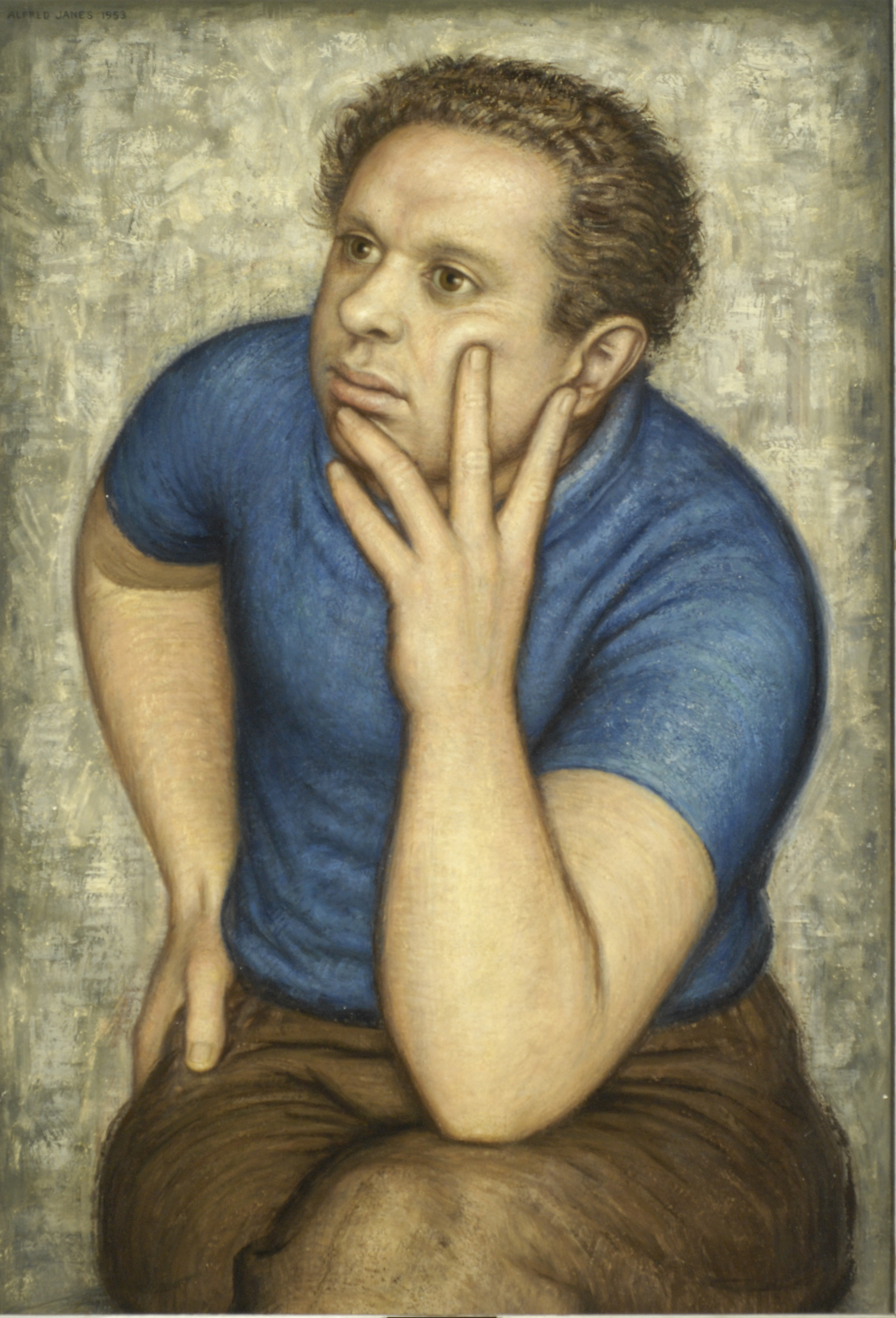
Dylan Thomas by Alfred Janes, 1953, Harry Ransom Centre, University of Texas at Austin © estate of Alfred Janes

To begin at the beginning:

It is spring, moonless night in the small town, starless

and bible-black, the cobblestreets silent and the hunched,

courters’-and-rabbits’ wood limping invisible down to the

sloeblack, slow, black, crowblack, fishingboatbobbing sea.

That’s how Dylan Thomas opened Under Milk Wood at his first readings of the drama in 1953. They were presented at venues from the Poetry Centre in the 92nd Street Y in New York City — with a full cast before an audience numbering 1,000 — to a solo performance for a local arts club at the Salad Bowl Café in Tenby on the south-west Wales coast. His health was deteriorating fast and he had died, aged 39, while back in New York for further performances — staying at the Chelsea Hotel, drinking at the White Horse Tavern — by the time Richard Burton read those words the following year in a famous BBC Radio production. Two years later the Caedmon label, which specialised in spoken-word recordings, issued a vinyl double-album of the Poetry Centre production, recorded using a single microphone.

The British pianist and composer Stan Tracey was so impressed by Under Milk Wood that he made it the inspiration for a suite recorded with his quartet in London in 1965. He started by jotting down some titles while listening to the play, then wrote the music to go with them. The producer Denis Preston supervised the recording at his Lansdowne Studios in Notting Hill, and it was released on EMI’s Columbia label the following year, to great acclaim. As an example of jazz arising directly from a literary or dramatic source, it has seldom been equalled.

More specifically, the album contains a track which has sometimes been called the greatest recording in the history of British jazz. That’s a big claim, and probably an absurdly unrealistic one, but the fact remains that “Starless and Bible Black”, the track in question, is a thing of unearthly and profound beauty, its simplicity of means and its relatively brevity (three minutes and 45 seconds) serving only to highlight its extraordinary nature and the intensity of its mood, preserved in a misty penumbra of reverb by the engineer Adrian Kerridge.

Tracey’s gentle outlining of the modal structure (the chords strummed almost as if by a harp), Bobby Wellins’s hushed tenor saxophone, Jeff Clyne’s bowed bass, and Jackie Dougan’s mallets on his tom-toms immediately recall the only possible model for this piece: John Coltrane’s immortal “Alabama”, recorded in 1963. But whereas Coltrane’s sombre threnody was recorded in response to the murder of four schoolgirls in the racist bombing of a church, Tracey’s tone poem issues from very different emotional source. It’s the sound of a small Welsh cockle-fishing village at night, the silence of its dark streets penetrated only by the dreams of its inhabitants — Captain Cat, Rosie Probert, Mrs Ogmore-Pritchard, Dai Bread, the Reverend Eli Jenkins, Organ Morgan and the rest of Thomas’s motley cast.

The remainder of the album consists of seven rather more conventional but still very worthwhile pieces, their titles, including “No Good Boyo”, “Llareggub” and “Cockle Row”, referencing Thomas’s play. Full of spirit and inventiveness, they display Tracey’s creative response to the stimulus of his two primary musical influences, Ellington and Monk. This particular quartet was one of the finest groups of the pianist’s long and illustrious career, affording a particularly welcome chance to listen at length to the marvellous Wellins, who was among the greatest of Scotland’s many distinguished jazz musicians.

Next Sunday, 14 May, is International Dylan Thomas Day, marking the anniversary — the 70th, on this occasion — of the first performance of Under Milk Wood in New York. I was reminded of this by Hilly Janes, an old colleague at The Times whose artist father, Alfred Janes, was a friend of Dylan’s and painted his portrait at various stages of his career — including, in 1953, the one above. It appears on the cover of Hilly’s excellent and warmly received biography of Thomas, first published in 2014, now in paperback, and containing a vivid description of the poet’s final year. Happily coinciding with the anniversary is the first vinyl reissue of Tracey’s album since 1976, remastered and with a new sleeve note by his son, the drummer and bandleader Clark Tracey.

Hilly also sent me someone’s playlist of other records inspired by Dylan, including John Cale’s “Do Not Go Gentle into That Good Night” and “A Child’s Christmas in Wales”, “Dylan & Caitlin” by the Manic Street Preachers, “Eli Jenkins’ Prayer” by the Morriston Orpheus Choir, Simon and Garfunkel’s “A Simple Desultory Philippic” and, of course, King Crimson’s very different idea of “Starless and Bible Black”. But on Sunday, to accompany the remembrance of a genius, the Stan Tracey Quartet’s album will be all the soundtrack you need.

* The vinyl reissue of Stan Tracey’s Jazz Suite Inspired by Dylan Thomas’s Under Milk Wood is on Resteamed Records. Hilly Janes’s The Three Lives of Dylan Thomas is published by Parthian Books. The portrait of Thomas by Alfred Janes is reproduced by permission of the Harry Ransom Centre, University of Texas at Austin, and is the copyright of the artist’s estate.
Songs of the Balkans

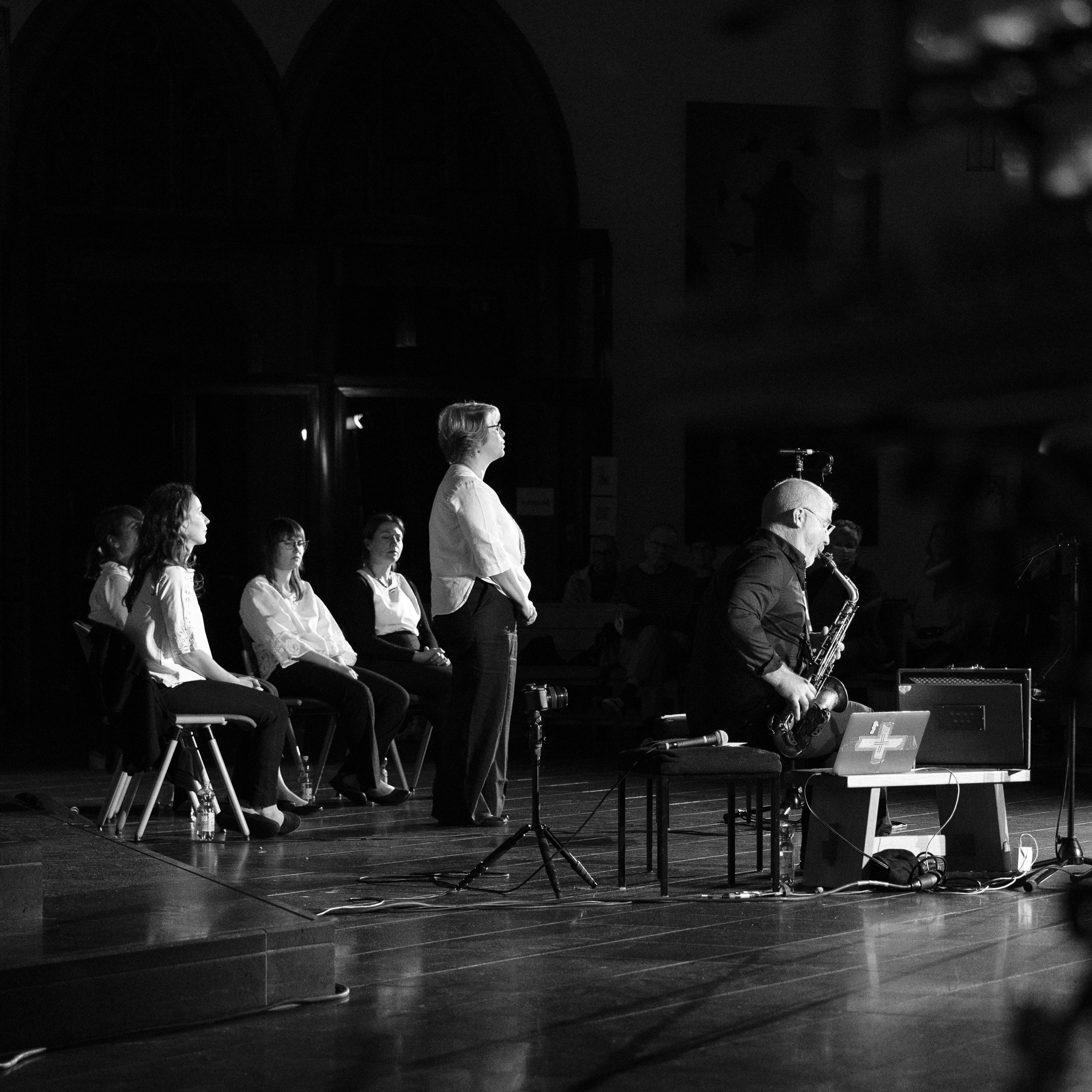
Its appeal somewhere between those of Le Mystère des Voix Bulgares, a leftfield favourite in the 1980s, and the collaboration between the saxophonist Jan Garbarek and the singers of the Hilliard Ensemble in the 1990s, Medna Roso is an album taken from a concert in a Cologne church in 2021 by PJEV, a quintet of female singers specialising in the traditional songs of Serbia, Kosovo, Croatia and Bosnia, with the alto saxophonist Hayden Chisholm and the organist Kit Downes.

Chisholm left his native New Zealand in the ’90s to explore the world of music: jazz at a conservatory in Cologne, Carnatic music in Chennai, and the music of the Balkans. I heard him at a festival in Berlin a few years ago, where I admired the distinctive personality of his playing, later enjoyed on a fine album called Breve which he made with the late pianist John Taylor and the bassist Matt Penman, released in 2015 on the Pirouet label.

Downes, of course, is the gifted English pianist known for his work with Empirical, ENEMY, Troyka and the cellist Lucy Railton, among others. His playing on church organs — which he studied at the Royal Academy of Music — has been heard on an album with the saxophonist Tom Challenger under the name Vyamanikal and on his ECM albums Obsidian and Dreamlife of Debris.

In collaboration with the singers Jovana Lukic, Zvezdana Ostojic, Gloria Lindeman, Lana Hosni and Julijana Lesic, the job of Downes and Chisholm (who also plays analogue synthesisers and shruti box and adds his own throat singing) is to create instrumental textures and interludes, counterpointing, underlining and separating the eight traditional songs that made up the programme for a concert held in St Agnes’ Church as part of Cologne’s JazzWeek.

The voices are plangent, not as lush as the Bulgarian choir, keening and ululating with an ardour and a harsher edge that seems to come from somewhere deep in human history. The songs are about life in mountain villages: families, lovers, the seasons changing (translations are provided in the accompanying booklet). Chisholm and Downes find ways of enhancing their inherent qualities, adding new dimensions and perspectives, providing connective tissue that swells and glows quite beautifully. In the eternal search for music suitable for quiet Sunday mornings, Medna Roso is a valuable discovery.

It’s also the third release on Red Hook, a label founded by the producer Sun Chung, the son of a classical conductor, who grew up in Europe and the US and studied at the New England Conservatory before spending several years at ECM, observing Manfred Eicher’s approach in the recording studio. His label’s debut, a final solo recording by the late pianist Masabumi Kikuchi, called Hanamichi, was one of the finest releases of 2021. Medna Roso will be on this year’s list, no doubt, and deserves a very wide hearing among those likely to respond to its special properties.

* The photograph of PJEV with Hayden Chisholm was taken by Niclas Weber during the concert in Cologne’s Agneskirche. The album is released on 5 May.

Still Kokomo

No band is more likely to make me smile from the first note than Kokomo. Almost 50 years after they emerged in the pubs of London, they’re still at it. Much changed, as we all are since we first gathered in Islington’s Hope & Anchor to marvel at the authenticity of their feeling for funk, but still keeping the faith.

Of the original members, the singer Frank Collins, the singer/keyboardist Tony O’Malley, the percussionist Jody Linscott and the guitarists Jim Mullen and Neil Hubbard were present last night at the Half Moon in Putney, one of their favourite venues. They were joined by the bassist Jennifer Maidman and the drummer Andy Treacey, long-term replacements for Alan Spenner and Terry Stannard, the saxophonist Jim Hunt, filling Mel Collins’s shoes, and the singers Helena May Harrison and Charlotte Churchman, who since 2014 and 2017 respectively have replaced the late Dyan Birch and Paddie McHugh.

The repertoire doesn’t change much as these reunions come around. No Kokomo fan would go away entirely happy without having heard Bill Withers’ “Lonely Town Lonely Street”, O’Malley’s instrumental “Tee Time”, Allen Toussaint’s “Yes We Can”, Hubbard’s sweetly soaring “Anytime” or their traditional showstopper, Bobby Womack’s “I Can Understand It”.

The sound was rough last night, and one or two instrumental stretches went on a bit too long, but the general vibrancy made up for it. The highlights for me were Churchman’s storming delivery of Stevie Wonder’s great “So What the Fuss”, Harrison bossing “Stuff Like That”, the divine Linscott’s beautifully subtle conga-playing on the closing “Third Time Around”, and Jim Hunt’s gruff Texas tenor touches throughout. It all made me very glad that there are still nights like these.

Listening to the music of time

By the time I started listening to Charlie Parker, he’d been dead for five or six years. I was in my early teens, too young to have heard “Parker’s Mood” and “Ko Ko” and the rest of his music as it emerged, first as 78s on the Savoy and Dial labels and then on Verve albums, interacting in real time with everything else around it. That didn’t stop me forming opinions and eventually writing about it. But it was a long time before I realised that older listeners might consider their opinions to be worth more than mine, simply by virtue of their perspective on the music’s initial impact.

I think the penny dropped in the 1970s during a bad-tempered exchange of letters with Derek Jewell, then the jazz and pop critic of the Sunday Times. Twenty years older than me, he tried put me in my place by telling me that he’d been listening to Parker’s records when they were new, while doing his national service in, if I remember correctly, the RAF. With the arrogance of youth, I answered back. But I did so with the uneasy recognition that, however much we both loved Parker’s music, his feelings about it might be intrinsically different from mine, his connection more intimate.

Now, half a century later, it’s my turn to have the sort of feelings that underpinned his words. Occasionally I find myself wondering how someone in their twenties or thirties today can possibly understand the music of Jimi Hendrix, or Martha and the Vandellas, or Albert Ayler, or Anne Briggs, or Curtis Mayfield, or Laura Nyro the way I think I do. I mean, you had to discover “Heat Wave”. “Quicksand”, “Live Wire”, In My Lonely Room”, “Dancing in the Street”, “Wild One” and “Nowhere to Run” in sequence, at the time, to make proper sense of them, didn’t you?

Soon nobody alive will know how it felt to experience that music as it came into the world, all brand new. But people will still want to have opinions about it. And there’s a possibility — heavens above! — that their opinions will be just as valid as mine, and possibly a lot more interesting.

This came home to me while watching Lisa Cortés’s new documentary about Little Richard in order to review it for Uncut magazine (seen above in a page from the June issue). I found it an extraordinary piece of work, on two levels. First, and most obvious, is the enduring charisma of Richard himself, who sets fire to the screen every time he’s shown either performing or giving an interview. The second and more unexpected level is the one on which it made me listen to the director’s choice of talking heads: young academics of colour, female and male, some gay, from American institutions, discussing Richard in terms of his self-presentation — derived from a sexually fluid segment of the black entertainment world — and its wider impact.

White rock critics of my generation, in other words the sort of people who generally get rolled out for such projects, are conspicuous by their absence from this project. But, as I say in the review, I listened to the views of Zandria Robinson, Fredara Hadley, Jason King and others, threaded throughout Little Richard: I Am Everything, with the feeling that I was hearing a new kind of voice discussing a familiar subject from a different and extremely valuable perspective. It gave me a jolt, but an inspiring one.

It’s possible that none of those young academics could list Richard’s first half-dozen Specialty singles in chronological order. Certainly none is anywhere near old enough to remember the precise cultural explosion each one caused on its release, just as I’ll never know how it felt to absorb Duke Ellington’s compositions as they emerged, one after another, on 78s in the 1920s and ’30s. But at this stage, perhaps there are more interesting things to know, and more important things to be said.

* Little Richard: I Am Everything is in selected UK cinemas on 28 April. The June issue of Uncut is out now.

Fire! drill

From the experiments of the Sun Ra Arkestra and Alex von Schlippenbach’s Globe Unity outfit in the ’60s through Charlie Haden’s long-running Liberation Music Orchestra and Mike Westbrook’s Marching Song band to Amir ElSaffar’s Two Rivers, serious attempts to integrate the extended techniques and strategies of free jazz within the format of a large ensemble have always been worth following. Fifty years ago, Keith Tippett’s short-lived 50-strong Centipede was a spectacular example; now we have a new album from the almost as populous Fire! Orchestra, founded in Sweden 14 years ago as an outgrowth of the trio comprising the saxophonist Mats Gustafsson, the bassist Johan Berthling and the drummer Andreas Werliin.

I saw a version of Fire! Orchestra in London a few years ago and was impressed more by the energy and diversity on display than by the subtlety of their music. In that respect, and others, they reminded me then of Centipede. Their new album, a 2CD or triple vinyl set, finds their membership up to 43 — still seven short of Tippett’s aggregation — but now capable of a much greater range of gesture, texture and attack from their four singers, four strings, eight brass, and 15 reeds and woodwind, plus a panoply of keyboards, electronics, guitar and percussion.

The album’s title, Echoes, is the name for a work in 14 parts involving various composers, mostly Gustafsson, Berthling and Werliin but also the violinist Josefin Runsteen (who also provides arrangements for the two violins and two cellos) and guest saxophonist and singer Joe McPhee, plus one cover: “Cala Boca Menino” by the late Brazilian songwriter Dorival Caymmi. The horn arrangements are by Mats Äleklint, one of the band’s trombonists. The whole thing is beautifully mixed by the much-travelled Jim O’Rourke, a sometime member of Sonic Youth who also mixed Wilco’s Yankee Hotel Foxtrot and Joanna Newsom’s Ys.

I won’t attempt a linear description of getting on for two hours of music; for one thing, the individual soloists aren’t identified, so I can’t tell you which of the baritone saxophonists plays the impassioned but beautifully balanced solo against hovering strings on the opening “I See Your Eye, Part 1” (which you can hear on this page from their label’s website) or which bassist contributes the insisted strumming above the atmospheric electronics and chattering woodwind on “Not Yet Born, the Blind Courage of Life”. But although that’s the kind of thing I usually care about, in this case it doesn’t really matter. As with Centipede, it’s the totality of the thing that counts: not just the weight and momentum of the riff passages but the fine detail (for example, the contrast of douss’ngouni and bass introducing “Forest Without Shadows”, or the exquisite tapestry of sound behind the beautiful lone female voice on “To Gather It All. Once.”) discernible even amid the mass.

If there are some familiar devices, such as the use of slow-moving written lines for horns and strings against busy percussion, there’s no sense of cliché. And what you won’t find is much in the way of the collective freak-outs familiar from the early years of such ventures. For all the musicians’ fervour, both explicit and implicit, this is music in which the free play of ensemble and individual imagination is tempered by an intelligent degree of control. When an explosion does come along (and there are a couple), it’s a shock and is either brief or carefully resolved: an example of the sort of tactical astuteness characteristic of what will undoubtedly be one of the albums of the year.

* Fire! Orchestra’s Echoes is on the Rune Grammofon label. The band photograph is by Johan Bergmark.

A portrait of Bud

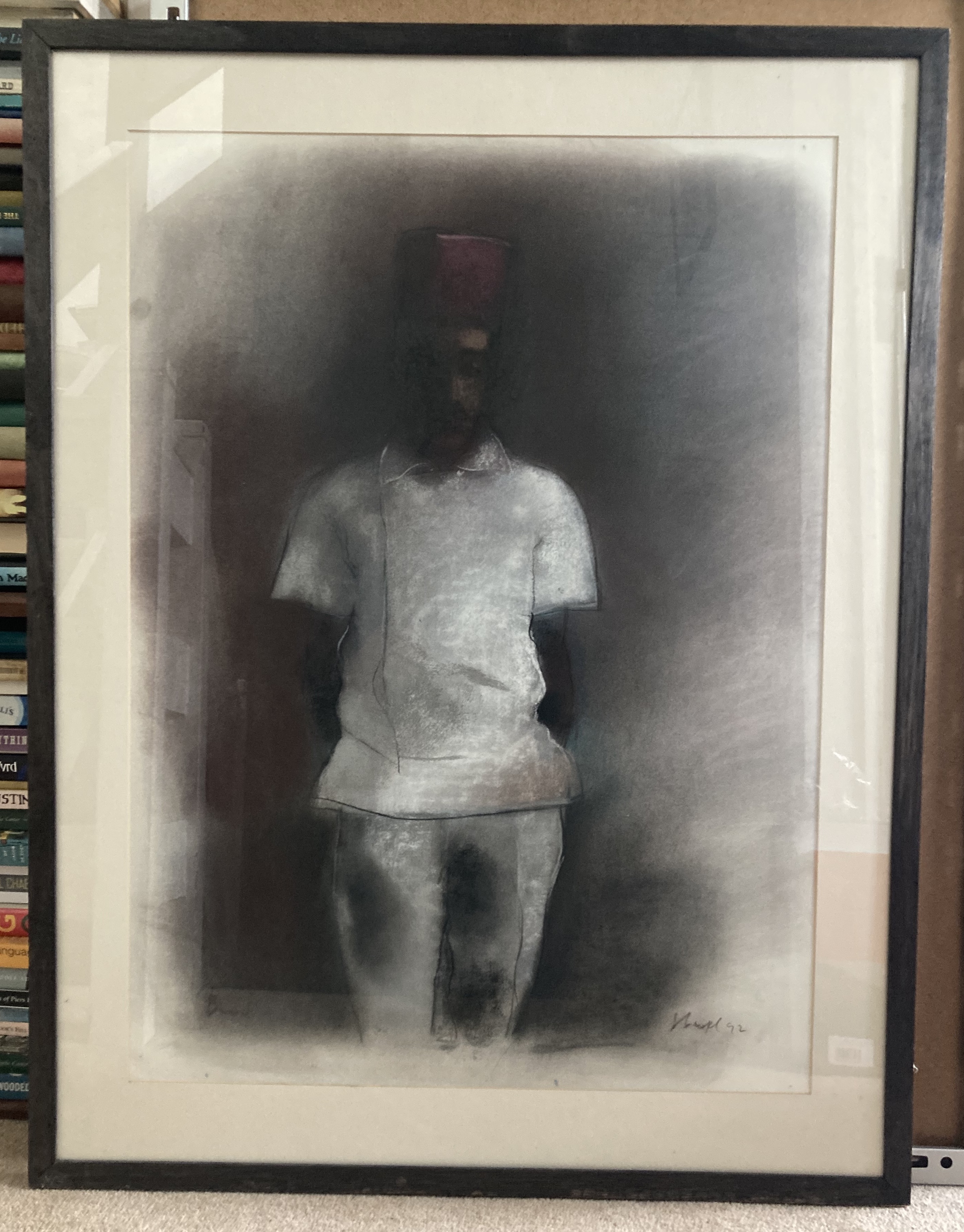
There’s this portrait that I bought about 30 years ago from an English artist called Johnny Bull. At the time, he was concentrating on jazz musicians: Miles, Coltrane, Monk. I liked his work, so I invested a couple of hundred quid in one of the less obvious subjects, a large pastel portrait of the bebop piano master Bud Powell. It hung on a wall in the house for a while but then I got uncomfortable with it and put it away. It emerged recently and I’ve been thinking about it a lot.

Bud was one of jazz’s great tragedies as well as one of its great masters. He was a classically trained prodigy from a highly musical family. But in 1945, aged 20, after being arrested while drunk on the streets of Philadelphia one night after a gig with the trumpeter Cootie Williams’s big band, he was beaten on the head. The effect was to change his personality, putting him in and out of mental institutions, where he was subjected to electro-convulsive therapy.

Some of those who heard him in his teens said his playing was never quite the same after the beating. But still it was good enough to make him the leader among modern jazz pianists in the late ’40s and early ’50s, the only one who could take the stage with Charlie Parker, Fats Navarro and Max Roach and exist absolutely on their level, matching their creativity. At his best — in his 1947 trio session released as a 10-inch LP on the Roost label, for example — he was incomparable, although drugs prescribed for what was then known as manic depression sometimes dulled his mind and his edge. But he remained capable of composing, alongside bop standards like “Wail” and “Bouncing with Bud”, such extraordinary pieces as “Parisian Thoroughfare” and “Glass Enclosure”.

After several years in Paris, where he had a trio with the great Kenny Clarke on drums and the French bassist Pierre Michelot and was looked after for a while by the writer, commercial artist and amateur pianist Francis Paudras, he returned to New York in 1964. He died there two years later, aged 41, of the effects of tuberculosis, exacerbated by alcoholism and general neglect.

If you want to know about Bud, there are several good biographies, including Paudras’s Dance of the Infidels (Da Capo, 1998) and Peter Pullman’s exhaustively researched Wail (available on Kindle). And I recommend an hour-long documentary called Inner Exile, made for French television in 1999 and now on YouTube, directed by Robert Mugnerot and featuring marvellous performance footage as well as interviews with those close to him. (The great René Urtreger, who made an album of Powell’s compositions in Paris in 1955, says of his hero: “He was not made to live in this society.”)

I contacted Johnny Bull via email a few days ago, wanting to talk about his portrait. As you can see, it shows Bud wearing a fez and what looks like some kind of hospital uniform. When I first saw it, it seemed a powerful way of dramatising the pathos of his story. So, after we’d become reacquainted, I told Johnny about my dilemma. It’s a very fine piece of art, and quite beautiful, but it brings too much sadness to a domestic setting. Exhibiting it in a public environment, like a gallery or museum, might not be the right way to introduce Bud to people who don’t know anything about him. It illustrates one aspect of his life with great sensitivity but gives no indication of what he brought to the world, which is why it wouldn’t really work on the wall of a jazz club, either.

The artist agreed. “It’s a distressing picture,” he said. “He looks such a lost soul. I made a painting of Lester Young once, towards the end of his life, and it was too disturbing to keep looking at, so I quite understand your feeling.”

Johnny Bull loves and understands the music. His intentions when he made the portrait were beyond reproach, his response to the subject was anything but superficial, and his execution was impeccable. I bought it because it moved me. But I have no clear idea of what its fate should be now. It seems wrong for it to spend any more years stacked away in my house. Maybe I’m writing this in the hope that someone will propose a solution. Failing a better idea, I’ll probably just give it back to the artist, who can put it in his archive. Then, one day, someone else will have to make the decision.

Some universal truths

Back in 1982, Billy Valentine and his brother John recorded a song called “Money’s Too Tight (To Mention)”, a slice of disco-funk that made the lower regions of the R&B chart. Its lyric reminded me of Jimmy Witherspoon’s “Money’s Gettin’ Cheaper” and I liked it enough to buy the 12-inch from Groove Records on the corner of Greek Street and Bateman Street in Soho. Three years later it was covered by the Manchester band Simply Red, for whom it provided a first hit and the basis of a rather more successful career than was granted to the Valentine Brothers.

Now Billy returns with what will certainly end up among my albums of the year: Billy Valentine and the Universal Truth, a collection of rearrangements of eight well-known songs united by a certain social relevance. In age they range from the spiritual “Wade in the Water” to Prince’s “Sign of the Times”, first recorded by its composer in 1987. In between come songs written by Curtis Mayfield, Stevie Wonder, Gil Scott-Heron, Pharoah Sanders and Leon Thomas, the members of War, and Leonard Caston and Anita Poree.

Valentine brings the wisdom of his years to these “message” songs. The softened edge to his tone reminds me of the great southern soul singer O. V. Wright, but his vocal agility enables him to handle the rapid-fire phrasing of the Prince song with ease. The anguish in “Home Is Where the Hatred Is” matches that of Esther Phillips’s famous 1972 version.

The arrangements here are modern and imaginative, often making use of jazz gestures. There’s the eloquent improvising of the new star saxophonist Immanuel Wilkins on Mayfield’s “We the People Who Are Darker Than Blue”, sensitively accompanied by Larry Goldings on piano, Linda May Han Oh on bass and Abe Rounds on drums. There’s Claire Daly’s barely controlled baritone saxophone, preaching the spiritual jazz message on Sanders’ “The Creator Has a Master Plan”, and Theo Croker’s elegant trumpet on “Sign of the Times”. There’s Goldings again, reincarnating the spirit of mid-’60s Ramsey Lewis on “Wade in the Water” and a beautiful opening-up of Wonder’s scathingly political “You Haven’t Done Nothin'”. Other featured players include the vibraphonist Joel Ross, the percussionist Alex Acuña and the guitarist Jeff Parker.

Produced by Bob Thiele Jr, the son of the man who produced John Coltrane’s Impulse albums and recorded Ornette Coleman on his own Flying Dutchman label, this isn’t a jazz record any more than it’s a soul record, a funk record or an R&B record (some of the tracks have a rhythm section of Pino Palladino on bass guitar and James Gadson on drums). It’s all of them, mixed together in perfect proportions. And if the message of these songs isn’t new, it’s never a bad thing to be reminded of the continuing urgency of what they have to say. In a post-truth world, they hit even harder.

* Billy Valentine and the Universal Truth is released on 24 March on the Acid Jazz/Flying Dutchman label: http://www.acidjazz.co.uk. The photograph is by Atiba Jefferson.

Picasso & Monk in Paris

In a room devoted to Pablo Picasso in the 1950s, there’s something unexpected: the sound of Thelonious Monk, alone at the piano, ruminating on “I’m Getting Sentimental Over You”. The rest of Thelonious Himself, the 1957 album consisting of seven solo tracks plus “Monk’s Mood” with John Coltrane and Wilbur Ware, is playing on a continuous loop, quietly and unobtrusively, conditioning the mood in which a handful of masterpieces, including Jacqueline aux mains croisées (1954), can be examined as part of a new exhibition in the Musée Picasso in Paris.

It’s one of several surprises introduced by the British designer Paul Smith, invited by the museum’s director to create a show commemoraing the fiftieth anniversary of Picasso’s death. His brief was to bring a fresh eye to bear on the selection and presentation of items from the 5,000 assorted artworks in the permanent collection, most of them acquired by the nation as part of an inheritance-tax settlement with the artist’s family.

I first met Paul in 1965, when we were still in our teens and he’d just begun managing the menswear department on the upper floor of a boutique in Nottingham. Called Birdcage, it was a minute’s walk away from the tiny premises in which, five years later, he would open the first shop bearing his own name. Now there are more than 120 Paul Smith shops in 60 countries around the world. Back then he was full of imagination, enthusiasm and a love of silly humour, all qualities that time, a knighthood and membership of the Légion d’honneur have done nothing to erode.

His instinctive response to the museum’s invitation was to emphasise the role of colour in the artist’s career, from the pink period of 1904-1906 to the blue and white stripes of the Breton sailors’ shirt Picasso was wearing when the photographer Robert Doisneau turned up to capture some famous images at his house in Vallauris in Provence in 1952, including the shot where sausage-shaped bread rolls — petits pains — take the place of his fingers.

Mounted with wit and zest, avoiding the reverence with which such retrospectives are traditionally mounted, some of the show is eye-popping. In one of the 24 themed rooms, originals are mounted on walls papered with posters from Picasso exhibitions around the world. His variations on Manet’s Le Dejeuner sur l’herbe are ranged in the greenest green room you’ve ever seen. A wall of pale blue and yellow lozenges echoes the harlequin costume worn by the painter’s three-year-old son Paul as he posed for his father in 1924. The abundance of floral and striped wallpaper makes the rooms in which a more sober approach is appropriate — the Blue and Rose periods, or the poignantly understated finale of Le Jeune peintre, from Picasso’s last year on earth, in a room washed in pale sunlight — even more effective.

Not just paintings, either. A dozen of Picasso’s one-off decorated dinner plates are mounted in the middle of a wall of plain white plates, which seem to be waiting for him to get up in the morning, grab his paints and start daubing fishbones or minotaur’s heads. The famous bull’s head fashioned in 1942 from a discarded pair of dropped handlebars and a bicycle saddle is hung high on one wall of the very first room, confronting a herd of cows on the opposite wall assembled from their modern equivalents, with the bars turned downwards, presumably to signify bovine submission in the face of taurean power. There’s a sense of semi-surrealistic comedy at work here that mirrors Picasso’s own sense of humour but also offers a quiet comment.

Perhaps purists will be relieved to have their Picassos restored to more neutral surroundings after the exhibition in the beautiful hôtel particulier in the Marais ends in August, but Paul’s inclusion of the sound of Monk’s piano — apart from giving me an excuse to devote a piece to the show in a blog about music — seemed to symbolise the benign and sympathetic creativity at work in the exhibition as a whole.

* Célébration Picasso: Le collection prend ses couleurs! is at the Musée Picasso, 5 Rue de Thorigny, Paris 75003, from 7 March to 27 August 2023.

At the Marquee

Was the Marquee Club really the world’s greatest music venue, as the subtitle to a new history of the club suggests? There might be arguments from Carnegie Hall, the Olympia music hall in Paris, Ronnie Scott’s, the Berlin Philharmonie, the Village Vanguard and a few others. But from its opening in 1958 to the closure in 2006 of the last club to bear that name, it had a fair claim to the title, given that its attractions over the years went from Dexter Gordon, Chris Barber and Dudley Moore through Alexis Korner and Long John Baldry, the Stones, the Yardbirds, Manfred Mann, Graham Bond, Little Stevie Wonder, the Who, David Jones/Bowie, Sonny Boy Williamson, Rod Stewart, Jimi Hendrix, King Crimson, Led Zeppelin, Fela Kuti, Genesis, Dr Feelgood and Dire Straits all the way through the Damned, the Sex Pistols (supporting Eddie and the Hot Rods), the Jam, the Police, Motorhead to REM and Guns N’ Roses and hundreds and hundreds of others, most of them still in their formative stages, including seemingly every British blues band and prog rock outfit assembled via the Musicians Wanted columns of the Melody Maker.

It began as a jazz club at 165 Oxford Street, in a basement ballroom beneath the Academy Cinema. In 1964, as R&B took over, it moved a couple of hundred yards south, to the ground floor of 90 Wardour Street, bang in the middle of Soho. That was its classic location, which it occupied until the summer of 1988, when it moved around the corner to 105-107 Charing Cross Road, which had been a cinema between 1911 and 1987. The Marquee was there for seven years, hosting Spiritualised, Aerosmith, Megadeath and others until it closed and the name was sold to people who briefly ran clubs exploiting its renown in Leicester Square and Upper St Martin’s Lane until the final closure in 2006.

Among many other things, the new history of the Marquee, by Robert Sellars with Nick Pendleton, told me that a contributory factor to the move out of Wardour Street was the crumbling detected in the façade of the building, an effect of the loud music being played within. One night that may have done more than most to shake the walls was 6 October 1970, the second night of a 36-date tour of Britain by Tony Williams’s Lifetime, recently expanded to a quartet with Jack Bruce joining Larry Young and John McLaughlin. If forced to nominate the greatest gig I’ve ever attended, that would probably be the one. For some of the many musicians who were present, it was a life-changing experience.

The club’s story is well told, with plenty of detail and a cast of characters that changes constantly as the decades whizz by. Not just the musicians but the people who ran the place, starting with Harold Pendleton (Nick’s father), a jazz-mad accountant who became president of the National Jazz Federation, and his wife Barbara, and including the lavishly toupéed manager John C. Gee and his assistant Jack Barrie, along with characters such as Tony Stratton-Smith, the founder of Charisma Records, whose acts often started their careers there. And not just the club itself but ancillary premises like The Ship, the pub a few yards up Wardour Street, where members of the audience could have a beer before going down to the non-licensed Marquee, or La Chasse, the first-floor drinking club where musicians and other music business types did likewise. If you were there during any of the club’s many eras, and even if you weren’t but wish you had been, the book will provide much enjoyment.

* Marquee: The Story of the World’s Greatest Music Venue is published by Paradise Road (320pp, £22). The photograph of the audience waiting outside 90 Wardour Street is from the book and is uncredited.

Sounds of the Lace Market

Bernard Siegel left Poland for England as a young man after the Second World War. Settling in Nottingham, he studied textile and hosiery manufacturing before entering the lace industry, of which the city was then a centre. Before long he had started his own business, with offices in the old Lace Market, some of whose handsome Victorian red-brick buildings are still standing. His family included a son, Julian, who grew up to be a musician.

Julian Siegel’s Tales from the Jacquard begins with the busy, shuttling sound of the sort of machines that made lace at his father’s factory in designs transferred from drawings to sets of punched cards, known as Jacquard cards. An album featuring the 30-minute three-movement suite for big band, recorded at Lakeside Arts in Nottingham, was released two years ago; last night it was performed at Ronnie Scott’s Club at the end of a short UK tour which acted as a pandemic-delayed launch.

Jacquard cards are the descendants of a system devised for French silk weavers by a man named Basil Bouchon in Lyon in 1725 and developed in the early 1800s by Jean-Marie Jacquard, who used it to control a mechanically operated loom. I had a bit of an a priori interest in Siegel’s project because Nottingham is my home town and my sister studied lace design at the local art college, going on to work for a short time in an industry that was already in the throes of a rapid decline and contraction. But the work of Bouchon and Jacquard was not lost: in 1830 it had inspired an English mathematician named Charles Babbage to create his Analytical Engine, the ancestor of the modern computer.

Based on the composer’s detailed study of the intricate punched-hole patterns, Tales from the Jacquard is a stimulating and absorbing piece of writing, the sort of thing you might expect if you crossed conventional modern big-band writing with the systems music explored by Steve Reich in “Music for 18 Musicians”. That, as it happens, is the size of Siegel’s ensemble, whose members negotiated the warp and weft of overlapping lines with panache, under the baton of Nick Smart.

Based around Siegel’s regular quartet, with Liam Noble on piano, Oli Hayhurst on double bass and Gene Calderazzo on drums, the band featured such fine soloists as Percy Pursglove on flugelhorn, Stan Sulzmann on tenor saxophone, Harry Brown on trombone, Mike Outram on guitar, Tori Freestone on flute, Mike Chillingworth and Paul Booth on altos, and Claus Stötter on trumpet — and, of course, Siegel himself, typically eloquent in his glancing way on soprano and tenor. Tom Walsh was the powerful lead trumpeter and Gemma Moore’s baritone saxophone anchored the ensembles. Pursglove and Stötter arrived for the tour from Hamburg, where they are colleagues in the redoubtable NDR big band.

Henry Lowther and Jason Yarde were featured on the recording; both would have been on the tour, had circumstances not intervened. A recent bout of Covid-19 put Lowther on the sidelines — literally so at Ronnie’s, where he was joined among the capacity audience by Yarde, who is continuing his recovery from the stroke he suffered while on stage in Toulouse last October. If Siegel’s impressive music provided one reason to be cheerful, that very welcome sight was another.

* Julian Siegel’s Tales from the Jacquard, commissioned by Derby Jazz and first broadcast on BBC Radio 3’s Jazz Now, is on the Whirlwind label.