Skip to content

The last of the Tops

There’s still something distinctly majestic, even monumental, about the run of more than a dozen hits that Eddie and Brian Holland and Lamont Dozier wrote and/or produced between 1964 and 1968 for the Four Tops, whose last surviving original member, Abdul “Duke” Fakir, died this week, aged 88.

It’s a Himalayan range of which the peak, of course, was “Reach Out, I’ll Be There”. I can still remember hearing it for the first time, played by Mike Raven on Radio 390 one evening in 1966, and being transfixed not just by its unprecedented arrangement — the galloping percussion, the piping woodwind, four to the bar on a tambourine, the celestial choir — but by the realisation that someone at Motown had been listening to Bob Dylan. For a fan of both kinds of music, that much was immediately obvious in the urgent repetitive incantation of the melody, so far away from the normal structures of Motown tunes.

The run of hits began in 1964 with “Baby I Need Your Loving”, its swinging rhythm carried by fingerpops on the backbeat — unusual for Motown, although also tried a couple of years later on Martha and the Vandellas’ “No More Tearstained Make Up” — and by James Jamerson’s inventive bass line. It reached the fringes of the Top 10, and remains much loved, but the follow-up, “Without the One You Love”, was too close to it to repeat that success. Listening to it now, I also realise that the bass player on this one must have been someone else; whoever it is, all he does is follow the root note, with none of the octave leaps, passing notes and general fluidity that made Jamerson’s work so distinctive.

Their third Motown single was a gorgeous anomaly: a heartbroken ballad written and produced not by H-D-H but by William Stevenson, the label’s A&R director at the time, and Ivy Jo Hunter. Jamerson returns here, working in conjunction with open strummed rhythm guitars. And as with its two predecessors, what’s particularly noticeable is the use of the Andantes, a female vocal trio, to add to the Tops’ own background harmonies. Jackie Hicks, Marlene Barrow and the soprano Louvain Demps never had a Motown hit in their own right, but they created a kind of penumbra of emotion that gave this record, and almost all the early Tops hits, a special quality that eludes analysis but goes straight to the inconsolable heart.

For their fourth single, and first No 1, they went back to Holland-Dozier-Holland in the spring of 1965 for “I Can’t Help Myself (Sugar Pie Honey Bunch)”, a record that established a template for bass-driven dance records, Jamerson bouncing off the 4/4 on the snare drum and Jack Ashford’s vibes. It was never a favourite of mine, unlike its slightly less successful successor, “It’s the Same Old Song”, which follows the formula but relies less on the bass line and has a lyric you could dance to.

“Something About You” emphasised the pounding beat, forfeiting some of the poetry rediscovered in “Shake Me, Wake Me (When It’s Over)”, and the move towards a funkier sound culminated in the return of Ivy Jo Hunter, co-writing “Loving You Is Sweeter Than Ever” with Stevie Wonder and producing a magnificent track based on chords whose voicings descend with a dark and thrilling inevitability, paced in a deliberate rhythm by the patented combination of tambourine, snare drum and chopped guitar on 2 and 4.

Then came the great run of “Reach Out, I’ll Be There”, “Standing in the Shadows of Love” and “Bernadette”, a trilogy united by the anguish of Levi Stubbs’ lead vocals and the exuberant imagination at work in the arrangements. Jamerson is at his towering best on “Standing in the Shadows”, where Eddie “Bongo” Brown’s congas grab the spotlight in four-bar breaks that foreshadow the tactics of disco remixers a decade later. The third part of the trilogy is remembered for a sudden silence broken by Stubbs’ cry of utter desperation — “BERNADETTE!” — but the female voices have already painted the backdrop, reaching up to touch the heavens.

After that came “7 Rooms of Gloom”, a track that almost turned the trilogy into a tetrad, its opening a masterpiece of suspense before drums and bass enter in a flurry, with a hint of harpsichord in the background. Then “You Keep Running Away”, notable for Jamerson’s hyperactivity and the two sets of syncopated convulsions that form a bridge between sections, and its B-side, the tearstained gospel-doowop fusion of “If You Don’t Want My Love”, with the harpsichord marking out the chord cycle.

We’re in 1968 now, and the two lush covers of the Left Banke’s “Walk Away Renée” and Tim Hardin’s “If I Were a Carpenter” were unexpected and beautifully soulful. But by the end of the year H-D-H were on their way out of Motown, leaving the Tops with one last masterpiece: “I’m in a Different World”, a gear-change in synch with (and perhaps a response to) Norman Whitfield’s increasingly adventurous productions for the Temptations. Dramatic changes of density with layers of guitars, a swoosh of strings, a bed of percussion: bass drum, congas, and that hi-hat, a single stroke hissing midway through every bar: “one-and-two-AND-three…”

Now Duke Fakir, whose tenor led the group’s background harmonies, has gone to joined his Detroit friends Lawrence Payton, who arranged those harmonies, Renaldo “Obie” Benson and Stubbs. What a run they had, and what a range of peaks they left, each one still catching the sun from a different angle.

‘In the Brewing Luminous’

Champagne, sorbet and cocaine. Who would have guessed, while falling under the spell of Cecil Taylor’s music at the beginning of the 1960s, that these formed the basis of the great pianist’s diet? From listening to Jazz Advance, “Excursion on a Wobbly Rail”, the “Pots”/”Bulbs”/”Mixed” session and the sublimely sombre trio reading of “This Nearly Was Mine”, I had him pegged as an artist of the ascetic variety. How utterly wrong.

Actually, I was given a clue at the end of a post-gig interview in London in 1969, when he asked if I could recommend a good discothèque. As Philip Freeman demonstrates in the course of In the Brewing Luminous, Taylor lived on his own terms, resistant to cliché in his life as much as in his music.

A full-scale biography of Taylor has long been needed, and Freeman’s densely packed 250-page volume is as good a one as we are likely to get. I say “densely packed” because the author has made the decision to include as much detail as possible of all the gigs Taylor played and all the recordings he made throughout his long career, along with impressionistic descriptions, where evidence survives, of how they sounded.

To begin with, I worried that this was going to produce the kind of play-by-play narrative familiar from sporting biographies, where one match or competition follows another in a way that can try the reader’s patience. Eventually my reservations faded to nothing. Apart earning our gratitude for the intrinsic value of having all this information assembled in one place, Freeman inserts enough first-hand testimony from participants and bystanders to bring Taylor, who died in 2018, aged 89, back to life.

In 2016, when the reopened Whitney Museum hosted a season to celebrate Taylor, Freeman interviewed him for The Wire. Although highly articulate and sometimes loquacious to a fault, the pianist was not always the most forthcoming or enlightening of witnesses on the subject of his own career. But enough exists for the author to have pieced together the remarkable story of his early life, his rise to notoriety as the first member of the avant-garde to send ripples through the jazz establishment, and his progress, as Freeman eloquently puts it, “from insurgent to institution”, from enduring the scorn of Miles Davis and others to becoming the recipient of a Guggenheim fellowship in 1973 and a MacArthur “genius grant” in 1991.

Writing about Taylor’s music in descriptive terms is straightforward enough. Almost any would-be Whitney Balliett can raid the adjective cupboard to produce a satisfactory review of a single concert or recording. As many of us have, Freeman makes considerable use of similes and metaphors drawn from the natural world, so there are lots of thunderstorms and tidal waves in his accounts of the sound and effect of Taylor’s music, particularly the solo work. Again, at first I thought this might become wearying. It doesn’t, because there’s a lot of other important stuff going on.

Freeman examines Taylor’s relationships with the music’s facilitators and gatekeepers, such as George Wein, a perhaps unlikely early champion, and the record producer John Snyder, and with the educational institutions where he taught and assembled groups as test-beds for his compositional techniques. This isn’t a book of musicology, so there isn’t much real analysis, but we hear enough from former sideman and students to get a glimpse of a man so supremely musically literate would write his pieces down in alphabetical form — a string of notes, such as D-B-E flat-A-F sharp-G — and give them to players without much else in the way of detail (no note values or registers) or instruction.

Over the course of the book, and without labouring the point, Freeman persuades us that Taylor, far from being a man with a mission to connect modern jazz with the Second Viennese School, as many assumed in the early days, was actually concerned with creating a language based on non-Western rituals and practices.

He could seem perverse. There are several accounts of how he would sometimes rehearse a band relentlessly, searching for something, only to abandon all the preparation once they had taken the stage. But that wasn’t always the case. I have a vivid memory from one night in 1969 of how intently Jimmy Lyons and Sam Rivers, his saxophonists, followed the scores on their music stands while performing his music at Hammersmith Odeon.

Many interesting people slip in and out of this narrative, from Amiri Baraka to Mikhail Baryshnikov to Pauline Oliveros. Some were collaborators, some were friends, some were adversaries. Death, alas, robbed Freeman of the chance to talk to many who would have had something interesting to say, such as Lyons, the Johnny Hodges to Taylor’s Duke Ellington, or Buell Neidlinger, the bassist in his early groups, a man with perfect recall of every session he ever played on, and with pungent views. I wish he’d talked to Evan Parker, who saw the classic Taylor-Lyons-Sunny Murray trio in New York and played with Taylor during the pianist’s stay in Berlin in 1988. But there are enough survivors, albeit inevitably weighted towards the later decades (including the pianist Vijay Iyer, the drummer Pheeroan akLaff and the trumpeter Amir ElSaffar), to provide a pretty rich portrait.

In his later years, Taylor’s performances increasingly involved the dramatic recitation of his poetry, a gloriously forbidding jumble of polysyllabic arcana. I was present one night in the year 2000 at St Mark’s Church on East 10th Street in New York when he shared a Poetry Project evening with Baraka. I had no idea what to make of his poetry. Nor, perhaps, was I meant to. Freeman can’t do much more than briefly describe it, which is not surprising. Impossibly gnomic, fearlessly impenetrable, it probably contained the key to the mystery of Cecil Taylor.

Freeman’s diligence enables him to preserve for us the details of events such as the ceremony surrounding Taylor’s acceptance of the 2013 Kyoto Prize in Tokyo, including a moving description of his duet with the dancer Min Tanaka at the ceremony and the pianist’s words in a subsequent interview: “The question is simply this: is the secret in the symbol of the note, or is it the feeling that exists before you translate the note into music? Music proceeds from within. The note is merely a rather uninteresting symbol that equates to the sound. But sound is always with us.”

Alas, a man posing as a friend and helper managed to separate Taylor from the prize money that went with the Kyoto award: a small matter of $492,725. For a man in his mid-eighties, in increasingly frail physical health, the ensuing legal battle for restitution was traumatic. Eventually he was granted a court-appointed legal guardian, who looked after him until his death.

Not surprisingly, the book becomes more emotionally compelling as it moves towards and through this final chapter. As I finished it, I realised that In the Brewing Luminous (which, of course, takes its title from one of Taylor’s compositions), is a work not just of heft but of sensitivity towards an awkward, sometimes forbidding subject.

Freeman notes that Taylor’s ashes were interred in the Woodlawn Cemetery in the Bronx, also the resting place of the remains of King Oliver, Coleman Hawkins, Miles Davis, Max Roach, Ornette Coleman, and Taylor’s own idol, Ellington, key figures in the tradition to which he made his own tumultuous, enigmatic, sometimes exasperating, but utterly original contribution.

* Philip Freeman’s In the Brewing Luminous was published on July 5 by Wolke Verlag. The photograph of Cecil Taylor was taken by Andrew Putler and is from Jazz: A Photographic Documentary, published by Studio in 1994. A previously unheard 1980 recording of Cecil Taylor with a sextet including Jimmy Lyons and Sunny Murray at Fat Tuesday’s in New York has just been issued by Hat Hut Records in the Ezz-thetics First Visit series.

Down the Dungeon

You can still find men and women in their late 70s prepared to argue over the best act they ever saw at the Dungeon Club. Was it Little Stevie Wonder, then 15 years old, or Little Walter? The Who or the Small Faces? Patti LaBelle and the Bluebelles or Inez and Charlie Foxx? The Yardbirds or the Moody Blues? T-Bone Walker or Sonny Boy Williamson? Sugar Pie DeSanto or the Soul Sisters? The Action or the Move? Lee Dorsey or Wilson Pickett? The Alan Bown Set or the Jimmy Brown Sound?

Stanford Street is an unremarkable stretch of road, about a hundred yards long, leading up from the empty shopfronts of Lister Gate in the centre of Nottingham towards the hill on which the Castle stands. It’s amid something of a wasteland now, close to the demolished remains of the Broadmarsh shopping centre, which awaits the money for redevelopment as an urban park. The estate agents’ website currently offering office space at No 6 — “to be refurbished to a high standard throughout” — mentions the building’s period features but nothing about its history, which I’m guessing began in the late 19th century with an involvement in the city’s then-thriving textile industry.

On July 10, 1964 — 60 years ago this week – the ground floor and basement of 6 Stanford Street were opened by a man called Mick Parker as a club for live music with room for two or three hundred teenagers and no drinks licence. It lasted three and half years. During its short but hectic life, the Dungeon’s basement stage hosted the artists mentioned above, and many others, including Georgie Fame and the Blue Flames, the Exciters, Long John Baldry’s Hoochie Coochie Men, the Moody Blues and the Dixie Cups (with Alvin “Shine” Robinson on guitar).

In those years Manchester had its Twisted Wheel, Sheffield had its Mojo and Newcastle had its Club A Go Go. London, of course, had its Flamingo and Marquee. But we in Nottingham felt lucky. We had the Dancing Slipper, where the acts booked by Bill “Foo” Kinnell (say it quickly) evolved from trad jazz to R&B (and where I first saw the 19-year-old Rod Stewart with Baldry’s band). We had the three rowing clubs, cheek by jowl along the towpath by Trent Bridge: the Union, the Britannia and the Boat Club, all of them with upstairs rooms presenting live music three or four nights a week: Graham Bond, Herbie Goins, John Mayall, Freddie Hubbard, eventually even the Pink Floyd. In the Lace Market there was the Beachcomber, where we were fortunate enough to see Jimi Hendrix, Martha and the Vandellas and the complete Ike & Tina Turner Revue at very close quarters.

But the Dungeon was a special place, which is why this week there will be an event commemorating its 60th anniversary. It was the centre of mod culture in the region, where the music you danced to and the clothes you wore seemed like the only things that mattered in life.

I was lucky enough to play there a number of times in a local semi-pro R&B band called the Junco Partners — not to be confused with the slightly better known Newcastle band who’d also borrowed their name from a record made in 1952 by the Texas-born singer James Wayne. I joined them in the autumn of 1964, playing drums alongside Mick Dale (lead guitar), Dave Turner (rhythm guitar, harmonica and vocals), an art student from down south called Ian Taylor on electric piano, and our leader, Rae Drewery, on bass guitar and vocals. (Rae was a builder by trade and after work he’d clear out his Transit van to take us and our gear to gigs; he was already the father of a small daughter who would become the wonderful Corinne Drewery of Swing Out Sister.)

We were all blues fans, missionaries for this music, and our repertoire included Sonny Boy’s “Don’t Start Me to Talkin'”, Howlin’ Wolf’s “Smokestack Lightnin'”, Jimmy Reed’s “Baby What You Want Me to Do”, Muddy Waters’s “Hoochie Coochie Man”, Bo Diddley’s “Before You Accuse Me” and “Mama Keep Your Big Mouth Shut”and John Lee Hooker’s “Boom Boom” and “Dimples”. Cultural appropriation on a grand scale, in other words. But, you know, at that stage everybody — us, the audience, the originators — benefited from this enthusiasm.

We were getting about £25 a night, as I recall, and it took us a few months to move up from art college hops, blues clubs and pub gigs to the comparative big time of the Dungeon. When an act couldn’t make it one Sunday just before Christmas, Parker called us in at a couple of hours’ notice to play what amounted to an audition. We must have passed because he booked us in to play on a Saturday night in January 1965, supporting the Original Checkmates.

Eight days later we were back in support of the Applejacks. A month later we were supporting Screamin’ Jay Hawkins, then the Lancastrians. In March we supported Robb Storme and the Whispers, Screamin’ Lord Sutch and the Savages, and the Moody Blues, a couple of months after “Go Now” had topped the chart. In April we supported Baldry, Mark Fayne and the Fontaines, and Eden Kane and his Downbeats. And on Friday 4 June we were the sole attraction: topping the bill.

A couple of weeks later I played my last gig with Rae, Mick, Dave and Ian, and went off to get a haircut and start a job. You can see us in those two photos (alas, only the top of Ian’s head), taken on one of those nights at the Dungeon. There’s also my membership card, with which I was able to dance with my friends to the likes of James Brown’s “Out of Sight” and Jr Walker’s “Shotgun”. I can’t be there to celebrate the anniversary this week, but a feeling for the place has never left me.

On visiting a friend

The front of the home of Robert Wyatt and Alfie Benge, a pretty Georgian house on a quiet street close to the centre of the Lincolnshire market town of Louth, was bathed in sunshine as I pressed the bell one day last week. The door was opened by Dee, Robert’s daughter in law, who took me inside to see him.

I’ve known Robert since the end of the ’60s, when he was still with the Soft Machine. He and Alfie tell the story of how I officiated at their marriage one night at Ronnie Scott’s in the early ’70s, before his accident, using a twisted-up piece of silver paper from a cigarette packet as an improvised wedding ring. A couple of years later they were formally married at Sheen register office on the day of the release of the extraordinary Rock Bottom, his great 1974 album of songs expressing fathomless emotions.

Alfie was in London for attention to her eyes on the day I visited to see Robert for the first time since before the pandemic. She’d warned me that a near-fatal encounter with something nasty called Lewy Body Dementia had impaired his memory, although “he’s far less away with the fairies than he was.” And his sight had improved after long-awaited double cataract surgery.

His eyes were bright as we started to talk, his conversation just about as animated and every bit as surreally funny as I remembered. A mention of that first informal wedding ceremony prompted him to talk about how he had been 10 years old when he first met Ronnie Scott, when they were both guests at Robert Graves’s famous house in Mallorca (Robert’s mother, Honor Wyatt, was a friend of the poet, and may have named her son after him). He loved Ronnie and his co-director Pete King — whose name provoked a chuckling mention of “The great smell of Brut!” — and the whole vibe of the club, where Alfie had worked behind the bar. He remembered young Henry, who looked after the cloakroom and saw the ageing Ben Webster safely home every night during the great and hard-drinking tenorist’s residencies.

We talked about a little about how Robert had enjoyed contributing vocals to three tracks on Artlessly Falling, Mary Halvorson’s second Code Girl album in 2020, about Duke Ellington, and about Gil Evans, another venerated figure whose “Las Vegas Tango” Robert turned into a mesmerisingly wayward two-part invention on his first solo album, End of an Ear, in 1970. And about the 1971 Berlin jazz festival, where Robert — having just left the Softs — was selected by the festival director, Jo Berendt, for the rhythm section accompanying a Violin Summit starring Don “Sugarcane” Harris, Jean-Luc Ponty, Michal Urbaniak and Nipso Brantner (“I don’t think they liked my playing — I was either too rock or too jazz”). When I remarked that a mutual acquaintance perhaps “fell in love too easily”, he picked up the cue, hummed the opening of “I Fall in Love Too Easily” and talked about how much he still enjoyed listening to Chet Baker singing such songs.

I stayed an hour and a half, longer than expected. On the drive home I listened to Comicopera and …for the ghosts within, two late masterpieces. It had been a joy to find that Robert is still entirely himself, one of the most original and loved figures of his generation, still living his “improvised life”, not making music any more but continuing to incarnate his socialist principles and thereby justifying his friend Brian Eno’s description of him (in Marcus O’Dair’s excellent authorised biography) as living without “any glaring inconsistencies between what he claims to believe in and what he does as a person and as an artist.”

Alfie wanted to leave me a copy of Side by Side, the book of poems, lyrics and drawings that she and Robert published in 2020. “It came out during the lockdown,” she said, “so it didn’t get much notice.” I told her I’d already bought one. If it escaped your attention, this might be the time to rectify that omission — maybe as a way of celebrating the fiftieth anniversary of their wedding (the official one), which falls on July 26**: a milestone in a remarkable, wonderfully creative and happily enduring partnership.

* Side by Side by Robert Wyatt and Alfie Benge is published by Faber & Faber. Marcus O’Dair’s Different Every Time: The Authorised Biography of Robert Wyatt was published by Serpent’s Tail in 2014. The photograph of Robert and me was taken by his son, Sam Ellidge.

** Correction: the piece originally said that the anniversary is on July 24. It’s the 26th. Alfie also points out that that they originally chose the date to coincide with the first day of Fidel Castro’s first attempt to start the Cuban Revolution: the attack on the Moncada garrison in 1953.

A Soho creative

Tot Taylor has an interesting history. Back in the mid-’80s, from an office near Oxford Circus, his Compact Organisation threatened to become to the London pop scene what Brooklyn’s Daptone outfit would be to R&B in the next century: a clever, occasionally brilliant re-imagining of past euphoria, creating music that could sometimes rival the sounds from which it took its inspiration. Compact’s founders, Tot Taylor and Paul Kinder, released records by Mari Wilson, Virna Lindt and Cynthia Scott that recalled the great days of the ’60s girl groups, while “The Beautiful Americans”, the sole 45 released by a non-existent group called the Beautiful Americans, evoked the early Walker Brothers in their semi-operatic prime.

Then Taylor and Kinder went their separate ways, the former diversifying his career. He composed music for film, TV and theatre (including the eight-hour Picasso’s Women for the National Theatre). From 2004-19 he co-ran a cutting-edge Soho art gallery called Riflemaker (after the business that had once occupied the premises on Beak Street). And in 2017 he published a 900-page novel titled The Story of John Nightly, a kind of Carnaby Street War and Peace, set amid the Swinging London music scene, its protagonist a pop star called “the most beautiful man in England” by the Sunday Times. And then he started making records again.

A confession: although I was sent an early proof copy of The Story of John Nightly, I haven’t read it properly. But I extracted it from the unread pile the other day. The reason is that I’ve been listening to his last two albums, Frisbee (2021) and Studio Sounds (2023), and falling for them to the extent that I’ve started thinking that if a bloke capable of this music has written a novel, it’s probably going to be worth reading.

Taylor makes records with a (sometimes deceptive) air of light-hearted whimsy and a deft, flexible craftsmanship that seem to have disappeared from contemporary pop music, overwhelmed by the prevailing modes of communal ecstasy and personal trauma. Crudely, you could place what he does somewhere between the Beatles of 1965-66 and the Beach Boys of Sunflower, maybe the last evolutionary step in songwriting terms before the art-rock of Kevin Ayers and Syd Barrett, but nothing he does sounds dated.

Every song has to have its own subject, shape and mood, just like a Beatles album. The humour is wry, never far away in things like “This Boy’s Hair” and “Vanity Flares”, both from the new album, on which he sings in his light, pleasant voice while playing pretty much everything except for drums (Shawn Lee), some of the guitars (Paul Cuddeford and Lewis Durham) and harp (Alina Brhezhinska).

Studio Sounds is a very good album, but the earlier Frisbee is, I think, the classic. The opener came about when the Guardian asked him to write a song for National Music Day, which is what the song is called. “Fortune’s Child” is a great slice of power pop. “Do It the Hard Way” opens with the sort of quatrain you don’t find much in a pop lyric any more (except maybe from Taylor Swift): “I drive my car up a one-way street / Dirty looks from everyone I meet / I ask the Lord my soul to keep / No reply — must be asleep.” Then there’s something called “Yoko, Oh”: a homage to John Lennon in the form of a gentle, loving pastiche of the ex-Beatles at his most blissed-out. Titles like “The Action-Painting Blues”, “Baby, I Miss the Internet” and “Sunset Sound” suggest the breadth of the topics that get him writing. A song called “This New Abba Record” lives up to its title.

The eight-minute “American Baby (Two-Part Invention in C)” is the one to which I keep returning, hooked by a minor-key electric piano riff that finds the ground between the Zombies’ “She’s Not There” and the Doors’ “Riders on the Storm”, achieving a momentum almost as subtly relentless as Steely Dan’s “Do It Again”. As a song, there’s not much to it. But you could say that about many of the greatest pop records. And the potency of the groove somehow turns the blankness of its lyric into something mysterious and compelling.

* Tot Taylor’s Frisbee and Studio Sounds are on the Campus label. The photograph of Taylor is from the sleeve of Studio Sounds. The Story of John Nightly is published by Unbound.

A stroll in the park

Although Wadada Leo Smith and Amina Claudine Myers are both longtime members of Chicago’s Association for the Advancement of Creative Musicians, they had never recorded together before going into the studio to make Central Park’s Mosaics of Reservoir, Lake, Paths and Gardens. Both are originally from the South — Wadada from Mississippi, Amina from Arkansas — but here they are in a suite of duets for trumpet and keyboards whose title refers to Manhattan’s 843-acre green space.

All but one of the pieces were written by Wadada, who likes to tie his compositions to specific sources of inspiration. In the past, these have included Rosa Parks, Thelonious Monk, Emmett Till, Billie Holiday, Martin Luther King and America’s national parks. His six pieces on Central Park find the two musicians conjuring solemn meditations, perhaps informed by the knowledge that part of the vast acreage was seized by compulsory purchase from the inhabitants of Seneca Village, a largely black settlement on what is now the Upper West Side, with a population of just over 200 (some of them Native Americans and Irish immigrants) in about 50 houses when it was taken and razed in 1857.

Individual sections are named after the Conservatory Garden — formal gardens located near 105th street — and two water features: the Harlem Meer, a man-made lake in the north-eastern corner, created at the confluence of three streams, and the Jacqueline Kennedy Onassis Reservoir, a little further south, between 86th and 96th Streets. Two others are titled “Albert Ayler — A Meditation in Light” and “Imagine — A Mosaic for John Lennon”. Ayler lived mostly in Harlem between 1963 and his death in 1970. Lennon died outside the Dakota building, where he and Yoko Ono lived, on Central Park West.

There’s nothing programmatic about these pieces, nothing to provide an explicit reminder of Jackie O, Ayler, Lennon or large expanses of water, although I suppose “Central Park at Sunset”, the sixth piece, could be described as a tone poem, at a push. But there is a sense of weight and contemplation to them all, and a powerful continuity of mood. These are veterans — both are 82 — but their playing is poised, firm, probing and heartfelt. Variations are provided by Wadada’s occasional use of a mute and Amina’s switch to a Hammond B3 on the Jackie dedication. And at the midpoint of the album she gets five minutes to herself for a solo called “When Was”, the piano ringing with echoes of hymns and ragtime airs until she gathers them up and and shakes them out in a terse, pounding finale.

From Louis Armstrong with Earl Hines through Ruby Braff with Ellis Larkins to Arve Henriksen with Harmen Fraanje, trumpet and piano duets are a precious jazz tradition. This, from two of the elders, is a very special one.

* Central Park’s Mosaics of Reservoir, Lake, Paths and Gardens is on the Red Hook label. The composite photo of Wadada Leo Smith and Amina Claudine Myers is by Luke Marantz.

Mod dreams

Q: Were there ways of walking?

A: Yeh. You walked speed-wise which is you put your hands in your mod jacket, in your Tonik jacket, which had three-inch lapels and a seven-inch centre vent, and breast pleats to give it enough tuck. It was a very solid cloth, a very heavy cloth, so you’d tuck your hands in there and you’d have flaps on the pockets. You’d have your jeans turned up and you’d have Hush Puppies with a pair of white socks. You’d be walking with three other friends up Great Windmill Street or Wardour Street at five or six in the morning just as light is coming up. Your head is bent against the wind, you’ve got your head down…

That’s Peter Meaden talking, interviewed by the writer Steve Turner in 1975, three years before he died at the age of 36, felled by barbiturates and vodka in his parents’ house in North London, where he had dreamed his mod dreams many years earlier, finding the Who and turning them from the Detours into the High Numbers — turned them into mods, getting them the French crop haircuts and the correct clothes, and writing the words for their first single — before accepting £500 to hand over their management to Kit Lambert and Chris Stamp.

Meaden was one of those people, like Guy Stevens, Andrew Oldham and Tony Hall, who shaped the London music scene in those vital years between 1963 and 1965. He deserves a book of his own, and now he has it. Steve Turner’s King Mod is his story, in all its slender, obsessive, doomed glory.

Once asked to define modism, Meaden came up with a much repeated phrase: “Clean living in difficult circumstances.” He provides another version here: “Mod is another aphorism for precision in life.” Romantic nonsense, of course. But part of the legend.

“Modism was my dream,” Meaden says in the unedited transcript of the interview that constitutes the second half of the book, after Turner has taken us through a relatively conventional narrative. Meaden’s words are rambling, repetitive, sometimes inaccurately recalled, the strange and touching testimony of a man who had a dream and saw it come more or less true but lacked, as Turner says, the business acumen and ruthlessness to profit from his vision as others did.

Stevens, who played records from his collection of red-hot R&B obscurities at the Scene Club in Ham Yard, just off Great Windmill Street, and had the 45s from which Meaden borrowed the music for his High Numbers songs, went on to involvement with Island Records, Spooky Tooth, Mott the Hoople, Free and the Clash. Oldham, who had partnered Meaden in a short-lived PR company, managed the Stones until they were taken from him, and created the Immediate label. Hall was one of the great promotion men of the British music business, a cool cat who moved smooth from the bebop ’50s to whatever came next, and who once threw Meaden out of a reception for Ben E. King with the words, “You’re a pilled-up mod!”

Which Meaden certainly was, as he goes to some lengths to explain in his descriptions of the virtues of Drinamyl — “good old Purple Hearts” — particularly when mixed, as was his preference, with cider. “It was bliss. Cocaine they say is bliss these days but it’s not bliss like a bit of speed in you, a couple of pints of cider maybe, down there bopping round from Friday night through until Sunday morning. Say no more!” One of the things he liked about Drinamyl was that it suppressed the libido. “You no longer have to worry about pulling a chick and making it because that’s what you feel the world made you for.” With girls out of the picture, there would be more time for the purer pursuits of choosing the right shirt at Austin’s on Shaftesbury Avenue or the right boots from Anello and Davide on Charing Cross Road.

Then acid arrived on the scene, and the picture — once so sharp and precise — started to go fuzzy. Some, like Townshend, who gave Meaden his first trip, could cope. Meaden was one who couldn’t, spending chunks of the years before his death in psychiatric care, as much of a casualty as Nick Drake or Syd Barrett.

It’s a curious book. More meticulous editing would have removed a plethora of irritating misspellings and inconsistencies: Kingley Street, vocal chords, Petula Clarke, Roger Daltry and Rick Gunnell are just a few of them, while a Miracles song that the High Numbers covered appears on the same page as “You Gotta Dance to Keep from Crying” (in the text) and “I Gotta Dance to Keep from Crying” (in a caption). And there is the increasingly common habit, infuriating to me, habit of capitalising the definite article in references to The Who, The Beach Boys, The Goldhawk Social Club, and so on.

But it’s clearly a labour of love by an author whose previous works have dealt with the Beatles, U2, Marvin Gaye, Johnny Cash, Van Morrison and religion in rock, and it’s very well illustrated. For anyone to whom the all too short era of modism — to use Meaden’s term — was something precious, its historical value in unquestionable.

* Steve Turner’s King Mod: The Story of Peter Meaden, the Who, and the Birth of a British Subculture is published by Red Planet Books (£25).

Croeso y Cafe Oto

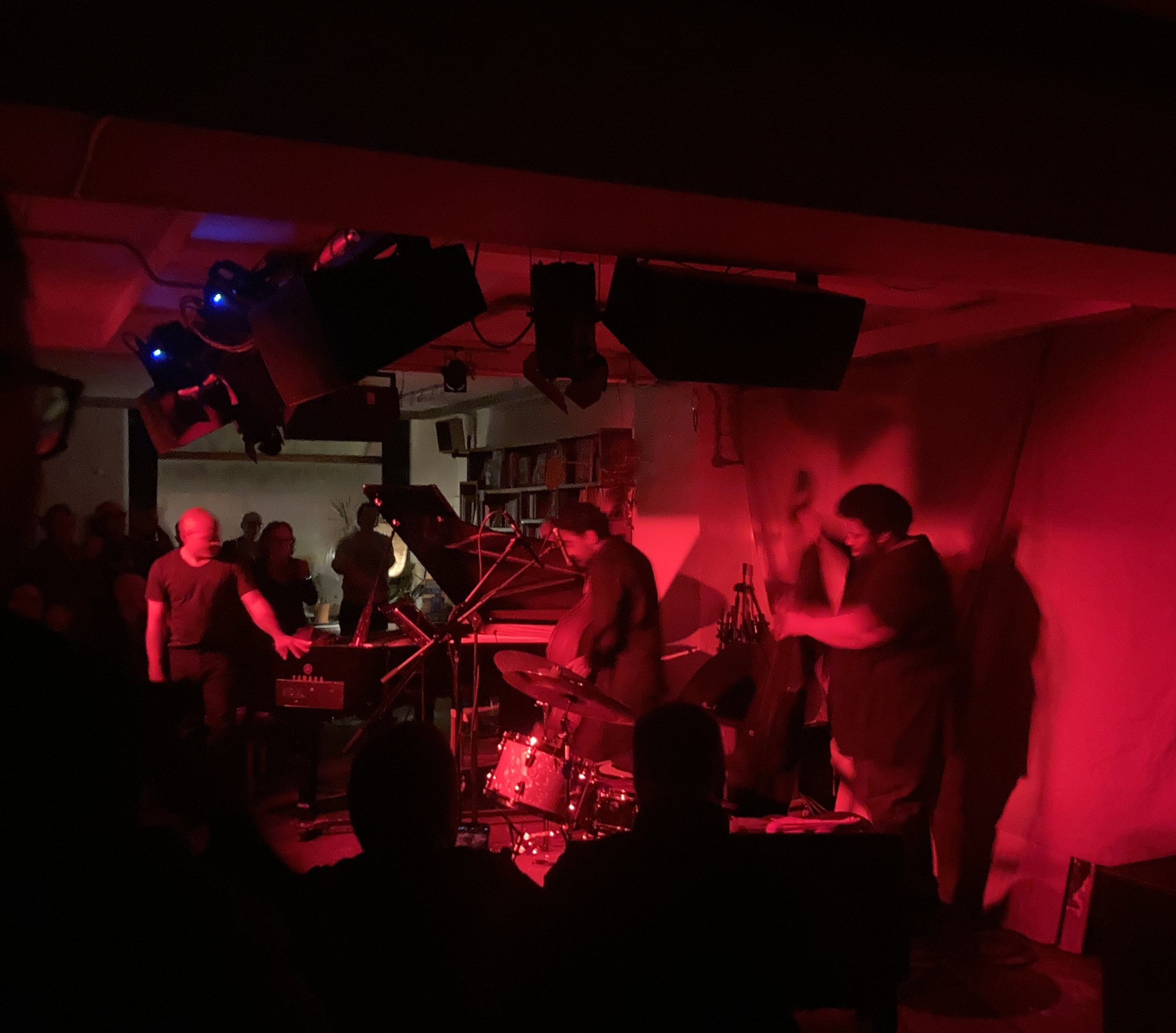
Cafe Oto, 8/6/24. From left: Melvin Gibbs, Eadyth Crawford, Mark O’Connor, Tomos Williams, Mared Williams and Nguyen Le

A welcome in Welsh from the trumpeter, composer and bandleader Tomos Williams prefaced the performance in Dalston of the third part of his Cwmwl Tystion series: Empathy, to follow the live recordings of Witness (released in 2021) and Riot! (2023) made during earlier tours. In all three, Williams blends the language of contemporary jazz with stories from the last 200 years of Welsh history.

For each part, he deployed different resources: the harp of Rhodri Davies and the voice of Francesca Simmons on Witness, the saxophone of Soweto Kinch and the vibes of Orphy Robinson on Riot!. For Empathy, he retained the voice of Eadyth Crawford and the drums of Mark O’Connor and added the Vietnamese guitarist Nguyen Le, the American bass guitarist Melvin Gibbs and a second voice, that of Mared Williams.

The two non-Welsh guests, both virtuosos of effects-enhanced stringed instruments, played powerful roles in setting the tone and trajectory of the music chosen and written to accompany pieces inspired by Paul Robeson’s recital to the mining families of Aberpennar (Mountain Ash) in 1938, the eviction of the villagers of Mynydd Epynt in Powys by the Ministry of Defence in 1940, the Aberfan disaster of 1966 and the miners’ strike of 1984. All these were accompanied by Simon Proffitt’s back-projected visuals.

Gibbs, once a member of Defunkt, has few equals in turning a five-string bass guitarist into an electronic orchestra. Le is one of the most adept of post-Hendrix guitarists. They found a willing accomplice in the powerful and dextrous O’Connor. At times I was reminded of Miles Davis’s Tutu period, of Jon Hassell’s Fourth World Music, and of Terje Rypdal at his wildest. One late passage raised the volume to death-metal levels.

That made the use of the two voices, sometimes combined in folk-like materials, even more valuable as a contrast, along with the sudden and very moving insertion, during the Aberfan passage, of the pre-recorded sound of a pipe organ and a chapel choir, and Williams’s use of Donald Byrd’s “Cristo Redentor” as a healing balm towards the conclusion. Earlier, the trumpeter had excelled in a tightly muted solo over a lovely habanera rhythm.

After six concerts at various venues around Wales in the preceding days, this visit to Llundain represented the tour’s finale: the final performance of this particular work by this particular band. As they laid down their instruments and stepped back from microphones, the sense of exhilaration had a special resonance.

* Parts one and two of Cwmwl Tystion are available on the Ty Cerdd label.

Artistry in algorithm

This morning’s newspaper headlines included one suggesting that artificial intelligence will play a significant role in the UK’s coming general election. My first response was that, given the mess humans have made of selecting the last four prime ministers, maybe the machines should be given a chance.

Music, though — well, that’s something else. Who, for example, wants the unique voice of Steve Marriott, 30-plus years dead, sliced and diced by AI algorithms and applied to songs he never sang, apparently with the endorsement of his widow?

But there are other applications of this slightly terrifying technology that may have a different and more benign outcome. At the Vortex last night, two sold-out houses heard France’s Orchestra National de Jazz play the compositions of Steve Lehman and Frédéric Maurin, specially written to make use of AI software developed by Jérôme Nika, a researcher at the celebrated IRCAM — the Institute for Research and Co-ordination in Acoustics/Music, founded in Paris by Pierre Boulez in 1977, at the request of Georges Pompidou, and now housed in the centre bearing the former president’s name.

The music was recorded last year as a live performance in the Tonstudio Bauer in Ludwigsburg and released as an album titled Ex Machina. It comes with extensive sleeve notes which I’ve read twice without really coming close to an idea of what the software actually does. But I do know that Lehman, who played the alto saxophone parts on the album and in London, and Maurin, the orchestra’s director and conductor, also based their compositions on prolonged study of the movement known as spectral music, in which such post-Messaien composers as Gérard Grisey and Tristan Murail experimented with creating microtonal ambiances.

I found the album interesting but not, on early hearings, as stimulating as Lehman’s work with his great octet or in his multilingual rap group, Sélébéyone. At the Vortex, however, where they were stopping off en route to performing tonight at Southampton University’s AI Arts Festival in Winchester, the music exploded into three dimensions and full colour, retaining all its complexity and subtlety while grabbing the audience and refusing to let them go until the final shimmer of a quarter-tone vibraphone had faded to silence.

Much of this had to do with the vigour of the playing, which ensured that the compositions never sounded dry or academic. Textures vibrated, rhythms were sprung. The shifting syncopations and abrupt stop-time figures had the excitement of James Brown’s band meeting Sun Ra in some distant galaxy.

The individual playing was uniformly brilliant in its response to the material. As well as Lehman’s serpentine, sweet-and-sour alto and the vibraphone of his octet colleague Chris Dingman (the only other American in the band), powerful impressions were left by improvisations from the bass trombone of Christiane Bopp, the tenor saxophone of Julian Soro, the clarinet of Cathérine Delaunay, the flute of Fanny Ménégoz, the baritone saxophone of Fabien Debellefontaine, and the trumpets of Fabien Norbert and Olivier Laisney. But what really fired the orchestra was the rhythm team: the deep power and agility of the double bassist, Sarah Murcia, in collaboration with the magnificent drive and awe-inspiring precision of the drummer, Rafaël Koerner. Thanks to them, the music never flagged.

It made me recall the last time I heard a largeish ensemble playing music that took the composition/improvisation dialogue in such a stimulating new direction. That was in 2016, when I first heard the White Desert Orchestra, led by the French composer/pianist Eve Risser — a graduate of the Orchestre National de Jazz. Obviously not a coincidence.

* Ex Machina by Steve Lehman and the Orchestra National de Jazz is on the Pi Recordings label.

The sound of style

John Simons, who turns 85 this Friday, remembers being 17 years old in 1956 and going to see Stan Kenton at the Albert Hall. He remembers the tall, imposing figure of the bandleader, and the thrilling sound of the music, one piece in particular: “‘Concerto to End All Concertos’!”

He also remembers that one of the band’s musicians had been sent home before they’d played a note on the hugely successful 53-date UK tour. It was the tenor saxophonist Spencer Sinatra, who’d been caught trying to score drugs soon after their arrival in London. Kenton packed him straight off back to the USA, along with his apparently blameless roommate, the baritone player Jack Nimitz. Simons claims that his memory for names isn’t so good any more, but he remembers the British replacements who were called in: Don Rendell and Harry Klein.

Perhaps less surprisingly, he also remembers how beautifully dressed the musicians were and the item of clothing he himself bought for the occasion: “It was a trenchcoat. Six guineas from Millet’s.” For John Simons, jazz and fashion have always been woven together.

A decent clothes shop that plays good music adds something to one of life’s pleasures. In Simons’ shop on Chiltern Street in Marylebone, the music is always good because it’s going to be something that refers in some way to the modern jazz on which the proprietor got seriously hooked as a young man in the 1950s. He’s not in the shop very often these days. His sons run it now, but they keep it on the Ivy League path he and his early partners established many years ago: button-down shirts, loafers, nice raincoats, soft-shouldered corduroy jackets, knitted ties. And the music, of course.

He was born into a tailoring family in 1939 and left school to study shop design and window dressing at St Martin’s School of Art. He was working at Cecil Gee in Shaftesbury Avenue when he was offered a job with Hope Brothers, whose stores included Burberry’s on Regent Street. Before long he and a friend started a business of their own, with a stall off Petticoat Lane and then a little shop called Clothesville next to Hackney Empire. He could design something, send it over to a tailor, and expect to have it back for sale the next day.

In the summer of 1964 he opened the Ivy Shop in Richmond, two doors up from L’Auberge, the café where the mod fans of the Stones and the Yardbirds would meet. His next venture was the Squire on Brewer Street in Soho. Then came the Village Gate, with branches on the King’s Road and Old Compton Street, named after the celebrated Greenwich Village jazz club, which he’d visited on a trip to New York. “I wrote to the owner of the Village Gate, Art D’Lugoff, for permission. He said, ‘As long as it’s not a jazz club, be my guest.'”

At the start of the 1980s he started a shop called J. Simons in Covent Garden, which became a haven for those to whom, in the words of Robert Elms, the classic modernist wardrobe represents “the only youth culture uniform that doesn’t look ridiculous in retrospect.” When the lease ran out he looked around before, in 2011, opening the current shop in a district which, as with Covent Garden, he has played a part in reshaping.

When I asked him to name some musicians whose work he really loves, he mentioned the Clifford Brown-Max Roach quintet, Chet Baker’s singing, the MJQ and Billie Holiday. And Thelonious Monk. “At the youth club I went to,” he said, “people danced to Monk. Can you believe that?”